

On 1 October 2026, former Nigerian vice president and presidential candidate of the African Democratic Congress (ADC), Atiku Abubakar, delivered an Independence Day address at the party’s headquarters in Abuja.
In his address, Atiku made several claims about Nigeria’s economy, insecurity, governance and other developments under president Bola Tinubu’s administration.
He made the claims while assessing the state of the country and the performance of the current administration, ahead of the 2027 general elections.
In this report, The FactCheckHub examines some of the verifiable claims made by Atiku, comparing them with official records, statutory reports, government data and other credible sources.
CLAIM 1
“N30,000 minimum wage could buy about 118 litres of petrol in April 2023.”
FINDINGS
Findings by The FactCheckHub show that the claim is TRUE.
The National Bureau of Statistics (NBS) reported that the average retail price of Premium Motor Spirit (PMS), commonly known as petrol, was N254.06 per litre in April 2023.
At that price, a N30,000 minimum wage could buy approximately 118 litres of petrol. The calculation is N30,000 ÷ N254.06 = 118.08 litres
This means Atiku’s estimate of about 118 litres is consistent with the NBS data for April 2023.
VERDICT
The claim that the N30,000 minimum wage could buy 118 litres of petrol in May 2023 is TRUE. At the NBS average price of N254.06 per litre, the minimum wage could indeed purchase about 118 litres.
CLAIM 2
“…While a N70,000 minimum wage buys just 50 litres today.”
FINDINGS
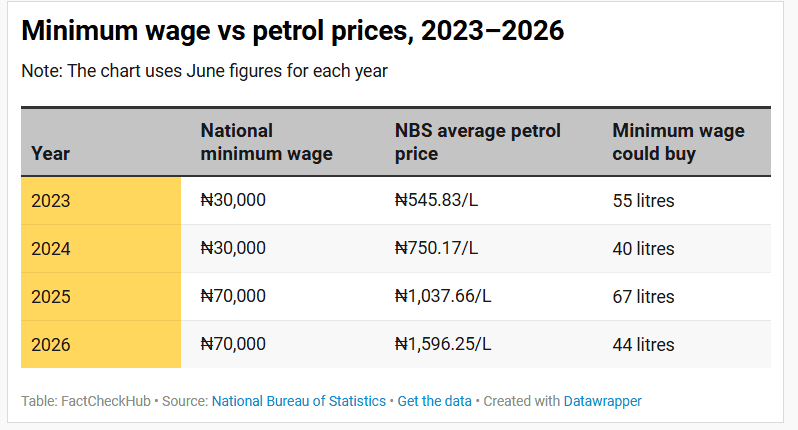
The NBS has since recorded a substantial increase in the average retail price of petrol. The latest available NBS Premium Motor Spirit (Petrol) Price Watch, available as at the date of publication, covers May 2026 and puts the national average price of petrol at ₦1,596.25 per litre.
At the latest NBS national average price, a ₦70,000 minimum wage would buy approximately 44 litres of petrol, not 50 litres. The calculation is ₦70,000 ÷ ₦1,596.25 = 43.85 litres.
The NBS figure is a national average based on prices collected from outlets across the 36 states and the Federal Capital Territory. Actual pump prices can therefore differ by location and filling station.
The continued rise in petrol prices has reduced the amount of petrol that can be bought with the minimum wage.
VERDICT
The claim that N70,000 minimum wage buys just 50 litres today is PARTLY TRUE. At N1,596.25 per litre, N70,000 would buy about 44 litres, meaning the claim overstates the purchasing power of the current minimum wage by approximately 6 litres, or 14 per cent.
CLAIM 3
“Nigeria’s public debt stood at N166.79 trillion at the end of June 2026.”
FINDINGS
Findings by The FactCheckHub show that the claim is TRUE.
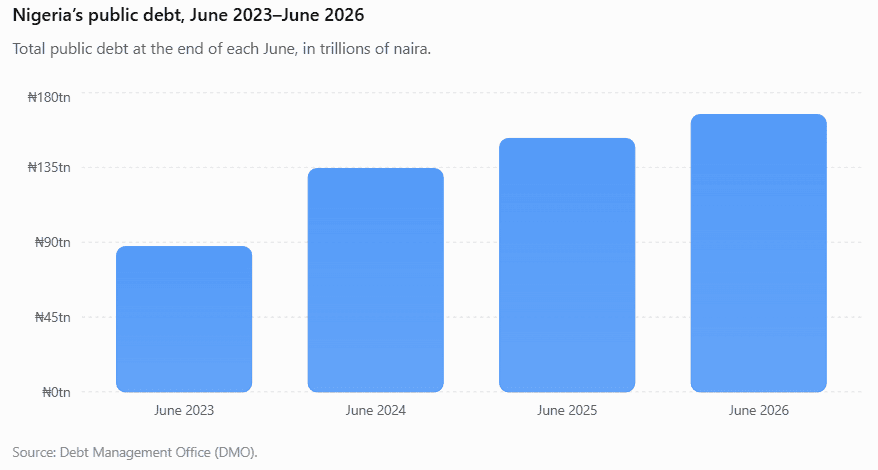
The Debt Management Office (DMO) published Nigeria’s total public debt position as of 30 June 2026, on 25 September 2026. According to the report, Nigeria’s total public debt stood at N166.79 trillion at the end of June 2026.
The figure represents the combined debt of the federal government, the 36 states and the Federal Capital Territory.
The DMO data show that domestic debt accounted for N91.59 trillion, representing 54.91 per cent of the total public debt, while external debt stood at N75.20 trillion, or 45.09 per cent.
In dollar terms, Nigeria’s total public debt stood at $120.93 billion, comprising $66.41 billion in domestic debt and $54.52 billion in external debt. The DMO noted that the Central Bank of Nigeria (CBN) official exchange rate of N1,379.1842 to US$1 as of 30 June 2026 was used to convert the external debt component into naira.
The June 2026 figure represented an increase from N159.35 trillion recorded at the end of March 2026. It also marked an increase from N152.40 trillion in June 2025, according to figures reported from the DMO data.
The chart below shows Nigeria’s public debt in June each year from 2023 to 2026.
VERDICT
The claim is TRUE, the DMO’s official debt statement confirms that Nigeria’s total public debt was ₦166.79 trillion as of 30 June 2026.
CLAIM 4
“…While the government was discussing another $1.5 billion in World Bank loans.”
FINDINGS
The Punch reported on 28 September 2026 that the federal government had opened discussions with the World Bank for three proposed loans totalling $1.5 billion. The proposed facilities were each valued at $500 million and were intended to support climate resilience, social protection and early childhood development.
One of the proposed facilities is an additional $500 million for the Agro-Climatic Resilience in Semi-Arid Landscapes (ACReSAL) project. The World Bank was expected to consider the proposed additional financing on 29 October 2026. If approved, the additional financing would increase ACReSAL’s total financing from $700 million to $1.2 billion. The Punch reported that the proposed facility was at the preparation stage and had been scheduled for consideration by the World Bank’s board on 29 October 2026. The details are also reported by Nairametrics.
Another proposed $500 million facility is for the Household Prosperity and Empowerment-Social Protection Project (HOPE-SP). The project was still at an earlier stage of preparation, with its technical design review expected on 30 October 2026, and an estimated World Bank approval date of 16 March 2027. The Punch reported these timelines based on documents from the World Bank. TheCable also reported that the project was scheduled for technical design review on 30 October 2026, with board approval expected on 16 March 2027.
The third proposed $500 million facility is for the Nigeria Early Childhood Development programme, with an estimated approval date of 15 March 2027. Its technical design review is also scheduled for 30 October 2026. The proposed programme would cover all 36 states and the FCT and seek to improve access to an integrated package of services, including health, nutrition, early learning, childcare, water and sanitation, for children aged zero to five. The Punch reported these details from the World Bank documents. TheCable also reported the proposed programme’s scope and approval timeline.
VERDICT
The claim is TRUE, reports based on World Bank documents confirm that the federal government was in discussions for three proposed World Bank facilities worth a combined $1.5 billion.
CLAIM 5
“The 2025 budget has been extended until 31 December 2026, while the 2026 budget also exists.
FINDINGS
Findings by The FactCheckHub show that the claim is TRUE.
On 30 September 2026, president Bola Tinubu signed the Appropriation (Amendment) (No. 4) Bill, 2025 into law, extending the implementation period of the 2025 budget from 30 September to 31 December 2026.
According to the State House announcement, the extension followed the passage of the amendment by both the senate and the house of representatives on 29 September 2026.
The presidency said the extension would give ministries, departments and agencies (MDAs) additional time to complete ongoing capital projects and ensure that funds already appropriated are fully utilised.
The latest extension is the fourth amendment to the 2025 budget’s implementation period. The extension means that some projects and spending authorised under the 2025 Appropriation Act can continue to be implemented until the end of 2026, rather than ending on 30 September 2026.
At the same time, Nigeria also has a 2026 budget. president Tinubu assented to the 2026 Appropriation Bill in April 2026, bringing the 2026 Appropriation Act into force from 1 April 2026. The 2026 budget provides for total expenditure of N68.32 trillion.
The existence of the 2026 budget is also confirmed by the Budget Office of the Federation, which published the details of the 2026 Appropriation Bill and lists the 2026 Appropriation Act among its budget documents.
Therefore, the two statements in the claim refer to two separate appropriation frameworks operating during the same calendar year. The 2026 Appropriation Act governs the 2026 budget, while the latest amendment allows the implementation of outstanding components of the 2025 budget to continue until 31 December 2026.
VERDICT
The claim is TRUE. The official records support both parts of the claim. The president signed the latest amendment to the 2025 Appropriation Act on 30 September 2026, extending its implementation period to 31 December 2026. Separately, the 2026 Appropriation Act is already in force, having received presidential assent in April 2026.
CLAIM 6
“More than 10 million Nigerians received N75,000 each in cash transfers, amounting to at least ₦750 billion.”
FINDINGS
Findings by The FactCheckHub show that the claim is TRUE.
On 26 September 2026, the national chairman of the All Progressives Congress (APC), Nentawe Yilwatda, said that more than 10 million Nigerians had received ₦75,000 each through the Federal Government’s conditional cash transfer programme.
Yilwatda made the statement while speaking to journalists after a three-day retreat of the APC national executive council in Maiduguri, Borno State. He said the beneficiaries were poor and vulnerable Nigerians who, in many cases, did not have mobile phones or access to social media.
If 10 million beneficiaries each received ₦75,000, the total would amount to ₦750 billion. This arithmetic is correct.
VERDICT
The claim that more than 10 million Nigerians benefited from the programme is TRUE.
CLAIM 7
“Some tertiary institutions raised their fees by more than 400 per cent.”
FINDINGS
Findings by The FactCheckHub show that the claim is TRUE.
There is evidence that some Nigerian tertiary institutions substantially increased tuition and other institutional charges. In October 2025, The Guardian reported that a document from the Nigerian Education Loan Fund (NELFUND) identified fee increases ranging from 20 per cent to 521 per cent at several tertiary institutions.
The institutions identified in the report included the University of Ilesha, Ekiti State University, University of Medical Sciences, Ondo, Edo State University, Ladoke Akintola University of Technology (LAUTECH), and David Umahi Federal University of Health Sciences.
According to the report, the increases covered tuition and other institutional charges, with the magnitude varying across institutions and programmes. The highest increase identified in the NELFUND document was 521 per cent, which exceeds the 400 per cent threshold in the claim.
A 400 per cent increase means that a fee becomes five times its original amount. For example, if a fee was ₦100,000 and increased by 400 per cent, the new fee would be ₦500,000. A 521 per cent increase would take the same ₦100,000 fee to ₦621,000.
The NELFUND figures therefore provide evidence that the claim is not referring merely to modest increases in school charges. At least one institution recorded in the document had an increase exceeding five times the previous charge.
The Guardian reported that NELFUND expressed concern about the scale of some of the increases and their potential effect on students and the student loan scheme. The fund also raised concerns about institutions increasing fees after students had already applied for or received loans based on earlier fee levels.
NELFUND subsequently continued to caution tertiary institutions against arbitrary increases in tuition and other institutional charges. In June 2026, Channels Television reported that the fund warned institutions against arbitrary fee increases and the withholding of tuition refunds.
VERDICT
The claim that some institutions increased their fees by more than 400 per cent is TRUE.
CLAIM 8
“Five young Nigerians were arrested in Borno after wearing T-shirts bearing the inscription ‘Tinubu Must Go’.”
FINDINGS
Findings by The FactCheckHub show that the claim is TRUE.
On 30 September 2026, Premium Times reported that police in Borno State had charged five men to court after arresting them over T-shirts bearing the inscription “Tinubu Must Go.”
The men were accused of criminal conspiracy, inciting disturbance, disturbing public peace and thuggery, according to the report. The allegations were not proof of guilt; they were charges that would have to be determined through legal proceedings.
The report supports Atiku’s claim that five men were arrested in connection with the T-shirts. However, whether they should be released, and whether their detention or prosecution violated their rights, are legal questions requiring examination of the court proceedings and the applicable law.
VERDICT
The claim that five men were arrested and charged in Borno over “Tinubu Must Go” T-shirts is TRUE.

Nurudeen Akewushola is a fact-checker with FactCheckHub. He has authored several fact checks which have contributed to the fight against information disorder. You can reach him via nyahaya@icirnigeria.org and @NurudeenAkewus1 via Twitter.

, Atiku Abubakar, delivered an Independence Day address at the ADC headquarters in Abuja.)