

PRESIDENT Bola Tinubu delivered a nationwide broadcast on Friday, June 12, as Nigeria marked Democracy Day in 2026.
During the address, he highlighted his administration’s achievements in security, economic reforms, governance, and public sector development.
Nigeria observes Democracy Day annually on June 12 in honour of the 1993 presidential election, widely regarded as the freest and fairest in the country’s history.
The day serves as an opportunity for the tiers government to reflect on the state of the nation, outline policy priorities, and present their achievements to citizens.
In his speech, Tinubu made several claims regarding improvements in security, foreign investment, debt management, police recruitment, and economic performance under his administration.
In this report, The FactCheckHub examines some of the verifiable claims made by the president and compares them with available data, official records, and independent reports.
CLAIM 1
Terror-related deaths have declined by over 81 per cent since 2015.
FINDINGS
Findings by The FactCheckHub show that the claim is TRUE, according to the Global Terrorism Index(GTI).
The GTI is a comprehensive study analysing the impact of terrorism for 163 countries, covering 99.7 per cent of the world’s population.
Produced by the Institute for Economics and Peace (IEP), using data from Terrorism Tracker and other sources, the GTI generates a composite score to provide an ordinal ranking of countries on the impact of terrorism.
The GTI scores each country on a scale from 0 to 10, where 0 represents no impact from terrorism and 10 represents the highest measurable impact of terrorism.
READ : Video from Mali used to depict attack on Oyo community
Data by the organisation shows that terrorism-related fatalities in Nigeria are significantly lower than they were during the peak of Boko Haram’s insurgency.
According to the data, 750 deaths were recorded in 2025 compared to 4,095 recorded in 2015. This indicates a 82 per cent decrease.
The data shows that Nigeria recorded some of its highest terrorism death tolls between 2014 and 2015, when Boko Haram was considered one of the world’s deadliest terrorist groups.
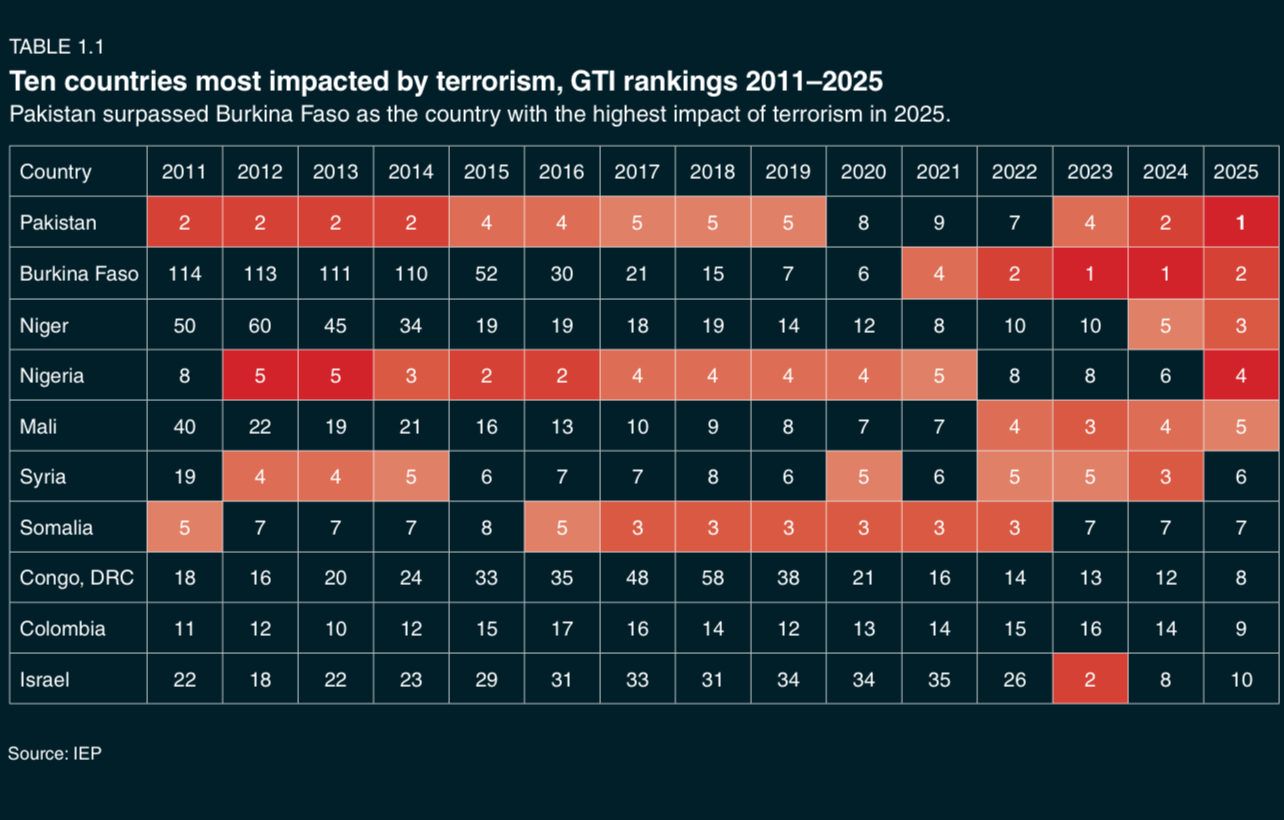
However, the GTI reports equally indicate that terrorist attacks and fatalities have risen in recent years.
The 2026 GTI report shows that Nigeria recorded one of the highest increases in terrorism deaths globally in 2025, while the number of attacks rose from 120 incidents in 2024 to 171 in 2025.
This means that while the comparison with 2015 produces a substantial decline, it does not reflect recent deterioration in terrorism indicators. It also doesn’t factor in serious security crises like kidnapping for ransom.
In addition, Nigeria was third among countries most impacted by terrorism in 2015, it dropped to 8th place on the index in 2022 showing an improvement under the late former President Muhammadu Buhari. But under Tinubu, Nigeria moved back to 4th place in 2025 among most impacted by terrorism.
VERDICT
The claim by Tinubu that terrorism-related deaths are now lower than they were during the peak years of Boko Haram is MOSTLY TRUE. However, the claim relies on comparing current figures with an exceptionally violent period and omits the recent rise in other attacks and fatalities from banditry, kidnappings and related criminalities.
CLAIM 2
“Over 13,000 terrorists and bandits were neutralised in 2025.”
FINDINGS
Findings by The FactCheckHub show that the claim is UNPROVEN.
Nigeria’s military recorded several operational successes against terrorist and bandit groups in 2025.
For instance, the Defence Headquarters (DHQ) announced that troops eliminated scores of terrorists during coordinated operations across the North-East and North-West regions. Similarly, military authorities reported the killing of several insurgent commanders and fighters during operations conducted under Operation Hadin Kai in Borno State.
In May 2025, the military also announced the neutralisation of dozens of terrorists and the destruction of insurgent enclaves during clearance operations in Sambisa Forest.
Likewise, periodic updates released by the Defence Headquarters throughout the year consistently reported the killing of terrorists, bandits, and other criminal elements, alongside the recovery of weapons and the rescue of kidnapped victims.
However, The FactCheckHub found no independently verifiable database or publicly available official breakdown supporting the specific claim that exactly 13,000 terrorists were killed in 2025.
While the Defence Headquarters periodically publishes cumulative operational figures, there is no transparent methodology or publicly accessible dataset that allows independent verification of the 13,000 figure cited by the president.
In addition, independent security trackers such as the Armed Conflict Location & Event Data Project (ACLED), the Global Terrorism Index (GTI), and other conflict-monitoring organisations do not provide evidence confirming that 13,000 terrorists were killed within the period.
VERDICT
The claim is UNPROVEN. Although Nigerian security forces reported numerous successes against terrorists and bandits throughout 2025, there is no publicly available or independently verifiable evidence confirming that 13,000 terrorists were killed during the year.
CLAIM 3
124,000 terrorists and their dependants have surrendered since 2023.
FINDINGS
Checks by The FactCheckHub show that the figure is linked to Operation Safe Corridor, Nigeria’s deradicalisation and reintegration programme for former insurgents.
The programme was established in 2015 and became operational in 2016 under former President Muhammadu Buhari.
In February 2025, the Chief of Defence Staff (now Minister of Defence), Christopher Musa, stated that over 120,000 terrorists and their family members surrendered since the inception of the programme.
The figure cited by Tinubu, therefore, represents a cumulative total recorded over nearly a decade, not a development that began in 2023.
VERDICT
The claim is FALSE. The 124,000 figure relates to the total number of terrorists and dependants who have surrendered since Operation Safe Corridor began in 2015, not since 2023.
CLAIM 4
Non-oil export grew by 21%
FINDINGS
Findings by The FactCheckHub show that the claim is TRUE.
The Federal Ministry of Industries, Trade, and Investments, in its 2025 report and priorities for 2026, acknowledged significant growth in its non-oil export activities and improved activities for its Specialized Economic Zones.
It also listed the four key industries that it would prioritise to drive growth in the economy. They include solid minerals industry value chain, digital trade and investment, creative economy, and climate-smart investments and green industrialisation.
READ ALSO : How false claims, recycled videos clouded Oyo school abduction
According to the agency, non-oil exports grew by 21 per cent reaching $12.8 billion in H1 2025, nearly double the $6.5 billion target and contributing to a N12 trillion trade surplus during the same period.
Overall trade value expanded by 14 per cent, with further gains expected as trade facilitation reforms and logistics infrastructure continue to mature.
The growth was driven largely by strong demand for cocoa, cashew, sesame seeds, and fertiliser, commodities that continue to anchor Nigeria’s non-oil export basket and attract buyers across Europe, Asia, and the Middle East.
A key contributor to this momentum has been the expanding network of Special Economic Zones (SEZs), which collectively generated an estimated $500 million in export revenues and supported the creation of about 20,000 jobs during the year.
VERDICT
The claim by President Bola Tinubu that non-oil export increased by 21% is TRUE according to data by the Federal Ministry of Industries, Trade, and Investments.
Nurudeen Akewushola is a fact-checker with FactCheckHub. He has authored several fact checks which have contributed to the fight against information disorder. You can reach him via nyahaya@icirnigeria.org and @NurudeenAkewus1 via Twitter.
- Nurudeen Akewushola
- Nurudeen Akewushola
- Nurudeen Akewushola
- Nurudeen Akewushola
- Nurudeen Akewushola
- Nurudeen Akewushola
- Nurudeen Akewushola
- Nurudeen Akewushola
- Nurudeen Akewushola
- Nurudeen Akewushola
- Nurudeen Akewushola
- Nurudeen Akewushola
- Nurudeen Akewushola
- Nurudeen Akewushola
- Nurudeen Akewushola
- Nurudeen Akewushola
- Nurudeen Akewushola
- Nurudeen Akewushola
- Nurudeen Akewushola
- Nurudeen Akewushola
- Nurudeen Akewushola
- Nurudeen Akewushola
- Nurudeen Akewushola
- Nurudeen Akewushola
- Nurudeen Akewushola
- Nurudeen Akewushola
- Nurudeen Akewushola
- Nurudeen Akewushola
- Nurudeen Akewushola
- Nurudeen Akewushola
- Nurudeen Akewushola
- Nurudeen Akewushola
- Nurudeen Akewushola
- Nurudeen Akewushola
- Nurudeen Akewushola
- Nurudeen Akewushola
- Nurudeen Akewushola
- Nurudeen Akewushola
- Nurudeen Akewushola
- Nurudeen Akewushola
- Nurudeen Akewushola
- Nurudeen Akewushola
- Nurudeen Akewushola
- Nurudeen Akewushola
- Nurudeen Akewushola
- Nurudeen Akewushola
- Nurudeen Akewushola
- Nurudeen Akewushola
- Nurudeen Akewushola
- Nurudeen Akewushola
- Nurudeen Akewushola
- Nurudeen Akewushola
- Nurudeen Akewushola
- Nurudeen Akewushola
- Nurudeen Akewushola
- Nurudeen Akewushola
- Nurudeen Akewushola
- Nurudeen Akewushola
- Nurudeen Akewushola
- Nurudeen Akewushola
- Nurudeen Akewushola
- Nurudeen Akewushola
- Nurudeen Akewushola
- Nurudeen Akewushola
- Nurudeen Akewushola
- Nurudeen Akewushola
- Nurudeen Akewushola
- Nurudeen Akewushola
- Nurudeen Akewushola
- Nurudeen Akewushola
- Nurudeen Akewushola
- Nurudeen Akewushola
- Nurudeen Akewushola
- Nurudeen Akewushola
- Nurudeen Akewushola
- Nurudeen Akewushola
- Nurudeen Akewushola
- Nurudeen Akewushola
- Nurudeen Akewushola
- Nurudeen Akewushola
- Nurudeen Akewushola
- Nurudeen Akewushola
- Nurudeen Akewushola
- Nurudeen Akewushola
- Nurudeen Akewushola
- Nurudeen Akewushola
- Nurudeen Akewushola
- Nurudeen Akewushola
- Nurudeen Akewushola
- Nurudeen Akewushola
- Nurudeen Akewushola
- Nurudeen Akewushola
- Nurudeen Akewushola
- Nurudeen Akewushola
- Nurudeen Akewushola
- Nurudeen Akewushola
- Nurudeen Akewushola
- Nurudeen Akewushola
- Nurudeen Akewushola
- Nurudeen Akewushola
- Nurudeen Akewushola
- Nurudeen Akewushola
- Nurudeen Akewushola
- Nurudeen Akewushola
- Nurudeen Akewushola
- Nurudeen Akewushola
- Nurudeen Akewushola
- Nurudeen Akewushola
- Nurudeen Akewushola
- Nurudeen Akewushola
- Nurudeen Akewushola
- Nurudeen Akewushola
- Nurudeen Akewushola
- Nurudeen Akewushola
- Nurudeen Akewushola
- Nurudeen Akewushola
- Nurudeen Akewushola
- Nurudeen Akewushola
- Nurudeen Akewushola
- Nurudeen Akewushola
- Nurudeen Akewushola
- Nurudeen Akewushola
- Nurudeen Akewushola
- Nurudeen Akewushola
- Nurudeen Akewushola
- Nurudeen Akewushola
- Nurudeen Akewushola
- Nurudeen Akewushola
- Nurudeen Akewushola
- Nurudeen Akewushola
- Nurudeen Akewushola
- Nurudeen Akewushola
- Nurudeen Akewushola
- Nurudeen Akewushola
- Nurudeen Akewushola
- Nurudeen Akewushola
- Nurudeen Akewushola
- Nurudeen Akewushola
- Nurudeen Akewushola
- Nurudeen Akewushola
- Nurudeen Akewushola
- Nurudeen Akewushola
- Nurudeen Akewushola
- Nurudeen Akewushola
- Nurudeen Akewushola
- Nurudeen Akewushola
- Nurudeen Akewushola
- Nurudeen Akewushola
- Nurudeen Akewushola
- Nurudeen Akewushola
- Nurudeen Akewushola
- Nurudeen Akewushola
- Nurudeen Akewushola
- Nurudeen Akewushola
- Nurudeen Akewushola
- Nurudeen Akewushola
- Nurudeen Akewushola
- Nurudeen Akewushola
- Nurudeen Akewushola
- Nurudeen Akewushola
- Nurudeen Akewushola
- Nurudeen Akewushola
- Nurudeen Akewushola
- Nurudeen Akewushola
- Nurudeen Akewushola
- Nurudeen Akewushola
- Nurudeen Akewushola
- Nurudeen Akewushola
- Nurudeen Akewushola
- Nurudeen Akewushola
- Nurudeen Akewushola
- Nurudeen Akewushola
- Nurudeen Akewushola
- Nurudeen Akewushola
- Nurudeen Akewushola
- Nurudeen Akewushola
- Nurudeen Akewushola
- Nurudeen Akewushola
- Nurudeen Akewushola
- Nurudeen Akewushola
- Nurudeen Akewushola
- Nurudeen Akewushola
- Nurudeen Akewushola
- Nurudeen Akewushola
- Nurudeen Akewushola
- Nurudeen Akewushola
- Nurudeen Akewushola
- Nurudeen Akewushola
- Nurudeen Akewushola
- Nurudeen Akewushola
- Nurudeen Akewushola
- Nurudeen Akewushola
- Nurudeen Akewushola
- Nurudeen Akewushola
- Nurudeen Akewushola
- Nurudeen Akewushola
- Nurudeen Akewushola
- Nurudeen Akewushola
- Nurudeen Akewushola
- Nurudeen Akewushola
- Nurudeen Akewushola
- Nurudeen Akewushola
- Nurudeen Akewushola
- Nurudeen Akewushola
- Nurudeen Akewushola
- Nurudeen Akewushola
- Nurudeen Akewushola
- Nurudeen Akewushola
- Nurudeen Akewushola
- Nurudeen Akewushola
- Nurudeen Akewushola
- Nurudeen Akewushola
- Nurudeen Akewushola
- Nurudeen Akewushola
- Nurudeen Akewushola
- Nurudeen Akewushola
- Nurudeen Akewushola
- Nurudeen Akewushola
- Nurudeen Akewushola
- Nurudeen Akewushola
- Nurudeen Akewushola
- Nurudeen Akewushola
- Nurudeen Akewushola
- Nurudeen Akewushola
- Nurudeen Akewushola
- Nurudeen Akewushola
- Nurudeen Akewushola
- Nurudeen Akewushola
- Nurudeen Akewushola
- Nurudeen Akewushola
- Nurudeen Akewushola
- Nurudeen Akewushola
- Nurudeen Akewushola
- Nurudeen Akewushola
- Nurudeen Akewushola
- Nurudeen Akewushola
- Nurudeen Akewushola
- Nurudeen Akewushola
- Nurudeen Akewushola
- Nurudeen Akewushola
- Nurudeen Akewushola
- Nurudeen Akewushola
- Nurudeen Akewushola
- Nurudeen Akewushola
- Nurudeen Akewushola
- Nurudeen Akewushola
- Nurudeen Akewushola
- Nurudeen Akewushola
- Nurudeen Akewushola
- Nurudeen Akewushola
- Nurudeen Akewushola
- Nurudeen Akewushola
- Nurudeen Akewushola
- Nurudeen Akewushola
- Nurudeen Akewushola
- Nurudeen Akewushola
- Nurudeen Akewushola
- Nurudeen Akewushola
- Nurudeen Akewushola
- Nurudeen Akewushola
- Nurudeen Akewushola
- Nurudeen Akewushola
- Nurudeen Akewushola
- Nurudeen Akewushola
- Nurudeen Akewushola
- Nurudeen Akewushola
- Nurudeen Akewushola
- Nurudeen Akewushola
- Nurudeen Akewushola
- Nurudeen Akewushola
- Nurudeen Akewushola
- Nurudeen Akewushola
- Nurudeen Akewushola
- Nurudeen Akewushola
- Nurudeen Akewushola
- Nurudeen Akewushola
- Nurudeen Akewushola
- Nurudeen Akewushola
- Nurudeen Akewushola
- Nurudeen Akewushola
- Nurudeen Akewushola
- Nurudeen Akewushola
- Nurudeen Akewushola
- Nurudeen Akewushola
- Nurudeen Akewushola
- Nurudeen Akewushola
- Nurudeen Akewushola
- Nurudeen Akewushola
- Nurudeen Akewushola
- Nurudeen Akewushola
- Nurudeen Akewushola
- Nurudeen Akewushola
- Nurudeen Akewushola
- Nurudeen Akewushola
- Nurudeen Akewushola
- Nurudeen Akewushola
- Nurudeen Akewushola
- Nurudeen Akewushola
- Nurudeen Akewushola
- Nurudeen Akewushola
- Nurudeen Akewushola
- Nurudeen Akewushola
- Nurudeen Akewushola
- Nurudeen Akewushola
- Nurudeen Akewushola
- Nurudeen Akewushola
- Nurudeen Akewushola
- Nurudeen Akewushola
- Nurudeen Akewushola
- Nurudeen Akewushola
- Nurudeen Akewushola
- Nurudeen Akewushola
- Nurudeen Akewushola
- Nurudeen Akewushola
- Nurudeen Akewushola
- Nurudeen Akewushola
- Nurudeen Akewushola
- Nurudeen Akewushola
- Nurudeen Akewushola
- Nurudeen Akewushola
- Nurudeen Akewushola
- Nurudeen Akewushola
- Nurudeen Akewushola
- Nurudeen Akewushola
- Nurudeen Akewushola
- Nurudeen Akewushola
- Nurudeen Akewushola
- Nurudeen Akewushola
- Nurudeen Akewushola
- Nurudeen Akewushola
- Nurudeen Akewushola
- Nurudeen Akewushola
- Nurudeen Akewushola
- Nurudeen Akewushola
- Nurudeen Akewushola
- Nurudeen Akewushola
- Nurudeen Akewushola
- Nurudeen Akewushola
- Nurudeen Akewushola
- Nurudeen Akewushola
- Nurudeen Akewushola
- Nurudeen Akewushola
- Nurudeen Akewushola
- Nurudeen Akewushola
- Nurudeen Akewushola
- Nurudeen Akewushola
- Nurudeen Akewushola
- Nurudeen Akewushola
- Nurudeen Akewushola
- Nurudeen Akewushola
- Nurudeen Akewushola
- Nurudeen Akewushola
- Nurudeen Akewushola
- Nurudeen Akewushola
- Nurudeen Akewushola
- Nurudeen Akewushola
- Nurudeen Akewushola
- Nurudeen Akewushola
- Nurudeen Akewushola
- Nurudeen Akewushola
- Nurudeen Akewushola
- Nurudeen Akewushola
- Nurudeen Akewushola
- Nurudeen Akewushola
- Nurudeen Akewushola
- Nurudeen Akewushola
- Nurudeen Akewushola
- Nurudeen Akewushola
- Nurudeen Akewushola
- Nurudeen Akewushola
- Nurudeen Akewushola
- Nurudeen Akewushola
- Nurudeen Akewushola
- Nurudeen Akewushola
- Nurudeen Akewushola
- Nurudeen Akewushola
- Nurudeen Akewushola
- Nurudeen Akewushola
- Nurudeen Akewushola
- Nurudeen Akewushola
- Nurudeen Akewushola
- Nurudeen Akewushola
- Nurudeen Akewushola
- Nurudeen Akewushola
- Nurudeen Akewushola
- Nurudeen Akewushola
- Nurudeen Akewushola
- Nurudeen Akewushola
- Nurudeen Akewushola
- Nurudeen Akewushola
- Nurudeen Akewushola
- Nurudeen Akewushola
- Nurudeen Akewushola
- Nurudeen Akewushola
- Nurudeen Akewushola
- Nurudeen Akewushola
- Nurudeen Akewushola
- Nurudeen Akewushola
- Nurudeen Akewushola
- Nurudeen Akewushola
- Nurudeen Akewushola
- Nurudeen Akewushola
- Nurudeen Akewushola
- Nurudeen Akewushola
- Nurudeen Akewushola
- Nurudeen Akewushola
- Nurudeen Akewushola
- Nurudeen Akewushola
- Nurudeen Akewushola
- Nurudeen Akewushola
- Nurudeen Akewushola
- Nurudeen Akewushola
- Nurudeen Akewushola
- Nurudeen Akewushola
- Nurudeen Akewushola
- Nurudeen Akewushola
- Nurudeen Akewushola
- Nurudeen Akewushola
- Nurudeen Akewushola
- Nurudeen Akewushola
- Nurudeen Akewushola
- Nurudeen Akewushola
- Nurudeen Akewushola
- Nurudeen Akewushola
- Nurudeen Akewushola
- Nurudeen Akewushola
- Nurudeen Akewushola
- Nurudeen Akewushola
- Nurudeen Akewushola
- Nurudeen Akewushola
- Nurudeen Akewushola
- Nurudeen Akewushola
- Nurudeen Akewushola
- Nurudeen Akewushola
- Nurudeen Akewushola
- Nurudeen Akewushola

