
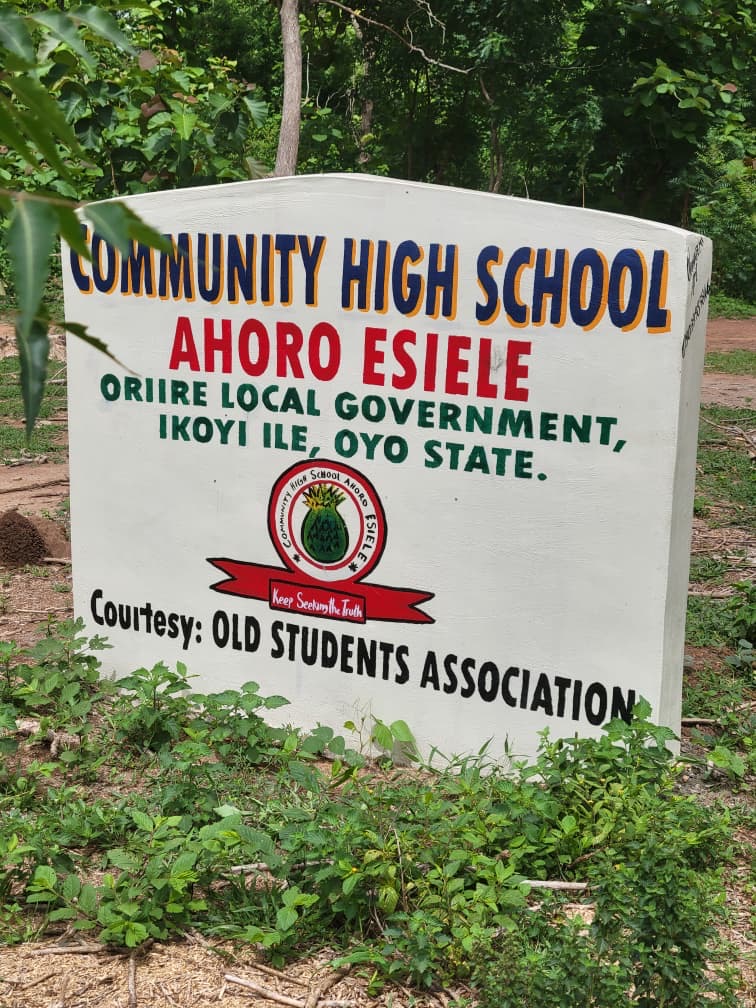
WHEN gunmen stormed communities along the Ahoro-Esiele/Yawota axis of Oriire Local Government Area in Oyo State and abducted pupils and staff from multiple schools on May 15, 2026, families and citizens were thrust into a desperate search for information.
As security agencies launched operations across nearby forests and communities, a parallel battle unfolded online. Social media platforms became flooded with unverified claims, recycled videos and misleading narratives that complicated public understanding of the crisis and amplified fears among already traumatised communities.
The attack, which targeted Community High School, Ahoro-Esiele, L.A. Primary School, Esiele, and Yawota Baptist Nursery and Primary School, sparked outrage across the country. Citizens demanded answers from authorities, while protesters called for stronger action to secure the victims’ release and prevent further attacks on schools.
But amid the legitimate public concern, misinformation quickly filled the information vacuum.
One of the most consequential false claims emerged from Tope Fasua, Special Adviser to President Bola Tinubu on Economic Affairs. In a Facebook post that was later deleted, Fasua claimed that a joint security operation involving 1,000 forest rangers had successfully rescued all the victims and that President Bola Tinubu had already congratulated security agencies for the feat.
The claim was false.
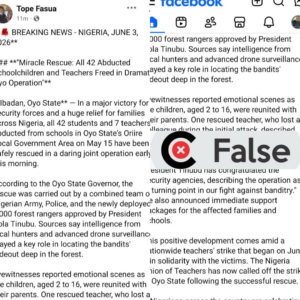
A fact-check by FactCheckHub found no evidence that the victims had been rescued at the time the claim circulated. Beyond its factual inaccuracies, the post carried significant implications. For families anxiously awaiting news about their loved ones, it created a misleading impression that the ordeal had ended. For the wider public, it risked shifting attention away from ongoing efforts to locate the victims and hold authorities accountable.
As demonstrations over the abductions intensified, another misleading narrative gained traction online.
A viral video claimed that the ruling All Progressives Congress (APC) had sponsored helicopters carrying giant promotional banners of Tinubu over grieving communities in the South-West, portraying the flights as evidence of leaders’ insensitivity during a national tragedy.
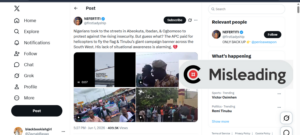
However, checks by FactCheckHub showed that the aircraft were not part of any political campaign. The helicopters belonged to the Nigerian Navy and were participating in ceremonial activities marking the service’s 70th anniversary celebrations and the International Fleet Review held at Eko Atlantic in Lagos.
By stripping the footage of its original context, social media users transformed a military ceremony into a politically charged narrative that fuelled public anger during an already tense period.
The misinformation extended beyond political narratives.
Popular musician and content creator Nasiru Lawal, popularly known as Nasboi, shared a now-deleted video showing dozens of armed men on motorcycles moving through a rural area. Accompanying the footage was a direct appeal to Tinubu to explain the apparent security breakdown.
Given the widespread concern generated by the Oyo abduction, many viewers interpreted the video as evidence that heavily armed terrorists were openly operating within Nigeria.
Yet verification revealed that the footage did not originate from Nigeria. The video was traced to insurgent activity in neighbouring Benin Republic and had no connection to the security situation in Oyo State.
The incident demonstrated how easily unrelated footage from conflict zones can be repurposed to reinforce existing fears, particularly during periods of heightened public anxiety.
The consequences of such misinformation are not limited to online engagement.
In Ondo State, schools in Akure reportedly shut down temporarily after rumours of an impending bandit attack spread rapidly through communities and social media platforms. Concerned parents rushed to withdraw their children despite the absence of verified evidence supporting the claims.
Security agencies have repeatedly warned that the circulation of false or misleading security information can trigger panic, undermine public trust and complicate emergency responses. Both the Lagos and Oyo State Police Commands have issued statements cautioning residents against sharing unverified reports capable of causing unnecessary alarm.
Experts say misinformation often thrives during security crises because fear creates an urgent demand for information. When official updates are delayed or insufficient, citizens frequently turn to social media, where emotionally charged claims can spread faster than verified reports.
Malik Samuel, a senior researcher with Good Governance Africa, warned that the circulation of misleading videos during periods of insecurity could have far-reaching consequences, including triggering panic, reprisals and further violence.
“Psychologically, it makes it difficult for people to know what to believe, even when the correct information eventually becomes available,” he added.
For Dengiyefa Angalapu, a research analyst at the Centre for Democracy and Development (CDD), the persistence of misinformation during crises reflects deeper shortcomings in public communication.
Responding to questions on how government institutions and independent media could better address information vacuums, Angalapu argued that the problem often begins with a lack of timely and transparent official communication.
“Information needs to be out there for people to access. When misinformation becomes rampant and widespread, it shows there’s a gap in communication. If something evident happened and everyone can see it, then it’s difficult for another person to twist the story. So, the whole idea is that it is this level of opacity in the way we’ve managed information that’s resulted to a situation whereby people fill in the gaps. And these gaps that have been filled, unfortunately, become the false news.”
He noted that fact-checking alone is often insufficient because corrections rarely achieve the same reach as the original falsehoods.
“One challenge that we’ve had is the fact that when you fact-check, it does not go as far as the original misinformation. So the only way to curb this is to fill the information gap.”
Angalapu also stressed the need for greater verification standards among celebrities and other influential figures, whose posts could shape public perception during emergencies.
On the national security implications of high-profile individuals sharing unverified information, he argued that influence must be accompanied by digital literacy.
“The celebrities that we have will have to be taught the ways of fact-checking or fact-checkers become the celebrities. These celebrities are being dragged to speak up, so, in the quest to not offend their followers, they speak out with the context in which they know. So, in that regard, the solution is simple. Either you make them fact-checkers by teaching them the basic skills of fact-checking, or, the fact-checkers become the celebrity.”
He emphasised that a lack of early, transparent communication from the government remains the central catalyst for digital panic.
“If citizens are kept in the dark regarding active security incidents within their states, they are left to garner whatever unverified fragments they can find across social media. When the state fails to speak early, speculative lies inevitably dictate the public narrative.”

Seasoned writer and literary curator, Zainab Abdulrasaq is a factchecker for The FactCheckHub in an effort to combat information disorder. She can be reached on IG @blackbookishgirl or zabdulrasaq@icirnigeria.org

