
THE race between generative Artificial Intelligence tools and the software built to detect them is heavily lopsided. While AI image and video generators are improving at a rapid pace, automated detection tools are failing to keep pace. This technical gap is creating a significant challenge for fact-checkers, as software built to catch fabrications is now flagging them as authentic.
When these automated tools fail, fact-checkers are left with either debunking AI-generated misinformation based on their intelligence or leaving it out, because the software used to flag it can no longer be trusted.
For Mutalib Jibril, a fact-checker with FactCheckAfrica, this technical failure turned a standard investigation into a game of trial and error. Working to debunk a viral video that carried distinct visual anomalies, Jibril ran the file through an AI detection tool. He expected the analysis to return a high probability score confirming the video was synthetic. Instead, the tool stated the video was real, showing only a 17 per cent probability of AI generation.
“There was a story I was working on, a video I was trying to debunk was AI-generated, and had the attributes of AI in it, but when I ran it by AI detection tools with the expectations that it would be 90 per cent probability or above, the analysis came out with 17 per cent probability, and stated that the video was real,” Jibril noted. “I had to run it on another detection tool, which later came out with an 87 per cent probability.”
Jibril is not the only fact-checker who has faced this kind of challenge. Mohammed Taoheed, a researcher at Dubawa, said he has encountered similar challenges while verifying suspected AI-generated content. He explained that although he could often identify AI-generated content through visual cues, he still needed forensic analysis to support his findings. However, when AI detection tools incorrectly classify deepfakes or AI-generated content as authentic, fact-checkers are sometimes left with no choice but to abandon the claim.
“I’ve experienced this many times, and most of my work has been turned down because of it. While I could tell that the content was AI-generated, I still needed forensic analysis to back it up. But when AI detection tools flag deepfakes and AI-generated content as real, I had no choice but to leave such claims,” Mohammed said.
He added that as AI-generated tools continue to advance, AI detection systems must also improve to keep pace.
Failure of AI detection tools
The rise of disinformation and misinformation due to Artificial intelligence is alarming. According to the World Economic Forum’s Global Risks Report 2026, misinformation and disinformation ranked as the second most severe risk in the short-term horizon, driven by AI-generated content and synthetic media.
As a result, the integrity of online news and information is increasingly under threat, as distinguishing between authentic and synthetic content, whether video, audio or written, is becoming more difficult.
According to a survey by the Reuters Institute, 58 per cent of respondents globally are concerned about how to distinguish truth from falsehood in online news. The figure rises to 73 per cent in both Africa and the United States.
The FactCheckHub has observed various instances where AI detection tools fail to detect clearly AI-generated visuals.
For instance, ZeroGPT’s website states its multi-model detection technology achieves 98.5 per cent accuracy across GPT-4, Claude, Gemini, and other large language models. The company says it uses Deep Analyse Technology to scan text patterns.
In an independent benchmark conducted by researchers from the Universities of Kansas and Rochester, Sightengine ranked #1 in AI-media detection accuracy with a 98.3 per cent accuracy rate on 80,000 images.
For instance, The FactCheckHub recently debunked a collage of images shared by the former lawmaker, Dino Melaye. The image purportedly showed heavily armed bandits in Katsina State handing over a casket to a local delegation.
While the image showed clear signs of AI generation, including distorted background features and inconsistent framing. Yet, when The FactCheckHub ran the imagery through Hive Moderation, an AI detection tool, the system returned only a 35.5 per cent probability of it being synthetic, concluding the image was real and had no AI-generated or deepfake content. The FactCheckHub then subjected the same image to Deep AI, another AI detection tool, which delivered a nine per cent probability, stating that the image was real.
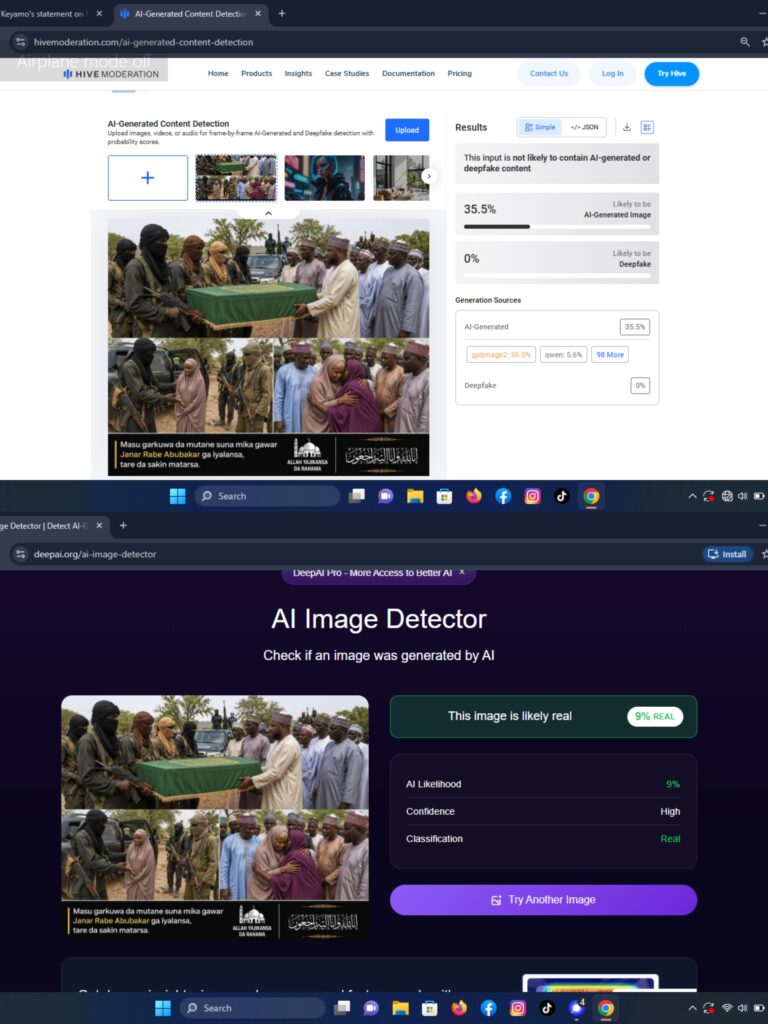
While alternative forensic checks eventually confirmed the images were fake, the initial failure of the two major detection platforms proved that automated tools are falling behind current generative technology.
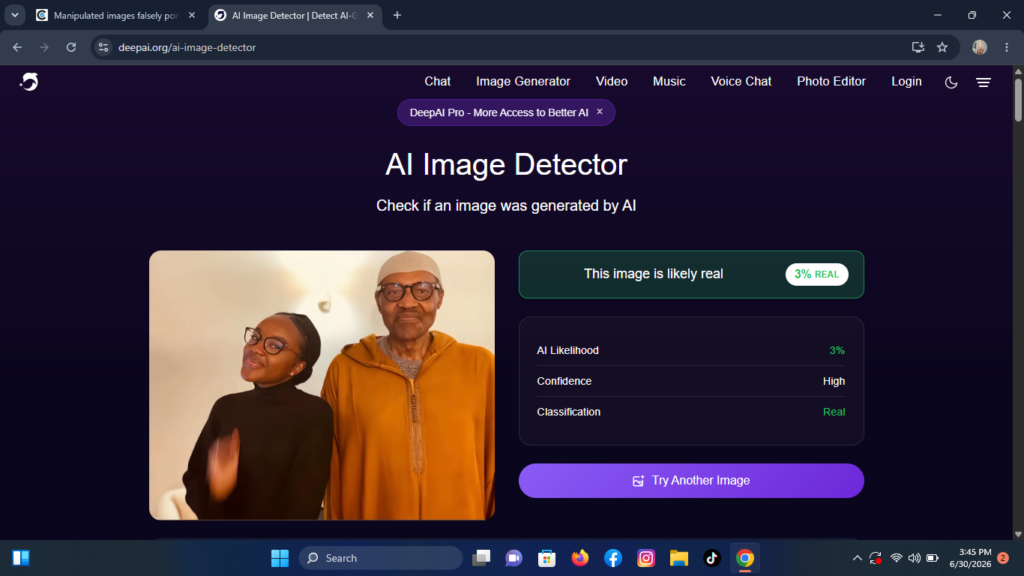
This isn’t all. The FactCheckHub debunked viral images of the late former president Buhari on May 19, 2026.
An X user posted Buhari’s images, claiming that he was alive and residing in Egypt. Many comments on the post showed people were confused because the former president had died months before the images surfaced online.
To verify the authenticity of the images, The FactCheckHub analysed them using DeepAI, and the result returned a three per cent probability and still declared the images to be real. The FactCheckHub then subjected the images to another tool, Hive Moderation, which then returned an 84.3 per cent probability score for a deepfake face swap and a 31.9 per cent score for fully AI-generated images.
The ICIR and other media outlets had reported the death of the late former president on June 13, 2025, ten months before the images surfaced online.
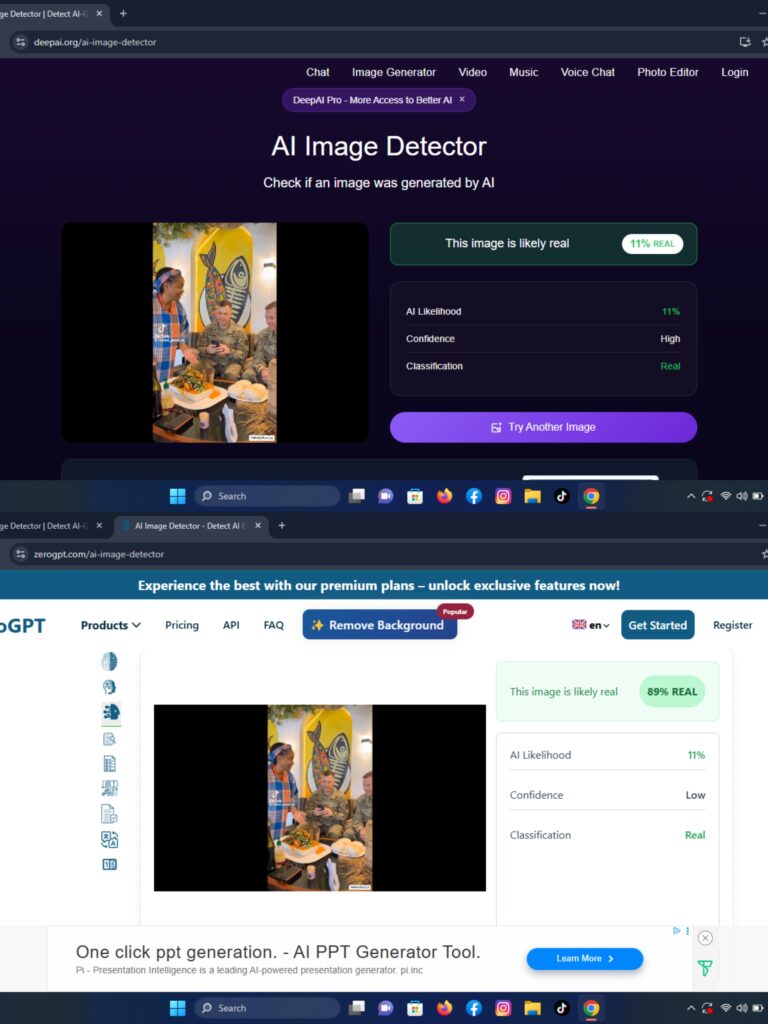
Also, in February 2026, FactCheckHub debunked a viral video of American soldiers eating egusi soup and fufu, a starchy African food in Nigeria, which surfaced online. The anomalies in the video reeked of AI-generated content due to the inconsistent movements in the video.
When The FactCheckHub subjected the video to an AI detection tool, ZeroGPT, for analysis, the result said that the video was 89 per cent real. The video was subjected to another AI detection tool, DeepAI, which corroborated that the video was real. It was after a series of verifications and human verification that the result showed that it was AI-generated.
A reverse image search done by The FactCheckHub led to the account that first posted it on social media. The account showed a consistent pattern of posting AI-generated content.
Speaking with The FactCheckHub, the editor of Dubawa, Kemi Busari, noted that a fact-checking organisation risks becoming a validator for falsehood when its internal tools fail.
“The understanding is that a fact-checking organisation helps you decipher truth from falsehood, but when such an organisation becomes a conduit for fake content, it means they are giving some kind of validation or amplification for a deepfake,” he explained.
Busari warned that repeated failures to detect deepfakes could erode public trust in news organisations and fact-checking platforms. According to him, if audiences repeatedly see manipulated content slip through an organisation’s verification process, they may lose confidence in its ability to distinguish fact from fiction.
He noted that the consequences could be particularly severe during elections, where misinformation can influence voters’ decisions. Busari said that if a fact-checking organisation mistakenly verifies a fake video as authentic, the public could rely on that false information when deciding whether or not to vote.
On her part, disinformation researcher Rejoice Taddy explained that resolving the failure of AI-detection tools requires journalists to prioritise human analysis over software results, adding that verification must start with human observation rather than an algorithmic score.
“It often starts with a human sense of what feels AI-generated or manipulated,” Taddy said. “That then guides how you approach the tools available to you. Sometimes you also have to question what the tools are saying because you might look at something and be convinced it is not realistic, even when a system is flagging it as not synthetic. That is where deeper verification becomes necessary.”
She said while these tools are good at recognising patterns, flagging harmful language, and identifying known narratives, they still rely heavily on human input, adding that human verification is what brings context, helps assess intent, identifies coordinated behaviour, and applies ethical judgment that machines cannot fully replicate, especially in high-risk situations.
To address the limitations of existing detection tools, Busari called for greater collaboration among technology companies, researchers and journalists to develop attribution systems that embed verification data directly into digital media.
According to him, such systems would enable anyone viewing an image or video to see the verification checks it had undergone and independently replicate the process before accepting the outcome.
Busari, however, stressed that no software should replace editorial judgement. He maintained that while artificial intelligence could support verification, decisions on the authenticity of content must ultimately rest with human reviewers.
He urged fact-checkers to treat AI-powered detection tools as assistants in the verification process rather than as final arbiters of truth.
“We need to keep humans in charge,” Busari emphasised, stressing that “Whatever you’re getting from AI detection tools must also go through your own human detection process to be sure that it’s accurate. Eventually, we have all these tools to help us, but your most important tool is still your own brain, your own instinct.”

Seasoned writer and literary curator, Zainab Abdulrasaq is a factchecker for The FactCheckHub in an effort to combat information disorder. She can be reached on IG @blackbookishgirl or zabdulrasaq@icirnigeria.org


This was an insightful read, keep writing.