

A race chart circulating on social media claims to show a data breakdown of the number of people living in extreme poverty by country between 1992 and 2026.
The interactive ranks Nigeria at the top of the global index, claiming that over 94 million (94,725,734) Nigerians live in extreme poverty.
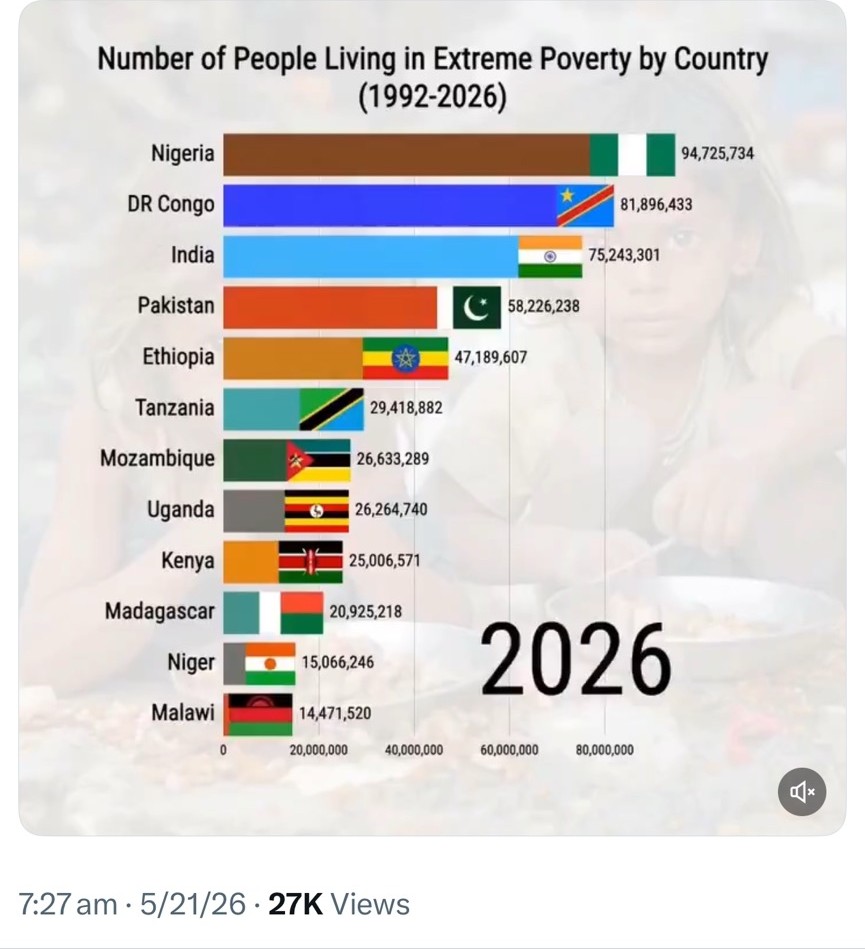
A verified x user @ejykmykel1 made this post on May 21, 2026, with the caption: “Number of People Living in Extreme Poverty by Country (1992–2026). Focus on Nigeria and China. “In 1992, China held the first position globally with the largest number of people living in extreme poverty. Nigeria ranked eighth during the same period.
“By 2026, Nigeria has advanced to the first position among countries with the highest number of individuals in extreme poverty. China, in turn, has moved from its leading position in 1992 to a position of negligible extreme poverty headcount.
“This dramatic shift in global rankings, with Nigeria ascending to the top while China has effectively resolved the challenge at scale, further demonstrates that Nigeria is a failing state.”
As of May 22, the post has garnered over 23,000 views, 450 reposts and over 400 likes. The post has misled many people due to the data used and the current economic realities.
READ: Manipulated images falsely portray Buhari as alive in Egypt
CLAIM
Data shows Nigeria currently ranks first globally with 94,725,734 people in extreme poverty.

FINDINGS
Findings by The FactCheckHub show that the claim is FALSE. The figures, current headcounts, and timeline metrics used in the viral infographics are completely fabricated and conflict directly with official global poverty databases.
A comparative analysis by The FactCheckHub of the data displayed in the viral chart against the official records of the World Poverty Clock reveals major data manipulation.
The viral chart claims Nigeria has 94,725,734 people living in extreme poverty. However, live data for 2026 from the World Poverty Clock dashboard shows Nigeria’s actual extreme poverty headcount stands at 73,099,724, which constitutes roughly 31 per cent of the population. The graphic’s creator inflated the current figure by more than 21 million people.
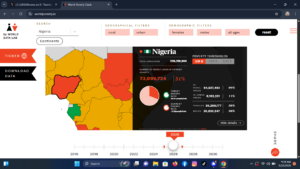
The historical benchmarks for other countries are also heavily distorted. The chart claims that China had an extreme poverty population of 26,318,034 in 2016. Data archived by the World Poverty Clock for 2016 shows the actual number was 19,863,870, representing about one per cent of China’s total population at the time.
World Poverty Clock data for 2016 shows Nigeria’s extreme poverty count was 46,101,218. This represented about 25 per cent of the country’s total population of 186,010,140 at the time, but the chart said otherwise.
Furthermore, checks show that Nigeria does not occupy the top position on the global extreme poverty index. According to current indicators from the World Poverty Clock, South Sudan ranks as the country with the highest extreme poverty rate in the world. That is, 13,324,141 people out of 16,590,820 are currently living with extreme poverty, and that’s over 80 per cent of its population living below the global poverty line.
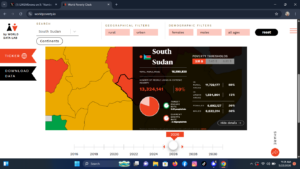
Also, according to the World Population Review Poverty Index, South Sudan maintains the highest extreme poverty density globally at approximately 82.3 per cent. This means that only 17.7 per cent of its population live above the poverty line (of $3.65 per day as set by the World Bank), while Nigeria maintains approximately 56.2 per cent extreme poverty rate, and only 43.8 per cent of its popular live above the poverty line.
While Nigeria currently maintains high extreme poverty rate, it’s not the top country on the list as claimed by the post.
VERDICT
The infographic ranking Nigeria’s extreme poverty population at 94.7 million is FALSE. Real-time indicators from the World Poverty Clock shows that the current 2026 figure is 73 million. South Sudan holds the highest global poverty density, and the historical reference points used across the chart’s timeline have been completely manipulated.

Seasoned writer and literary curator, Zainab Abdulrasaq is a factchecker for The FactCheckHub in an effort to combat information disorder. She can be reached on IG @blackbookishgirl or zabdulrasaq@icirnigeria.org

