
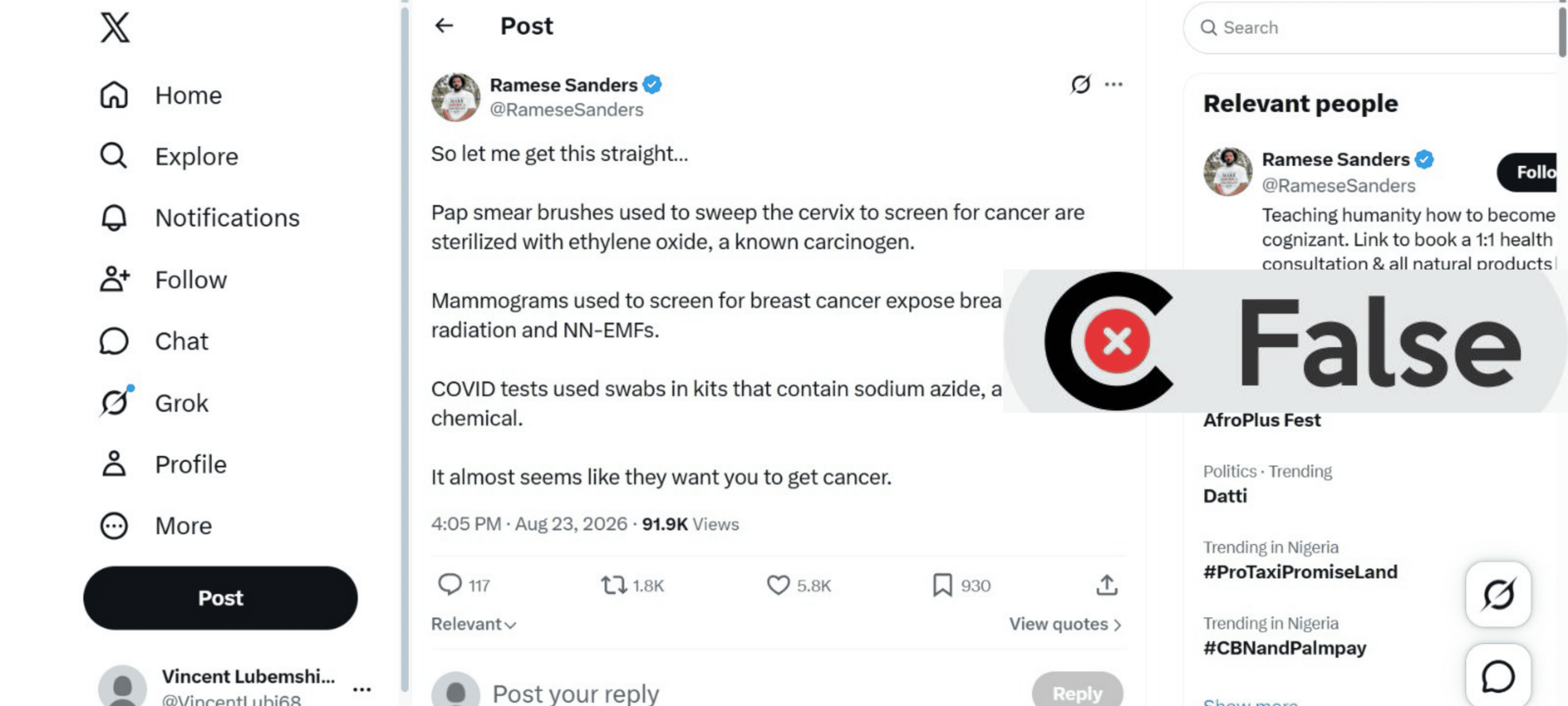
A VIRAL post on X claims that routine medical screening and diagnostic tests, including Pap smears, mammograms, and COVID-19 tests, expose people to cancer-causing substances or radiation and could therefore cause cancer.
The claim was posted by X use @RameseSanders with the text:
“So let me get this straight… Pap smear brushes used to sweep the cervix to screen for cancer are sterilised with ethylene oxide, a known carcinogen. Mammograms used to screen for breast cancer expose breast tissue to radiation and NN-EMFs. COVID tests used swabs in kits that contain sodium azide, a known toxic chemical. It almost seems like they want you to get cancer.”
As of 8 September 2026, the post has gained over 91,000 views, 5,800 likes, and more than 1,800 reposts.
READ: Claim that genetic mutation makes people entirely immune to HIV is misleading
CLAIM
Standard medical screenings including Pap smears, mammograms, and COVID-19 swab tests contain dangerous carcinogens, radiation, or toxic chemicals intended to cause cancer.
FINDINGS
Findings by The FactCheckHub show that the claim is FALSE.
The FactCheckHub examined each assertion made in the post regarding medical device manufacturing and diagnostic procedures.
A Pap smear (Papanicolaou smear) is a screening test for cervical cancer that involves collecting cells from the cervix and examining them for precancerous or cancerous changes.
Dr Steve Okoro, a Consultant Obstetrician and Gynaecologist, explained that Pap smears can be performed using two main methods: conventional cytology and liquid-based cytology.
In a conventional Pap smear, cells are collected from the cervix, spread onto a glass slide, immediately fixed and sent to a laboratory for examination. In liquid-based cytology, a plastic cytobrush or broom is used to collect cells from the cervix. The collected material is then rinsed into a vial containing a preservative solution for laboratory processing.
Okoro said the sampling devices are designed for single use and are discarded after the sample is collected. He added that if any health facility reuses such devices, as suggested in the viral post, it would be contrary to established medical standards. Standard practice requires collection tools to be used once and then discarded or, where applicable, placed in the preservative vial for laboratory processing.
Therefore, he said the claim that Pap-smear procedures expose patients to cancer-causing substances through reused collection devices is not supported by standard medical practice.
Regarding mammography, Dr Amali Joshua, a Resident Radiologist, said the claim is incorrect. He explained that mammography uses low-dose X-rays and breast compression to produce detailed images of breast tissue. Although the procedure exposes patients to a small amount of radiation, he said the benefits of mammography, particularly its role in the early detection of breast cancer, outweigh the associated risks.
Regarding COVID-19 tests, medical guidance and information from Poison Control show that the nasal swab used to collect a sample is a sterile collection device and does not contain the liquid reagent used in some test kits. Some test kits contain liquid reagents that may include small amounts of sodium azide as a preservative. The reagent is contained in a vial and is not applied to the swab before it is inserted into the nose.
VERDICT
The claim that Pap smears, mammograms and COVID-19 tests are designed to cause cancer or expose patients to harmful chemicals is FALSE. Medical evidence shows that these procedures and tests are designed to detect or diagnose disease, not cause it. While some procedures, such as mammography, involve limited exposure to potential risks, health authorities consider the benefits of appropriate screening and testing to outweigh these risks. When used as intended and in accordance with established medical standards, these procedures do not expose patients to substances known to cause cancer.

Seasoned writer and literary curator, Zainab Abdulrasaq is a factchecker for The FactCheckHub in an effort to combat information disorder. She can be reached on IG @blackbookishgirl or zabdulrasaq@icirnigeria.org

