
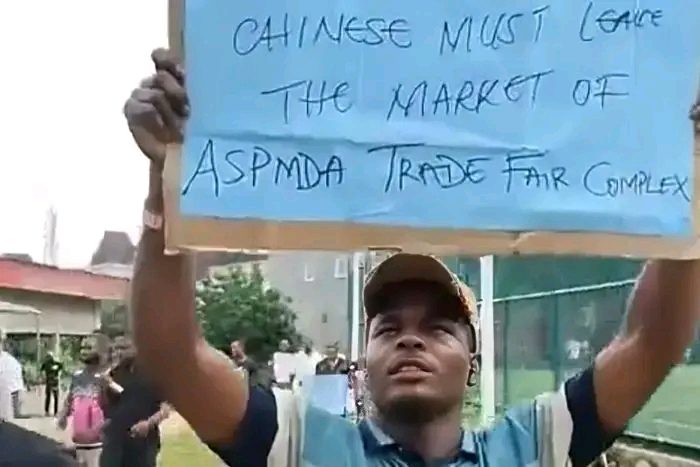
ON September 15, 2026, traders at the Lagos Trade Fair Complex staged a protest, alleging that Chinese merchants were selling goods at retail prices, a development they said threatens local businesses’ survival. This report by The ICIR examines the legal and regulatory framework governing foreign participation in Nigeria’s retail market. It analyses what the law says about fair competition and the protection of local businesses from foreign merchants.
Videos of the protest circulated on social media, showing protesters marching through the market with placards, accusing foreign merchants of importing manufactured goods, occupying stalls, and selling directly to consumers at wholesale or below-market prices.
The Lagos State Police Command intervened during the protest, prompting questions about the laws regulating foreign nationals’ participation in Nigeria’s retail market. The Lagos International Trade Fair Complex Management Board also moved to address the dispute, urging traders to avoid taking the law into their hands.
The protest drew mixed reactions on social media, with one X user noting that the Nigerian government favours foreign traders over its own citizens.
What Nigerian law currently allows
The 1972 Nigerian Enterprises Promotion Decree, also known as the Indigenisation Decree, explicitly identified retail trade as a sector to be taken over from foreign traders. Therefore, reserving retail trade for Nigerian citizens.
However, the Nigerian Investment Promotion Commission (NIPC) Act, 1995, abrogated this. The NIPC Act does not specifically prohibit foreign nationals or foreign-owned businesses from engaging in retail trade. In fact, Section 17 allows non-Nigerians to invest in and participate in the operation of any enterprise in the country, subject only to the restrictions set out in Section 18, the “negative list.”
Section 31 of the Act explains the negative list as sectors of investment prohibited to both foreign and Nigerian investors, namely:
(a) production of arms, ammunition, etc.;
(b) production of and dealing in narcotic drugs and psychotropic substances;
(c) production of military and paramilitary wear and accoutrements, including those of the Police and the Customs, Immigration and Prison Services; and
(d) such other items as the Federal Executive Council may, from time to time, determine.
This means that the Act permits foreigners to own up to 100% equity in any business in Nigeria, provided they comply with applicable laws and regulatory requirements. Section 19(2) of the Act also makes clear that foreign participation does not exempt an enterprise from obtaining the licences, permits and other approvals required to establish or operate a business.
Similarly, the Federal Competition and Consumer Protection Act (FCCPA) 2018 regulates anti-competitive behaviour and abuse of market dominance but does not reserve retail trade exclusively for Nigerian citizens.
Under Sections 70 and 72, the Act prohibits the abuse of a dominant position in a market. However, selling goods at lower prices does not, by itself, establish a violation of the law.
What expatriate permits require
Eze Onyekpere, a lawyer and director of the Nigerian Centre for Social Justice, argued that the NIPC Act should not be considered in isolation from immigration and expatriate employment regulations.
He explained that although foreign investment is permitted, foreign nationals who intend to work in Nigeria must also obtain the appropriate authorisation. According to him, expatriate quotas and work permits are intended for foreigners bringing specialised skills that are not readily available in the country, rather than those seeking to compete with Nigerians in businesses where local expertise is already abundant.
“Even if you want to set up a retail shop, the general spirit of the law does not encourage foreigners to do so. Running a retail shop is work, and you need an expatriate quota or permit to work in Nigeria,” Onyekpere said.
He argued that the Ministry of Interior and other relevant authorities should examine the permits issued to foreign nationals to determine whether their activities correspond with the purpose for which they were authorised to work.
For instance, he said a foreign national who obtained permission to work as an engineer or in the information technology sector could be violating the terms of the permit if found operating a cosmetics shop in an open market.
“If you follow up on expatriate quotas and work permits, you can ask: where is the permit the Federal Government gave you to come into Nigeria, and what does it entitle you to do? Some of them may have claimed to be engineers with qualifications and specialised skills that Nigeria does not have. But if you were permitted to come here for construction or IT work and are found selling cosmetics in a market, you are violating the terms of your permit,” he said.
Other African countries regulate foreign retail trade
On September 2, less than two weeks before the Lagos Trade Fair protest, Kenyan President William Ruto ordered the closure of small retail shops and informal trading operations run by foreigners across the country.
“All those foreign traders and hawkers doing small businesses should close down,” he said, adding that “From next week, those small businesses must be left for local citizens.”
Ruto asserted that Kenya remained open to foreign investment, but argued that foreign investors should create jobs and expand production rather than compete with Kenyans in small businesses. He directed the Ministry of Investments, Trade and Industry to begin enforcement action against foreigners engaged in local trading and hawking on 7 September.
The president stated that foreign direct investment should target large-scale projects like manufacturing and infrastructure, rather than taking over neighbourhood retail markets meant for local citizens. He stressed that the directive was based on the need to protect local Kenyan traders and ensure that businesses reserved for citizens are not affected by unfair competition.
Furthermore, in July 2025, the Tanzanian government published Government Notice No. 487A, barring non-citizens from 15 economic sectors under the Business Licensing (Prohibition of Business Activities for Non-Citizens) Order 2025.
The order explicitly stops foreigners from getting or renewing licenses for retail sales, mobile money transfers, phone repairs, salon operations, and small-scale mining.
According to the order, foreigners who violate the directive face fines of at least 10 million Tanzanian shillings, imprisonment for a term not exceeding six months, and the revocation of their visa and residence permits. It also stated that Tanzanians who assist non-citizens in these restricted sectors face fines up to 5 million shillings or three months in prison.
Ghana also restricts foreign participation in certain small-scale commercial activities under the Ghana Investment Promotion Authority Act, 2026 (Act 1173), which repealed the Ghana Investment Promotion Centre Act, 2013 (Act 865).
Section 32 of the new Act reserves activities such as petty trading, hawking, selling goods or providing services in markets, and selling goods from stalls exclusively for Ghanaian citizens and wholly Ghanaian-owned enterprises. Other restricted activities include operating beauty salons and barbering shops, taxi services with fewer than 25 vehicles, and retailing finished pharmaceutical products.
The Act also sets conditions for foreign nationals who wish to engage in other trading activities. Under Section 31, a non-citizen must invest at least $500,000 in the trading enterprise and ensure that at least 75 per cent of its employees are skilled Ghanaians. However, these requirements do not permit foreign participation in activities specifically reserved for Ghanaians under Section 32.
Economic implications for local traders and consumers
Ikemesit Effiong, an economic expert and Managing Partner at SBM Intelligence, said foreign merchants selling directly to consumers could put pressure on local traders by reducing the profit margins that sustain traditional distribution networks.
He explained that foreign merchants’ access to capital and global supply chains could allow them to undercut local retailers, affecting wholesalers, sub-wholesalers and market associations that employ millions of people.
“The immediate effect is margin compression for local traders. Foreign merchants, with better access to capital and global supply chains, can undercut traditional retailers, squeezing the margins that sustain local distribution networks. Over time, this could hollow out the indigenous retail value chain, including wholesalers, sub-wholesalers and market associations that employ millions of people,” Effiong said.
However, he noted that consumers could benefit from lower prices and a wider variety of goods in the short term.
On the possible effects of restricting foreigners from small-scale retail trade, Effiong said the policy could increase consumer prices, reduce competition and affect the availability of some goods.
“You’d likely see three effects. First, consumer prices could rise in the short term, because local traders may not have the same sourcing efficiencies or economies of scale. Second, market competition would initially thin out, particularly in niche segments where foreign merchants have filled gaps local traders haven’t. Third, availability of goods could suffer at the margin, especially imported products where foreign merchants have direct supply relationships,” he explained.
Citing Ghana and Kenya, he said restrictions in both countries had produced mixed results, with local retail capacity growing in some sectors while consumers paid more in others.
On attracting foreign investment without displacing local traders, Effiong recommended that Nigeria distinguish between different functions in the retail market.
“The key thing is to segment the market by function, not just size. Foreigners should be supply chain partners, not last-mile competitors,” he said.
He suggested tying investment incentives to local sourcing and distribution partnerships, alongside requirements for technology transfer and skills development. He also recommended using development finance to strengthen local traders’ access to credit and modern retail skills.
“The model is to make foreigners partners in the supply chain rather than competitors at the last mile. You condition incentives on local sourcing and local distribution partnerships, require technology transfer and skills development, and use development finance to build local retail capacity,” he concluded.
What should local traders do?
Onyekpere advised Nigerian traders who have concerns about foreign participation in their markets to seek the assistance of legal experts to prepare petitions and submit them to relevant government authorities, including the ministries responsible for trade, foreign affairs, and industry and investment.
He urged traders to pursue lawful channels rather than resort to violence or take the law into their own hands.
“I don’t expect them to take the law into their own hands, as happened in South Africa or Ghana,” he concluded.
This is republished from the ICIR, you can read here.

Seasoned writer and literary curator, Zainab Abdulrasaq is a factchecker for The FactCheckHub in an effort to combat information disorder. She can be reached on IG @blackbookishgirl or zabdulrasaq@icirnigeria.org

