

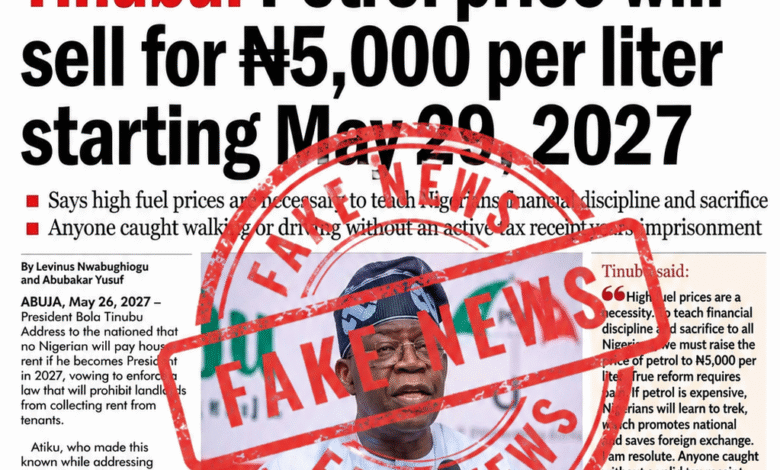
From free housing to petrol at ₦5,000 a litre, Nigerians are increasingly being presented with campaign promises that presidential candidates never made.
As the 2027 presidential election approaches, Nigeria’s leading presidential contenders have begun outlining competing manifestos to address the country’s economic and social challenges. From cheaper fuel to free education, improved electricity supply and healthcare reform, the promises are unending. However, alongside legitimate campaign manifestos, a coordinated disinformation trend has emerged ahead of the election.
The attribution of fabricated policy commitments to political figures is fuelling pre-election information disorder ahead of the 2027 general elections. Rather than relying solely on traditional mudslinging or personal character assassination, disinformation actors are increasingly deploying extreme populist fabrications, such as promises of free housing or specific fuel-price guarantees, to influence public perception of political candidates.
These actors have also moved beyond conventional social media posts to creating forged newspaper front pages that impersonate trusted media organisations.
In a recent case, a viral graphic mimicking the Nigerian Tribune alleged that President Bola Ahmed Tinubu, the 2027 presidential candidate of the All Progressives Congress (APC) promised that petrol would sell for ₦5,000 per litre from May 29, 2027. Although the claim appeared in a graphic designed to resemble a Nigerian Tribune front page, its masthead read “The Daily Tribune”, a media organisation that does not appear to exist in Nigeria’s news and media space.
A debunk by FACTCHECKAFRICA highlighted glaring technical flaws, including a fabricated masthead, altered fonts, missing logos and an impossible date stamp set in the future.
The tactic is not limited to a single candidate or political party. Another forged front page, using similar layout manipulation, falsely claimed that former vice president and current presidential candidate of the African Democratic Congress (ADC) Atiku Abubakar, said no Nigerian would pay house rent during his presidency and that landlords caught collecting rent would face 10 years in prison.
X users also posted similar narratives here and here, while Abubakar’s special assistant on media, Abdul Rasheeth, debunked the claim as “false and does not reflect the views or policy position of His Excellency”. The use of forged newspaper front pages targeting multiple political figures points to a broader tactic of exploiting the visual authority of established news organisations for political manipulation.
The spread of altered front pages also prompted the Nigerian Tribune to publish an official guide on how to identify genuine editions. The guide outlined key visual markers, standard typography rules and logo placements to help readers distinguish authentic newspaper front pages from digitally manipulated versions.
Generating absurd policy guarantees can appeal to voters’ economic vulnerabilities while potentially setting up candidates for public backlash when the claims are disproved or the supposed promises go unfulfilled.
But the manipulation is not limited to fabricated newspaper covers. Disinformation actors are also deploying AI-generated or manipulated audio and video to construct statements out of whole cloth or distort the context of past public addresses.
In one instance, a circulated claim alleged that the presidential candidate of the Nigeria Democratic Congress (NDC), Peter Obi, stated that Yoruba Muslims are not practising “real Islam” and that real Islam is practised only in northern Nigeria.
The FactCheckHub found the claim to be misleading. A review of his full Arise Television interview showed that he made no such statement. Instead, his comments were about his intention to spend Sallah in Sokoto or Kano if elected president.
The FactCheckHub also previously debunked a viral video purporting to show Peter Obi miscalculating Ghana’s health budget during an interview. Findings revealed that the original 2020 Arise News interview contains no such statement, while the viral clip features audio that was digitally overlaid on the original footage and falsely shared as a recent recording.
Similarly, a viral post falsely claimed that Oyo State governor Seyi Makinde, who is also the presidential candidate of the Allied Peoples’ Movement (APM), said President Bola Tinubu removed the petrol subsidy to enrich himself and the governors. The FactCheckHub reviewed Makinde’s official newsletter, The Business of Governance, and found that he argued for transparency in crude oil benchmarks and border security, rather than making the statement attributed to him.
These examples illustrate how fabricated quotes and manipulated media can be used to provoke political resentment and shape perceptions of candidates ahead of an election.
Silas Jonathan, Digital Investigations Manager at CJID, explained that false positive promises can appeal directly to voters’ hopes and economic concerns. He said claims about free housing or cheap fuel can make voters believe that a candidate has promised policies they never announced.
“False positive promises can be more effective because they appeal directly to people’s hopes and economic concerns,” he said.
Caleb Ijioma, Executive Director, Roundcheck, also linked the spread of these claims to the election season. He said political actors can use the needs of ordinary citizens to push narratives that help the candidates they support. He pointed to the high cost of housing and fuel as examples of issues that could make such promises attractive to voters.
On fake newspaper covers, Jonathan said they take advantage of the trust people already have in legitimate news organisations.
“When people encounter convincing fabrications, it becomes harder to distinguish authentic reporting from manipulated content,” he said. He explained that this can eventually reduce people’s trust in the media.
Ijioma said this is even more concerning for people who do not have the skills or resources to verify what they see. He explained that people can come across a claim, fail to verify it and continue spreading it in their communities. “And the election is local, election is not online,” he said, noting that information that starts online can still reach people who vote in local communities.
Both experts also warned about the effect of false promises on voter trust and accountability after elections. Jonathan said that when voters are exposed to many false promises, they may misunderstand what candidates actually stand for. He added that it can become difficult to hold elected officials accountable for promises they never made.
Ijioma similarly said that voters may support a candidate because of a promise that was falsely attributed to them and later become disappointed when the promise is not fulfilled. “If we have false information flooding our digital spaces, it becomes an issue and it can increase voter apathy,” he said.
Ultimately, the experts warned that the spread of false promises does not only affect how people vote but can also make it harder for voters to trust the electoral process and hold leaders accountable after elections.

Seasoned writer and literary curator, Zainab Abdulrasaq is a factchecker for The FactCheckHub in an effort to combat information disorder. She can be reached on IG @blackbookishgirl or zabdulrasaq@icirnigeria.org

