Please note that the FactCheckHub has not obtained any right from the authors or copyright owners of all third-party contents from embedded links and shall incur no liability in this regard.
Please note that the FactCheckHub has not obtained any right from the authors or copyright owners of all third-party contents from embedded links and shall incur no liability in this regard.
Please note that the FactCheckHub has not obtained any right from the authors or copyright owners of all third-party contents from embedded links and shall incur no liability in this regard.
Please note that the FactCheckHub has not obtained any right from the authors or copyright owners of all third-party contents from embedded links and shall incur no liability in this regard.
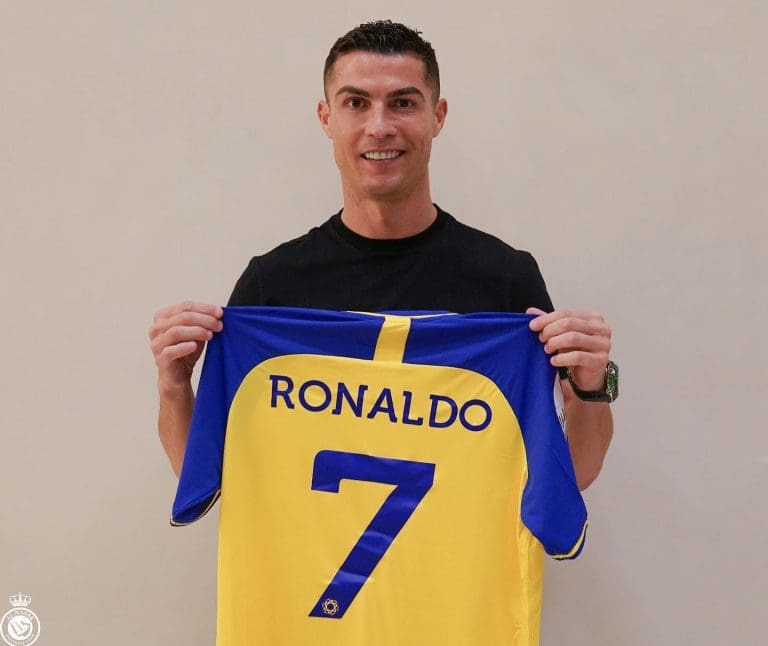
A claim that Digital Satellite Television (DSTV), the Sub-Saharan African direct broadcast satellite service owned by MultiChoice, has set up a new channel to broadcast the Saudi Arabian League has surfaced online.
The claim is circulating following the recent signing of Portuguese football star, Cristiano Ronaldo by a Saudi Arabian club, Al-Nassr FC.
A fake Al-Nassr FC Facebook account on January 3, 2023, posted the claim with a caption thus:
“Al Nassr FC. DSTV Has Added A Saudi League Channel *240*.Ronaldo Effect(sic).”
The post has garnered more than 3,000 likes and over 1,500 shares on Facebook as of 7th of January, 2023.
A Twitter user, @AsiimweMiles, had also tweeted the claim earlier on January 1, 2023, with another caption that read:
“DSTV has already added Saudi Arabian league on channel 240. This effect has been impacted on by a player who joined the league this season and thats non other than the GOAT. Ronaldo was given five private cars, stadium, restaurant and a Palace in Riyadh with complete security(sic).”
The tweet has garnered over 20 retweets and over 100 likes as of Saturday, 7th of January, 2023.
Similarly, another Twitter user, @DocOmeiza tweeted the claim on January 3, 2023 with a caption thus:
“Just In: DSTV Has Added A Saudi League Channel
(Channel 240). Ronaldo Effect.My G.O.A.T(sic).”
The tweet has garnered over 40 retweets and 100 likes as of Saturday, 7th of January, 2023.
CLAIM
DSTV added new channel to broadcast Saudi Arabian League due to Cristiano Ronaldo’s transfer.
Screenshot of one of the viral post.
THE FINDINGS
Findings by The FactCheckHub show that the claim is FALSE.
It will be recalled that Ronaldo had in December signed for Al-Nassr after his contract with Manchester United was terminated earlier in November 2022.
The 37-year-old was officially unveiled as an Al Nassr player on Tuesday, 3rd of January, 2023.
The Portuguese national football team captain signed a contract with the Saudi Arabian side that would see him remain at the club until 2025.
However, findings by The FactCheckHub revealed that the Channel 240, “Liyu Amharic HD” purported to have been added on DSTV is a horse racing Channel that has been in existence on the cable service provider’s packages prior to Ronaldo’s transfer to Al-Nassr football club.
The TV channel was added on Wednesday, 19th of January, 2022 on the DSTV.
According to the information obtained from the DSTV website , Racing 240 “is a 24- hour horse racing channel operating under the auspices of 4RacingTV and is available in South Africa to all DStv Premium, Compact Plus , Compact, Family and Access customers on DStv.”
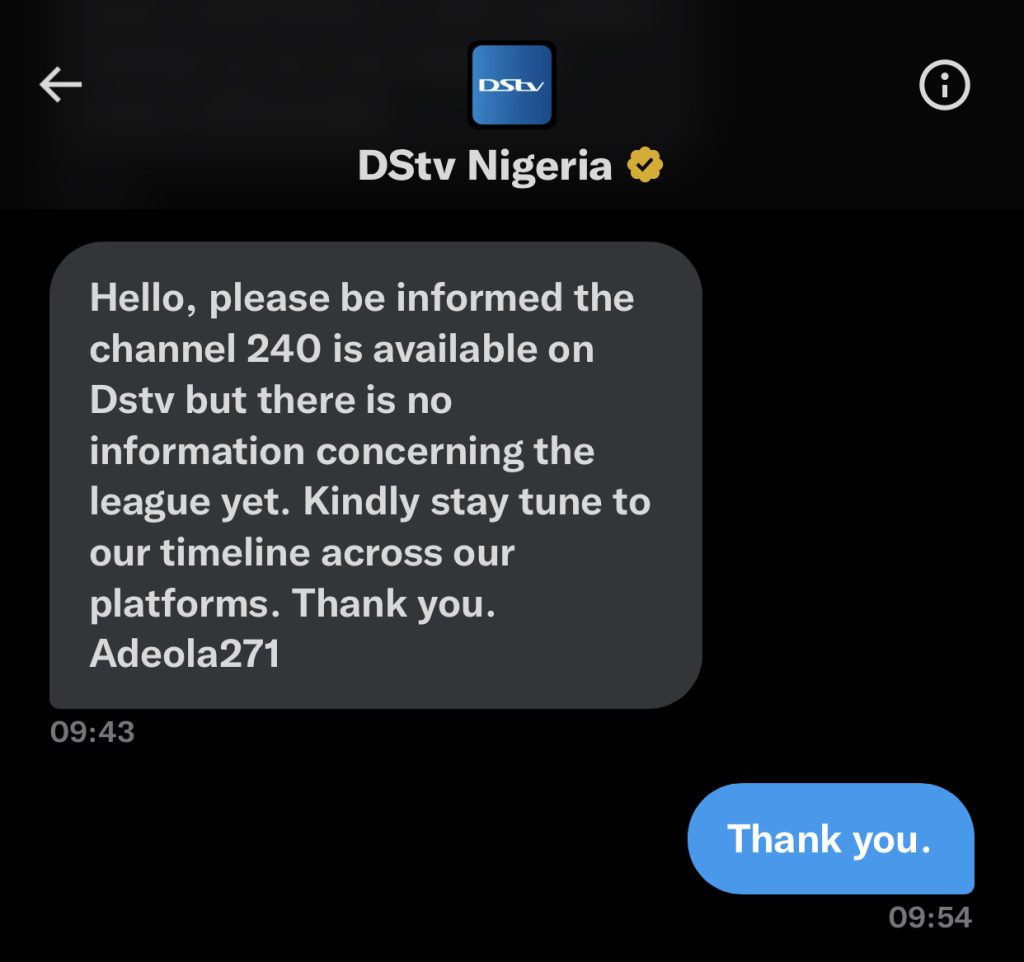
For further confirmation, TheFactCheckHub reached out to the Nigerian branch of DSTV on Twitter and the company debunked the rumour.
Screenshot of the DSTV’s response to the FactCheckHub’s enquiry.
THE VERDICT
The claim that DSTV added Channel 240 to broadcast Saudi Arabian League due to Ronaldo’s transfer is false; findings reveal that the horse racing channel has been in existence before Ronaldo moved to Al-Nassr FC.
THE impact of information disorder has begun to play out in the build-up to Nigeria’s general election, holding in February and March this year.
The social media is filled with several forms of information disorder emanating from politicians and their supporters, with many simply aimed at misleading the electorate.
Information disorder is a threat to Journalism and by extension, Nigeria’s fragile democracy. A recent report by the Centre for Democracy and Development (CDD) warns that information disorder, if not tamed, could mar the coming election.
In recent times, The FactCheckHub has fact-checked several claims from Nigerian politicians; mostly presidential candidates and their supporters online.
In this explainer, we highlight a few steps you can take to protect yourself and your community against false and misleading information ahead of the election.
Understand election guidelines
When it comes to elections, knowing basic facts about the voting guidelines can be the best way to avoid falling victim to misinformation and disinformation.
The regulations and guidelines cover elections and arrangements for their conduct, accreditation and voting procedures at elections, and collation of election results and making returns.
As an eligible voter, you must read these pieces of information and understand the election procedures.
Verify before you share
The need for verification of information has become more paramount than ever due to the forthcoming elections which have been overwhelmed by false information from politicians and their supporters.
The FactCheckHub had earlier put together basic steps you can follow to spot fake news online. This ranges from checking the credibility of the source and originality of the domain plus seeking confirmation from fact-checking platforms to verify the authenticity of the information.
Source news from credible platforms
There is always an increase in misinformation and disinformation sources during election season as many fake news platforms camouflage as information-sharing platforms to lure electorate and feed them with false information to promote an agenda.
This is the reason why it’s important to ensure that the information you are consuming is either from the official websites or verified social media platforms of the INEC or credible media organizations with a track record of accurate reporting.
Understand basic verification tools
During election season, fake news purveyors manipulate images and videos or take them out of context to portray their opposition candidates in bad light.
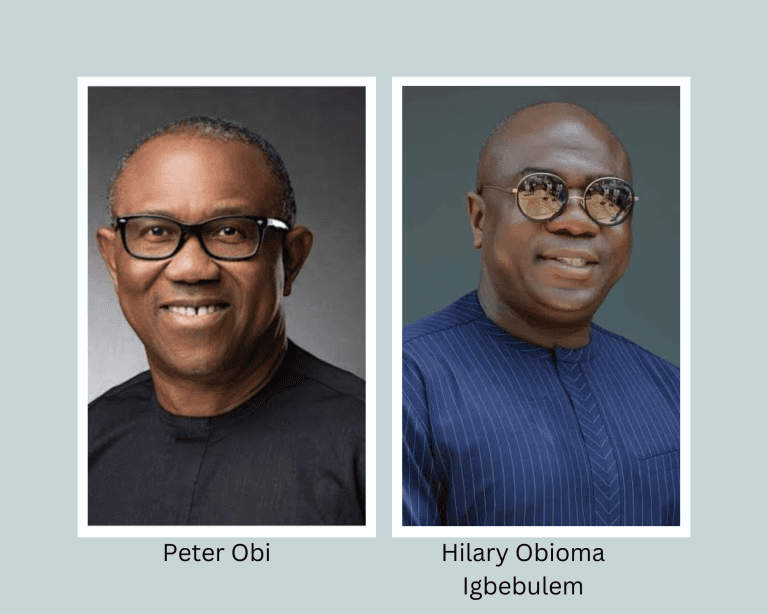
For instance, visuals showing some packaged rice have surfaced online with a claim that it shows bags of rice branded with the People Democratic Party’s (PDP) logo and image of Peter Obi, the Labour Party’s presidential candidate for this year’s general election in Nigeria.
When TheFactCheckHub checked the claim, findings revealed that the image seen on the branded bags of rice is that of Hilary Obioma Igbebulem, the principal secretary to the Delta State governor who reportedly sponsored or bought the items and not Peter Obi as claimed in the viral social media posts.
This is one of several instances where visuals were weaponised to discredit some candidates.
In addition, when you are skeptical about the images and videos shared with you or seen online, you can use a few basic tools to verify them. Using tools like Google Reverse Image Search to check the source or earlier versions of the image. If it has been uploaded online before, it would enable you to know its actual context.
InVid fake news debunker can also help you to break videos into frames and subject it to reverse image searches to understand the original context of it.
This explainer by The FactCheckHub guides you on how to fact-check images online and this guides you on how to identify fake visuals online. While this explainer teaches you how to use Yandex for reverse image search.
Know the candidates
This seems like a digression but it is very imperative due to the fact that notorious fake news purveyors spread incredible information to discredit candidates.
As election day approaches, you are more likely to see online disinformation posts or messages aimed at influencing your vote.
Screenshot of a Google search of Nigeria’s presidential candidates in the 2023 election.
Furthermore, you may do thorough research on each candidate before deciding who to vote for by simply typing their names in the Google search box and clicking the search button. This may give you a better insight into their profiles and enable you to make informed decisions at the polls.
Beware of fake results
In previous Nigerian elections our researchers had monitored, the trend where several election results are shared on various social media platforms during the collation of results often surfaced; and some of them are often not accurate. Some popular social media influencers and notable personalities sometimes go as far as using their social media platforms to announce fake results which usually gain traction online.
Always ensure that whatever platform you read the election results from are credible sources to avoid being misinformed. Also, don’t share any results you see online until their source is confirmed to be credible and the information contained therein is verified.
It is also important to analyse the political stance of the individual sharing the result by looking at their social media profile and previous posts to know the party they are affiliated with or supporting for context.
Beware of false safety threats
One of the tactics that are usually used to discourage people from going to cast their ballot on election day is fake news about violence which might raise voters’ concerns about their safety or lead to voter apathy.
Merchants of fake news often spread rumours about violence at polling units to instill fear in the minds of voters to create apathy or tension during election.
THE Independent National Electoral Commission (INEC) has disowned a website advertising ad-hoc staff positions for the agency for the 2023 general election.
It will be recalled that INEC had earlier in September 2022 opened a portal for the recruitment of ad-hoc staff.
Then, the commission said the online portal for the applications would open on September 14, 2022 at 8 am and close on December 14, 2022 at 8 pm (Nigerian time).
However, a website looking like that of INEC recently surfaced online and asked applicants to register for various categories of ad-hoc positions.
In a statement issued on Tuesday, Rotimi Oyekanmi,the Chief Press Secretary to INEC chairman, said the website was created with the intention to defraud the general public. He, therefore, asked Nigerians to disregard it.
“The website/blog is advertising ad-hoc staff positions for the 2023 General Election.
“However, the commission is no longer recruiting ad-hoc staff for the 2023 general election. The INEC ad-hoc staff recruitment portal was officially shut down on 14th December, 2022.
“Therefore, the site, with the URL – https://www.yournewclaims.com/Inec-Recriutment/ is fake. It is intended to defraud unsuspecting members of the public. Nigerians should disregard it,” the statement read.
The FactCheckHub had earlier reported several phishing websites created to deceive and swindle citizens and provided a guide on how to identify phishing scams and websites.
A visual showing some packaged rice have surfaced online with a claim that it shows bags of rice branded with the People Democratic Party’s (PDP) logo and image of Peter Obi, the Labour Party’s presidential candidate for this year’s general election in Nigeria.
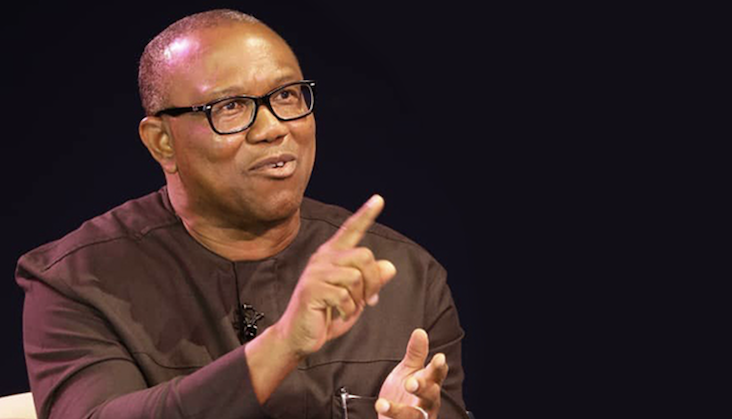
The purported Obi’s image printed on the bags of rice shows a man in a dark blue native dress wearing glasses.
A Tweep, @Ikechuk07996899 tweeted the video with a caption that reads:
“PDP is now using @PeterObi picture to deceive voters. Their candidate @atiku is no longer sellable. This is impersonation, and @OfficialPDPNig should be sued.”
The video, posted on January 1, 2023, has garnered over 300 retweets and more than 13,000 views as of Tuesday, 3rd of January, 2023.
A Tweep, @Adokwuandy also tweeted its photo on 31st of December, 2022 with a caption that reads:
“What is this rubbish the PDP is doing. Why are they putting peter Obi’s picture on bag of rice with Atiku and Okowa written on it.. They say he don’t have structure still they are trying to manipulate The public.”
The tweet has garnered more than 400 retweets and over 600 likes as of 3rd of January, 2023.
Another Twitter user, @BenethEbere also tweeted the photo with another caption thus:
“Don’t vote for a thief. He will steal your money and future. Pdp using Peter Obi picture on their posters and rice bags is another height of desperation. Totally unacceptable, that’s identity theft.”
CLAIM
Visuals show image of Peter Obi on bags of rice branded with PDP logo.
Screenshot of the tweeted photo.
THE FINDINGS
Checks by The FactCheckHub show that the claim is FALSE.
The purported video shows a scene where some bags of rice branded with PDP logo and the names of some contestants under the party were being loaded into a truck.
When our researcher did a keyframe analysis of the footage using InVid – a video verification tool, findings show the branded bags of rice had on them names of some PDP candidates who are contesting for various elective positions in Delta state as well as that of Atiku Abubakar and Ifeanyi Okowa, the party’s presidential candidate and his vice, respectively.
A clearer pictures of branded bags of rice/ Source: Facebook
Names seen on the bags include: Hilary Obioma Igbebulem, secretary to the Delta state governor; Atiku Abubakar, presidential candidate; Ifeanyi Okowa, vice-presidential candidate; Sheriff Oborevwori, PDP governorship candidate in Delta state, Ned Nwoko, Delta North senatorial candidate, Victor Nwokolo, representing Ika Federal Constituency and Marilyn Okowa, a contestant for Delta state House of Assembly.
Further checks online revealed a clearer image of the packaged rice. Findings revealed that the image seen on the branded bags of rice is that of Hilary Obioma Igbebulem, the principal secretary to the Delta State governor who reportedly sponsored or bought the items and not Peter Obi as claimed in the viral social media posts.
Another clearer image showing the bags of rice
THE VERDICT
The claim that the visuals show image of Peter Obi on the bags of rice branded with PDP logo is FALSE; findings revealed that the image shows Hilary Obioma Igbebulem, the secretary to the Delta state governor.
Mama Risikat Kasali’s back burned from the welts of the scorching sun as she dropped the ice cold bowl of cold drinks in front of Ikeja City Mall in the heart of Nigeria’s commercial capital, Lagos that heated afternoon.
She had spent the better part of this Saturday morning chasing customers who alighted at the Alausa secretariat bus, asking if they were seeking sausage rolls and soft drinks for their on-the-go meal, as the beads of sweats trailed down their foreheads in front of the popular ShopRite mall.
Ikeja City Mall, Lagos.
She is however obvious of the latest tax the Federal Government passed on January 2022 on carbonated drinks. It was formerly N100 for 50cl around January 2022.
It’s currently double the price now and reaching even for more heights as this piece is being read, adding more pressure on a nation where 133 million poor people (out of 200 million people) are struggling to keep head over water with spiralling inflation. She tells me the government has to intervene in the matter, adding, “Before now, it was N150 per 5ocl, and customers said it was expensive. The price is still on the rise.”
The rise of Sugar tax in Nigeria
On January 5, 2022, the Federal Government of Nigeria introduced sugar tax on non-alcoholic beverages. The Finance Minister, Zainab Shamsuna Ahmed, who disclosed this while giving a breakdown of the highlights of the 2022 Appropriation Act said the tax became law to discourage excessive consumption of sugar in beverages.
Ahmed stated that the sum of N10 per litre had been imposed on sweetened beverages as part of critical policy thrusts of the Finance Act 2021.
Zainab Shamsuna Ahmed.
She said, “In section 17 of the Finance Act, there is a law that has imposed a duty on non-alcoholic carbonated sweetened beverages. There is an excise duty of N10 per litre imposed on all non-alcoholic carbonated and sweetened beverages and this is designed to discourage excessive consumption of sugar in beverages which contributes to a number of health conditions including diabetes and obesity.
“This new sugar tax is introduced to raise excise duties and revenues for health-related issues and other critical expenditures. It is in line with the 2022 budget priorities.”
This is not the first time a country has imposed a tax on sugar-sweetened beverages (SSBs). A blog, Obesity Evidence Hub revealed that at least 55 countries have introduced a tax on SSB, including the United Kingdom, South Africa and Mexico. A few blogs report that the approach works in stemming the tide of sugary drinks consumption, especially in Mexico and South Africa.
Sugary drink taxes around the world.
Quite commonly, research has continued to advocate for how excessive taxation on tobacco, alcohol, and sugary beverages could avert 10 million premature deaths each year and about 16 per cent of all deaths in the world. Already the research noted that 6 million deaths are linked to diabetes and obesity as a result of the growing sugar consumption in low and middle-income countries and amongst adolescents. While these benefits may be very good, they fail to account for the unemployment ripple effect that could affect businesses if these SSBs taxes are enforced and increased over time in countries, especially like Nigeria.
Blowback
Already, the Manufacturers Association of Nigeria (MAN) kicked against the Federal Government of Nigeria’s idea to tax drinks, noting that it could hurt 1.5 million jobs.
The Director-General of MAN, Segun Ajayi-Kadir, said, in an interview six days after, that pronouncement that the tax was just a way of taxing the vulnerable and raising revenue for government projects.
He said, “We know, for instance, that the food and beverage sub-sector contributes about 38 per cent of the manufacturing contribution to Gross Domestic Product (GDP) and 22.5 per cent of the jobs created, employing 1.5 million persons. We have a feeling that this is the kind of sector we need to guide against any negative thing falling there.
“We see that in the long run, the introduction of this excise duty will not augur well for revenue for the government and performance for the sector. The way it hit us, we are looking at a situation where it ought to be revisited with adequate dialogue and then we can find a common ground.”
Director-General of MAN, Segun Ajayi-Kadir.
He added, “It is what has been described by some who have commented on it as ‘pennywise and pound foolish’ in a sense. If you look at a revenue gain of N81 billion between 2022 and 2025, you compare this with a possible revenue loss of N142 billion in Value Added Tax (VAT) and N54 billion in Company Income Tax (CIT) over this period, I think it would be a better idea to allow the sector to continue on its growth pathways.
In another opinion piece by the chairman of the Foundation for Consumer Freedom Advancement, Olumayowa Okediran, he believes that the argument of taxing Nigerians to avoid them from consuming sugar drinks doesn’t carry water.
“According to the minister, this policy will discourage excessive sugar consumption in beverages. And because it contributes to several health conditions like diabetes and obesity, the government thinks this tax will raise revenues for the health sector. If you think about it, this argument is flawed. Excessive sugar consumption is not the only known cause of diabetes and obesity; neither is increased taxes the solution to diabetes.
“There are two things we need to note here. First, the government wants to prevent Nigerians from having diabetes and obesity by collecting more taxes from beverage companies. And second, the primary aim of the government is to source funds to cushion its budget deficit, as it is projected that this excise duty will bring about N81 billion to the government’s coffers in three years. Despite these seemingly lofty aims, we must understand that this is a bad idea economically,” he wrote.
Already, the acting Managing Director of BUA Foods, Ayodele Abioye, said that the imposition of sugar tax on companies could impact the firm’s production of sugar.
Sugar Sweetened Beverages (SSBs)
Abioye, who spoke at the Facts Behind the Listing event organised by the Nigerian Exchange Group earlier this year, stressed that the sugar market was majorly underserved.
“The impact of tax as we know is going to affect our customers largely in the downstream value chain of the food industry and that will also have a backward impact on us. However, we believe that the market is underserved,” he said.
Our findings
This analysis is designed to verify if Nigeria’s finance minister’s claim that “excessive consumption of sugar in beverages contributes to a number of health conditions including diabetes and obesity” is true.
The World Health Organization (WHO) defines diabetes as “a chronic disease that occurs either when the pancreas does not produce enough insulin or when the body cannot effectively use the insulin it produces.”
It explains that insulin is a hormone that regulates blood glucose. It further stated that Hyperglycaemia, also called raised blood glucose or raised blood sugar, is a common effect of uncontrolled diabetes and over time leads to serious damage to many of the body’s systems, especially the nerves and blood vessels.
While there are different types of diabetes, two are the most common, Erica Julson, a registered dietician nutritionist wrote in an evidence-based article on the health blog, Healthline.com.
According to her, Type 1 is caused when the immune system is attacked by the pancreas and insulin production is stopped while type 2, usually the commonest, is when the pancreas stops producing insulin.
She acknowledged the fact that people who regularly drink sugar sweetened beverages have a 25% risk of type 2 diabetes. She also argued that the impact of fructose can increase the risk of the impact, but may not significantly lead to diabetes as claimed by Nigeria’s finance minister.
She further explained that natural sugars do not contribute to diabetes, adding that natural sugars can be found in fruits and vegetables that have not been processed.
A United Kingdom health blog, Diabetes UK, while providing the distinction between sugar and diabetes states that one doesn’t need to cut out sugar if one has diabetes. It goes further to argue that for diabetes type 1, sugar “doesn’t directly cause the condition.”
“The question of whether sugar directly causes type 2 diabetes is a bit complicated. Because diabetes is a condition where blood sugar levels are too high, it’s all too easy to think eating too much sugar is the cause,” it stated.
The health blog clearly states that sugar doesn’t cause diabetes type 1 as it is a matter of insulin-producing cells in one’s pancreas being destroyed by the immune system. For diabetes type 2, it says that being overweight makes it more likely for one to suffer diabetes.
Carbonated drinks
“You gain weight when you take in more calories than your body needs, and sugary foods and drinks contain a lot of calories.
“So you can see if too much sugar is making you put on weight, then you are increasing your risk of getting type 2 diabetes. But type 2 diabetes is complex, and sugar is unlikely to be the only reason the condition develops,” it explains.
“Research into the connection between sugar consumption and type 2 diabetes is ongoing. Eating sugar alone may not lead directly to diabetes, but sugar may play a role. Diabetes is a complex condition that results from a range of factors.”
One thing is clear from these three scientific journals, high calories can lead to obesity which in turn, can be a risk factor for diabetes 2.
Harvard School of Public Health is affirmative that excessive sugar intake leads to diabetes. It states that there is strong evidence that sugar-sweetened soft drinks contribute to the development of diabetes. It adds that people who take between 1-2 cans of sweetened beverages daily have a 26% greater risk of developing type 2 diabetes than people who rarely have such drinks, noting that the risk is greater in young adults and Asians.
It is important here to add that the World Health Organisation (WHO) recommends no more than 10% of sugar daily for consumption. In fact, the American Heart Association (AHA) recommends a maximum of 9 teaspoons or 36 g or 150 calories of sugar daily for males while it sets the maximum limit of 6 teaspoons or 25 g or 100 calories daily for females.
Emeritus Professor at the University of Ibadan, who specialises in Human Nutrition, Professor Tola Atinmo, argues that sugar must be avoided at all costs.
Professor Tola Atinmo.
“If you eat too much sugar, it is related to heart disease, diabetes and obesity. There are three problems. There is a cardiovascular problem. There is a direct relation between too much sugar and those causes- obesity, heart disease and diabetes. You have to educate the people to understand that they should take very little sugar,” he said.
“As an expert, I don’t take sugar. It is better to avoid it. All these sweet drinks, Coca-cola and Chivita, you have to avoid it to live long. Type 2 diabetes affects people who are very old. From 40 onwards, you have maturity-onset diabetes because your pancreas cannot produce a lot of insulin. You have to undergo various issues. You have to avoid it,” Professor Atinmo added.
A medical practitioner, Dr Eghosa Omoruyi, offers clarity into the matter by stressing the health risk of excessive sugar in a human’s bloodstream.
“For starters, we may not be able to say A=B or Sugar= diabetes. But I can guarantee you that A + B +C= diabetes. What that means is that A being sugar, B being another thing else, C being another risk factor, when they all come together, it hastens the rate of coming down with diabetes. There is a relationship between sugar and diabetes, we cannot deny that. But it in itself doesn’t translate to diabetes.
“The body utilizes the food we eat in the form of sugar. The more sugar dumped in the body, the more insulin is required to pump it. You are now giving the pancreas extra work.
“For instance, to simplify my point, let’s say if the pancreas is meant to work for just two hours at a time, it may be forced to work five hours giving the unusually huge amount of glucose to deal with. Continuous dumping of sugar overworks the pancreas till it breaks down and then there is excess sugar in the blood which leads to diabetes,” Dr Omoruyi explained.
He noted that type 1 diabetes may not be common among adults but he adds that type 2 is common. He adds that obesity, and fat compounds the sugar problem which would lead to diabetes. He stresses that sugar cannot be exempted from the diabetes conversation.
Dr Eghosa Omoruyi.
Dr. Omoruyi, nonetheless, weighs into the Nigerian finance minister’s reason for taxing sugar. He explains that increasing the tax on sugar would not do any to curb consumption.
“On a policy level, that is a big lie. The sugar tax is not a means to control sugar consumption. There are many things taxed in the world that the consumption has not reduced. Do you know the amount of money nations are making from taxing tobacco? It hasn’t stopped smoking.
“One could create revenue financially by taxing beverages, however if the tax is for health reasons, it doesn’t make any scientific sense. It doesn’t accomplish anything. Does the inflation we are currently experiencing stop people from buying stuff? No.
“So, taxing sugar doesn’t reduce the consumption of non-alcoholic carbonated and sweetened beverages. Taxation of other addictions like tobacco, gambling and sugar sweetened beverages (sin taxes) are never controlled by increasing the monetary cost of those products. Rather, we have seen an upsurge in the consumption of these products over time,” he explained.
Reduced sugar consumption?
Mrs Suleiman who hawks drinks around ShopRite in Ikeja area of Lagos state believes that taxing the drinks would not solve any immediate problem.
“If they want to tax drinks, won’t it make it increase? They haven’t taxed it yet and some people can’t afford it,” she responded.
Eniola Prysce, who weighed into the matter, said the policy was not to tackle sugar consumption but fund the budget.
“The policy is obviously a way to generate revenue because they cannot fund the budget. Budget deficit is going to increase next year so they are looking for other alternatives to fund their lifestyle.
“This includes taxation, import and export duties, Value Added Tax (VAT) and possibly social media-content creators. Subsidy removal is also another way. Is the budget working for the Nigerian people… no? So they want to fund the budget and pay their overheads,” he stated.
Prysce added that a functional government would not be taxing soft drinks as the way forward.
Peace Odia, an athlete said he was not a heavy consumer of carbonated drinks. He, however, believed the government should be focusing on other endeavours than taxing soft drinks.
Already, the Nigerian government led by President Muhammadu Buhari had introduced six new taxes. They are the Companies Income Tax (CIT), Tertiary Education Tax (TET), National Information Technology Development Agency (NITDA), Police Trust Fund Levy, National Agency for Science and Engineering Infrastructure (NASENI) levy and the NYSC levy. Experts have repeatedly flayed the President Buhari-led administration for imposing multiple taxes on Nigerians.
Nigeria ranked number 4 highest consumer of soft drinks – NGO
An Abuja-based non-governmental organisation, known as Project PINK BLUE revealed that Nigeria ranked 4th in the world as the highest consumers of soft drinks. Its Executive Director, Runcie Chidebe, stated this during the global week of action for non-communicable diseases held in September 2022.
She said, “Nigeria is the world’s 4th highest consumer of SSBs commonly known as soft drinks. An estimated 38.6 million litres of soft drinks are sold in Nigeria annually. Of particular concern is overconsumption among adolescents as indicated in a study where 97 percent of the 1,000 respondents consumed at least 35cl of soft drink daily. A 35cl bottle may contain as much as nine cubes of sugar, while the WHO recommends that individuals should take less than 10 cubes per day.”
The biggest losers in this policy
While the SSB tax is already in effect, the Nigerian Government has recently proposed in raising the tax to 20% which has led to more blowback from carbonated drinks manufacturers, as many complained that there had been an 8% decrease in revenue between July and August this year, and this decline is expected to reach 25% by December 2022.
At a recent stakeholders meeting held in December 2022, manufacturers revealed how the tax discouraged one of the bottling companies from proceeding with its £300 million investment plan.
In conclusion
Dr. Omoruyi stressed the importance to let the audience control and reduce their sugar intakes.
“Increased sugar leads to diabetes in association with other factors. However, saying that the tax on sugar beverages would lead to the even the slightest reduction in sugar consumption is not tenable neither is it practicable,” he buttressed.
2022 has been a tortuous year filled with several forms of inaccurate and misleading claims from politicians and most especially candidates for Nigeria’s 2023 general elections.
Whenever they make claims worth fact-checking in the course of the year, The FactCheckHub helps the public to examine their veracity and disseminates our findings to the public via our website and various social media platforms.
Unlike previous years, most of our fact-checks this year are political related. This is due to the forthcoming elections which have been overwhelmed by false information from politicians and their supporters.
In this analysis, we take a recap of some of the most prominent politicians that we fact-checked in 2022.
Nigeria’s President Muhammadu Buhari is the first on this list. He initially assumed office as a duly elected democratic president of the West Africa nation on May 29, 2015.
President Muhammadu Buhari
Buhari, in response to Bloomberg’s questions published on June 21, 2022, claimed that his administration will be leaving Nigeria “in a far better place than he found it.”
An appraisal of Buhari’s administration in the aspects of security, economy, corruption index and other key sectorspublished by The ICIR, show that the president’s claim lacks credibility.
Earlier on Sunday, 12th of June, 2022, in commemoration of this year’s Democracy Day, President Buhari claimed that the primary elections conducted by political parties in the country for the 2023 general elections were peaceful and orderly. But a fact-checkpublished by The FactCheckHub shows that the claim is MOSTLY FALSE.
One of the earliest claims fact-checked by The FactCheckHub this year was a claim by the former Nigerian Senate President, Abubakar Bukola Saraki.
Bukola Saraki
Saraki, who was a contestant in the primary election of the Peoples Democratic Party (PDP), had via his verified Facebook page made claims about the statistics of the voting population in Nigeria.
According to him, women hold more than 50% of the voting population and youths under 25 years old hold more than 70% of the voting population.
To examine the veracity of this, The FactCheckHub sent a freedom of information request to the Independent National Electoral Commission (INEC), the nation’s electoral umpire. According to the data obtained, both claims were FALSE as at the time.
Yahaya Bello, the current Kogi State Governor, was also one of the leading Nigerian politicians caught sharing misinformation in 2022.
Yahaya Bello
Speaking on the 7th of June, 2022, while canvassing for delegates’ support at the All Progressives Congress (APC) convention held in Abuja, Bello claimed that there has been no strike action in the state-owned tertiary institutions since he became the governor in 2016.
The FactCheckHub subjected the claim to verification and outlined various instances where the lecturers in the state-owned institutions embarked on industrial actions.
Speaking on Arise TV on July 22, 2022, the PDP presidential candidate, Atiku Abubakar, claimed that 90 per cent of Nigerians from the Northern part of the country are not on social media.
The presidential candidate of Labour Party in next year’s election, Peter Obi, has often come under the radar of fact-checkers across the country especially since he emerged the party’s presidential flagbearer in May, 2022; partly because of his penchant for quoting statistics.
Peter Obi
According to our recent analysis, at least ten of the claims he made in the year under review were checked to be TRUE. This is the highest compared to other presidential candidates that have been fact-checked by this medium in 2022.
However, there are instances where his claims were found to be FALSE. For instance, while speaking at an event in Umuahia, Abia State capital on Saturday, 23rd of July, 2022, Obi claimed that Nigeria’s total export was less than 30 billion US dollars in 2021.
When The FactCheckHub checked the claim using data from National Bureau of Statistics, the results show that Nigeria’s total exports was 18.9 trillion Nigeria naira which is about $47 billion (U.S. dollars) based on the average exchange rate in 2021 – 403.5 naira per dollar. The result from the calculation show higher figure than the $30 billion (dollars) that Obi claimed.
A former Lagos State governor, Bola Ahmed Tinubu, of the ruling All Progressives Congress (APC) was also among the top politicians fact-checked in 2022 by this medium. He is also the party’s presidential flagbearer for the 2023 election.
Bola Ahmed Tinubu
Earlier this year while speaking to members of the APC in January 2022, Tinubu claimed that the Permanent Voter’s Cards (PVCs) issued by the Independent National Electoral Commission (INEC) had expired.
He told the party’s members who visited him in Abuja that they needed to register for a new PVC as he claimed the ones with them had expired.
When the claim was fact-checked, the result shows that the claim is FALSE, as a permanent voter’s card doesn’t carry an expiry date.
Tinubu also claimed that he brought a leading mobile telecommunications company, Econet, now Airtel to Nigeria. The claim was also checked by The FactCheckHub and it was found to be FALSE.
The current governor of Kaduna State, Nasir El-Rufai, also made this list.
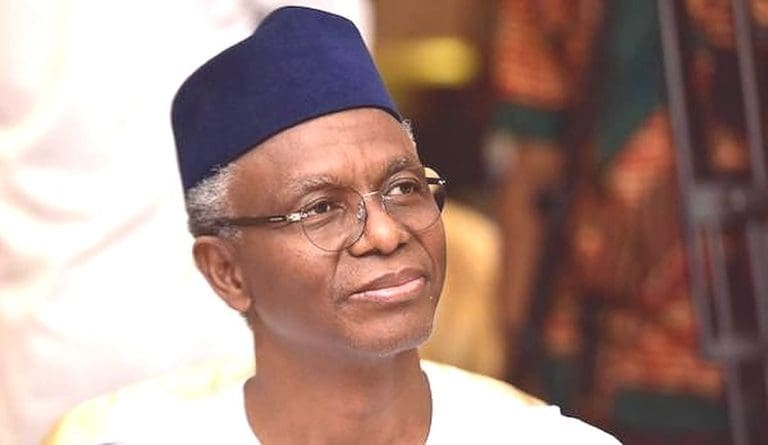
El-Rufai, while speaking as one of the surrogates who accompanied Tinubu to the Chatham House in the United Kingdom on December, 5, 2022, made several claims on Nigeria’s security situation.
Nasir-El-Rufai.
He claimed that Nigeria has about 300,000 policemen and that Nigeria’s Armed Forces are not more than 200,000 in size. He also claimed that the Nigerian Army was 10,000 in 1967 before it was later increased to 250,000. Most of his claims checked were found to be FALSE.
Similarly, the former governor of Osun State, Gboyega Oyetola, made the list due to his claims at the governorship debate organised by Channels TV in July, 2022.
Gboyega Oyetola
Oyetola, while speaking on his achievements as the governor of the state, claimed that the state had not experienced any serious case of banditry, armed robbery, and kidnapping since he assumed office as the governor in 2018.
The FactCheckHubchecked the claim using data from the Nigeria Security Tracker and identified several cases of the banditry, armed robbery and kidnapping recorded in the state under his watch. His claims were found to be MOSTLY FALSE.
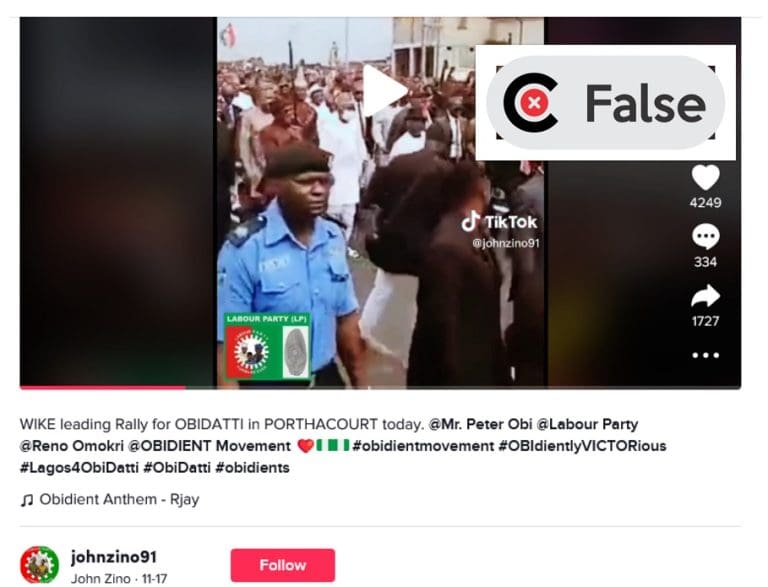
A video has circulated online with the claim that it shows moments Rivers State Governor Nyesome Wike was leading a campaign rally for the 2023 presidential candidate of the Labour Party (LP), Peter Obi.
The footage, now circulating on WhatsApp, shows Obi and Wike walking amid a large crowd, with the campaign song of LP playing in the background.
The clip shows the Labour Party’s logo with a voice-over saying, “My people, see Wike leading rally in Port Harcourt for Obi… Can you beat this? See Wike raising up his walking stick.”
The video, which has been archived here, was traced to John Zino (with the username @johnzino91), one of the party’s loyalist. It was posted on TikTok on November 17, 2022 with a caption that reads: “Wike leading rally for OBIDATTI in PORTHACOURT today.”
The post has since garnered over 4,000 likes, more than 300 comments and 1,700 shares as of Friday, December 23, when it was retrieved from TikTok.
CLAIM
Video shows Governor Wike leading a campaign rally for Peter Obi in Port Harcourt.
THE FINDINGS
Findings by The FactCheckHub show that the claim is FALSE.
The viral video was traced to the TikTok post made on Thursday, November 17, 2022, the same day Peter Obi and his running mate, Datti Baba-Ahmed visited Port Harcourt to commission a project for the Rivers State Governor, Nyesome Wike, who is a member of the Peoples Democratic Party (PDP).
Wike had in November invited Obi to the state capital for the commissioning of the 9th flyover by his administration.
Screenshot of the news footage showing the moment Wike and Obi arrived the event venue to commission a flyover in Port Harcourt, Rivers state on November 17, 2022. CREDITS: TVC News.
Checks revealed that the viral video show the moment the former governor of Anambra state alongside his running mate was received by a large crowd of his supporters at the venue of the Nkpolu – Oroworukwo flyover inauguration.
A footage of their arrival at the event’s venue uploaded on YouTube by TVC News Nigeria shows people with PDP flags at the venue of the project inauguration.
My team and I just arrived at the Government House in Port Harcourt, Rivers State, for the Commissioning of a new Flyover constructed by HE @GovWike. -PO pic.twitter.com/u3tI1h6reG
That was not the first time Governor Wike would invite a member of an opposition party for project commissioning in Rivers State.
He had earlier invited the current Nigeria’s Vice President, Yemi Osinbajo, Speaker of the Federal House of Representatives, Femi Gbajabiamila, and a former Edo state governor, Adams Oshiomole, who were all members of the All Progressives Congress (APC) to commission some of the projects executed by his administration.
Wike also invited the presidential candidate of the New Nigeria Peoples Party (NNPP), Rabiu Musa Kwankwaso, to inaugurate Mgbutanwo Internal Roads in Emohua Local Government Area of Rivers State.
THE VERDICT
The claim that the video shows Governor Wike of the PDP leading a campaign rally for Peter Obi of the Labour Party is FALSE; as the footage shows the moment Wike received Obi and his running mate for the commissioning of a flyover project in Port Harcourt.
A press release attributed to the Civil Defense, Correctional, Fire and Immigration Services Board (CDCFIB) has claimed that the application for the Nigeria Immigration Service (NIS) staff replacement has commenced.
The circular titled: “Nigeria Immigration Service Notice of 2022/2023 General Replacement” was retrieved from a WhatsApp group on the 10th of December, 2022.
It stated that the CDCFIB has: “approved the commencement of the Nigeria Immigration Service 2022/2023 replacement exercise.”
“Applications are hereby invited from qualified persons for full-time employment into the following positions:
The circular stated that the number of applicants required is 3,600, adding that interested persons should go through the portal, www.niscareer.org.ng to apply.
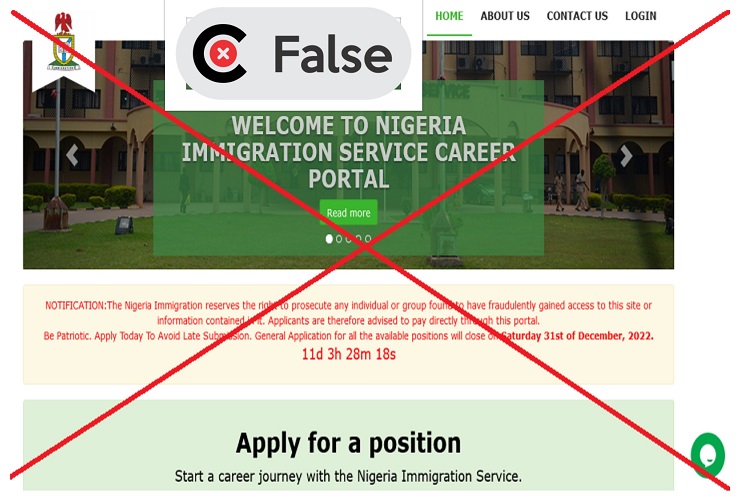
Screenshot of the fake NIS recruitment website.
A click on the application link stated in the circular directs users to a webpage with a pop-up instruction that reads:
IMPORTANT NOTICE FOR APPLICANTS This is to notify the public that The Nigeria Immigration Service does not have any agent for the online application. Therefore, you are to Make the payment of ₦1,000 Application fee on this website (www.niscareer.org.ng) and you will get a confirmation of approval for your application if successful. Kindly report such act through the phone numbers on our website or email. The Nigeria Immigration reserves the right to prosecute any individual or group found to have fraudulently gained access to this site or information contained in it. Applicants are therefore advised to pay directly through this portal.
Below the instruction is a signage that directs users to “click here to continue”. When clicked it takes users to another webpage which listed the various categories of positions available. They include: Superintendent Cadre; Inspectorate Cadre; and Assistant Cadre. It also has information about the general requirements for eligibility as well as a brief history of the NIS.
Screenshot of the fake NIS recruitment webpage where the available positions were listed.
CLAIM
Application opens for Nigeria Immigration Service (NIS) 2022/2023 general replacement.
THE FINDINGS
Findings by The FactCheckHub show that the claim is FALSE.
When contacted yesterday, the NIS debunked the viral claim, saying it is fake as no such announcement emanated from the agency.
The NIS, in a disclaimer made available to TheFactCheckHub via WhatsApp, advised members of the public to ignore and report every platform sharing the recruitment announcement.
“We state categorically and for the avoidance of every doubt, that we are not recruiting at the moment.
“If and when we begin recruitment, such information would be made available via our official social media channels and our only website: www.immigration.gov.ng,” the disclaimer read.
The agency also posted on its Twitter page a similar disclaimer on Monday, December 19, 2022. (See the embedded tweet below).
DISCLAIMER!!!
This is to inform the general public that the Nigeria Immigration Service is NOT currently recruiting.
Please disregard and report any of such accounts or platforms claiming otherwise.
The FactCheckHub observed that there are at least four different websites online being operated as the Nigeria Immigration Service career/recruitment portal.
The websites are niscareer.org.ng, nisportal.com, immigrationrecruitment.org, and immigrationrecruitment.org.ng.
In a telephone conversation with our fact-checker/researcher, the NIS Public Relations Officer, Anthony Akuneme, stated that none of the websites is run by the agency.
“Anyone (website) you see now is not authentic,” Akuneme said.
While stating that the CDCFIB is in charge of recruitment into the agency, he said the application currently open as approved by the board is that of the Nigeria Security and Civil Defence Corps (NSCDC).
He further noted that when it is time for the NIS recruitment exercise, the official announcement will be available on the board’s website, adding that the official recruitment portal will also go live.
Further checks on the domain names of the viral websites using Whois Domain Lookup revealed that Access Solutions Limited located in Abuja created immigrationrecruitment.org.ng on March 13, 2020 while someone named Christopher West created niscareer.org.ng on April 26, 2022.
Immigrationrecruitment.org was created on February 21, 2021, and Nisportal.com was earlier created on February 8, 2008. The information about their registrants however shows “redacted for privacy”; that is, they are hidden from public records.
Over time, The FactCheckHub has debunked several of such claims hiding under the guise of recruitment, support fund, empowerment programme, a government activity or free internet data.
These claims usually follow a similar modus operandi by targeting areas that would be of interest to a lot of persons.
They are often shared via the WhatsApp platform. Oftentimes, they impersonate a group, person or organisation and they all have a link they ask people to click.
It will be recalled that The FactCheckHub had earlier published a tutorial on how to fact-check viral post shared via WhatsApp to help online users, including our readers avoid falling victim to misinformation spread through the encrypted WhatsApp platform.
The claim that the Nigeria Immigration Service (NIS) is calling for applications for 2022/2023 general replacement is FALSE; the agency debunked it via its official Twitter handle: @nigimmigration and by its spokesperson.
SINCE political parties’ primaries ended around mid-year, presidential candidates have kicked off their nationwide campaign activities, making several claims ahead of Nigeria’s 2023 general elections.
This was after the nation’s electoral umpire, the Independent National Electoral Commission (INEC), lifted the ban on political campaigns for the 2023 general elections in September 2022.
This pre-election year is a critical moment in Nigeria’s current electoral cycle.
In the run-up to the election year, The FactCheckHub has since been on the lookout for potential claims from all the candidates, including presidential, governorship, federal and state lawmakers etc that may influence the outcome of the electioneering process.
That has led to fact-checking several claims made by some of the presidential candidates on different occasions.
The presidential candidates that have been fact-checked in the build-up to the 2023 polls include Peter Obi of the Labour Party (LP), Bola Ahmed Tinubu of the ruling All Progressives Congress (APC), and Atiku Abubakar of the People’s Democratic Party (PDP).
Others are Rabiu Musa Kwankwaso of the New Nigeria Peoples Party (NNPP), Omoyele Sowore of the African Action Congress (AAC), Kola Abiola of the People’s Redemption Party (PRP), Adewole Adebayo of the Social Democratic Party (SDP), and Peter Umeadi of the All Progressive Grand Alliance (APGA).
Aside from granting press interviews, the presidential candidates have taken part in presidential town hall series being aired by news media channels in partnership with civil society groups and the Nigerian Fact-checkers’ Coalition.
A review of the fact-checks carried out on claims made by the leading presidential candidates so far and published on The FactCheckHub showed that Peter Obi has the highest number of claims found to be true.
Ten of the claims Peter Obi made in the year under review were checked to be correct. This is the highest compared to other presidential candidates that have been fact-checked by this medium.
Atiku Abubakar and Omoyele Sowore recorded two correct claims each while Kola Abiola and Adewole Adebayo had one each.
PETER OBI – LP
Obi claimed that Northern states made up the top 10 poorest states in Nigeria. It was mostly true as findings revealed that Ebonyi, a Southeastern state, was among the top 10 poorest states.
During ‘The Candidates’ presidential town hall series hosted by Daria media, Obi made four claims found to be true.
He claimed that over 130 million Nigerians live in poverty. He also claimed that Nigeria’s export was N18.9 trillion in 2021.
He added that River Nile is over 1,000 kilometres longer than River Niger and River Benue combined.
He further claimed that oil contributes less than 10 percent of Nigeria’s GDP.
At the Arise News presidential town hall series held on December 4, 2022, Obi made five claims found to be true.
The LP flagbearer claimed that the average life expectancy in Nigeria is 55 while the global average is 72.9 years.
He claimed that the education budget in Nigeria is less than 10 percent in six years.
Obi also stated that Nigeria is rated 163 out of 191 countries in the global Human Development Index (HDI).
He said that education is among the three indices used in measuring human development index.
Obi also claimed that Nigeria’s total health budget in the last six years is N2 trillion, 250 billion.
ATIKU ABUBAKAR – PDP
Atiku Abubakar made two claims at Arise News presidential town hall, which were found to be true.
He said Nigeria’s poverty rate when PDP was in government was not as high as it is under the present administration.
The PDP flagbearer also claimed that agriculture is the highest employer of labour in Nigeria.
OMOYELE SOWORE – AAC
Omoyele Sowore made two claims found to be true during ‘The Candidates’ presidential town hall series.
He said that Korea and Senegal do not have Senate.
The AAC flag bearer also claimed that the Nigerian government still funds electricity despite privatizing it.
KADUNA State Governor, Nasir El-Rufai, was among the surrogates who accompanied the presidential candidate of the ruling All Progressives Congress (APC), Bola Ahmed Tinubu, to the Chatham House in the United Kingdom recently.
The world-leading institute and think-tank hosted Tinubu on Monday, December 5, 2022, to speak on his presidential bid ahead of Nigeria’s 2023 general elections.
The former Lagos governor was asked to field questions from the audience following his address on the topic, “Nigeria’s 2023 Elections: Security and Economic Development and its Foreign Policy Imperatives.”
When asked about how his administration would address insecurity and kidnapping of women in Nigeria if elected, Tinubu called on El-Rufai to respond to the question.
Reacting to the question, the former minister of the Federal Capital Territory (FCT) acknowledged that insecurity has been a major issue in the country in the last few years, adding that it has affected the economy, agricultural production, and commerce, among others.
El-Rufai further stated three ways in which the Bola Tinubu-led presidency, if he wins, would address the nation’s security challenges.
“First, Policing. Nigeria has about 300,000 policemen for a population of over 200 million. We need at least twice that number. That will be achieved by amending the constitution so that policing can be at federal, state and even at community levels,” he stated.
“The second step is to look at our armed forces and security architecture. Nigeria’s armed forces are not more than 200,000 in size – the Army, Navy, and the Airforce. While some countries are even looking at a space military, we are struggling with just less than 200k members of the Armed Forces for a country with a population of 200m+,” El-Rufai said.
He added that the total size of the Nigerian Army was “only 10,000” in 1967, which he said was increased to 250,000 because of the civil war.
CLAIM 1
Nigeria has about 300,000 policemen.
THE FINDINGS
Findings by The FactCheckHub show that the claim is FALSE.
An analysis published by Dataphyte on October 7, 2019 showed that the population of the Nigeria Police Force (NPF) was at 371,800, with police to population ratio of one police officer to five hundred and forty (540) citizens.
According to INTERPOL, the strength of the Nigeria Police Force is more than 350,000 men and women across the 36 states and the FCT.
Also, a security expert, Bola Bakare stated in a report published by the Vanguard on July 7, 2021 that the personnel strength of the Nigeria Police Force stood at 370,000.
THE VERDICT
The claim that Nigeria has about 300,000 policemen is FALSE; findings show that the nation’s police population is more than 350,000.
CLAIM 2
Nigeria’s Armed Forces are not more than 200,000 in size.
THE FINDINGS
Findings by the FactCheckHub revealed that the claim is FALSE.
A report published by Dataphyte on March 3, 2022, shows that the Nigerian military size stood at 215,000 out of which 135,000 are active while 80,000 make up the paramilitary, according to a 2022 data.
The country’s military strength index was said to be at 0.5745, a slight improvement compared to 2021 when the power index was 0.62.
In terms of strength, Nigeria’s military was ranked fourth in Africa and thirty-fifth in the world, the report stated.
THE VERDICT
The claim that Nigeria’s Armed Forces are not more than 200,000 in size is FALSE; data revealed that the country’s military size is 215,000 as of March 2022.
Nigerian Army was 10,000 in 1967 before it was increased to 250,000.
THE FINDINGS
Findings by The FactCheckHub show that the claim is HALF-TRUE.
A report by Military Wiki shows that the Nigerian Army (NA) had a force of 18,000 in infantry battalion and supporting units before the strength rose to about 126,000 in three divisions by the start of the Nigerian Civil War in 1967.
Also, a report by Global Security shows that the Nigerian Army’s strength was about 10,500 at independence, which later rose to 250,000 all ranks at the end of the Nigerian Civil war in 1970.
According to the report, the strength of NA was reduced to about 150,000 in all ranks by 1980 due to economic reasons and the country’s threat perception. It was then structured into three Infantry Divisions and Lagos Garrison Organisation (LGO).
“To meet targeted force reduction levels, in 1990 the Army began discharging soldiers who could not read or write after the four-year literacy campaign (1986-89), strictly enforcing disciplinary codes, and encouraging early retirements,” part of the report read.
THE VERDICT
The claim that the Nigerian Army was 10,000 in 1967 before it was increased to 250,000 is HALF-TRUE; findings revealed that the nation’s Army was more than 10,000 at independence in 1960 before the start of the civil war in 1967. However, the second part of the claim is true, based on the data stated above.