Please note that the FactCheckHub has not obtained any right from the authors or copyright owners of all third-party contents from embedded links and shall incur no liability in this regard.
Please note that the FactCheckHub has not obtained any right from the authors or copyright owners of all third-party contents from embedded links and shall incur no liability in this regard.
Please note that the FactCheckHub has not obtained any right from the authors or copyright owners of all third-party contents from embedded links and shall incur no liability in this regard.
Please note that the FactCheckHub has not obtained any right from the authors or copyright owners of all third-party contents from embedded links and shall incur no liability in this regard.
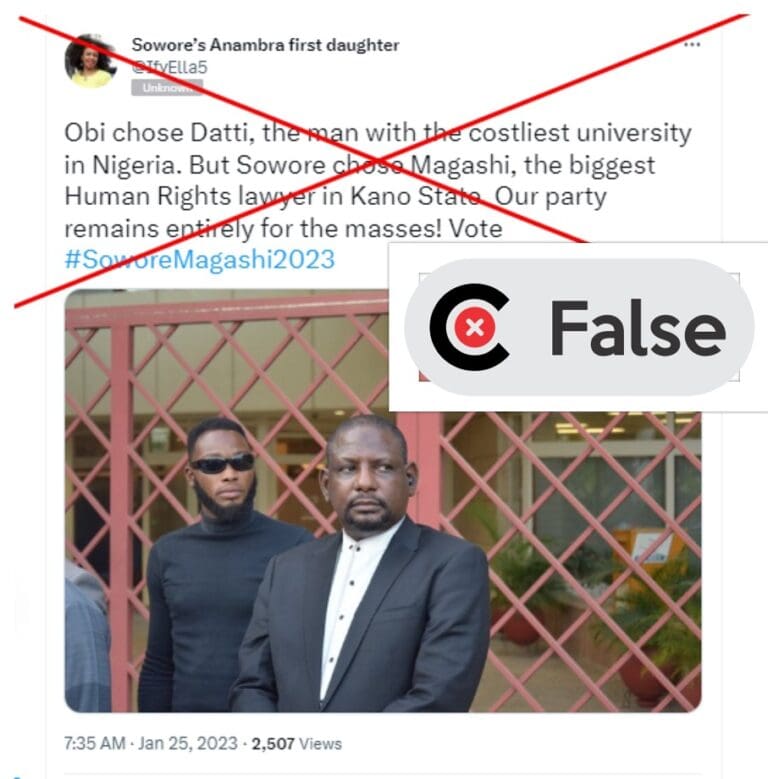
A tweep simply identified as Ify Ella has claimed in a tweet archived here that Baze University owned by Yusuf Datti Baba-Ahmed is the costliest university in Nigeria.
This was in an attempt to promote the presidential candidate of the African Action Congress (AAC), Omoyele Sowore, and his running mate, Haruna Magashi ahead of the February 25 election.
The tweet reads:
“Obi chose Datti, the man with the costliest university in Nigeria. But Sowore chose Magashi, the biggest Human Rights lawyer in Kano State. Our party remains entirely for the masses! Vote #SoworeMagashi2023.”
The post made on Wednesday, January 25, 2023, has since garnered over 2,000 views, and more than 90 likes as of when it was retrieved on Saturday, January 28, 2023.
Datti’s university, Baze University, is the costliest in Nigeria.
THE FINDINGS
Findings by The FactCheckHub show that the claim is FALSE.
An assessment of the rankings of Nigerian universities by multiple platforms revealed that Baze university was not the most expensive university in the country.
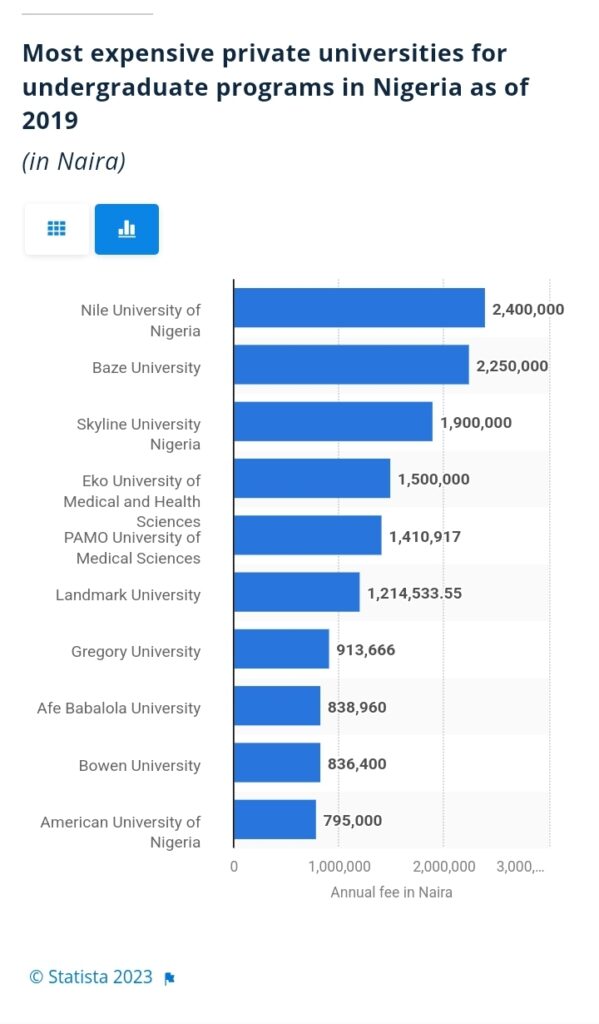
A report published by Statista in September 2022 on the average annual undergraduate tuition fees at private Nigerian universities in 2019 put Nile University of Nigeria as the most expensive, with Baze University coming second on the list.
The report shows that the average annual tuition fee for bachelor’s degree programmes at Nile University and Baze University stood at ₦2.4 million (about 5,800 US dollars) and ₦2.3 million (about 5,500 US dollars) in 2019 respectively.
Screenshot of the 2022 report by Statista.
Also, in a rating by Legit NG published in October 2022, Nile University of Nigeria was ranked ahead of Baze University in terms of tuition fees.
The fees range at Nile University stood between ₦2,400,000 and ₦5,750,000 while that of Baze was between ₦2,722,500 and ₦3,025,000, according to the report.
In another report published by Inside OAU in December 2022, Baze University was put at number 3 on the list of top ten most expensive private universities in Nigeria.
THE VERDICT
The claim that Datti’s university, Baze University, is the costliest in Nigeria is FALSE; multiple reports show it is not.
A fake quote attributed to the presidential candidate of the African Action Congress (AAC), Omoyele Sowore applauding his counterpart Peter Obi of the Labour Party has surfaced online.
According to the quote, Sowore described Peter Obi as a humble man despite him being from an opposition party in this year’s Nigerian election.
The quote reads:
“Whenever other presidential candidates see me, they will ignore me as nobody because I have no money.
Peter Obi always walks to me to greet me anytime he sees me. Even though he is my opponent, I will not deny the fact that he is a humble man.”
A Twitter user, @UzomaPreciousF1 tweeted the quote and it has generated more than 1,300 retweets and over 5,000 likes as of Saturday, 28th of January, 2023.
A Facebook Page, South East Nigeria also posted the claim and it generated more than 500 likes, over 60 shares and more than 50 comments as of Saturday, 28th of January, 2023.
Another Twitter user, @IgweOdysse also tweeted the claim.
CLAIM
Sowore authored quotes praising Peter Obi for being a humble man.
Screenshot from one of the posts.
THE FINDINGS
Findings by FactCheckHub show that the quote was fabricated.
The FactCheckHub observed that none of the social media users who posted the texts referenced their source(s) publicly, thus raising a red flag.
Also, a keyword search on Google Search did not reveal anywhere or when Sowore made the statement.
Moreover, no credible media organisation in the country reported the quote attributed to Sowore.
TITI Abubakar, one of the wives of Atiku Abubakar, the presidential candidate of the Peoples Democratic Party (PDP) in this year’s election has made a claim about the office of Nigeria’s First Lady.
Titi, while speaking during the party’s campaign rally in Abeokuta, the Ogun state capital on Wednesday, 18th of January, 2023 asked people to vote for her husband in the coming election.
According to her, since the adoption of First Lady in Nigeria’s Presidency, no Yoruba woman has had the opportunity to occupy the seat to bear the title.
She added that she would be the first Yoruba First Lady should Atiku win in the 2023 general election.
She said in Yoruba language (one of the major Nigerian languages), “Lati’gba ti won ti se presidency ti won ni won se First Lady, omo Yoruba o se iyawo president ri. Mo be yin l’okurin l’obirin, e wa je ki temi se akoko.”
This was translated into English to mean that, “No Yoruba woman has had the opportunity to be a first lady. I beg you, men and women, make me to be the first.”
While there are no constitutional provisions backing the creation of office of the First Lady in Nigeria, the title has gained wide recognition in the country’s political space over the years, with wives of elected presidents and governors given the title to perform ceremonial functions in governance.
CLAIM
No Yoruba woman has bore the title of First Lady in Nigerian Presidency.
THE FINDINGS
Findings by The FactCheckHub show that the claim is FALSE.
Since 1963, during the administration of the country’s first president, Nnamdi Azikwe till date, Nigeria has had 15 First Ladies in the Presidency.
They include: Flora Azikiwe (1963-1966), Victoria Aguiyi-Ironsi (1966-1966), Victoria Gowon (1966-1975), Ajoke Muhammed (1975-1976), Esther Oluremi Obasanjo (1976-1979, Hadiza Shehu Shagari (1979-1983), Safinatu Buhari (1983-1985), and Maryam Babangida (1985-1993).
Others are Margaret Shonekan (1993), Maryam Abacha (1993-1998), Fati Lami Abubakar (1998-1999), Stella Obasanjo (1999-2005), Turai Yar’Adua (2007-2010), Patience Jonathan (2010-2015), and Aisha Muhammadu Buhari (2015 till date).
In the last 59 years, Nigeria has had at least three First Ladies from the Yoruba ethnic group.
The Yorubas among the past First Ladies include Ajoke Muhammad, wife of the (late) General Muritala Muhammad; Esther Oluremi Obasanjo, wife of Chief Olusegun Obasanjo (now ex-wife); and Margaret Shonekan, wife of the (late) Chief Earnest Shonekan.
This shows that 2023 would not be the first time that Nigeria will be having a Yoruba First Lady, contrary to the claim by Atiku’s wife, Titi.
THE VERDICT
Titi Abubakar’s claim that no Yoruba woman has bore the title of First Lady in Nigerian Presidency is FALSE; findings show that Nigeria has had three First Ladies from the Yoruba ethnic group since 1963 till date.
NIGERIAN music artiste, Charles Chukwuemeka Oputa, has tweeted quote attributed to the former Emir of Kano, Sanusi Lamido Sanusi, saying tribalism is the problem of Nigeria.
According to the quote, Sanusi accused the Yoruba tribe of supporting the presidential candidate of the All Progressives Congress (APC), Bola Tinubu due to ethnic sentiment.
“In 2019, Yorubas wanted President Buhari to resign and handover power to Vice President Osibanjo due to his health.
In 2023, the same Yorubas are supporting Bola Tinubu whose health is worse than President Buhari’s health.
2023 general election has shown that North is not the problem of Nigeria but tribalism.”
CLAIM
Sanusi authored a quote saying North is not the problem of Nigeria but tribalism.
Screenshot of Charly Boy’s tweet showing quote falsely attributed to Sanusi.
THE FINDINGS
Findings by The FactCheckHub show that the quote was fabricated.
Further checks revealed that the quote started making round on internet since two weeks ago as seen here and here.
However, the FactCheckHub observed that none of the social media users who posted the same quote disclosed their source(s) publicly, thus raising a red flag.
Also, a keyword search on Google did not reveal anywhere or when the former Emir made the statement.
Moreover, no credible media organisation in Nigeria reported the quote attributed to Sanusi.
This is not the first time a false quote would be attributed to Sanusi. For instance, the FactCheckHub had earlier debunked a quote attributed to him, where he was purportedly analyzing the uniqueness of at least three presidential candidates contesting Nigeria’s 2023 election.
When contacted, Imam Murtala Gusau, a regular Islamic columnist and a close friend of Sanusi confirmed to FactCheckHub that the quote was not from the former Emir.
Charly Boy is a regular purveyor of disinformation who has been fact-checked several times by The FactCheckHub. He wields strong influence online and has over 185,000 followers on Twitter.
For instance, the FactCheckHub had earlier reported how he shared a misleading video with a claim that it showed Peter Obi’s supporters in boats holding a campaign rally in riverine areas.
The FactCheckHub also reported how he made a false claim about the electronic transmission of election results by the Independent National Electoral Commission (INEC).
He also tweeted a misleading photo showing the presidential candidate of the All Progressives Congress (APC), Bola Ahmed Tinubu, watching Peter Obi, on a television screen in an aircraft.
THE VERDICT
The claim that the former Emir of Kano authored the viral quote attributed to him is FALSE; findings revealed that it is fake.
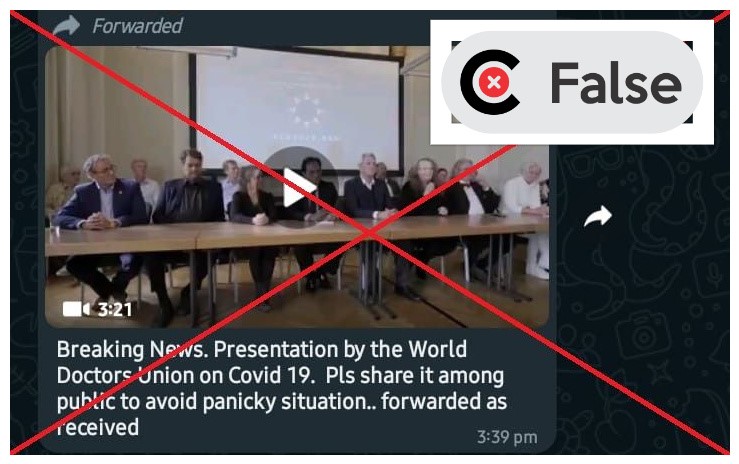
A video of a press conference where a European-based group of medical practitioners were seen discrediting the COVID-19 pandemic has resurfaced on social media.
The video is being circulated on WhatsApp as ‘breaking news’ with the claim implying that the global doctors’ union recently held a public event on the Coronavirus.
The caption shared alongside the viral video reads:
“Breaking News. Presentation by the World Doctors Union on Covid-19. Pls share it among public to avoid panicky situation. Forwarded as received.”
The 3:21 minute clip shows how the group of medical practitioners was equating Covid-19 with flu virus.
One of the said doctors, who identified herself as the President of the World Doctors Alliance, said that Covid-19 is a seasonal viral infection.
“We are here to say that there is good news. The coronavirus is a seasonal virus that causes illness and symptoms from December to April.
“There is no need for lock-down, there is no need for fear, there is no need for mask, for social distancing, or for quarantining people. They are locking people in their homes for last year flu,” parts of her statement read.
Towards the end of the clip, a male member of the group claimed that there was no evidence of a medical pandemic.
“We see no evidence of a medical pandemic. So, it looks like a plandemic. And we all together say we don’t want this new normal,” he opined.
CLAIM
World Doctors Union meet and held a conference on the COVID-19 pandemic recently.
THE FINDINGS
Findings by The FactCheckHub show that the claim is FALSE.
Our researcher traced the footage to the ACU2020 website, where the full and original version of the video was found.
ACU2020 is a German acronym used by a group headed by a German physician, Heiko Schöning.
The footage, uploaded on November 13, 2020, was titled “official video of the founding of the WDA- World Doctors Alliance”. It was tagged “A better normal, not a new normal.”
This shows that the resurfaced footage has been on the internet since 2020, during the ‘pandemic year.’
Further checks revealed that various claims made by the group on Covid-19 pandemic in the video have been debunked by several credible fact-checking organisations and media platforms including the Associated Press, Voice of America, The Guardian, and FactCheck.org etc. Other debunks on the footage can also be seen here, here, and here.
THE VERDICT
The claim that the World Doctors Union recently held a conference on the Covid-19 pandemic is FALSE; findings show that the viral footage is an old video from over two years ago.
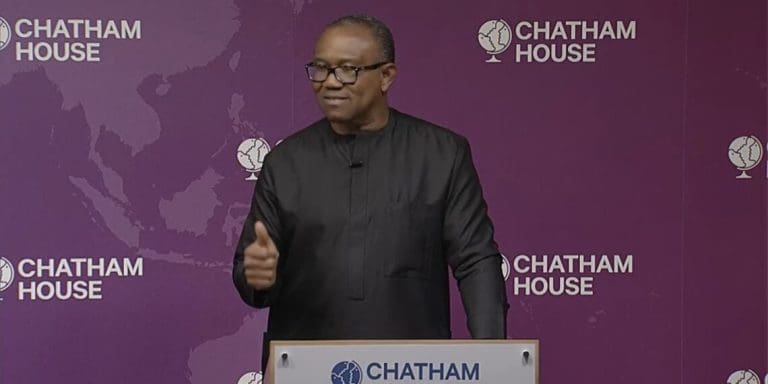
Obi becomes the second Nigerian presidential candidate who appeared at the Chatham House after Bola Ahmed Tinubu, the presidential candidate of the All Progressives Congress (APC) in Nigeria’s 2023 election.
He made several claims on his achievement as a former governor of Anambra state alongside his vision and plans for Nigerians if elected. In this fact-check, The FactCheckHub examines the veracity of some of his claims.
CLAIM 1
63 per cent of Nigeria’s population lives in poverty.
THE FINDINGS
According to a recent report by the National Bureau of Statistics (NBS) on multi-dimensional poverty, about 133 million people in Nigeria, representing 63 per cent of the population, are living in different categories of poverty.
The report stated that 65 per cent of the poor (86 million people) live in Northern Nigeria, while 35 per cent (nearly 47 million) live in the South.
The National Multi-Dimensional Poverty Index (MPI) report is 0.257, indicating that poor people in Nigeria experience just over one-quarter of all possible deprivations.
The report stresses that poverty levels across states vary significantly, with the incidence of multi-dimensional poverty ranging from a low of 27 per cent in Ondo to a high of 91 per cent in Sokoto.
Accordingly, the incidence of monetary poverty is lower than the incidence of MPI across most states.
Obi’s claim that the national unemployment rates and youth employment rate is 40% and 60% is FALSE, according to the last official statistics by the National Bureau of Statistics.
CLAIM 3
Britain’s debt is 70 per cent of their GDP.
THE FINDINGS
According to a report by Trading Economics, the British government debt was equivalent to 97.4 per cent of the country’s GDP in 2020-21 fiscal year.
UK’s debt-to-GDP ratio. Source: Office for National Statistics.
But data by the UK government’s Office of National Statistics show that the national debt to GDP of the country stands at 105.6 per cent as of fourth quarter of 2021 while it stands at 101.9% as of first and second quarters of 2022.
THE VERDICT
Obi’s claim that Britain owes about 70 per cent of their GDP is FALSE; findings show that the figure is higher.
CLAIM 4
The debt of America is almost about 100% of their GDP.
THE FINDINGS
A report by S&P Global Market Intelligence published in February 2021 stated that for the first time since the end of the Second World War, the U.S. national debt rose to 100% of GDP in 2020.
Also, data by Sound Dollar show that the US government debt was estimated to have reached 123.39 per cent of the country’s GDP by the fourth quarter of 2021.
US debt-to-GDP ratio. Source: World Economics Research.
By the end of third quarter of 2022, the Federal Reserve Bank of St. Louis put the U.S. debt-to-GDP ratio at 120.23 per cent.
In addition, the World Economics also reported that the U.S. debt-to-GDP ratio stands at 113.8 per cent as of 2022 (although it did not indicate which quarter).
THE VERDICT
The claim by the Labour Party’s presidential candidate that the debt of United States of America is almost about 100% of their GDP is FALSE; multiple data revealed that the U.S. debt-to-GDP ratio is higher than 100 per cent.
CLAIM 5
China’s debt is over 60 per cent of their Gross Domestic Product.
China’s debt-to-GDP ratio. Source: World Economics Research.
However, another report revealed that the latest China’s debt-to-GDP ratio stands at 62.4 per cent as of 2022, citing the World Economics Research, London.
THE VERDICT
Obi’s claim that China’s debt-to-GDP ratio is over 60 per cent is TRUE as shown in the 2022 report by the World Economics.
CLAIM 6
Japan’s debt is over 230 per cent of their GDP
THE FINDINGS
Trading Economics reported that Japan recorded its government debt-to-GDP ratio of 262.50 per cent in 2021.
However, the latest data from the World Economics Research in London revealed that Japan’s debt-to-GDP ratio stands at 240.7 per cent as of 2022.
THE VERDICT
Peter Obi’s claim that Japan owes over 230 per cent of its GDP is TRUE; multiple data have shown.
CLAIM 7
Niger state has 76.3 thousand km (square) of land.
THE FINDINGS
According to Britannica, Niger state, located in the North-Central part of Nigeria, has a vast land mass of 76,363 square kilometre. A 2019 report by Daily Trust also shows that Niger State is the largest state in Nigeria with 76, 363 square kilometres of land.
THE VERDICT
Obi’s claim that Niger State has 76.3 thousand square kilometres of land is TRUE; multiple data show.
CLAIM 8
Nigeria has 20 million out-of-school children in the North.
According to the statistics, India, Nigeria, and Pakistan have the highest figures for out-of-school children globally.
UNESCO, in partnership with the Global Education Monitoring (GEM) Report, showed that sub-Saharan Africa remains the region with most children and youths out of school.
THE VERDICT
The claim that Nigeria has 20 million out-of-school children in the North is MISLEADING; the UNESCO report shows that the 20 million out-of-school children cut across all the states in the country.
Nigeria’s budget for the health sector is under N2.5 trillion from 2015 – 2021.
THE FINDINGS
Findings by The FactCheckHub revealed that the claim is MISLEADING.
Nigeria’s health sector under the President Muhammadu Buhari-led administration since 2015 has been receiving less than 7% of the government’s annual budget, contrary to the commitment made by African leaders under the 2001 Abuja declaration to allocate at least 15% of its annual spending to the sector.
Nigeria’s health budgets – 2015-2021. CREDITS: Dataphyte.
A careful look at the amounts allocated to the nation’s health sector from 2015 – 2021 show that the total health budget is exactly N2.51 trillion.
THE VERDICT
Peter Obi’s claim that the Nigerian Government’s annual budget for the health sector from 2015 – 2021 is under N2.5 trillion is Misleading; data from the country’s budget office show that it is the exact N2.5 trillion and not under.
CLAIM 10
Nigeria’s budget for health is about N1.5 trillion in 2023.
THE FINDINGS
An analysis of the 2023 budget shows that N1.08 trillion was allocated to the health sector for the 2023 fiscal year.
THE VERDICT
Obi’s claim that the Nigerian government’s budget for the health sector is N1.5 trillion is FALSE; as the amount is lower.
CLAIM 11
Nigeria’s budget for education in 2023 is N2 trillion.
THE FINDINGS
Nigeria’s 2023 budget for education stands at N1.08 trillion, according to a breakdown by the Budget Office of the Federation. This is lower than the N2 trillion quoted by Peter Obi.
THE VERDICT
Obi’s claim that Nigeria’s budget for education in 2023 is N2 trillion is FALSE; as the amount is lower than what he mentioned.
CLAIM 12
Nigeria’s budget for subsidy in 2023 is about N3.6 trillion.
THE FINDINGS
The Vanguard newspaper reported that President Muhammadu Buhari has allocated N3.6 trillion to fund the fuel subsidy for the first half of the year 2023.
THE VERDICT
Obi’s claim that Nigeria’s budget for fuel subsidy in 2023 is about N3.6 trillion is TRUE; media report has shown.
INEC’s Director of Voter Education and Publicity, Victor Aluko, disclosed this on Friday at the launch event of ‘RunAm’, an artificial intelligence application designed by Rise Networks. The mobile app is to serve as a fake news verification platform for the 2023 election.
While commending Meta’s initiative to stem the tide of misinformation on its platform, Aluko said the commission has also found ways to fight the spread of misinformation and disinformation in the country.
“Only yesterday in the office, we were having a meeting with Meta, who is now in charge of Facebook, Instagram and WhatsApp, about this issue of how we can combat all these fake posts, all those things that tend to undermine the electoral process. That is where my department, voter education and publicity, has all the issues,” Aluko said.
He added: “There was a time when a whole press release sheet of INEC was cloned. When I read that press release myself, I thought it was true. It carried the signature of my commissioner, who normally signs releases. And he himself, looked at the signature, he said ‘This is my signature, but I didn’t release this’. And we had to issue a rebuttal immediately.
“We are going to what we call, possibly, let me just use that term, the mother of elections, a very serious election, that will be contested seriously by very powerful parties and individuals, more than anytime in the history of our country. And now, you will see a situation where the electoral process will be pulled in different directions and when you have that, there will be a combination of both fake news, a lot of misinformation and a lot of disinformation.”
INEC called for more collaboration between the social media company and the commission in combating fake news in the country.
NIGERIA’S Minister of Works and Housing, Babatunde Fashola, has claimed that the All Progressives Congress (APC) presidential candidate, Bola Ahmed Tinubu, was the first governor in Nigeria to raise bond for infrastructure and development in the country.
Fashola, who succeeded Tinubu as governor in 2007, made the claim while speaking on TVC News on Thursday, January 12, 2023.
While defending whether Tinubu was fit and proper to rule Nigeria, the minister said Tinubu raised the bond despite a federal PDP opposition, which many states are now modelling.
“Let us remember that the first state bond for infrastructure and development in this country was raised during his term as governor. And it was raised in spite of a Federal PDP opposition,” he said.
He added that Tinubu’s initiatives, including his Internally Generated Revenue (IGR) style, have become a model today for many states of the Nigerian federation.
Fashola’s claim was also uploaded to Twitter by a tweep @Osazenoo with a caption that reads:
“Fashola’s take on whether Tinubu has the capacity to lead Nigeria. Interesting facts”.
The video, which has wide acceptance among Tinubu’s followers on the social media site, was posted on Thursday, January 12.
It has garnered over 1,737 retweets and more than 500,000 views as of Friday, January 13.
Fashola's take on whether Tinubu has the capacity to lead Nigeria.
Tinubu was the first governor in Nigeria to raise bond for infrastructure and development in Nigeria.
THE FINDINGS
A bond, according to Investopedia, is a fixed-income instrument that represents a loan made by an investor to a borrower (typically corporate or governmental). A bond could be thought of as an I.O.U. between the lender and borrower, including the loan details and its payments.
Bonds are used by companies, states, and sovereign governments to finance projects and operations. Owners of bonds are debt-holders, or creditors, of the issuer. Bond details include the end date when the principal of the loan is due to be paid to the bond owner and usually include the terms for variable or fixed interest payments made by the borrower.
The Nigerian Securities and Exchange Commission (SEC) defined a bond as tradable security issued by the borrower (bond issuer) representing a formal agreement to repay the lender (the bondholder) the full amount plus interest over the lifetime of the bond.
In Nigeria, a bond may be publicly placed (i.e., listed on an exchange for trading) for trading by the public or maybe a private placement, sold to qualified investors, i.e., institutional investors (like Pension Funds, Banks, etc.) and high net worth individuals.
Findings by The ICIRrevealed that in 1978, the old Bendel state government headed by Husaini Abdullahi, a military governor took a bond, this preceded Tinubu’s administration in Lagos state. The Bendel State Loan Stock valued at N20 million was taken to develop housing estate in the region. The bond matured in 1988 at a 7 per cent coupon rate.
Then, there was a bond taken by the Ogun State Revenue Bond, which took a N15 million, 10-year bond in 1986 for the development of a water project. When the bond was taken, Raji Alagbe Rasaki was the state’s military governor.
Between 1987 and 1988, the Lagos State Revenue Bond issued a total sum of N90 million bond for the development of the Lekki Peninsula. Mike Akhigbe was the military governor then.
In 1987, the first Oyo State Revenue Bond of N30 million for Adamasingba Shopping Complex and Gbagi Market Development was a 12-year bond.
The Kaduna State Revenue Bond took a N60 million bond between 1989 and 1993 for the development of Ginger factory. Abdullahi Sarki Mukhtar and Lawal Jafaru Isa were the military governor and administrators, respectively, within these periods.
The Edo State Revenue Bond took a N1 billion bond in 2000 for the development of Ogba Riverside Housing Estate. Lucky Igbinedion was the elected executive governor. The same year, the Delta State Revenue Bond, which took N3.5 billion to develop market, healthcare, water and education in the state. James Ibori was the governor.
In 2002, Yobe State Revenue Bond and Ekiti State Revenue Bond took bonds for various developmental projects in their states, respectively.
The Lagos State government under Tinubu in 2002 took N15 billion bond through the Lagos State Bond for the refinance of developmental projects in the state.
As of February 26, 2015, Lagos State was leading other states with a total of N290.09 billion in bond issuance. The highest was N87.5 billion government Bond – Series 2 under the N167.5 billion debt issuance programme of 2013 for maturity in 2020.
The bond raised, which was issued at a 13.5 coupon rate, was meant for infrastructure developments (roads, rail, buildings and bridges etc), health facilities, Adiyan Water Project Phase II construction, and shoreline protection work.
Lagos had in 2012 issued a N80 billion bond under the Series 1 of the N167.5 billion debt issuance programme at a 14.5 per cent coupon rate for construction of Adiyan Waterworks (Phase II), infrastructure developments (roads, rail, buildings and bridges etc.), health facilities and redevelopment of Eric Moore Schools (Phase I).
THE VERDICT
Fashola’s claim that Tinubu was the first governor in Nigeria to raise bond for infrastructure and development in Nigeria is FALSE. Findings by The ICIR has shown that before Tinubu, other states, including regional and local governments, had raised bonds for various developmental projects in Nigeria.
Although some of the governments before 1999 were headed by military personnel, the first state to borrow from the bond market when Nigeria returned to democracy in 1999 was the Edo and Delta states governments headed by Lucky Igbinedon and James Ibori, respectively, not Tinubu, who was then the Lagos State governor.
EDITOR’S NOTE:
The bonds for Ogun, Oyo, Lagos and Kaduna mentioned in this report have been corrected to millions from billions.
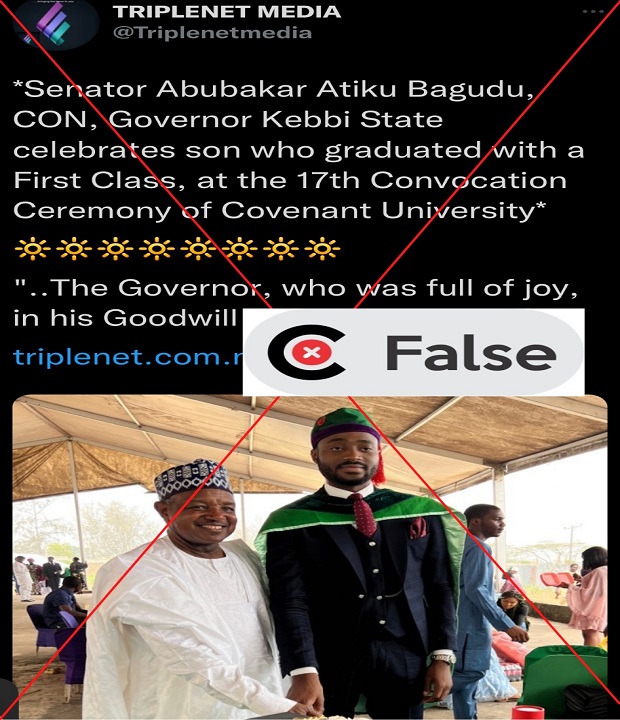
ON the 6th of January, 2023, a Twitter user, @tripplemetmedia tweeted a photo showing the Governor of Kebbi State, Abubakar Atiku Bagudu posed with a convocation cake with a young man in an academic gown.
The Twitter account shared the photo with a caption suggesting that it shows the governor celebrating his son who graduated with first class at Covenant University.
The tweet, which has garnered over 100 retweets and more than 1,600 likes as of 10th of January, 2023, reads:
“Senator Abubakar Atiku Bagudu, CON, Governor Kebbi State celebrates son who graduated with a First Class, at the 17th Convocation Ceremony of Covenant University. The Governor, who was full of joy, in his Goodwill message(sic).”
CLAIM
Image shows Bagudu and his son who graduated at the 17th Convocation Ceremony of Covenant University.
THE FINDINGS
Findings by The FactCheckHub show that the claim is FALSE.
Checks using Google Reverse Image search show Bagudu and Israel Danmanya Maikyau, the son of NBA president (Y.C Maikyau, OON), who graduated from the Covenant University, Otta in Ogun state on the 6th of January, 2023.
It was reported that the ceremony had in attendance the Governor of Kebbi State, Senator Abubakar Atiku Bagudu; NBA General Secretary, Adesina Adegbite; NBA Welfare Secretary, Chinyere Obasi; the National Assistant Publicity Secretary of the NBA, Charles Ajiboye, among others.
The NBA president, Yakubu Maikyau and Bagudu are both from Kebbi state and the governor was at the occasion as one of the dignitaries that graced the convocation ceremony. It was also reported here and here.
THE VERDICT
The claim that the image shows Bagudu and his son who graduated at the 17th Convocation Ceremony of Covenant University is FALSE; findings revealed that the image is that of Bagudu and Israel Maikyau, the son of NBA president, who graduated from the Covenant University on the 6th of January, 2023.
Nigeria’s 2023 elections are only weeks away. Voters are set to pick a president and members of the national assembly on 25 February, and governors and state assemblies two weeks later.
As campaigning hits the home stretch, false political narratives aren’t far behind. The stories have affected candidates, parties – and the electoral process.
Here we pick out 10 trends in election disinformation – false information spread deliberately – identified in our reports. Africa Check has also helped expose this disinformation as a member of the Nigerian Fact-checkers’ Coalition.
A notable trend is quotes falsely attributed to politicians and past presidents.
One of the most “attributed” is former president Olusegun Obasanjo. Well known for weighing in on public debate, including penning open letters on the state of the nation, Obasanjo governed Nigeria from 1999 to 2007.
Many quotes attributed to Obasanjo are about the Labour Party’s Obi. Obasanjo endorsed Obi in January 2023.
Months before the endorsement, quotes falsely attributed to Obasanjo did the rounds online. One has him vouching for Obi’s integrity. In another, Obasanjo appears to claim that getting Obi into the presidency would reduce violence and insecurity in Nigeria.
Information minister Lai Mohammed has also been a target of false quotes. One is that he said Obi was the “brain behind the #ENDSARS protests” that rocked Nigeria in 2020. The ministry has refuted this.
2. False claims of size
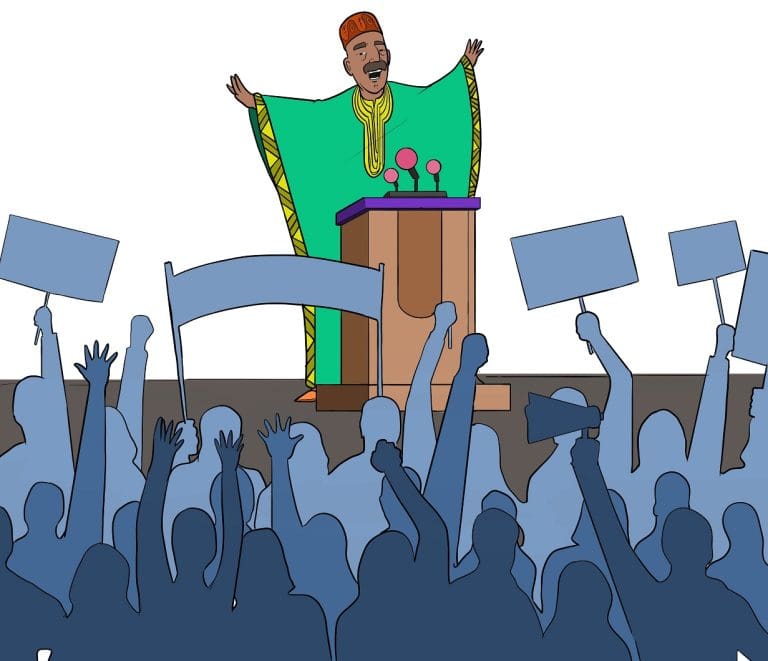
The size of a crowd a candidate can attract is often a source of interest.
As in previous elections, candidates and their supporters have compared the attendance at their rallies. The narrative is that the candidate with the biggest crowd has the best chance of winning the election.
The captions to crowd photos may be false. But politicians do rent crowds to give a false impression of their popularity. That’s what Kamilu Fage, a professor of political science at Bayero University in Kano state told Africa Check.
Misinformation, or false information spread unintentionally, and disinformation are rampant in Nigerian politics, Fage said.
“With those large crowds, they make their supporters believe they will win the election,” Fage said.
“When the outcome of the election shows otherwise, they claim the election was manipulated and this often ends up in crisis.”
3. Misleading achievements attributed to candidates
Three of the four presidential front-runners are former state governors. Tinubu, the APC candidate, was governor of Lagos state. The Labour Party’s Obi governed Anambra state. Kwankwaso of the NNPP ran Kano state.
To burnish their presidential credentials, some of the candidates and their camps have claimed achievements as governors. Some of these assertions have turned out to be either false or misleading.
For example, Kwankwaso and his supporters have claimed that in his two terms as governor he had not borrowed a dime. He also claimed he had repaid all Kano state debt. We rated both claims as incorrect.
Tinubu’s supporters have also exaggerated his contribution to the financial growth of Lagos state, the country’s economic hub.
4. Nonexistent endorsements
Supporters have often circulated photos and videos of prominent people across the globe appearing to endorse their candidates.
Obi’s supporters have been particularly active here, perhaps unsurprisingly, given their youth.
We have debunked several fake endorsements of the Labour Party candidate.
In late 2022, a manipulated video seemingly showing a host of Hollywood stars campaigning for Obi also did the rounds on social media.
We’ve also debunked fake support for Tinubu. As early as January 2020, a manipulated photo of Nigerian footballer Mikel Obi supposedly endorsing Tinubu for president in 2023 circulated online.
In December 2022, another viral photo appeared to show Tinubu meeting US president Joe Biden. The central claim was that the US government had recognised Tinubu as Nigeria’s next president, which would have been a public relations coup for him as his time in the US has often been scrutinised.
Fake endorsements are another way politicians deceive people, Fage told Africa Check.
“They visit prominent people, circulate photos of the visit and then claim it was an endorsement. When the prominent person keeps quiet, the claimed endorsement is taken as real and some voters might then vote for that candidate,” he said.
5. Edited videos and misleading photos
Altered photos and videos are another disinformation trend.
In the example of the Hollywood stars supposedly endorsing Obi, the video showed dozens of famous US and British actors displaying white cards with the inscription: “Yes. It makes sense to Vote for Peter Obi in 2023.”
It turned out to be a combination of over 20 doctored episodes of the US magazine Wired’s autocomplete interview series.
In the original photo, posted on Twitter by a Tinubu support group, the APC presidential candidate is looking out of the plane’s window while returning to Nigeria in October 2022. The screen in front of him is blank.
Editing is popular because it has a “low barrier to entry”: the skills and equipment needed are often easily available.
6. Bots and trolls on Twitter
There have also been Twitterbots and trolls helping push narratives and hashtags about candidates and their supporters.
Rosemary Ajayi is the lead at the Africa Digital Research Lab, a nonprofit that examines issues such as the misuse of social media.
Several disinformation techniques were being used in the buildup to the elections, she told us. But it was either too difficult or too early to measure their impact.
Automated “bot” – robot – social media accounts were also being used. But more worrisome were the activities of trolls and hired influencers, Ajayi told us.
“We have been picking up evidence of coordinated inauthentic behaviour on social media – usually around trends. Influencers and their many minion accounts are pushing narratives,” she said.
7. Activities of online influencers
Online influencers – people able to influence understanding of major public issues – are major players in several disinformation trends ahead of the 2023 elections. Some have consistently promoted their candidates at the expense of others. Others have taken every opportunity to attack opposing candidates, sometimes using false information.
Influencers’ work was more complex in this election than it was in 2015 and 2019, Dr Theresa Amobi, a senior lecturer in the department of mass communication at the University of Lagos, told Africa Check.
“Since this presidential election has more than two leading candidates, influencers have engaged on multiple fronts, unlike in 2015, when it was only the PDP and APC,” she said.
“Politicians hire these influencers to spread false information on social media to promote themselves and de-market their opponents. Unfortunately, they do to some extent because not many people are media literate enough to critically analyse these things and spot disinformation.”
Ajayi added that some influencers bribe other social media users to use certain hashtags. “And this is not hidden. They openly promise to give money to whoever uses the hashtags they want to trend.”
8. Dubious and partisan news websites, and fake social media accounts
The election season has come with the emergence of fake news websites and blogs used by different camps to publish information – sometimes false information – that advances their campaigns.
Some of these less known news websites are often referenced by the spokespeople for presidential campaigns. The websites usually have reports promoting the party, several of them making false and unsubstantiated claims about their opponents.
Ethnicity and religion are two critical factors in Nigerian politics. They influence most political decisions mainly because of the country’s population and geography.
Nigeria has about 250 ethnic groups. The country’s north is predominantly Muslims and while the south is mainly Christian, with these populations roughly equal.
Since independence in 1960, Nigerian political leaders have often negotiated political power based on ethnicity and religion. And the presidency is expected to rotate between the north and south, and between Muslims and Christians.
More than any other poll since the return of democracy in 1999, ethnicity and religion are playing major roles in this election. This is reflected in the type of information being shared.
“We’ve also seen narratives targeted at ethnic nationalities. I believe this has to do with the unwritten agreement of rotation of power between north and south and the fact that someone from the southeast, Peter Obi, is a front-runner in this election,” Ajayi said.
Amobi, whose recent research interests have been misinformation and disinformation, also noted that much of the recent election-related false information has been about ethnicity.
Similarly, a lot of the disinformation has been about religion, partly fuelled by fears of the impact of APC’s Muslim-Muslim ticket. Both the APC presidential candidate, Tinubu, and his running mate, Kashim Shettima, are Muslims.
10. Fake giveaways and scams
Another trend is claims that political parties and their candidates are giving cash and other goodies to their supporters. These often circulate in SMS or WhatsApp messages.
Another claims that Abubakar is giving out N5,000 airtime vouchers and 10 GB of mobile data. It includes several weblinks and encourages Facebook users to click on them and share them with their friends.
Many would-be voters fall for these scams, affecting both their pocket and their perception of political issues.
How disinformation could affect the 2023 election
Disinformation is part of a rigging process that Nigerian politicians have perfected, Kamilu Fage, a professor of political science at the Bayero University in Kano, told Africa Check.
“The use of disinformation works for them sometimes, when they succeed in deceiving many people to vote for them. It backfires at other times.
“However, election-related disinformation is dangerous because if supporters judge by what they see on social media and conclude that a candidate will win the election, they may resort to violence when the candidate loses. This was part of the reason for the 2011 post-election violence that led to the death of many people,” he said.
Contrary to what some think, disinformation on social media has real life consequences, Dr Amobi told Africa Check.
“Some people erroneously think that an election cannot be won on social media. The truth is that social engagement influences conversations offline. People on social media, some of whom are in the diaspora, can influence the voting behaviour of their relatives in rural areas without access to the internet,” she said.
Amobi said the greatest impact of disinformation would be on undecided voters.
“Some people have decided who to vote for and they will not shift no matter what you say about their candidate. But undecided voters are likely to be swayed by disinformation especially when they are exposed to it constantly over a relatively long period,” she said.
This report was written by Africa Check, and republished by The FactCheckHub as part of the Nigerian Fact-checkers’ Coalition initiative. See the original piece here.