
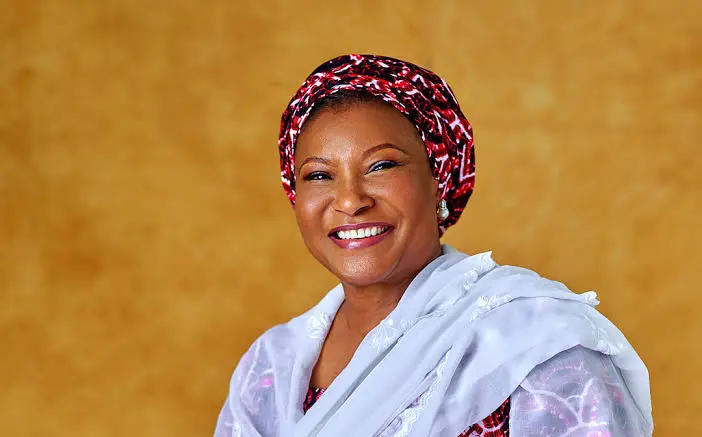
A VIRAL video circulating across social media shows senator Ireti Kingibe, representing the Federal Capital Territory (FCT), addressing a crowd of supporters during a political event.
In the video, Kingibe claims that a tax law recently passed by the National Assembly requires every Nigerian to pay 25 per cent of their earnings as tax to the federal government. She further alleges that the law’s implementation is being delayed until after the 2027 general election.
Kingibe made the remarks while discussing economic hardship and urging citizens to unite to change the political system.
The footage which started circulating on 18 October 2026, was shared by @Kingsholzy, with the caption:
“Nigerians are not aware that a tax law has been passed, which requires everyone to pay 25% of their earnings as tax. The National Assembly has already passed this law, and it will swing into action after the election.”
As of 20 October 2026, the post has generated over 260,000 views, more than 7000 likes, and over 4,500 people reposted it.
The claim also surfaced here, and here.
READ: How myth of tax deductions through bank narrations spread in Nigerian markets
CLAIM
Ireti Kingibe claimed that a newly passed law mandates every Nigerian to pay 25% of their earnings as tax, with implementation set to begin after the election.

FINDINGS
Findings by The FactCheckHub show that the claim is MISLEADING.
The claim misrepresents the provisions of the Nigeria Tax Act, 2025. Although the Act establishes a maximum personal income tax rate of 25 per cent, it does not require every Nigerian to pay that rate on their entire earnings. It also does not postpone the commencement of the new tax framework until after the 2027 general election.
How Nigeria’s tax reforms began
Nigeria’s tax reform process began in July 2023 with the establishment of the Presidential Committee on Fiscal Policy and Tax Reforms, chaired by Taiwo Oyedele.
The committee was tasked with reviewing the country’s tax system and recommending reforms to simplify tax compliance, improve revenue collection and create a more coherent tax framework.
In October 2024, the federal government submitted four tax reform bills to the National Assembly. Following legislative consideration and subsequent passage, President Bola Tinubu signed the four tax reform Acts into law on 26 June 2025.
The reforms include the Nigeria Tax Act, 2025; the Nigeria Tax Administration Act, 2025; the Nigeria Revenue Service (Establishment) Act, 2025; and the Joint Revenue Board (Establishment) Act, 2025.
According to The ICIR, the reforms were introduced to simplify the tax system, harmonise tax administration, broaden the tax base and modernise tax practices.
The Nigeria Tax Act, 2025, consolidates several existing tax laws, including provisions previously contained in the Personal Income Tax Act and the Companies Income Tax Act.
The new tax framework is already in effect
Contrary to Kingibe’s assertion that implementation will begin after the election, the Nigeria Tax Act, 2025, took effect on 1 January 2026.
The Federal Ministry of Finance confirmed the commencement date in its guidelines for transitioning from the previous tax laws to the new framework.
The guidelines explain that tax liabilities and other matters relating to periods before 1 January 2026 are to be handled under the repealed laws, while the new framework applies to the relevant periods beginning on or after that date.
This means the commencement of the tax framework is not conditional on the outcome of the 2027 general election.
What does the law say about personal income tax?
The Fourth Schedule of the Nigeria Tax Act, 2025, sets out progressive personal income tax rates.
Under this system, different portions of a person’s taxable income are taxed at different rates. The applicable rate increases as taxable income rises, rather than every taxpayer being charged a flat rate of 25 per cent.
The rates specified in the Act are:
- First N800,000: 0%
- Next N2.2 million: 15%
- Next N9 million: 18%
- Next N13 million: 21%
- Next N25 million: 23%
- Above N50 million: 25%
These rates apply to taxable income after applicable reliefs and exemptions have been taken into account.
Consequently, individuals with annual taxable income of N800,000 or less are exempt from personal income tax under the new schedule. For those with higher taxable incomes, the relevant rates apply progressively to the portions of income falling within each band.
For example, the 25 per cent rate applies only to the portion of taxable income exceeding N50 million. It does not mean that a person whose taxable income exceeds that threshold automatically pays 25 per cent on every naira earned.
The FactCheckHub previously examined similar claims in its report, “Misleading claims on new personal income tax act circulates online”. That report also explained that the N800,000 exemption threshold applies annually, not monthly, and that the new system uses progressive rates.
Does the law mean everyone will pay the same tax?
No. The Nigeria Tax Act, 2025 does not impose a flat 25 per cent personal income tax on every Nigerian. Tax payable depends on taxable income, applicable rates, exemptions and reliefs. The 25 per cent rate applies only to the portion of taxable income above N50 million, while annual taxable income of N800,000 or less is exempt.
Personal income tax is different from taxes imposed on businesses, goods, services and transactions. The new tax law came into effect on 1 January 2026, not after the 2027 election as Kingibe claimed.
If she was referring to another tax proposal, she did not identify it in the statement.
READ ALSO: No, Tinubu government has not introduced new fuel tax starting January 2026
VERDICT
The claim made by Ireti Kingibe that a newly passed law requires all Nigerians to pay 25 per cent of their earnings as tax after the election is MISLEADING. Findings show that the 25 per cent tax rate applies strictly as a marginal bracket for individuals earning over N50 million annually, while low-income earners making N800,000 or less per year remain fully exempt.

Seasoned writer and literary curator, Zainab Abdulrasaq is a factchecker for The FactCheckHub in an effort to combat information disorder. She can be reached on IG @blackbookishgirl or zabdulrasaq@icirnigeria.org

, addressing a crowd of supporters during a political event. )