Please note that the FactCheckHub has not obtained any right from the authors or copyright owners of all third-party contents from embedded links and shall incur no liability in this regard.
Please note that the FactCheckHub has not obtained any right from the authors or copyright owners of all third-party contents from embedded links and shall incur no liability in this regard.
Please note that the FactCheckHub has not obtained any right from the authors or copyright owners of all third-party contents from embedded links and shall incur no liability in this regard.
Please note that the FactCheckHub has not obtained any right from the authors or copyright owners of all third-party contents from embedded links and shall incur no liability in this regard.
A viral claim that the United States has drastically reduced tariffs on Chinese goods including phones, computers, microchips, TVs, and solar panels from 145% to just 10% has circulated on X.
An X user, @sprinterobserve, shared the post on the X platform thus:
“Washington reduces tariffs on dozens of Chinese goods from 145% to just 10%, including: phones, computers, electronic chips, televisions, and even solar panels! This is just the beginning!”
The post had garnered over 3 million views with 46,000 likes, more than 2,500 comments, and 9,000 reposts as of April 16, 2025.
CLAIM
US slashes tariffs on several Chinese goods, dropping rates from 145% to just 10% for items like phones, computers, microchips, TVs, and solar panels.
THE FINDINGS
Checks by The FactCheckHub show that the claim is FALSE as credible media reports show that the U.S. has increased tariffs on Chinese imports but places electronic products on a new tariff called “semi-conductor tariff” which were pegged at only 20% tax while other Chinese imports into America still stands at 145%.
Screenshot of the post retrieved from X. INSERT: FALSE verdict.
Since returning to office for a second term as American president, Donald Trump has embraced an escalating tariff policy aimed at addressing what he calls “decades of unfair trade” practice. In April 2025, the White House announced sweeping tariff hikes, including an escalated 145% rate on most Chinese imports whereas China has retaliated with a 125% tariff on all American goods. These measures were introduced by the Trump-led U.S. presidency as part of a broader strategy over economic and national security concerns.
To verify the claim, our researcher subjected the keywords: “Chinese good tariffs on electronics” to a Google search. The results show that the U.S. president had addressed the controversial issue. In a report, Trump reacted strongly to media reports about tariff exemptions, stating that “no exceptions were announced”. He added that the technology products in question “are subject to the current 20% tariffs on fentanyl, and they are simply being moved to another tariff category”.
Also, in a social media post on his Truth Social, Trump accused the media of spreading “fake news” and stated that his team is investigating the entire supply chain of semiconductors and electronic products as part of future national security measures.
After dramatic back-and-forth tariff hikes between the US and China through last week, Washington appeared to bend last Friday.
A notice issued by US Customs and Border Protection on April 11, 2025 listed more than a dozen product categories that would be exempted from the wave of tariffs that Trump has imposed on China since April 2.
They included computers, laptops, disc drives and automatic data processing equipment, products that are largely not made in the US but in China. Smartphones, memory cards, semiconductor devices, solar cells, modems, routers and flat panel displays were also included on the exemptions list.
Last Friday’s notice specifically mentioned exemptions for these products from tariffs imposed on China on April 2, Aljazeerareported.
Further checks by our researcher show multiple media reports from Reuters and Associated Press, among others which revealed that the U.S. president has made a U-turn to review the hiked tariffs on goods imported from dozens of other countries which trades with the United States to what he called the “baseline tariff” to 10% only.
While some U.S. neighbours such as Canada and Mexico received temporary relief which reduced to 10% in tariff rate, China was not among them.
The claim that the United States has reduced tariffs on Chinese goods from 145% to just 10% is FALSE; multiple media reports show that the U.S. has not reduced tariffs on Chinese imports from its last hiked rate of 145% but only moved electronic goods from China to a tariff called a “semi-conductor tariff” which currently stand at 20%.
DANIEL Bwala, the Special Adviser on Policy Communication to the Nigerian president, Bola Ahmed Tinubu, has claimed that Senator Ali Ndume has not had any executed projects throughout his 22-year stay in the National Assembly.
He made the claim (15:39 – 17:01) during an interview on Channels TV’s programme, Sunday Politics on April 13, 2025 in response to earlier criticisms of the presidential media team by Ndume on the same programme on April 11, 2025.
Bwala also stated that despite spending 22 years in the Nigerian National Assembly as a lawmaker, Ndume has not completed a single project in Southern Borno, his constituency. He also accused the senator of neglecting over 120,000 internally displaced persons (IDPs) from his constituency who are still refugees in Cameroon.
Bwala went on to criticize Ndume’s legislative performance, claiming that 90 percent of his bills don’t make it past the second reading.
Part of the audio is transcribed below thus:
…120,000 of his people are in Cameroon as IDPs, during this period Ali Ndume has served as a minority a majority leader and also Senate chair committee on defense and army he has never done anything to bring his people back from Cameroon. The monies that have come to southern Borno in form of a project, there is no single project in the southern Borno. This is a senator who knows his primary assignment is lawmaking and oversight he has never had a bill passed, 90% of his bill they don’t even get to reach second reading they’ll be dismissed not to talk of bringing it for debate he goes about parading and saying that the bill that brought about the Northeast Development Commission he was one that sponsored and it’s a lie it is Senator Nyako…
The FactCheckHub decided to verify the accuracy of these claims as it had gained significant traction in the media space.
CLAIM 1
Ali Ndume has not executed any constituency project throughout his 22 years as a lawmaker.
THE FINDINGS
Findings by The FactCheckHub show that the claim is FALSE!
In 2024, Leadership newspaper reported that Ndume initiated an educational support project designed to benefit students within his constituency. The initiative was aimed at providing assistance to a total of 1,100 students drawn from the nine local government areas that make up Borno South.
According to the report, the project was part of Ndume’s efforts to invest in human capital development and improve access to education for young people in the region, many of whom have been affected by years of conflict and displacement. The educational support was intended to ease the financial burden on families and encourage school enrollment and retention among students.
In a separate report by Blueprint in 2017, Ndume facilitated the drilling of two boreholes and donated two tractors to each of the nine local government areas within the Borno South Senatorial District. The initiative was part of his development efforts aimed at improving access to clean water and boosting agricultural productivity across his constituency.
In 2020, Ndume faced criticism from the Independent Corrupt Practices and Other Related Offences Commission (ICPC) during its investigation into the implementation of constituency projects. The ICPC revealed that the North-East region was the most affected by non-execution of these projects, largely due to the Boko Haram insurgency, which hindered contractors from being mobilized to project sites.
In response, Ndume, speaking on behalf of his fellow lawmakers from the region, told ThisDay newspaperthat the blame should lie with the ministries, departments, and agencies (MDAs) responsible for implementing the projects. He explained that while lawmakers only recommend the projects, it is the MDAs that handle the selection and supervision of contractors.
Ndume dismissed allegations that lawmakers from the region misappropriated project funds, insisting that it is the MDAs and contractors who should be held accountable for any shortcomings in execution.
Another report by Mawa Foundation noted that Ndume was reported to have failed to account for the N22 million constituency project funds for his senatorial district in 2017.
According to the report, the senator had proposed to supply empowerment equipment to residents of his senatorial district as part of the initiative. However, findings by Tracka indicated that 70% of the funds allocated for the project had been released, but there was no clear explanation from the senator on how the money was utilized.
It was also reported that the project was intended to be implemented in several local government areas, some of which were inaccessible at the time due to insurgent occupation.
THE VERDICT
The claim that Ali Ndume has not executed any constituency project throughout his years as a lawmaker is FALSE; while the senator had come under scrutiny a number of times, reports show that he has executed some projects in his senatorial district.
CLAIM 2
Ali Ndume has never had any bill passed at the Senate.
THE FINDINGS
Findings by The FactCheckHub show that the claim is FALSE!
Checks revealed a number of bills that have been sponsored by Ndume include the Peace Corps Establishment Bill, which has passed the second reading at the Nigerian Senate.
He also initiated the Electoral Act Amendment Bill that allowed internally displaced persons (IDPs) to vote in the 2015 general elections.
Similarly, the bill that established the North East Development Commission which Bwala claimed was sponsored by Senator Nyako was actually sponsored by Sen. Ndume at the Senate level and Yakubu Dogara at the House of Representatives level. It was passed into law and currently an Act.
A further look at the bill progression chart of the 9th Senate uploaded by the Policy and Legal Advocacy Centre (PLAC) shows that of all the ten bills Ndume proposed, the Nigerian Peace Corps bill and the bill to establish a Federal College of Education (FCE) in Marama, Borno state passed its second reading, while the bill seeking to establish the Nigeria Army University, Biu passed its third reading at the Senate.
THE VERDICT
The claim that Ali Ndume has never had any bill passed in the Senate is FALSE; the lawmaker has bills that have passed second reading to his credit at the Senate and bills that have become Acts (law) such as the North East Development Commission Act, among others.
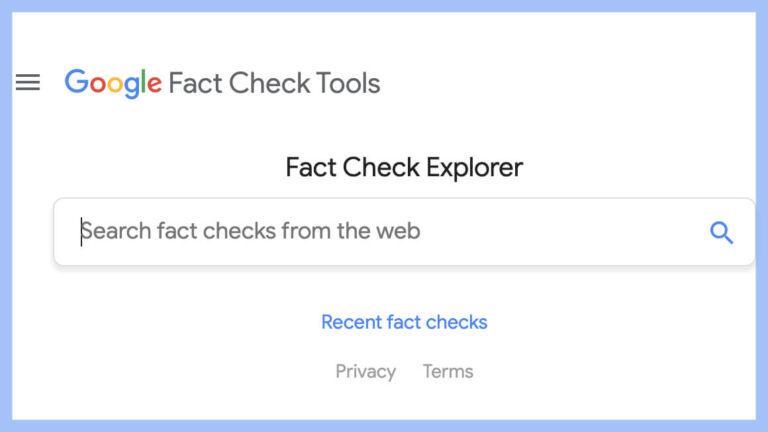
Google Fact Check Explorer is a simple tool that allows online users to verify information by providing fact-checked content from trusted sources especially credible media and fact-checking organisations.
With access to databases from many media and fact-checking organisations across the world, users can search for information to verify its accuracy or otherwise.
The platform, designed by Google.com, aims to help journalists, researchers, and the public verify information by accessing fact-checks from credible organisations worldwide. It allows users to search for claims, topics, or keywords and see fact-checks published by credible sources, making it easier to combat misinformation. Another tool similar to this is Claim Buster, developed by a team of students from the Department of Computer Science and Engineering, University of Texas at Arlington.
This Google tool is particularly useful for quickly assessing the credibility of viral information including images and video shared on social media and tracing the origins of such information.
The tool also allows you to easily browse and search for already published fact-checks. For example, you can search for a politician’s statement, celebrity’s public speech, government official statement or any topic of your choice. You can also limit the results to a specific publisher or medium.
Step 2: Search for any Topic, Information or Image
In the Search bar on the displayed web page, type keywords from the information you’re seeking its accuracy or any topic you want to verify. For example, if you want to check a claim about climate change, simply enter relevant keywords like “climate change” in the search bar or the specific topic you want verified.
Keywords can be anything from specific topics to full quotes.
You can search by keywords and see a list of matching information and the corresponding fact-checks. Similarly, you may search for fact checks related to an image, either by specifying an image URL or by uploading the image.
Following the search, you’ll see a list of articles with fact-checks, including the claim, the source, and the ratings or verdicts (True, False, etc.).
Click on any link among the displayed results to read the full fact-check and see the evidence supporting its rating.
Step 4: Cross-Check with other Sources
You can also read related articles or use similar fact-checking tools like Claim Buster to check further or submit the information or claim on the FactCheckHub mobile app if the information or claim is yet to be verified.
Step 5: Stay Updated
You can set up Google Alerts or follow multiple credible media and fact-checking organisations via their social media platforms such as Facebook, X, Instagram, TikTok, YouTube or WhatsApp channel to stay informed or get notification of newly verified information or claims. You may also send us any information to help you verify via our WhatsApp number by clicking here.
In conclusion, the Google Fact Check Explorer is a quick and reliable way to verify any information and ensure that the information you’re consuming is accurate and from credible sources. You may also learn more about how the tool works here.
BASHIR Ahmad, a former media aide to ex-Nigerian president, Muhammadu Buhari, has claimed that the Nigerian Senate passed the Emergency Powers (Repeal and Re-enactment) Bill 2018 into law in February 2018.
He claimed on the X platform that the passed bill grants the Nigerian president the authority to suspend an elected State Governor or Local Government Chairman during an emergency period.
His post read thus:
”In February 2018, the Nigerian Senate passed the Emergency Powers (Repeal and Re-enactment) Bill 2018. The Act says, “The President may, with the approval of the National Assembly, suspend a State Governor or the Local Government Chairman in an emergency area during an emergency period.”
The claim has garnered over 400,000 views, with more than 500 reposts and comments plus over 1,700 likes as of April 13, 2025.
CLAIM
Emergency Power Act 2018 grants the Nigerian president the power to suspend state governor or council chairman.
THE FINDINGS
Findings by The FactCheckHub show that the claim is FALSE, as the bill was only passed in the Nigerian Senate and has not been signed into law by the nation’s president.
Screenshot of the post retrieved from X. INSERT: FALSE verdict.
Recall that on March 18, 2025, the Nigerian president, Bola Ahmed Tinubu, declared a state of emergency in Rivers State. In his nationwide broadcast that day, he also suspended the state governor, Siminalayi Fubara, his deputy and the state lawmakers. This sparked a constitutional debate, as politicians, legal experts and citizens wade in.
Note that Section 305of the 1999 Nigerian Constitution allows the President to declare a state of emergency under specific circumstances, such as threats to public order, public safety. However, the Constitution does not explicitly grant the President the authority to suspend elected state officials, including governors and state lawmakers, during such declarations.
But Ahmad claimed that the Emergency Act (repeal and re-enactment) Bill 2018 gives the president the power to remove a governor or local government chairman with the approval of the National Assembly.
A check through the Nigerian Senate’s records and official legislative reports from 2018 revealed that after the Emergency Powers (Repeal and Re-enactment) Bill 2018, sponsored by Senator David Umaru (Niger East), was introduced for consideration, it was subsequentlypassed into law by the Senate after the third reading.
However, the bill was not signed into law by any Nigerian president, even though it sought to repeal and replace the existing Emergency Powers Act of 1961. The bill outlined the scope of presidential powers during national emergencies. Though it also grants the Nigerian president the authority to suspend a State Governor or Local Government Chairman, it was never assented to by the then president, Muhammadu Buhari.
Further examination of Nigeria’s1999 Constitution (as amended) shows that only the National Assembly has the power to remove an elected governor, and this can only be done through an impeachmentprocess as outlined in Sections 188 and 189 of the constitution. Thus, the claim that the President can unilaterally suspend elected officials contradicts constitutional provisions.
FILE PHOTO: Femi Falana (SAN).
“In the 320 sections of the Nigerian Constitution, nowhere is the president empowered to remove the governor of a state or suspend the governor of a state, suspend the deputy governor of a state, suspend the legislators in a state,” Femi Falana, a Senior Advocate of Nigeria (SAN) said in an interview with Channels TV recently.
At an inaugural lecture event in 2008, Professor Itse Sagay, a professor of law and Senior Advocate of Nigeria, said: “The whole tenor of section 11 of the Constitution (which is the section containing all the powers exercisable during an emergency shows that an emergency declaration is intended to be a cooperative endeavor between the federal government and state government, whose organs, governors, House of Assembly and judiciary are fully functioning.”
FILE PHOTO: Professor Itse Sagay.
This was also corroborated in a legal research work by an Edo-based lawyer, Bright E. Oniya. Similarly, an article published in a Beijing Law Review journal in December 2019, notes that: “The International Covenant on Civil and Political Rights 1966 in Article 4 empowers state parties to declare state of emergency subject to certain rules which do not include dissolution of democratic structures in a country.”
In addition, The FactCheckHub spoke to Muhammed Adam, a Nigerian human rights lawyer fondly called “foundational Nupe lawyer” on X (formerly Twitter). He confirmed that the bill was never assented to by any Nigerian president, adding that it was only a bill.
“There is no such law in existence, it is just a bill,” Adam said.
THE VERDICT
The claim that the Emergency Power Act 2018 grants the Nigerian president the power to suspend state governor or council chairman is FALSE; there is no such law currently, as the bill was never signed into law by any Nigerian president. Also, the president lacks power to suspend any elected state or local council official, according to the amended 1999 Nigerian Constitution.
A protest intended to express public dissatisfaction with the way the Nigerian government was managing the country’s economy turned into a march that featured calls for a coup d’état and the flying of Russian flags.
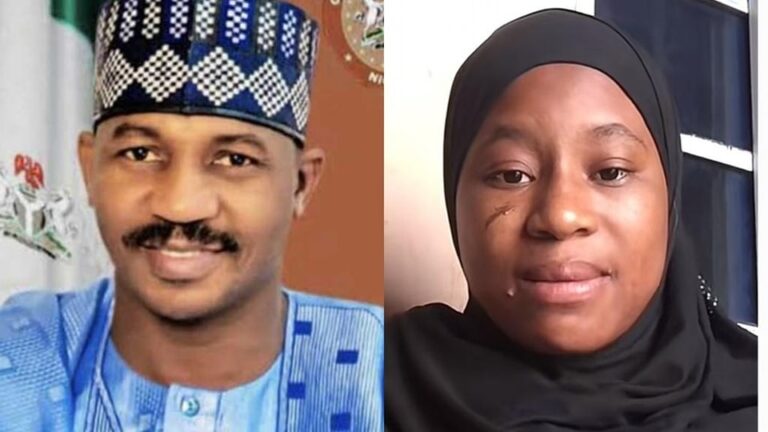
A claim that a Sokoto magistrate court has sentenced 18-year-old activist, Hamdiyya Sidi, to 12 strokes of the cane or a two-year prison term, or to pay a fine of N50,000 has surfaced online.
The claim has been widely circulated on X (formerly Twitter), blogs, and Facebook posts.
For instance, a Facebook account, Africom posted the claim with a caption that read:
“Breaking: The court has sentenced Hamdiyya Sidi to 12 strokes of the cane, or 2 years imprisonment, or a fine of fifty thousand Naira (₦50,000)…
Hamdiyya Sidi, was charged by the Sokoto State government with “use of insulting or abusive language” and “inciting disturbance” after she criticized Governor Ahmed Aliyu in a
TikTok video.
Barrister Abba Hikima was there for her since from day 1, May Allah bless him.”
The post has garnered traction online.
Also, an X user, @Hashafcee1 also posted the claim on April 10, 2025 and it has generated more than 65,000 views alongside over 900 reposts and over 700 likes as of April 11, 2025. The claim was also shared here by another Facebook user.
CLAIM
A Sokoto magistrate court has sentenced Hamdiyya Sidi to 12 strokes of the cane, or two years in prison, or to pay a N50,000 fine.
THE FINDINGS
Findings by The FactCheckHub show that the claim is FALSE.
In November 2024, Hamdiyya Sidi published a video criticising Sokoto State governor, Ahmed Aliyu, over insecurity and the plight of displaced persons in the state. She also called on internally displaced people to occupy the governor’s office in protest.
Following her remarks, the Sokoto State Police Command arrested her and accused her of making inciting statements and using abusive language. After her release on bail, she reportedly suffered physical attacks, including abduction and assault, which left her with serious injuries.
She later issued a public apology and retracted her statement urging IDPs to occupy government property.
Screenshot of the viral post retrieved from X. INSERT: FALSE verdict.
In February 2025, Sidi was arraigned before a Sokoto magistrate court. Prosecutors accused her of circulating content capable of causing public unrest.
The last update on the case showed that it was been adjourned to March 13 and 14, but no public record has confirmed any ruling or judgement as of the time of this report.
The FactCheckHub also found a video released by Sidi and her lawyer, Abba Hikima where they debunked the viral story.
In the video, which was posted on Facebook in Hausa language by her lawyer, Sidi said:
“No ruling has been made. We are still continuing with the Sharia proceedings as we have always done from the beginning… Today’s session was when we started presenting witnesses under my lawyer’s guidance. So, there’s no judgement. To those spreading these false stories, I urge you to fear Allah and stop spreading things that are not true.”
News Central TV also reported on April 10, 2025 that Abba Hikima, the lead counsel for Hamdiyya Sidi Shareef — the young woman arrested over a critical TikTok video targeting Sokoto State Governor Ahmed Aliyu — has dismissed circulating social media claims suggesting that his client has been sentenced.
Our fact-checker observed that there were no credible media reports or court documents confirming that Sidi has been sentenced. Neither has the Sokoto judiciary nor relevant authorities released any statement indicating that a ruling has been delivered in her case.
THE VERDICT
The claim that a Sokoto magistrate court sentenced Hamdiyya Sidi to 12 strokes of the cane, or two years in prison, or a N50,000 fine is FALSE; findings show that no such ruling has been made on her case, which is still ongoing in court as of the time of filing this fact-check.
A claim that the penalty for stealing in Dubai, United Arab Emirates, is slavery has been circulated online.
An X user, @BluebriarArts, made the post with a caption that read:
“They don’t like to tell you that if you get caught stealing something with even 1% of the value of that in Dubai, you will literally be enslaved for the rest of your entire life, and if you’re a woman you’ll get sold off to a polygamist millionare and your kids will be slaves too.”
The post was in response to a video content shared by another X user, @idanpapii, showing a woman who left a piece of jewelry at various places allegedly to depict Dubai as a safe place.
The video has garnered over 11 million views while the comment has generated over 13,000 reposts alongside more than 260,000 likes and over 16,000 bookmarks as of April 10, 2025.
CLAIM
The penalty for stealing in Dubai is slavery.
THE FINDINGS
Findings by The FactCheckHub show that the claim is FALSE.
The United Arab Emirates’ punishment for theft is governed by a combination of Sharia law and the UAE Penal Code. The UAE has clear and firm punishments for anyone found guilty of theft. This approach is not just about deterrence but also about maintaining the country’s security and trust.
Theft is considered a serious crime in the UAE, typically regulated under Federal Decree-Law No. 31 of 2021 (UAE Penal Code). According to Federal Law No. 3 of 1987, theft is legally defined in the country as the act of unlawfully taking possession of another person’s property with the intent to deprive them permanently of it.
Screenshot pf the viral X post. INSERT: FALSE verdict.
This can include tangible assets like money, jewelry, or electronics, as well as intangible assets like intellectual property. This includes movable properties with tangible value, and the key elements to establish this offense are the “mens rea” (intention) and “actus reus” (action) of the perpetrator.
The FactCheckHub reviewed the country’s law published by various law firms and experts, and we cannot find anywhere slavery is listed as a penalty for stealing.
According to an explainer by lawyers in Dubai, perpetrators of theft, if found guilty of theft in Dubai, will face imprisonment ranging from 6 months to 3 years, along with potential fines.
In addition, attempted theft carries legal consequences, with imprisonment durations ranging from 3 months to 18 months or monetary penalties.
Meanwhile, perpetrators of aggravated theft which involves aggravating factors such as the use of weapons, theft committed at night, theft by multiple individuals, or theft involving coercion could face harsher penalties, including potential life imprisonment.
In the UAE, theft is categorized into various types, each carrying specific legal consequences based on the severity and circumstances. Petty theft involving low-value items under AED 1,000 can result in fines up to AED 5,000, short-term imprisonment up to six months, and possible deportation for non-citizens.
Theft by a servant is treated more seriously due to the breach of trust involved, leading to penalties of up to AED 10,000 in fines, imprisonment of up to five years, and potential deportation. Aggravated theft, which includes factors like violence or group involvement, attracts harsher punishments of up to ten years in prison and fines reaching AED 50,000.
THE VERDICT
The claim that the penalty for stealing in Dubai is slavery is FALSE. Theft is punished under UAE law with fines, imprisonment, or deportation—not slavery. There is no legal basis for the claim, and slavery is illegal in the UAE.
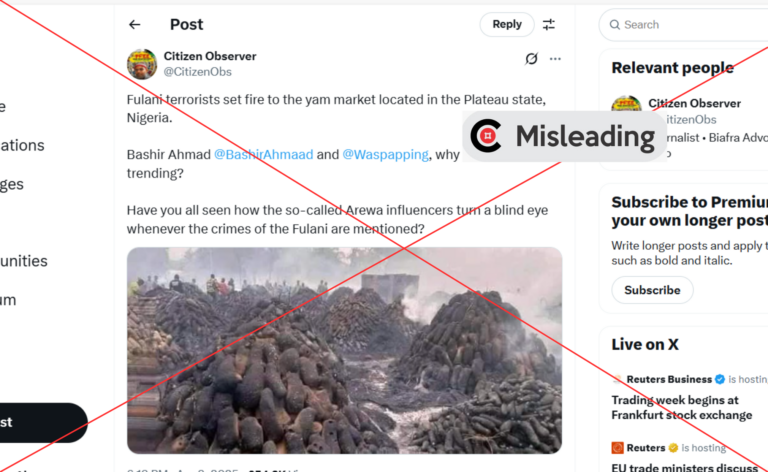
AN image showing piles of yams engulfed in flames has been circulated on X alongside a claim that it depicts a yam market allegedly set ablaze by terrorists in Plateau State recently.
An X account, Citizen Observer (@Citizensobs), posted the image with a caption thus:
“Fulani terrorists set fire to the yam market located in the Plateau state, Nigeria. Bashir Ahmad @BashirAhmaad and @Waspapping, why is this photo not trending? Have you all seen how the so-called Arewa influencers turn a blind eye whenever the crimes of the Fulani are mentioned?”
The post has generated over 600,000 views, with more than 5,000 reposts, over 6,000 likes and more than 1,000 comments as of April 9, 2025.
CLAIM
Image shows a yam market set ablaze in Plateau State.
THE FINDINGS
Findings by The FactCheckHub show that the claim is MISLEADING.
The FactCheckHub understands that the claim went viral due to the recent attack on Hurti community in Plateau State, which led to the killing of over 40 people, destruction of 383 houses and displacement of over 1,000 people.
Apart from attacking Hurti, the gunmen, suspected to be armed herders, also attacked other communities like Josho and Daffo in the Manguna District of Bokkos Local Government Area (LGA) of Plateau.
Plateau State has a history of conflicts, often between nomadic herders and indigenous farming communities, primarily over land and resource disputes.
Our fact-checker subjected the keyframes in the image to a Google Reverse Image search, and the results show that the image depicts a fire accident that rocked the popular Namu Central Yam Market of Qu’an Pan Local Government Area of Plateau State in 2021.
The fire had a devastating impact on the local community, with over 100 farmers and traders affected.
Daily Trust reported that the fire may have been caused by a spark from a grinding engine within the market, with dry grasses used to preserve yam heaps contributing to the rapid spread.
“The dry grasses used to preserve yam heaps at the market made it easy for the fire to rage quickly and spread widely. In effect, hundreds of farmers and traders were affected by the fire outbreak and are presently counting their losses,” part of the report reads.
There were no indications of terrorist involvement in this incident.
THE VERDICT
The claim that the image shows a yam market in Plateau State set ablaze recently by terrorists is MISLEADING; the image depicts a fire accident that happened in the state in 2021 and not recent.
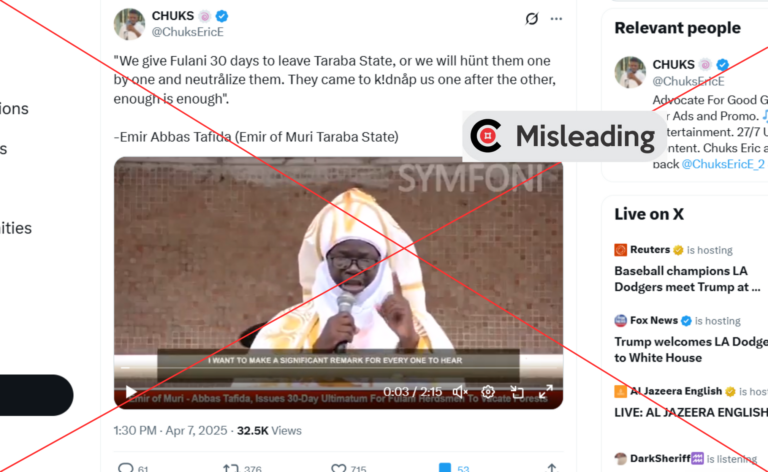
A video showing Abbas Tafida, the Emir of Muri kingdom in Taraba State, issuing a directive to herders to leave the state has resurfaced online.
According to the video, Tafida issued a 30-day ultimatum to herders terrorizing residents of the state to vacate forests within the state or be forced to do so.
An X user, Dr Crocs (@MgajiInnocent), posted the video with a caption that read:
“We give Bororo Fulani 30 days to leave Taraba State, or we will hunt them one by one and neutralize them, they come to kidnap us one after the other, enough is enough” ~Emir Abbas Tafida (Emir of Muri Taraba State). Dear @BashirAhmaad the Fulanis are not profiled.”
The post has generated over 200,000 views, with more than 1,500 reposts and more than 2,500 likes as of April 8, 2025.
Another X user, Aina Dipo (@dipoaina1) posted the video with another caption thus:
“Emir Abbas Tafida of Muri Taraba State: Has given the Bororo Fulani 30 days to leave Taraba State, or they will hunt them one by one and neutralize them, he further said Islam does not per this herders to be doing this heinous crime against humanity. If this isn’t fixed with time it will turn into something else. The respective security agency should take action and secure the lives and properties of the people.”
The post, now deleted, has generated 90 reposts and more than 100 likes as of April 8, 2025.
The video has also been shared by multiple users on social media as seen here and here.
CLAIM
Video shows Emir of Muri in Taraba State asking herders to leave the state recently.
THE FINDINGS
Findings by The FactCheckHub show that the claim is MISLEADING, as the video is not recent and has been online since 2021.
Our fact-checker observed that the claim gained traction online following a recent attack on the Hurti community in Plateau State, which resulted in the killing of over 40 people, the destruction of 383 houses, and the displacement of more than 1,000 residents, Punchreported.
screenshot of the viral post
In addition to Hurti, the assailants, suspected to be armed herders, also targeted other communities, including Josho and Daffo, located in the Manguna District of Bokkos Local Government Area (LGA), the report added.
Plateau State has long grappled with recurring violence, often stemming from tensions between nomadic herders and indigenous farming communities over land ownership and access to natural resources.
Like Plateau, Taraba State, located in the Northeastern region of Nigeria, is faced with heinous crimes ranging from kidnapping to bandit attacks.
Our fact-checker subjected keyframes in the video to a Google Reverse Image Search and the results show that the video has been online since 2021. An earlier version of the video can be seen here and here as published by credible media platforms.
After the Eid prayers held in July 2021, the emir issued a 30-day ultimatum to herders terrorizing residents of the state to vacate forests within the state or be forced to do so.
This followed a rising spate of kidnappings, killings, and attacks in the state by criminals suspected to be herders.
Tafida claimed that Fulani herders were responsible for perpetrating crimes in the state and should therefore vacate forests in the state within 30 days or be forced out.
The Emir who spoke in Hausa language urged the leadership of Fulani Herdsmen to fish out the bad eggs among them.
“Our Fulani herdsmen in the forests, you came into this state and we accepted you, why then will you be coming to towns and villages to kidnap residents, even up to the extent of raping our women?
“Because of this unending menace, every Fulani herdsman in this state has been given thirty days ultimatum to vacate the forests.
“We are tired of having sleepless nights, and the hunger alone in the land is enormous, and we will not allow it to continue,” the Emir said in 2021.
THE VERDICT
The claim that the video shows Emir of Muri in Taraba State asking herders to leave the state recently is MISLEADING, as the video has been online since 2021.
THE Labour Party presidential candidate in Nigeria’s 2023 election, Peter Obi, appeared on Arise Television‘s Prime Time on April 1, 2025, where he spoke about how the nation is faring under President Bola Ahmed Tinubu-led administration.
Obi spoke on various issues ranging from insecurity, unemployment and poverty as well as the political crisis in Rivers state, which led to the declaration of a state of emergency by the president.
In this fact-check, TheFactCheckHubassesses the veracity of some of his claims.
CLAIM 1
There are over 20 million children out of school in Nigeria.
THE FINDINGS
The United Nations Educational Scientific and Cultural Organization (UNESCO) 2020 Model Estimates on out-of-school children, published in 2022, states that almost 20 million Nigerian children are out of school.
According to the data, India, Nigeria, and Pakistan have the highest figures for out-of-school children globally.
The data show that the secondary school out-of-school population has grown by 61 per cent, from 6.3 million to 10 million since 2010.
Also, the number of primary school-aged children who are not in school also increased by 50 per cent, from 6.4 million to 9.7 million since 2010.
Globally, this puts Nigeria as the country with the third highest number of children deprived of education, only behind India and Pakistan.
THE VERDICT
The claim that over 20 million children are out of school in Nigeria is MOSTLY TRUE; the 2022 UNESCO data puts the estimate at 20 million.
CLAIM 2
South Africa is the largest economy in Africa.
THE FINDINGS
Checks by The FactCheckHub show that the claim is TRUE.
The Gross Domestic Product (GDP) is an indicator of any nation’s economic size. It measures the value of goods and services produced in a country over a certain period.
The International Monetary Fund (IMF), a global financial institution with 191 member countries, tracks and publishes economic data including GDP.
Nigeria was Africa’s biggest economic powerhouse between 2012 and 2016, based on IMF data. It dropped to second place in 2017 but returned to pole position the following year and maintained this spot until 2022. Egypt overtook Nigeria in 2023 to become Africa’s largest economy.
Infographics showing the top countries with highest GDP in Africa. Source : IMF
According to the IMF’s 2024 GDP estimates, South Africa is the biggest economy in Africa with a GDP Of $403.05 billion followed by Eypt and Algeria with GDP of $380.04 billion and $260.13 billion respectively. Nigeria’s economy is placed fourth with a GDP of $199.72 billion.
THE VERDICT
The claim that South Africa is the largest economy in Africa is TRUE; latest estimates by the IMF show.
CLAIM 3
A federal lawmaker can lose his seat in South Africa and UK for defecting to another political party.
THE FINDINGS
Findings by The FactCheckHub show that the claim is HALF-TRUE.
In South Africa, originally, Members of Parliament (MPs) who switched political parties would lose their seats. However, the. nation’s 1996 Constitution allowed for adjustments to this rule, leading to a bill in November 2001 that permitted floor-crossing within a designated two-week period without penalty. The President of South Africa, in consultation with party leaders and provincial premiers, had the authority to set the time frame for this process.
A subsequent law further refined the system, allowing MPs to change parties twice within a five-year term without losing their seats. However, defections were only permitted if at least ten percent of a party’s representatives agreed to switch, a measure introduced to prevent political opportunism. MPs wishing to cross the floor had to notifythe country’s Independent Electoral Commission (IEC), which is responsible for determining the specific timeframe during which the defection could occur.
However, in the United Kingdom, Members of the Parliament (MP) do not face any sanction when they cross the floor to another party but they may face pressure from other MPs and the public. They are also allowed to change their party affiliations at any time.
THE VERDICT
The claim that a federal lawmaker can lose his seat in South Africa and UK for defecting to another political party is HALF-TRUE, while there are laws and sanctions guiding floor crossing in South Africa, there is none in the United Kingdom.
CLAIM 4
The cost of Nigeria’s debt servicing is higher than its budget for education and health sectors.
THE FINDINGS
Findings by The FactCheckHub show that the claim is TRUE!
Nigeria’s 2025 budget highlights a significant allocation to debt servicing, which overshadows critical sectors such as education, healthcare and infrastructure. The government has earmarked ₦15.81 trillion for debt servicing—more than double the combined budget for education (₦3.5 trillion) and health (₦2.48 trillion), which together total ₦5.98 trillion.
This debt repayment figure also surpasses the cumulative allocation for key sectors, including security (₦4.9 trillion), infrastructure (₦4.06 trillion), education, and healthcare, which together amount to ₦14.95 trillion.
For context, in Nigeria’s 2023 national budget, debt servicing accounted for 29% of total spending, while education received 8%, healthcare 5%, and infrastructure 6%.
In 2024, the government planned to spend ₦27.5 trillion ($34.7 billion), with 30% allocated to debt servicing. Meanwhile, education will receive 7.9%, healthcare 5%, and infrastructure a similar proportion.
These figures highlight the country’s growing debt burden, which continues to limit investments in critical sectors essential for national development.
THE VERDICT
The claim that the cost of Nigeria’s debt servicing is higher than its budget for both education and health sectors is TRUE, as the nation’s budgets from recent years show.
CLAIM 5
Nigeria has less than 5% health insurance to comparable countries like Indonesia with 95%.
THE FINDINGS
Checks by The FactCheckHub show that the claim is FALSE!
A report from Nairametrics highlights that by October 2024, Nigeria had enrolled 19.18 million people in its health insurance programmes, representing about 8.9% of the population. According to the Director General, National Health Insurance Authority (NHIA), Dr. Kelechi Ohiri, this feat was at the end of Q3 in 2024.
In December 2024, the number grew to 19.2 million people; this was also disclosed by Dr. Ohiri in a report from the Punch.
Meanwhile, an article from The Jakarta Globe reports that as of August 2024, JKN coverage reached 98.19% of Indonesia’s population. JKN is the National Health Insurance Scheme of Indonesia.
However, the above data show that Nigeria’s health insurance enrollment is higher than the 5 per cent as claimed by Obi while the health insurance enrollment in Indonesia is currently put at 98.19 per cent.
THE VERDICT
The claim that Nigeria has less than 5% health insurance to comparable countries like Indonesia with 95% is FALSE. Data show that Nigeria’s health insurance sits at 8.9% while the enrollment rate in Indonesia is at 98.19%.
CLAIM 6
Nigeria has spent over N35 billion on its International Conference Centre (ICC).
THE FINDINGS
Findings by The FactCheckHub reveal that the claim is TRUE.
Nigeria’s president, Bola Ahmed Tinubu, during the ECOWAS Parliament inauguration on April 4, 2024, condemned the dilapidated state of the Abuja International Conference Centre, describing it as an ‘eyesore,’ and subsequently ordered its rehabilitation.
Following this directive, FCT minister, Nyesom Wike, suspended all activities at the facility on April 8, 2024, to allow the contractor to begin the renovation work. Wike emphasized that the restoration was critical to bringing the centre back to international standards, as its previous condition had significantly tarnished its reputation.
According to Wike, the Federal Capital Territory Administration (FCTA) has invested approximately N39 billion in the renovation of the Abuja International Conference Centre. As of March 2025, the project is 70% to 80% complete, with an expected completion date in May 2025.
THE VERDICT
The claim that Nigeria has spent over 35 billion on Nigeria Conference Center is TRUE, media reports show that 39 billion has been rolled out for the rehabilitation of Nigeria’s International Conference center.
CLAIM 7
Bangladesh with 148,000 square kilometers of land is producing about 60 million tons metric of rice and Nigeria with over six times of its size of land cannot do 10% of that.
THE FINDINGS
Findings by The FactCheckHub show that the claim is HALF-TRUE.
Bangladesh, with a total landmass of 147,570 square kilometers (56,977 Sq. miles), is one of the most densely populated countries in the world, and its agricultural land (130,170 sq km) is heavily utilized. Whereas Nigeria has more than six times the land area of Bangladesh, making it one of the largest countries in Africa with a total landmass of 923,768 square kilometers (356,667 sq miles).
The United States Department of Agriculture (USDA) estimates that Bangladesh’s rice production for the 2024/2025 marketing year is approximately 36.8 million metric tons (milled basis), and 54.9 million in (rough basis) slightly down from the previous year.
The harvested area is expected to be 11.5 million hectares, which is a 2% decrease compared to last year. This reduction in area is attributed to challenges during both the aus and aman seasons. Despite this, Bangladesh’s yield is forecasted to reach a record4.80 tons per hectare, which is a 2% increase from the previous year.
According to the data from USDA, Bangladesh has never produced 60 million tons of rice in milled and even rough production since 2014.
However, Nigeria in 2023/2024 produced 5.6 million metric tons in milled and 8.9 million in rough basis, according to the USDA data. But in January 2025, Punchreported that Nigeria’s rice production (rough basis) has dropped to 8.3 million, while the milled rice is pegged at 5.2 million.
In conclusion, Bangladesh highest rice production (rough basis) since 2014 was 55.5 million metric tons in 2023/2024 season while Nigeria’s highest rice production (rough basis) since 2014 was during the same 2023/2024 season and puts at 8.9 million tons. Thus, despite Nigeria’s landmass is truly over six times bigger than that of Bangladesh, its rice production is more than 10 per cent of that of Bangladesh – in fact, it is around 15-16%.
THE VERDICT
The claim that Bangladesh, with 148,000 square kilometers of land, produces about 60 million metric tons of rice while Nigeria, with over six times its land area, cannot produce 10% of its rice production is HALF-TRUE; Nigeria actually produces between 15-16% of that of Bangladesh.