Please note that the FactCheckHub has not obtained any right from the authors or copyright owners of all third-party contents from embedded links and shall incur no liability in this regard.
Please note that the FactCheckHub has not obtained any right from the authors or copyright owners of all third-party contents from embedded links and shall incur no liability in this regard.
Please note that the FactCheckHub has not obtained any right from the authors or copyright owners of all third-party contents from embedded links and shall incur no liability in this regard.
Please note that the FactCheckHub has not obtained any right from the authors or copyright owners of all third-party contents from embedded links and shall incur no liability in this regard.
ON June 16, a viral post on social media by Kiffasblog claimed that Denis Mukwege, a medical doctor and Nobel Peace laureate from the Democratic Republic of Congo, resigned from the Congolese government’s Coronavirus Response (Taskforce) Team after he was reportedly asked to declare any illness from patients, brought to hospitals in his province as Coronavirus Disease (COVID-19).
The post, which went viral on Twitter, Facebook, and among WhatsApp users in Nigeria, Cameroon and Kenya, etc, was also shared by a Facebook page, Feedback Express Show, on June 17. As of Friday, June 19, it has been shared 370 times and garnered 395 reactions with 99 comments.
FALSE CLAIM
The Claim
“I cannot in any case dirty my Nobel Peace Prize for money, we had been ordered to declare any illness to be Coronavirus and any death.
“In addition, the thing that displeased me is that, after more than 100 samples, none came out positive. I have a career to protect and I am Congolese by blood. Getting rich by lying is a sin before God, I quit,” the blogger stated quoting Mukwege.
The Findings
A fact-check by The ICIR revealed that Mukwege had earlier issued a statement explaining his position on why he decided to resign. This was published on June 10 on the website of Panzi Foundation RDC.
The ICIR reports that Mukwege had on Wednesday, June 10 announced his resignation as vice president of the Multi-sectoral Commission and president of the Health Commission at the Province of South Kivu.
Mukwege, a renowned gynaecologist had assisted over 30 rape victims and targets of sexual violence with medical care at the Panzi Hospital in Bukavu, a gesture that earned him the global peace award in 2018.
In the statement, Mukwege attributed his decision to resign his position to slow the testing of suspected COVID-19 cases due to lack of laboratories.
The obstetrician-gynaecologist also blamed the Congolese government and identified challenges of poor coordination and organisation among the team members.
These concerns were reported by credible international news media such as Washington Post, rfi, France 24 but to mention a few.
FALSE CLAIM
“Two major difficulties prevented us from effectively applying our strategy:
“On one hand, the impossibility of having in our province of RT‐PCR allowing to quickly confirm the diagnosis of COVID +. The time required, of more than two weeks, to receive the results of the samples sent to the National Biomedical Research Institute in Kinshasa, constituted a major handicap for our strategy based on “testing, identifying, isolating and treating,” he said in the statement.
He added: “On the other hand, a loosening of prevention measures by our population, denial of realities, the impossibility of enforcing barrier measures, the porosity of our borders with the massive return of thousands of compatriots from neighbouring countries without having been quarantined, decreased the effectiveness of our strategy.”
But a blog – Kiffasblog.com, contrary to Mukwege’s position reported wrongly why he resigned. Though the news report has since been deleted from the website, it has gone viral and shared many times on social media.
Four days after the statement was released, Mukwege took to his verified Facebook account to warn against deceitful statements that might be credited to him.
“Please note that all statements or press releases posted appearing to be in my name, that do not appear on our social networks or official sites (Panzi Foundation DRC, Panzi Foundation USA, Mukwege Foundation, and Panzi Hospital) are unauthorized and/or fraudulent statements,” he stated in the Facebook post.
Meanwhile, as of Thursday, June 18, 116 COVID-19 related deaths have been recorded in DR Congo with 5,282 confirmed cases, according to the World Health Organisation (WHO).
The Verdict
Based on The ICIR findings, the report on Dr. Mukwege by Kiffasblog is FALSE.
A VIRAL post on WhatsApp claimed that the Lagos University Teaching Hospital (LUTH) admits not less than 500 COVID-19 patients on a daily basis.
The report has been circulating on various WhatsApp group in Nigeria for days.
The claims
“The coronavirus pandemic is now spreading rapidly in Lagos. Use your face masks all the time. Avoid going out unless necessary. Avoid entering commercial buses
“My LUTH consultant friend is just telling me that LUTH Lagos admits not less 500 coronavirus patients daily. At the moment, 9 LUTH Professors are presently on admission at LUTH for COVID. So let’s be extraordinarily careful.”
“To wrap this confirmation – Covid-19 is real… and anybody can be infected…,” a part of the WhatsApp text reads.
Screenshot of the viral WhatsApp post
From the above, two claims were established:
· LUTH admits not less down 500 COVID-19 patients on a daily basis
· 9 Professors from the LUTH are on admission due to COVID-19
The findings
In a bid to curtail the Coronavirus pandemic, the Lagos State Government established at least 8 isolation centres in the state to manage COVID-19 patients.
“Gbagada General Hospital – 118; Lagos University Teaching Hospital, Idi- Araba – 60; Infectious Disease Hospital, Yaba – 115; Onikan Stadium Centre – 100; Landmark Centre – 70; Lekki Centre – 45; Agidingbi Centre – 34 and First Cardiology Hospital – 5 (Critical Care),” the Health commissioner stated.
But in a telephone conversation with TheICIR on Thursday, a Professor of Medical Virology, Prof Sunday Omilabu, who is also a Consultant Virologist and Director of Central Research Laboratory (CRL), College of Medicine, University of Lagos/Lagos University Teaching Hospital (CMUL/LUTH) disclosed that the capacity of the LUTH Isolation Centre is just 120.
“LUTH isolation centre is just 120 capacity, and we are even yet to exhaust the capacity. The claim that we admit 500 patients on a daily basis is fake,” he told The ICIR.
Commenting on the second claim that 9 professors from LUTH were on admission due to COVID-19, Professor Omilabu said: “This is totally fake news”.
Further findings by The ICIR from other unofficial sources also corroborated Prof. Omilabu’s comment, thus showing that the WhatsApp post was full of FALSEHOODS.
“It’s fake news; LUTH doesn’t admit 500 COVID-19 patients on a daily basis,” LUTH’s spokesman, Mr Kelechi Otuneme, told The ICIR.
He also refuted the claim that 9 professors from the hospital were currently COVID-19 patients.
“This is far from the truth,” Otuneme said.
The verdict
Based on all available information obtained by TheICIR, it is evident that the claims are FALSE.
ON June 16, several news platforms and blogs reported that the Nigeria Economic Sustainability Committee (ESC), Chaired by the Vice President Yemi Osinbajo, recommended the suspension of the compulsory National Youth Service Corps (NYSC) for Nigerian graduates for the next two years.
Though few news organisations reported the information accurately, many other news platforms got it wrong, and the wrong version has since gone viral on social media.
The claim reported by NYSC.info
THE CLAIM
“The Economic Sustainability Committee (ESC) chaired by Vice President Yemi Osinbajo has asked the Federal Government to suspend the National Youth Service Corps, NYSC, for two years.”
FINDINGS
The ESC was established by President Muhammadu Buhari on March 30, 2020 and his Vice, Osinbajo, was made the Chairman of the committee to oversee activities of the team.
Part of their responsibilities was to provide a clear cut policy direction to support each sector of the economy, as well as possible interventions with the main target for job creation amidst effects of the Coronavirus (COVID-19) pandemic.
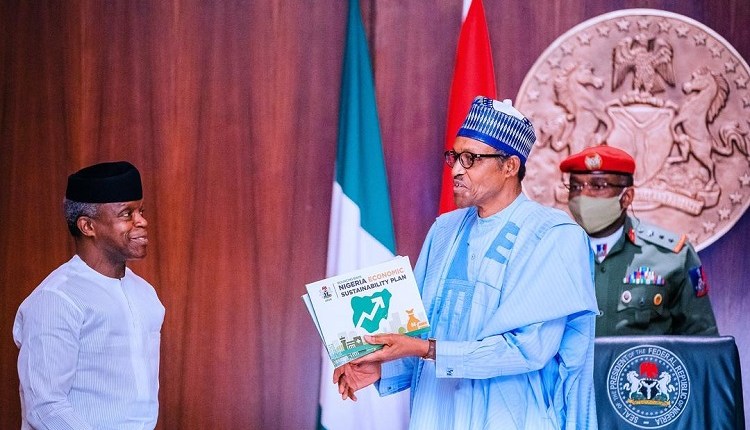
On June 11, 2020, Osinbajo officially submitted the economic sustainability plan to the President at the Presidential Villa in Abuja.
The 76 pages document was titled: “Bouncing Back: Nigeria Economic Sustainability Plan.”
The vice president the economic plan would avert the looming, “impending economic headwinds,” thus, convert the anticipated crisis to success stories for Nigerians.
It was also developed to reduce non-essential spending, spell out specific measures to support the State and the Federal Capital Territory (FCT) and place the nation’s economy on solid foundation against the pandemic, among others.
The major categories of the plan are the Fiscal Monetary Measures and the Real Sector Measures.
From the real sector which includes education, the document suggested practical measures such as virtual learning, virtual convocation and using of technology tools at all levels of education to address disruptions caused by the pandemic.
However, on the reported claim on NYSC, the document only suggested that the compulsory NYSC orientation camp should be suspended for two years, and not the NYSC scheme in particular.
Section of the 2020 Nigeria Economic Sustainability Plan that reflects the Committee’s true recommendation. Document Source: Federal Ministry of Information and Culture
This, based on the recommendation, is to prevent a backlog of the NYSC postings.
“In similar context, consideration will be given to suspending the National Youth Service Corps (NYSC) Orientation Camp Exercises for at least 24 months while allowing deployment to places of primary assignment,” the document stated.
“This will ensure that there is no backlog in the National Service placement pipeline.”
VERDICT
Based on the statement of the vice president as documented in the Economic Sustainability Plan, the claim reported by many news websites including those listed above is FALSE and MISLEADING.
A news story, published by Legit.ng on Wednesday, June 10 claimed that a Nigerian man has invented a machine that could transform nylons and plastics into petrol.
The report, titled: “Brilliant! Nigerian man invents machine that transforms nylons and plastics into petrol (photos),” has garnered about 60,000 views on the website and shared at least 462 times on Facebook with over 400 likes and 129 comments as of Monday, June 15.
THE CLAIM
The story claimed that Emeka Nelson Ugwueze, a Nigerian invented a machine that could transform nylons and plastics into petrol.
Published on the website with photos embedded, the story read: “A Nigerian man has invented a machine that might develop Nigeria for the better – The man built a machine that transforms waste into petrol, Kerosene and Diesel.
“It was reported that the machine can also transform waste into tiles and roofing sheets.
Mr. Ugwueze. Insert: his ‘plastic-to-fuel’ machine.
“Emeka Nelson, a Nigerian from the eastern part of the country, remains celebrated in his own right for being able to create a machine that converts wastes to petrol. The machine does other things and there is hope that Emeka’s innovation will help Nigeria’s struggling economy.
“The young man shared a posting, stating what the list of things the machine can do with photos of the invention on his Facebook page. On the Facebook post, the young Nigerian man reported that the machine transforms hydrocarbon related wastes like plastic, nylon and so on.”
THE CHECK
Independent findings by TheICIR confirmed that Mr. Ugwueze actually fabricated the machine and posted it on his Facebook page on October 31, 2018 (about 20 months ago).
Ugwueze in an interview with The ICIR said: “Yeah, it’s true, it can make diesel, petrol, kerosene. A single machine can do all that depending on the design but we found out that the efficiency can be low. So now, we’ve decided to split them so that they (machines) do single thing. For instance, if we want to transform the plastics into pavement blocks or whatever, each one has its own different machine that does that.
“The one that converts plastics to petrol, diesel or whatsoever in that regard is more complex. So, it’s a different machine for that. But technology has made it possible that we can incorporate so many things into one; it’s just like combining two different machines into one.”
When asked if he knew why the platform decided to republish his Facebook post of about two years as fresh report, Ugwueze said: “I don’t know, I don’t know.”
“Whatever they posted there was actually an earlier design. The improved one (machine) we’ve been working on is still doing same thing. But we’re just trying to increase its efficiency,” he said.
Ugwueze added: “at some point, I just talk less and no longer post them (online). They didn’t reach out to me; but what they published wasn’t far from the truth.” He noted that he has improved on the designs published by the platform, adding “but I have kept it personal.”
Further investigation by The ICIR revealed that there are actually incinerating plants or machines that recycle plastics through chemical processes such as gasification and pyrolysis.
Gasification and pyrolysis are completely different processes to simply incinerating the plastic. Gasification and pyrolysis can produce electricity or fuels, and provide more flexible ways of storing energy than incineration, Muxina Konarova, a senior Research Fellow at The University of Queensland, Australia wrote in theconversation.com
She added that gasification involves heating the waste plastic with air or steam, to produce valuable industrial gas mixtures called “synthesis gas”, or syngas. “This can then be used to produce diesel and petrol, or burned directly in boilers to generate electricity.”
“In pyrolysis, plastic waste is heated in the absence of oxygen, which produces mixture of oil similar to crude oil. This can be further refined into transportation fuels,” she opined.
PHOTO CREDITS: Theconversation.com
Dr. Anjan Ray, Director, CSIR-Indian Institute of Petroleum, also pointed out that “The fuel obtained from conversion of plastic is completely environmentally friendly due to absence of any toxic substances. Apart from producing petroleum and diesel, this technology will also ensure that urban and semi-urban areas become plastic free, as instead of disposing plastics as waste, they can be converted to fuel.”
“Countries like Japan, Germany and the United States have already implemented the plastic to fuel conversion process with much success. These three also have been successful in creating business models out of the conversion process, resulting in the conversion model becoming a profitable business one,” Saptarshi Dutta also wrote on NDTV.com.
Estimates show that less than 5% of the plastic manufactured each year is recycled, with production of the material set to increase by 3.8% every year until 2030, adding to the 6.3 billion tonnes churned out since production began 60 years ago, according to the National Geographic (NatGeo) channel.
The ICIR reports that the plastics-to-fuel ecosystem if supported could provide major economic benefits to the nation, not only through job creation but also by curbing environmental pollution.
THE VERDICT
The claim was TRUE, however Legit.ng was re-circulating the Facebook post earlier made about two years ago by Mr. Ugwueze as fresh news. And this is MISLEADING.
On June 11, 2020, a popular entertainment news blog known as weddingdigestnaija.com reported that Pastor Enoch Adeboye, General-Overseer of the Redeemed Christian Church of God (RCCG) allegedly threatened to kill anyone that ‘messes’ with his wife, Folu Adeboye.
The report, which was also published by other online news platforms, claimed that the strict warning was issued to the general public during the clergy’s virtual morning devotion last week. It was posted on the clergy’s verified Instagram account: @PastorEAAdeboyeOfficial with the topic: Joys of Having a Successful Marriage.
The Claim
“You have heard me say it before. You can do whatever you like to me, you can criticize me, you can insult me, you can trample on me, I will only pray for you. But if you mess around with my wife, I will kill you,” the report stated, quoting Adeboye.
“I will kill you so thoroughly you won’t even be able to rise on the resurrection morning. When some people ask how are you going to do that, I tell my daddy to send you to hell straight away, so that there will be no need to come forward for judgement.”
Findings
The ICIR’s findings revealed that the video footage is real and the comment true, as it was also posted on the verified Instagram page of the clergy named @pastoreaadeboyeofficial on 4th June, 2020.
In the sermon, the clergy spoke on how couples could enjoy a successful marriage based on Biblical teachings. He established some of these teachings with different Biblical passages including Ephesians 5: 20-30.
For instance, while he encouraged women to submit to their husbands irrespective of the academic qualifications and status, he tasked men to love their wives, just as Christ loves the church.
Based on the context of the teaching, the two adults he identified are man and woman. But on the claim to kill anyone that ‘mess’ with his wife, Adeboye emphasised that a man should love his wife to the extent that he could give his life for hers.
“The only big problem comes when you asked the question, how much love must I have for my wife? And the Bible made it clear, as Christ loves the church. That is a big one because it means you have to love your wife to the extent of being willing to die for her,” he stated in the 36 minutes and 34 seconds footage.
The influential clergy particularly stressed that he would not shoot the person, as the government could only arrest him if he uses any lethal weapon. However, he said his divine power would come against such an individual.
“…who told you I’m going to shoot the fellow? You can only arrest me if I use any human weapon. To mess around with my wife, then every power God has given me will descend on you.”
“Why? Because the Bible says you are to love your wife as Christ loves the church that he gave himself for man,” he said, describing the act of love as an assignment of every husband in marriage.
Adeboye insisted further that husbands should develop such love for their wives only. He buttressed the teachings in Yoruba language, after citing examples including that of two couples who were both Professors.
“Husbands will forever be husbands, but you, the husband must love your wife. That should not be difficult until the Bible added that as Jesus loves the church….”
“That made it a bit difficult because it implies that you must be ready to die for your wife,” he stated.
Further findings revealed that the clergy disassociated himself from the actual killing but would rely on divine help.
THE VERDICT
Though the claim that Adeboye threatened to kill anyone who messes with his wife is TRUE, the short footage was taken out of context, to MISLEAD members of the public.
THE Nigerian President, Muhammadu Buhari, in the speech delivered on Friday, June 12, 2020 to commemorate the national Democracy Day, claimed that “all the Local Governments that were taken over by the Boko Haram insurgents in Borno, Yobe and Adamawa have long been recovered and are now occupied by indigenes of these areas…” The claim has stirred intense public reactions offline and on the internet.
Buhari, while giving stewardship account of his All Progressives Congress (APC)-led government in the area of national security during the presidential broadcast, had claimed that the local government areas in three north-eastern states of the country – Adamawa, Borno and Yobe – hitherto known for relentless insurgency since almost a decade ago have been secured as the areas “are now occupied by indigenes of these areas who were hitherto forced to seek a living in areas far from their ancestral homes.”
All the Local Governments that were taken over by the Boko Haram insurgents in Borno, Yobe and Adamawa have long been recovered and are now occupied by indigenes of these areas who were hitherto forced to seek a living in areas far from their ancestral homes.
Parts of his speech read: “In the area of security, we remain unshaken in our resolve to protect our national infrastructure including on-shore and off-shore oil installations, secure our territorial waters and end piracy in the Gulf of Guinea.
“Ending insurgency, banditry and other forms of criminality across the nation is being accorded appropriate priorities and the men and women of the Armed Forces of Nigeria have considerably downgraded such threats across all geo-political zones.
“All the Local Governments that were taken over by the Boko Haram insurgents in Borno, Yobe and Adamawa have long been recovered and are now occupied by indigenes of these areas who were hitherto forced to seek a living in areas far from their ancestral homes.
“The total collapse of the economies of these areas, which constituted a threat to our food security, has also been reversed with the gradual recovery of farming and other economic activities.
“I regret recent sporadic incidents with tragic loss of lives in Katsina and Borno States as a result of criminals taking advantage of COVID-19 restrictions. Security Agencies will pursue the perpetrators and bring them to swift justice.
“I must implore state and local governments to revamp their intelligence assets so that the Security Agencies can nip in the bud any planned attacks in remote rural areas. I send my heartfelt condolences to all the relatives and communities affected.
“As part of the strengthening of our internal security architecture, the Ministry of Police Affairs was created.
“Amongst others, Government has expanded the National Command and Control Centre to nineteen states of the federation, resuscitated the National Public Security Communication System and commenced the implementation of the Community Policing Strategy.
“Government has similarly established a Nigerian Police Trust Fund as a public-private sector vehicle for alternative sources of funding security activities.
“To reduce security challenges through our external borders especially smuggling of oil products out of the country, inflow of small arms and drugs into the country and equally protect our local manufacturers, we introduced operation “Ex-Swift Response” closing our borders from August 20th 2019, and have considerably succeeded in meeting its objectives as well as improving our national revenue.”
THE CHECK
A fact-check investigation by The ICIR shows that contrary to the victory claim by the Nigerian president against the Boko Haram insurgents, “the fight is still ongoing,” according to the nation’s Army chief, General Tukur Buratai.
A news report published on Monday, June 8 on Daily Trust website quoted Buratai as saying that “The fight is still ongoing and over 1,429 Boko Haram terrorists have been neutralised and we have arrested over 166 Boko Haram terrorists informants, their spies, couriers on logistics and their coordinators in the villages, the towns and even the forest.”
Nigeria’s Army chief, General Tukur Buratai.
Buratai disclosed this on Monday at the Presidential Villa, Abuja, while speaking with journalists on his two months’ sojourn in the theatre of war (North East) after briefing President Buhari.
“So, this is a tremendous achievement, our intelligence corps along with the Department of State Services and of course our good friends the civilian Joint Task Force (CJTF), have worked very hard to see that this is achieved and I assure you that things will continue to improve as the days go by,” the Army chief added.
Media reports within the week indicated that Boko Haram insurgents were still in control of several villages and remote areas especially in Abadam, Damboa, Guzamala, Gubio, Bama, Konduga and Mafa local government areas of Borno state, from where they launched deadly attacks on other parts of the state.
Though no recent attack was reported in Yobe and Adamawa as of June 11, 2020, the insurgents’ attack on Dapchi, headquarters of Bursari local government in Yobe state on May 18, 2020 still leaves some residents displaced, as the attackers set fire on the palace of Dapchi District head, media reports noted.
On Tuesday, 69 persons were killed and seven others abducted by the Boko Haram insurgents at Foduma Kolomaiya village, in Gubio local government area of Borno state, but the state governor, Professor Babagana Zulum, on Wednesday confirmed that 81 civilians were buried following the attack, media reports stated.
“It is the most deadly attack in recent times. The location of the village made rescue mission a bit difficult. Many people were killed and others missing because the attackers waylaid the village in broad daylight, surrounded it and opened fire,” a source told Daily Trust.
It said insurgents from the Islamic State West Africa Province (ISWAP) in trucks equipped with machine guns, attacked the Auno base, 25 kilometres from Maiduguri, Borno’s capital.
“We lost six soldiers in the attacks which the terrorists launched around 6:30 pm (1730 GMT), on Saturday,” a military officer told AFP. “A search is ongoing for 45 soldiers who are still unaccounted for but we assume they escaped during the attack and are yet to return,” the second source said. Auno lies on a 120-kilometre highway linking Maiduguri and Damaturu in neighbouring Yobe state. The area has been repeatedly targeted by militants who attack troops and abduct motorists at bogus checkpoints.
Also, a weekly report by the Nigeria Security Tracker, published on the Council on Foreign Relations (CFR) website also revealed fighting between Boko Haram insurgents and the Nigerian military in two of the three north-eastern states, as they battle for control of the areas.
On May 26, Nigerian troops killed seventy-five Boko Haram militants in Bama, Borno, it said.
It listed incidence of violence related to the Boko Haram insurgency from May 30 to June 5 as follows:
May 30: Boko Haram killed two in Askira/Uba, Borno.
May 31: A Boko Haram suicide bomber killed herself but no others in Konduga, Borno.
June 1: Boko Haram killed four in Konduga LGA and four in Damboa LGA, Borno.
June 1: Nigerian troops killed one Boko Haram militant in Madagali, Adamawa.
June 2: Boko Haram kidnapped one soldier and three aid workers in Guzamala, Borno.
June 2: Nine Boko Haram militants and one soldier were killed during a clash in Kukawa, Borno.
June 3: Nigerian troops killed six Boko Haram militants in Konduga, Borno.
Professor Zulum, in two separate reports published by Daily Trust this week also confirmed that many displaced persons were still homeless, as the state government races against time to house them and provide them with sustainable means of livelihood.
The IDPs, now staying in Bama town, according to the report, were mostly from villages sacked by insurgents in Banki, Gulumba, Jaudari and Nguro Soye, in Bama local government area and in Ajiri, a community in Mafa local government area of Borno state.
Prof. Zulum seated with some villagers on Wednesday when he visited the scene of Tuesday’s Boko Haram attack in Gubio LGA of Borno state. PHOTO CREDITS: Daily Trust/ Olatunji Omirin
The rising spate of Boko Haram attacks in north-eastern Nigeria also worried the nation’s lawmakers, as the Senate President, Ahmad Lawan, and the Speaker, House of Representatives, Femi Gbajabiamila, reportedly plan to meet with President Buhari over the issue.
Addressing parliamentarians on Thursday in Abuja, Lawan, who spoke while giving his remark to a motion on the resurgence of Boko Haram attacks in some parts of Borno state by Senator Abubakar Kyari (APC, Borno), said: “Boko Haram has now become an industry. It is an industry because what they do is no more religious. They have people from different faiths, different countries among them.”
Earlier in his lead debate, Senator Abubakar Kyari, noted that the attacks had become worrisome in view of the fact that the Nigerian Army had recorded successes recently in their fight against the insurgents, adding that the attacks had resulted in the killings of people and other dastardly acts like kidnapping, cattle rustling and displacement of communities.
While charging the security agencies to deploy more personnel and equipment to critical areas of the Lake Chad shores to flush out the insurgents, the lawmakers urged the federal government to provide enough equipment to the troops prosecuting the ‘Boko Haram war.’
Further report by John Campbell, a Conflict and Security expert and Ralph Bunche Senior Fellow for Africa Policy Studies also confirmed the presence of Boko Haram insurgents in the north-eastern states.
“They operate freely in Borno and Yobe States, and in adjacent parts of Cameroon, Chad, and Niger. They share the goal of destroying the Nigerian secular state and establishing a new polity based on their idiosyncratic seventh-century interpretation of Islamic theology and law,” Campbell wrote in the report.
The ICIR reports that the Boko Haram insurgency had claimed more than 37,500 lives since May 2011, displaced an estimated 2.7 million people in the Lake Chad Basin and turned 292,510 Nigerians into refugees in Chad, Cameroon and Niger as of May 31, 2020, according to data obtained from the United Nations High Commissioner for Refugees (UNHCR).
THE VERDICT
All evidence available in public domain invalidates the claim by President Buhari as several media reports indicate that some areas in these three north-eastern states are still suffering from recurring Boko Haram attacks while many residents of these areas have fled to and/or still living in Internally Displaced Persons (IDPs) camps hosted by their respective state governments. The claim is absolutely FALSE.
THE Guardian (Nigeria) newspaper on Friday, June 5, 2020, reported that “By July 10 this year, Nigeria may lose 24 local councils, by way of ceding, to a new country to be known as United Nations Organisation (UNO) State of Cameroon at its borders with la Republique du Cameroun.” The report has generated reactions from the public both in Nigeria, Cameroon as well as in the international community.
The report, published by some Nigerian newspapers and online news platforms, was titled: “Nigeria may lose 24 councils to new UN state”
THE CLAIM
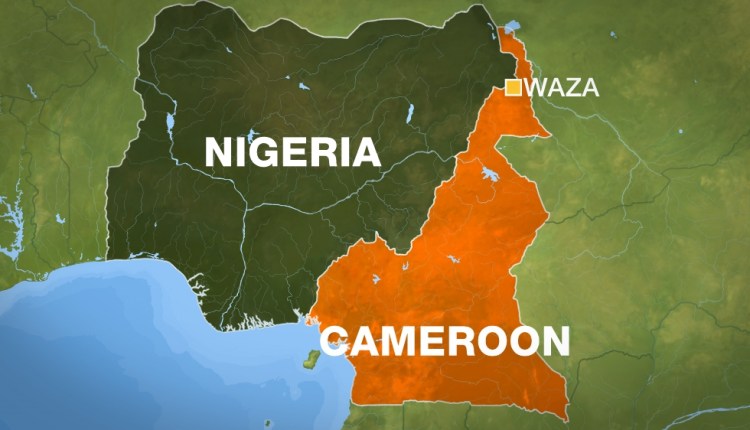
The report claimed that Nigeria may lose 24 local government areas to a new country to be known as United Nations Organisation (UNO) State of Cameroon, which shall be carved out from parts of Nigeria and Cameroon.
Pillar construction project at Taraba State (Nigeria)/North West Region (Cameroon): Nigerian customs officer (right) of Cross River State’s local Boki government inspects location of newly erected Primary Pillar BP 67 (boundary pillar), which replaces the old “Anglo-German Pillar. Credit: UN Photo/MABAYA
The report stated further that President Paul Biya has commenced the withdrawal of his country’s soldiers from the southern part of the new state.
“The withdrawal of troops by Biya was formally demanded by the former President of the United Nations General Assembly, Ali A. Treki on May 20, 2020,” The Guardian reported.
The UN, according to recent reports, pledged to actualize a new State of Cameroon on July 10, 2020, which will be known as the UNO State of Cameroon or simply as “Ambazonia.”
The media report has been trending online since the news broke out on Friday. So far it has been shared severally by hundreds of internet users especially on Twitter and Facebook, including @Amaka_Ekwo, the Press Secretary to Nnamdi Kanu, the leader of the proscribed Biafra group, IPOB.
THE CHECK
A fact-check investigation by The ICIR shows that the United Nations (UN) is not creating a new country in Africa though there had been agitations for the creation of Ambazonia State by some leaders from Southern Cameroon.
The Director, United Nations Information Centre for Nigeria, Ronald D. Kayanja, on Monday, denied the media report in a terse response to an email enquiry by The ICIR.
“This is fake news. Should be disregarded,” he said.
UN Helicopter Support to the CNMC lands on Gotel Mountain (Cameroon/Nigeria), to reach border areas of difficult access during the delineation of the two nations’ boundaries. Credit: UN Photo/BARIL
Bashir Ahmaad, an aide to the Nigerian President, Muhammadu Buhari, has also debunked the report.
He said: “Nigeria may lose 24 councils to new UN state” you might have read this story on the Guardian newspapers, WhatsApp or somewhere else, the story is 100 per cent fake, fabricated, maybe for an agenda only best known to those that started the spreading the fake news.”
“Nigeria may lose 24 councils to new UN state” you might have read this story on the Guardian newspapers, WhatsApp or somewhere else, the story is 100% fake, fabricated, may be for an agenda only best known to those that started the spreading the fake news.
Similarly, Barrister Abdul Oroh, a solicitor to some detained leaders of Southern Cameroon agitators who were currently facing trial in Cameroon, told The ICIR that the Southern Cameroonians were unaware of the UN attempt to create the new State. He said all his sources in Southern Cameroon denied knowing anything about it.
When The ICIR reached out to Nigeria’s Ministry of Foreign Affairs, its spokesperson, Ferdinand Nwonye could not be reached on his mobile line. Text messages sent to him since Friday were not replied either.
The ICIR also reports that the October 10, 2002 ruling of the International Court of Justice (ICJ) at The Hague on boundary dispute between Nigeria and Cameroon only delineated boundaries between the two nations; it didn’t make any provision for the creation of an autonomous State to be carved out of the two countries.
Following the world court judgement, the Cameroon-Nigeria Mixed Commission (CNMC) was established in November 2002 by the UN Secretary-General at the request of Presidents Paul Biya and Olusegun Obasanjo of Cameroon and Nigeria respectively.
The goal of the CNMC was to facilitate the implementation of the 10 October 2002 judgement of the International Court of Justice (ICJ) on the Cameroon-Nigeria boundary dispute.
THE VERDICT
There is no evidence to support the claim that the UN is creating a new state from parts of Nigeria and Cameroon. Therefore, the report is FALSE.
A REPORT which claims that the South-South zonal head of Nigeria’s anti-graft agency, the Economic and Financial Crimes Commission (EFCC), Ishaq Salihu, addressed a group of protesters in its Port-Harcourt office, Rivers state recently over the trial of George Turnah has started spreading like wildfire on WhatsApp.
Turnah, a lawyer, is an aide to a former managing director of the Niger Delta Development Commission (NDDC), Bassey Dan-Abia.
The report, shared on WhatsApp on Tuesday, June 2, and published by a few online news platforms in Nigeria, was titled: “Youths in Niger Delta protest EFCC arrest but were shocked to hear…”
THE CLAIM
The report claimed that youths stormed EFCC’s South-South office in Port Harcourt, Rivers State, “describing Turnah’s arrest as an act of injustice, saying he is a good man with a good heart. They stayed there demanding his unconditional release. The EFCC South-South Zonal head, Ishaq Salihu, instead of pushing away the protesters, called them together and began to educate them.”
It added: “If I tell you all how this young man has contributed to the underdevelopment of your region, you will be ashamed to be here…
“Next time, before you join this kind of protest, ask yourself what his source of income is as compared to his flamboyant life. I will leave your conscience to communicate with you.”
The report further noted that “Immediately the EFCC South-South head ended his speech, the protesters were all cold, they could not utter a word again, one by one, they started dropping their placards, and before you know it, even his close associates who were all there, were shocked at the revelations, they too threw away their placards, everybody went back home.”
THE CHECK
Verification of the claims by The ICIR shows that George Turnah was neither rearrested by the EFCC nor was there any recent protest by any Niger Delta youth group on his case with the anti-graft commission.
EFCC spokesman, Dele Oyewale, confirmed this in a text message to The ICIR Nigeria on Tuesday.
“We are still in court against George Turnah. His trial started in 2016. He was never re-arrested, please. Thanks,” Oyewale stated.
Also, several Google searches revealed that the claim is at least three years old as the exact content of the report was first posted online on Nairaland, a popular Nigerian blog, on June 1, 2017, and subsequently published word for word on several online websites including Thenigerialawyer.com, Echonigeria.com and blogs such as Ajisamvoice.blogspot.com .
Facebook pages such as Daily Crime Reporters and InfotrackNaija had also shared the same report in the last four days. An online news platform, Observertimes.com, also posted the same report as an exclusive on its website on June 1, 2020.
Findings by The ICIR indicated that several protests were held between May and July 2017 regarding Mr. Turnah’s case, but no mainstream media reported that EFCC’s Salihu addressed any group of protesters during the period.
According to an EFCC release of May 26, 2017, some protesters, under the aegis of Niger Delta Volunteer Services Scheme, and Celtic Pride and Event Limited (employees of Turnah), visited EFCC office in Port Harcourt, on that day but they were not addressed by EFCC zonal head, Mr.Salihu.
Rather, the press release said that “the protesters were received by Mrs.Akpos Ekisowei of the Public Affairs Department on behalf of the EFCC, who promised to convey their message to the appropriate authorities.”
The Punch newspaper’s report of July 1, 2017, also confirmed another protest by youth groups “from nine states of the Niger Delta” who visited the zonal office of the EFCC in Port-Harcourt on Friday, June 30, 2017. However, the newspaper only reported that an unnamed “top officer of the EFCC, promised the protesters that the commission would ensure justice was made in the matter.”
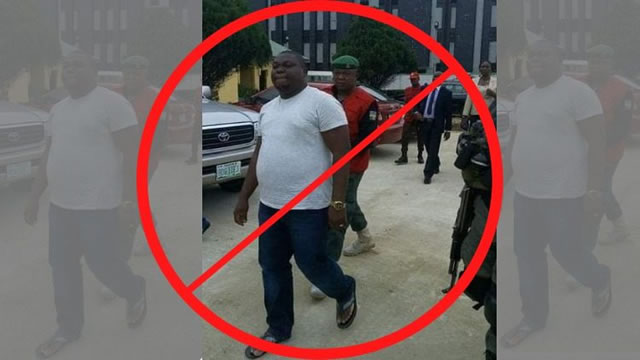
Our findings also revealed that a picture of Mr. Turnah’s arrest which has been circulating online since about four days ago, especially on Twitter and Facebook, alongside the report, first emerged online early 2017 when he was first arrested by the EFCC. The same picture reposted on May 31, 2020 by one Twitter account user, @Gen_Buhari, had over 1,000 likes and over 1,100 retweets as at Wednesday noon.
A call to Mr. Turnah’s mobile phone number by The ICIR to verify if he was rearrested was not connecting as his line was unreachable at the time of filing this report.
The resurfacing of a 2017 post might be connected to a current controversy over financial mismanagement at the NDDC, which has led to an investigation by Nigeria’s National Assembly.
It will be recalled that the Interim Management Committee (IMC) of NDDC headed by its acting Managing Director, Kemebradikumo Pondei, and the Executive Director of Projects, Cairo Ojougboh, had recently engaged Nigerian lawmakers in a brawl of accusation and counter-accusation.
While the lawmakers accused the IMC of alleged financial misappropriation, the commission had accused members of the Nigerian parliament of allegedly padding the 2019 budget of the NDDC.
The Senate and House of Representatives had on May 5, 2020, resolved to investigate how the IMC of the NDDC allegedly squandered N40 billion within three months and thereafter set up an adhoc committee headed by Senator Olubunmi Adetunbi (APC, Ekiti North) to look into financial transactions carried out by the IMC on behalf of the commission within the period and present a report this June.
But the NDDC management, who has since denied the allegation, however, accused Senators and members of the House of Representatives of allegedly inserting over 500 projects into the 2019 budget of the commission and were arm-twisting the Interim Management Committee (IMC) from carrying out a forensic audit as directed by President Buhari. Mr Ojougboh also said the House of Representatives “vandalized and raped” the 2019 budget by adding ₦85 billion to the budget.
A statement by the Special Adviser (Media and Publicity) to President Buhari, Femi Adesina, said the president gave the directive after receiving governors of the states that make up the NCDC, led by Governor Seriake Dickson of Bayelsa State. The president had said what was presently on ground in the South-South region did not justify the huge resources that had been made available to the agency.
THE VERDICT
There is no evidence to support the claim that Mr. George Turnah was recently rearrested by the EFCC. Similarly, there was no recent protest by any Niger Delta youth group regarding his case with the anti-graft commission, which is already before the Federal High Court, Port Harcourt.
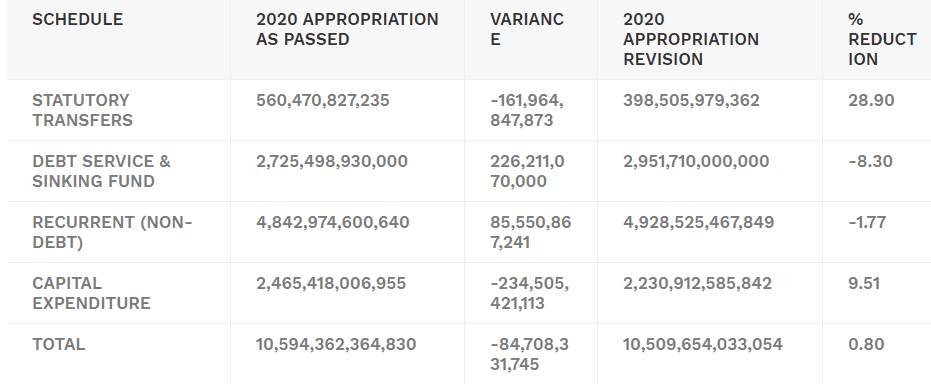
A REVIEW of the Revised 2020 Budget exclusively obtained by DATAPHYTE indicates that the Federal Government has reduced the total budget size by only ₦84.71 billion. Against the background that the government initially proposed a ₦1.5 trillion budget cut (over 14 percent reduction of the total budget size), the new cut is low.
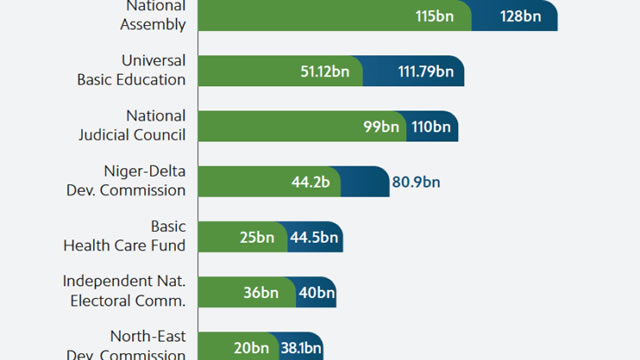
On a close look, the revision proposes less than one percent reduction to the initial budget size. With less than one percent budget reduction, one wonders the real essence of the whole budget review attempt. In addition, the budget review dampens the hope of many the Nigerians optimistic of a reduction of the enormous cost of governance. Budget for the National Assembly only reduced by 10 percent while the budget for the Presidency reduced by only 9.75 percent.
Revised 2020 Budget across Main Expenditure Items
The composition of the revised budget implies more dilemma for Nigeria’s development aspiration. Across Nigeria’s four main expenditure items, only the budgetary provisions for statutory transfers and capital expenditure have been reduced. While statutory transfers decreased by 28.9 percent, capital expenditure reduced by close to 10 percent. Against the background that budgetary provision to development propellants continue to be low, the reduction is not satisfactory.
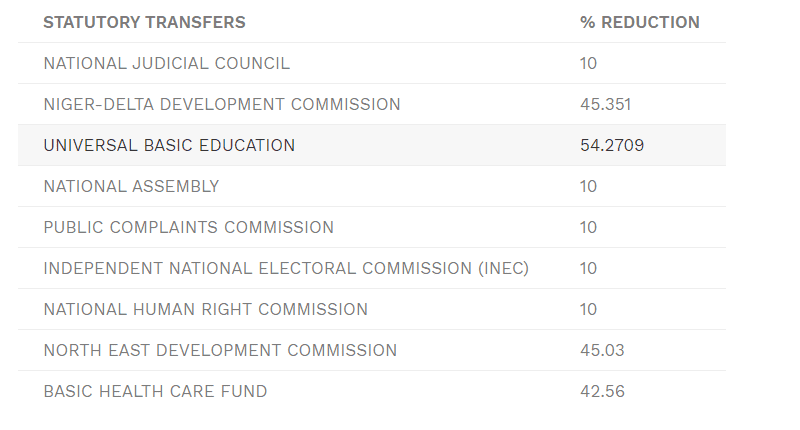
But the bigger dilemma bothers on Nigeria’s priority. While budgetary allocation to the National Judicial Council, National Assembly, Independent National Electoral Commission, and other agencies of government have been reduced only by about 10 percent respectively, budgetary provision for education reduced by close to 55 percent. Similarly, provision for basic health care fund reduced by over 42 percent.
With the reality of the COVID-19 pandemic, reduction in budgetary share for education and healthcare does not reflect the prioritization of the citizen’s real needs. With the growing number of COVID-19 cases in the country, an increase in budget share to the health sector is expected. To expand education access to the teeming Nigerian school children who are deprived of education during this period, additional budgetary commitment is also required. This is to cover up the cost of setting up virtual learning alternatives.
Revised Budgetary Allocation to Statutory Transfer
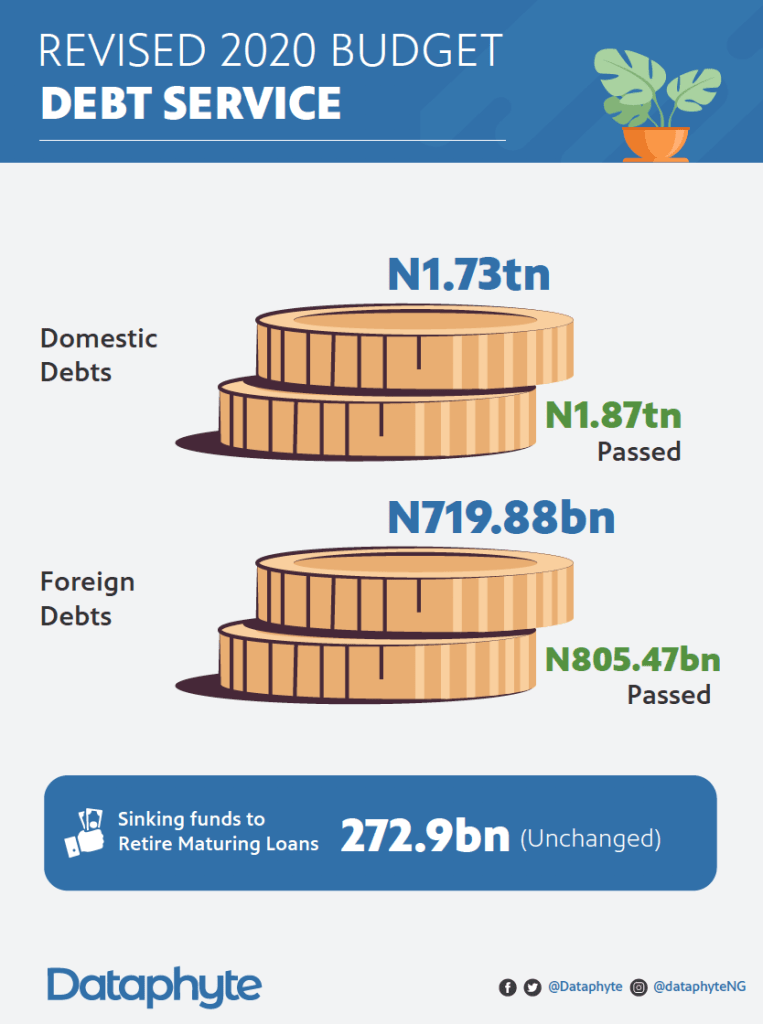
Increased Recurrent and Debt Servicing Expenditure
Contrarily, budget share for recurrent expenditure as well as debt servicing has increased. By implication, spending on recurrent items will continue to suppress Nigeria’s aspirations for development this year. But there are even bigger questions on the items that have increased the recurrent expenditure figure. For instance, insensitive recruitments like that of the Nigerian National Petroleum Corporation would have added to these expenditure burdens. Also, the increasing budgetary commitment to debt servicing over health and education may affirm that Nigeria indeed cares more about its debt profile than the citizens.
Conversely, Nigeria’s revenue realities continue to expose the need for stiffer revenue management measures. In fact with the realities presented by the Addendum to the 2020-2022 Medium Term Expenditure Framework and Fiscal Strategy Paper (MTEF/FSP), the proposed budget revision appears like a mere child’s play. As at Q1 2020, gross oil and gas revenue was short by over 28 percent of the anticipated revenue.
In addition, the net oil and gas revenue inflow to the Federation Account was ₦940.91 billion. This represents a shortfall of ₦425.52 billion (or 31.1 percent of the pro-rata amount). Similarly, non-oil tax revenue was only ₦269.41 billion by the end of the first quarter of 2020. This is a shortfall of about 40 percent of the predicated non-oil revenue earning for 2020.
From the revenue earnings in Q1 2020, as well as the existing realities on oil trade and the ongoing global pandemic, hopes for increased revenue earnings may be blurry. The continued lockdown is expected to impact on tax revenue from Nigeria’s business community. Thus, the revised budget may be somewhat impracticable without a corresponding increase in Nigeria’s debt.
Counting on the National Assembly To Do Better
At this point, the National Assembly must step in to show solidarity to the Nigerian people. Therefore, it must use its oversight powers to ensure the proposed budgetary revision is jettisoned and replaced with a more realistic and citizen-focused budget. Increasing commitment to capital investments will show Nigeria’s commitment to the course of development. DATAPHYTE’s recent occasional paper provides a guide for the budget revision.
Moreover, the legislative arm needs to show it is truly not patronised by the executive arm of government. Especially as the Zonal Intervention Project budget and the National Assembly Library budget tied to the two chambers were untouched in the budget revision. Above all, a budget that allows for increasing provision for basic education and healthcare should be developed.
In an interview with a health advocate, Ms. Aanu Rotimi, the Program Manager at Health Reform Foundation of Nigeria (HEFRON), she said the current COVID-19 situation has revealed proper investment in the health sector is central to economic growth and development. “Nothing can be more important now than appropriate and focused investment in human development according to the current realities and the future needs of this country”, she further stressed. The health advocate said this is the time to push aside superfluity of a few for direct and impactful investments for all that can be tracked and validated. In conclusion, she nudged the legislatures to walk the talk, translate their commitments to actions and ensure there are no wastages as usual.”
Also reacting to the budget revision, Mr. Kolawole Oluwadare, the Deputy Director Socio-Economic Rights and Accountability Project (SERAP) said these cuts are not inevitable. He said the Nigerian government had a lot of choices as to what to cut but chose to balance the budget on the backs of the most disadvantage. “In the absence of concrete social protection for over 80 million poor Nigerians, these cuts (and what was left uncut) will not only worsen the plight of the poor but also deepen the trust deficit of citizens in government.” Mr. Oluwadare submitted.
In April, SERAP gave the President and leadership of the National Assembly 14 days to reverse the proposed illegal cut of N26.51 billion in basic healthcare budget and to cut the National Assembly and Presidency budgets instead, or face legal action.
Impounded aircraft is owned by Flair Jet Limited, a UK company
CONTRARY to claim by Hadi Sirika, the Minister of Aviation that the “impoundedFlair Aviation” is a United Kingdom (UK) -based chartered aircraft, findings by The ICIR has shown that the airline’s operation base is in Germany.
The ICIR can also authoritatively report that the erring airline is not Flair Aviation as announced by the minister, but Flair Jet Limited, an airline company headquartered in the United Kingdom.
Flair Jet Limited, founded in 2008, offers private jet charter, pilot training, aircraft acceptance, and management services. Flairjet serves customers in Europe.
“Flair Aviation, a UK company, was given approval for humanitarian operations but regrettably, we caught them conducting commercial flights…,” the Minister had stated.
The ICIR checked through the list of licensed airline operators by the UK Civil Aviation Authorities (CAA) but Flair Aviation was missing in the three categories of license holders. The only airline operator that appeared close is Flairjet limited but again, it has a different corporate logo and also based in Oxford, UK.
But, several media organisations have reported Flair Aviation as a UK airline operator.
However, the Aviation Minister had earlier expressed disappointment at the airline for flouting the special flight arrangement it had with the federal government.
He said the airline was given approval by the federal government for humanitarian operations but was caught conducting commercial flights.
He thereafter threatened that a maximum penalty would apply.
“…This is callous! The aircraft is impounded, the crew being interrogated. There shall be the maximum penalty. Wrong time to try our resolve, “Sirika tweeted via his official handle on Sunday.
Moreover, it was gathered that the aircraft was chartered to evacuate foreign nationals out of Nigeria, but rather than stick with the agreement, it flew more passengers for commercial purposes.
As a result, the aircraft was impounded while its crew members are currently being interrogated.
The airline operates a fleet of Boeing 737-400 aircraft that is capable of conveying up to 156 passengers. Aside, it also operates on behalf of other Canadian airlines.
Meanwhile, the Nigerian Civil Aviation Authority (NCAA) on 23rd March 2020 placed a restriction on flights into Nigeria for an initial one month as measures to curb the Coronavirus disease spread(COVID-19).
Following the one month completion, the airport closure was extended by two weeks.
On 6th May, Boss Mustapha, Chairman of the Presidential Task Force on Coronavirus Disease (COVID-19), announced an extension by another four weeks.
OUR ERROR: The ICIR had previously reported that Flair Aviation is based in the United Kingdom. Our subsequent check has shown that this information is incorrect. Flair Aviation is based in Germany. We have also noted that the erring airline is not Flair Aviation, but Flair Jet, a UK-based airline. We have corrected these errors and updated the report. We regret the errors and apologise to our readers.