Please note that the FactCheckHub has not obtained any right from the authors or copyright owners of all third-party contents from embedded links and shall incur no liability in this regard.
Please note that the FactCheckHub has not obtained any right from the authors or copyright owners of all third-party contents from embedded links and shall incur no liability in this regard.
Please note that the FactCheckHub has not obtained any right from the authors or copyright owners of all third-party contents from embedded links and shall incur no liability in this regard.
Please note that the FactCheckHub has not obtained any right from the authors or copyright owners of all third-party contents from embedded links and shall incur no liability in this regard.
BARELY 24 hours after the Oyo State governor Seyi Makinde commissioned the remodelled Lekan Salami Stadium, Adamasingba, Ibadan, the state capital, mixed reactions have trailed the stadium some people described as water-logged.
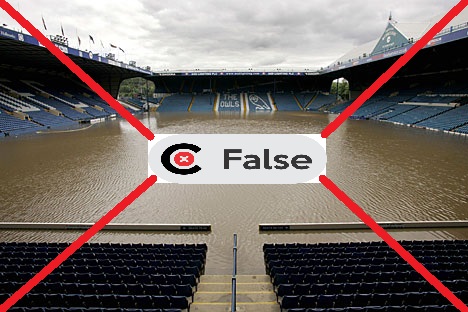
Although, the roof of the stadium was reportedly leaking and part of the pitch water-logged during the official commissioning of the stadium, a picture has, however, emerged on social media, with people claiming it emanated from the Lekan Salami Stadium.
A Facebook user, Abdullah Ayofe Olaniyi, shared the picture of the pitch submerged by flood, claiming it is that of the recently commissioned Lekan Salami Stadium.
“FLASH: Omituntun International Stadium, Ibadan, Oyo State. Engr Se*yi INAROBO , you are doing well 5. 5billion,” his post read.
The post, which was shared on Thursday, September 2, has gathered 220 shares, 186 comments as of 12noon on Friday, September 3, 2021.
THE CLAIM
Lekan Salami pitch submerged by flood.
Screenshot of the viral images of Lekan Salami Stadium shared by the Facebook user.
THE FINDINGS
Checks by the FactCheckHub show that the picture emanated from the 2007 flood incident at the Hillsborough pitch of Sheffield Wednesday, located in South Yorkshire, England and not that of the Lekan Salami Stadium in Adamasingba, Ibadan.
A Google reverse image search conducted by the FactCheckHub shows the image first hit the internet on June 26, 2007, when Sheffield Wednesday’s pitch known as Hillsborough was submerged by flood.
According to a Dailymail report, Sheffield Wednesday was forced to close the Hillsborough stadium after it was submerged with heavy floods.
THE VERDICT
The viral image of a football pitch submerged by floods and shared by a Facebook user was that of the 2007 flood incident at the Hillsborough pitch of Sheffield Wednesday in England, and not that of Lekan Salami Stadium, thus making the claim FALSE.
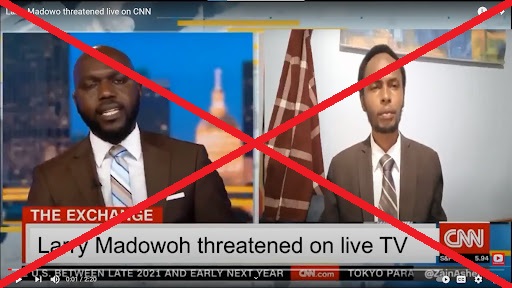
POPULAR Nigerian blog, Instablog9ja, on Thursday, 26th August 2021, posted on its Instagram page a viral video that claimed that a Kenyan government official chided CNN Journalist, Larry Madowo.
The same video was also posted on several YouTube channels albeit with slightly different claims. While Instablog9ja claimed the interviewee was a Kenyan government official, most of the YouTube videos say it was a Ugandan government official.
In the video, Larry Madowo asked his interviewee, “You said that everybody is free in Uganda and yet you, as Internal affairs minister in March, presented a list of 177 people who are under military detention to the parliament and later President Museveni said at least 50 people have been arrested for a treasonable act of opposition, is this the sign of freedom to you.”
The interviewee, a young man (later identified as Mungai Wamutego) with dark afro-like hair veered away from the question and accused Madowo of speaking to a government official without decorum.
“Where you come from, you know you don’t ask such questions to the government. So, I will give you another chance, Larry, please rephrase your questions and ask with a bit of decorum now that you know you are addressing a government official,” the interviewee answered in the video.
Larry, in the video, immediately went further with the questions.
The video, now deleted on Instablog9ja, had garnered over 600,000 views from its over 3.7million Instagram followers.
Though Instablog9ja deleted the video on both its Instagram and Facebook pages, it is still on its Twitter handle @instablog9ja as archived here. However, the video has resurfaced on various YouTube channels days later.
THE CLAIM
Kenyan government official chided CNN journalist, Larry Madowo, during a live interview.
THE FINDINGS
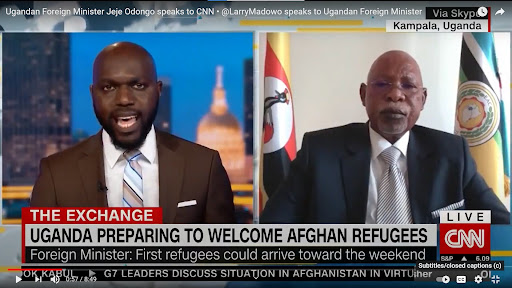
A quick search on Google and CNN website showed that Larry Madowo did had an interview with Uganda’s Foreign Minister, General Jeje Odongo on Tuesday, 24th August 2021.
Screenshot of the original CNN footage showing Ugandan foreign minister, General Jeje Odongo.
However, unlike a young man with dark afro-like hair, Larry’s interviewee and Uganda’s Foreign Minister is a bald man and quite bulky than the purported interviewee. The only thing related in both videos is Larry Madowo and his questions – the answers and interviewee were altered.
Responding to Larry’s questions, General Odongo said: “I think let’s get our facts correct, it is true a number of individuals were arrested because of disobeying the standard operating procedures…”
The interview however continued on CNN’s The Exchange television programme, where Madowo asked further questions relating to accusations of human rights violations levelled against the Ugandan government.
Where did the video come from?
The video was created by Mungai Wamutego, who himself was the interviewee in the doctored version, and posted across his social media pages.
On Facebook, he captions it “No one will show you this! I had an interview with CNN’s Larry Madowo today on The Exchange and am sure he learnt a thing or two about tree zones and what constitutes the constitution. It’s not easy representing the government. #mdimbly”.
On Wamutego’s Twitter page, the Video has recorded almost 300,000 views.
According to his Social Media profiles, Wamutego is a Content Creator, Digital Strategist and Agronomist.
VERDICT
The claim is FALSE. No! Kenya government official did not threaten Larry Madowo. The video was doctored to remove visuals of the Ugandan foreign minister and his audio responses from the footage.
* Qosim Suleiman was a 2020 Fact-Checking Fellow with Dubawa, PTCIJ.
The minister of environment Mohammed Mahmood Abubakar on Monday, August 23, 2021 claimed that the cholera outbreak has so far led to the death of 938 lives in 22 states in Nigeria.
Abubakar disclosed this at a press briefing to sensitize the media and general public on the Cholera outbreak in the country.
The minister in the news reported here, here and here added that the country has so far recorded 33,661 suspected cases of cholera.
He stated that the data of suspected cholera cases and mortality rate in Nigeria was gotten from the situation report released by the Nigeria Centre for Disease Control (NCDC).
“Latest situation report from Nigeria Centre for Disease Control (NCDC) released on 10th August 2021 indicated a total number of 33,661 suspected cases including 938 deaths in 22 states and FCT (Benue, Delta, Zamfara, Gombe, Bayelsa, Kogi, Sokoto, Bauchi, Kano, Kaduna, Plateau, Kebbi, Cross River, Niger, Nasarawa, Jigawa, Yobe, Kwara, Enugu, Borno, Kastina, Adamawa and FCT) with an increasing number of new cases in, Zamfara, Bauchi, Kano, Gombe, Plateau, Niger, Zamfara and Abuja FCT,” he said.
THE CLAIM
From the report, the following claims were deduced:
The total number of suspected cases of cholera in Nigeria as of August 10 was 33,661.
Cholera killed 938 people in 22 states in Nigeria.
THE FINDINGS
CLAIM 1: The total number of suspected cases of cholera in Nigeria as of August 10 was 33,661.
The FactCheckHub findings revealed that the claim is MISLEADING.
In a bid to verify the claim, the FactCheckHub checked the NCDC situation report dashboard for the Cholera outbreak in Nigeria and realised that the official data is quite different from what was quoted by the minister.
From the data, the document released for Week 31: 2nd August – 8th August 2021 revealed that a total of 37,819 suspected cases were recorded in the country.
The number is quite different from what was quoted by the minister, thus making his claim MISLEADING.
Against the minister’s claim that the data was released on August 10, the NCDC stated boldly on the data that it was curated on August 13.
However, the NCDC has released an updated report which puts the countries total suspected cholera case at 47,603.
The FactCheckHub findings revealed that NCDC did not at any time on August 10 release any data that puts the country’s suspected cholera cases at 33,661, thereby making the minister’s claim MISLEADING.
CLAIM 2: Cholera killed 938 people in 22 states in Nigeria.
The FactCheckHub findings revealed that the claim is MISLEADING.
The figure gotten from the NCDC situation report dashboard for the Cholera outbreak in Nigeria contradicts what was quoted by the minister.
From the data, the document released for Week 31: 2nd August – 8th August, 2021 revealed that a total of 1,178 deaths were reported from 23 states and FCT.
The number is quite different from what was quoted by the minister, thereby making his claim MISLEADING.
However, the NCDC has released an updated report which stated that 1,768 deaths have been reported from 23 states and FCT.
VERDICTS
The two claims by the Nigerian minister on suspected cholera cases and mortality rate are MISLEADING, as data gotten from the NCDC differs.
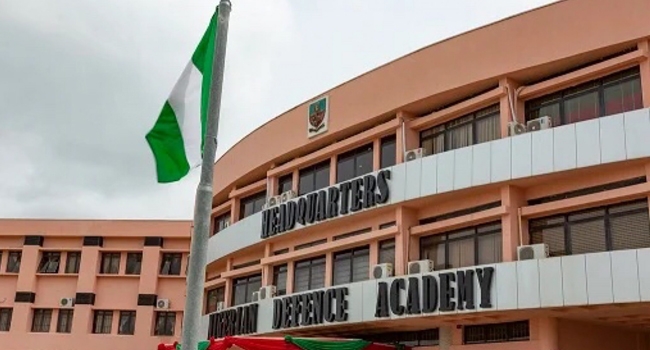
A viral video, on Tuesday, August 24, 2021, emerged on social media shortly after local media reported news of the bandits’ attack on the Nigerian Defence Academy (NDA) in Afaka, Kaduna State.
The one-minute 49-second video shows turbanned armed men on motorcycles, speaking a yet-to-be-identified language. However, the poster claimed that they were the bandits who attacked NDA, Kaduna.
In the video, the bandits appeared to have emerged from the forest as the entire vicinity was full of trees, with a narrow path. But, the footage has been circulated widely, especially on WhatsApp.
Officials confirm attack
Following the incident, the NDA and the Nigerian Defence Spokesperson confirmed the incidents of the bandits’ attack. They disclosed that the attackers were able to breach the perimeter fencing of the residential area of the NDA where two officers were killed and one other abducted.
“The security architecture of the Nigerian Defence Academy was compromised early this morning by unknown gunmen who gained access into the residential area within the Academy in Afaka. During the unfortunate incident, we lost two personnel and one was abducted,” a statement issued by Bashir Muh’d Jajira, the academy’s spokesperson said, stressing that the incident occurred early in the morning.
The Nigerian Defence spokesperson Benjamin Sawyer put the time of the incident at 02:15 am.
Sawyer’s timing aligned with the initial report by Daily Trust, where an officer narrated his experience to the medium, saying “the bandits took advantage of the time when most people had gone to bed…”
Usually, 02:15 am was not daybreak, thus it would be dark by then. Conversely, the circulating video was well lit implying the attack was carried out in the day.
Sawyer was asked to validate the viral video. But he said in his reaction “this video (the claim) is of the daytime and could have been anywhere,” he told The FactCheckHub when the footage was shared with him.
“The attack happened in the night at about 02:15 am,” he emphasised.
Video Analysis
Further analysis of the footage reveals that there were neither landmarks and structures nor notable buildings and infrastructure to establish the exact location.
A Google Reverse Image search of keyframes (images) taken from the footage using the InVid video verification platform shows that the images were not available online as of 18:00 GMT on Tuesday evening. Other reverse image tools including TinEye, Yandex and Bing deployed for the same purpose also yielded no result.
Using InVid for forensic analysis of the visual shows that the images are nowhere to be found online; thus, it is likely a fresh video that has not been uploaded to the internet yet.
A Google Earth image showing the Nigerian Defence Academy, Kaduna. CREDIT: Google.com
The FactCheckHub could not independently verify the source of the video as it has been forwarded severally in WhatsApp groups.
However, the use of the Google Earth tool to identify the NDA premises in comparison with the footage shows a contradicting live image as there are multiple structures within the NDA.
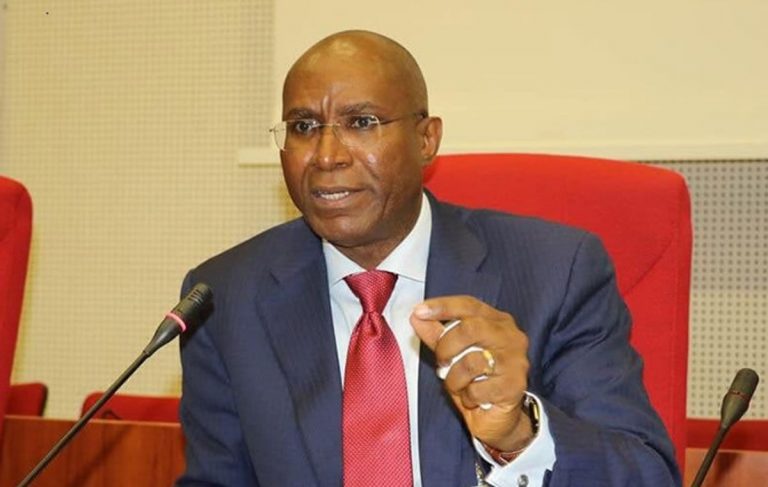
ON Saturday, August 21, 2021, the Deputy President of the Nigerian Senate Ovie Omo-Agege repeated the APC cliché about ‘Buhari change’ which Nigerians’ reality and credible data have contradicted.
At a lecture held in Lagos during the weekend, the deputy Senate president declared that Nigerians were worse off six years ago before President Muhammadu Buhari came to power.
“Buhari promised change, and he brought change, introducing new policies that encouraged domestic production of what we consume and cutting down imports of goods that we can produce locally.
“Under his watch, we now consume made-in-Nigeria rice and other locally produced commodities, and today Nigeria is on course to self-sufficiency in food production. In the process, millions of jobs have been created in the agricultural sector. He also changed our politics, and once more, the people’s priorities have become the government’s priorities,” he said.
Omo-Agege, represented by his Special Adviser on Media and Publicity Yomi Odunuga at the eighth annual lecture organised by the Afrikanwatch Network Communications at Yaba College of Technology, Lagos, said that the Buhari administration had prepared Nigeria for a more sustainable and inclusive economy as well as a prosperous nation.
But this claim is contradicted by hard facts and data.
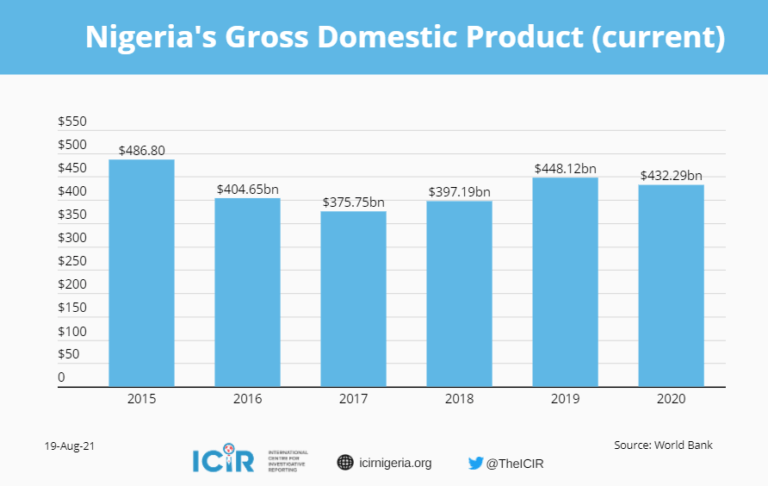
For instance, according to the World Bank Data, Nigeria’s productivity level under President Buhari has dropped by 11.2 per cent between 2015 and 2020.
Nigeria’s Gross Domestic Product (current).
Six years ago, Nigeria’s Gross Domestic Product was $486 billion, and by 2020, the GDP has come down to $432 billion, despite Buhari’s promised change.
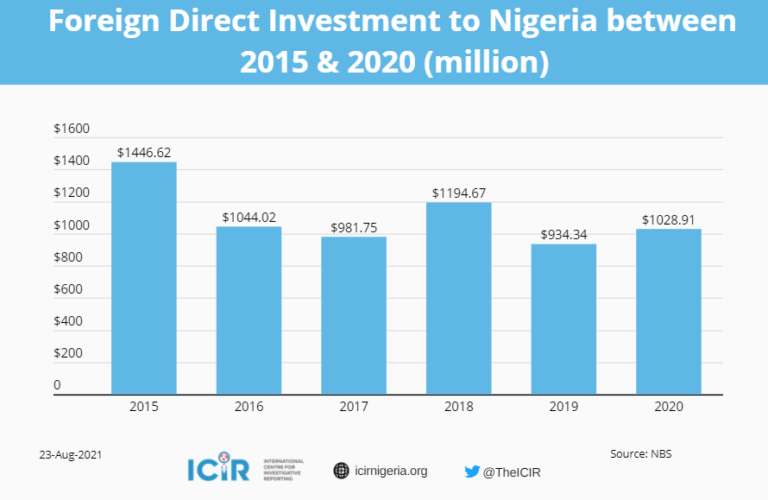
Similarly, Foreign Direct Investment to Nigeria was $1.5 billion in 2015.
Six years into the Buhari government, fewer investors want to come to Nigeria, and some have relocated their investments to other countries, including Ghana.
The Nigeria Bureau of Statistics data shows that FDI declined to$1 billion in 2020, representing a 29 per cent fall.
Recall that Google and Twitter, two big tech giants, recently located their operations in Ghana, where the subscribers are fewer than in Nigeria.
Germany moved the West Africa Centre of Global Health to Ghana and not Nigeria at about the same time.
In 2016, a year after the inauguration of President Buhari, United Airlines suspended its daily flight from Lagos to Houston-Texas, and Spanish carrier, Iberia.
The same year, it ended its flights to Nigeria from Madrid due to a shifty foreign exchange policy.
Foreign Direct Investment to Nigeria between 2015 – 2020.
Contrary to the claim by the deputy Senate president, other indicators have shown that the Buhari administration has not managed the economy better than the previous governments.
The NBS report has shown that the value of Naira has eroded under President Buhari compared to his predecessors.
In 2015, the inflation rate was 9.55 per cent, but as of last month, July, the inflation rate was 17.38 per cent.
Therefore, the real income of Nigerians has been negatively affected by inflation by more than 90 per cent between December 2015 and July 2021.
As that is not enough burden for a people, the economic condition of the Nigerian citizens is worsened by the foreign exchange rate, which is currently estimated at N522 to a dollar as against $305 in 2015.
Using the World Bank’s income poverty threshold of $3.20 per day, Nigeria’s poverty rate is 71 per cent.
The World Bank estimated that the number of poor people in Nigeria would increase to 90 million, or 45 per cent of the population, in 2022.
Yet Senator Omo-Agege was silent on these critical indices.
He also failed to share the unemployment data with his audience, which currently stands at 33.3 per cent.
At the inauguration of President Buhari in 2015, the unemployment rate was just 10.4 per cent.
Manufacturers also say that patronage of made-in-Nigeria products is on the decline.
In the Manufacturers Association of Nigeria’s CEOs Confidence Index for the third quarter of 2019, which was also done in the fourth quarter of 2019 and the first and second quarters of 2020, 63 per cent of chief executives of manufacturing companies disagreed that patronage of locally-made products was increasing, despite Omo-Agege’s claim of ‘private sector growth’.
In fact, contrary to the senator’s claim, more Nigerians have sunk into the poverty hole during the Buhari administration than his predecessor.
While criticising the budget management under Buhari, Professor Pat Utomi in 2017 had said Nigeria was in the hand of ‘bad managers.’
He said the Buhari government should have foreseen the recession if it had been forward-looking in budget planning and management of resources.
In his article published in The Conversation, Stephen Onyeiwu, Professor and Chair of the Economics Department, Allegheny College, described Nigeria’s poverty profile as “grim and embarrassing for a country endowed with humongous human and natural resources.”
Onyeiwu relied on NBS data and other public records to arrive at this conclusion.
Despite this concrete data, the senator representing Central Senatorial District Delta State said he did not doubt that Nigeria was on the road to progress.
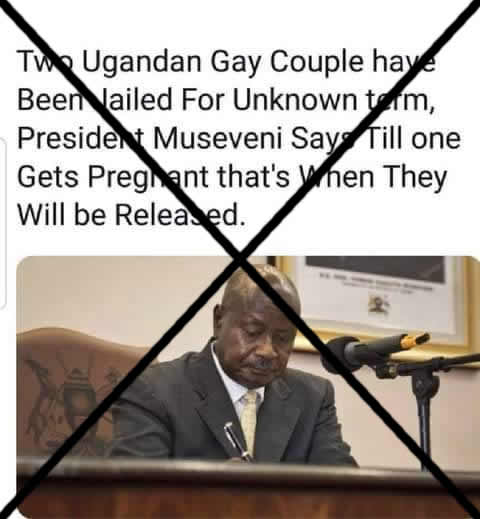
ON August 19, 2021, FactCheckHub received a post shared on WhatsApp alleging that the Ugandan President, Yoweri Kaguta Museveni, said a gay couple would remain in jail until one gets pregnant.
The message which appears to be a screenshot of a tweet reads: “Two Ugandan gay couple have been jailed for unknown term, President Museveni says till one gets pregnant that’s when they will be released.”
The text was accompanied by a photo of Museveni.
THE CLAIM
Ugandan President Yoweri Kaguta Museveni says jailed gay couple will regain freedom only if one gets pregnant.
THE FINDINGS
An internet search revealed that the claim has been in circulation since 2020; it was published by a Somali platform, archived here. The claim was also published by Opera News and in April 2021 by a blog, 9jaBlitz.
Since 1986, Museveni has been the president of Uganda.
Using the Google Reverse Image Search, Musveni’s photo attached to the claim was traced to an article dated February 24, 2014, and authored by Rodney Muhumuza for the Associated Press (AP) and published on The Christian Science Monitor.
The report detailed the ban on homosexuality in Uganda. It was the signing into law, anti-homosexuality bill by Museveni. The parliament had earlier passed the bill in December 2013.
Rebecca Vassie shot Museveni’s photograph for the AP during the signing, with the caption, “Uganda’s President Yoweri Kaguta Museveni signs a new anti-gay bill that sets harsh penalties for homosexual sex, in Entebbe, Uganda Monday, Feb. 24, 2014.”
The claim.
Three months after the enacted anti-gay law dubbed “killed the gays”, AP reported how two Ugandans were charged for flouting the newly enacted law.
The report says the trial was the first of its kind against homosexuals in the African country. The UK Guardian identified the gay couple as Jackson Musaka and Kim Mukisa.
However, in the same 2014, the anti-gay law was later annulled by the Ugandan Supreme Court. As at when the posts were published, Uganda had no anti-gay laws. The closest to that is the Sexual Offenses Bill, 2019, which was passed by the Parliament in early May 2021 and awaiting presidential assent.
Furthermore, aside from blogs, no mainstream local media or international media reported the claim attributed to Museveni.
The FactCheckHub reached out via email to the author of the Opera News article; there was no reply after four days.
The judiciary in Uganda is responsible for the interpretation and application of the law, and not the President who is an executive.
THE VERDICT
There is no evidence to validate the claim that President Museveni of Uganda said a jailed gay couple will be released only when one gets pregnant. Thus, the claim is FALSE.
FACEBOOK has removed 18 million posts containing misinformation about COVID-19, the founder and CEO, Mark Zuckerberg said.
Zuckerberg told “CBS This Morning” co-host Gayle King in an exclusive interview that misinformation is against his platform’s policy, hence why harmful misinformation is always removed once seen.
“But do we catch everything? Of course, there are mistakes that we make or areas where we need to improve. But that’s the best number that we have in terms of what we’ve seen and what our systems have been able to detect,” he said.
“But how many people have viewed the misinformation? Is it more than 18 million? Is it less than 18 million?”, asked the interviewer.
To which Zuckerberg replied “I understand what you’re saying, the number that I have off the top of my head that I can share is the number of pieces of misinformation that we’ve taken action against.”
Facebook, Twitter and other social media platforms have been criticized for the spread of misinformation, especially regarding the coronavirus pandemic.
U.S President Joe Biden in July accused Facebook and other social media platforms of “killing people” by enabling the spread of COVID-19 misinformation but later clarified that he meant that misinformation itself was causing deaths.
However, Facebook said they actually helped increase vaccine acceptance as people get to view authoritative information.
Many media reports claimed that the World Health Organization (WHO) has ranked Nigeria as the 4th best in COVID-19 response.
These media reports which are archived here,here and was also published by the Nigerian embassy in Sweden all attributed the claim to WHO Country Representative in Nigeria, a doctor, Walter Mulombo.
According to reports, Mulombo made the statement at an event on the arrival of the first consignment of 177,600 doses of the Johnson and Johnson (J&J) COVID-19 vaccine in Abuja.
“We are witnessing the symbolic arrival of 177,600 Johnson & Johnson vaccines, another landmark event in Nigeria’s response to COVID-19 pandemic; widely acclaimed by many as one of the most successful so far in the world.
“Nigeria was ranked fourth among the top ten most successful responses to COVID-19,” the statement attributed to Mulombo read.
In a swift reaction, the Buhari Media Organisation (BMO), a group that supports and attempt to court goodwill for Nigeria’s President Muhammadu Buhari celebrated the news, saying his fight against the pandemic was what necessitated the ranking.
In a statement signed by BMO Chairman, Niyi Akinsiju and Secretary Cassidy Madueke, BMO noted President Buhari’s determination to safeguard the lives of Nigerians and residents alike during the pandemic
“We also note that President Muhammadu Buhari did not spare any resource in ensuring that the Presidential Task Force on COVID-19 carried out its responsibilities without let or hindrance,” their statement react.
WHO debunks the claim
In a bid to verify the claim that Nigeria ranked 4th best in COVID-19 response, The FactCheckHub checked the WHO website but found nothing of such.
The FactCheckHub, however, reached out to the WHO spokesperson in Nigeria Charity Warigon, who clarified the issue.
“I wish to clarify that, WHO has not ranked countries in relation to COVID-19 response,” says Warigon.
2nd right, WHO Country Representative, Walter Mulombo at the arrival of Johnson & Johnson vaccine in Nigeria. Photo: WHO/Ogbeide E.
Warigon in a telephone conversation with The FactCheckHub said what the country representative meant was that the country was efficient in handling COVID-19
“The WHO Representative [Walter Mulombo] meant to say Nigeria mounted one of the most effective response to COVID-19, putting in place courageous measures and helping to avert the widespread that was predicted,” she added.
She added that “Some independent media analysis had previously presented a ranking for top 10 countries including Nigeria appearing on 4th position. It should be noted however that this is not a WHO ranking.”
In addition when WHO reported the same event on their website, archived here, the statement about the ranking was not including.
THE VERDICT
The claim that WHO ranked Nigeria 4th best in COVID-19 response is inaccurate and MISLEADING, the WHO communication officer in Nigeria said the ranking did not emanate from the organisation.
AS the world battle ongoing concerns around COVID-19 vaccine safety, side effects, vaccine hesitancy and refusal, a Twitter user posted that reports related to vaccine deaths are hushed.
The tweet which has over 470 engagements posted in July 2021 and archived here read “Have you noticed how quickly they report a death as a COVID-19 death, but ever so reluctant to tell us when a vaccine kills someone?”
The post generated comments with some alleging vaccines damages the immune system and another, alleging the virus with reference to the Lambda variant “is spreading fast” via water.
Does COVID-19 spread via water?
At the onset of the pandemic, there were fears and concerns that COVID-19 spread through water as such swimming wasn’t safe. However, the number one health body, the World Health Organizations (WHO) noted that the fears were unfounded.
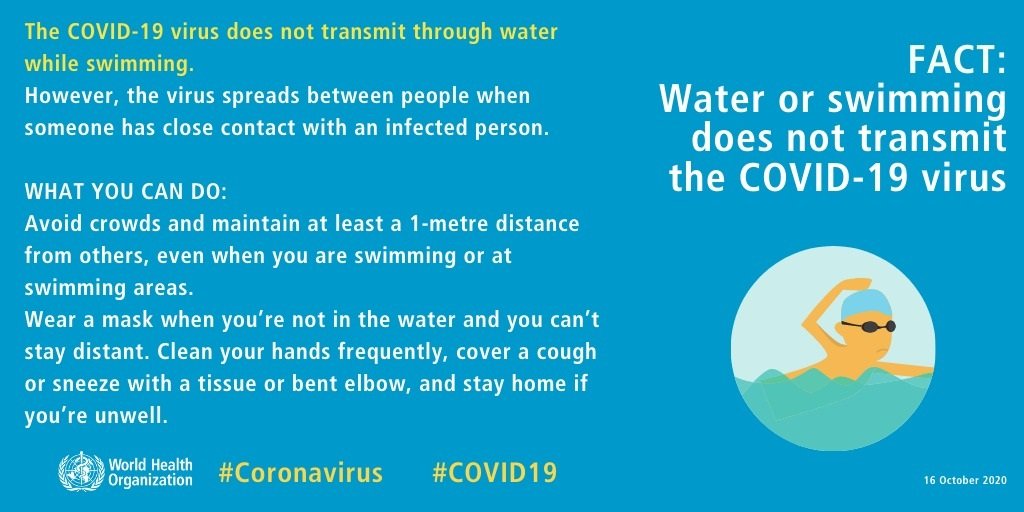
Poster by the WHO.
The WHO clarified “Water or swimming does not transmit the COVID-19 virus”.
It further explained that “The COVID-19 virus does not transmit through water while swimming. However, the virus spreads between people when someone has close contact with an infected person.”
As such there was a need to maintain social distance from others while swimming and “wear a mask when you’re not in the water and you can’t stay distant”, this is in addition to adhering to other COVID-19 protocols.
Viruses change over time. The COVID-19 virus which is caused by SARS-CoV-2 is no different. Most Changes have negligible or no impact on the virus properties however some changes might affect how “it spreads, the associated disease severity, or the performance of vaccines” says The WHO.
To keep track of the changes in COVID-19 virus the Greek Alphabet was adopted. As of July 2021, the variant is at the 11th alphabet which is the Lambda.
However, this variant is not on the WHO’s Virus of Concern (VOCs) list but rather on the Virus of Interest (VOIs) list.
The emergence of variants that posed an increased risk to global public health are classed under the VOCs, this is in order to prioritise global monitoring and research, and ultimately to inform the ongoing response to the COVID-19 pandemic says WHO.
Alpha, Beta, Gamma and Delta are the currently the VOCs while Epsilon, Zeta, Eta , Theta, Iota, Kappa and Lambda are VOIs
Even though Lambda is considered to have a potentially increased transmissibility, this spread was not noted to be via water.
… on vaccines deaths
As of August 5, 2021, the total number of COVID-19 cases worldwide surpassed 200 million, including over four million deaths, this was just six months after reaching 100 million cases.
Whereas as of 12 August 2021, the cumulative number of vaccine doses which have been administered surpassed 4.4 billion.
There have been several conspiracy theories and concerns that the vaccines are resulting to deaths and these deaths are high, hushed or not reported enough. Debunking one of such claims the U.S. Deputy director for Center for Disease Control and Prevention’s Immunization Safety Office Tom Shimabukuro said it inaccurate to equate death after vaccine as caused by the vaccine.
The doctor noted that “Statements that imply that deaths following vaccination equate to deaths caused by vaccination are scientifically inaccurate, misleading, and irresponsible.”
A look at the multiple variations of such claims in circulation show that they were hinged albeit wrongly on data gotten from a U.S. government database called VAERS (Vaccine Adverse Event Reporting System) where anyone in the U.S. can report adverse effects after receiving a vaccine.
A verification done in June on a series of posts claiming that the number of deaths related to vaccines may soon rival the number of deaths from COVID-19 are false according to a verification done by Reuters , as the “the large number wrongly described as ‘vaccine-related deaths’ in a series of online posts is the total number of reports that were made on VAERS”.
Another of such claim that the “death toll” of COVID-19 vaccines is more than 20 times higher than that of past vaccines was also found to be inaccurate.
There was also the claim attributed to a “whistleblower” that the administration of U.S. President Joe Biden is covering up at least 45,000 vaccine-related deaths this was also found to be inaccurate.
Similar claims were widely shared on Tiktok that there are tens of thousands of unreported deaths from the COVID-19 vaccine this was also found to be inaccurate by the BBC as it misrepresented data from the VAERS website.
Why the misrepresentation?
COVID-19 vaccines have a broader reporting requirement on VAERS as healthcare providers are expected to report all serious adverse health events, even if the provider does not think the vaccine caused that event.
These events can include death, inpatient hospitalisation among others. This reporting protocol is because the FDA authorised the COVID-19 vaccines for emergency use, USA Today reports.
The Centers for Disease Control and Prevention (CDC) also clarified that the reports of adverse events to VAERS following vaccination, including deaths, do not necessarily mean that a vaccine caused a health problem.
A TWITTER user on Friday August 13, 2021 shared a picture of a tarred road claiming it emanated from Kaduna State in Nigeria.
The Twitter user with the handle @Mamatee001 in a tweet archived here said the road was constructed by Kaduna State governor Nasir El-Rufai.Kad
The tweet read “This is not Canada but Kaduna. A road constructed by that man u hate @elrufai he is not sharing kerosene neither Is he giving wheel barrow but building future. A leader who excel even when some evil are bent in destroying his government. A great Man to study like encyclopedia.”
THE CLAIM
Picture shows tarred road in Kaduna state.
A screenshot of the tweet.
THE FINDINGS
Checks by The FactCheckHub show that the picture emanated from Pakistan and not Kaduna as claimed by the twitter user.
A Google reverse image search conducted by The FactCheckHub shows the image was on the internet before.
Similarly, a Google earth imagery search conducted by The FactCheckHub revealed that the picture is that of Hazara Motorway in Pakistan.
The google earth imagery picture of the Hazara Motorway.
Hazara Motorway, otherwise known as M-15 Motorway is a 180-kilometre controlled-access road motorway linking Brhan interchange near Hassan Abdal in Punjab province with Khyber Pakhtunkhwa province.
The road starts from Havelian and ends at Thakot.
THE VERDICT
The picture of tarred road shared by a Twitter user was constructed in Pakistan and not Kaduna thereby making the claim FALSE