Please note that the FactCheckHub has not obtained any right from the authors or copyright owners of all third-party contents from embedded links and shall incur no liability in this regard.
Please note that the FactCheckHub has not obtained any right from the authors or copyright owners of all third-party contents from embedded links and shall incur no liability in this regard.
Please note that the FactCheckHub has not obtained any right from the authors or copyright owners of all third-party contents from embedded links and shall incur no liability in this regard.
Please note that the FactCheckHub has not obtained any right from the authors or copyright owners of all third-party contents from embedded links and shall incur no liability in this regard.
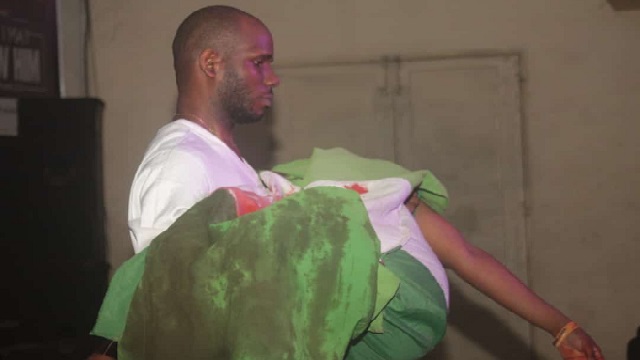
A photo of a man carrying a woman wrapped in a blood stained Nigeria flag has been shared repeatedly on social media as one of the victims of Lekki Toll Gate incident.
A twitter user @seefinish tweeted the picture with caption, “RIP fallen hero, your death shall not be in vain” this was accompanied with hashtags like #LekkiMassacre #EndSARS #Genocide #StopNigeriaGovernment #LekkitollgateMassacre.
Another Twitter user, @fbilash while responding to a tweet by the Lagos State Governor, Babajide Sanwo-Olu also tweeted the same picture with the caption, “Did you have enough time to visit her too?
Similarly, Spread.ng, Businessday, Xtremenews and some news website in Nigeria also used the picture to illustrate reports related to the Lekki Toll Gate incident.
This was not limited to the Nigerian media, as it also went viral in Ghana where GhanaSummary, Ghbase and MyNewsGhana used the picture in illustrating their reports.
“Photo: See the sad moment female protestor died and was wrapped in a bloody Nigerian flag,” the news read on MyNewsGhana.
This image is not from the Lekki Toll Gate incident, it is from a play.
THE CLAIM:
That the photo of a man carrying a woman wrapped in a blood stained Nigerian flag is from Lekki Toll Gate incident.
THE FINDINGS:
Checks by the FactCheckHub shows that it is False.
On Tuesday, October 20, 2020, news broke that Nigerian soldiers shot at #EndSars protesters that gathered at the Lekki Toll Gate in Lagos state.
End Special Anti-Robbery squad is a social movement calling for good governance and an end to police brutality which had led to street demonstration. One of the rallying point for protesters is the Lekki Toll Gate.
While both local and international media organisations were reporting the news of what occurred at the Lekki Toll Gate, the picture of the woman wrapped in a blood stained Nigerian flag was shared repeatedly on the internet.
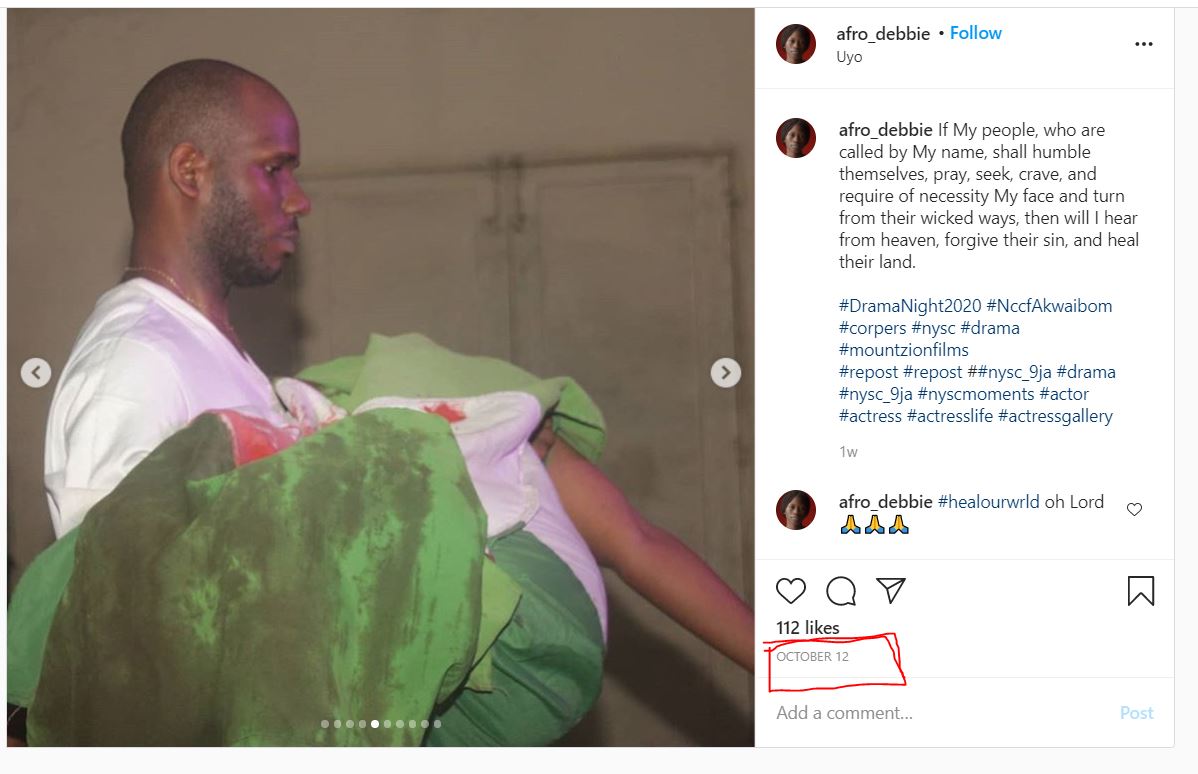
Afro Debbie posted this Image on October 12 this was several days before the Lekki Toll Gate incident which happened on October 20, 2020.
Nigerian singer, Yemi Alade, in a now deleted post also shared the picture on her verified Facebook page with that caption, “Stay safe”.
Reacting to her post, Oyinye Francis, said the photo was false, while pointing out that it emanated from a drama done in commemoration of Nigeria’s independent anniversary on October, 1, 2020.
“Please ma she’s not dead, it was a drama we acted on 1st October 2020 in NCCF Akwa Ibom state ‘drama night,’ themed ‘Heal our land oh lord’. I can send you the drama video,” Francis wrote.
A scene from a video clip of the drama posted on the NCCF Instagram account.
In a bid to verify the picture, The FactCheckHub reached out to Joshua Ogbodo, the President of the Nigeria Christian Corpers’ Fellowship (NCCF), the Akwa Ibom State chapter, who disclosed that the photo was from a scene from the association’s drama.
“That picture of the man carrying a lady covered in Nigerian flag appearing dead is a picture from our stage drama night tagged “Lord, heal our land” that took place on October 1, 2020 at the NCCF secretariat,” Ogbodo told The FactCheckHub in a telephone conversation.
Similarly, the NCCF has in a press release debunked the claim.
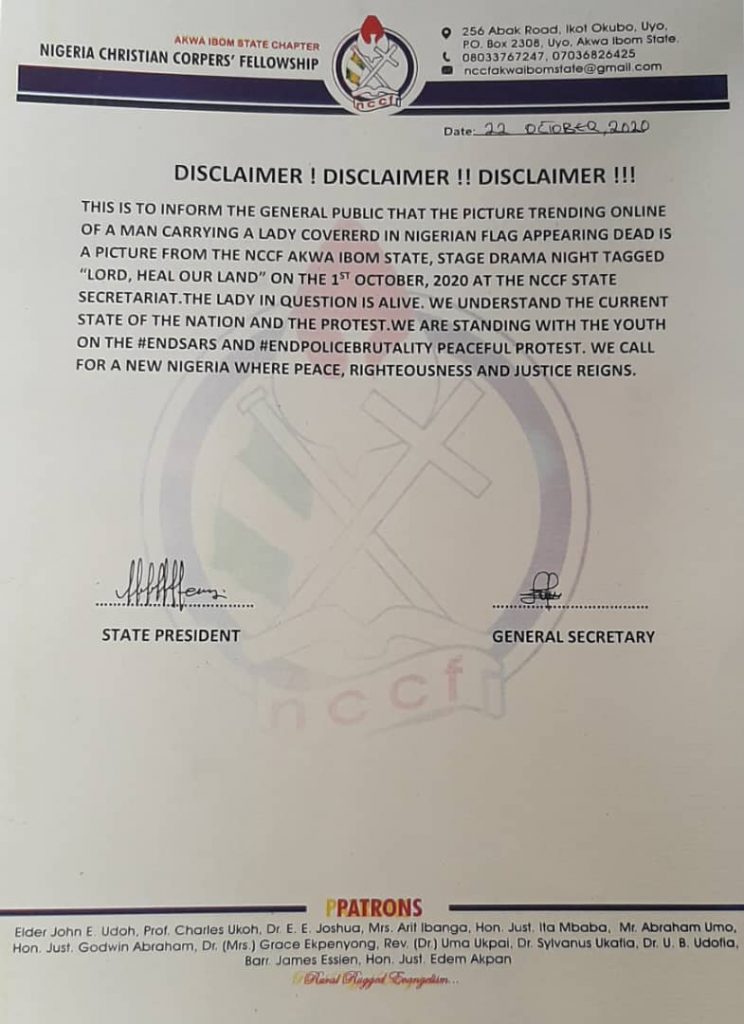
The release signed by the President and Secretary stated that the picture was not from the Lekki toll gate incident but from a drama acted by the association.
A screenshot of the press release by the NCCF, Akwa Ibom State
Similarly, the NCCF Akwa Ibom State has on their Instagram page released pictures and video from the drama to justify their claim.
In addition, the picture has been posted since before the Lekki Toll Gate incident.
Afro_Debbie had shared the image on her Instagram account on October 12, 2020.
https://www.instagram.com/p/CGQaOtFJ4o0/
THE VERDICT:
The claim is FALSE, the picture emanated from a drama by NCCF Akwa Ibom State and not from the Lekki Toll Gate incident.
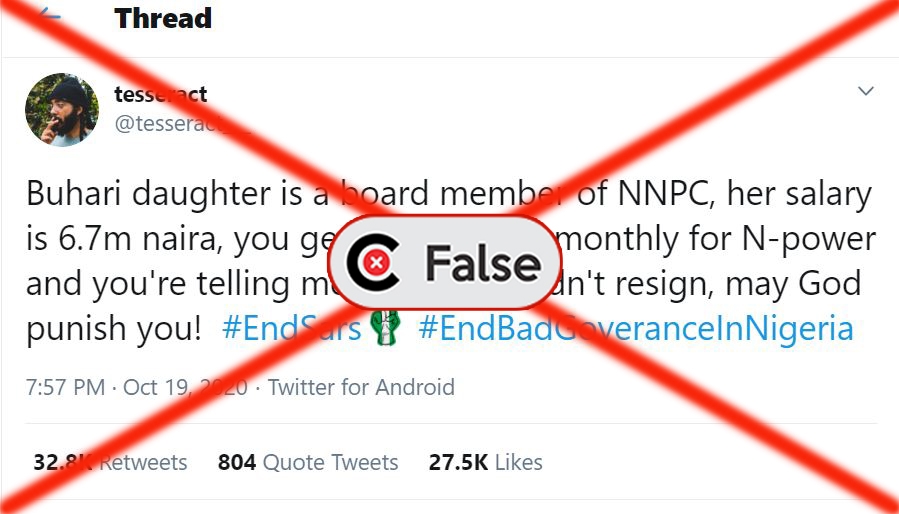
“BUHARI’S daughter is a board member of NNPC,” a social media user @tesseract_ claimed on Monday, October 19, 2020.
“Her salary is N6.7 million, you get N30, 000 monthly for N-Power and you are telling me Buhari shouldn’t resign” reads part of the tweet which also have the EndSARS hashtag.
The hashtag, End Special Anti-Robbery Squad (#EndSARS) or is a decentralised social movement against police brutality and bad governance in Nigeria.
Muahammadu Buhari is the President of Nigeria.
N-Power is a social investment scheme which pays enrolled youth a monthly stipend of N30,000.
The claim has been retweeted by over 30, 000 people, quoted 720 times and garnered more than 24, 000 likes.
The claim that Buhari’s daughter is a board member of the NNPC.
THE CLAIM:
That Buhari’s daughter is a board member of Nigerian National Petroleum Corporation (NNPC).
THE FINDINGS:
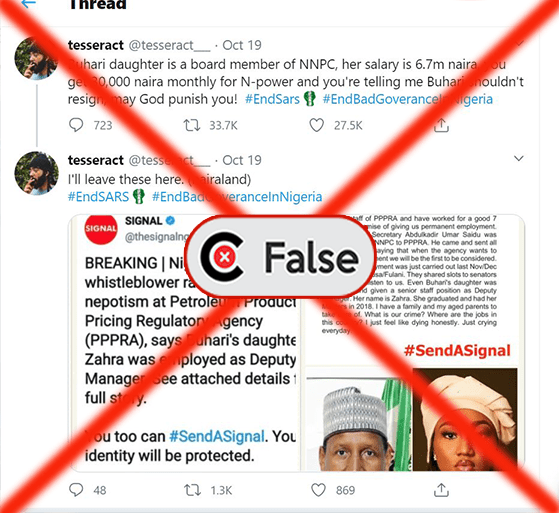
The claim did not state which of the Buhari’s daughters is being referred too. However, a picture of Zahra Buhari was added to the the thread. In addition to a contradictory screenshots which state that she is a deputy manager at the Nigerian National Petroleum Corporation, NNPC.
The NNPC is the state owned oil corporation which asides its exploration activities, has powers and operational interests in refining, petrochemicals and products transportation as well as marketing.
A check on the official website of the NNPC shows a list of a 10-member board of the corporation which does not include Zahra Buhari or any of his known daughters.
They are: Chief Timipre Sylva, the Minister of State for Petroleum Resources, Mele Kyari, Group Managing Director of the NNPC, Dr Stephen Dike, member of the NNPC board and Chief Pius Akinyelure also a member.
Other members are Sen. Magnus Abe, Dr Tajuddeen Umar, Mallam Mohammed Lawal, Mrs Lami Onayi Ahmed, Dr Mahmoud Isa Dutse and Mrs Hadiza Coomassie who is the Secretary to the Corporation and Legal Adviser.
Screenshot of NNPC board members from it website.
More so, on June 24, 2020, the Federal Ministry of Information and Culture (FMIC) published a press statement announcing the list of the board members approved by the president.
The statement was signed by Mrs Enefaa Bob-manuel, a Deputy Director (Information) in the Federal Ministry of Petroleum Resources.
“The members of the NNPC Board who had on 2nd June, 2020 been approved by President Mohammadu Buhari are the Hon. Minister of State for Petroleum Resources, Timipre Sylva who doubles as the Alternate Chairman of the Board, Mallam Mele Kolo Kyari, GMD of NNPC, Senator Magnus Abe, Dr Isah Dutse, Permanent Secretary Ministry of Finance, Dr Tajudeen Umaru, Dr Steven Dike, Mrs Lami Ahmed, Chief Pius Akinyelure, Malam Mohammed Lawal and Secretary of the Board, Mrs Hadiza Commassie,” the statement reads in part.
The claim that Buhari’s daughter is a board member of the NNPC.
Prior to that, the list of the board members was earlier released by the Presidency on May 30.
In addition, the list of the previous set of board members during leadership of the late Group Managing Director, Dr Maikanti Baru did not have Buhari’s daughter’s name either.
THE VERDICT:
Available evidence does not support the claim that Buhari’s daughter is a board member at NNPC. The claim is FALSE.
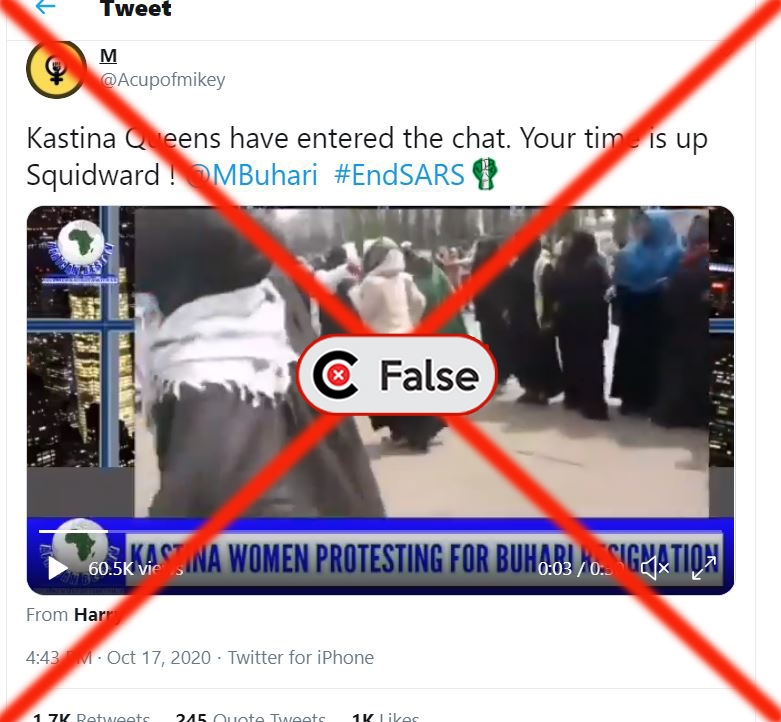
A video that went viral on Saturday, October 17, 2020, claimed that women in Katsina State have joined the #EndSARS protest to demand for the resignation of Muhammadu Buhari as Nigeria’s president.
The video has been shared multiple times online.
Some of the captions accompanying the video alleged that the women in President Buhari’s state of origin, Katsina State have joined the ongoing #EndSARS – a decentralised youth-led protest asking the government to end bad governance and police brutality in the country.
A Twitter user, @Acupofmikey, tweeted the video with the caption: “Kastina Queens have entered the chat. Your time is up” while adding the hashtag: #EndSARS.
Another Twitter user, @hailfinger1, tweeted the same video with another caption: “#EndSARS-For those trying to sectionalise the protest, this happened in President @MBuhari’s home town, Katsina state girls/women protesting and asking the President to resign.”
THE CLAIM
That Katsina women have joined #EndSARS protest and are calling for Muhammadu Buhari’s resignation as the President of Nigeria.
THE FINDINGS
Checks by The FactCheckHub show that the caption does not tally with the content of the video, thus making it FALSE.
The women in the video where chanting in Hausa – a major language in Northern Nigeria.
The woman with the megaphone in the video said an expletive word while other women chorused a response with “Hey, Buhari, modern day Pharaoh, release our leader/cleric.”
Muhammadu Buhari is the current president of Nigeria who came to power as a democratically-elected president in 2015.
Sheikh Ibraheem El-Zakzaky is an Islamic scholar and religious leader who was arrested under Buhari’s administration, leading to widespread protests calling for his release.
He was incarcerated after a clash between his sect and Nigerian soldiers. He was granted bail by the court many times but the order was reportedly not obeyed. This led to multiple protests by the sect members demanding for his release.
The chant “Modern day Pharaoh” alludes to the Pharaoh in the Abrahamic religion that refused to let the Israelites go even after multiple requests. While “Release our leader” refers to El-Zakzaky who is in detention.
In addition, at no point in the video did they called for the resignation of President Buhari.
The video is that of a protest calling for the release of El-Zakzaky and not Katsina (which was wrongly spelt as Kastina) women joining the #EndSARS protest as alluded.
THE VERDICT
The claim is FALSE, as the women in the video were neither calling for the resignation of President Buhari nor were they making reference to the #EndSARS movement.
A post which states that in 1959, 69 African-American boys, aged 13 to 17 were padlocked in their dormitory for the night at the Negro Boys Industrial School in Wrightsville, Arkansas and a fire started which led to the death of 21 of them has garnered a lot of reactions on social media.
Arkansas is a state in South Central region of the United State of America.
The post which was published on Facebook here on February 13, 2020 has 58,000 reactions, 25,000 comments and 169,000 shares.
A screenshot of the viral post on Facebook.
THE CLAIM:
That in 1959, 21 boys died from a dormitory fire that affected 69 African-American boys in a Negro Boys Industrial School in Wrightsville, Arkansas.
THE FINDINGS:
Checks by the FactCheckHub shows that the post is TRUE.
It has been the subject of several media reports in the 1950s when it happened and even after the millennium.
In 2008, Arkansas Times did a report which takes a look at the event and also spoke to the mother and brother of one of the victims.
The Arkansas Times also published a video interview with one of the survivors.
The FactCheckHub traced the image used to illustrate the Facebook post to a report by KATV.
The reporter told the FactCheckHub that “the image is just a generic class photo of the boys. It’s unclear if the victims that died are in the photo.”
The investigative report titled ‘Tragedy in Wrightsville: What really happened in 1959’ followed Frank Lawrence who it says dedicated majority of his life to trying to solve the tragedy.
“It was a carefully calculated murder that involved 21 boys but was designed to kill 69 that were housed inside of this dormitory,” said Lawrence.
The event is also the subject of Grif Stockley’s book ‘Black boys burning’.
“Most of the boys that were killed had run back to a corner of the building. If you look at the diagram, you can see that although there were a couple of doors, in fact we know there was no one there to unlock the doors,” Stockley told KATV.
A description of the book on the University Press of Mississippi states that Black Boys Burning “presents a focused explanation of how systemic poverty perpetuated by white supremacy sealed the fate of those students. A careful telling of the history of the school and fire, the book provides readers a fresh understanding of the broad implications of white supremacy.
Grif Stockley’s research adds to an evolving understanding of the Jim Crow South, Arkansas’ history, the lawyers who capitalized on this tragedy, and the African-American victims.”
In April 2019, the Arkansas Department of Correction remembered the “Wrightsville 21” by dedicating a memorial site to the 21 lives lost in the fire.
A few months later, the tragedy was the subject of a Fact-Check.
The post surfaced on the Nigeria cyber space in 2020 when a news platform which has a branch in the country republished the content of the Facebook post.
THE VERDICT:
The claim in the post is TRUE. A fire started in a dormitory housing 69 African-American boys which led to the death of 21 of them.
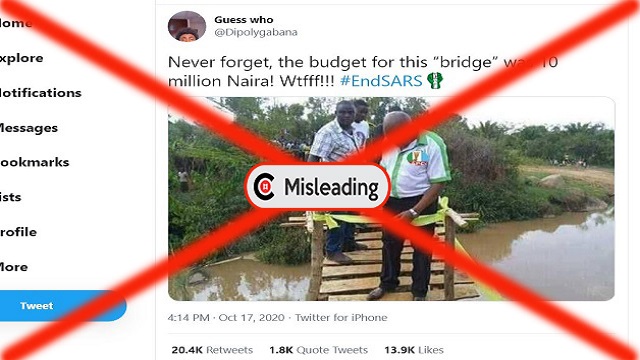
“Never forget, the budget for this “bridge” was 10 million Naira,” says a Twitter post by Guess Who published on Saturday October 17, 2020.
The post has a picture of man cutting a ribbon to commission a small rickety wooden bridge. The man’s white shirt has the logo of All Progressives Congress (APC).
The APC is the ruling political party in Nigeria.
The post suggests that the government (APC) was responsible for an overpriced bridge by adding the hashtag #EndSARS. It seeks to amplify the demands of Nigerian youths who have continued to demonstrate against Police brutality and bad governance in the country using #EndSARS.
The tweet was made at about 4:14pm on Saturday and within 24 hours, the tweet garnered over 20, 000 retweets and more than 13, 700 likes.
THE CLAIM:
That the image shows an APC leader commissioning a wooden bridge which was supposed to have cost 10 million Naira.
THE FINDINGS:
Checks by the FactCheckHub shows that the picture was manipulated and therefore MISLEADING.
Using the Reverse Image Search and Tin Eye tools, the picture was traced to publications in Zambia, Ghana, Kenya, Sierra Léon and other forums in Nigeria.
The Google reverse image showed the picture first appeared on the internet on Monday, February 6, 2017 on a Kenyan platform.
“Kenya’s social media is a gold mine of crazy. From misspellings, photoshop fails, memes and strange habits caught on camera, they are sprawling from all corners of this country,” the post read.
A few weeks after, the image was tweeted by a South African government official Tito Mboweni on February 26, 2017.
In addition, the Zambian Scribe used the same picture on January 21, 2019 to complement a story alleging that a member of parliament from an East African country commissioned the wooden bridge said to have cost 500, 000 dollars.
The picture which showed a man about to cut a ribbon does not have the APC logo on his shirt as portrayed on the viral picture.
It also appeared on a Nairaland, a Nigerian platform on May 27, 2019; this time around, the APC logo which was not there initially was added.
The size and dimension of the logo relative to the size of the man is off, in that the logo is too big, plus it looks super-imposed.
Furthermore, the image was earlier fact-checked on January 2019 when The Nigeria Politics Today, a Facebook page shared it.
THE VERDICT:
From the information presented above, the APC logo was super-imposed on the image thus it is MISLEADING.
A viral WhatsApp message which promises Nigerian citizens free N50,000 lockdown funds allegedly by the Federal Government has been shared widely.
The message was forward to the FactCheckHub by a concerned Nigerian for verification.
It reads: “FG has finally approved and have started giving out free N50,000 Relief Funds to each citizen?
“Below is how to claim and get yours credit Instantly as I have just did now”
The claim also included a website and a caveat that an individual is entitled to it only once.
Since the onset of the coronavirus claims such as this that promises financial relief as a result of the lockdown flooded the internet.
THE CLAIM
That FG has finally approved and have started giving out free N50,000 relief funds to each citizen.
THE FINDINGS
The FactCheckHub checked the domain name of the website on the Whois.com to unravel the identity of the person(s) behind it.
Our findings revealed that the main domain name of ngodataz.com – the website in the claim – was registered on June 15, 2020 in the United States of America (USA).
Screenshot of the website’s domain name when checked on the Whois.com database.
The website was created amidst the lockdown in Nigeria that halted almost all the nation’s economic activities, following the spread of the COVID-19 pandemic in the country.
It hosted the sub-domain which in a way similar to a survey form used in collecting users’ data.
Clicking on the website takes users to a page that asks users to fill a survey form, after which it asks them to share the webpage at least 8 times, similar to how other spamming websites work.
Thereafter, it asks users to fill-in their bank details such as account number, account name and bank’s name.
Though the website is fortified with the HTTPS (Hyper Text Transfer Protocol Secure), details about its registrant and administrator names and contacts were publicly unavailable as they were protected.
The HTTPS appears in the URL (Uniform Resource Locator) when a website is secured by a Secure Sockets Layer (SSL) certificate.
The details of the certificate, including the issuing authority and the corporate name of the website owner, can be viewed by clicking on the lock symbol on the browser bar.
The SSL is a secure protocol developed for sending information securely over the Internet. It encrypts the data being transmitted so that a third party cannot “eavesdrop” on the transmission and view the data being transmitted.
Since the onset of the coronavirus, claims that promises financial relief as a result of the lockdown flooded the internet with links directing individuals to fill and share a survey form.
Relevant stakeholders speak…
The FactCheckHub enquired from the Nigerian Presidency to verify if there are any lockdown funds being disbursed to Nigerians via that website.
In response, Segun Adeyemi, the Special Assistant to the Minister of Information, Lai Mohammed, debunked the claim.
“This is fake news,” he stated in a text message to our fact-checker.
Similarly, Garba Shehu, the spokesman to President Muhammadu Buhari, in a text message to the FactCheckHub asked our fact-checker to verify from the Minister of Finance, Zainab Shamsuna Ahmed.
“Can you check with the Minister of Finance, please?” he stated.
When the FactCheckHub contacted Nigeria’s ministry of Finance, Yunusa Tanko, the media aide to the Finance minister, He also discredited the claim and the website, saying “this is not from us, please.”
“Government don’t put out announcements especially of giving out money in such open forum/forms,” he added.
Further checks by the FactCheckHub revealed that the purported N50,000 Relief Funds is not connected with any Nigerian government-led initiatives to cushion the effects of the coronavirus pandemic on her citizens.
Our fact-checker also contacted the nation’s ministry of Humanitarian Affairs, Disaster Management and Social Development (FMHDSD) headed by Sadiya Umar Farouk, to verify the claim. The FMHDSD supervises the Nigerian government’s relief initiatives.
The media aide to the minister, Halima Oyelade, debunked the claim that the federal government is giving out free N50,000 to each citizen.
“Not true please,” she replied the FactCheckHub’s enquiry via a text message.
Not the first time…
It will be recalled that similar claims verified by the FactCheckHub previously were found to be false.
Similarly, a viral WhatsApp message in June 2020 which claimed that the Nigeria Centre for Disease Control (NCDC) is providing monetary palliatives to all Nigerians to cushion the impact of the Coronavirus Disease (COVID-19) was also found to be false.
The claims that promises financial relief as a result of coronavirus lockdown ask individuals who fill the survey form to share it multiple times.
Why such scams persist and the way forward
Commenting on why such claims are still going viral, Chukwuemeka Fred Agbata Jnr., Co-founder, Tecbuild.africa, said “Scammers have been able to use their victim’s greed and compassion to sway them. Sometimes, the scammers set up in such a way that they offer huge financial profit that appears irresistible in return with no effort.”
He added: “Many of these victims had initially expressed desires to offer a helping hand or likely become a hero.
“The scammers succeed in putting their victims in a position where they would appear to be solving a problem, either by saving an orphan or helping some poor soul recover money that purportedly belongs to them.
“Another way includes preying on the victims’ greediness. They mostly win over those who want to amass wealth too quickly and can easily fall for unrealistic promises.
“In general, lack of orientation is a major cause for victims always falling prey to these schemes. It’s mostly important for people to always do “reality check” for any information and kill greed that makes them fall for unrealistic promises.”
Also commenting, Remi Afon, the President, Cyber Security Experts Association of Nigeria (CSEAN) noted that “Anyone can easily fall prey of online scams as cybercriminals are crafty.”
“The reason why most people fall prey is because they don’t take their time to check the website they are directed to before clicking and supplying their personal information. When you land on a page or you receive a link, Stop, Think before you connect,” he said.
When asked how Nigerians can detect online scams to avoid falling victim, Afon stated that the HTTPS on the website alone does not guarantee that the website is not fraudulent.
“Internet users need to be at alert whenever they visit any website especially if there are promises of money e.g. COVID-19 relief package, employment that requires you to pay for form etc.
“It’s important to check the URL which is the address you see on the address bar properly. A government agency will not use .com but rather .gov.ng.
“Also, there might be imitation in terms of legitimate site. So, check out for spelling mistakes. Also, look closely at the content for grammatical errors, spelling mistakes or broken (pidgin) English. You can also find out who owns the website using online website checker such as LookWhois or Whois.net,” he added.
The survey forms ask for bank details among other questions.
Agbata also tasked online users to identify possible methods cybercriminals employ in defrauding their unsuspecting victims, saying “Scammers try to create a sense of urgency to encourage you to do something quickly without thinking it through or checking that it’s genuine. Don’t rush — take the time to consider and check whether an email (or message) is real. Always verify directly with the sender or (payment) recipient, using known and trusted contact details.”
He urged Nigerians in particular to be wary of the following: Fake Bank loan or fake credit card, Fake Bitcoin, Emotional Scam, Facebook impersonation, Fake antivirus software, Fake news scam, Fake shopping websites, Hitman scam, Fake Job offer, Loyalty points phishing scam, Make money fast scams (Economic scams), Overpayment Online Scam, Phishing email scams, SMS Scamming (Smishing), Tech Support Online Scams and Travel scams.
Both tech experts confirmed that cybersecurity awareness is key in curbing the menace of such online scams.
“There is need for public–private partnership as regards to Cybersecurity awareness. Internet users need to be more conscious when online and treat everything with suspicion. Government and private organisations need to invest more in Cybersecurity,” Afon stated.
Agbata further advised: “The government should set up intelligence units that can investigate and track scammers. The government should arrest and prosecute cybercriminals to serve as a deterrent to intending scammers.”
THE VERDICT:
From all information gathered from relevant stakeholders and sources, the claim that the FG has approved and started giving out free N50,000 relief funds to each citizen is FALSE.
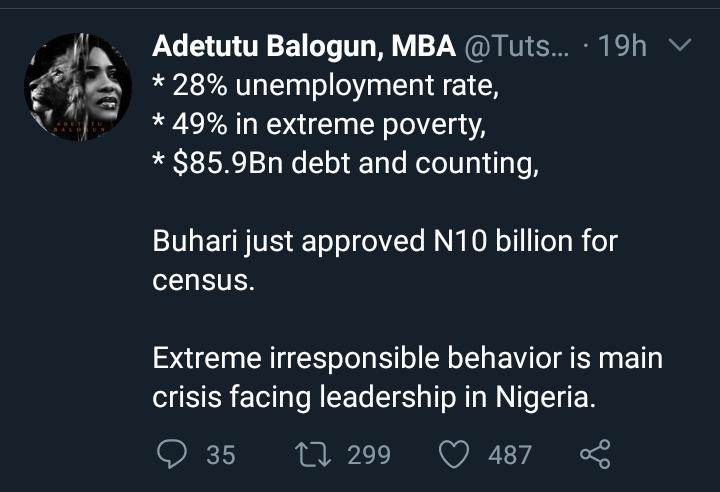
A viral post on Twitter claimed that Nigeria has 28% unemployment rate, 49% poverty rate and $89.5billion debt profile.
The claims were made by a Twitter influencer Adetutu Balogun with the handle @Tutsy22 on October 5.
Balogun is currently having over 230,000 followers on her Twitter account where these claims were made.
She also stated in the tweet that Nigeria’s President Muhammadu Buhari has approved N10 billion for population census which was reported by several mainstream media organisations.
The tweet read: “* 28% unemployment rate, * 49% in extreme poverty, * $85.9Bn debt and counting, Buhari just approved N10 billion for census. Extreme irresponsible behavior is main crisis facing leadership in Nigeria.”
A screenshot of the tweet.
THE CLAIMS:
From the tweet, these claims were established:
That Nigeria has 28% unemployment rate.
That 49% of Nigerians are in extreme poverty.
That Nigeria has $89.5bn debt profile.
THE FINDINGS:
Claim 1:
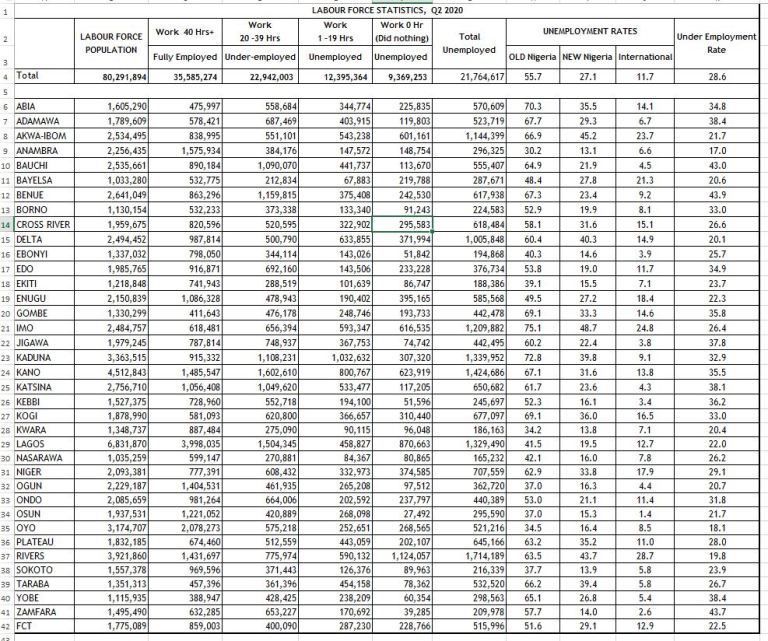
The FactCheckHub first checked the National Bureau of Statistics (NBS) website for the data on Nigeria’s labour statistics to determine the total percentage of unemployment rate in the country.
According to the statistics on Nigeria’s labour force released by the NBS for 2nd quarter (Q2) of 2020, Nigeria currently has 21,764,617 unemployed people. The data also stated that 27.1% people are unemployed in the country.
The NBS also stated in the labour force report that “The unemployment rate during the reference period, Q2, 2020 was 27.1%, up from the 23.1% recorded in Q3, 2018.”
From the data, it is obvious that the Nigeria’s unemployment rate stands at 27.1% and not 28%, which makes the claim FALSE.
Claim 2:
According to the United Nations, Extreme poverty, also known as Absolute or Abject poverty is known as “a condition characterised by severe deprivation of basic human needs, including food, safe drinking water, sanitation facilities, health, shelter, education and information. It depends not only on income but also on access to services.”
The World Bank in collaboration with the United Nations Children Fund (UNICEF) in a 2019 report stated that those living in extreme poverty are those living on less than $1.90 per day
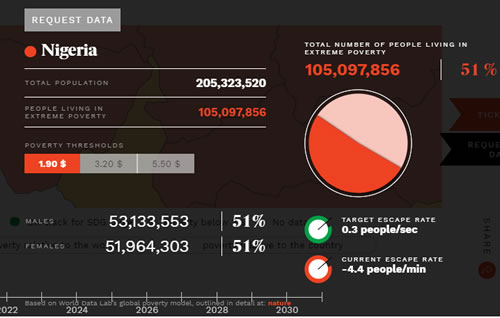
In a bid to check if 49% of Nigerians are in extreme poverty, The FactCheckHub checked the World Poverty Clock, a web tool produced by World Data Lab. The World Poverty Clock on October 13, 2020 revealed that 105,097,856 people equating 52% of Nigerian are living in extreme poverty in Nigeria based on the $1.90 benchmark.
The result stated further that 53,133,553 of the total people living in extreme poverty in Nigeria are males while 51,964,303 are females.
From the data, it is evident that 51% and not 49% of Nigerians are living in extreme poverty, thereby making the claim FALSE.
Claim 3
In a bid to check if Nigeria’s total debt profile stands at $89.5bn, The FactCheckHub checked the Nigeria’s Debt Management Office (DMO) ― the office in charge of keeping record of the country’s debt.
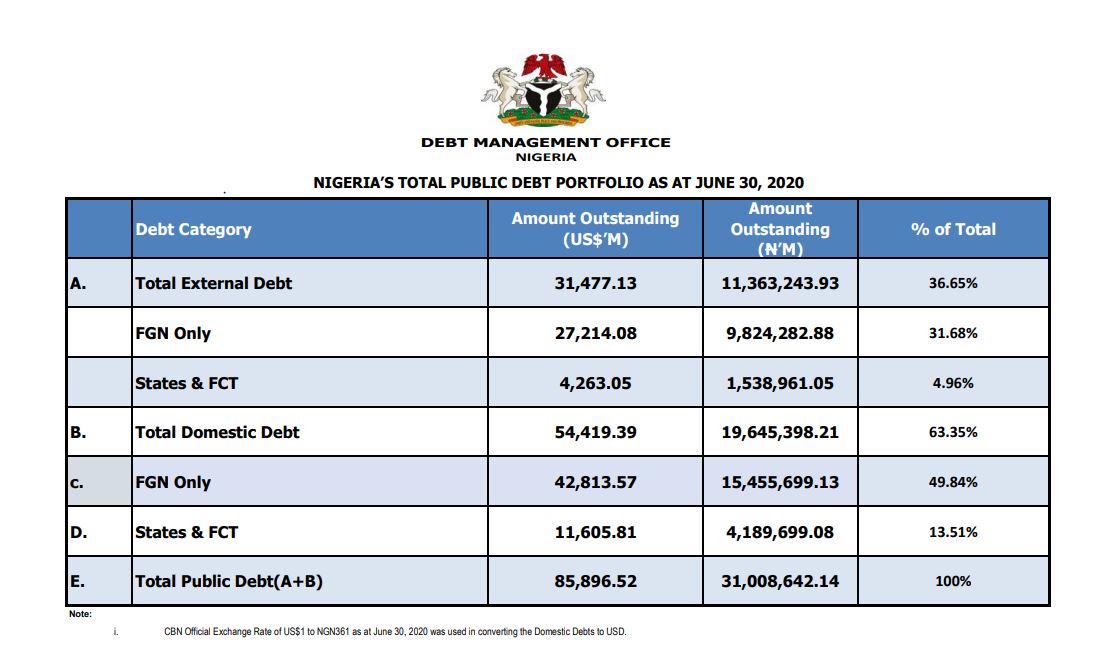
From the data gotten from the DMO, as at June 30, 2020, Nigeria’s external debt stands at $31,477.13M, while the total domestic debt was $54,419.39 making Nigeria’s total debt $85,896.52M.
Nigeria’s total public debt portfolio as at June 30, 2020 from Debt Management Office.
THE VERDICT:
Based on the information presented above the first two claims are FALSE while the third claim is TRUE.
Have you ever wondered how fact-checks are done? Do you think it is something you could do? The simple answer is Yes! You can.
Fact-Checking requires special skills. It involves a process. That is, it is systematic and you have to be deliberate in finding out the facts to confirm or debunk a claim. A claim can come in form of a video, text, images and so on.
False claims could be misinformation or disinformation deliberately orchestrated, composed to suit an agenda. It could be wrong attribution, wrong caption to a genuine photo or even outright fabrication.
However, for this section, we will look at claims that come in form of images. The images could be distorted to misrepresent an issue. It could as well be an old image shared to depict a new reality but from a different context.
Whichever form an image is presented on the internet you might be able to verify it with the aid of tools for image fact-checking such as are Google Reverse Image Search, Tin Eye, InVid, Yandex and so on.
This how to fact-check images tutorial will look at:
On any web browser of choice, visit www.labnol.org/reverse.
Scroll downward and click on the Upload Image button.
Select the image which must have been downloaded on your device or use the Take Photo option.
Click the Use or Open button.
Next, click the Show Matching Images button.
The next page shows you the similar pictures while a little scroll downward reveals where the pictures have previously appeared on the internet including the various sizes it was adjusted.
The Tin Eye is another reliable image search tool. It can be handy for a Fact-Checker who is interested in verifying picture and possibly document sources. It provides the date a picture first appeared on the internet, the website where the image was used as well as the image dimensions and sizes.
An interesting quality of the tool is that it gives the user an option of comparing the uploaded picture with the newly searched image through its compare button.
The button becomes active once the mouse cursor is placed on the searched images.
The simple steps to use the Tin Eye technology are:
Different variations of a video which went viral on Saturday, October 10, 2020 claimed that violence has erupted at a polling unit in Ondo state and that the wife of the state governor, Betty Akeredolu, was injured.
The video is alleged to have been aired by Channels Television, a national television station in Nigeria.
Some of the captions accompanying the video alleged that the governor of Ondo state, Rotimi Akeredolu, sponsored the attack when he sensed that he was losing the election at a polling unit: “Governor @RotimiAkeredolu sensed that he was losing in his own polling unit, then he ordered his police men to scatter the place!! 3 people have died on the spot!!! Everybody should pay attention to Ondo!!!”
Another reads “Breaking: Governor Rotimi Akeredolu’s wife injured, 3 killed as Governor’s details invaded polling unit in Owo. #OndoDecides2020”
The Independent National Electoral Commission (INEC), Nigeria’s electoral umpire, on Saturday, October 10, 2020 conducts the Ondo State Governorship election. The race to elect a new governor for Ondo is ongoing as at press time. Ondo is a state in Western Nigeria.
Akeredolu is contesting for a second term under the All Progressives Congress (APC) platform. While other front runners are Eyitayo Jegede of People’s Democratic Party (PDP) and Agboola Ajayi of the Zenith Labour Party (ZLP). Agboola is the current deputy governor of the state.
The APC is the ruling party at the nation’s centre.
A false claim shared on Twitter that Akeredolu’s wife was injured at a polling unit following a violence which erupted during the Ondo state governorship election.
THE CLAIMS:
That the video shows a polling unit in Ondo state where violence erupted.
That Akeredolu’s wife – Betty – was injured at the polling unit.
THE FINDINGS:
Checks by the FactCheckHub revealed that the video is MISLEADING as it has been doctored. The event in the video is not part of the 2020 Ondo state election coverage.
Combing the social media shows the same video with different locations stated on the bottom right side where locations of event is written. One of the videos stated that the disruption happened in Akure South. Another stated that the disruption happened at a polling unit in Owo while another stated that the event happened in Asaba.
The difference in location on the same video content said to have been broadcasted LIVE is a red flag that indicated that the video have been doctored.
The same video showing different locations.
What is the story behind the video?
Channels Television has reacted to the viral video and labelled it as “Fake News”.
The TV station tweeted that the video is doctored and it is not part of its coverage of the Ondo 2020 Governorship Election.
They further stated that the original video happened a few years ago and provided a link to it .
“The events playing out in the video is from an incident in Delta State two years ago”, the tweet reads.
The accompanied link leads to a video uploaded on Youtube on October 3, 2018. The video is titled “Gunshots, Violence Disrupt Delta PDP House Of Reps Primary”. Asaba is the location written on the original video at the bottom’s right hand corner.
This means that the video that resurfaced online is two years old and as such could not have been an event that happened at a poling unit in Ondo in October 2020.
A look at the various videos in circulation shows people within a blue and white fenced location.
In addition, there are several white canopies. However, two canopies standing side by side with what appears to be a human figure standing on top of one can be seen in all the videos in circulation. Also, the canopies are beside an arched-doorless door painted white.
FAKE NEWS: The video below is doctored and is not part of Channels Television's coverage of the Ondo 2020 Governorship Election.
The events playing out in the video is from an incident in Delta State two years ago.
Since the video did not emanate from Ondo state, it can be deduced that Betty, Akeredolu wife was not injured. And perhaps she was injured, it was not at the event portrayed in the video.
Furthermore, Betty Akeredolu has debunked the claim that she was injured at a polling unit as put forward by one of the posters of the video.
In a report by the Nation newspaper, she said the video was meant to damage the voting exercise, distort information and put it in a bad light.
Speaking at her Owo residence in Ondo state, she said, “That is insane, that is absurd. That tells you how desperate people can be in politics or our political landscape.
“I am here in the ambience of my country home and somebody is there doctoring video that I was injured.
“Were you the one that injured me? Such desperation will not do any good to them.
“The detractors want to damage the exercise, to distort information and put one on a bad light. It is all false,” the report reads in part.
False tweet claiming a video that emanated from Delta state is as an event that happened in Ondo state.
Why misinformation abounds in the time of elections
This will not be the first time that a content will be manipulated and attributed to Channels Television.
In September 2020 during the Edo State Governorship election, the FactCheckHub checked a claim here that put forward that Channels Television has released the result of the governorship debate which was false.
A multimedia journalist and social media strategist, Alade Abiodun, had explained to the FactCheckHub that elections bring about the proliferation of misinformation.
He said misleading information are in circulation because “It is the season of election.”
Alade further explained that “Politicians, their supporters and apologists will want to woo voters by selling their preferred candidates, not minding if they make use of misleading information to achieve this”.
He added: “Some are deliberate, others are done out of mischief with the sole aim of scoring political gains.”
THE VERDICT:
The claim that Akeredolu’s wife – Betty – was injured in the election violence portrayed in the video is FALSE. Furthermore, the claim that the video shows a polling unit in Ondo state where violence erupted is MISLEADING because the incident depicted happened in 2018 in Delta state.
Viral WhatsApp texts and image which claim that Agboola Ajayi, the candidate of the Zenith Labour Party (ZLP) for the Ondo state governorship election has reportedly dumped his governorship ambition and withdrew from the race is making rounds on social media.
The texts alongside the ZLP candidate’s withdrawal letter written on the party’s letterhead paper were forward on Saturday, October 10, 2020 to the FactCheckHub by a concerned Nigerian for verification.
The texts read: “BREAKING: ZLP candidate, Ajayi Agboola has reportedly dump his governorship ambition, and withdraw from the race.” (see the image below)
The FactCheckHub reports that the Independent National Electoral Commission (INEC), Nigeria’s electoral umpire, on Saturday, October 10, 2020 conducts the Ondo State Governorship election.
Ondo is a state in Western Nigeria.
Screenshot of the WhatsApp post with the image.
The race to elect a new governor for Ondo state is ongoing as at press time, as three major contestants including the ZLP candidate, Agboola Ajayi, slug it out at the poll.
The other major contestants in the election are Rotimi Akeredolu of the All Progressives Congress (APC) and Eyitayo Jegede of the Peoples Democratic Party (PDP).
While Akeredolu of the APC is the current governor of the state, Ajayi of the ZLP is the current deputy governor of the state.
THE CLAIM:
That the ZLP candidate in the Ondo state gubernatorial election, Agboola Ajayi, withdrew from the poll.
THE FINDINGS
The FactCheckHub reached out to Babatope Okeowo, the Chief Press Secretary to the Deputy Governor of Ondo State, Agboola Ajayi, to verify the image and viral WhatsApp post.
In his brief response to the FactCheckHub’s enquiry via his WhatsApp number, he stated that it’s “fake news”.
Similarly, Comrade Allen Sowore, the Media Adviser to the Deputy Governor (Agboola Ajayi), in a press statement on Saturday also debunked the post and withdrawal letter.
“Again, the attention of the Deputy Governor and candidate of the Zenith Labour Party (ZLP), Agboola Ajayi has been drawn to a forged resignation letter from the Governorship Election holding today, Saturday- 10 October, 2020…”
“For the umpteenth time, and for the purposes of clarity and emphasis, the Deputy Governor and candidate of ZLP, Agboola Ajayi will not resign or back out from the race he’s winning ultimately.
“The general public, members of our great party and most importantly the electorate should therefore disregard this latest antics…” the statement reads in part.
The FAKE letter of withdrawal.
Further findings by the FactCheckHub show that the image (ZLP letter) announcing the withdrawal of Ajayi from the poll was not dated. It also noted that the letter was signed by Ajayi, instead of the party’s state chairman, as obtained normally.
In addition, Dr. Kola Ademujimi, the Director-General of Agbo/Gboye Campaign organisation, the ZLP candidate’s campaign organisation, also corroborated the FactCheckHub’s findings in a statement released to newsmen on Saturday (October 10).
In the statement titled: ‘Disregard their propaganda & lies of withdrawal of H.E, Hon. Agboola Ajayi from the governorship race’, he said; “This is entirely false! A letter without a date and bearing a falsified signature of our candidate on the letter-headed paper of ZLP cannot deter our resolve to vote out the anti-people forces.”
He added: “Please note that Hon. Agboola Ajayi deos not sign letters on the ZLP letter-headed paper as he is not the Chairman of the party.”
THE VERDICT:
From all information gathered and presented above, the claim that the Zenith Labour Party (ZLP) candidate in the Ondo state gubernatorial election, Agboola Ajayi, has withdrawn from the poll is FALSE.











 The Tin Eye is another reliable image search tool. It can be handy for a Fact-Checker who is interested in verifying picture and possibly document sources. It provides the date a picture first appeared on the internet, the website where the image was used as well as the image dimensions and sizes.


