Please note that the FactCheckHub has not obtained any right from the authors or copyright owners of all third-party contents from embedded links and shall incur no liability in this regard.
Please note that the FactCheckHub has not obtained any right from the authors or copyright owners of all third-party contents from embedded links and shall incur no liability in this regard.
Please note that the FactCheckHub has not obtained any right from the authors or copyright owners of all third-party contents from embedded links and shall incur no liability in this regard.
Please note that the FactCheckHub has not obtained any right from the authors or copyright owners of all third-party contents from embedded links and shall incur no liability in this regard.
NIGERIA’s minister of Labour and Employment and Spokesperson of the All Progressives Congress (APC) Presidential Campaign Council, Festus Keyamo, has said the Action Congress of Nigeria (ACN) fielded the same faith presidential ticket in 2011.
He said this while speaking onChannels TV on Sunday, September 25, 2022 while defending the decision of the APC to field two Muslims as presidential and vice-presidential candidates respectively in the nation’s 2023 general elections.
“In the past, there have been Muslim -Muslim ticket before, and there was not so much noise. The ACN fielded a Muslim-Muslim ticket in 2011,” Keyamo said.
Speaking further, he argued that Atiku Abubakar, the presidential candidate of the People’s Democratic Party (PDP) did not get up to 10 per cent of votes in certain Northern states in the 2019 presidential election.
“I just want to make a statement of fact. They (Northern Elders Forum) don’t speak for the North. When they campaigned against Buhari in 2019, Buhari won resoundingly, and Atiku lost.
“Atiku lost. He did not even get 10 per cent of the votes in certain parts of the North. It is just to show that there are very wise elders, but they don’t control the street,” Keyamo stated.
Some Nigerians have expressed doubts on the veracity of both claims made by Keyamo, hence this verification.
CLAIM 1
ACN fielded a Muslim-Muslim ticket in 2011.
THE FINDINGS
Findings by The FactCheckHub show that the claim is TRUE.
The Action Congress of Nigeria fielded Nuhu Ribadu, a former Chairman of the Economic and Financial Crimes Commission and Fola Adeola, a co-founder of Guaranty Trust Bank (GTBank), as the presidential and vice-presidential candidates of the party, respectively in 2011.
Checks show that they are both Muslims.
Reports show that Christian groups canvassed support for Ribadu’s gubernatorial candidacy in Adamawa state in the 2015 election whom they acknowledged was a Muslim. Ribadu also felicitated with fellow Muslims during Ramadan in 2020 via his tweet.
According to his biography published by the entrepreneurs.ng, Fola Adeola was referred to as Tajudeen, which is a Muslim name. His wife is Hajara Adeola, who is also a Muslim.
The FactCheckHub also found one of his tweets where he responded to a tweet acknowledging that he’s a Muslim.
Atiku did not get up to 10 per cent of the votes in certain Northern parts of Nigeria.
THE FINDINGS
Findings by The FactCheckHub show that the claim is also TRUE.
PDP’s Atiku Abubakar lost his 2019 presidential bid to Muhammadu Buhari of the APC, who won 19 of the 36 Nigerian states. Atiku won in 17 states and the Federal Capital Territory.
Buhari won 15,191,847 of the total votes cast, while Atiku had 11,262,978 votes.
The APC candidate won in 19 states including Ekiti (219,231), Osun (347,634), Kwara (308,984), Nasarawa (289,903), Kogi (285,894), Gombe (402,961), Yobe (497,914), Niger (612,371), Jigawa (794,738), and Kaduna (993,445).
Other states where Buhari won are Bauchi (798,428), Lagos (580,825), Ogun (281,762), Kano (1,464,768), Katsina (1,232,133), Borno (836,496), Sokoto (490,333), Kebbi (581,552), and Zamfara (438,682).
Atiku won in 18 states including the FCT (259,997), Ondo (275,901), Abia (219,698), Enugu (355,553), Ebonyi (258,573), Anambra (524,738), Oyo (366,690), Adamawa (410,266), Edo (275,691), Benue (275,691).
Other states where Atiku won are Imo (334,923), Plateau (548,665), Taraba (374,743), Cross River (295,737), Akwa-Ibom (395,832), Delta (594,068), Bayelsa (197,933) and Rivers (473,971).
Atiku did not get up to 10 per cent of votes in Borno and Yobe states.
According to ananalysis by the BBC, Atiku got 71,788 votes representing 7.8 per cent of the total votes cast in Borno state, and 50,763 votes representing 9.08 per cent of total votes cast in Yobe state in the 2019 presidential election.
THE VERDICT
The claim that Atiku did not get up to 10 per cent of votes in the 2019 presidential election in certain Northern states is TRUE; as finding revealed that he got less than 10 per cent of votes in Borno and Yobe states.
But this year, local media are reporting a surge in people registering to vote, and collecting their permanent voter cards.
In August, INEC announced that it had added 12.2 million voters to the roll during the continuous voter registration that closed on 31 July, bringing the total number of registered voters to 96.2 million.
The elections agency, which is now cleaning up its register, says it expects to end up with 95 million voters. This would be a significant increase on 2019 figures, when there were 84 million registered voters. This later dropped to 82.34 million after a similar cleanup.
He said the enthusiasm of young people was “unprecedented”.
“There is an increase in awareness and more Nigerians developing confidence in the electoral process, especially with the introduction of the bimodal voter accreditation system,” he told Africa Check.
The new system verifies the biometrics of voters, such as fingerprints and facial features.
Igbuzor also attributed interest to the emergence of a “third force”, or alternatives to the mainstream parties. Two parties – the All Progressives Congress (APC) and the People’s Democratic Party (PDP) – have dominated Nigeria’s electoral politics since the return of democracy in 1999.
But a new candidate is making electoral waves. (More on this later.)
Saleh Dauda, a professor of political science and international relations at the University of Abuja, also predicted that turnout would be significantly higher than in the previous election.
“Many people are angry with the state of things in the country and they would be coming out to vote for an alternative,” Dauda said.
A unique risk of voter apathy
But the permanent voter’s card (PVC) is essentially a government-issued identity card, so there are concerns that people have applied for the card for purposes other than voting.
Voter cards should only be used for elections, INEC chairperson Mahmood Yakubu said at a public awareness event in Abuja in June.
“I want to thank you for making PVCs the most popular ID in Nigeria today. But when you collect your PVC, don’t use them for other things. They are for elections, not for the opening of bank accounts,” Yakubu told the crowd.
The jobs
Political parties finalised the nomination of their candidates in June. On 20 September, INEC published the final list of candidates seeking presidential and national assembly seats. Campaigning started on 28 September.
The final list of people eyeing jobs as governors and in state assemblies will be published on 4 October. The official contest for these seats starts on 12 October.
Elections for governors will be held in 28 of the country’s 36 states. The election cycles for governors of the other eight states do not align with the general elections. This is due to legal challenges to election results, which led to court-declared winners starting their four-year term months and even years late.
A presidential candidate can only win the first round of voting if they get more than 25% of the votes in two-thirds of the country’s 36 states.
The importance of ethnicity, religion and geography
Many issues will affect the outcome of the presidential race, Igbuzor told Africa Check.
“Factors such as ethnicity, religion, security, the economy, corruption, the amount of money the candidates spend, party structure and young voters will largely determine who wins the election,” he said.
We take a closer look at a few.
Nigeria was united as a single British colony in 1914. Before that, it was divided into northern and southern protectorates. More than a century later, the division can still be seen: a Muslim-dominated north and Christian-majority south.
Before the party nominations, some religious, ethnic and political leaders said the presidency should go to the south. Current president Muhammadu Buhari, a northerner elected on an APC ticket in 2015, has been in office for eight years.
This influenced the emergence of Tinubu, a southerner, as the APC’s presidential candidate. Obi, who left the PDP for the Labour Party just before party nominations, is also from the south.
But the PDP’s Abubakar and the NNPP’s Kwankwaso are from the north.
The politics of zoning
Some Nigerian politicians have also made a case for zoning. This is where the leading political parties pick their presidential flag-bearer from a specific geopolitical zone.
Beyond its other divisions, Nigeria has six geopolitical zones: three in the north and three in the south.
The northwest zone has seven states, and the northeast and north-central zones six each.
The southwest and south-south zones both have six states, and the southeast five.
The zoning argument would favour the southeast, which zoning supporters argue has been marginalised at top levels of government for years. But no candidate from the southeast won the presidential nominations of the major parties, the APC and PDP.
Tinubu is from the southwest zone, Abubakar from the northeast and Kwankwaso from the northwest. But Obi is from the southeast.
Religion and the north-south divide
Religion is also a key factor. Nigeria’s north is predominantly Muslim while the south is largely Christian.
Outgoing president Buhari is a Muslim from the north. Some Christian leaders have accused him of favouring fellow northern Muslims and being lenient with bandits. He has denied these accusations.
But his party, the APC, chose two Muslims for the presidency: Tinubu from the south and running mate Kashim Shettima from the north. This prompted mixed reactions. Some leaders have argued that for religious balance, Tinubu should have chosen a Christian from the north as his running mate.
On the PDP side, Abubakar is a northern Muslim. He picked a Christian running mate from the south-south zone. The NNPP’s Kwankwaso, a Muslim, also chose a Christian running mate from the south.
Of the four frontrunners, the Labour Party’s Obi is the only Christian. His running mate, Yusuf Datti Baba-Ahmed, an economist and politician, is a Muslim from the northern state of Kaduna.
How the zones voted in previous elections
The APC’s historic victory in 2015, which ended the PDP’s winning streak, owed much to how the zones voted.
That election was largely decided by the northwest, which has the largest voting population and is where Buhari is from.
But the APC also attracted southwest voters, and turned the previous PDP stronghold of north-central.
Voting data shows the APC held much of its ground in 2019.
The ‘third force’: alternatives to the main parties?
In the 2015 presidential election, the APC and PDP polled 98.92% of all valid votes. In 2019, this dipped to 96.82%.
This trend suggests that the two parties are still the ones to beat. But analysts say the Labour Party could eat into this in the south, and the NNPP may chip away at northern votes.
Gains for Obi are likely to come at the expense of the PDP, while Kwankwaso could be a threat to some of the APC’s strongholds.
A wealthy businessperson with a reputation for frugality, he has dominatedonline polls, although these rely on volunteers and an internet connection. But there have also been opinion polls. One put Obi eight percentage points ahead, stoking sharp criticism from his rivals. Another gave him an eye-raising lead of 26 points.
The merits of these polls and the actual outcome on election day aside, there’s little doubt Obi is appealing to younger Nigerians and people weary of mainstream parties dominated by 70-something-year-old candidates.
Insecurity, the economy, and a divided country
Insecurity, a struggling economy and national unity are some of Nigerians’ most pressing challenges.
Insecurity has increased in recent years, fuelled by jihadism, banditry, kidnappings and a separatist insurgency.
A candidate with a track record of managing public funds would have an advantage. That’s according to Tukur Garba, a professor of development economics at the Usmanu Danfodiyo University in Sokoto, northwestern Nigeria.
“Nigeria’s economy is in a difficult situation with debt servicing exceeding revenue,” he told Africa Check. “Corruption is at the root of Nigeria’s economic woes. Even the insecurity, which is impacting agriculture and trade, is linked to corruption in the security agencies.”
Some prominent Nigerians, including former president Olusegun Obasanjo and Nobel laureate Wole Soyinka, have also warned that Buhari’s administration has left Nigeria more divided.
The survey calculated a social cohesion index of 44.2%, indicating that “the country has become more divided along ethnic, social, political, economic and religious lines, thereby threatening the social fabric, unity and peaceful co-existence of the country”.
So, an ability to unite the country would appeal to many voters.
Unfortunately, Nigeria’s presidential elections are rarely issue-based, Dauda said.
“So the pertinent issues of security and the failing economy will not have as much impact on the outcome of the election as ethnicity, religion and regionalism.”
Disinformation schemes influencing the election
Previous elections have seen disinformation campaigns to influence voting behaviour.
An example is the Cambridge Analytica operation ahead of the 2015 presidential election. This targeted individuals and groups with false narratives about Buhari, then an opposition party candidate.
Misleading narratives about candidates are already spreading. Since announcing the election schedule, Inec has had to debunk several messages misinforming Nigerians about the registration, polling and conduct of the elections.
Misinformation and disinformation would play a significant role in this election, Dr Theresa Amobi, a senior lecturer at the Department of Mass Communication, University of Lagos, told Africa Check.
Amobi has recently researched the spread of misinformation in Nigeria.
“Disinformation around the election has already taken a life of its own. We are seeing different types of disinformation. Some have been spread to incite sections of the country against a presidential candidate,” she told us.
“For instance, a photo of a young man dressed in the colours of the Biafran flag stepping on the Nigerian flag was circulated with a claim that it is Obi’s son. That was done to associate Obi with the Indigenous People of Biafra, which would damage his candidacy among undecided voters, especially in the north. That claim has been debunked,” she said.
“Generally, where there is limited information, misinformation thrives. Candidates need to provide accurate information and debunk false narratives. Even though debunking false information may not completely erase its impact, it helps a great deal,” she said.
Africa Check is part of a coalition of Nigerian fact-checkers who have written an open letter to politicians, urging them to avoid making false claims and to debunk false or misleading information related to their parties or candidacies.
This report was written by Africa Check, and republished by The FactCheckHub as part of the Nigerian Fact-checkers’ Coalition initiative. See the original piece here.
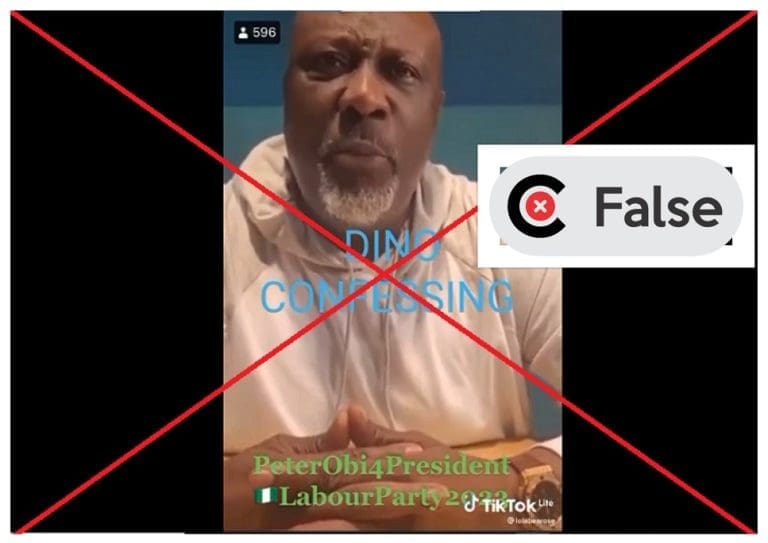
A video, which depicted Senator Dino Melaye expressing his support for Peter Obi, the Labour Party’s presidential candidate, ahead of Nigeria’s 2023 general elections, is circulating on social media, especially on WhatsApp.
This is coming few months ahead of the country’s general elections billed for February 2023.
Melaye, a former Nigerian senator and one of the spokespersons to Atiku Abubakar, the People’s Democratic Party’s (PDP) presidential candidate, said in the video footage that Obi is fantastic and a good man. He added that the Obi movement should continue, noting that everyone should be part of it.
“I wanna say, it is time for us to think. I encourage the crusade, the movement started by Peter Obi to continue, move from campus to campus, move from community to community, move from one progressive group and organisation in this country to another to campaign for the new Nigeria that is to come and be part of the movement,” Melaye said in the video.
The 38-second video was traced back to a TikTok account with the username @lolabearose, with a caption that read:
“Thank you, Mr Dino, for always saying the truth.”
The video post has garnered a significant amount of interactions with over 500 views, over 200 likes, 80 comments and shared 119 times as of 2:00PM on Thursday.
One TikTok user, @tapcurrent, apparently in consensus with the post, commented that PDP might merge with Obi’s Labour Party.
“Hahahahaha, they have started to revise the truth. Don’t be surprised that PDP will merge with LP.”
Another user, @user kingh, stated that Melaye might switch from PDP to LP hopefully.
“Mr Dino is coming into the Labour party this week by God grace and u are going to handle that aspect of the campaign,” the user commented.
Nigerians have expressed some doubts as to the credibility of the video since it went viral online, even as Melaye reinstated his support for Atiku last Saturday.
CLAIM
Video depicts Dino Melaye expressing support for Peter Obi, the Labour Party’s presidential candidate.
THE FINDINGS
Findings show that the claim is FALSE.
When the video was analysed on Deepware – a tool used to determine whether a video is a deep fake or not, the results show that the video is not a deep fake.
The result of the Dino’s video analysed on Deepware shows it is not a deepfake.
When the footage was subjected to further analysis using the InVid video verification tool, findings from the video fragmentation revealed the clip was taken out of context from a longer and original version.
The original video
On the 1st of July, 2022, Melaye shared a 6-minute, 25 seconds video of himself with the caption:
“Obi is a fantastic and a good man, but he lacks the capacity to unify Nigerians.”
In the full video, Melaye pledged his support for PDP’s Atiku Abubakar and downplayed Obi’s candidacy ahead of the election.
Melaye further stated that Atiku is a unifier and outlined some qualities which he believes make Atiku the best candidate to be president.
Screenshot of the original Dino’s video posted on YouTube.
“So, we need one Nigerian, who is going to be trusted by every part of this country, who the north will believe in, who the south will believe in and that person without blinking eyes is Atiku Abubakar,” he asserted in the video.
Even though Melaye did say the exact words in the footage, however, the context was attributed to Obi’s role as Atiku’s Vice President when the duo unsuccessfully ran for the presidential elections in 2019.
The 38-second footage, excised exactly at 4:30 – 4:58 timing, was taken from the original video that is six minutes and twenty-five seconds long (6:25).
In fact, Melaye further shared the same YouTube video on his Twitter account with a caption that read: “WATCH……SDM. Peter Obi is Fantastic and a good man, but he lacks capacity to unify Nigerians. Unity is more important than cutting cost of governance.”
Screenshot of Dino’s viral video posted on his Twitter account, @dino_melaye.
THE VERDICT
Findings show that the claim is FALSE; this is because even though Dino Melaye was talking about Peter Obi, he wasn’t showing support for the Labour Party’s presidential candidate as claimed on social media.
ON Monday, 5th of September, 2022, a report published by an online blog named “School Beginner”, claimed that Usmanu Danfodiyo University, Sokoto, (UDUS), has announced the commencement of sales of Post UTME screening form for the 2022/2023 academic session for undergraduate programmes.
Screenshot of the blog post shared in a WhatsApp group.
The report, archived here and retrieved from a WhatsApp group, was circulated by a student of UDUS identified as Abdullahi Akorede, popularly nicknamed ‘Solution’ by his peers.
The report also claimed that the sales of 2022 UDUS Post UTME screening form will begin officially on 6th September 2022 and ends on 6th October 2022 on UDUS website.
CLAIMS
The claims read:
“The management of the Usmanu Danfodiyo University (UDUSOK) has announced 6th September 2022 as the latest commencement date for the sales of the 2022/2023 Post UTME Screening Application form.”
“The management of the Usmanu Danfodiyo University (UDUSOK) has announced Two Thousand Naira (N2,000) as the latest cost Price for the 2022 Post UTME form.”
“The management of the Usmanu Danfodiyo University (UDUSOK) has announced 6th October 2022 as the latest closing date for the 2022/2023 UDUSOK Post UTME online registration/screening.”
Screenshot of the blog post.
THE FINDINGS
Findings by TheFactCheckHub revealed that the post is FALSE.
Checks at the school’s admission office show that Usmanu Danfodiyo University, Sokoto is yet to announce a date for the commencement of sales of the Post UTME form for the 2022/2023 academic session.
Mallam Shehu Abubakar, the university’s admission officer, has debunked the post published on the School Beginner blog.
Abubakar told TheFactCheckHub that UDUS is still running the 2020/2021 academic session, adding that the next session shall be 2021/2022.
He said the school had, in February 2022, notified “all candidates that applied for admission into the Usmanu Danfodiyo University, Sokoto for the 2021/2022 session, to upload their O’level (WAEC, NECO, NABTEB, etc) on the JAMB portal through their CAPS e-facility.”
Screenshot of the blog post.
He noted that the university’s 2022 academic calendar is yet to be decided by the school authority.
“Also, UDUS has stopped conducting Post UTME exercise for its candidates, and if it will be conducted in the next academic session which is 2021/2022, the school will decide on that and ask us to inform the UTME applicants. But for now, no information regarding that has been passed by the management. So, the information on that platform is fake. It’s not from UDUS,” he said.
Further checks revealed that the last time UDUS conducted Post UTME examination for her UTME applicants was in the 2015/2016 academic session, while its admission is currently being conducted through the JAMB Central Admission Processing System (CAPS), a platform introduced by JAMB to ensure transparency for students’ admission into Nigeria’s tertiary institutions.
Screenshot of the blog post.
Also, findings revealed that UDUS did not announce 2,000 naira as the cost for the 2022 Post UTME form; thus FALSE. In fact, the students admitted into the current 2020/2021 academic session paid an acceptance fee of 7,000 naira, screening fee of 2,000 naira, T-ship fee of 2,000 naira, and ID card fee of 2,000 naira – all amounting to 13,000 naira which the applicants paid when the school offered them admission, checks show.
When contacted, Akorede who shared the false post claimed that he got the information online and shared it in multiple WhatsApp groups without verifying.
Similarly, when the blog was subjected to verification on Whois domain tool, one Ofa Joseph was found to be the website owner.
Screenshot of the blog URL when subjected to search on Whois domain tools.
When The FactCheckHub reached out via email to Joseph for comments, he was yet to respond to the press inquiry three days after.
The claims that UDUS has announced opening and closing dates for the sales of Post UTME form for the 2022/2023 academic session are FALSE. Similarly, the claim that the university is selling Post UTME form for N2,000 is also FALSE.
The Independent National Electoral Commission (INEC) has tasked media organisations in Nigeria to always fact-check stories before processing them for public consumption.
INEC chairman, Professor Mahmood Yakubu, made this remark while speaking on Monday at a sensitisation forum for broadcasters and stakeholders on fair and responsible coverage of the 2023 general election organised by the National Broadcasting Commission (NBC), held at the NAF Conference Centre in Abuja.
He urged media organisations and professionals to continue to abide by journalism ethics anchored on the law, the regulations and guidelines published by INEC and the NBC Code.
“As campaigns start, the media has a huge responsibility. We have all been talking about issue-based campaigns. I believe that the media has a critical role to play in this respect. Equitable access to the media for all political parties and candidates is essential to the promotion of issue-based campaigns.
“By doing so, the media will also steer the discussion and engage the candidates away from the mundane to the critical issues that matter to citizens. Consequently, the public will be better positioned to make informed decisions on Election Day.
“Beyond the commencement of campaigns by political parties, I would like to seize this opportunity to appeal to the media to continue to fact-check stories before going to press. Politics is an intensely partisan activity. The media and INEC stand for neutrality,” Professor Yakubu said.
He further warned political parties against using hate speeches that could elicit physical attacks, disruption of election materials and other forms of violence.
He reiterated the commission’s commitment to ensuring that the forthcoming 2023 General Election is free, fair, credible, transparent, inclusive, and verifiable.
THE popular video-sharing app, TikTok, has announced additional policies after a report indicted its platform of exposing its users to misinformation.
Blake Chandlee, president of global business solutions for the short-form video platform, said in a blog post that he hopes these actions will help curb the misinformation that has been plaguing American democracy.
“As we have set out before, we want to continue to develop policies that foster and promote a positive environment that brings people together, not divide them,” Chandlee said in the post.
He added: “We do that currently by working to keep harmful misinformation off the platform, prohibiting political advertising, and connecting our community with authoritative information about elections.”
Chandlee said verification of politicians or government entities would be crucial to building trust with platform followers.
He noted that political advertising is already banned on TikTok, adding that the social media platform is “working to keep harmful misinformation off the platform.”
“Today, we are building on that approach by making a series of changes to government, politician, and political party accounts that we believe will help ensure TikTok remains a fun, positive and joyful experience,” he stated.
A report published by NewsGuard last week had showed that when a TikTok user searches the social media app for information on top news stories, ranging from Covid-19 vaccines to school shootings, nearly 20 per cent of the videos presented as search results contain misinformation.
Researchers at NewsGuard, a journalism and technology tool that tracks online information, searched TikTok and Google this month for information on major news topics such as the 2020 presidential election, the Russia-Ukraine war and abortion to compare the misinformation delivered by their search engines.
The report shows that TikTok’s users, who are predominantly teens and young adults, are consistently fed false and misleading claims when they search on TikTok for information about prominent news topics.
According to the report, a search on TikTok for information about politics, COVID-19, the Russia-Ukraine war, the 2022 U.S. midterm elections, abortion, and school shootings, among other topics in the news repeatedly delivered videos containing false claims in the first 20 results, often within the first five. Google, by comparison, provided higher-quality and less-polarizing results, with far less misinformation.
NewsGuard researchers also found that TikTok’s search engine “is consistently feeding millions of young users health misinformation, including some claims that could be dangerous to users’ health.”
The 2023 election fever has gripped many Nigerians, politicians and political parties alike. So also, the society, mainstream media, online blogs, and social media platforms have been so polarized in Nigeria.
“You’re either in my camp or against me”; that was the story of a Nigerian gender activist and journalist, Udeme Edoamaowo, who had an altercation with her friend of more than fifteen years on social media. The friend is a staunch supporter of one of the presidential candidates in Nigeria.
Recently, Udeme’s friend posted a statement that she considered to be too extreme and boom, the attack on her person.
According to Udeme, “I think all journalists should be politically neutral in order not to be biased during reportage, but I am surprised that some Nigerian journalists have clearly projected their candidates, even going extra mile to discredit other candidates and bully whoever has a contrary opinion”.
She narrated her encounter, “a colleague and friend whom I have known for over 15 years in journalism not only bullied but blocked me on Facebook because I condemned her post saying derogatory things and discrediting another candidate that was not hers. My advice was simple; there is life after the 2023 elections. Mind the way you discredit someone. She took it so personally; we argued for a while, and she ended up blocking me”.
“l was so amused because I am still wondering why the masses have never seen beyond their noses how fake these politicians are,” Udeme added.
She laid the blame on antagonistic conduct. “The masses are fooled into fighting and killing each other, but the politicians always have a common ground of meeting. None of them wants to lose out on money they spent before elections, so they always find a way to tag along the winner while we are here fighting and killing each other,” Udeme said.
In the last couple of months, caustic online political conversations have found their way to the mainstream media, thereby amplifying online narratives that are often divisive, ethnoreligious and full of hate speech.
The mindset of “if you’re not on my side or support my preferred candidate, you’re my enemy” amongst some journalists calls to question adherence to the ethics of the journalism profession.
The back page column published by the Nation newspaper with the title, “Obi-tuary”, a below-the-belt play on the surname of the presidential candidate of the Labour Party, Peter Obi, by a senior journalist, Sam Omatseye, is an example of online hate speech finding its way into mainstream media.
If journalists, under the guise of liberty to write, cannot tolerate the opinions of others, then the Nigerian media landscape will be more polarised before the general elections. This can trigger pre, D-day, and post-election violence.
Tolerance and the ability to allow people with opposing views to express their opinions are golden.
Dr Olunifesi Suraj, Associate Professor, Department of Mass Communication, University of Lagos, said the media is also not spared or immune from the stings of online hate.
According to him, “I have experienced online hate. I must tell you, it is devastating with some of us who preached about media and information literacy, and we are digital and media literate; the way I personally handle it I build resilience towards it. I know people who spread hate online have particular reasons for doing it.”
Dr Suraj added: “As a lecturer and somebody who criticizes government to put them on their toes, a public analyst and one who has a voice in the society, definitely some people are not going to like you for that and will not like what you stand for.
“They will do everything to run you down; use common things that people believe to run a smear campaign and blackmail you, and make you feel so bad in society. When such things come up, the majority of people are not media literate, and they believe whatever they read online.
“Another way is not to speak at all… you trying to defend yourself is like putting more petrol on the fire to burn. Online hate speakers want to provoke you to respond and make you react to their narratives. It is advisable to keep quiet sometimes. Defending yourself will not solve the problem, and it will not justify you because people have already made up their minds about what they want to believe, trend and say, because of economic reasons and the aims behind it, and just allow time to justify you.”
Ben Adoga is another Nigerian journalist that couldn’t withstand what he tagged ‘the poison of online hate speech.’ He had recently stayed off social media for years to regain his mental health, according to him.
He narrated his ordeal: “I experienced hate speech; it was massive just after the 2015 general elections as I was in the [Goodluck] Jonathan Campaign team. I only expressed my opinions on Facebook and other social media platforms during the campaign. But when Presidential Goodluck Jonathan lost, they swooped on me; they called me thief, rogue etc. So, if I post or respond to anything, they bullied me on Facebook. I decided to leave social media for two years.
“It affected my mental health; I felt humiliated, dejected, and lonely because I wasn’t interacting with the outside world as I left social media. Even now, I rarely post on Facebook due to the trauma and fear of online trolls,” Adoga said.
Online hate speech has been further exacerbated by Nigerian journalists who run such narratives on the mainstream media.
Dr Suraj counselled that as Nigeria heads to the 2023 general election, journalists should not heat the polity.
He insists that patriotic reporting in a way that puts Nigeria on the bigger picture, rather than serving the interest of any politician, must be their guiding principle.
The media scholar noted that Nigerian journalists should not allow “their economic interest” to sabotage the national interest and urged them to be fair and balanced in their reportage.
“We have some wrong people in journalism. People who do not abide by the ethics and principles of journalism. When those principles are compromised, we have a lopsided society. The society is a reflection of the journalism being practised.
“Journalists should know that we must first have a country before they can practice journalism. If there is no country, there’s nowhere you can practice,” Dr Suraj opined.
He insisted that journalists should ensure that society is well informed. He also lamented that some journalists in Nigeria act irresponsibly for pecuniary gain, emphasising that fact-checking information obtained from social media must be intensified.
This, he said, is to ensure that hate speech is curtailed, content is balanced, and objectivity is upheld in their reportage of the build-up to the general elections.
Online hate speech has affected and ruined the lives of not a few people.
And as Adoga, who has been a journalist for over 25 years, said, the freedom of speech and expression is being replaced with the fear of online trolling and hate speech.
He said when this is coming from professional colleagues, then it leaves a lot to be desired.
The campaign season gets underway in a few days, and the media landscape will get busier.
Dr Suraj said some factors such as media ownership and political affiliation would play a huge part in media programme content and reportage.
“The Nigerian media is not politically neutral. There is political affiliation by the media. The political news often carries political inclination. The polarization is also tilted towards religious affiliation and geographical affiliation.
“The media also pushes the candidacy (based on) from those areas of ethnic colouration, sentiments they agitate and advocate for. Generally, the media either online, social and mainstream are polarised along ethnicity, geographical distribution, religious sentiments and along ownership influences,” he noted.
Free speech devoid of hate speech towards colleagues and friends who hold opposing views and perspectives, either online or offline, is key to peaceful, rancour-free election.
* Joy Jaiyesimi can be reached via email: joyamazing18@gmail.com
FORMER Nigerian President, Goodluck Jonathan, has urged Nigerians to shun fake news, hate speech and propaganda ahead of the nation’s 2023 general election.
Jonathan made this remark on Tuesday at the second edition of the ‘peace conference’ organised by the Goodluck Jonathan Foundation with the theme: ‘Nation Building: The Role of Elections in a Multi-ethnic Context’.
The former president noted that hate speech, fake news and propaganda have been identified as the greatest threat to Nigeria’s democracy, and anybody who engages in any of these should be regarded as a threat, just like a gun.
Speaking at the event, the former president said he is very pleased to see that young people are interested in the nation and election matters.
He, however, said hate speech must be discouraged.
“Before this time, we were always afraid of guns as a threat to democracy. But the biggest threat to democracy now is the issue of propaganda, fake news and hate speech,” he said.
“Anybody that’s an advocate of this is a threat to democracy. Our young people should know that we should embrace good conduct that will lead to good elections.”
Speaking further, Jonathan said anybody interested in leadership has the responsibility of protecting the nation.
“We must first have a country before we talk about having a president. If we destroy a country, then we do not need a president,” he said.
THERE are more conversations about how to combat election disinformation and misinformation on social media, but there seems not to be a comparable effort for text messages.
What seems to be the biggest election disinformation event of this year’s midterm primaries in the United States played out through text messages, NBC News reported.
The night before Kansans were set to have a historic state-wide referendum last month, voters reportedly received a text message on their phone, misinforming them about the consequence of their votes on abortion rights.
The text messages read that a “yes vote” protected abortion access in their state.
That was said to be false as a “yes vote” would result in the removal of abortion protections from the state’s constitution.
Even Scott Goodstein, who built the bulk text messaging apparatus for Barack Obama’s campaign in 2008, has since called for stronger reforms against potential abuse of political text spam.
According to him, there was little effort to stop political groups from spamming voters with disinformation.
Goodstein said, “This is very easy, and there is no real cost or consequences for a bad actor to upload very, very targeted voter-file-based groups and spread misinformation, disinformation, horrible rumours.”
Regarding what played out in August’s referendum, he said Kansas “was just foreshadowing the future.”
There is no regulatory agency that monitors the contents of all the billions of text messages that are sent every day.
Even though American phone carriers employ some anti-spam measures, they are said to be clearly limited.
More Americans reportedly filed complaints about spam and scam text messages with the country’s Federal Trade Commission this year than ever before, an Agency spokesperson told NBC News.
The Senior Vice President of an industry group (CTIA), Nick Ludlum said in a statement that “Wireless carriers do not pre-screen the content of their customers’ text messages.”
Also, a Clemson University professor, Darren Linvill, who studies disinformation, said while there has been substantial data-based research of disinformation on social media from academia and third-party social analytics companies, there has never been any way to comparably study text messages.
“What are you going to do with text messages? There’s no tool to collect it all, and nor should there be, necessarily.
“This is an underappreciated tactic, and I feel like it’s becoming more popular than in the past,” Linvill said. “It’s really hard to measure,” he added.
The media space, especially social media platforms, has been inundated with claims that the current spread of monkeypox was linked to at least four United States biological laboratories in Nigeria.
Monkeypox in 2022 was first found on May 6 in the United Kingdom in a person with travel ties to Nigeria, which was where the initial cluster of cases was found. Monkeypox has never before spread so widely elsewhere since it was first discovered in Central and West Africa in 1970.
From May 18, 2022, cases were reported from an increasing number of countries and regions, predominantly in Europe and North and South America, Asia, Africa, and Oceania.
As cases began popping up in different countries, so did unverifiable claims linking the monkeypox outbreak to it being manufactured in biological laboratories.
In a widely reported press statement, Nigeria became a target after the Russian government alleged that monkeypox was biologically made from at least four U.S.-controlled biological laboratories in the country.
BACKGROUND
Three weeks after the first reported case in Europe, the Russian government claimed that the new spread of monkeypox was linked to, at least, four U.S.-controlled biological laboratories in Nigeria.
The report linking biolabs in Nigeria to the spread of monkeypox was released during a Russian Defense Ministry press briefing by Chief of Russian Radiation, Chemical, and Biological Protection Force, Igor Kirillov, titled, ‘Briefing on the results of the analysis of documents related to the military biological activities of the United States on Ukrainian territory.’
Chief of Russian Radiation, Chemical, and Biological Protection Force, Igor Kirillov. Photo Credit: Russian Defence Military.
During the briefing, Kirillov claimed that the U.S. operated, at least, four biological laboratories in Nigeria and linked the current monkeypox outbreak in Europe to the alleged U.S.-funded biolabs (U.S.-financed facilities) in Abuja, Zaria, and Lagos.
He said, “According to the WHO report, the introduction of the West African strain of the causative agent of monkeypox originated in Nigeria, another state where the United States has placed its biological infrastructure.
“According to available information, there are, at least, four biological laboratories controlled by Washington in Nigeria.”
The report made headlines on social media platforms and some media houses in Nigeria, India, Iran, Russia and Europe.
It was also shared on Twitter by pro-Russian accounts.
Two tweets were shared by AZ OSINT (@AZmilitary1), a Twitter user, on Friday, May 27, immediately after the Russian government made the announcement.
The first tweet, 1:43 pm, read, “☣️😱Smallpox of monkeys was brought from Nigeria, where, at least, four biolabs of the United States work, said Igor Kirillov, head of the radiation, chemical and biological protection troops of the Armed Forces of the Russian Federation😱☣️”
The second tweet was a collage of images purportedly proving the existence of US-sponsored bio-laboratories in Nigeria, possibly linked to the recent monkeypox outbreak.
AZ OSINT tweets, which have now been deleted, are archived here and here.
Screenshot on August 12, 2022 at 00:34 GMT.
“Russia Ministry of Defense published photos as evidence of the existence of bio-laboratories in Nigeria (they have released more material we hope to have time to translate it for you), related to monkey smallpox spreading. Currently, there are 4 🇺🇸biolabs in 🇳🇬👇”
The Twitter user shared a link to a Telegram post in the second linked tweet. The channel, иноорон оccии, is validated by Russia’s Defense Ministry’s verified Twitter handle (Ministry of Defense of Russia).
The post on Twitter and Telegram elicited responses indicating that some believed the claims were true.
A check on Twitter and Facebook found the claim to have been widely shared.
Screenshot of tweets
The Russian government shared the claim without providing evidence that monkeypox was produced in a Nigerian lab.
According to the World Health Organization, there were 257 confirmed monkeypox cases and about 120 suspected cases in 23 nations where the virus is not endemic when the Russian government shared the claim on May 27, 2022.
Currently, at least 60,000 confirmed cases had been reported from more than 100 countries and territories since the start of 2022.
Nigeria is not the first country that Russia has accused of operating a United States-funded biological lab. The Russian Government had accused Ukraine and Georgia in 2018 and 2022, respectively, of operating biological laboratories with support from the United States.
THE FINDINGS
Igor Kirillov’s claim was shared on the Russian Ministry of Defence Telegram channel, along with a graphical collage image of three lab equipment and a Nigerian map with Lagos, Abuja, and Kaduna locations.
Though the Russian government mentioned, allegedly, four U.S.-controlled bio-labs in Nigeria, the Lagos laboratory received no location, facilities, or equipment.
The collage image retrieved from the Russian Ministry of Defence Telegram channel.
The collage image also included two buildings and three infected monkeypox human body images.
A Nigerian flag was also placed next to the title of the collage image.
The collage, originally in Russian, was translated using Google Lens, a Google image recognition technology designed to bring up relevant information about objects it identifies using visual analysis based on a neural network.
Google Lens translation of texts on the collage image.
Modular BSL-3 Laboratory, Zaria, Kaduna State
A reverse image search revealed that the equipment was part of the modular BSL-3 laboratory set-up in Zaria, Kaduna State, Nigeria, in 2010.
This was revealed in an article published in the African Journal of Laboratory Medicine and available on ResearchGate, titled, ‘Diagnostic system strengthening for drug-resistant tuberculosis in Nigeria: impact and challenges.’
Modular BSL-3 Laboratory, Zaria, Kaduna State
According to the article, the medical equipment is from Movable BSL-3 containment laboratories delivered to Nigeria in 2010 by the United States President’s Emergency Plan for AIDS Relief (PEPFAR) programme through the Institute of Human Virology at the University of Maryland in Baltimore, Maryland.
United States deployed a modular, BSL-3 laboratory to support the national tuberculosis programme in drug-resistant tuberculosis detection and bio-surveillance for effective tuberculosis prevention and control.
It said the lab’s objective was to examine the impact and challenges of tuberculosis diagnostic capacity development for detecting drug-resistant tuberculosis and bio-surveillance using a modular biosafety level 3 (BSL-3) laboratory in Nigeria.
Defense Reference Laboratory, Abuja
The first building image is the Defense Reference Laboratory in Abuja. The lab, according to the U.S. Military Research Program, is a multi-purpose laboratory for PEPFAR-supported research and diagnostics and also serves as a reference laboratory for USDOD/NMOD sites and Nigerian military hospital laboratories, which send samples for HIV Viral Load, emerging infectious diseases, and other PEPFAR supported laboratory investigations.
Defense Reference Laboratory, Abuja
The laboratory is a collaboration between the United States Department of Defense and Nigeria’s Ministry of Defence via the Walter Reed Program-Nigeria and the Emergency Plan Implementation Committee.
Clinical Research Centre, Abuja
Street view of Clinical Research Centre, Abuja.
The final image, according to Humangle, is the Clinical Research Centre (CRC) in Abuja, which was established to “support high-quality clinical research aimed at generating knowledge for the prevention, control, and development of countermeasures against emerging infectious diseases of public health importance.”
Experts, NCDC, U.S embassy respond to Russian claim
In an email to experts at Meedan Health Desk, The ICIR asked if it is possible to manufacture monkeypox and use it as a biological weapon.
Meedan Health Desk responded that it is possible but added that there is no evidence to suggest that current monkeypox outbreaks are biological warfare or from a leak.
It said analyses of the genetic material from monkeypox cases in the current outbreak show that it is tied to an outbreak in West Africa and not manufactured.
Their response read in part, “According to the World Health Organization, biological and toxin weapons are either microorganisms like virus, bacteria or fungi, or toxic substances produced by living organisms that are produced and released deliberately to cause disease and death in humans, animals or plants.
“Monkeypox has the potential to be used as a biological weapon. However, there is no evidence that any past or current outbreaks of monkeypox are due to intentional manufacturing to use in this way. Analyses of the genetic material we have from the monkeypox cases in this outbreak show that the current outbreak is tied to a naturally-occurring outbreak in West Africa. These findings show that this outbreak is in no way manufactured.
“Monkeypox does have the potential to be used in this manner; viruses, including the monkeypox virus, can be cultivated in a lab, and have the potential to be released and spread deliberately. That being said, there is no evidence that this has occurred or may occur.”
In a fact-check, the BBC determined that there is no evidence that the latest monkeypox outbreak was caused by pathogens released from a lab, as suggested by the Russian government.
The fact that the virus’s genetic sequences can be traced back to a common West African strain “tells us this it is not something manufactured,” according to geneticist Fatima Tokhmafsha.
The Nigeria Centre for Disease Control (NCDC), in response to the claim shared with them by The ICIR,denied the Russian government’s claim linking the current outbreak of monkeypox to alleged United States-funded and controlled bio-laboratories in Nigeria.
It claimed that the Russian government’s statement was unsupported by evidence.
The US Embassy through the Information Specialist, Public Affairs Section (PAS) of the US Consulate General in Nigeria, Temitayo Famutimi, said reports that the United States was working with Nigeria to spread monkeypox were pure fabrication.
The statement said there were zero merits to any allegation regarding the use of US-assisted Nigerian laboratories in the spread of monkeypox. Furthermore, the statement added that Nigeria has no “US-controlled” laboratories.
Instead, the embassy said the US government has continued supporting Nigerian health authorities with technical assistance and funding to tackle disease outbreaks such as COVID-19 and monkeypox.
What experts are saying about Monkeypox spread
Monkeypox originates in the Democratic Republic of the Congo and Nigeria, where it is endemic. The monkeypox virus usually does not spread easily between people.
The first human-reported case was diagnosed in the DRC in 1970, in a 9-month-old boy in a region where smallpox had been eliminated in 1968.
Since then, most cases have been reported from rural rainforest regions of the Congo Basin, particularly in the Democratic Republic of the Congo, and human cases have increasingly been reported from across Central and West Africa. The virus mainly spreads through people exposed to infected animals, either through bites or scratches or preparing meat from wild game.
According to research, the number of monkeypox cases in the DRC has increased. From 2010 to 2019, there were more than 18,000 confirmed or suspected cases, up from roughly 10,000 occurrences from 2000 to 2009, and more than 6,000 suspected cases in 2020.
According to the WHO, Nigeria has reported more than 400 confirmed cases and more than 1,100 suspected cases since 2017.
Individuals with a travel history to Nigeria have been linked to the current spread of monkeypox outside of Nigeria. The first cluster of cases was discovered in the United Kingdom in an individual with travel links to Nigeria.
Nigeria reported the first monkeypox case in 38 years when a professor of medicine and infectious diseases at the Niger Delta University in Nigeria, Dr. Dimie Ogoina in 2017, discovered it in an 11-year-old boy.
Ogoina blamed the spread on health officials in slowing down their search for new cases during the monkeypox outbreak in 2017.
Ogoina, in a report published by the National Public Radio (NPR) in July 2022, said the number of cases in Nigeria was not an accurate representation of actual cases.
“Over time, interest and attention to monkeypox just dropped. Surveillance declined. The number of cases we’ve had in Nigeria is not a true representation of actual cases because we are not doing sufficient surveillance,” he said.
Prominent Nigerian virologist, Oyewale Tomori, in a May 2022 article, said Nigerians probably did not know how much of the monkeypox disease they had.
He said, “In Nigeria, we probably don’t know how much of the disease we have because surveillance is not what it should be. We are definitely missing many of the monkeypox cases in the rural areas.
“All of the imported cases outside of Africa that have occurred since 2018 have been from Nigeria,” said Dr. Agam Rao, a medical officer at the Centre for Disease Control and Prevention’s Division of High Consequence Pathogens and Pathology, in an article published by Infectious Diseases Special Edition.
According to the WHO, the recent cases are from the West African clade of monkeypox, which is relatively mild: only about 1 per cent of people who contract it die, compared to 10 per cent in the Congo Basin clade.
Six cases were identified among people who travelled from Nigeria to other countries between 2018 and 2021. Secondary infections occurred in two of these cases.
While in the United States, the first case was identified in a man who travelled from Lagos, Nigeria, to Dallas. After that, another case occurred in the United States, which was also from a traveller from Nigeria.
Many of the people who have subsequently gotten monkeypox in the current outbreak have no history of recent travel to Africa or known exposure to an infected person. Cases have largely been identified among young men who have sex with men, leading experts to believe that the disease is being spread through skin-to-skin contact, perhaps from exposure to rashes and lesions during sexual activity, World Health Organization officials said.
In an interview with the Associated Press in May, a former head of WHO’s emergencies department, Dr. David Heymann, described the unprecedented outbreak of the rare disease monkeypox in developed countries as “a random event” that could be explained by sexual or close, physical contact at two recent mass events in Europe.
He said the spread of the disease was sexual transmission among gay and bisexual men at two raves held in Spain and Belgium.
“We know monkeypox can spread when there is close contact with the lesions of someone who is infected, and it looks like sexual contact has now amplified that transmission,” said Heymann.
CONCLUSION
The claim that monkeypox was created in a Nigerian lab is FALSE because there is no evidence that current monkeypox outbreaks result from biological warfare or a leak. Genetic material from current monkeypox cases shows that it is linked to an outbreak in West Africa and not manufactured.


 Checks show that they are both Muslims.

 An

 INEC has cleared