Please note that the FactCheckHub has not obtained any right from the authors or copyright owners of all third-party contents from embedded links and shall incur no liability in this regard.
Please note that the FactCheckHub has not obtained any right from the authors or copyright owners of all third-party contents from embedded links and shall incur no liability in this regard.
Please note that the FactCheckHub has not obtained any right from the authors or copyright owners of all third-party contents from embedded links and shall incur no liability in this regard.
Please note that the FactCheckHub has not obtained any right from the authors or copyright owners of all third-party contents from embedded links and shall incur no liability in this regard.
An X user, Mohammed Jammal with the username @whitenigerian, has posted a claim that Dangote built the biggest refinery in the world, while he built the biggest sports and recreational facility in Nigeria.
The X post was published on December 30, 2024 with a picture collage of Aliko Dangote and Dangote’s refinery in Ibeju Lekki, Lagos atop, and Mohammed Jammal and Monoliza Sport and Recreational Centre in Abuja, FCT beneath.
“Dangote built the biggest Refinery in the world. Mohammed Jammal built the biggest sports and recreational center in Nigeria. Add your own below.”
The post has garnered over 300,000 views, with more than 5,000 likes and over 700 reposts plus over 200 comments as of January 5, 2025.
CLAIM 1
Dangote built the biggest refinery in the world.
THE FINDINGS
Findings by The FactCheckHub show that the claim is FALSE.
The Dangote Refinery, situated in the Lekki Free Zone in Lagos, Nigeria, is a groundbreaking project aimed at transforming the country’s oil and gas sector. Owned by the Nigerian billionaire Aliko Dangote, the refinery has the capacity to process 650,000 barrels of crude oil daily, though it hits 85 per cent refining capacity in December 2024, few months after launch. It is designed to produce a variety of refined products, including gasoline, diesel, and aviation fuel, to meet domestic demand and support exports.
Despite challenges such as construction delays and funding issues, the Dangote refinery was officially inaugurated in May 2023. It is expected to significantly impact Nigeria’s economy by increasing local refining capacity, saving foreign exchange spent on fuel imports, and creating jobs.
When our fact-checker reviewed the ranking capacity of top refineries in the world, Dangote Refinery ranks 7th with 650,000 crude oil processing capacity per day.
Further checks show that Jamnagar Refinery owned by a private company called Reliance Industries located in Gujarat, India is the biggest refinery with 1.4million barrel capacity per day.
The Dangote refinery is said to be the largest in Africa, overtaking the Skikda refinery in Algeria which has a 565,500-barrel-per-day capacity.
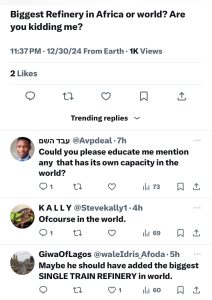
Snapshot of the conflicting conversation among the commenters under the post.
Even though the X user might have made the claim with the intent of comical impression to promote his facilities, but the conversation that arose from the post made FactCheckHub verify the claim.
However, further checks revealed that the Dangote Refinery has the highest single-train refining facility in the world. A single-train refinery operates with a single crude distillation unit (CDU), unlike larger refineries that rely on multiple units to process crude oil into various products. In this setup, the entire refining process is carried out using one integrated distillation unit.
THE VERDICT
The claim that Dangote built the biggest refinery in the world is FALSE, as Dangote Refinery currently ranks 7th largest in the world.
CLAIM 2
Monoliza is the biggest sport and recreational facility in Nigeria.
THE FINDINGS
To verify this claim, our fact-checker checked the facility linked to Mohammed Jamal using a keyword search on Google search engine. The results show that the Monoliza Sports and Recreational Centre, located in Garki Area 11, Abuja, is a sports facility launched on April 24, 2024 and projected to accommodate 600 people at a time. It is one of the biggest privately owned sports facilities in Abuja, but not in Nigeria.
Further checks using a keyword search on Google show that Moshood Abiola Stadium is the largest sports centre in Nigeria with 60,491 spectators capacity.
THE VERDICT
The claim that Monoliza is the biggest sports centre in Nigeria is FALSE, as Moshood Abiola Stadium is the biggest sports facility in the country.
As 2024 ends, we flashed back into a series of events that unfolded in Sports during the year, especially notable misinformation that occurred in the sector.
The FactCheckHub has been monitoring most of these sporting events closely and for the purpose of this report, we are documenting some claims debunked by our fact-checkers in the year. Such sporting events include the Paris Olympics 2024, AFCON 2023, UEFA Championship, and FIFA Women’s U20 World Cup, among others.
Below are some of the viral claims we debunked in the field of Sports in 2024:
1. Nwabali pictured with wife
Nigeria’s Super Eagles goalkeeper, Stanley Nwabali, who plays for Chippa United, a South African side, stole the show at the African Cup of Nations (AFCON 2023) with a laudable performance that saw him save two penalties in a semi-final shootout against the South African team to win the tie for the Eagles. His performance gave him more recognition among Nigerian fans and online conversations about the goal-keeper trended then. In the conversations, some female fans expressed love interest in Nwabali.
A Nigerian sports journalist, Sulaiman Pooja, made a post on February 11, 2024, showing Nwabali and a lady in three different photos alongside a claim that she is the goal-keeper’s wife, and asking people to keep off.
When The FactCheckHub verified the claim here, our findings showed that it was MISLEADING as the photos were photoshopped. Our fact-checker retrieved the original photos from the social media handles of the goalkeeper via thorough search.
2. Photo shows Ivorian goalkeeper with charm at AFCON’s final match
Nigeria’s Super Eagles progressed to the final of the 2023 AFCON and lost to the host rival, Ivory Coast, in a match that ended 2-1. Online reactions greeted the match thereafter, as Nigerian netizens claimed that Ivorian players used voodoo to win against the Nigerian team.
Sequel to this, popular Arise News TV host, Reuben Abati, and other social media users shared a photo showing a goalkeeper with a black object strapped to his back alongside a claim that it shows the Ivorian goalkeeper, Yahia Fofana, with a charm at the 2023 AFCON final match.
The FactCheckHub checked the claim and found it MISLEADINGhere.
3. Salah beats up a fan after English Premier League (EPL) match
The EPL 2023/2024 season which kicked off in August 2023 ran into 2024 and showcased some players performance.
An Egyptian international, Mohamed Salah, who plays for Liverpool also became a subject of misinformation during the season after a photo of him and a young boy with a bleeding nose as seen here went viral online that he had beaten up the minor after his team lost a match recently (in February 2024).
However, The FactCheckHub found the claim to be MISLEADING as reported here. UK’s The Standard newspaper reported on August 11, 2019 that the eleven-year-old Louis Fowler ran into a lamp-post and knocked himself unconscious while trying to keep up with Salah’s car as he left Liverpool Football Club’s Melwood training ground.
4. Tinubu suffers heart attack each time Chelsea loses EPL match
A video purportedly showing the Nigerian president, Bola Ahmed Tinubu, saying that he’s a supporter of Chelsea Football Club and that he suffers a heart attack anytime the English club loses has surfaced online.
The claim was posted by an X user, @X_Dailly, on May 2, 2024.
The FactCheckHub analyzed the video which showed traces of manipulation. The speech and lip gestures of the president do not match the audio in the clip – a common feature of deepfakes.
The original footage showed President Tinubu’s speech while breaking 2024 Ramadan fasting with traditional rulers and religious leaders at the Presidential Villa in Abuja in March 2024. Read the full fact-check here.
5. No African country has won the Olympics men’s basketball game since 1996
The 2024 Olympic games which was held in Paris, France from July 26 to August 11, 2024 also witnessed some misinformation about the tournament, including when South Sudan won the men’s basketball.
The FactCheckHub investigated one of the claims whichsaid that no African country has won the Olympics men’s basketball game since 1996.
Findings by The FactCheckHub indicated that the claim is FALSE, as the Nigerian men’s basketball team, D’Tigers, won two matches at the London 2012 Olympics and Rio 2016 Olympics respectively.
6. Man displays human head as ‘prize’ from skull mining competition
The photo of a man holding a human head as his “prize” from a skull-mining competition went viral in August 2024.
An X user, @ChiemekaEb9240, shared the photo with a claim that the man in the photo was the winner of a skull mining competition.
Findings by The FactCheckHub showed that the claim is MISLEADING! When our fact-checker verified the image, it revealed earlier versions of the photo which circulated online and attributed primarily to multiple news platforms. Media reports indicated that the image was that of a farmer who had beheaded another man in Benue State.
One of the news websites, Idoma Voice that used the image in its report stated that the suspect, named Raphael Agazi, and the victim, Ajah Asim, had been in a long-standing dispute over a piece of land. The conflict escalated in July 13, 2015 at the farm, where Agazi allegedly decapitated Asim, buried half of his body in a grave on the disputed land and fled the scene. He was later arrested.
Using Google Translate, the claim was translated into English language thus:
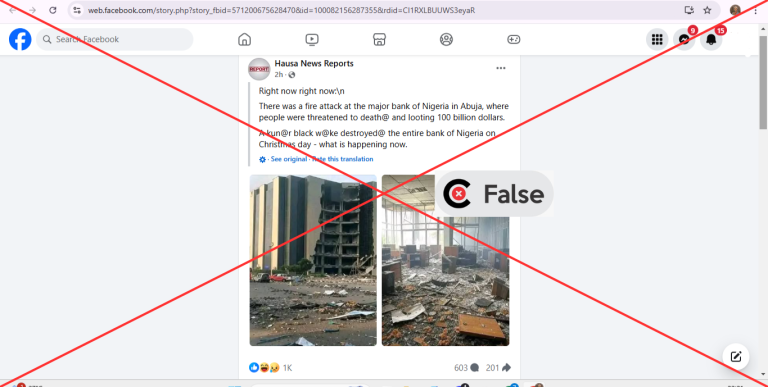
“A suicide bomber has struck the Central Bank of Nigeria in Abuja, with fears of casualties and the destruction of $100 billion. A suicide bomber completely destroyed the Central Bank of Nigeria on Christmas Day – what’s happening now.
Two images purportedly showing the aftermath of the destruction were also attached to the post.
The post has garnered over 1,500 likes, with more than 800 comments and over 200 shares as of December 28, 2024.
CLAIM
Images show aftermath of damaged CBN headquarters in Abuja.
THE FINDINGS
Findings by The FactCheckHub show that the claim is FALSE!
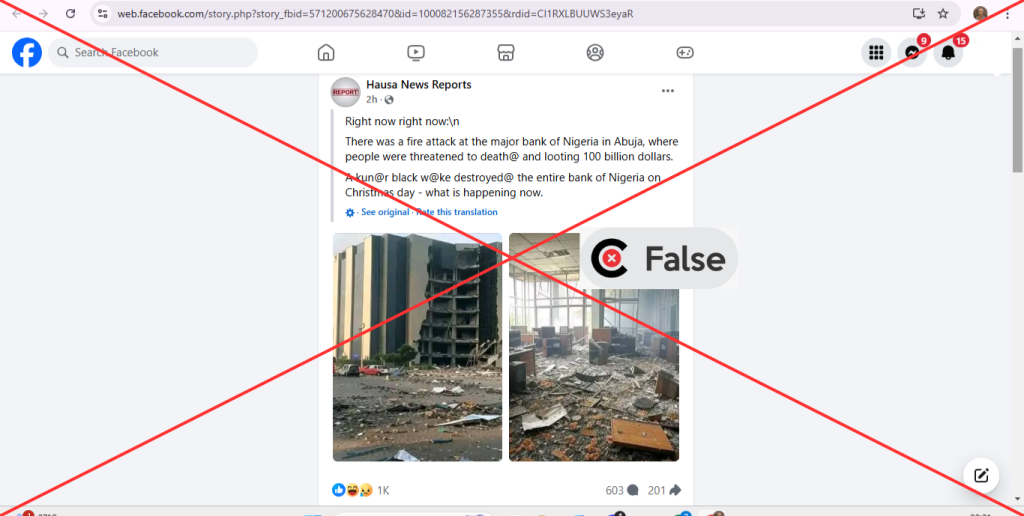
Screenshot of the claim extracted from Facebook; INSERT: False verdict.
A Google Reverse Image search conducted on both images did not provide any visuals depicting the exact posted images. It, however, show images of the CBN headquarters in Abuja, Nigeria’s capital city.
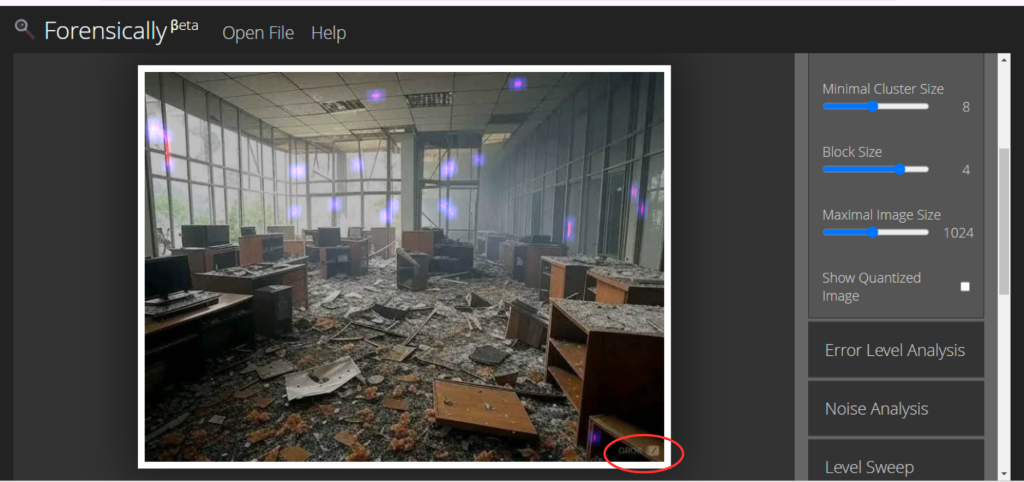
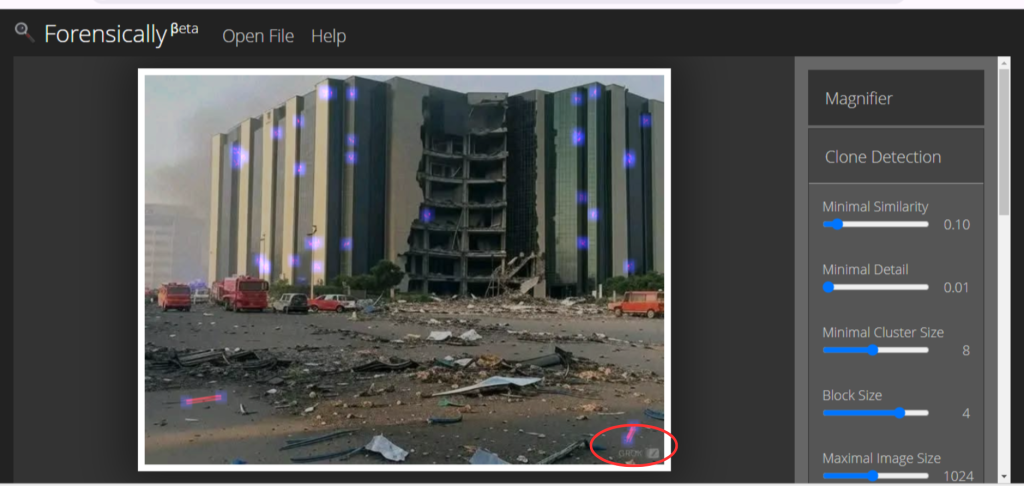
Checks by our fact-checker show that the image had elements of manipulation. Using the clone detection feature in Forensically, an image detection tool, it pinpointed areas on both images that might have likely been manipulated as seen below.
Images showing Clone detection areas and AI watermark being highlighted
Further findings show that both photos have an AI watermark which shows that the images were AI-generated.
A keyword search on Google search engine on the words, “CBN Destroyed” did not provide any related media report, as such incident would be widely reported by local and international media platforms.
THE VERDICT
The claim that images show aftermath of damaged CBN headquarters in Abuja is FALSE; the images are AI-generated.
IN what is reportedly the first presidential media chat since President Bola Ahmed Tinubu assumed office, he interacted with media personnel on Monday, December 23, 2024, to address pressing issues facing Nigeria.
Since taking office on May 29, 2023, Tinubu has introduced a series of controversial policies, including the removal of petroleum subsidy, the floating and devaluation of the naira, multiple increases in electricity tariffs and tax reforms etc, which have sparked numerous questions from Nigerians.
In an unexpected announcement, the presidency, via spokesperson Bayo Onanuga, confirmed the president’s first media chat at 9 PM on Monday, inviting all media outlets to participate.
Recent events, such as the presentation of the 2025 budget and the tragic stampedes that killed over 72 people in Ibadan, Anambra, and the nation’s capital, Abuja, have further fueled public concern, prompting calls for the president to address these issues through the media.
The media chat was moderated by Reuben Abati of Arise News TV, with representatives from notable media platforms such as NTA, Bloomberg, Channels TV, TVC News and ThisDay also participating. During the session, Tinubu made a series of claims in response to questions from the journalists in attendance, particularly concerning his administration’s reforms and his self-assessment, describing his performance over the past 18 months as “excellent.”
The FactCheckHub team closely examined the president’s statements during the media chat monitored on Channels TV, assessing the accuracy of his claims in response to the questions raised.
CLAIM 1
Tinubu claimed that it was impossible to travel by road to Maiduguri, Katsina and Kaduna before, adding that the roads are now safe for commuting.
THE FINDINGS
Findings by The FactCheckHub show that the claim is HALF-TRUE.
In a 2019 report by ThisDay, the former governor of Kaduna Mallam Nasir El-Rufai assured that the Abuja-Kaduna Road is now safe, countering Nigerian lawmakers claim that it is Africa’s most dangerous route. El-Rufai dismissed the claim as unfounded and media-driven as at then.
In 2022, there was an attack on the Abuja – Kaduna train which highlighted the dangers of traveling between the two northern cities, leaving many travellers reconsidering both the highway and rail options due to security concerns.
In a media report published by BusinessDay in December 2021, it noted that the Sokoto-Gusua road, Akure-Akoko road, Abuja-Abaji-Lokoja road, Loko-Oweto road, Okpella-Auchi-Okene road, Obajana-Kabba road, Okigwe-Uturu road, Abuja-Kaduna road, Zaria-Kaduna highway, Maiduguri-Damaturu road, and the Akure-Ilesa road were unsafe.
Also, in another 2022 report by HumAngle, it highlighted states that had become a security threat for travellers in northern Nigeria especially major roads across Kaduna, Zamfara, Katsina, Sokoto, and Niger states.
THE VERDICT
The claim by Tinubu that travelling to Maiduguri, Katsina and Kaduna is now safer is HALF-TRUE. Some of the roads such as Abuja-Kaduna road are reported to be safe due to the deployment of security agents manning multiple sections of the routes, while others like parts of Maiduguri-Yobe road and Katsina are found unsafe for travelling though people still commute on the routes, as they suffer bandits’ and terrorists’ attacks sometimes.
CLAIM 2
Tinubu claimed that he reduced debt service from 98 per cent to 68 per cent.
THE FINDINGS
During a press conference in July 2024, Nigeria’s minister of Finance, Wale Edun said that Nigeria’s debt service to revenue ratio has declined from 97 per cent in 2023 to 68 per cent in 2024, indicating a reduction in the government’s debt burden.
Edun said the country’s revenue is now being managed to promote transparency, accountability, and visibility of government’s spending.
THE VERDICT
The claim by Tinubu claimed that he reduced debt service from 98 per cent to 68 per cent is TRUE, according to multiple media reports.
CLAIM 3
Tinubu said that he created 37 local government development areas in Lagos state.
THE FINDINGS
During his tenure as Governor of Lagos State from 1999 to 2007, Bola Ahmed Tinubu initiated the creation of 37 Local Council Development Areas (LCDAs) in 2003. This move was aimed at enhancing grassroots development and bringing governance closer to the people.
However, Nigeria’s 1999 Constitution recognizes only the 20 Local Government Areas (LGAs) listed in its First Schedule. Consequently, the federal government, under President Olusegun Obasanjo, withheld funds meant for the newly created LCDAs, leading to a legal dispute. The Supreme Court ruled that while states have the power to create new local councils, these councils would not be entitled to federal allocations until they are recognized by the country’s National Assembly.
According to a recent report by Daily Trust, the Lagos State House of Assembly called for formal listing of the existing 37 Local Council Development Areas (LCDAs) in the state as full-fledged Local Government Areas (LGAs) by the National Assembly.
The report indicated that the legislature is considering a “Bill for a Law to Provide for the Local Government System, Establishment and Administration, and to Consolidate All Laws on Local Government Administration.”
THE VERDICT
The claim by Tinubu that he created 37 Local Council Development Areas (LCDAs) in Lagos state is TRUE; media reports have shown.
CLAIM 4
Tinubu said that he hasn’t taken any money from NNPC to meet other obligations in the last three months.
THE FINDINGS
NNPCL had earlier debunked a claim that the commission has not remitted to the federal government since January. Also, a statement on its official page titled “NNPC Ltd is not owing $6.8bn” highlighted a section that addressed the revenue remittance.
It reads: “It is not correct to say that NNPC Ltd. has not remitted any money to the Federation Account since January. NNPC Ltd. and all its subsidiaries remit their taxes to the Federal Inland Revenue Service (FIRS) regularly. This is in addition to payments of CIT to road contractors under the Road Investment Tax Credit Scheme. In all, NNPC Ltd. is the largest contributor to the tax revenue shared every month at the Federation Account Allocation Committee (FAAC).”
There is no media reports to confirm when the Commission last remitted revenue to the FAAC.
THE VERDICT
The claim that the federal government has not received revenue in the last three months is UNPROVEN; there is no sufficient proof to debunk or confirm the claim.
CLAIM 5
Tinubu claimed that there is no livestock ministry in Nigeria before he created it.
THE FINDINGS
On July 9, 2024, during the inauguration of the Renewed Hope Livestock Reform Implementation Committee, Tinubu announced the creation of the Ministry of Livestock Development at the State House in Abuja.
This was a measure to curb thousands of people losing their lives to violent clashes between migrant herders and local farming communities across various states in Nigeria. Notable states affected by this violence include Plateau, Benue, Kaduna, and Taraba.
On October 23, President Tinubu appointed Alhaji Idi Mukhtar as the Minister for the Federal Ministry of Livestock Development (FMLD).
The announcement was made during the Federal Executive Council (FEC) meeting in the Presidential Villa, showing the administration’s commitment to improving food security and advancing the livestock industry.
THE VERDICT
The claim by Tinubu that his administration created the Ministry of Livestock is TRUE; multiple reports show that the ministry was created in July 2024.
Popularly called Pastor Adeboye, the Christian cleric who is widely respected globally oversees the church which has presence in many countries with thousands of parishes and millions of parishioners worldwide.
CLAIM
Image shows Pastor Adeboye in Saudi Arabia.
THE FINDINGS
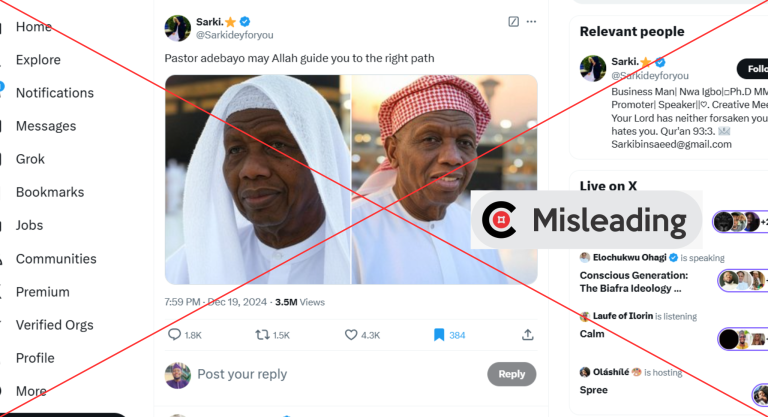
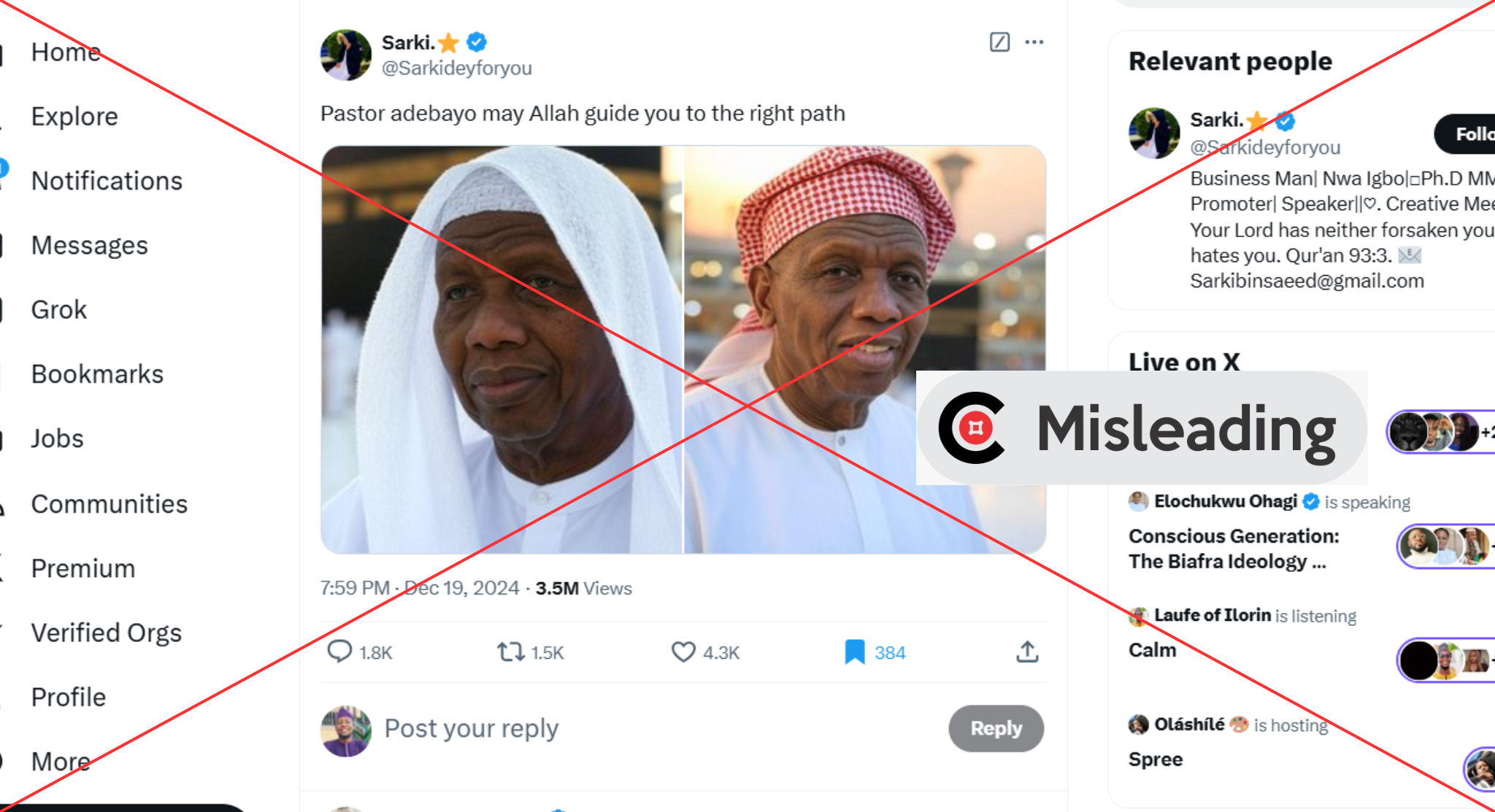
Findings by The FactCheckHub show that the claim is MISLEADING as the images are deepfakes, and very likely generated using Artificial Intelligence (AI).
AI-generated images of Pastor Adeboye in Mecca that went viral on X.
The FactCheckHub used multiple AI detection tools to verify the two images and the results shows high likelihood that they were generated using artificial intelligence (AI) tools.
For instance, The FactCheckHub checked the images using hive moderation, an advanced AI detection tools, the result shows 99.7% and 99% probabilities of being AI-generated or deep fake content.
We also checked the images using TrueMedia.org, another AI content detection tool, the result also shows that the images are digitally manipulated and showed 99% confidence of them being generated by AI.
In addition, our fact-checker reviewed Adeboye’s social media accounts and media reports but couldn’t find the images or any report indicating that the pastor went to Saudi Arabia.
THE VERDICT
The claim that the images show Pastor Adeboye in front of Kaabah in Saudi Arabbia is MISLEADING; findings show that the images are very likely AI-generated.
Imagine waking up one morning to find your face splashed across social media with a “Rest in Peace” watermark or being falsely accused of a crime you never committed. This is the reality for many who fall victim to misinformation and disinformation campaigns in the digital age.
While countless individuals unknowingly spreading false claims online, the real damage is felt by those caught in the crossfire — individuals, institutions, and public figures whose reputations and lives are upended by the viral nature of these false information.
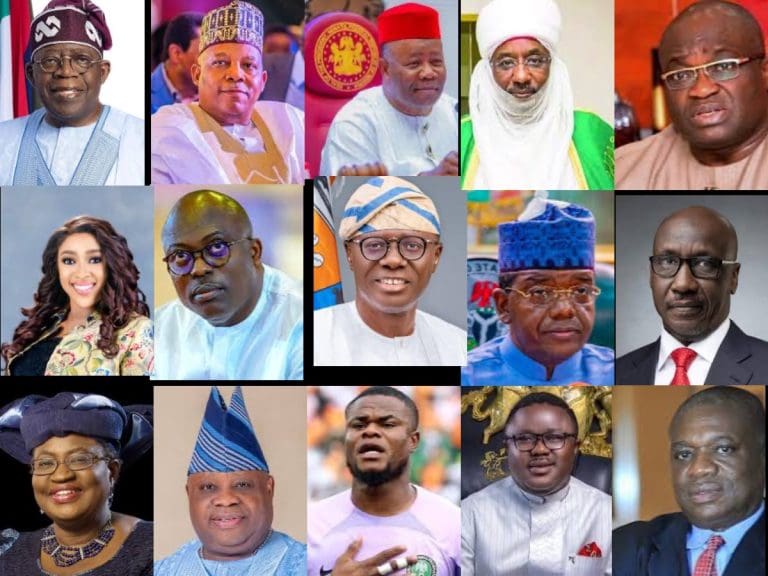
In 2024, The FactCheckHub uncovered numerous instances where public figures were targeted with misinformation. We bring you our topmost 15 Nigerians on the list below:
1. Bola Ahmed Tinubu
The Nigerian president, Bola Ahmed Tinubu, still remains our number one on this list. Before the nationwide protest by Nigerians which later took place in August 2024, a video purportedly showing Tinubu promising to reduce the purchasing power of citizens, slow down the economy and widen the tax net resurfaced online.
Bola Ahmed Tinubu.
Our findings show that the claim is MISLEADING as Tinubu was quoted out-of-context. The video was also edited to suit the goal of the disinformation campaigners – to mislead the public.
Contrary to the viral video, Tinubu didn’t promise to reduce the purchasing power of Nigerians. What he called for was a stop to the proposal by former President Buhari’s economic team to increase VAT in the country.
Tinubu argued that increasing the VAT would result in a reduction of the purchasing power of Nigerians with the unintended consequences of further economic slowdown, according to the Channels TV report. Thisday newspaper also reported same here.
As an alternative, he proposed a broadening of the tax base which will get more people to pay their taxes and lead to increased tax revenue instead of placing additional tax burdens on Nigerians.
In May 2024, a video purportedly showing President Tinubu saying that he’s a supporter of Chelsea Football Club and that he suffers a heart attack anytime the English club loses surfaced online.
The FactCheckHubanalyzed the video and it shows traces of manipulation. The speech and lip gestures of the president do not also correlate in the video – a common feature of deepfake. The original footage highlights Tinubu’s speech while breaking the Ramadan fasting with traditional rulers and religious leaders at the Presidential Villa in March 2024.
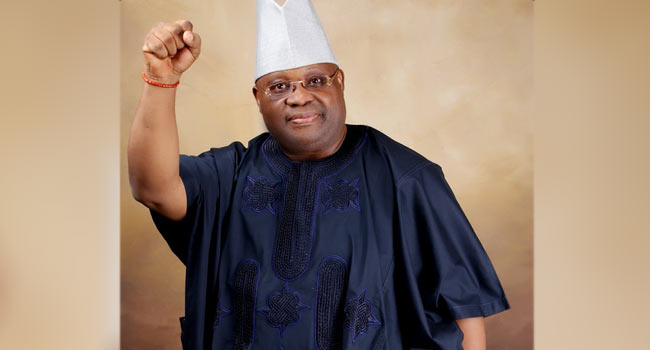
2. Ademola Adeleke
A video showing a man wearing a traditional cap with a wrapper once trended online this year with a claim that it shows the governor of Osun state, Ademola Adeleke, dancing to a music in a room.
Ademola Adeleke, Osun State Governor.
The FactCheckHub conducted a thorough examination of the extended version of the viral footage to identify the individual therein. It was observed that the person in the video is not Governor Adeleke, despite a few resemblance in terms of physique.
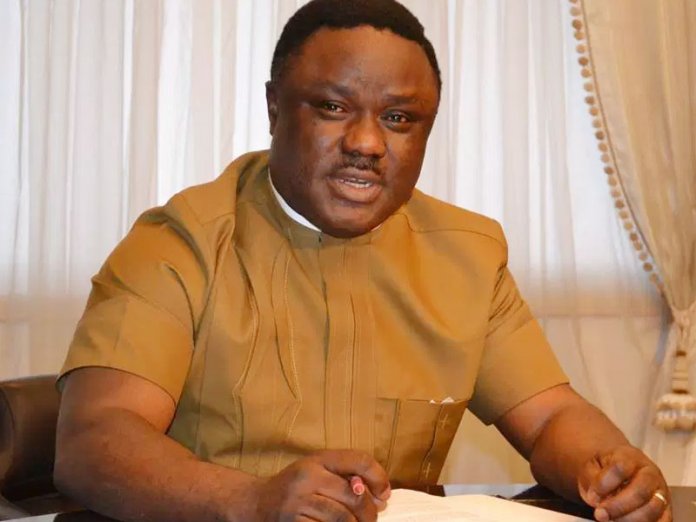
3. Ben Ayade
In July 2024, a video clip of Ben Ayade, an ex-governor of Cross River State addressing youths surfaced on social media with a claim that Ayade was on the streets to caution youths to shelve the planned nationwide protests starting on August 1, 2024.
FILE PHOTO: Ben Ayade.
Our findings indicatedthat the claim is MISLEADING, as the video has been online since 2020.
4. Bello Matawalle
A photo showing some vehicles buried underground surfaced online with a claim that they were seized from Bello Matawalle, Nigeria’s minister of State for Defence and former Governor of Zamfara state in January 2024.
Bello Matawalle, Minister of State for Defence.
When the image was subjected to a Google Reverse Image search, the results showed that the photo was shared by a Reddit user in November 2023 with a claim that a former corrupt Afghan politicians hid the vehicles.
5. Mele Kyari
Following concerns over speculations that the Nigerian government is secretly paying fuel subsidies, a video showing the Group Chief Executive Officer of the Nigerian National Petroleum Company (NNPC) Limited, Mele Kyari, saying there’s no subsidy on fuel imports resurfaced online.
Mele Kyari, Group CEO, NNPCL.
Our findings revealed that the video shows when Kyari was addressing State House Correspondents at the Presidential Villa in Abuja in October 2023 where he vehemently denied the return of the fuel subsidy regime.
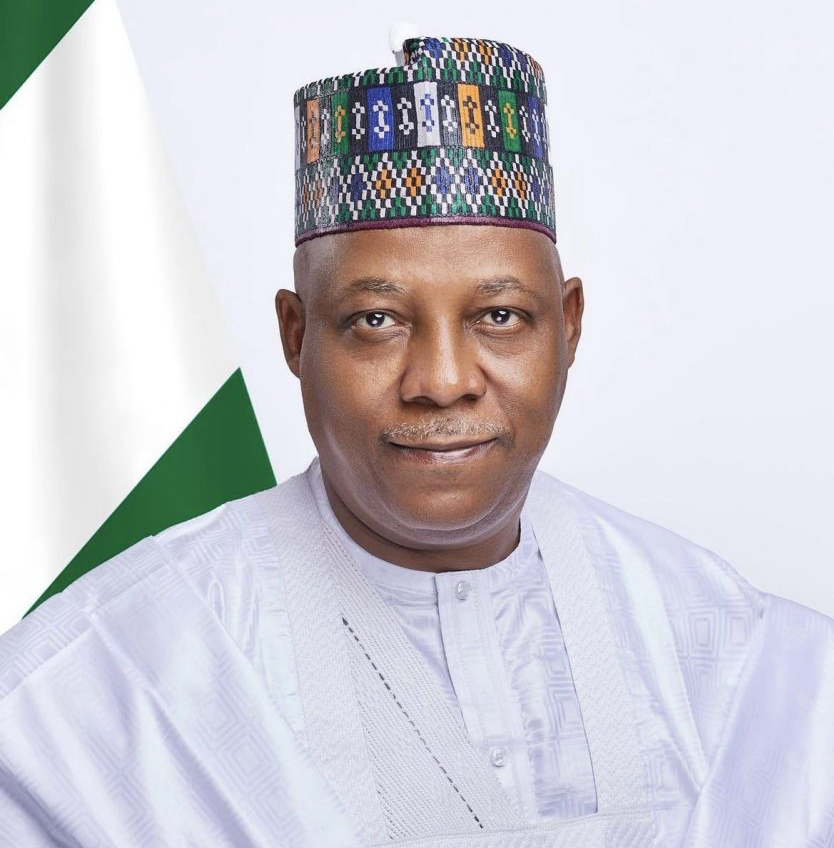
6. Kashim Shettima
In January 2024, a video showing Nigeria’s Vice President, Kashim Shettima, exchanging pleasantries with some tribal Fulani men resurfaced online with a claim that it shows the vice president during a visit to some terrorists.
Kashim Shettima. PHOTO CREDITS: State House.
Our findingsshowed that the video was posted by Shettima on his Facebook account in June 27, 2017, when he was the governor of Borno State. Shettima said the video shows when he went to inspect Lamisula Primary School in Maiduguri, Borno state where they were facilitating the construction of classrooms.
7. Godswill Akpabio
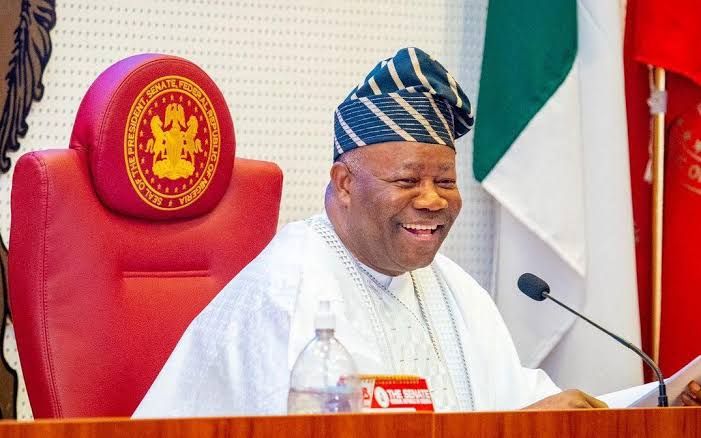
In June, a verified X user, @Frankekechukwu, claimed that the Nigerian Senate President, Godswill Akpabio, said they “know Nigerians are hungry but that they will not stop to approve a private jet for Mr President.”
Godswill Akpabio.
Our fact-check showed that the quote did not originate from the Senate President. A search online showed that claim was not reported by any local or international media platform. Akpabio’s media aide also debunked the claim.
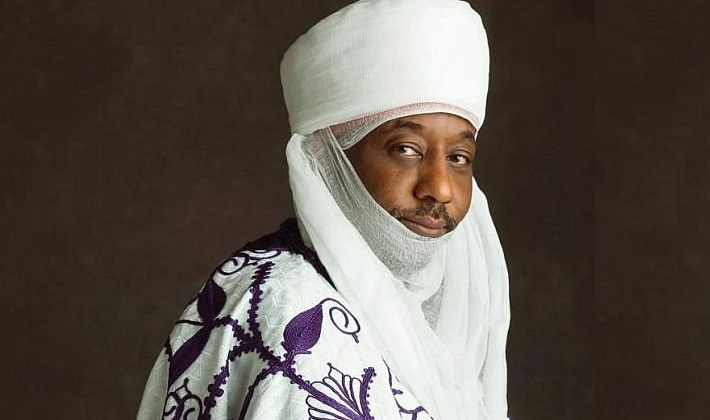
8. Sanusi Lamido Sanusi
In June 2024, a video showing the reinstated Emir of Kano, Sanusi Lamido Sanusi, speaking on the failure of the Nigerian government to address various problems bedevilling the country resurfaced online.
Emir Sanusi Lamido Sanusi.
In the footage, Sanusi urged Nigerians to get involved in governance and hold politicians to account. The video is being circulated with a claim that he delivered the speech after his reinstatement.
The FactCheckHub’s findings revealed that the earlier version of the video depicts Sanusi’s speech at the launch of a stage play titled “Emir Sanusi: Truth in Time” held in August 2022 in Lagos.
9. Ngozi Okonjo-Iweala
Another victim of misinformation is the Director-General of the World Trade Organisation (WTO), Dr Ngozi Okonjo-Iweala who debunked a viral quote attributed to her regarding Nigeria’s debt profile and fuel subsidy removal.
Dr. Ngozi Okonjo-Iweala, Director- General of the WTO.
Iweala was wrongly quoted to have said “Nigeria debt for the first time in history has risen to 24 trillion in just 2 months even after removing subsidy.”
10. Siminalayi Fubara
In May, a claim that the incumbent governor of Rivers State, Siminalayi Fubara, is wanted by the Economic and Financial Crimes Commission (EFCC) resurfaced online.
Our findings showed that the announcement was made in 2022. However, the anti-graft agency was unable to investigate and tried him until he became the governor of Rivers State in May 2023.
Fubara Siminalayi, Rivers State Governor.
In May 2022, the EFCC declared Fubara and 58 others wanted over an alleged N435 billion fraud. Fubara, and four other Rivers State government officials, among others, were wanted for suspected N117 billion fraud, alleged criminal conspiracy, money laundering, misappropriation of public funds, and abuse of office.
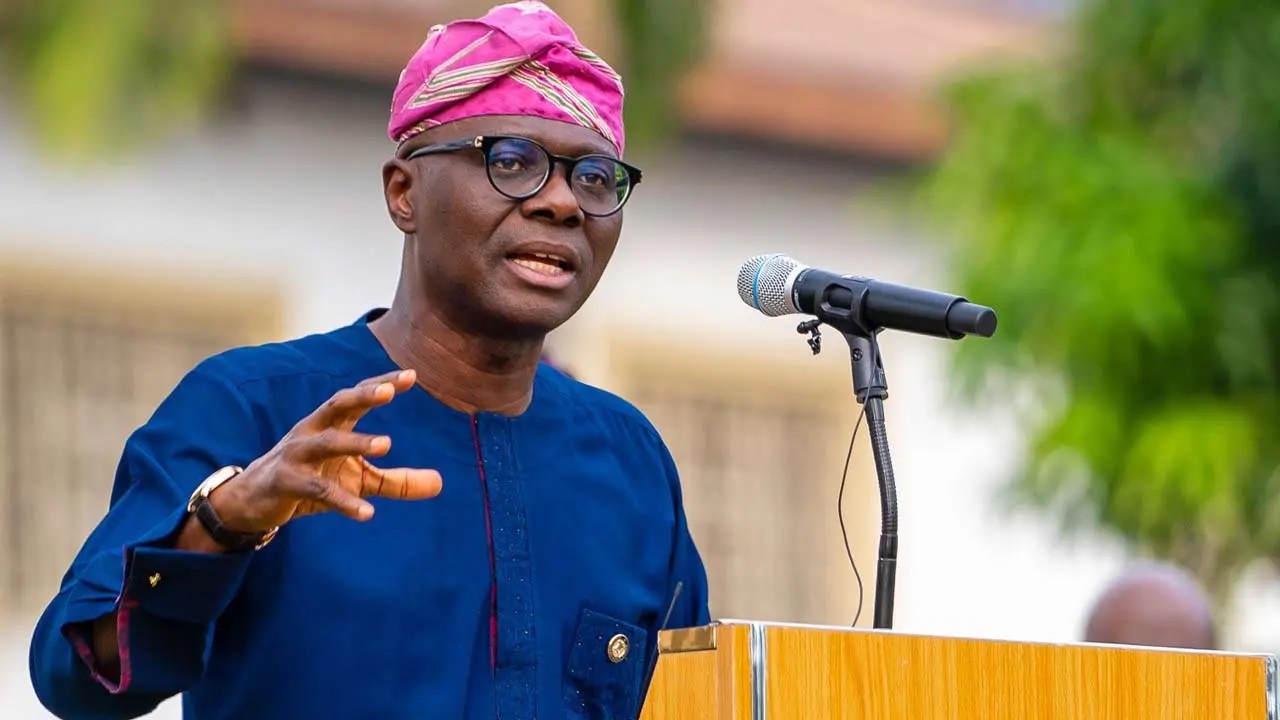
11. Babajide Sanwo-Olu
In April 2024, a video purportedly showing Lagos State governor, Babajide Sanwo-Olu, announcing that the state government increased the minimum wage from N35,000 to N70,000 went viral.
Babajide Sanwo-Olu, Lagos State Governor.
Our checks showed that Sanwo-Olu’s speech which was made at the launching of the Lagos State Social Intervention Programme tagged: “Eko Cares” has been taken out of context. A review of the full video uploaded by TVC News on Thursday, April 25, 2024 showed that Sanwo-Olu did not increase the minimum wage for the state workers; rather, it said the state had implemented the N35,000 minimum wage as directed by the federal government.
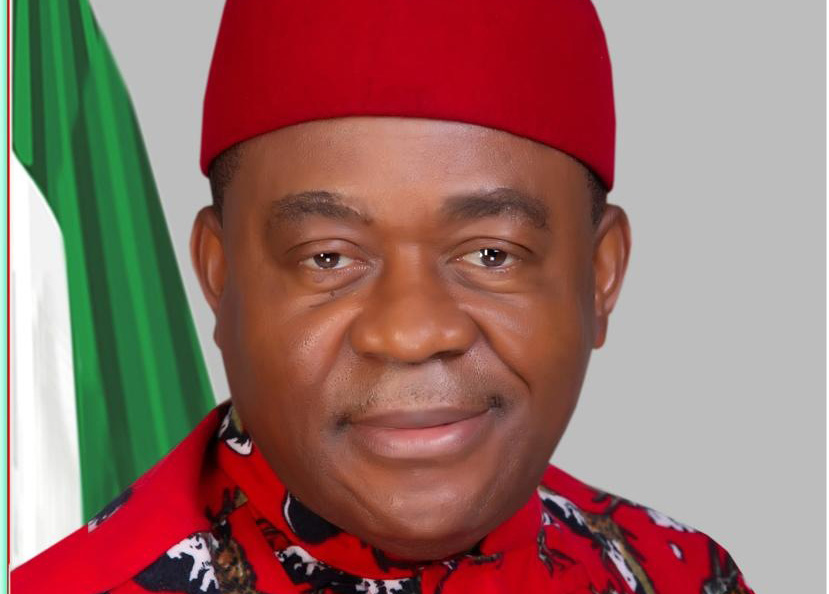
12. Theodore Ahamefule Orji
Theodore Ahamefule Orji.
In May 2024, an online news blog, Igbo Times Magazine, published a report that Theodore Ahamefule Orji, a former governor of Abia State, has threatened to cause unrest in the state if his pension as a former governor is stopped. Our findings showed that the claim is FALSE.
13. Betta Edu
A claim that the Economic and Financial Crimes Commission released a list of some valuable properties recovered from the suspended Nigerian minister of Humanitarian Affairs and Poverty Alleviation, Betta Edu, surfaced online in January 2024.
File Photo: Dr. Betta Edu. PHOTO CREDITS: @edu_betta via X.
The list which went viral on social media contains valuable items such as a filling station, an estate and millions of naira among other assets purportedly owned by the suspended minister.
The FactCheckHub reviewed the media handles of EFCC including Facebook, X and its website but we could not find the viral list. We also contacted the EFCC and they debunked the claim.
14. Okezie Ikpeazu
In February 2024, a photo showing a stack of cash surfaced online with a claim that the EFCC discovered $800 million (dollars) in cash stashed at the home of a former Abia state governor, Okezie Ikpeazu.
File Photo: Okezie Ikpeazu.
When subjected to Google Reverse Image search, the result showed that the image has been online since 2007 and it showed that cash and other valuable items were recovered by Mexican Police from a drug dealer whose house was raided.
15. Stanley Nwabali
Three photos showing Super Eagles goalkeeper, Stanley Nwabali and a woman surfaced online with a claim that they showed the footballer with his wife.
Stanley Nwabali.
The photos were posted by a Facebook user who claimed to be the goalkeeper’s wife following the Super Eagles’ victory against South Africa at the semi-final of African Cup of Nations. Our findings showed that the images were photoshopped.
NOTE: This story contains distressing images. Viewer discretion is advised.
Wakili Abdu, 63, returned from his farm at sunset in Sabon-Gida, looking uneasy. A few minutes later, he headed into the shrub behind his hut with a plastic kettle and hoe, gazed around, bent over, and pulled down his trousers.
When nature calls, Abdu prefers to answer as his forefathers had taught him. He believes toilets are for women while the men should defecate in the open.
“Using toilets is a practice mainly for women. Even if toilets were built, it is mainly for women and children. We [men] prefer going to the bush, which is our traditional belief,” he told DUBAWA as he settled under a tree in front of his house.
Abdu, sitting in front of his hut. Photo Credit: Sunday Awosoro/DUBAWA.
Abdu’s reluctance to use a toilet is not uncommon in rural communities in Nigeria, where long-held cultural beliefs promote open defecation, especially among men. These traditions present a barrier to the efforts aimed at eradicating open defecation in Nigeria.
According to WHO/UNICEF Joint Monitoring Programme, open defecation refers to the practise of defecating in fields, forests, bushes, bodies of water, or other open spaces.
In Sabon-Gida, a community in Kafin-Hausa LGA where Abdu hails from, open defecation is a common practice despite the fact that the National Task Group on Sanitation (NTGS) and the United Nations International Children’s Emergency Funds (UNICEF) announced the entire Jigawa as Nigeria’s first and only Open Defecation-Free (ODF) state on Oct. 26, 2022.
Before the announcement, Ibrahim Hannungiwa, the state’s water resources commissioner, disclosed that Jigawa State had expended N500 million to build toilets in public places with support from UNICEF.
Data from the Federal Ministry of Water Resources (FMWR) revealed that 48 million Nigerians, mostly rural community residents, defecate in the open despite the Sustainable Development Goals (SDG) introduction. In 2016, the ministry, with UNICEF’s support, launched a National Open Defecation Free Roadmap to end open defecation in Nigeria by 2025. As of Dec. 2023, only 117 out of the 774 local government areas (LGAs) in Nigeria have been declared ODF.
While acknowledging its slow progress, the FMWR stated that “Nigeria needs to build about 3.3 million toilets per year and achieve 224 ODF LGAs each year” before it can meet its 2025 target.
How was Jigawa declared ODF?
As defined by the NTGS, ODF’s primary indicator is that “all households in a community have a latrine with handwashing facilities.” Its secondary requirement is to provide water sanitation and hygiene (WASH) facilities in public places like health centres, schools, and markets.
After that, “an LGA is announced ODF when the National Task Group on Sanitation (NTGS) visits 20% randomly selected communities in the LGA and confirms that all households, schools, health facilities, public places, markets, and motor parks have latrines and handwashing facilities.”
According to the NTGS, the 27 LGAs that make up Jigawa met these requirements. As reported by UNICEF, the state implemented a comprehensive strategy to achieve the Open Defecation Free (ODF) status, which included developing state and LGA-level roadmaps, declaring a state of emergency, and ensuring consistent funding for WASH departments at LGA levels.
The governor launched a campaign to end open defecation and established the Jigawa Open Defecation Award to encourage residents. He also strengthened collaboration with traditional leaders and enacted sanitation bylaws (at each LGA) that empowered the police and other security forces to enforce these laws, ensuring that violators of the open defecation ban were held accountable.
In July 2024, less than two years after the declaration, DUBAWA visited different communities across seven LGAs in Jigawa state – Birniwa, Hadejia, Malam-Madari, Gwaram, Kiri Kasama, Kafin Hausa, and Guri – to verify their ODF status based on these metrics.
‘We need food before the toilets’
In Sabon-Gida, the community head reported that approximately 200 of the 2,300 households have local pit latrines, and 20 have concrete latrines, although DUBAWA did not independently verify these figures. Local latrines are cheap; residents need to place two slabs across a pit and cover the sides with mud.
Unlike in Sabon-Gida, where traditional beliefs discourage men from using toilets, residents of Taljare Village in Birniwa LGA, regardless of gender, prefer to use toilets. Unfortunately, no household in Taljare has a toilet.
Amadi Sule, the community head, attributed this to economic hardship. While they could have used local pit latrines, most have collapsed due to the rainy season. With the bush serving as an alternative, the community has stopped seeking other solutions.
“Well, we had them (toilets) before, but they are now collapsed due to the rainy season because we do not apply cement on them. We prefer toilets, it’s just that we cannot afford them now. We struggle to feed our families, not to build toilets for them. Feeding is our priority,” he said.
Muhammed Bulama’s local pit latrine. Photo Credit: Sunday Awosoro/DUBAWA.
Muhammed Bulama, the village head of Garin Ando village, Kiri Kasama LGA, said only about 50 out of 300 households have functional latrines, most of which are built using local materials. Bulama explained to DUBAWA that the community opts for local toilets due to their low cost. While concrete latrines cost around N100,000, the locally constructed ones only cost about N10,000.
“As you may know, building toilets involves money. While people are struggling with the current economic turmoil, they are looking for ways to feed their families rather than building toilets that we consider unnecessary. Most of those using bush toilets are extremely poor, but there are some with local clay ones which usually collapse or get full due to their poor condition,” he stated.
Water collapses our latrines
All seven LGAs DUBAWA visited reported that their locally-built latrines frequently collapse during the rainy season, forcing them to rebuild every six months. This problem is particularly severe in Karidu village, where the topography causes groundwater to seep into the pits, most of which collapse in two months.
In 2023, WASH Jigawa State constructed a local latrine for each of the 500 households in Karidu, Guri LGA. However, Karidu’s waterlogged terrain means that any attempt to dig a pit often results in the collapsing of the pit. Some residents tried burying jerrycans, but these quickly filled up without a proper evacuation plan. As a result, the community has reverted to open defecation, with 400 of the originally installed latrines now collapsed.
“We are soliciting the government to intervene through the provision of cement and other items that can help our toilets to last long,” Maimuna Muhammad, a mother of four, pleaded.
Maimuna Muhammed pointing at a collapsed latrine in her compound. Photo Credit: Sunday Awosoro/DUBAWA.
Wakili Kaigama, the village head, confirmed that residents prefer using toilets for the privacy they provide. However, they cannot afford concrete latrines due to financial constraints, as many are still struggling to meet basic needs. Despite its ineffectiveness, Kaigama solicited jerry cans in order to build lasting pit toilets.
Sensitisation with no enforcement
To kick start its battle against open defecation, Jigawa state government launched a state-wide campaign and introduced bylaws criminalising the practice in each local government. Residents confirmed the campaign and the law’s enactment, with some reporting that they received various forms of intervention. However, after this initial push, the government’s presence faded, and they have seen little to no further action thereafter. Residents confirmed that no one has ever been arrested or penalised for defecating in the open. WASH officials fail to show this reporter the law being referred to, as it’s not publicly available.
In 2021, the government conducted a sensitisation campaign in Gabasmari village, Birniwa LGA, where residents previously saw no reason to build toilets. During the visit, officials educated the community on the dangers of open defecation and provided detergents and kettles. This prompted some villagers to construct local latrines, but like in other communities, these structures have since collapsed.
Usman Galadima, one of the campaign stakeholders in the village, said the villagers initially adopted the end-open-defecation initiative but later abandoned it “due to lack of support from the government.”
Galadima’s pit toilet was behind this hut before it collapsed. Photo Credit: Sunday Awosoro/DUBAWA.
The assistant village head, Muhammad Abubakar, said the government introduced a law against open defecation and provided initial support. However, the initiative failed due to a lack of sustained effort, and people reverted to open defecation.
“They only sensitised us and provided us with detergents and kettles. I can assure you that if the government sustains its gesture, people will embrace it and refrain from open defecation,” he noted.
Like Gabasmari, residents of Duleri, Taljare, Matamu, and Aljari in Birniwa LGA, Garin-Ando in Kiri-Kasama LGA, and Aji-Bukara and Karidu in Guri LGA, who reported similar interventions, are now faced with the same challenges.
A Karidu villager stepping on the collapsed latrine. Photo Credit: Sunday Awosoro/DUBAWA.
As part of the intervention efforts, residents of Matamu were asked to pay N700 per household for the construction of local pit toilets. Sanin Magini, the village head, said no villager could afford it.
“I can allocate land for it, but if I have to pay, I don’t actually have the money. I can even allocate land right now if someone volunteers to build it for me,” he said.
Schools are not exempted
Jigawa State, through UNICEF’s Sanitation Hygiene and Water in Nigeria (SHAWN) project, installed a water facility for the Matamu Primary School. However, the facility has stopped working. Likewise, portions of the male and female pit toilets have collapsed. Pupils have now resorted to defecating in the handwashing stations, behind the toilet buildings, and in the classrooms’ backyard. Unfortunately, DUBAWA could not speak to any teacher as the school had closed for the day.
The conditions at Taljari Primary School mirrored those at Matamu Primary School. Umar Sule, Headmaster of Taljari Primary School, told DUBAWA that all pupils defecate in the open, but he blamed the government for not providing adequate maintenance.
“They all go to the bush since there is no toilet. They (the government) built the toilet, but they eventually abandoned it. The toilets have now collapsed due to lack of proper sustenance,” he said.
The situation at Day Secondary School Sabon-Gida is also troubling, with pupils defecating in abandoned classrooms as the school toilets are out of order.
At Matsaro Primary School in Hadejia (Hadejia LGA), only the teachers have functioning toilets, while students are left to defecate behind their classrooms.
In Madachi, although the concrete pit toilets at Govt. Day Secondary School remain functional, those at the primary school have collapsed.
LGA headquarters improve
The central communities of the seven LGAs visited have indeed improved on open defecation. Most houses are modern, unlike the traditional mud houses found in the villages. Additionally, many of these modern homes are equipped with built-in toilets, and few people with mud houses have made concrete pit latrines. But people still defecate by the roadside, dump sites, and uncompleted buildings.
Human faeces found around Hadejia Central Market. Photo Credit: Sunday Awosoro/DUBAWA.
In Hadejia, private toilet operators in the market and motor park charge N50 for urination and N100 for defecation. Despite this, some people still defecate by the roadside or within the market, a situation also observed in Malam-Madari, Malam-Madari LGA.
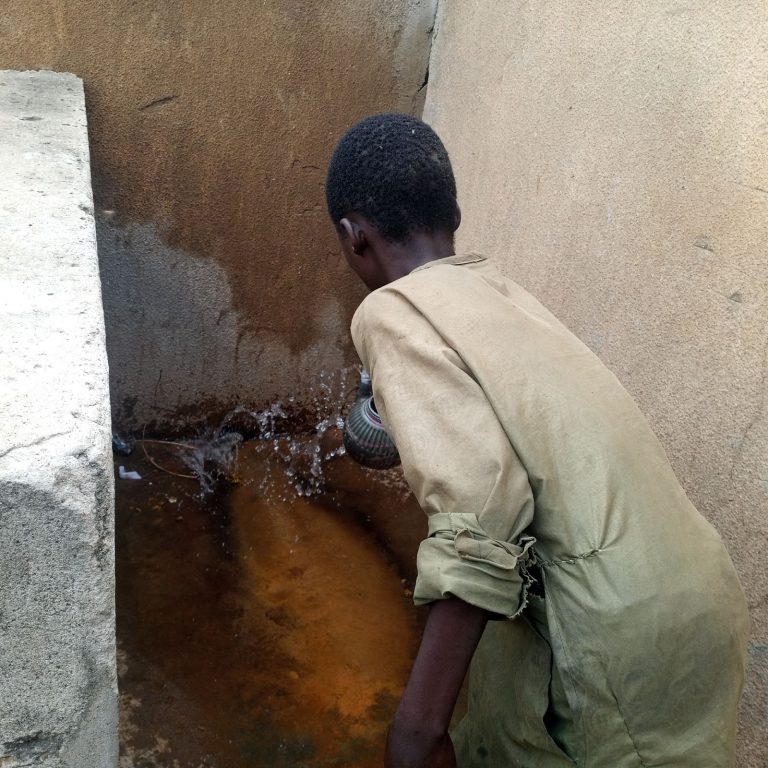
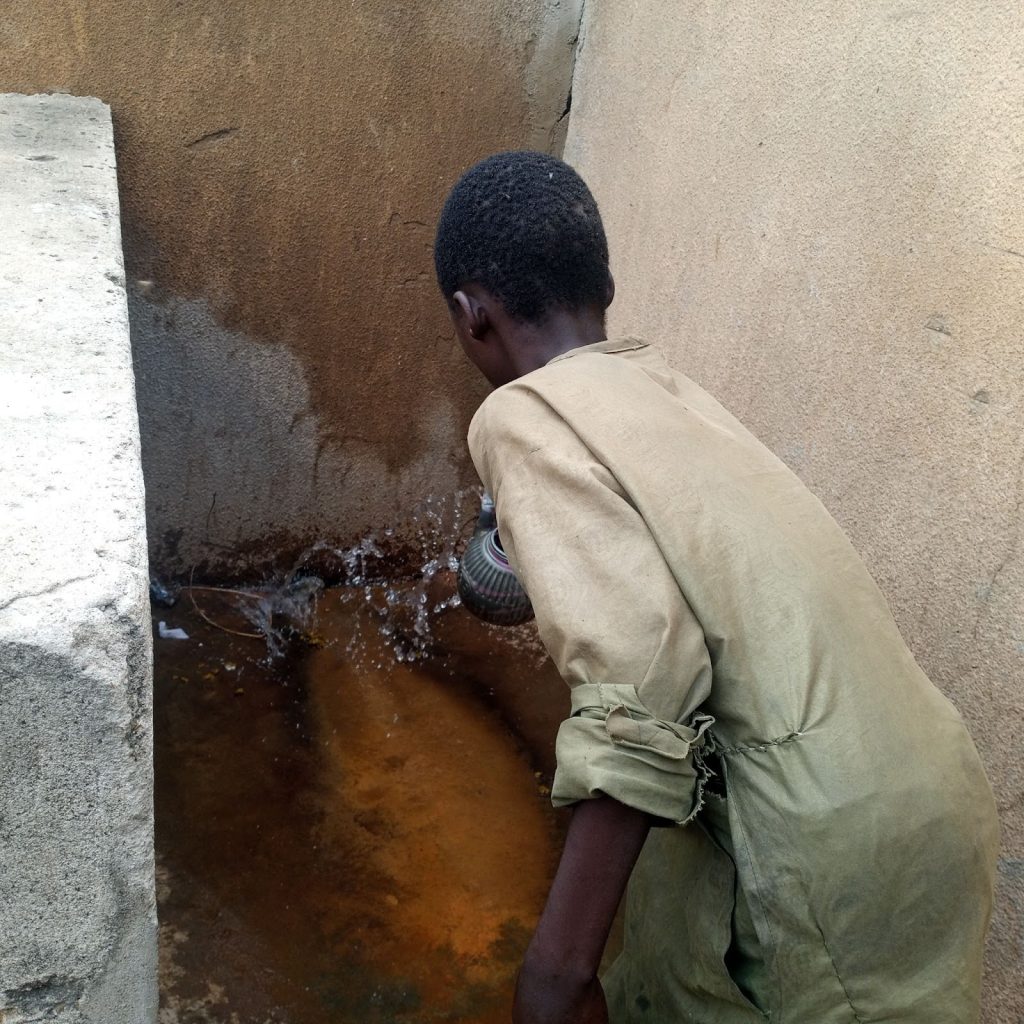
In Dutse, the state capital, DUBAWA witnessed a young boy, Mustapha Waje, at “Investigate Motor Park” flushing faeces into a drainage meant for bathroom water. The drainage, intended to carry wastewater, has become a makeshift toilet, with users washing their faeces into the gutter behind. Although a commercial toilet that charges N150 is available, cab drivers and others at the park prefer this practice.
Mustapha Waje, a boy washing off his faeces into drainage at a Motor Park in Dutse, Jigawa’s capital. Photo Credit: Sunday Awosoro/DUBAWA
At the newly constructed Malam Umar Maladi ultra-modern motor park in Guri, drivers have littered the toilets, rendering them unusable. As a result, users have resorted to relieving themselves in the surrounding area.
Hospitals face the same issue
Not all the communities visited by DUBAWA had access to health facilities. In some areas, residents had to walk up to an hour to reach the nearest healthcare services. However, Sabon-Gida and Matamu were exceptions, as both had Primary Health Care (PHC) facilities. Unfortunately, like the schools in these communities, the facilities’ toilets were non-functional.
Current condition of Malam Umar Maladi Motor Park, Guri. Photo Credit: Sunday Awosoro/DUBAWA.
In Matamu PHC, the outdoor latrines and indoor water closets had long been abandoned. DUBAWA found the facility unattended, with no one present to explain the situation.
Abdullahi Gamani, the Officer in Charge at Sabon-Gida PHC, explained that their pit latrine had developed a plumbing issue in April, which led to its complete blockage.
‘‘The problem started three months ago due to the pipe leakage between the toilet bowl and soakaway. We even tried to fix it, but we have yet to achieve that, which is why we blocked the toilet. We don’t have a toilet, but we have a hole where people can urinate and bathe. We need total renovation.”
Upon assuming his role as Officer in Charge, Gamani collaborated with community members to renovate the toilet but realised the issue was beyond his capacity.
Government officials speak
In Jigawa State, officials struggle to maintain the Open Defecation Free (ODF) status due to several challenges. Abba Tahir, a WASH facilitator in the state, noted that while progress has been made in changing behaviours, using temporary latrines often leads residents back to old habits when these structures fail.
“What I’m trying to say is that if you’re looking for those areas that used to do this thing outside, it’s very simple. Any local government, you can go to the ward. They have small villages, and they have that kind of attitude of doing the open defecation outside,” he said.
“The problem of sustainability is something. When we did this project, they used to call us and express their gratitude that things had changed and their town was now clean. But sustainability is what matters. There’s no provision for building advanced latrines that could last longer for them. The village heads and household members are the ones who usually contribute to dig local latrines for themselves,” he added.
Corroborating DUBAWA’s findings, Isyaku Umar, WASH Coordinator for Birniwa LGA, noted that sustaining ODF status has been challenging in some communities due to heavy rains that have caused many latrines to collapse. He mentioned that Birniwa’s WASH department received N100,000 monthly for vehicle maintenance from January to August 2024, intended for monitoring visits. However, residents say they had never seen WASH officials in their communities after the initial sensitization.
Umar also mentioned that they occasionally recruit local partners within different communities, offering them N1,000 to help with sensitisation efforts. However, despite having a bylaw in place, they are unable to enforce penalties on those practising open defecation or households without toilets. He attributed this to Nigeria’s economic hardships and the potential for violent resistance from residents.
“This time is a time that each and every person in the communities is looking for what they are going to eat. They may not even listen, and you can’t force them. That is what we are going through. It can lead to trouble if we try to punish someone,” he said.
Ado Isah, WASH Coordinator for Kafin Hausa LGA, maintained the same narrative, saying offenders are not punished but only encouraged to adopt toilet use. He said that open defecation is only happening in riverine areas and communities with flooding problems. Unlike Birniwa, he said that they have not received the N100,000 for vehicle maintenance for over two and a half years which is hindering their monitoring responsibility.
“No, people there cannot be punished. We regularly advise them to make a latrine in their place. Sometimes, flooding demolishes the community, and people move from one place to another. They cannot build permanent toilets. Other places are still maintaining ODF except for those with flooding challenges. They’re trying to upgrade from local to concrete.”
DUBAWA’s several attempts to reach Abubakar Sidi, the Acting Director of the Rural Water Supply and Sanitation Agency (RUWASA), Jigawa, proved abortive. He ignored all calls and messages.
UNICEF speaks
Chiranjeevi Tiwari, UNICEF’s Officer in Charge of WASH, attributed the situation in Jigawa to a slippage, where communities initially meet ODF criteria but regress due to factors like population growth, migration, or toilet infrastructure collapse. He, however, promised to discuss the problem with the UNICEF office in Kano State, noting that UNICEF only supports the government with resources and not individual households.
Tiwari also noted that UNICEF’s limited resources have not been focused on Jigawa since it was declared open-defecation-free. He emphasised that maintaining ODF status is the responsibility of the state and local governments in Jigawa.
“Sometimes, if the donor funding to, let’s say, Jigawa has ended, we might not have an intensive programme in Jigawa. That’s the challenge we also have because our resources are also limited. We focus on the areas where the work has to be done. Once the work is done, it’s the responsibility of the government to sustain it so that it doesn’t really slip back or it doesn’t fall down,” he said.
‘ODF certificate could be withdrawn’ – Ministry of Water Resources
In an interview with DUBAWA, Okpara Chisoma, the National Coordinator for Open Defecation at the Ministry of Water Resources and Sanitation, also addressed the concern of slippage in Jigawa’s open defecation-free status.
She expressed disappointment, saying “It is really disheartening that a whole lot of work has been done trying to sensitise and all that, and then just when you have been declared open defecation free, we are hearing that.”
While Chisoma confirmed that a sustainability discussion is ongoing, she stressed the need for continuous monitoring and community involvement, highlighting that the state, local government, traditional rulers, private sectors, and media are responsible.
“So again, we need to sustain it, and the only way to sustain it is to ensure that it is followed up bumper to bumper, by the local government, by the state, in our mosques, in our churches, and then ensuring that it is happening. A lot of responsibility rests on them to sustain what has been achieved,“ she said.
When asked how the ministry handles cases of slippage, Chisoma explained that the National Task Group on Sanitation (NTGS) has a “national verification and certification protocol” that mandates periodic assessments after areas are declared open defecation-free. She noted that the open defecation certificate could be withdrawn if the status is not sustained.
DUBAWA also contacted Adeyemi Ajose, the Officer in Charge of NTGS. He declined an interview, saying that all requests should be channelled through the Ministry of Water Resources.
*This report was republished from Dubawa. You can read the original articlehere.
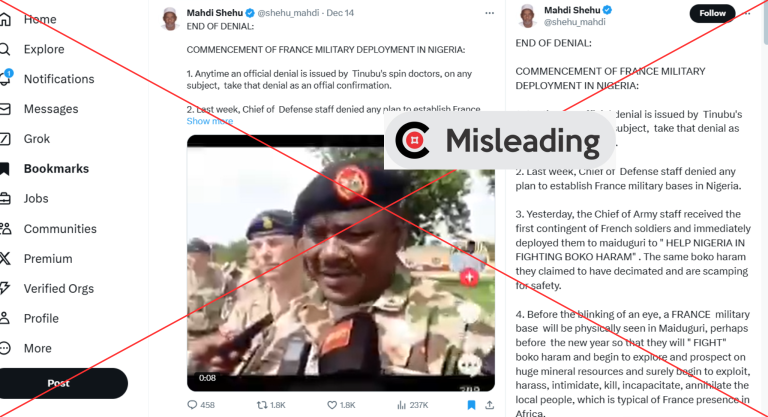
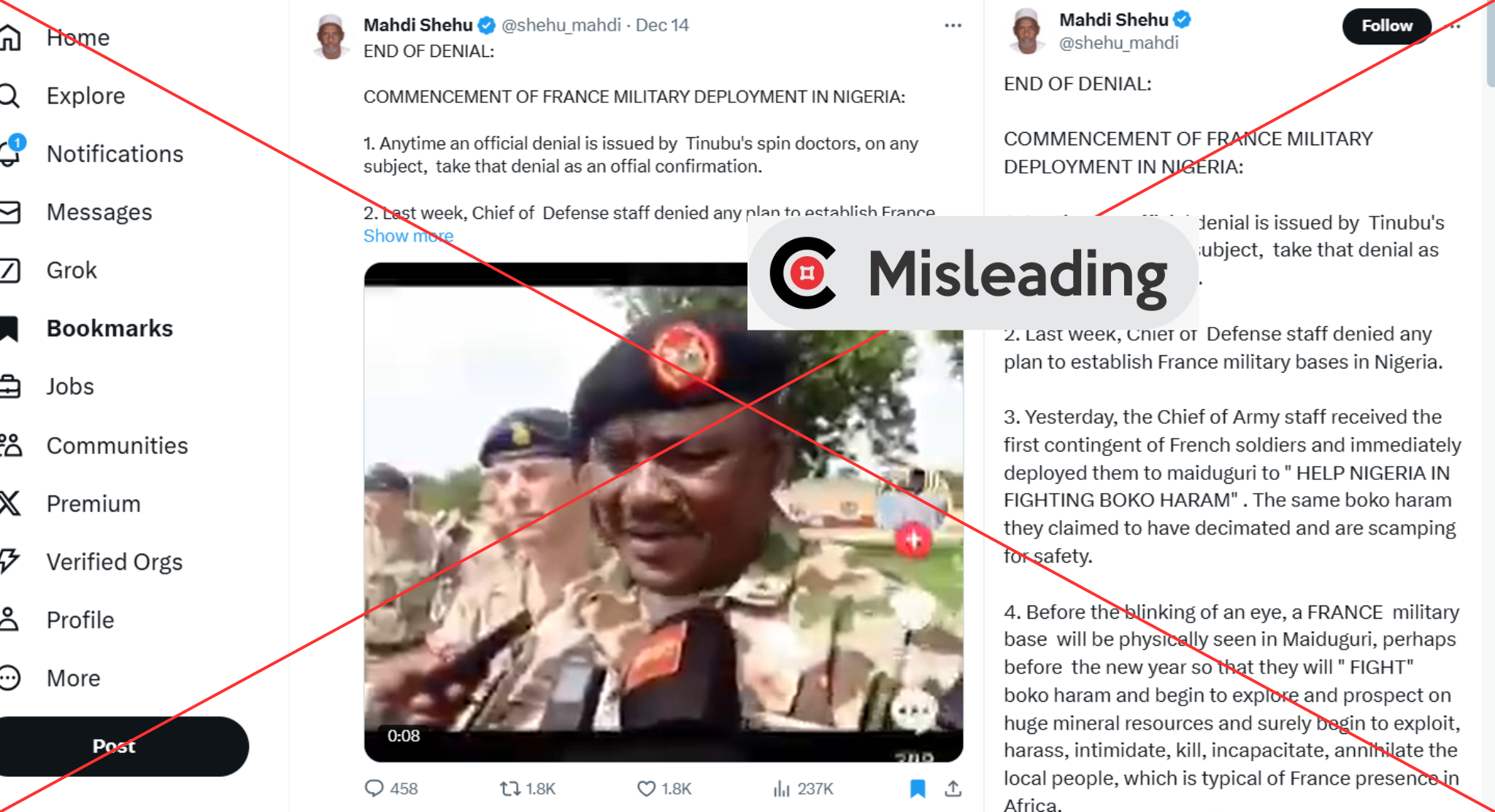
A Nigerian social critic, Mahdi Garba, has posted a video showing a military General addressing the press with a claim that it depicted the deployment of French military personnel in Nigeria.
“END OF DENIAL: COMMENCEMENT OF FRANCE MILITARY DEPLOYMENT IN NIGERIA:”
The post alleged that the French military had begun deploying troops to Maiduguri in Borno State, to fight Boko Haram and establish military bases with the ulterior motive of exploiting Nigeria’s mineral resources.
It has generated about 300,000 views with over 2,200 reposts and more than 2,200 likes as of December 16, 2024.
CLAIM
Video shows the deployment of French military troops in Nigeria.
THE FINDINGS
Findings by The FactCheckHub show that the claim is MISLEADING.
screenshot of the viral post
The video shared by Mahdi actually shows a programme that took place on October 25, 2024 in Maiduguri, Borno State where the UK Government donated advanced Counter-Improvised Explosive Devices (IEDs) to Nigeria’s Operation Hadin Kai (OPHK) Theatre Command.
Counter-IED equipment is created primarily for military and law enforcement. They are used for standoff detection of explosives and explosive precursor components and defeating Improvised Explosives Devices.
This donation, handed over to Waidi Shuaibu, the Nigerian military’s Theatre Commander, included specialized tools and equipment designed to detect and neutralize IEDs, enhancing the Nigerian military’s operational capabilities.
Representatives of the British Defence Staff West Africa and Nigerian senior military officials attended the event, reinforcing the partnership between the UK and Nigeria.
No evidence or official announcement supports claims of French military involvement or bases in Nigeria, specifically in the Northeastern region.
The video posted by Mahdi was cut in the middle, leaving out crucial context. News Central posted an extended version of the video on October 27, 2024, which clearly shows that the event was related to the UK donation. Punch newspaper also reported the event, confirming the same.
The General Officer Commanding (GOC) in the video was briefing the press about the donation of the IED materials, saying it would go a long way in supporting military operations.
THE VERDICT
The claim that the video shows the deployment of the French military in Nigeria is MISLEADING. The video indicates the UK government’s donation to Nigerian military forces, not French military involvement.
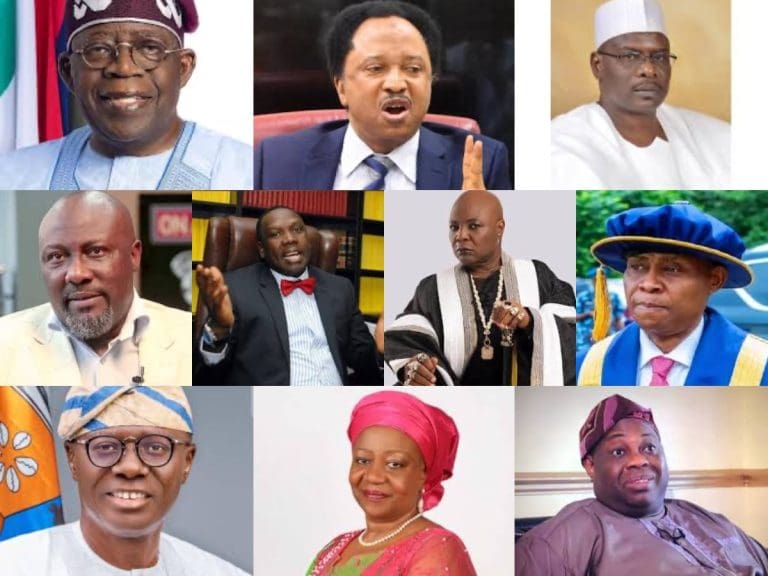
THE year 2024 is marked by a flurry of claims from Nigerian public figures, spanning diverse topics such as politics, economics, and sports. With the growing prevalence of misinformation, public statements by prominent individuals have increasingly come under scrutiny.
Prominent among the fact-checked individuals this year was President Bola Ahmed Tinubu, whose statements on Nigeria’s population, economic policies, and national developments were analyzed at least three times. Other influential individuals, including Adedeji Adeleke, Dino Melaye, and Lauretta Onochie, also made headlines with claims that turned out to be MISLEADING, FALSE, or UNPROVEN following our thorough investigation.
This report highlights some of the most prominent fact-checks conducted by The FactCheckHub in 2024 where notable Nigerians either misrepresented facts or propagated outright falsehoods. This list is in no particular order.
1. Bola Tinubu
Nigeria’s President, Bola Ahmed Tinubu, is the top on our list having got fact-checked on at least three different occasions this year.
The first was during an early morning nationwide broadcast on Monday, October 1, 2024. President Tinubu had shared updates on the nation’s progress, economic outlook, and security measures as Nigeria celebrated its 64th anniversary.
In this report, we fact-checked some of Tinubu’s claims using verifiable data and official sources. Out of the nine claims analysed by The FactCheckHub, six wereTRUE, while three were either MISLEADING or FALSE.
Also, following the nationwide protests that rocked Nigeria over economic hardship, President Tinubu addressed citizens in the early hours of Sunday, August 4, 2024.
The FactCheckHub team monitored the Nigerian president’s broadcast on Channels TV and examined the veracity of his claims. Out of the six claims that we analysed, three were found to be TRUE, while the remaining three were either UNPROVEN or FALSE.
In March, Tinubu claimed that Nigeria’s population is over 240 million. He made the claim while speaking during the Nigeria-Qatar Business and Investment Forum in Doha held on March 3, 2024.
Our findings showed that his claim was FALSE, as Nigeria’s population is not up to that figure, according to data by Worldometre, UNFPA and the National Population Commission (NPC) as at then.
2. Adedeji Adeleke
In October, Nigerian billionaire, Adedeji Adeleke, the father of popular Nigerian music artiste, Davido said he is building a 1,250-megawatt thermal power plant which will also become the biggest thermal power plant in Nigeria.
He said it during the Seventh Day Adventist General Conference Annual Council in Maryland, United States of America (USA) on October 15, 2024.
Findings by The FactCheckHub show that the claim is FALSE.Publicly available data have shown that Egbin power station is the biggest thermal power plant in Nigeria at 1,320MW; this therefore means a 1,250MW power plant cannot be said to be the biggest.
3. Dino Melaye
In August, a former Nigerian lawmaker, Dino Melaye, posted on X footage that shows the Nigerian athlete, Tobi Amusan, partaking in a race alongside a claim that she won two gold medals at the Paris 2024 Olympics in France.
Our findings showed that the claim was MISLEADING, as the footage posted by Melaye has been online since July 2022.
Also in April, Melaye shared footage of a sitting of the Federal Executive Council with the claim that the Federal Government of Nigeria has scrapped some parastatals and agencies alike.
Our findings showed that only PTAD and NSSEC are to be scrapped, according to the Oronsaye Report while others are yet to be merged or subsumed as announced by the Nigerian government in February 2024.
4. Dele Momodu
In August, a prominent Nigerian journalist and publisher, Dele Momodu, posted an aerial video that shows a large crowd protesting on a busy street to depict the August nationwide protest in Niger State.
Our findings showed that the claim is MISLEADING, as the video is from a protest in Kenya held in June 2024 over the proposed tax bill.
5. Shehu Sani
In March, a former federal lawmaker, Shehu Sani, claimed that Nigeria is the only country without a museum in its capital city.
Our findings showed that Nigeria’s Federal Capital Territory (FCT), Abuja has several museum centres which serve as a hub of tourism and attractions for visitors from across the country and beyond its borders. They include Thought Pyramid Art Centre and Discovery Museum in the nation’s capital, among others.
6. Daniel Bwala
In February, Daniel Bwala, who is now a Special Adviser to President Tinubu shared a press release from the Central Bank of Nigeria (CBN) stating that the apex bank would convict any individual transacting with foreign currency.
Our findings showed that the press release was published on July 4, 2015 and not this year.
7. Ali Ndume
The Nigerian Senate Majority Chief Whip, Ali Ndume, claimedthat Nigeria has only 200,000 armed forces personnel across the country.
Ndume stated this on January 23, 2024 while speaking on the country’s security situation during an interview on Channels TV’s programme, Politics Today.
Our findings, based on data obtained from the Global Fire Power (GFP) website, which was last updated on January 9, 2024, showed that Nigeria has an estimated total military personnel of 280,000, while the number of active military personnel stood at 230,000. These figures are higher than the figure quoted by Senator Ndume.
8. Lauretta Onochie
In September, a former Presidential aide, Lauretta Onochie, posted a photo showing a woman arrested by Police with a claim that it shows Canada-based Nigerian woman, Amaka Sonnberger, who threatened to poison Yoruba and Benin people living in the North American country on TikTok.
Our findings showed that the claim is MISLEADING, as the woman in the photo is Nikema Williams, a Georgia State lawmaker, when she was arrested during a protest in 2018.
Williams (D-Atlanta) was arrested by Capitol police during a protest over election ballot counts in the rotunda of the state capitol building on November 13, 2018, in Atlanta, USA.
Sanwo-Olu said Lagos is recording 90-94 per cent budget performance year in and year out but our findings showed that the state’s yearly budget has consistently fallen below that range. He also said Lagos state budget has tripled from about N620 billion to N2.3 trillion in 5 years which was also found to be FALSE.
10. Charly Boy
Finally, on this list is a Nigerian musician, Charles Oputa also known as Charly Boy. He posted a video allegedly showing the looting of a warehouse during the nationwide #EndBadGovernance protests in Nigeria.
Our findings showed that the claim is MISLEADING, as the video has been online since March 2024 and showed mobs who broke into a government storage facility in Gwagwa area of the Federal Capital Territory (FCT) on March 3, 2024 and looted stored food items.
STAKEHOLDERS in the media sector on Friday underscored the urgent need for collaborative efforts from local, religious, and national leaders to combat gendered disinformation and gender-based violence (GBV).
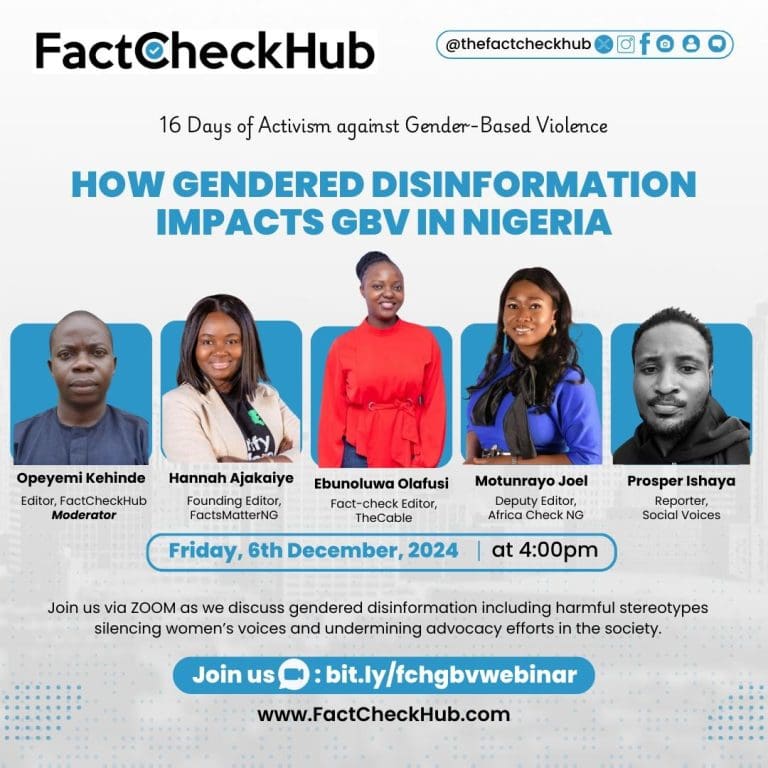
This consensus emerged during a webinar hosted by The FactCheckHub as part of its commemoration of the annual 16 Days of Activism Against Gender-Based Violence.
The webinar came against the background of this digital age where voices are amplified and connections are forged across borders, but where an insidious menace thrives in the shadows—gendered disinformation.
This targeted form of abuse transcends cyberspace, often escalating into real-world violence against women, particularly those who step into leadership roles, advocate for equality, or challenge societal norms.
The webinar, titled: How Gendered Disinformation Impacts GBV in Nigeria, was moderated by The FactCheckHub Editor, Opeyemi Kehinde, where panelists provided insights into the pervasive issue of gendered disinformation and its real-world consequences.
Hannah Ajakaiye, the founding editor of FactsMatterNG, highlighted the coordinated nature of online attacks targeting women. She cited the case of Senator Natasha Akpoti and Rinu Oduala, who were subjected to a smear campaign involving organized disinformation, including the release of their physical addresses online.
“Twitter (now X) is actually like a very toxic space where a lot of gendered disinformation happens, especially in the Nigerian context when it comes to Nigerian women. So we’ve seen that and we’ve seen even instances where like the physical address of some of the GBV victims were released online,” Ajakaiye noted.
Ebunoluwa Olafusi, the FactCheck Editor at The Cable, drew attention to the use of memes and false narratives as tools of disinformation. She described how the gender wars on X (formerly Twitter) often devolve into coordinated attacks, with participants weaponizing personal insults and spreading disinformation about women and girls.
“Someone would just drop a picture. You don’t need to put a caption. And by the time you look at the comments, or the topic of discussion that is causing the wahala, and you look at the picture or the image that has been dropped, you don’t need the caption to tell you what they are talking about.
“You see memes used to discredit women. They bring up false narratives, even if a bit of them are true. But there’s a way they coordinate themselves to, you know, amplify these narratives against women,” Olafusi stated.
Addressing the persistent barriers to women’s emancipation, Prosper Ishaya, a reporter with Social Voices attributed it to the role men played in perpetuating patriarchal norms.
He said that despite the increasing number of women taking on breadwinner roles, many men still hold onto outdated beliefs that confine women to traditional domestic roles.
“Most men feel like the whole gender equality shouldn’t be a thing. Most men still hang on to the belief that women belong to the kitchen, women belong to the rooms, and stuff like that.
“But, on the fight for gender equality and gender equity, we still have a long way to go. Because of the perception of the majority of men… women as a demography are actually a minority at present. And, for now, I think the fight just needs to be on. The pressure needs to be pushed, worked out,” Ishaya emphasized.
Stakeholders observed that proffering solutions to address gendered disinformation requires a multifaceted approach that involves not only debunking false narratives but also actively promoting accurate, inclusive, and respectful representations of gender issues across various platforms.
Motunrayo Joel, the Deputy Editor of Africa Check Nigeria, emphasised the importance of establishing robust support systems for survivors of gender-based violence (GBV), noting that efforts should go beyond merely addressing the issues of gender disinformation and fake narratives about women and girls.
She also called for a collective approach involving various stakeholders, including local leaders, religious leaders, national leaders, and community representatives, to combat GBV and gender disinformation effectively. She stressed the need for engaging with communities through council meetings and outreach efforts to rally support and foster a united stand against these issues.
“Our leaders have to come together. You know, this is a fight that’s not only by us, either as survivors or fact-checkers or journalists. Local leaders, religious leaders, and national leaders must be involved.
“Yes, this is something we hear over and over again. But I’ve come to realize that when we all come together to fight something, the fight is always much stronger. We also need to invest in women. Starting from a young age, we should start preaching empowerment. We should start looking at how to invest in girls,” Joel stated.
On her part, Ajakaiye echoed the need for systemic reforms, pointing out that while Nigeria has laws addressing GBV and gendered disinformation, enforcement remains a significant challenge. She urged digital platforms to establish mechanisms for accountability and provide avenues for victims to seek redress. Legislative reforms and institutional strengthening were also highlighted as essential steps to protect women’s rights whether online or offline.
Olafusi however emphasised the need for stringent punishments for GBV perpetrators and increased awareness about available resources to help women seeking justice. She also called on the media to avoid perpetuating gender stereotypes in their reportage, urging journalists to exercise caution in their choice of adjectives and narratives to prevent harmful biases from taking root.