Home Blog Page 174

FACT CHECK: Was Buhari arrested in UK by INTERPOL to answer allegations of war crimes?

0

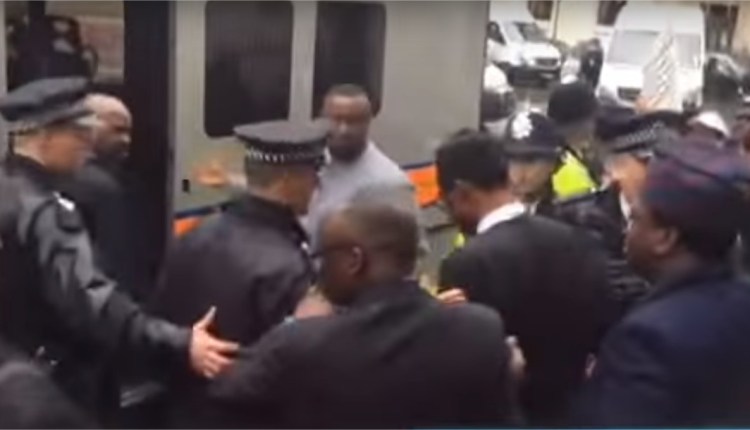
A video has gone into circulation, which appears to show President Muhammadu Buhari, Transport Minister Rotimi Amaechi, APC national leader Bola Tinubu, and Festus Keyamo, Buhari’s re-election campaign spokesperson, being ushered into a police van in the United Kingdom.

“Buhari in Black Maria, London Nightmare,” says the caption on the video, which is copyrighted by one Emmanuel Uche.

Accompanying it also is an explanatory note, stating that the video was blocked by the federal government to prevent Nigerians from having access. It further claims Buhari was arrested by the INTERPOL, acting on a warrant of the International Criminal Court, before his eventual release on bail.

“International Criminal Court ICC warrant raised against General Muhammadu Buhari (Rtd),” it said.

“The Interpol arrested him briefly during one of his recent visit to the United Kingdom, Buhari was released on bail as lawyers prepare his case at the ICC. It was like a joke when a video showing clips of General Buhari being conveyed to a waiting British Police Armor Criminal Carrier {ACC} to be whisked off, to answer cases of crime against humanity levels against him.”

The ICIR examines the facts to determine if these events truly took place.

THREE-YEAR OLD VIDEO

The video in question has not just surfaced but is merely recycled. It was first uploaded and shared three years, during Buhari’s pre-election visit to the Chatham House. It was again uploaded two years ago by another YouTube, and then even more recently with similar claims.

In February, 2015, then presidential candidate Muhammadu Buhari was at the Chatham House, an independent policy institute based in London, to deliver a speech on “Prospects for Democratic Consolidation in Africa: Nigeria’s Transition”.

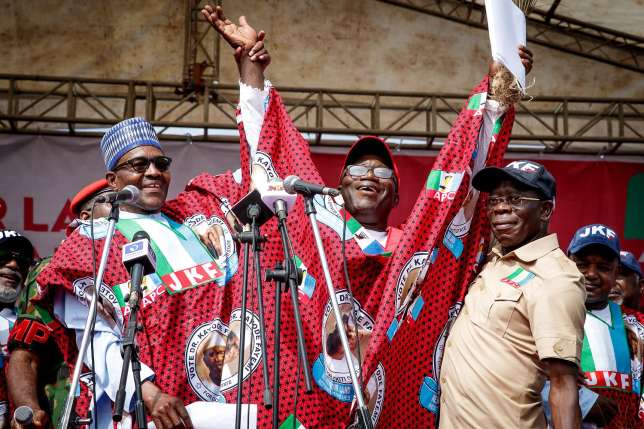
He was in the company of Bola Ahmed Tinubu, national leader of the All Progressives Congress (APC), John Odigie Oyegun, former APC national chairman, Rotimi Amaechi, then governor of Rivers state, and Adams Oshiomhole, then governor of Edo state.

At the venue also was a crowd of protesters who demonstrated against Buhari’s candidacy and political aspiration. Video evidence, meanwhile, later emerged suggesting that the protesters were paid $20,000 by the People’s Democratic Party (PDP) to stage the rally.

Another pointer to the age of the video is the reference to Buhari as “General Muhammadu Buhari (Rtd)”, a title which was more appropriate three years ago before he was sworn in as Nigeria’s president.

DENIED BY INTERPOL

In an emailed response to The ICIR‘s enquiry, the INTERPOL Press Office said the organisation “does not make arrests”, adding that all arrests are made by the police force of a country in compliance with local laws.

A source at the INTERPOL who spoke with The ICIR also confirmed that the claims surrounding the video aren’t true, and said members of the Metropolitan Police Service he spoke to described it as doubtful. A cop who works with the Metropolitan Police also said they do not make arrests using such vehicles.

The vehicle is a Metropolitan Police Mercedes Sprinter Public Order Vehicle (POV) used by the Territorial Support Group (TSG). The TSG is a specialist unit of the Police that maintains public order and addresses riots, disorder, or large scale riots.

A Met Police POV seen in Newport, Wales during the NATO Summit. Photo Credit: Chris’ 999

NO ICC WARRANT AGAINST BUHARI 

A look through the records of the International Criminal Court (ICC) also revealed that Buhari is not among the 42 defendants listed to have one case or the other, some of whom are said to be at large and have warrants issued for their arrest.

The ICC case file on Nigeria with respect to “alleged crimes against humanity or war crimes” is still undergoing preliminary investigation and has been open since 2011 — long before Buhari’s presidency.

It is noteworthy also that Buhari was invited to an event held on July 17 at the ICC headquarters in the Netherlands, to mark the 20th anniversary of the adoption of the Rome Statute. The event, in fact, featured a keynote speech by Nigeria’s president.

The PDP, which complained to the ICC in May over alleged hate speech by Buhari, has however described the invitation as an indictment on the administration. It also urged Buhari to report himself to the international court over “documented human right abuses, crime against humanity and killings in Nigeria”.

(Left to right) ICC Registrar Mr Peter Lewis, ASP President H.E. O-Gon Kwon, President of Nigeria H.E. Muhammadu Buhari, ICC President Judge Chile Eboe-Osuji and ICC Prosecutor Fatou Bensouda at the high-level commemorations of the Rome Statute’s anniversary on 17 July 2018 ©ICC-CPI

REBUTTED BY KEYAMO

Festus Keyamo, a Senior Advocate of Nigeria who was in May appointed as the Director of Strategic Communications for Buhari’s 2019 presidential campaign and was among the 2015 delegation to Chatham House, has also denied the viral claims.

He explained to The ICIR that, as a result of confrontations between pro- and anti-Buhari protesters outside the Chatham House in 2015, the British Police’s help had to be sought to ensure the presidential aspirant’s safety.

“During 2015 campaigns, after Buhari’s address at Chatham House, London, APC and PDP supporters [were] almost fighting outside,” he said. “British Police was called in to take us to safety to prevent any harm befalling him.”

CONCLUSION

It is not true Buhari was arrested by the International Police based on a warrant issued by the ICC “to answer cases of crimes against humanity leveled against him”. Not only does the INTERPOL not make arrests, the British Police does not deploy the van shown in the video to arrest individuals and Buhari is not under the ICC’s list of wanted persons.

In a nutshell, the circumstances surrounding what happened in the circulated video are much different than have been painted.

FACT CHECK: Was the Nigeria Air logo designed by a Bahraini company? Yes

0

FOR many reasons, a vote of no confidence has been passed by many on the recently released Nigeria Air logo — as the entire flag carrier project. Many have said it is below quality. Some say it lacks originality, as the ribbon symbolism has been overused in the past. 

The federal government has also been severely criticised since indications emerged that the logo contract was awarded to  a Bahraini company, From 6, despite the abundance of similar service providers in the country. There is also a claim that the contract was worth $600,000 (N183 million).

The ICIR examines available evidence around these claims.

Yes, admits From 6 Communucations

From 6 Communications, a branding and advertising agency co-founded by Pennie Nixon and Steve Doleman, has indeed confirmed it designed the Nigeria Air logo.

It made a video post on its Facebook page on Wednesday, the same day the carrier name and logo was unveiled in London by Hadi Sirika, Minister of State for Aviation, to showcase their “most recent airline branding project”.

Photo credit: Bella Naija

The post was however pulled down and replaced with a similar announcement on Friday, in which the company revealed the branding project was carried out in conjunction with “Nigerian marketing agency Image & Time and Airline Management Group (AMG), Transaction Advisors for the new National Flag Carrier”. The same post was released through From 6’s LinkedIn page.

Image & Time is a corporate branding and communication company with offices in Lagos and London, and Airline Management Group is a UK-based company that assists in developing and implementing complex airline and aviation industry projects.

Air Management Group was hired by the federal government in February, after Lufthansa Consulting was dropped, to provide transaction advisory services for the establishment of a national carrier.

A check of the Corporate Affairs Commission (CAC) company portal revealed that neither From 6 Communications nor Image & Time are incorporated with the commission.

Contract cost unknown

The ICIR could not independently verify the amount utilised for the branding project. The Minister of State for Aviation could not be reached as a call placed to his line did not go through.

The federal government, however, budgeted the sum of N555 million for the establishment of national carrier and N200 million for consultancy for the establishment in the 2017 budget.

And, in 2018, N50 million was allocated for the establishment of the carrier, while N20 million was allocation for consultancy.

Local content executive order still valid 

In May, 2017, the federal government signed and released an Executive Order On Support for Local
Content in Public Procurement. This law generally provides that “all Ministries, Departments and Agencies (MDAs) of the FGN shall grant preference to local manufacturers of goods and service providers in their procurement of goods and services.”

Item 4 of the instrument further states that Information and Communication  Technology (ICT) shall be given preference and at least 40 percent of the procurement expenditure on it in all MDAs shall be locally manufactured goods or acquired through local service providers.

Again in February, President Muhammadu Buhari signed Executive Order 5 to promote science and technology acquisition and the participation of local companies in government procurement activities.

However, the government has evidently not adhered strictly to this declaration.

Conclusion

While it is true the branding of the proposed flag carrier, Nigeria Air, was done by a foreign company, there is no evidence to suggest $600,000 was expended by government on the said contract.

FACT CHECK: Has Olusola, Ekiti PDP governorship candidate, authored any books, papers? Yes

0

THE mega rally of the All Progressive Congress (APC) on Tuesday ahead of the Saturday’s governorship election in Ekiti State presented an opportunity not only to praise the party’s candidate but also to write off the opposition.

One of those who passionately seized this opportunity was Adams Oshiomhole, newly elected APC National Chairman. He said he made efforts to read books, published works and the PhD thesis written by Kolapo Olubunmi Olusola, the PDP governorship candidate, but was unable to find any of those documents.

He further questioned the legitimacy of Olusola’s professorship based on his findings.

“I understand the one they are bringing, they said he is a professor,” Oshiomhole said.

“So I went to the library and I was looking for any of the books that he may have written, because to be a professor you are supposed to have published a lot of materials. I wanted to read any of the books written by this professor so that I can gauge how his mind works.

“But then, when I couldn’t find, I asked the librarian, this candidate who wants to contest with Dr Fayemi, where are his published works, I want to see his PhD thesis so that I can evaluate it and it will give me a window into his heart. There is none. I say none.”

“Se ti iwo o ba ko iwe, bawo ni iwo se je professor,” he added using a Yoruba expression, which translates in English as: if you did not write a book, how then did you become a professor.

Olusola, reports say, graduated as the best student of his set in 1989 when he had his first degree in Building from Obafemi Awolowo University (OAU). He holds a Master’s Degree in Construction Technology from University of Lagos in 1993 and PhD in Building Structures from Obafemi Awolowo University in 2005. And he has lectured both at Covenant University and OAU.

However, is it true as the APC chieftain strongly suggested that Olusola does not have any books or academic papers written by him or accessible to the general public?

NO, SAYS GOOGLE SCHOLAR

Kolapo Olusola’s page on Google Scholar

A simple search by the ICIR on Google Scholar, a freely accessible web search engine that indexes a wide range of academic literature, revealed that Kolapo Olusola has an exclusive profile page.

His works have been cited in 390 places. The vast majority of indexed academic papers are, however, either authored only by him or in conjunction with other researchers.

Also according to the Google application, his unpublished PhD thesis―with the topic: Factors affecting compressive strength and elastic properties of lateriased concrete―has been cited up to 21 times, including in this paper: Determining the Properties of Green Laterized Concrete with
Fly Ash for Sustainable Solid Waste Management.

Office of the HoD Secretary, Department of Building, OAU

Twice on Wednesday, the ICIR reporter visited the OAU Department of Building to confirm the submission and availability of Olusola’s PhD thesis. However, the departmental secretary, with access to the theses, requested the reporter to come the following day. On Thursday, there was no official available to attend to the ICIR’s request.

HIS BOOK ON AMAZON

Additionally, Olusola’s scholarly works have been featured on Amazon, the world’s largest electronic commerce company. A book, which he co-authored with Babatunde Olawuyi, Volcanic Ash Blended Cement Laterized Concrete, is listed for sale on the platform. It was published in 2017 and costs $49.

‘Volcanic Ash Blended Cement Laterized Concrete’ by Babatunde Olawuyi and Kolapo Olusola

CONCLUSION

It is false – as the APC National Chairman suggested – that Olusola has not written any books, research papers or PhD thesis. While it is possible the library he visited does not contain any of such works, a simple web search is all that is needed for Oshiomhole to have an idea about the PDP aspirant’s scholarly works.

FACT CHECK: Can the GCFR national honour be awarded posthumously?

PRESIDENT Muhammadu Buhari, on Wednesday night, announced that Moshood Kashimawo Olawale Abiola, the popularly acclaimed winner of the June 12, 1993 general election – which was annulled by then military Head of State, Ibrahim Babangida – will be honoured with a posthumous national award of Grand Commander of the Order of the Federal Republic (GCFR).

Buhari also announced that henceforth, Nigeria will mark its Democracy Day on June 12 every year, as the events of June 12, 1993, hold more significance for Nigeria than that of May 29, 1999, when the military, again, handed over power to a democratically elected government.

However, Alfa Belgore, former Chief Justice of Nigeria between 2006 and 2007, said it is illegal for Buhari to confer a national honour to a deceased person.

“It is not done. It (the award) is for people living,” Belgore told Premium Times. “The only thing they could do is to name a place after him, but national honours award, no.”

TRUE OR FALSE?

Checks by the ICIR shows that section 3(2) of the National Honours Act provides that “a person shall be appointed to a particular rank of an Order when he receives from the President in person, at an investiture held for the purpose”.

A deceased person cannot receive anything “in person”.

However, section 3(3) reads as follows: “If in the case of any person it appears to the President expedient to dispense with the requirements of paragraph (2) of this article, he (the President) may direct that that person shall be appointed to the rank in question in such a manner as may be specified in the direction.”

There is no specific provision in the Act stating that national honours cannot be conferred to a deceased person. The President is at liberty to use his discretion to confer the honours on anyone who could not appear in person.

So, Alfa Belgore’s claim – that awarding a national honour posthumously is illegal – can best be described as misleading.

OTHER EXPERTS’ VIEWS

When The ICIR contacted Itse Sagay, a professor of law and Senior Advocate of Nigeria, he said there is no illegality in Buhari’s action.

Sagay, who also heads the Presidential Advisory Committee on Anti-Corruption (PACAC), disagreed with Belgore, insisting that honouring Abiola is an action that “binds the wounds of the nation”.

He said he does not know the specific provisions of the National Honours Act, but there are instances where more emphasis should be placed on the spirit and intent of an action rather than the technicalities of law

“In this case, justice should prevail over technicalities of the law. President Buhari did the right thing by acknowledging the events of June 12 and honouring Abiola,” Sagay said.

On whether it was the right timing for such a decision to be announced, and whether the move is a political one, aimed at appealing to South West voters in the forthcoming 2019 general election, Sagay said there can never be a wrong timing to do the right thing.

“People are bound to say anything they like. This is the right thing for President Buhari to have done, it doesn’t matter whether it is a political move or not. It also does not matter when he did it. It is the right decision.

“If Jonathan had done it, it would have been good. If Obasanjo had done it, it would have been good. They didn’t. Now that Buhari has done it, it is the right thing to do,” Sagay insisted.

Also, Rotimi Jacobs, SAN, agreed with Sagay that there was no illegality whatsoever in conferring a posthumous national honour on Buhari.

Jacobs described Belgore’s claims as a “purely political and personal opinion” which has “no legal basis”.

“Posthumous awards are recognised all over the world, and besides, it is the right thing for President Buhari to do,” Jacobs said in a phone interview with The ICIR.

Similarly, Benjamin Obidegwu, a Lagos-based legal practitioner, told The ICIR that there is nothing illegal in President Buhari’s actions.

“I’m aware that honours are given posthumously, it’s nothing new and it’s nothing illegal, except if the Act specifically says that, which I don’t think is true,” Obidegwu said.

“What Abiola’s own indirectly means is that he was recognized as the winner of that (1993) election, because that GCFR is given only to presidents.

“The only challenge I have with that is that Abiola was never a President. The fact that he won did not mean he was President, until you are sworn in, you are not a president, that’s the only challenge. Otherwise, there is nothing illegal in the decision.”

Is Nwokolo, Lagos DSP with impressive qualification, whom he claims to be?

0

A picture recently surfaced on the social media showing a business card belonging to Michael Nwokolo. Nwokolo, according to the card, has not only a Ph.D, but also a “CSS, OSHS, PFSO, PGD, MSc, BSc, Higher Diploma, Diploma, FNIIS, FOSHA, FCIPM, FCFE, FABS, FIGRLT, FCFN, FCILM, FIBTM, FIGAN, MNIM, MISOM, [and] MIACP”.

It also states that he is a forensic fingerprint expert, Dr. in leadership, Dr. in graphognomy, Dr. in theology, Deputy Superintendent of Police (DSP), and the head, Latent Fingerprint Unit, Forensic and Crime Data Section, Criminal Investigation Department, Ikoyi, Lagos.

A visit to his LinkedIn and Facebook pages also reveals these many qualifications, and even more. Nwokolo is not shy to flaunt his achievements and has realised the power of the social media in improving career prospects.

A picture of him and a heap of certificates in his office have also been in circulation, and have triggered many Nigerians to ask why Nwokolo, with his numerous honours and degrees, has not been promoted above his current rank as a DSP. Some have even celebrated him as Nigeria’s most educated police officer.

WHAT WE KNOW ABOUT HIM ― OR WHAT HE WANTS US TO KNOW

Professor Michael Nwokolo on his Facebook page says the following about himself:

  • EOD [Explosive Ordnance Disposal] at Forensic Expert
  • Senior Lecturer at University of Lagos
  • Studied Business Administration at Nigerian Institute of Journalism, Lagos (Post graduate, Class of 1999)
  • Studied Sociology at University of Lagos (MSc)
  • Studied Sociology at Green Hills University, Copenhagen, Denmark (PhD)
  • Studied Public Administration at Adekunle Ajasin University, Ondo (Class of 2004)
  • Went to Unity School Agbarho Delta State (Class of 1980)

And on LinkedIn, he makes the following claims:

  • Author of some books like The Science of Fingerprint and its importance and, The Challenges of Kidnappings in Nigeria
  • Can speak English and French
  • Lecturer, UNILAG, International Academy of Forensic (2017 – present)
  • Has a PhD in Sociology, Green Hills University, Denmark (2011-2013)
  • M.A., Professional Use of English, OAU (2007-2009)
  • Director of Theology (ThD), MOSBI, Lagos (2007-2008)
  • BSc Public Administration, Adekunle Ajasin University (2000-2004)
  • Post Graduate Diploma, Business Administration and Management, Nigerian Institute of Journalism (1998-1999)
  • Professor of Sociology – Green Hills University Denmark (Registrar Africa Campus)
  • Professor Security Management – Edexcel University, Benin Republic
  • Professional achievements: Master Numerologist, Professional Graphologist, Forensic Fingerprint Expert, Document Examiner, Occupational Safety and Health Specialist (OSHS)
  • FOSHA – Fellow Occupational Safety and Health Association, UK; FCIPM – Fellow Charter, Institute of Public Management; FCFE – Fellow Chartered Fraud Examiners; FABS – Fellow African Business School; FCFN – Fellow Chaplain Fellowship of Nigeria; FIGRLT – Fellow Institute of Government Research and Leadership Technology; FIBTM – Fellow Institute of Business and Technology Management; FCLIM – Fellow Chartered Institute of Leadership and Management; FIGAN – Fellow Institute of Graphologist of Nigeria; MNIM – Member Nigerian Institute of Management; MISOM – Member International School of Minis; MIACP – Member International Association of Chief of Police; Fellow and Exco, Nigerian Institute for Industrial Security, Lagos
  • Crack Detective/Investigator in the force for over 30 years
  • Head Security: ECOWAS/Banks/UN/Embassy/PA/Special Adviser/Security Adviser/C.S.O/Security Supervisor/HR Manager/Chancellor etc.
  • CSO – UN, ECOWAS, Embassies, Commissioner or Minister, PRO, Chancellor, Vice Chancellor etc.
  • Has special skills as a numerologist, graphologist/document examiner etc.
Professor Nwokolo’s display of awards and certificates, uploaded on Facebook

WHAT WE FOUND OUT

It goes without saying that this list is mind-blowing. But it also appears almost too good to be true, thus triggering the decison by the ICIR to investigate how true the claims are. Emails were sent to some of the institutions and calls placed to some others.

However, it is generally expected that for someone with such a robust profile, his internet footprints would be massive. But oddly, a Google search of the words “Michael Nwokolo” returns little relevant results: his LinkedIn profile, his Facebook profile, and numerous blog posts that were published following the emergence of a picture of his business card. There are no news reports, opinion articles, or academic papers in his name.

SOME CLAIMS ARE TRUE

The Green Hills University (GHU), Copenhagen, Denmark, confirmed to the ICIR through an email that “the student Michael Nwokolo graduated from us”. Collins Walsh of the Information Desk also replied that the university has an authorised campus in Nigeria.

Asked if he was at any point a professor or member of faculty, and additionally for details of this Nigerian campus, Walsh said: “Yes, he was a member of the faculty also. I don’t have much information about the Nigeria Station but I will check later with some colleagues who were dealing. Currently we are having a long break/holiday for renovation work and not easy to have my colleagues.”

Agumba Nwajei, President of GHU Africa Campus confirmed to the ICIR, as stated on their Facebook page, that courses are strictly online, and said what they have in Nigeria is an office for guidance and counselling, not a campus.

Wilson Esangbedo, Executive Secretary of the Nigerian Institute for Industrial Security (NIIS) also confirmed to the ICIR that Nwokolo’s claim to being a fellow and executive of the institute is correct and he is known to them.

Likewise, the Occupational Safety and Health Association (OSHA), United Kingdom, replied to similar enquiries in the affirmative. “This is to inform you that the above mentioned name is a confirmed Fellow of the Association, in Nigeria Region,” the Membership Team Unit wrote.

It is also true that Nwokolo has authored a book called “The Challenges of Kidnappings in Nigeria: Kidnapping is a Social Evil”. A picture of the book as well as another, “Unveiling the Power, Potency, Mysteries in Number and the Power in Names”, is uploaded on his Facebook wall.

Uploaded on LinkedIn: a flyer containing Nwokolo’s qualifications

SOME CLAIMS ARE NOT

Nwokolo says he is a Fellow, Chartered Fraud Examiners (FCFE); but there is no sign of this body online. There are however web references for an Association of Certified Fraud Examiners (ACFE). John Warren, Vice President and General Counsel of the association’s world headquarters, told the ICIR that, according to their records, “Michael Nwokolo has never been a member of the Association of Certified Fraud Examiners”. “We also do not offer a ‘FCFE’ designation, nor do we designate anyone as a ‘Fellow’ of the ACFE’, he added.

More so, there is no recognised Chartered Institute of Fraud Examiners in Nigeria. In 2017, the Nigerian Senate considered a bill to establish a Chartered Institute of Fraud Examiners, sponsored by senator Foster Ogola. However, the bill was eventually withdrawn after opposition from Dino Melaye, who insisted the Economic and Financial Crimes Commission (EFCC) was already performing the duties of the proposed institute.

Also, while Nwokolo says he is a member of the International School of Minis (MISOM), checks revealed there is no such school. What is closest to it is the Montessori in Nature International School (MINIS), which “offers authentic Montessori educational programs for families and children from birth to 6 years old”.

There is equally no such body as the Institute of Graphologist of Nigeria. There is, however, an Institute of Graphoanalysts of Nigeria. But while Nwokolo says he is a ‘FIGAN’, according to their website, the Associates of this institute are called AInstGAN, while fellows are referred to as FInstGAN.

OTHERS ARE SUSPICIOUS

According to Nwokolo, he is a Fellow of the African Business School (FABS), Fellow Chartered Fraud Examiners (FCFE), and Fellow Chartered Institute of Leadership and Management (FCLIM). While no official website can be linked to any of these bodies, they appear to have something in common: the last two, according to this overview, are both institutes under the African Business School (ABS).

The ABS does not have any functional website but is listed on at least seven internet listing services and business directories: Nigeria Training Courses, Finelib, Business List, VConnect among others.

Additionally, Nwokolo’s claim to have graduated from the Nigerian Institute of Journalism (NIJ) are, at best, suspicious. He states that between 1998 and 1999, he was enrolled in a Post Graduate Diploma in Business Administration and Management at the NIJ. But the institute’s programmes as contained on its website has no mention at all of Business Administration or Management.

The NIJ also confirmed it only offers Mass Communication after a call was placed to its helpline. But it added that they offered other courses in the past and recommended a mail is sent so the examination officer can verify the details. The mail sent has however neither been acknowledged nor replied.

The ICIR has been unable to get reactions from the United Nations and Economic Community of West African States (ECOWAS) for which Nwokolo says he worked as a Chief Security Officer. Also, email enquiries sent to EdExcel University, Chartered Institute of Public Management of Nigeria, Institute of Business Technology Management of Nigeria, Chaplains Fellowship of Nigeria, Nigerian Institute of Management, and International Association of Chiefs of Police were not responded to.

’The Challenges of Kidnappings in Nigeria: Kidnapping is a Social Evil’ by Michael Nwokolo M.Sc Ph.D

NOT ALLOWED TO COMMENT

When one of his numbers was called by the ICIR, Nwokolo said he will invite the centre when he has an event as he is unable to comment. “I can’t report anything,” he said. “There is some restriction about me now. We want people not to write anything yet.”

“But if you want to see me, anytime you come into Lagos, I am in the force C.I.D, Alagbon, Lagos. I am a forensic expert. I lecture in UNILAG. I lecture in other universities. In November I will be lecturing in Benue State University; so I lecture in different places. Whenever you are in Lagos, just come. We’ll see and chat.”

Probed further, he maintained that he cannot give any comments, and added: “You must be very loyal to your boss, and you’re supposed to know I am very loyal to my bosses.”

FACT CHECK: President Buhari’s fancy lies on past oil prices

0

MUHAMMADU Buhari, Nigeria’s President, loves to repeat a claim about oil prices averaging $100 from 1999 to 2014. This claim has been fact-checked and debunked but Buhari cannot stop his obsession with this disinformation.

On Tuesday when he received members of the Buhari Support Organisations (BSO) led by Hameed Ali, the Comptroller-General of Customs, at the Presidential Villa, Buhari repeated the claim and challenged everyone to verify it.

‘‘I challenge anybody to check from Europe, America and Asia; between 1999-2014, Nigeria was producing 2.1 million barrels of crude oil per day at an average cost of 100 USD per barrel and it went up to 143 USD. When we came, it collapsed to 37 – 38 USD and later was oscillating between 40 and 50 USD,” Buhari said.

In his 2017 Independence Day speech, Buhari said: “we should remind ourselves of the recent journey from 1999-2015 when our country happily returned to democratic rule. However, in spite of oil prices being an average of $100 per barrel and about 2.1 million barrels a day, that great piece of luck was squandered and the country’s social and physical infrastructure neglected.”

In November 2016 at the presentation of report on poverty reduction by Course 38 of National Institute for Policy and Strategic Studies, NIPSS, Kuru, Plateau State in the Presidential Villa, Buhari made the same claim.

He said then: “gentlemen, I have to digress now. For 16 years and eight consecutive governments of the other party, you know that there was unprecedented revenue realized. The oil projection which can be verified was 2.1 million barrels per day. 1999-2015, the average cost of each Nigerian barrel of oil was $100 per barrel. When we came it fell to less than $30 per barrel and is now oscillating between 40 and 50.”

In July 2015 when Buhari received Niger Delta Dialogue and Contact group led by King Alfred Diete-Spiff, he made the same misleading statement.

“He then talked about the impact of the collapse of the oil prices, which averaged about 100 US Dollars from 1999 to 2015, saying that its fall to about 30 Dollars a barrel some weeks ago was shocking. ‘I would have been in coma if not for the fact that I was in Oil (sector as a past minister) for three years,’” Garba Shehu, his Senior Special Assistant on Media and Publicity wrote.

WIDE GAP BETWEEN $100 AND $61

The Organization of Petroleum Exporting Countries (OPEC) which Nigeria is a member keeps a record of oil prices.  In its Basket Price, OPEC publishes the weekly, monthly, quarterly and yearly averages of oil prices based on daily quotations.

Based on OPEC data, the average crude oil price from 1999 to 2015 was $61 a barrel. The only time in history when average crude oil price reached $100 was in 2011 ($107), 2012 ($109.45) and 2013 ($105.87).

The highest price ever paid for crude oil was between June and July 2008 when a barrel of crude oil was sold around $130 to $147, although the average crude oil price in 2008 ended up being $94.45 per barrel.

In 1999 when the military handed over power to Olusegun Obasanjo, the average crude oil price was $16.56 per barrel. In 2003 when he was re-elected for a second term, average crude oil price rose to $28.05 per barrel and $69.08 per barrel in 2007. The average crude oil price during Obasanjo’s tenure from 1999 to 2007 was $37.18.

By 2008, during Musa Yar’Adua’s tenure, a barrel of average crude oil was $94.45 and later fell to $77. 45 when he died in 2010. During Yar’Adua’s tenure from 2007 to 2010, the average crude oil price was $75.51 per barrel.

Average crude oil price per barrel rose to $107 in 2011 and an all-time high of $109.45 in 2012 as well as $105.87 in 2013.  It fell to $96.29 in 2014 and a very record low of $49.49 in 2015. From 2010 to 2015 during Goodluck Jonathan’s tenure, the average crude oil price per barrel was $91.

CONCLUSION: The average price of crude oil per barrel from 1999 to 2015 was $61, not $100 as Buhari has repeatedly claimed since he became president.

FACT CHECK: IGP’s ‘transmission’ video wasn’t doctored

0

A video emerged online Wednesday, showing a scene where Ibrahim Idris, the Inspector General of Police (IGP), was struggling to read his speech at an event.

The video recording was done on Monday in Kano where Idris went to commission the Nigeria Police Force Technical Intelligence Unit.

The video was released by Voice of Liberty, an online media outfit with office in Abuja.

Idris was inarticulate and mumbling in the video: “I mean, transmission, I mean effort, that the transmission cooperation to transmission, I mean transmission to have effect, ehm, apprehend, I mean, apprehensive towards the recommendation, recommended formation effective and effect, I mean, apprehensive at the transmission of…and transmission and transmission for the effective in the police command.”

The widely circulating video on social media caused mixed reactions – disbelief, outrage, hilarity and absurdity.

POLICE CLAIMED VIDEO WAS DOCTORED

The only official reaction to the video by the police authority was a single replied tweet that the video was doctored when a Twitter user sought to ascertain the authenticity of the video.

Abike Dabiri-Erewa, the Senior Special Adviser to the President on Diaspora & Foreign Affairs also claimed that the video was doctored with special effect technique used to repeat a mistake made by the police chief.

“This video is definitely doctored, the error was made once, then special effects used to repeat it. What I don’t understand is why anyone would believe. Well, it’s a SM [Social Media] world,” she tweeted in reaction to Joe Abah who suggested that IGP might have a medical problem called dyslexia.

This particular tweet was no longer on her timeline when the ICIR checked on Saturday evening, suggesting that she has deleted it.

Since the video emerged, opinions have been divided on whether the video was manipulated or not. The police could have cleared the confusion by presenting the original video since they claimed the video was doctored.

FACT CHECKING VIDEO

The most available tools for fact-checking a video are mostly to check if a video is original. For example, reverse image search can be used to find out if there has been an original version of a video online. Another useful online tool to verify a video is the Amnesty International’s YouTube DataViewer which generates the thumbnails used by a video on YouTube and gives room to conduct a reverse image search on them.

In the case of IGP’s video, the online fact-checking tools cannot apply because it has been established that the video is not fake.  Rather the contention is that it was manipulated.

The claim by Dabiri-Erewa that the IGP made the mistake once which gave the manipulators the chance to use special effect technique to repeat the mistake is not plausible. For this claim to be realistic, the repetition could have been uniform since he made the mistake once.

In video editing, the voice and image can be separated. The separated voice can be superimposed on the motion picture at any point. Therefore, the first mistake made by Idris can be separated and superimposed on the motion picture repeatedly. That is, the video will be showing changing scenes but the voice is superimposed from an earlier mistake.

If the mistake was made once and subsequently superimposed on the rest of the video, the repetition will be uniformed voice of that earlier mistake.

YES, VIDEO WAS EDITED

The ICIR reached out to the Voice of Liberty to find out whether the video was originally captured by the organisation or whether the video was sent to the media platform. The lady who answered the phone call said she was in the marketing department of the organisation but promised to get the appropriate person to respond to the ICIR’s inquiry. She never did.

In its website, Voice of Liberty says one of its principles include: “what we write, publish or broadcast shall not be divisive, hurtful, libelous or defamatory. We should be aware of the impact of our words and images on the lives of others and the peace of the Nation.”

The website is run by ATAR Communications Limited with an office address in Abuja.

An examination of the IGP’S video showed that the video was edited but was not manipulated. The only editing technique used in the video was cutting. The video was split and joined shortly before a man appeared to help Idris. Probably, this was done to reduce the duration of the video for easy sharing online.

A subsequent video shared by Voice of Liberty showed that the IGP struggled with his speech from the beginning by making unwarranted mistakes but got worse when he started reading from the written speech.  Another video purportedly released by the police showed that he eventually discarded the written speech; nevertheless, he was struggling and repeating words but not as bad as when he was reading.

BASIS FOR DOUBTING THE VIDEO

If the video was released about a decade ago, nobody would have doubted the authenticity of the video. The emergence of reality-altering technologies has made it possible that videos can no longer be accepted on face value.

Supasorn Suwajanakorn, a researcher and his team from the University of Washington shocked the world last year by creating a fake video of Barrack Obama, former US President, by using a computer-generated version of Obama mapped to fit an audio recording.

In a paper published last year, Susajanakorn and his team described how they developed an algorithm that took audio and transposed it on to a 3D model of the president’s face.

The task was completed by a neural network, using 14 hours of Obama speeches and layering that data on top of a basic mouth shape.

Another fake video involving Jacob Zuma, former South African President, also circulated online last year.  Zuma was made to look like he was trying to say the phrase “in the beginning” correctly.

While there are available technologies to create fake videos, none of these were used in the IGP’s video.

Apart from technologies, the fact that IGP has university degree and has been seen reading fluently in the past have made people to believe that the video was doctored.

CONCLUSION: The discernible editing on the IGP’s video was “cut and join”. This does not in any way suggest that the video was doctored as claimed by the police and the presidency.

FACT CHECK: Ita Enang lied, Buhari already approved funds for arms purchase before seeking legislators’ consent

President Buhari had already approved the withdrawal of the sum of $496 million (N151 billion) from the Excess Crude Account (ECA), before seeking the approval of the National Assembly.

This is contrary to comments attributed to Ita Enang, a former senator and current Special Adviser to the President on Legislative Affairs, who claimed that Buhari has not, and could not have approved such spending without first seeking legislative consent as provided for in the constitution.

The National Economic Council (NEC) had agreed that $1 billion be withdrawn from the ECA to be used to procure arms for Nigeria’s anti-terrorism operations. Buhari later gave approval that the money be withdrawn, in spite of the fact that the legislative arm of government had not been informed and its approval not gotten, as required by the constitution.

Section 80, subsection (3) and (4) of the 1999 Constitution states:

“No moneys shall be withdrawn from any public fund of the Federation, other than the Consolidated Revenue Fund of the Federation unless the issue of those moneys has been authorised by an Act of the National Assembly.

“No moneys shall be withdrawn from the Consolidated Revenue Fund or any other public fund of the Federation, except in the manner prescribed by the National Assembly.”

However, Buhari wrote a letter, addressed to Yakubu Dogara, Speaker of the House of Representatives, in which he explained that he granted the approval for the withdrawal of the said $496 million, in anticipation that the National Assembly would approve of the deal.

“It would be recalled that, for a number of years, Nigeria had been in discussions with the United States Government for the purchase of Super Tucano Aircraft under a direct Government-to-Government arrangement,” Buhari stated in the letter dated April 13, 2018 sighted by ThisDay newspaper.

“Recently, approval was finally granted by the United States Government, but with a deadline within which part payment must be made otherwise, the contract would lapse.

“In the expectation that the National Assembly would have no objection to the purchase of this highly specialised aircraft, which is critical to national security, I granted anticipatory approval for the release of US$496,374,470.00. This was paid directly to the treasury of the United States Government.

“I am therefore writing, seeking approval of this House for the sum of US$496,374,470.00 (equivalent to N151,394,421,335.00) to be included in the 2018 Appropriation Bill, which the National Assembly is currently finalising. The balance of the requirements for critical operational equipment is still being collated from the different security services and will be presented in the form of a Supplementary Appropriation Bill, in due course.

“The Honourable Minister of Defence and other appropriate officers will be available to provide further details, as may be required.”

Already, the National Assembly had issued a summons to Kemi Adeosun, Minister of Finance, Mansur Dan-Ali, Minister of Defence, and Godwin Emefiele, Governor of the Central Bank of Nigeria, to come and explain why money was withdrawn from the ECA without an approval by the legislature.

However, before Buhari’s letter became public knowledge, Ita Enang had denied that the President approved the withdrawal. He insisted that “the said sum has not and cannot be approved for spending by Mr. President”.

“As of now, the process of approving the money for use is inchoate and still undergoing executive standard operating procedure before laying same before the National Assembly for appropriation,” Enang said in a statement he issued on April 9.

“The processes now being worked on is to fast-track these procedures so that it may be forwarded to the National Assembly while it is still considering the 2018 Appropriation Bill (budget) for incorporation as Mr. President’s supplementary request under the 2018 budget, or if completed after the 2018 budget, it may be forwarded as a Supplementary Appropriation Bill.

“Succinctly stated, Mr. President has not approved the sum for any release of this procurement or application howsoever, the executive is conscious of the provisions of Section 80 (3) and (4) of the 1999 Constitution.

“We are also conscious of the provision of Sections 4 and 5 of the 2017 Appropriation Act (relating to Excess Crude Account) and would not take any action in breach thereof.

“Therefore, the matter of the security fund is still undergoing standard processes, the said sum can only be spent, and in the manner, as shall be approved by the National Assembly, and assented to in the Appropriation Act or Supplementary Appropriation Act.”

ThisDay reports that an official of the US government has confirmed the payment of over $400 million by the Nigerian government, adding that the weapons, which include bombs and rockets, will arrive Nigeria by 2020.

FACT CHECK: Has Buhari reduced rice importation by 90%? NO!

President Muhammadu Buhari apparently considers the huge cut to rice importation from Thailand one of his administration’s greatest achievements. During his ongoing visit to London, he has boasted to Justin Welby, Archbishop of Canterbury, and British Prime Minister Theresa May about Nigeria’s ‘road to food self-sufficiency’.

HIS CLAIMS

According to statements released on Wednesday and on Monday by Femi Adesina, Buhari narrated to the two personalities ― in what appeared almost like memorised speech ― how Nigeria has cut rice importation by 90 percent.

“I am very pleased with the successes in agriculture,” he told Prime Minister May, on Monday. “We have cut rice importation by about 90%, made lots of savings of foreign exchange, and generated employment. People had rushed to the cities to get oil money, at the expense of farming. But luckily, they are now going back to the farms. Even professionals are going back to the land. We are making steady progress on the road to food security.”

This claim by the President is backed by figures released by the Thai Rice Exporters Association, which detail rice exports from Thailand to all countries, including Nigeria, from 2015 to 2017.

In 2015, the Asian country exported 644,131 metric tons (MT) of parboiled rice to Nigeria. In 2016, this figure dropped drastically to 58,260MT. And, in 2017, it fell even more to 23,192MT, resulting in a 96.7% decrease in just two years. This is apparently great news for the country ― except that these figures do not tell the whole story.

FACTS AND FIGURES

Benin Republic has always been another major importer of rice from Thailand. In 2015, Thailand exported 805,765MT of parboiled rice to the West African country. This figure, however, skyrocketed to 1,427,098 in 2016, and 1,811,164 in the year that followed. The same trend can also be noticed regarding Cameroon, another country bordering Nigeria. It imported 449,297MT of rice in 2015, 505,254MT in 2016, and 744,508MT in 2017.

According to the 2013 Benin Coarse Grains and Rice Report, the total demand for white rice in Benin is 385,000 metric tons, thus provoking the question, as asked by Lai Mohammed two weeks ago: “Who are they importing for?”

“Nigerians, of course,” Mohammed had himself confessed. “In fact, as Nigeria’s rice import falls, Benin’s rice imports increase. Most of the parboiled rice imported by Benin eventually land in Nigeria through smuggling.”

Even Audu Ogbeh, Nigeria’s Minister of Agriculture and Rural Development, admitted in 2016 that Benin traders imported parboiled rice shipped in from Thailand, “station themselves at our borders and smuggle these items into our economy”.

According to data from the International Grains Council, over half of Nigeria’s imports in 2015 entered from neighbouring Benin, where the duty on rice is only 12%, and most of Benin’s rice imports, up to 30,000 truckloads per year, are routed via transit shipments through Niger to the northwest of Nigeria.

It is also suggested that since Nigeria is the only West African country that exclusively consumes parboiled rice, it is easy to deduce that the 85% share of Benin imports that are parboiled are Nigeria-bound through the orchestrations of clever traders.

THEREFORE…

President Muhammadu Buhari has, therefore, been economic with the truth in his conversations with his English friends. Under his administration, Nigeria may have cut lawful rice importation by more than 90% but unlawful importation is still booming, which clearly means suggestions the country has equally made 90% progress on the path towards agricultural self-sufficiency are completely false!

NBS pulls down misleading education statistics after fact check by ICIR

0

The National Bureau of Statistics (NBS) has secretly pulled down inaccurate and misleading ‘Education Statistics’ uploaded on its website after the ICIR fact-checked the data.

The education statistics gave a breakdown of school enrolment across the country from 2014 to 2016.

NBS published the statistics on its website on February 16, 2018 and by February 24, the data had been downloaded 303 times.

In analysing the data, NBS said children who enrolled in public early childhood education dropped from 4,672,908 in 2015 to 2,694,787 in 2016.

According to NBS, enrolment in private early childhood education also reduced from 2,076,420 in 2015 to 1,457,461 in 2016.

Subsequently, several media houses published stories based on the education statistics, quoting NBS on the substantial drop in preschool enrolment in 2016.

A FACT CHECK by the ICIR showed that the education statistics was highly inaccurate and misleading. Rather than the reports that enrolment decreased drastically in 2016, evidence indicates that enrolment in early childhood education has been steadily growing since 2001.

After the ICIR fact-checked the education statistics, NBS pulled it down secretly.

To be fair to NBS, the misleading statistics was not generated by the NBS — the custodian of national statistics. The education statistics originated from the Federal Ministry of Education as the third edition of Nigeria Digest of Education Statistics.

While NBS has removed the education statistics from its website, the Ministry of Education still has it on its.

The failure of Ministry of Education to retract the misleading statistics means unsuspecting persons will continue to download and make decisions based on the wrong data.

Adamu Adamu, the Minister of Education, had described the education statistics as a “masterful effort to marshal education data”. He said the education statistics would fulfill the need for reliable and accurate data for effective planning and decision making.

“I would, therefore, wish to urge researchers, planners and policymakers to use the data presented here with confidence for all purposes,” he said.