Home Blog Page 175

FACT CHECK: Did Metuh take N1.4bn from NSA, as claimed by Lai Mohammed?

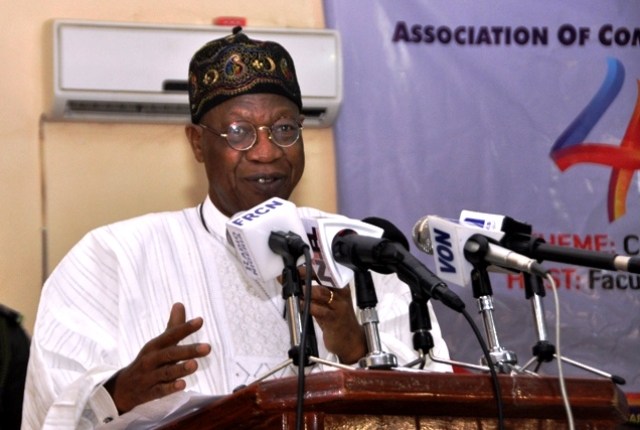
Lai Mohammed, Minister of Information and Culture, says Olisa Metuh, former National Publicity Secretary of the Peoples Democratic Party (PDP), is being tried for defrauding the nation of the sum of N1.4 billion.

Mohammed said this when he addressed a press conference in Lagos on Friday, in response to PDP’s charge that APC should mention names of those it claimed looted the country’s treasury.

“Well, I am sure they know that the treasury was looted dry under their watch, yet they decided to grandstand,” Mohammed said.

“Let’s just give them a teaser with this list: PDP Chairman, Uche Secondus (on the 19th of February, 2015, he took N200m only from the office of the then National Security Adviser).

“The then PDP Financial Secretary (on the 24th of October, 2014, he took N600m only from the office of the then NSA).

“The then National Publicity Secretary, Olisah Metuh (on trial for collecting N1.4bn from the office of the then NSA).

“Dr. Raymond Dokpesi, Chairman of DAAR Communications, (on trial for taking N2.1bn from the office of the then NSA).

“Former SSA to President Goodluck Jonathan, Dudafa Waripamo-Owei, (on trial over N830m kept in accounts of four different companies).

“Former President Jonathan’s cousin, Robert Azibaola, (on Thursday, a Federal High Court ruled that he has a case to answer for collecting $40m from the office of the then NSA.)”

FACT

While it is true that Olisa Metuh is on trial for allegedly collecting money from Sambo Dasuki, former NSA, it is not true that the amount he was accused of collecting is N1.4 billion.

According to information of the official website of the EFCC, Metuh is alleged to have received N400 million from Dasuki, from funds meant for arms procurement. This is way lower than the amount Mohammed said Metuh was being tried for.

One of the charges against Metuh by the EFCC reads: “That you, Olisa Metuh and Destra Investments Limited on or before the 24th November, 2014 in Abuja within the Jurisdiction of this Honourable court took possession of the sum N400,000,000 (Four Hundred Million Naira) only, paid into the account of DESTRA INVESTMENTS LIMITED with DIAMOND BANK Plc account number: 0040437573 from the account of the National Security Adviser  with the Central Bank of Nigeria without contract award when you reasonably ought to have known that the said sum formed part of the proceeds of an unlawful activity of Col. Mohammed Sambo Dasuki (rtd), the then National Security Adviser (to wit; criminal breach of trust and corruption) and thereby committed an offence contrary to Section 15(2), (d) of the Money Laundering (Prohibition) Act, 2011 as amended in 2012 and punishable under Section 15(3) of the same Act”.

Metuh pleaded not guilty when the charges were read to him.

Though the EFCC would file fresh charges against Metuh, they were not for any financial crime, but rather for destruction of evidence.

The charge reads: “Olisa Metuh on the 5th day of January 2016 in Abuja within the jurisdiction of the High Court of the Federal Capital Territory destroyed a document, to wit: a statement made under caution to investigators/operatives of the Economic and Financial Crimes Commission on the 5th of January 2016, with the intention of preventing the same from being produced or used as evidence in a court of law.”

According to the EFCC, the offence is punishable under Section 166 of the Penal Code Cap 532 laws of the Federation of Nigeria, (Abuja) 2004.

Mohammed stressed that the cases he mentioned were not made up as “many of these cases are in court and the records are available”.

However, there’s presently no court case against Uche Secondus, National Chairman of the PDP for collecting N200 million from Dasuki. So Mohammed’s claim to this effect remains debatable unless he has provided evidence to back it.

Secondus has already issued a statement saying Mohammed should get ready to establish his argument in court.
FACT CHECK: Did Dapchi girls return from captivity with ‘Ghana Must Go’ bags?

0

The mood in Nigeria has generally been celebratory since Wednesday, following the release of 105 schoolgirls abducted by Boko Haram from the Government Girls Science and Technical College, Yobe State.

But this has not stopped allegations, counter-allegations and even conspiracy theories from seeping into the ongoing conversations. Most prominent of all, the APC-led Federal Government has been accused of staging the saga, from the abduction to the eventual release of the girls.

The People’s Democratic Party (PDP) levelled this allegation on Wednesday through its official Twitter handle, and called on “the  and the International Criminal Court to declare this evil by the  Federal Government a war crime against humanity and immediately commence investigation on the matter”.

Mr. Kola Ologbondiyan, the party’s National Publicity Secretary, made the same allegation at a press conference in Abuja.

“Nigerians know that the main aim of this devilish act was to delude the public, set the stage for an orchestrated rescue, create a heroic myth and false sense of achievement around the APC administration and serve as a spur for President Muhammadu Buhari’s declaration to contest the 2019 presidential election, perhaps in the coming weeks,” he said.

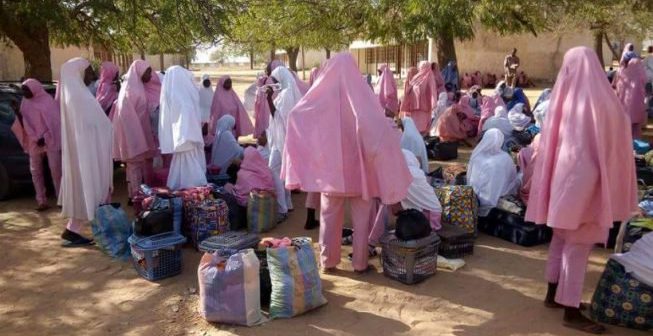
More specifically, eyebrows have been raised regarding a picture making the rounds, showing the Dapchi girls in pink hijabs and heavily-loaded “Ghana-must-go” bags. The picture was used by PremiumTimes Hausa in a report published on Wednesday about the ordered closure of boarding schools in Dapchi and Borno.

One of the prominent personalities who have raised questions respecting the photo is lawyer and former minister, Femi Fani-Kayode.

In an article published on Thursday, he wrote: “So many questions need to be answered. For example how do you explain the Ghana Must Go bags that the girls were carrying on their return? Did they go shopping in Sambisa Forest? Or is it that when they abducted them they gave them time to pack all their clothes and allowed them to bring them back when freed?”

Another blog has the picture uploaded and asked two similar questions, “Were they kidnapped or did they go on vacation? How did they come by the Travel Bags and the items therein when they were kidnapped from the School?”

Many other Nigerians have shared the picture on the social media with questions and allegations along the same line.

Picture with caption uploaded by a Facebook user

THE SOURCE OF THE PICTURE?

Although the exact source of this picture is unclear, it has been on the Internet for at least a month before yesterday’s release of the Dapchi schoolgirls, also in connection to the case.

In fact, The Cable used it on February 24 in a story titled ‘FULL LIST: The 105 missing Dapchi girls’.

Daily Post had used it two days earlier in another story: ‘2 Yobe schoolgirls killed in rescue operation, others still missing’. The same platform again used it on February 25 in a published list of the names of the missing schoolgirls.

Also on February 25, 2018, Business Online used the same picture in a report of the Federal Government’s confirmation of the abduction.

FACES OF THE REAL DAPCHI GIRLS

Let us start with this photo news by Daily Nigerian with eight pictures showing some of the released schoolgirls in light brown hijabs.

PM News also uploaded a similar picture on Wednesday with the caption, ‘The released Dapchi girls’.

Picture uploaded by PM News

A story from Punch contains even greater detail. The feature image used has the caption, ‘Freed 106 Dapchi girls assembled at the Nigerian Air Force Base in Maiduguri on Wednesday. Source: @buharisallau Instagram page.’

Buhari Sallau, who describes himself as a news personality, has even more pictures showing the schoolgirls indoors on his Instagram page.

The Guardian Nigeria has also uploaded an image showing the released girls, which was credited to Ola Lanre of Reuters. The caption states: ‘Some of the newly-released Dapchi schoolgirls are pictured in Jumbam village, Yobe State, Nigeria March 21, 2018.’ Similar pictures were published by The Cable and Vanguard.

Picture uploaded by The Guardian

CONCLUSION

It is NOT TRUE, based on available evidence, that the released Dapchi girls were wearing uniform pink hijabs, bearing large travel bags colloquially known as ‘Ghana Must Go’.

On the contrary, many of the schoolgirls wore brown hijabs upon their return and were seen nowhere close to the ‘Ghana Must Go’ bags suggesting they had time to pack their belongings before the abduction or that their abductors gifted them the bags and their contents.

Whether or not the government played an active role in the abduction and release is in doubt, but the circulated picture DOES NOT substantiate the theory that it was “stage-managed”.

Did Nigeria record a reduction in preschool enrolment?

0

The National Bureau of Statistics (NBS) recently reported that the number of children who enrolled in public early childhood education dropped from 4,672,908 in 2015 to 2,694,787 in 2016. Enrolment in private early childhood education also reduced from 2,076,420 in 2015 to 1,457,461 in 2016.

The report was contained in Education Statistics (2014 – 2016) that NBS published on its website on February 16, 2018. Subsequently, the report made the headlines in several media platforms.

This early childhood education refers to children attending organised education programme before primary school. It is a form of education that is also known as pre-primary, preschool, playschool, kindergarten or nursery.

WILD SWING IN ENROLMENT

Enrolment in public pre-primary school increased by 70.6% from 2014 to 2015 and decreased by 73.4% from 2015 to 2016. In private pre-primary school, enrolment increased by 34.1% from 2014 to 2015 and decreased by 42.5% from 2015 to 2016.

DETERMINANTS OF EARLY SCHOOL ENROLMENT

A study by Olanrewaju Olaniyan of the University of Ibadan points out that parents’ education, income and geographical zone influence early school enrolment in Nigeria. Educated parents are more likely to enrol their children in school early. Also, parents with stable income are likely to enrol their children in school. The influence of geographical zone means that children from certain parts of the country are more likely to enrol in school than children from other parts.

Multiple Indicator Cluster Survey of 2017 shows that 35.6 percent of children between the ages three and five years attend an organised early childhood education programme but there is a huge regional disparity. While only 23.2 percent of children in northern Nigeria are attending preschool, 80.5 percent of children in the southern part of the country are enrolled in preschool.

Early school enrolment is influenced by social, cultural, economic, policy and historical factors, according to Unicef, the UN children’s agency. Curiously, there is no evidence of unprecedented economic, social and policy disruptions in Nigeria that accounted for the disproportionate increases and decreases in pre-primary school enrolment between 2014 and 2016.

TRENDS IN ENROLMENT

Enrolment in pre-primary school has shown a steady increase since 2006, according to Nigeria Education For All Review Report (2000-2014), published by the United Nations Educational, Scientific and Cultural Organization (UNESCO).

The report indicated that enrolment in both public and private preschool rose from 2 million in 2006 to 2.7 million in 2010. Improvement in enrolment was sustained in subsequent years, as enrolment in public pre-primary school rose from 2.1 million in 2011 to 2.2 million in 2012 and 2.9 million in 2013.

These enrolment figures in the UNESCO report were based on the first Nigeria Digest of Education Statistics from 2006 to 2010 and the second in the series from 2011 to 2013.

QUESTIONABLE DATA FROM STATES

The education statistics uploaded by the NBS on its website show that enrolment in public schools in Rivers State increased by 5,470.7% from 2014 to 2015 and decreased by 11,520.3% from 2015 to 2016. In private preschool, enrolment decreased by 1,050.4% between 2015 and 2016 in the state.

The state recorded 1.8 million children in public preschool enrolment in 2015. Overall, the state had 2.4 million in both public and private pre-primary school in 2015. This number of children in preschool was not proportionate to the population of the state.

The Rivers State’s population as of the 2006 census was 5,198,716. In view of Nigeria’s annual population growth of 2.6 percent, the state’s population would have been projected at 6,549,714 in 2015. It was unlikely that more than one-third of the population of Rivers State in 2015 was enrolled in pre-primary school in 2015.

Other states in the southern part of the country also showed disproportionate increases and decreases in enrolment between 2014 and 2016. For example, Lagos State recorded 134,578 children in public preschool in 2014 but only 90,640 in 2015 and 69,240 in 2016. Similarly, Ondo State recorded 668,494 in public preschool enrolment in 2014 and 671,341 in 2015, but the figure fell to 296,369 in 2016. Also, Imo State recorded 50,600 in 2014 and 54,255 in 2015 but skyrocketed to 172,597 in 2016.

ORIGIN OF THE CONFLICTING FIGURES

The education statistics (2014 – 2016) published by NBS was the third edition of the Nigeria Digest of Education Statistics compiled by the Federal Ministry of Education.

In presenting the data, Adamu Adamu, the Minister of Education, described it as a “masterful effort to marshal education data” to address obvious gaps in education statistics. He said the education statistics would fulfill the need for reliable and accurate data in education for effective planning and decision making.

“I would, therefore, wish to urge researchers, planners and policymakers to use the data presented here with confidence for all purposes,” Adamu said.

NBS is the custodian of nation’s statistics, but it analysed and published the data without validating it.

CONCLUSION

It is most certainly inaccurate and untrue that enrolment in pre-primary school decreased drastically in 2016. The fluctuations in enrolment reported by several media platforms based on NBS education statistics were based on invalid and unreliable data that originated from the Federal Ministry of Education.

There is no evidence that enrolment in pre-primary school decreased in 2016. It is more likely that there has been a steady increase in enrolment since 2001.

FACT CHECK: Did ‘Kano underage voting’ happen in Kenya as claimed by INEC?

0

The Independent National Electoral Commission (INEC) has exonerated the Kano State Independent Electoral Commission from allegations of gross underage voting in the last local government election in the state.

Abubakar Nahuce, Chairman of a special panel set up by Mahmood Yakubu, INEC National Chairman, to probe the allegations, made this known while briefing newsmen on Friday.

Nahuce said there was no concrete evidence to prove that the pictures of underage voters making the rounds on the Internet were from the Kano LG elections.

He said that some of the pictures were from the recently held Kenya presidential elections.

The Kano LG election was won by the All Progressives Congress (APC) in all the 44 council areas in the state.

“From the interaction with civil society organisations and media, no evidence of underage voting has been presented,” Nahuche said.

“We have discussed with you media men, but none of you said he saw any underage voter in the line on election day.

“All what we saw were from social media and they are not verifiable… some of them are not even from Nigeria, some are from Kenya elections but people are attributing them to Nigeria.”

Earlier, Mohmmed Garba, Kano State Commissioner of Information, had claimed the pictures were taken during the 2015 general election.

FACT

In one of the videos posted online and seen by ICIR, the children were seen chattering gaily as they queued up to vote and the cameramen who spoke in Hausa could be heard chanting APC.

Checks by ICIR showed that no political party with the acronym APC exists in Kenya. The closest are AP for Agano Party; ARC for Alliance for Real Change and APK for Alliance Party of Kenya.

So it would be out of place for voters to be chanting APC in Kenya.

Secondly, the children in the video spoke Hausa; and of the many languages spoken in Kenya, chief of which is Swahili, Hausa is not one. The Hausa ethnic group is found mostly in West Africa.

CONCLUSION

INEC must acknowledge the seriousness of underage voting. To continue denying it will do no one no good.

The video above was shot during an election that held in Nigeria, whether it was during the recent Kano LG polls or the 2015 general election is another matter entirely.

Lai Olurode, a Professor and former INEC Commissioner, admitted during a recent interview with Punch that there were places in Nigeria where INEC personnel were being compelled, sometimes even threatened, to register underage voters.

“There are certain areas of this country where even if they know the person is a kid, they will insist that the child must vote,” Olurode said.

“I had to run for my life at one of the election centres in a part of the country because these people said children must vote or there would be no election at all. It was that bad.”

INEC’s first reaction to the latest claims of underage voting was was to deny responsibility, saying it had no legal powers over state electoral commission. It was cheery news, therefore, that Yakubu made an about-face and ordered a probe into the allegation.

However, INEC probe panel’s dismissal of the reports as mere hearsay not backed with evidence leaves a lot to be desired.

Did Buhari promise to revitalise 10,000 PHCs, as denied by Adewole?

0

On Sunday, Isaac Adewole, Minister of Health, said the Federal Government never promised to revitalise 10,000 Primary Healthcare Centres (PHCs) across the country.

While saying this on Sunday, he explained that what the FG said was that it would love to see about 10,000 PHCs revitalised — not that it would undertake the project itself.

“It’s not FG that is revitalising, what we said is that we want to see 10,000 PHCs revitalised in Nigeria. Because if 10,000 is done, it will cover about 100 million people and we did this to stimulate the governors and many of them have taken it up,” Adewole had said.

He added: “PHCs are not under us, they are under LGAs. Why we made PHC a focus is that we just have to take care of it. But normally, PHC is not the responsibility of the FG.”

But is it true that the Federal Government never said it would revive 10,000 PHCs?

INAUGURATION OF KUCHINGORO MODEL PHC

On January 10, 2017, President Muhammadu Buhari flagged off of what he described as one of the cardinal programmes of his administration – revitalization of PHCs — with the inauguration of a “Model” PHC at Kuchingoro, a suburb of the Federal Capital Territory, Abuja.

“We shall focus more on the people living in the rural areas and the vulnerable population in our society, such as women, children under five years of age and the elderly in collaboration with national and international partners,” Buhari said at the time.

“Our vision is to revitalize 10,000 Primary Health Care Facilities in Nigeria using a phased approach. The first phase of this approach is what we are flagging off today. It will signal the revitalization of the first 109 Primary Health Care facilities across the 36 states and the FCT.”

CONCLUSION

While Adewole’s claim that primary health care is the responsibility of local governments is true, the same cannot be said of his claim that FG did not promise to revitalise 10,000 PHCs.

President Buhari did so promise.

Also, during the interview, Adewole said that over 3,000 PHCs had been revitalised nationwide by the Federal Government, state governments, and international partners, including the World Bank, European Union, and the British Government.

However, these claims cannot be true, since a series of investigations by the ICIR on the state of PHCs across the states of the federation show that many of them are still in decay. Some that were renovated are not in use and have been overgrown by bushes.

Journalists, supported by ICIR, toured the six geo-political zones of the country, from the North Central, to the North West, South East, to the South South and South West. The reports remain the same: abandoned PHCs scattered all over with citizens groaning under the pains of ill-health.

FACT CHECK: Is INEC really handicapped to curb underage voting in LG poll?

0

Following the reports of massive underage voting in the just held Kano State local government election, the Independent National Electoral Commission (INEC) said it had “no legal control or responsibility whatsoever” over State Independent Electoral Commissions (SIECs).

INEC reacted to the scandal by saying it could not be held “directly or vicariously liable for an exercise outside our legal purview”.

“The attention of the Independent National Electoral Commission (INEC) has been drawn to videos and pictures purportedly showing some underage thumb printing ballot papers in a recent election. These images have been circulating online since Saturday,” it said in a statement by Oluwole Osaze Uzzi, its Director of Voter Education and Publicity.

“The Commission wishes to inform the public that the images do not relate in any way to any election organised, conducted or superintended by INEC.

“As far as the Commission can ascertain, they relate to a Local Government election conducted at the weekend, and over which we have no legal control or responsibility whatsoever…

“It should be pointed out here that Local Government elections are exclusively the constitutional responsibility of the respective State Electoral Commissions, who are in no way under the control or supervision of INEC.”

On Friday, however, Mahmood Yakubu, INEC National Chairman, said the commission had formed a panel to investigate the reports so the anomaly would be corrected.

The nomenclature ‘State Independent Electoral Commissions’ seems to suggest that INEC, as the national electoral body, cannot in any way exercise influence over the electoral bodies of the various states of the federation, since they are all independent bodies. But is that really the case?

WHAT THE CONSTITUTION PROVIDES

The 1999 constitution, as amended, provides that SIECs shall have power “to organise, undertake and supervise all elections to local government councils within the state”, and that INEC shall have power “to organise, undertake and supervise all elections to the offices of the President and Vice-President, the Governor and Deputy Governor of a State, and to the membership of the Senate, the House of Representatives and the House of Assembly of each State of the Federation”.

Also, that same section of the constitution, among other things, empowers INEC to “carry out such other functions as may be conferred upon it by an Act of the National Assembly”.

Now, the Independent National Electoral Commission Establishment Act states the functions of INEC thus: “To organise, conduct and supervise the elections into the office of chairmen and vice-chairmen of local government councils and area councils, membership of the local government councils and area councils, office of Governor and Deputy Governor, membership of the Houses of Assembly of the States, the office of President and Vice President and membership of the Senate and House of Representatives as may be specified in any enactment or law”.

CONCLUSION

Since INEC is empowered by its establishment Act to conduct local government council elections, and the constitution also empowers INEC to carry out any functions conferred on it by an Act of the National assembly, it can be argued, therefore, that INEC does have the power to conduct or at least supervise the various SIECs during LG elections.

FACT CHECK: Jonathan or Buhari, who launched the first made-in-Nigeria drone?

0

On Thursday, President Muhammadu Buhari launched what the Nigerian Air Force described as the first Unmanned Aerial Vehicle (UAV), popularly known as drone, that was completely manufactured in the country.

“The Nigerian Air Force (NAF), in its resolve to promote innovation and enhance its Intelligence, Surveillance and Reconnaissance (ISR) capabilities, today, 15 February 2018, inducted its first indigenous operational Unmanned Aerial Vehicle (UAV) nicknamed, Tsaigumi,” read a statement issued by Olatokunbo Adesanya, NAF’s Director of information.

But ‘Tsaigumi’ is not the first made-in-Nigeria drone to be launched by NAF, and this is according to the same NAF. However, it could be the first that becomes operational.

In December 2013, then President Goodluck Jonathan also launched a UAV (named Gulma), which Nigerians were told was the first of its kind to be built in-country.

During that ceremony, Jonathan praised the Nigerian Air Force to the high heavens, describing the achievement as “historic”.

“Considering the potential impact of its benefit and versatility, I cannot but say how proud I am of the men and women of our Armed Forces,” Jonathan said at the time.

“Apart from their commitment to the protection of our sovereignty, they are helping to keep our nation ahead in military science and technology and to keep their civilian counterparts on their toes.

“Today, as we stand in appreciation of the gallant men and women of our Air Force, we are reminded that hard work and diligence can break many barriers.”

Also speaking at the event, Alex Badeh, then Chief of Air Force, said the drone could be useful to media practitioners, and urged the government to sustain the tempo of development by ensuring adequate funding for technology-based initiatives.

“The GULMA, as a qualitative, timely and reliable source of information, could serve as a powerful tool for media practitioners. To sustain the current tempo of development, the NAF would require the assistance of government in infrastructure and human capacity development,” Badeh had said.

Thursday’s statement by NAF, however, claimed that the Gulma UAV launched by Jonathan was a “prototype”, unlike the Tsaigumi UAV, which is “a much more advanced and operationalized version”.

The explanation corroborated an earlier statement issued by Yusuf Anas, a NAF spokesperson, in May 2014, which noted that ‘Gulma’ was only a prototype and could not  be operational.

“The Nigerian Air Force unmanned aerial vehicle ‘Gulma’ is yet to be deployed for operational uses. Meanwhile, training of the NAF UAV operators is currently ongoing,” the statement read.

Later on Thursday evening, the Presidency, on its official tweeter handle, clarified that the drone launched by Buhari, is the first “OPERATIONAL” made-in-Nigeria UAV.

CONCLUSION

A NAF engineer demonstrating how the ‘Amebo’ UAV works. Photo credit: www.beegeagle.wordpress.com

Before the ‘Gulma’ UAV, there was a drone named ‘Amebo’, also built by the Nigerian Air Force in 2012, but that too, according to NAF, was a prototype and did not become operational.

Apparently, if or when ‘Tsaigumi’ becomes operational, it will be the first made-in-Nigeria drone to so become.

FACT CHECK: Does Adeosun have the powers to suspend the SEC DG?

0

Mounir Gwarzo, the suspended Director General of the Securities and Exchange Commission (SEC), on Tuesday insisted that Kemi Adeosun, Minister of Finance, has no power to remove him from office.

Gwarzo stated this during the House of Representatives hearing into the circumstances leading to his suspension.

“On whether the Minister can suspend me from office, the answer is no,” Gwarzo said when Tajudeen Yusuf, Chairman of the probe panel, gave him the opportunity to make his final comments.

However, Adeosun maintains that she, as the Minister of Finance, has powers to suspend Gwarzo, adding that she would be making recommendations to President Muhammadu Buhari based on the matter.

“Mr Mounir is not removed, he has been suspended and he is not the first DG of SEC to be suspended. In the absence of a board, the Minister does have powers to suspend,” Adeosun said.

WHAT THE INVESTMENTS AND SECURITIES ACT SAYS

A screen-grab of the relevant section of the Investment and Securities Act 2007

Section 8 (1) of the Investments and Securities Act 2007 provides how a Director General or any member of the SEC board could be removed: “A member of the Board shall cease to hold office if he (a) becomes of unsound mind; (b) becomes bankrupt or makes a compromise with creditors; (c) is convicted of a felony or any offence involving dishonesty; (d) is guilty of serious misconduct in relation to his duties; or (e) is a person who has a professional qualification, and is disqualified or suspended (other than at his own request) from practicing his profession in any part of Nigeria by the order of any competent authority made in respect of him personally.

“The President may at any time and upon the recommendation of the Minister remove a person to whom subsection (1) of this section applies: Provided no full-time member of the Board of the Commission shall be removed from office without the approval of the Senate.”

The Investments and Securities Act 2007, however, is silent on whether a Minister can suspend a serving SEC DG, pending investigation. In fact the Act did not make any provision for the suspension of a serving DG or commissioner.

On Adeosun’s remarks that “in the absence of a board, the Minister does have powers to suspend”, nothing in the Act supports this.

WHAT THE PUBLIC SERVICE RULES SAYS

A screen-grab of the relevant sections of the Public Service Rules

During Tuesday’s investigative hearing at the National Assembly, Gwarzo pointed out that the letter of suspension issued to him stated as follows: “This suspension is in line with the Public Service Rule 03405 and public service rule 03406 pending the conclusion of the investigation.”

He, however claimed that “this public service rule that she quoted does not exist in the Public Service Rule. Her intention is to make reference to 030405 rather than 03405. That 030405 does not give the Honourable Minister the power to suspend the DG of SEC”.

Gwarzo

ICIR found Gwarzo’s claim to be true. There are no rules 03405 and 03406 in the Public Service Rules, and rules 030405 and 030406 do not confer on the minister the express authority to suspend a DG.

According to Rule 030304 of the PSR, “(a) It shall be the duty of every officer to report any case of misconduct that comes to his/her notice to an officer superior to the officer involved.

(b)  When an officer’s misconduct is brought to the notice of his/her superior officer, it shall be the duty of               that superior officer to report it to the Permanent Secretary/Head of Extra Ministerial Office without                   delay. If he/she considers it necessary that the officer should be interdicted, such recommendations                 shall be made in the report.

(c) On receiving the report, the Permanent Secretary/Head of Extra Ministerial Office shall take action in               accordance with Rule 030302-030306 as appropriate and, if necessary, shall interdict the officer.

(d)  At the appropriate point in the investigation, the officer may be suspended in accordance with Rule                  030405.”

Rule 030405 states: “(a) An officer who is under interdiction or suspension shall notify his/her Permanent Secretary/Head of Extra Ministerial Office of his/her intention to leave his/her station. He/she shall however not leave the country without the specific approval of the Head of the Civil Service of the Federation.

(b) An officer under interdiction is also responsible for keeping his/her Ministry/Extra-Ministerial office                      informed of the address at which instructions to him/her can be delivered.

(c) If he/she fails to comply with the instructions delivered to him/her at such address within seven                         days of such delivery, he/she will be regarded as absent from duty without leave.”

Rule 030406: Suspension should not be used as a synonym for interdiction. It shall apply where a prima
facie case, the nature of which is serious, has been established against an officer and it is considered
necessary in the public interest that he/she should forthwith be prohibited from carrying on his duties.
Pending investigation into the misconduct, the Federal Civil Service Commission or the Permanent
Secretary/Head of Extra Ministerial Office (if within his/her delegated powers) shall forthwith suspend
him/her from the exercise of the powers and functions of his/her office and from the enjoyment of
his/her emolument.

Gwarzo also argued that the Public Service Rules cannot be used to suspend him since SEC has its own separate rules and regulations, as contained in the Investments and Securities Act. He quoted PSR 160103 to support his claims.

“If you look at the Public Service Rule, which is 160103, it clearly states that, for an institution that already has their own policies, they should be guided by that. My letter of appointment clearly states that my appointment will be governed by the provisions of the Investment and Securities Act. So, the question is, what instrument did the honourable Minister use or rely on in my suspension?” Gwarzo said.

Now, PSR 160103 states: “Parastatals are to retain and improve existing rules, procedures and practices in their establishments and ensure that there are no deviations from the general principles contained in the Public Service Rules. For example variations in probationary periods and maturity periods for promotion only reflect organizational peculiarities and not inconsistencies with the Public Service Rules. However in the absence of internal rules and regulations on any matter, the relevant provisions of the Public Service Rules shall apply.”

CONCLUSION

Going by the above rules, and by Adeosun’s narrative during the hearing, a prima facie case was established against Gwarzo after it was proven (through documents from the Corporate Affairs Commission as well as bank mandates) that he remained a director and shareholder in two separate companies while still DG of SEC. One of the companies, Outbound investments, had, in fact, transacted business with SEC by supplying diesel to the organisation.

Adeosun had also stated that a thorough investigation into the matter could not be carried out with Gwarzo still at the helm of affairs, and that there were information (not supported by evidence, though) that he was already moving documents away from his office, hence the need for him to be suspended.

It is also safe to say that since the Securities and Investments Act (cited above) is not clear on the suspension of the SEC DG, the ministry of finance was right to have relied on the Public Service Rules to suspend Gwarzo.

However, it appears Gwarzo has a valid point since his letter of suspension was signed by Kemi Adeosun, not the Federal Civil Service Commission or the Permanent Secretary of the finance ministry.

FACT CHECK: Did Jonathan, as president, ‘take education seriously’, as he claimed in Malaysia? Well…

0

On Friday, Goodluck Jonathan, former President, told a gathering in Malaysia that the education sector in Nigeria recorded significant improvement during his time in office.

Jonathan said this while presenting a paper at the International Summit on Peace, organised by the Junior Chambers International (JCI).

He said that his administration’s special attention to education was based on his belief that it was the only way to achieve sustainable peace and development in Nigeria.

JONATHAN’S WORDS

“My administration took education seriously because I saw education as the weapon with which we could break the bond between illiteracy and crime levels,” he said.

“Throughout the time I was in office, education enjoyed the highest sectoral allocation in the nation’s budget.

“This was why we were able to scale up our education programmes, especially at the tertiary level, where there was an obvious need to address the challenge of insufficient spaces for our youths.

“We built 12 additional conventional universities and two more specialised institutions, including one maritime university and a police university.

“With that, we expanded the opportunities to educate our youth in relevant fields, and produce the manpower needs of our economy.

“I am a firm believer in education, and just as I had said elsewhere, any nation that does not spend its wealth in educating its youth will eventually spend that wealth to fight insecurity.”

FACTS

Indeed, the Jonathan administration approved the creation of 12 new federal universities in states that, before then, had no federal university. They include Kogi (Lokoja), Nasarawa (Lafia), Gombe (Kashere), Taraba (Wukari), Jigawa (Dutse) and Katsina (Dutsin-ma).

Others are in Ebonyi (Ndufu-Alike), Bayelsa (Otuoke), Ekiti (Oye Ekiti), Yobe (Gashua), Kebbi (Birnin Kebbi) and Zamfara (Gusau).

It is also true that Jonathan commissioned Nigeria’s first Maritime university, located in Okerenkoko community in Warri, Delta State, in 2014.

Also, the Jonathan-administration upgraded the Nigerian Police Academy in Kano to a degree-awarding institution in March 2015.

It is arguable, however, whether the creation of these new universities translated into “significant improvements” for the education sector.

For instance, the Maritime University in Warri has remained a source of controversy, with Rotimi Amaechi, now Minister of Transportation, threatening that the federal government could abandon the project, and branding it “a waste of resources”.

Most of the newly-created federal universities, like almost all government-owned institutions, lack adequate funding and infrastructure to run optimally.

ASUU STRIKES UNDER JONATHAN

According to Isaac Obasi,a professor at the University of Abuja, the Nigerian university system recorded a total 14 months of industrial action by the Academic Staff Union of Universities (ASUU) during Jonathan’s five-year presidency.

They are as follows: five months in 2010, shortly after Jonathan was sworn in to succeed late President Musa Yar’Adua; three months in 2011 and six months in 2013.

It must be said that the problem was not specifically caused by Jonathan, but, well, they took place under his watch.

JONATHAN’S BUDGETARY ALLOCATION TO EDUCATION

The budgetary allocation to the ministry of education in 2010 — when Jonathan was Yar’Adua’s deputy — was N295 billion. However, the amount increased considerably to N356.4 billion in 2011, Jonathan’s first full year on the job. And it kept increasing subsequently: N400.1 billion in 2012; N432.6 billion in 2013, N495.2 billion in 2014 before dropping slightly to N483.1 billion in 2015.

Under Muhammadu Buhari, it dropped to N367.73 bn (6.01 percent) in 2016 and N448.01bn (approximately 6 percent) in 2017.

Spreadsheet of the Budget Allocation to some MDAs from 2010 to 2015. Data from www.budgetoffice.gov.ng

CONCLUSION

Jonathan was right to state that the education sector received the highest budgetary allocation during his presidency, even though the allocations fell way short of the 26 percent recommendation by the United Nations.

However, just like successive administrations, the increase in the budgetary allocations to the education sector under Jonathan, did not directly translate to a “significant improvement” in the sector.

Many Nigerian students, mostly children of the rich, continued to flock out of the country in search of better education in Europe and America and even neighbouring Ghana.

The United Nations Educational, Scientific and Cultural Organization (UNESCO) recommends that every country set aside at least 26 percent of its total budget to enable nations pay proper attention to rising education demands.

FACT CHECK: Does a Nigerian legislator earn more than the US president, as claimed by Sagay?

0

At a public lecture in Lagos, earlier in the week, Itse Sagay, Chairman of the Presidential Advisory Committee against Corruption (PACAC), accused legislators of earning way higher than the US President.

SAGAY’S CLAIMS

“While the United States President earns $400,000 per annum, a Nigerian senator earns over $1.7 million,” he said.

The vocal professor of law said that though the basic salary of a lawmaker is about N2.4m per month, they earn many funny allowances adding up to N29.5m per month and N3.2bn per annum.

Sagay said the legislative arm of government poses the greatest challenge to the anti-corruption campaign of the Muhammadu Buhari administration.

SENATE’S REPLY

Aliyu Sabi-Abdullahi, Chairman of the Senate Committee on Media and Public Affairs, described Sagay’s comments as false and borne out of sheer ignorance.

“Sagay has been one of the few divisive elements in the Buhari administration who believe their relevance is enhanced only when they create constant tension between the legislature and the executive while also setting members of the executives against each other,” Abdullahi stated.

“Let us make it clear that our salaries and allowances are open books and the details can be taken from the RMFAC by any interested party.”

THE FACTS

When the ICIR checked the website of the Revenue Mobilization Allocation and Fiscal Commission (RMAFC), the column for ‘Remuneration Package’ read “Empty section. Edit page to add content here.”

This indicates that there was no information on the remuneration of public officers on the site as of Saturday, when it was last checked.

However, a report by Premium Times in August 2015 detailed how much each senator and member of the House of Representatives earns on monthly and annual basis at the time.

This includes their basic salaries and numerous regular allowances. However, legislators are also paid some other allowances such as estacodes and duty tour allowances.

“The earning of each of the 360 members of the House of Representatives is estimated at N18.26 million, (while) each of the 109 senators earns a bit higher, pocketing N19.66 million each a year,” the report said.

“Additionally, each senator collects N1.01 million a year for his or her domestic staff, while each member of the House of Representatives collects N1 million for the same purpose.”

All the allowances put together, “the 360 members of the House of Representatives gulp N6.58 billion from the nation’s treasury in annual salaries and allowances, while the 109 Senators cost the nation N2.14 billion in similar emoluments.

“Cumulatively, the country shells out a hefty N8.72 billion every year in salaries and allowances to lawmakers in the two chambers of the National Assembly.”

However, the analyses of the lawmakers’ pay did not include “the illegal but hefty quarterly allowances lawmakers pay themselves” in the name of “office running cost”.

“It is unclear how much it is now. In 2009, it was N192million per senator per quarter while their House of Representatives counterparts received N140 million per quarter,” the report added.

Courtesy: Premium Times

Similarly, a 2016 report by the Economic intelligence magazine, “Senators and Members of the House of Representatives received a total of N6.78 billion as their official salaries and allowances in one year”.

“The remuneration packages include annual salaries, accommodation, vehicle maintenance and fuel, Personal Assistants, House maintenance, domestic staff, entertainment and utilities allowances, constituency allowance, annual Leave, hardship allowance, wardrobe, newspapers and responsibility allowances.”

CONCLUSION

While the official earnings of each lawmaker is not as high as the N3.2 billion quoted by Sagay, the opaqueness that has characterised the remuneration of lawmakers over the years has made it difficult, if not impossible, to state with clarity how much they actually take home monthly, quarterly or annually.

For instance, in April this year, Yakubu Dogara, Speaker of the House of Representatives, released his  six months payslips in reply to a challenge by Nasir El-Rufai, the Governor of Kaduna State, who had dared him to make his earnings public.

The published payslips, which ranged from October to March 2016, showed that he earned a minimum of N206,577 and a maximum of N346, 577 within the six months.

But Abdulmumin Jibrin, the suspended former House Committee Chairman on Appropriation, countered Dogara’s claims, saying that if what the Speaker published was true, then he earned more than Dogara, which was impossible.

This only buttresses the fact that there is little or no transparency with regards to what Nigerian lawmakers earn and this does not augur well for the anti-corruption campaign.