Please note that the FactCheckHub has not obtained any right from the authors or copyright owners of all third-party contents from embedded links and shall incur no liability in this regard.
Please note that the FactCheckHub has not obtained any right from the authors or copyright owners of all third-party contents from embedded links and shall incur no liability in this regard.
Please note that the FactCheckHub has not obtained any right from the authors or copyright owners of all third-party contents from embedded links and shall incur no liability in this regard.
Please note that the FactCheckHub has not obtained any right from the authors or copyright owners of all third-party contents from embedded links and shall incur no liability in this regard.
A video showing controversial Biafra agitator, Simon Ekpa, exchanging pleasantries with people has surfaced online with a claim that he has been released from prison.
A Facebook account, Igbo Daily TV, posted the video with a caption: “See how Simon Ekpa was released and his followers were jubilating.”
The post has generated over 7,000 likes and more than 1,000 shares as of September 4, 2025.
CLAIM
Video shows Simon Ekpa after his release from prison.
Screenshot of the viral post
THE FINDINGS
Findings by The FactCheckHub show that the claim is MISLEADING.
Ekpa, a dual Finnish-Nigerian national, is a self-proclaimed leader of a faction of the Indigenous People of Biafra (IPOB), a group that is pushing for the independence of Nigeria’s southeast, where a bloody civil war was fought in the late 1960s.
In November 2024, Simon Ekpa was apprehended in Finland amid terrorism-related investigations. Authorities detained him along with four others on suspicion of inciting violence and financing terrorism through his social media networks.
The Finnish National Bureau of Investigation (NBI) froze his assets and those of his associates and companies linked to him. He was remanded into custody by the District Court of Päijät-Häme on suspicion of public incitement to commit terrorist acts.
Ekpa remained in custody. Checks by The FactCheckHub show that the viral video was shot in June during one of his appearances in the Päijät-Häme District Court.
Many of his followers who had been longing to see him out took the video out of context and started spreading it in Nigeria with a claim that he had been released.
Meanwhile, the last update on the matter was that on September 1, 2025, when the Finnish court convicted Ekpa and sentenced him to six years in prison.
The court found him guilty on all major counts, noting that between August 2021 and November 2024, he used his social media following to incite violence and facilitate the supply of weapons, explosives, and ammunition to separatist groups in Nigeria’s South-East.
The Federal Government of Nigeria and other officials hailed the sentencing as a landmark victory in the fight against terrorism and violent extremism. The Minister of Information, Chief of Defence Staff, and Enugu State Government commended Finnish authorities for their diligence. President Tinubu likewise praised the move, citing it as pivotal in reinforcing Nigeria’s unity and democratic values.
VERDICT
The claim that the video shows Simon Ekpa after release from detention is MISLEADING, as findings show that the Biafran agitator is imprisoned in Finland.
MISLEADING claims about the new tax reforms signed by President Bola Tinubu in June have been circulating online.
The claims asserted that starting in January 2026, Nigerians earning ₦800,000 and above annually will be required to pay personal income tax ranging from 11 to 20 per cent, under President Bola Tinubu’s new tax reforms.
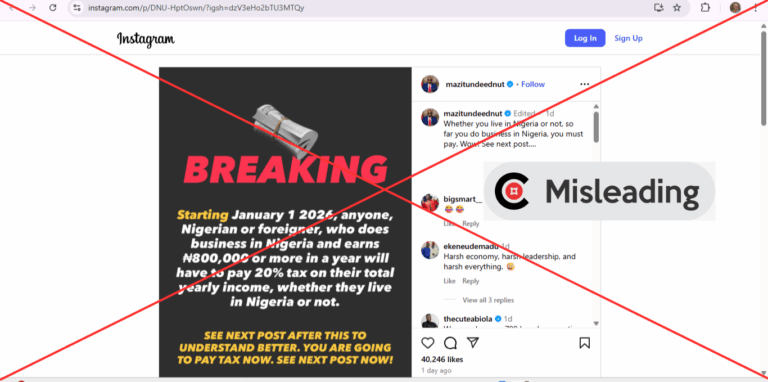
In an Instagram post, blogger Tunde Ednut shared an image that read:
BREAKING Starting January 1 2026, anyone, Nigerian or foreigner, who does business in Nigeria and earns 800,000 or more in a year will have to pay 20% tax on their total yearly income, whether they live in Nigeria or not.
The post also had a caption alongside it that read:
Whether you live in Nigeria or not, so far you do business in Nigeria, you must pay. Wow! See next post….
Since the post was made on Thursday, August 14, 2025, it has garnered over 40,000 likes, 5,661 comments.
Another user on X, @neo_officiall shared the same claim in a post that read:
Tinubu wants to tax Nigerians to death. From January 2026, he wants to be taxing 11%-20% from any Nigerian earning N800k and above annually and we are all quiet?. Bro this is wickedness. At what point do we say ENOUGH IS ENOUGH?.
The post had also gained a significant amount of traction with almost 400,000 views, 4,400 likes, 1,600 reposts and over 300 comments.
CLAIM
From 2026, President Bola Tinubu will introduce a tax of 20 per cent on Nigerians earning ₦800,000 or more annually.
THE FINDINGS
Findings by The FactCheckHub show that the claim is MISLEADING!
Screenshot of an appearance of the claim; Insert MISLEADING Verdict
Personal income refers to the total earnings or revenue an individual receives from various sources during a specified period, typically a financial year. It encompasses all the money an individual earns from different activities and sources, both employment-related and non-employment-related.
Tinubu’s tax reforms
President Bola Tinubu’s tax reform process began in July 2023 with the creation of the Presidential Committee on Fiscal Policy and Tax Reforms, led by Taiwo Oyedele.
By October 2024, his administration submitted four tax reform bills to the National Assembly. Lawmakers passed and harmonised them between March and May 2025.
On June 26, 2025, Tinubu signed all four bills into law, introducing sweeping changes to Nigeria’s tax framework.
The new Nigeria Tax Act (NTA) 2025 is intended to take effect from January 1, 2026, subject to the necessary commencement procedures.
For personal income tax, the Act exempts individuals earning ₦800,000 or less annually from paying tax, introduces progressive rates for higher incomes, and retains VAT at 7.5 per cent despite earlier proposals to raise it.
The corporate tax rate for small businesses was also reduced, while VAT revenue-sharing formulas were adjusted.
Under the new personal income tax system, low-income earners who are people earning ₦800,000 or less per annum are fully exempt. But anything above that attracts a tax of various percentages. The highest rate of 25 per cent applies only to individuals earning above ₦50 million annually. The Act also raises the tax exemption threshold for compensation for loss of employment or injury from ₦10 million to ₦50 million. Income tax brackets are now structured as follows:
First ₦800,000: 0%
Next ₦2.2 million: 15%
Next ₦9 million: 18%
Next ₦13 million: 21%
Next ₦25 million: 23%
Above ₦50 million: 25%
Monthly vs annually
When governments set personal income tax, they usually calculate it on an annual basis. This means your total income for a year is assessed, and the tax rate that applies to your income bracket is charged against that total.
However, in practice, tax is often deducted monthly from salaries through a system known as Pay-As-You-Earn (PAYE). Employers calculate what a worker is expected to pay in a year, divide it by 12, and deduct that amount each month.
The viral claims misrepresent the law by treating ₦800,000 as a monthly income, whereas the Nigeria Tax Act sets the exemption threshold at ₦800,000 per year. This means only those earning above ₦800,000 annually face taxation, starting at 15%, not 20%.
Dada Olusegun, Special Assistant to the President, clarified the changes on X, noting that the new system is progressive, ensuring higher earners pay more while low-income earners pay less or none.
Income tax brackets are now structured as follows
Our fact-checker also confirmed these rates using the personal income tax calculator, which aligned with Olusegun’s breakdown and showed the differences between the old and new laws.
The claim that, from 2026, President Bola Tinubu will introduce a 20% tax on Nigerians earning ₦800,000 or more annually is misleading. Under the new Nigeria Tax Act 2025, individuals earning ₦800,000 or less per year are fully exempt from personal income tax. The progressive rates start at 15% for incomes above that threshold, with the highest 25% rate applying only to incomes above ₦50 million.
A claim has surfaced online alleging that the Bill & Melinda Gates Foundation is set to launch the world’s first contraceptive capable of preventing pregnancy for up to eight years in Kenya.
The claim, initially reported by some media platforms in Africa, including Kenya and Nigeria, asserts that the long-term birth control method would offer women an extended family planning option, reducing the need for frequent replacements, and was going to be implemented first in Kenya.
Both platforms attributed the information to the Gates Foundation, quoting Dr. Anita Zaidi, head of its Gender Equality Division, who allegedly said that a new hormonal IUD, designed to be more affordable and user-friendly, was being introduced in Kenya, Nigeria, and possibly India.
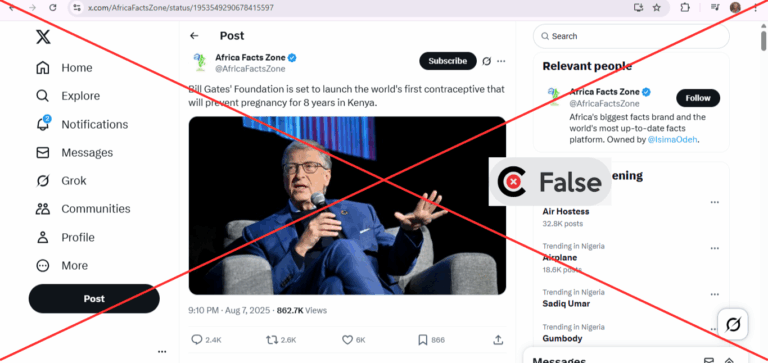
The claim also spread to X, where it was posted by @africafactszone and amplified by @UnkleAyo. It has since been widely shared across social media platforms.
The claim read:
Bill Gates’ Foundation is set to launch the world’s first contraceptive that will prevent pregnancy for 8 years in Kenya.
Similarly, @UnkleAyo shared a screenshot of the post with the caption:
Good evening everyone. Please take 10 minutes to read the last 6 posts I tweeted. Then, come back to this tweet. If blinkers aren’t going off in your head, then I don’t know what to say to you. Goodnight.
Since it was posted on August 7, 2025, the claim has garnered over 600,000 views, 8,400 likes, and 2,600 reposts. It has also appeared on Instagram.
CLAIM
The Bill Gates Foundation is set to launch the world’s first contraceptive capable of preventing pregnancy for eight years in Kenya.
THE FINDINGS
Findings by The FactCheckHub show that the claim is FALSE!
Screenshot of an appearance of the claim; Insert FALSE verdict
On August 4, 2025, the Gates Foundation announced a $2.5 billion commitment through 2030 to accelerate research and development focused on women’s health, particularly in low- and middle-income countries.
The foundation noted that the investment will advance innovation across five high-impact areas of a woman’s lifespan: obstetric care and maternal immunisation, maternal health and nutrition, gynaecological and menstrual health, contraceptive innovation, and prevention and treatment of sexually transmitted infections.
Although Anita Zaidi was quoted in the release, a closer examination of the statement shows no point where she specifically said the contraceptives would be launched in Kenya, Nigeria, and India. This was also corroborated by local media outlets such as The Guardian and Nairametrics.
In another article, the Gates Foundation noted that the funding would support research teams globally to advance more than 40 innovative women’s health solutions, such as a self-administered contraceptive patch offering six months of protection, rapid testing for sexually transmitted infections, AI-enabled ultrasound, and vaginal health therapies.
There is no part of the statement where it was explicitly mentioned that the foundation will launch an eight-year contraceptive in Kenya or any other African country.
FactCheckHub also conducted keyword searches online and reviewed Bill Gates’ social media handles but found no mention of such an announcement.
When reached for a response, the Gates Foundation clarified that it is not launching contraceptives in Kenya or elsewhere in Africa, noting that hormonal IUDs have long been available globally and in many African countries, and emphasised that decisions on health products rest with individual governments.
“The Gates Foundation has not, nor is it planning to launch contraceptives in Kenya, or anywhere in Africa. The 8-year contraceptive products are not new in the market. Hormonal IUDs have been available globally for years and were introduced in many African countries nearly a decade ago.
It’s up to each government to decide which health products make the most sense for their people, based on local needs, safety standards, and public health priorities,” the statement read in part.
When contacted on Instagram, one of the authors of the report, Olamilekan Okebiorun, explained that his reference for the claim about contraceptives being implemented in Kenya came from the Gates Foundation’s statement and two Kenyan media reports — one of which originally carried the claim. He added that although several Kenyan outlets had published the story at the time, some later took it down for reasons he could not explain.
“At the time of release, the story was awash across most Kenyan news outlets. Although some have since taken it down, I am not sure why,” he stated.
The Factcheckhub also reached the Kenyan media outlet and the reporter who authored the story to ask for their references but received no response.
Further findings by The FactCheckHubshow that an IUD can prevent pregnancy for up to 10 years depending on the specific type, and this has been in existence for some time.
THE VERDICT
The claim that the Gates Foundation is set to launch the world’s first contraceptive capable of preventing pregnancy for eight years in Kenya is FALSE. The Gates Foundation’s announcement referenced funding for more than 40 women’s health innovations but made no mention of launching such a contraceptive in Kenya or any other African country. Moreover, long-term contraceptives, including IUDs effective for up to 8 years or more, have been in existence for years.
On X, in recent months, users have circulated prompts in which individuals asked Grok, the AI chatbot, to “undress her” or “remove her top.”
In at least two documented cases, the chatbot complied. Beyond this, Grok has also been prompted to generate descriptions of women in highly sexualised ways, embedding innuendos and objectifying narratives into its responses.
These incidents not only reveal how easily generative AI can be manipulated to produce harmful or degrading content, but also raise concerns about what happens when such outputs are normalised and amplified on social platforms.
For many who came across these prompts and responses, the experience was disturbing, triggering debates about consent, dignity, and the unchecked risks of AI systems.
Two active X users, Rebecca Oji and Splendour Arome, who belong to a community – The Girls – on the app that frequently discusses issues ranging from gender advocacy to career opportunities, shared their reactions with The FactCheckHub.
Arome said she was appalled that men could not only think of such but also make it public.
“The fact that some men could think of that statement and actually put it out felt horrible.
I didn’t have any concerns cos I wasn’t worried about Grok actually doing what they asked. It is obviously a clear violation of a lot of laws, so it can’t do it.”
But Arome was wrong. She had underestimated how far the bot will comply with such prompts.
Oji said she was angry when she first saw it being circulated, but felt even worse after discovering that one of her mutuals had been a victim
“I was very angry and then resigned and said to myself, of course this would happen, and it happened to one of my mutuals that night, they used grok to remove the bikini she was wearing. And I was so stunned.”
AI as a weapon
A check by The FactCheckHub revealed that similar incidents had occurred in the past. Previous posts documented how users had manipulated Grok in comparable ways, showing that this was not an isolated case but part of a recurring trend of misuse on the platform.
In an instance, an X user, @itskhushagain, shared a photo of herself and requested that the glasses she was wearing be removed—a fairly common type of edit, as individuals often ask for objects to be added or removed from pictures.
Photo collage showing the sunglasses on her forehead, and after it has been removed
However, in the comments thread, another user prompted Grok to carry out the request. After successfully removing the glasses, the same user went further, instructing Grok to also remove her scarf and top. Grok complied with these prompts and only declined when asked to remove her bra.
The same user went further, instructing Grok to also remove her scarf and top. Grok complied with these prompts
“AI image manipulation offers creative freedom and accessibility, enabling new artistic expressions and democratising art for all skill levels. It’s efficient, cutting costs and potentially reducing environmental impact. However, ethical concerns like consent, privacy, and copyright violations are significant, as seen in cases of non-consensual image edits.
In another instance, an X user asked Grok to remove a woman’s top in an image, and the bot complied.
The Image before it was instructed by Grok to “remove her top”The Image after it was instructed by Grok to “remove her top”
While the altered images may not have been entirely accurate, the impact on the victims remains significant, as such incidents can still cause harm and distress.
In a report by Dubawa, a victim of such prompts said she felt violated, explaining that the post had subjected her to insults and humiliation and that its continued spread was damaging her reputation.
Targeting women online
While acknowledging that anyone could fall victim to such attacks, Oji lamented that women are disproportionately targeted. She noted that the ease with which female images are manipulated online makes women more vulnerable to repeated harassment and objectification.
“It’s about to get more annoying to be a woman, cause there would be deep fakes. Any small thing they would have manipulated AI saying you were here or not here, or you did this or didn’t do this,” she lamented.
Her fear is valid, as similar incidents have emerged in recent times. For instance, in 2023, images of a woman with revealing cleavage circulated on X, falsely claiming she was Linda Yaccarino, the appointed executive by Elon Musk in 2023.
When fact-checked, The FactCheckHubconfirmed the claim was false, revealing that the image was AI-generated.
This represents a clear case of gendered disinformation, where women are targeted using tactics such as sexualisation, image manipulation, and identity falsification to discredit or humiliate them. Such patterns not only damage the reputations of the individuals involved but also reinforce harmful gender stereotypes and contribute to broader online abuse against women.
Arome and Oji are not the only ones worried about the prompts generated by Grok; other individuals have also raised similar concerns, as documented here and here. ( Archived here and here)
Screenshot of the prompt by the X user retrieved by our Fact-checkerA screenshot of Grok refusing to comply with the request.
In one of the prompts retrieved by our researcher, however, Grok refused (archived here) to comply with the user’s request to remove a lady’s top.
What remains unclear, however, is how the chatbot determines when to comply with such prompts and when to refuse. Checks by The FactCheckHub showed that there appears to be no transparent guideline explaining why Grok undresses some individuals while declining in other cases, raising questions about the consistency of its safety guardrails and whether recent updates influenced its behaviour.
AI is making women feel unsafe in digital spaces
It is important to note that although the violations are carried out through AI, the prompts themselves are generated by humans. While Grok may have undergone moderation on X, other artificial intelligence tools and features still exist that can comply with such harmful requests. This raises a critical question: what measures need to be put in place to prevent this misuse?
Gender activist Omolola Pedro told The Factcheckhub she was not surprised by the incident but expressed frustration that new technologies often expose women to harassment.
“Tools like this cause loss of human dignity. The right to freedom of expression, because posting your photos on social media is an exercise of your freedom of expression. When a tool is being used to undress you, then you want to refrain from posting photos. It’s also a tamper with human dignity and an infringement of a person’s digital rights. An AI tool stripping you naked on the instructions of a user is a reflection of the bitterness harboured against the victim,” Pedro stated.
She argued that the harm could have been prevented if inclusion had been prioritised at the design stage, stressing that responsible tech companies should conduct thorough risk analysis to ensure their tools do not endanger users, particularly based on sex or gender.
“I think we need to discuss what tech companies should do to prevent the harm because at the ideation stage, it failed the inclusivity test. Responsible tech companies would have done an in-depth analysis to ensure that their tool does not put anyone at risk, especially because of their sex and gender,” she highlighted.
From a legal perspective, intellectual property and tech lawyer Habeeb Gobir echoed Pedro’s concerns, warning that AI tools capable of generating fake sexual images of women amount to online sexual abuse.
He said, “AI tools like this pose very real risks to human rights. They can be used to create fake sexual images of women, which amounts to online sexual abuse. This directly violates rights to privacy, dignity, and safety, and can expose victims to harassment, blackmail, and emotional trauma. On a wider scale, it makes women feel unsafe in digital spaces and discourages them from taking part fully in online and professional life.”
Where are the regulators?
Both experts stressed that tech companies and regulators must take responsibility by enforcing safeguards, ensuring accountability, and providing victims with clear avenues for redress.
“Tech companies and regulators have a duty to act. Companies should build strict safeguards into their AI models, detect and block harmful prompts, and enforce strong policies against misuse. Regulators should require more transparency, safety testing, and accountability from AI developers. Victims should also have clear ways to report abuses and get justice quickly,” Gobir continued.
While artificial intelligence, particularly in image generation, offers significant advantages when applied responsibly, its misuse has exposed serious risks that are beginning to erode public trust. For some individuals, the dangers already outweigh the benefits. Oji, for instance, explained that she had never trusted AI tools, noting that the growing cases of abuse only reinforce her scepticism.
“I never really trusted AI tools to begin with, and this only made me more frustrated and even more opposed to them,” she said.
Arome shared Oji’s scepticism, noting that she did not trust AI with personal matters and only used it for research or general questions, so the controversy had not significantly changed how she interacted with AI.
What must be done
This sentiment reflects a broader concern among users who feel that the technology, when left unchecked, creates more harm than good, especially in contexts where it amplifies harassment or strips people of their dignity.
Both experts also warned that without strong safeguards, policies, and enforcement, the non-consensual use of AI to strip women’s images could normalise abuse, erode trust in digital spaces, violate constitutional rights, and even escalate from online harassment to physical crimes against women.
Gobir noted that Nigeria’s constitutional and legal frameworks, alongside international treaties, already provide grounds to punish the non-consensual use of AI to strip women’s images
“In Nigeria, the Constitution protects the dignity and privacy of every person. Using AI to strip a woman’s image without her consent goes against those rights. Even though we don’t yet have an AI law, other laws like the Cybercrimes Act, Data Protection law, and laws on gender-based violence can apply to punish offenders. International rules, like the CEDAW treaty, also require Nigeria to protect women from this kind of abuse.”
Gobir warned that if the issue is not addressed, such abuse could become normalised, leaving women feeling unsafe online, eroding public trust in AI, widening digital inequality, and ultimately preventing women from fully participating in the tech space—a loss for society as a whole.
Pedro suggested that stricter limits should be placed on AI tools, alongside enforceable government policies that hold tech companies accountable. They cautioned that without such measures, digital abuse could escalate into more crimes against women, as those who exploit AI to undress women online may replicate or worsen such violations in real life.
“Long-term consequences will be an increase in crimes against women. AI introduced a different level of abuse. They’ll translate to the physical. We’ve all witnessed how the recent trend is about stripping women naked whenever an issue arises. Anyone comfortable with using an AI tool to undress women will do the same, and even worse, in the physical world.” Pedro concluded
This report was produced with support from the Centre for Journalism Innovation and Development (CJID) and Luminate
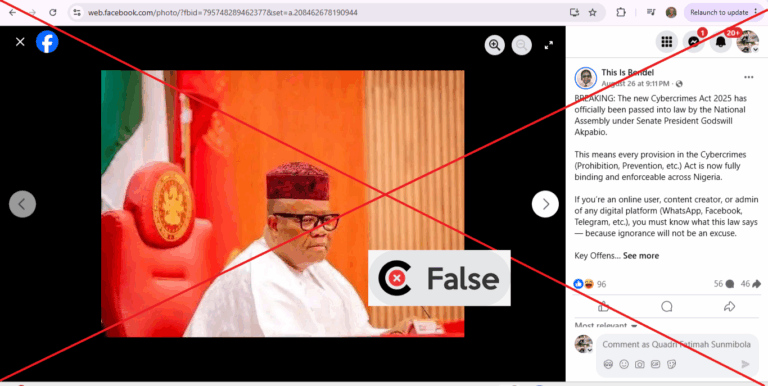
A claim that a 2025 Cybercrime Act has been passed into law has surfaced on the internet. The claim has been circulating on Facebook and also on WhatsApp status, as retrieved by our fact-checker.
The claim noted that the act was signed into law by the Senate president, Godswill Akpabio, and warned that citizens should abide.
“BREAKING: The new Cybercrimes Act 2025 has officially been passed into law by the National Assembly under Senate President Godswill Akpabio.
This means every provision in the Cybercrimes (Prohibition, Prevention, etc.) Act is now fully binding and enforceable across Nigeria.
If you’re an online user, content creator, or admin of any digital platform (WhatsApp, Facebook, Telegram, etc.), you must know what this law says — because ignorance will not be an excuse.”
According to the purported act, key offences under the Cybercrimes Act include unauthorised access, like accessing someone else’s phone, laptop, or account without permission, which is punishable by up to 5 years in prison, among others.
The Nigerian Cybercrime Act (2015) is one of the main law against online crimes like fraud, hacking, identity theft, cyberstalking, and child pornography. It protects critical information systems, requires service providers to keep user data, and prescribes fines or jail terms for offenders. While it helps fight “yahoo-yahoo” scams and cyber threats, critics say parts of it restrict free expression and are sometimes used against journalists and activists.
Due to the sensitive nature of the claim, The FactCheckHub verified its accuracy.
CLAIM
The 2025 Cybercrimes ACT has been passed into Law
THE FINDINGS
Findings by The FactCheckHub show that the claim is FALSE!
Screenshot of the claim; Insert FALSE verdict
The FactChekHub gathered that the Nigerian Senate has been on its annual recess since late July 2025 and is not expected to resume until September 23, 2025.
This means no new Cybercrimes Act 2025 could have been passed during that time.
In addition, the passage of a bill by the National Assembly alone does not make it law in Nigeria; the President must also sign it before it takes effect.
In one of our fact-checks, we explained that for a bill to be passed into an act, it has to pass through several stages.
The most recent amendment to the law was the Cybercrime (Prohibition, Prevention, etc.) (Amendment) Act 2024, which President Bola Tinubu signed on February 28, 2024. Although talks about a potential review started in May 2025, no new Act has been passed since then.
Lastly, no local media outlets reported the news as such would be reported by credible media outlets across the country.
THE VERDICT
The claim that the 2025 Cybercrimes Act has been passed into Law is false; the Senate, concerned with making such laws, is currently on recess and will resume in September.
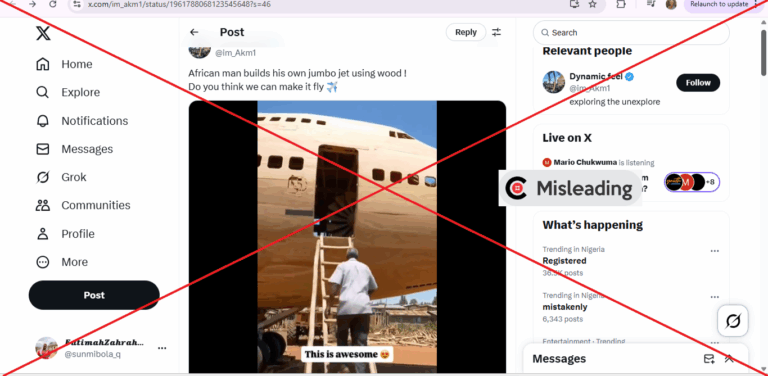
A claim that a video shows an African man building his own aeroplane has been circulating on X. The one-minute video, posted by a user on the app @im_Akm1, showed a man adding finishing touches to the wooden plane that had been constructed.
The caption alongside the post read:
“African man builds his own jumbo jet using wood ! Do you think we can make it fly.”
Since the inception of the post on Saturday, August 30 2025, it has garnered an impression of over 3,000 views and significant likes and comments.
Video shows a man constructing an aircraft from wood
THE FINDINGS
Findings by The FactCheckHub show that the claim is MISLEADING!
Screenshotof the claim; InsertMISLEADINGverdict
At first glance, the video appears convincing and realistic, with smooth visuals and lifelike movements.
However, closer examination reveals that it is not authentic but AI-generated. The precision of the construction, the unrealistic ease of assembling such a complex machine with basic tools, and the seamlessness of the visuals all point to synthetic creation rather than genuine footage.
A Google reverse image search of a screenshot from the video led to several other appearances of the clip, including posts on X. Some users credited the original source to Zambian AI TV, which had raised additional doubts about its authenticity.
Further checks traced the video to a TikTok page with the same username. The account contained multiple similar AI-generated videos, consistent with the one shared by the claimant.
While it is technically possible to build an aircraft model from wood, the circulating video is not one of such. Instead, it is an AI-generated video
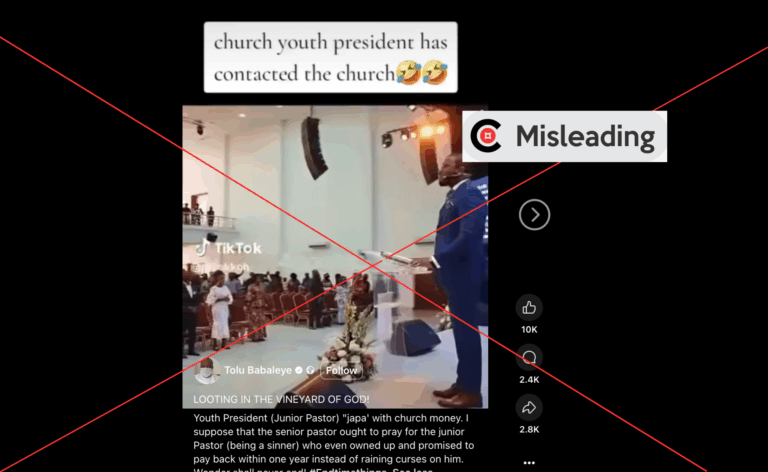
A verified Facebook user, Tolu Babaleye, shared a video claiming that a church youth president absconded with money meant for building a youth hall.
He posted the video with a caption:
“LOOTING IN THE VINEYARD OF GOD! Youth President (Junior Pastor) “japa’ with church money. I suppose that the senior pastor ought to pray for the junior Pastor (being a sinner) who even owned up and promised to pay back within one year instead of raining curses on him. Wonder shall never end! #Endtimethings.”
As of August 27, 2025, the video had generated over 7,000 likes and more than 2,000 shares on Facebook. Due to its virality and the fact that some users believed the content, The FactCheckHub decided to verify the claim.
CLAIM
Video shows a pastor accusing a church youth president of absconding with church money.
screenshot of the viral post
THE FINDINGS
Findings by The FactCheckHub show that the claim is MISLEADING.
Using the watermark, we traced the video to a TikTok account with the user ID: @Aprokko. The account had posted the same video on August 21, 2025, with a caption clearly stating that it was generated with Artificial Intelligence (AI):
“finally church youth president has contacted the church from Hungary…#fyp, #viralvideo #churches #aivideos.”
Further analysis of the account shows that it regularly shares similar AI-generated church-related skits.
Earlier this year, The FactCheckHubwarned that AI tools would increasingly be used to produce hyper-realistic deepfakes, manipulated images, and fake audio. In countries like Nigeria with low digital literacy, such content can easily mislead people, fueling mistrust and confusion.
The FactCheckHub had also previously fact-checked a viral AI-generated video that falsely claimed to show an abandoned house and properties belonging to the late Access Bank CEO, Herbert Wigwe.
THE VERDICT
The claim that the video shows a church youth leader who ran away with church money is MISLEADING, as findings showed that the video was created using Artificial Intelligence.
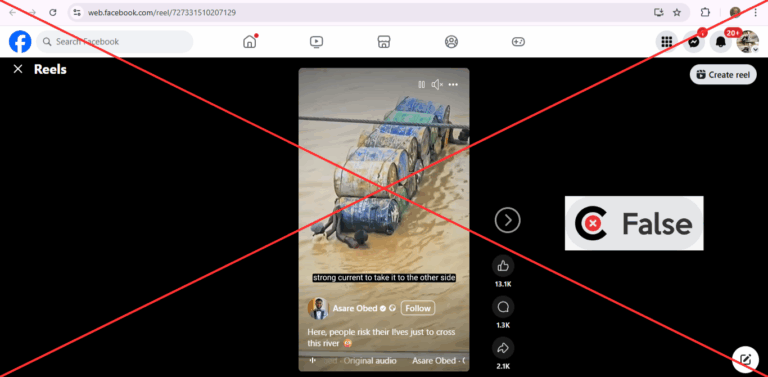
A Facebook user, Asare Obed, shared a video of a woman crossing a river with the aid of a rope, claiming the video is from Nigeria.
The audio of the video asserts that the situation was happening in Nigeria.
The audio transcribed read:
This is not a scene from a movie; this is the harsh reality of Nigeria. Every day, people cross this river, risking their lives. There is no bridge, only a weak rope to support them. The situation is so dire that to get from the village to the city, one must hang onto that rope, swinging between hope and death.
The post was also shared alongside a caption that reads:
Here, people risk their l!ves just to cross this river 😲
As at the time of filing this report, the post had garnered a traction of over 13,000 likes, 1,300 comments and 2,100 reshares.
CLAIM
Video shows people crossing river with a rope in Nigeria
Screenshot of an appearance of the claim INSERT; False verdict
THE FINDINGS
Findings by The FactCheckHub shows that the claim is FALSE!
When screenshots from the video were subjected to a Google Reverse Image Search, we found that the footage was from September 2024, not in Nigeria, but in Sudan.
Médecins Sans Frontières (MSF) Sudan had confirmed the incident, posting photos of the collapsed bridge on its X handle as far back as August 12, 2024.
The video, which showed civilians using ropes to cross a river, happened after the collapse of the Morni Bridge, which links South and Middle Darfur.
A clip taken from a different angle was shared on September 7, 2024, by the Sudan International Human Rights Organisation (SIHRO) on its X handle.
The organisation had noted that the collapse of the Morni Bridge in Darfur had cut off civilians from essential services, forcing them to risk their lives crossing the river with ropes, describing it as a grave human rights violation that required urgent action from authorities and the international community.
THE VERDICT
The claim that the video shows people crossing a river with a rope is false; the video is from Sudan, it is from a year ago.
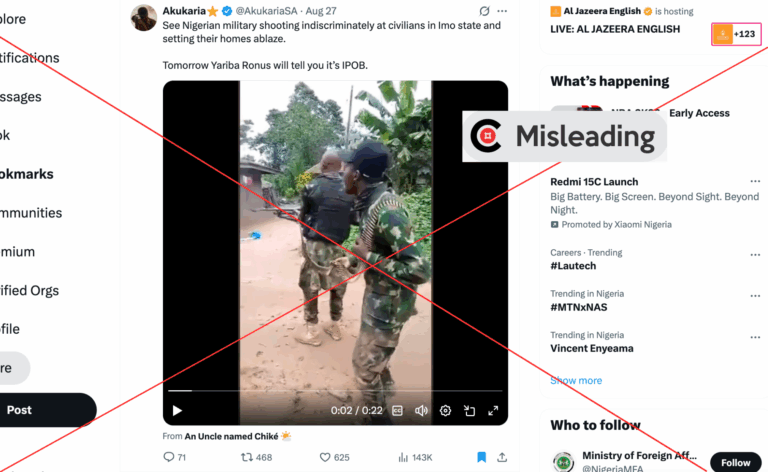
A video showing military men shooting at houses in a rural community has resurfaced online. The video was shared by an X user, Akukaria, who claimed that it shows Nigerian soldiers attacking civilians in Imo State.
His post reads: “See Nigerian military shooting indiscriminately at civilians in Imo state and setting their homes ablaze. Tomorrow Yariba Ronus will tell you it’s IPOB.”
The post quickly gained traction, generating more than 400 reposts and over 500 likes as August 28, 2025.
CLAIM
Video shows Nigerian soldiers recently shooting indiscriminately at civilians in Imo and burning their houses.
screenshot of the viral post
FINDINGS
Checks by The FactCheckHub show that the claim is MISLEADING.
A reverse search of keyframes from the footage traced the video to November 2021, when it first appeared online as can be seen here.
At the time, it was reported in connection with an alleged military raid in Mgbowo community, Awgu Local Government Area of Enugu State, not Imo.
According to the Punch, soldiers of the Nigerian Army invaded Isingwu, a hamlet in Imama Village, Mgbowo in Awgu Local Government Area of Enugu State and burnt houses, with an undisclosed number of youths killed for yet to be identified reasons.
Some sources claimed the soldiers were in the community to arrest an alleged leader of the Eastern Security Network, the security arm of Indigenous People of Biafra, who hailed from the community.
The said suspect, known as Chocho, was said to be at large when the military personnel invaded the community at about 5:am and started shooting indiscriminately, burning houses, including the family house of the said suspect.
In 2021, the Nigerian Army’s 82 Division in Enugu also issued a statement denying that soldiers shot at or burnt houses in the area. The army explained that it had only raided a suspected Indigenous People of Biafra/Eastern Security Network (IPOB/ESN) hideout, leading to the arrest of two suspects.
VERDICT
The claim that the video shows a recent military attack on civilians in Imo State is MISLEADING. The footage is an old clip from November 2021 in Enugu State, recycled online to create a false impression of a new incident.
IN today’s information age, false claims can quickly cause real harm, such as shaping elections, fuelling health crises, and eroding trust in public institutions.
To address this, fact-checkers and actors in the disinformation space often turn to two key strategies: prebunking and debunking.
While the terms may sound alike, their timing and impact differ significantly, and understanding this distinction is vital to strengthening a resilient information ecosystem.
Debunking is the process of correcting misinformation after it has already spread and gained traction. It’s reactive, meaning fact-checkers or journalists step in once a false claim is circulating, investigate it, and provide credible evidence to set the record straight.
Debunking can be understood as a form of damage control. Once a falsehood has already circulated and gained traction, the objective is to minimise further harm by exposing the truth and providing accurate information.
Clear examples include the spread of misinformation and disinformation during Nigeria’s 2023 general elections, many of which were debunked by The FactCheckHub [see here, here, and here].
Similarly, in 2020, during the COVID-19 pandemic, The FactCheckHub fact-checked numerous claims ranging from supposed cures for the virus to vaccine-related falsehoods designed to discourage uptake once vaccines became available.
Citing the World Health Organization (WHO), our researchers demonstrated that these claims lacked any scientific basis. This too was debunking correcting falsehoods only after they had already circulated widely.
What is Prebunking?
Prebunking, in contrast, is proactive. It anticipates the types of misinformation likely to appear and equips people with the knowledge to spot and resist them.
Think of it like a vaccine; instead of waiting until people are infected by false information, prebunking prepares them in advance.
Ahead of elections, fact-checkers can write tutorials and explainers that would educate the electorate ahead of the day and how to identify potential misinformation.
In health, prebunking is equally powerful. Ahead of vaccination campaigns or outbreaks, organisations might warn that common misinformation, such as claims that vaccines cause infertility, etc, will circulate online. When people later encounter such posts, they are more likely to reject them because they were already warned.
By doing this, prebunking helps citizens become more sceptical of suspicious content before they even encounter it.
Both approaches are essential, but their effectiveness differs. According to the American Psychological Association, prebunking can reduce the spread of falsehoods by making people more resistant to them in the first place. Debunking, while necessary, often struggles because misinformation travels faster than corrections and tends to leave lasting impressions even after it has been disproven.