Please note that the FactCheckHub has not obtained any right from the authors or copyright owners of all third-party contents from embedded links and shall incur no liability in this regard.
Please note that the FactCheckHub has not obtained any right from the authors or copyright owners of all third-party contents from embedded links and shall incur no liability in this regard.
Please note that the FactCheckHub has not obtained any right from the authors or copyright owners of all third-party contents from embedded links and shall incur no liability in this regard.
Please note that the FactCheckHub has not obtained any right from the authors or copyright owners of all third-party contents from embedded links and shall incur no liability in this regard.
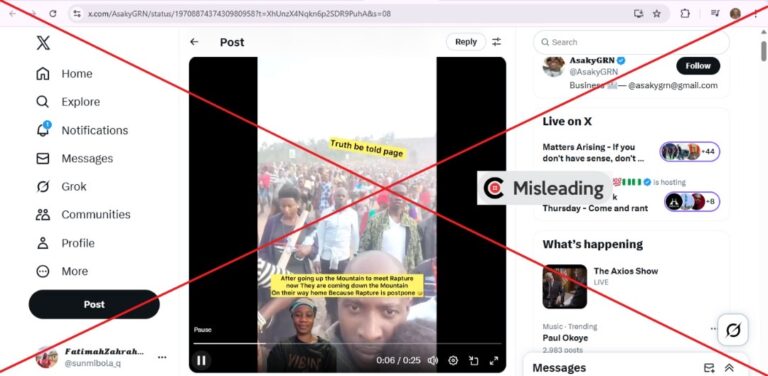
A claim that a group of people went to a mountain expecting the rapture, but later returned home disappointed, has been circulating online.
The claim, first shared by an Instagram user, @truthbe423, in a series of posts, has since been amplified across various social media platforms.
In a series of posts, as seen here, here, and here, she shared a podcast featuring a South African preacher who allegedly claimed that the rapture would occur on September 23. The poster had then followed with different video posts of people praying and ululating in the woods, after which she followed with a video of the worshippers going to the mountain and coming back.
In one of the posts amplified by a user on X @AsakyGRN, on Wednesday, September 24, 2025, the caption read :
The people who climbed the mountain expecting rapture, here’s the video of them returning home when nothing happened.
The posts can also be seen here, here, and here on TikTok and X.
Since the inception of the posts, it has garnered significant traction on the various platforms posted.
According to Brittanica, the belief in rapture emerged from the anticipation that Jesus would return to redeem all members of the church.
CLAIM
A video circulating online claims to show worshippers climbing a mountain to await the rapture.
THE FINDINGS
Findings by The FactCheckHub indicate the claim is MISLEADING!
Screenshot of the claim extracted from TikTok; Insert Misleading verdict
The first video shared by the poster was from a clip cut out on YouTube, uploaded on September 9, 2025, where a South African preacher identified as Joshua Mhlakela prophesied that there would be a rapture on September 23.
A part of the video, which showed worshippers in the woods, was subjected to a Google Lens search, and the result showed that the video had earlier been posted on Tiktok in August.
Various worshippers who had attended the service on the same day had posted videos from a miracle scene that had happened the same day, as seen here and here.
The FactCheckHub had gathered that from the posts, the place the worshippers were at was a prayer mountain in Uganda, popularly known as the Calvary Prayer Mountain.
The Calvary Prayer Mountain is a pilgrimage site of a Catholic church, which is located in Mirama village in Uganda. The site is also known as the Mirama Hills.
Further findings showed that there are various similar videos of people climbing the hill to the holy site, coming back, anytime worshippers visit the site on TikTok
THE VERDICT
The claim that a video circulating online claims to show worshippers climbing a mountain to await the rapture is misleading; the videos have been on the internet prior to September 23, which are sights and sounds from a pilgrimage site in Uganda and not in any way connected to the rapture the South African preacher was talking about.
Ousmane Dembélé is a French professional footballer who plays as a forward for Ligue 1 club Paris Saint-Germain and the France national team. Dembélé is one of ten players to have won the FIFA World Cup, UEFA Champions League, and the Ballon d’Or in his career.
CLAIM
Ousmane Dembele is the first black player to win the Ballon d’Or
THE FINDINGS
Findings by The FactCheckHub indicate that the claim is FALSE!
The Ballon d’Or (French for “Golden Ball”) is one of football’s most prestigious individual awards, presented annually by the French magazine France Football.
It honours the player judged to have delivered the best performance over the preceding season, taking into account individual brilliance, team success, and influence on matches. Over the decades, it has evolved originally Europe-only award and later expanded to all players worldwide.
Since 2016, the winner has been decided by a panel of international journalists.
The 2025 Ballon d’Or ceremony took place on 22 September 2025 at the Théâtre du Châtelet in Paris, recognising performances in the 2024–25 season.
In the men’s category, Ousmane Dembélé of Paris Saint-Germain won the award for the first time, finishing ahead of Barcelona’s Lamine Yamal (runner-up) and Vitinha (third) in the voting.
Screenshot of the claim; Insert FALSE verdict
However, he is not the first black person to have won the award. Findings by TheFactCheckHub showed that in 1965, Eusébio da Silva Ferreira, the Portuguese forward of Mozambican heritage, won the Ballon d’Or.
Also in 1995, George Weah of Liberia won the Ballon d’Or, making history as the first African player to claim the prestigious prize before Dembele’s clinch in 2025.
The claim that Dembele is the first black player to win the Ballon d’Or is false; Eusebio of Mozambican heritage and George Weah had clinched the prestigious prize before him.
When Temitope Afolabi realised her husband could get imprisoned due to debt he incurred from a bad business deal, she resolved to become a surrogate to earn money to save him. She had initially considered selling one of her kidneys, but unable to find a source, she settled for being a surrogate.
Surrogacy is a form of assisted reproduction in which a woman (the surrogate) carries a pregnancy on behalf of a third party—the intended parent. Usually, the surrogate is paid for her service in a commercial arrangement.
The global surrogacy industry is valued at $27.9 billion, and the United Nations regards the practice as a form of violence against women and girls. Meanwhile, in Nigeria, surrogacy is becoming increasingly common. Celebrities like Nancy Umeh, Ini Edo, and Chimamanda Adichie have used surrogate services. Lifestyle influencer Ife Agoro also plans to use one regardless of health challenges.
But what is the experience of surrogates in Africa’s most populous country, and how did it become so common? I followed Temitope’s journey from pregnancy to postpartum through a Facebook Messenger conversation, where she unveiled her experience with me. I would eventually meet with her for more details.
Temitope became a surrogate in May 2024. She was paid about N2,233,000, including transportation, accommodation allowance, childbirth fee, and wardrobe allowance.
An infographic representing a breakdown of Temitope’s payment plan.
However, her compensation did not reflect Nigeria’s economic realities. Her N3,000 transportation allowance was insufficient to cover her logistics. She lives at Sango Ota, along Oju ore in Ogun State, and was to travel 41.9 kilometres to her healthcare centre in Ikorodu.
Although her transport fare was later increased to N5,000 after several complaints, the catch was that she would visit a clinic in Ikeja, Lagos State. Amidst tears, Temitope swore she always added an extra N1,000 from her funds to cover the lapse in logistics costs while enduring the stress of commuting farther. She also barely had enough money to eat after she paid her rent and her children’s school fees.
Her teary voice, while sharing her experience, soon switched to anger when she recounted that her agent collected N450,000 for logistics from intending parents, alleging they went to the hospital via Uber.
“Nigerians are users,” she said, her voice hoarse. “They just use people because of what they are going through. They did not even look at the stress of carrying pregnancies, vomiting, and everything. They are just using us as slaves because they believe that if you don’t do it, another person will.”
Although Temitope was informed of the compensation plan from the outset, she wasn’t aware of the terms and conditions until much later. Her contract, dated August 26, 2024, was given to her to sign when she was already three months pregnant. It includes a death clause stating she understands that she could die. A BBC report highlights that Nigeria is the worst country to give birth in, with one death happening every seven minutes. Also, Temitope’s contract mandates that only the intended parent and the doctor can decide how to proceed if the pregnancy is harming her health. She is also forbidden to speak to the media.
Temitope’s surrogacy contract Sensitive information has been blurred for the confidentiality of the parties involved
During her journey as a surrogate, Temitope was prohibited from leaving her home and eating specific food items for two weeks: noodles, orange, pineapple, mineral drinks, and anything that burns were forbidden. She was also mandated to visit the agency regularly, even when she didn’t feel like it, or her child was sick.
After she delivered the baby on Feb 24, 2025, Temitope suffered several medical conditions. She began menstruating thrice a month, had a fibroid and ovarian cysts, and often suffered from lightheadedness. When she complained, she was told by her agent that post-partum healthcare ends at six weeks.
“I feel used, stupid, and depressed,” she said, expressing regret at being a surrogate. “At the end of the day, my husband still went to prison on Dec. 18, 2024.”
Like Temitope, another surrogate I spoke to reported medical challenges after childbirth. The student of the University of Benin, who wants to be kept anonymous, gave birth to twins as a surrogate. She shared that her healing process after birth was difficult, and she spent half of the money she was paid just to get better.
A doctor, Sunday Olarenwaju, the managing director of Mother and Child Hospital, said that twin pregnancies are dangerous, carries, the higher the risk of being exposed to diseases, including hypertension, haemorrhage, and even death.
Dr Sunday Olarenwaju, Managing Director, Mother and Child Hospital at Omole, Lagos.
Researchers also document that when a woman gestates an embryo unrelated to her genes, she is more likely to develop placental issues and preeclampsia, among other ailments.
“Nigerians do not understand,” Temitope said, explaining she once tried to raise concerns about the experience of surrogates on social media. “They say we agreed to it. If not for financial problems, who would agree to such a thing? There is no one to fight for us,” her voice flattened in resignation.
Facebook group fuels surrogacy in Nigeria
While the surrogates I conversed with are of different age groups, one thing they have in common is that they belong to the Facebook Surrogate group: Egg donor and surrogate mother in Nigeria. The community, created on January 5, 2023, has over 4,800 members within two years.
An image showing the number of members in the group as of May 5, 2025.
Countless surrogacy adverts flood the group daily. Some adverts encourage people to contact them via DM (Facebook Messenger) and WhatsApp.
A collage of surrogate adverts in the group
Meta is the parent company of Facebook, Instagram, WhatsApp, and Messenger. The multinational technology company has an estimated monthly active user base of 3.98 billion on its apps and has a community standard guiding its platforms.
Its website states that it has “a responsibility to promote the best of what people can do together by keeping people safe and preventing harm.” Its Community Standards, which guide Facebook advertisements, also prohibit content that facilitates human exploitation, such as sales of children and labour exploitation.
I contacted Meta through their dedicated email for the press. I inquired whether they consider surrogacy a form of human exploitation and, if so, why surrogacy groups such as Egg donors and surrogate mothers in Nigeria, which facilitate surrogacy for women like Temitope, exist. The tech giant deleted the group, with the response,
“Ads and Groups that exploit people through the sale or illegal adoption of children violate our policies, and we remove this content when it’s found – as we have done in this case.”
An image of the deleted Egg donor and surrogate mother in Nigeria by Meta after this investigation
However, Olivia Maurel, the spokesperson for the Casablanca Declaration, an international non-governmental organisation working on a universal ban on surrogacy, advised that, beyond deleting such groups, Facebook should implement a policy that monitors and bans all forms of surrogacy advertisements in vulnerable regions like Nigeria.
Misinformation abounds
Beyond its rules against human exploitation, Meta is explicit in its intolerance for misinformation. Yet, conversations with surrogate agents on WhatsApp are often half-truths, outright lies, or concealment in their pursuit to recruit women.
One such experience is an interaction I had with a surrogate agent, Omobolanle Oguntolu, on WhatsApp. I found her advertisement for Surrogacy on Facebook in the Surrogate Mothers Nigeria group, which has over 5,600 members. She added her phone number to the post so interested surrogates could contact her through her agency, Regal Surrogate Services.
I brought the group Surrogate Mothers Nigeria to Meta’s attention, and they deleted it. However, when I contacted Omobolanle on WhatsApp about being a surrogate, she claimed she had helped more than 35 women become surrogates.
She told me I would be paid about N2,243,000 and sent me a breakdown.
An infographic representation of the breakdown of the N2,243,000 payment plan
I tried negotiating a higher figure with her and other agents, but soon discovered it was a take-it-or-leave-it deal. One surrogate agent, who identified herself simply as Sophia, had a disclaimer to the financial offer she gave me. “Kindly read through the rules and regulations of the payment plan; there must be no complaints once you have signed the contract.”
I returned to Omobolanle. I told her that it was my first time being a surrogate and that she should tell me everything I needed to know. She responded that aside from the payment, there wasn’t much, but she offered to answer any more questions I had.
“Since this is your first time, you should know what you are getting yourself into,” she said.
But when I asked her which hospital I would use as a surrogate, she told me it was confidential and she wouldn’t give me the details until I was on my way there. Puzzled, I asked her how I could research the hospital with which my fate lies; she said I couldn’t. I asked what would happen if I experienced complications during the pregnancy or if I died. Surprisingly, she gave me a “100 per cent guarantee for safety.”
Jumoke Falade, a nurse practitioner at Lagos State University Teaching Hospital, was shocked that surrogacy could be tagged “safe,” saying that it came with risks associated with pregnancy, including death.
Omobolanle also claimed that as a surrogate, I would birth the baby through a cesarean section (CS) because it was “better and safer” than a natural birth. However, Olarenwaju, who is also a gynaecologist at Mother and Child Hospital, revealed that natural birth, not CS, is better for a surrogate because it comes with a faster post-delivery recovery process and does not leave a scar.
The medical professional further clarified that surrogacy does not deal only with the usage of the woman’s womb.
“The woman’s lungs are being used to help the baby breathe. The blood is used for circulation, and the nutrients from the woman’s body nourish the baby,” he said. “The womb is only the house of the baby.”
Beyond the health misinformation, Omobolanle affirms that commercial surrogacy is legal in Nigeria, and that is why it is a norm in the country.
But, legal practitioner Marvellous Igbineweka argues that the National Health Act of 2014 provides a framework that makes commercial surrogacy illegal. The Act prohibits the donation of human organs, cells, or tissue for monetary purposes, gains, or profit. The learned fellow further cited that the Child Rights Act of 2003, Section 13 of the Trafficking in Persons (Prohibition) Enforcement and Administration Act, and Order 23 of the Code of Medical Ethics in Nigeria can be used to argue the illegality of the practice.
Another lawyer, Dogo Joy Njeb, emphasised that it is only an argument. She states that “anything the law has not explicitly criminalised is legal.” She added that Nigeria allows citizens to engage in contractual agreements, under which many surrogate arrangements occur.
So, when I asked Omobolanle why I couldn’t find online information about her agency, Regal Surrogate Services, to confirm her legitimacy, she responded that it is just something “she calls herself.”
Nigeria Government Complicity
Omobolanle’s surrogate agency is unregistered. Nigeria is silent on the practice of surrogacy, so the legality of commercial surrogacy is debatable. Members of the National Assembly, responsible for making legislation in the country, have attempted to pass a law but were unsuccessful. The Bill for Establishing a Nigerian Assisted Reproduction Authority (2012) and the Assisted Reproductive Technology (Regulatory) Bill 2016 were not passed due to lawmakers’ lack of majority support.
I contacted Christiana Eguma, the Head of the Gender Technical Unit (GTU) in the National Assembly, regarding Nigeria’s lack of a surrogacy bill. Christiana is also the Programme Coordinator of Women’s Rights Advancement & Protection Alternatives (WRAPA). She stated that the GTU would intervene by developing a policy brief to highlight the gender, ethical, and health implications of unregulated surrogacy practices.
However, Olamijuwonlo Alao-Akala, a House of Representatives member representing Ogbomoso North, South and Oriire constituencies, is sponsoring a National Surrogacy Regulatory Commission Bill (2024) to remedy the lack of legislation in the country. The bill passed the second reading in the House of Representatives in October 2024. It is expected to monitor and mandate the registration of surrogate agencies, making surrogacy legal. It will also prohibit monetary compensation in surrogacy arrangements (commercial surrogacy). This means that surrogates would not be paid for their service. Hence, carrying a baby without payment (altruistic surrogacy) would be the norm.
Regarding the bill’s relevance, Olamijuwonlo argued, “It is to regulate and evaluate surrogacy in Nigeria, thereby ensuring medical and health laws are not flouted.”
Similarly, Uchenna Okonkwo, representing the Idemili North/Idemili South Federal Constituency of Anambra State, is sponsoring a surrogacy bill titled “A Bill for an Act to Protect the Health and Well-being of Women, Particularly in Relation to Surrogacy and for Related Matters.” The bill will also criminalise commercial surrogacy but legitimise altruistic surrogacy.
However, Olivia, who is also a woman born through surrogacy, during an email correspondence with me, decries the problem with such bills.
“We should not differentiate between commercial and altruistic surrogacy, ever, because there is no real difference between the two. Both rely on the same mechanism: using a woman’s body to fulfil the desires of others, often at the cost of her own health, autonomy, and dignity.”
The United Nations also recommends that countries must eradicate surrogacy in all its forms, criminalise surrogacy agencies and those facilitating it. It states that lawmakers must nullify surrogacy contracts, provide exit support strategies for surrogate mothers and regard them as the legal mothers of the babies they carry.
I contacted Olamijuwonlo via X (formerly Twitter), WhatsApp and email regarding the bill he is sponsoring and the international standard, but he is yet to comment. I then spoke to Uchenna Okonkwo about discussing his surrogacy bill. The lawmaker asked to call back in two hours but never responded to subsequent calls, texts, or emails.
Meanwhile, Olivia warns, “If Nigeria doesn’t act now, it risks becoming a hub for a global market that treats women’s bodies as tools and children as products.”
Back to Square 1
As Temitope continues to battle health challenges as a result of being a surrogate, the N1.3m she was paid for birthing the child was exhausted in three months.
She spent the larger portion of the money to feed, pay her four children’s school fees, send money to her husband in prison, and settle the debts she owed.
Temitope displaying her ponmo for sale
With all the money gone, Temitope now sells dried ponmo (local cow skin), hoping she can make enough to survive and care for her children.
IMAGES of giant statues allegedly depicting Hyacinth Alia, governor of Benue State, have surfaced on the internet.
The images, posted on X by a user, @SadiqMaunde, show two large statues placed at busy roundabouts, claiming that the monuments are currently being erected in Benue state.
In one of the viral pictures, the statue is dressed in the Tiv traditional black-and-white attire, while another shows the figure in a green suit with a bishop collar.
The images were accompanied by a caption that read:
The executive governor of Benue state. APC governors just dey compete for clown pass.
Since the post was published on Friday, September 12, 2025, it has garnered over 350,000 views, 2,000 likes, and 702 reposts.
CLAIM
Images show statues of Hyacinth Alia in Benue Roundabouts
THE FINDINGS
Findings by The FactCheckHub show that the claim is FALSE!
Screenshot of the claim; Insert FALSE verdict
A closer examination of the pictures revealed several features typical of AI-generated images. In the photos, for instance, the workers standing on the scaffolding appear without distinct heads or facial features.
Further scrutiny shows an electrical pole merging unnaturally with the statue and scaffolding, while the texts on nearby billboards are incomprehensible — all common indicators of AI-generated content.
A Google Lens search of the images also returned other similar, AI-generated visuals of the same nature.
A photo purportedly showing a young version of President Bola Tinubu in 1966 has surfaced online.
An X user, @imakun122, posted the image among a photo collage, which has four photos chronicling the growth of the president since childhood. The image is located in the first frame of the collage.
He posted the collage with a caption :
“Our president since childhood to old age.”
The post has generated over 500 reposts and more than 2000 likes as of September 22, 2025.
CLAIM
Photo shows Tinubu in 1966.
screenshot of the viral post
THE FINDINGS
Findings by The FactCheckHub show that the claim is MISLEADING.
For decades, Bola Ahmed Tinubu’s identity has been the subject of political debate and public controversy in Nigeria. Questions have persisted about his real date of birth, with conflicting records suggesting different years.
While official documents list his birth date as March 29, 1952, some reports and critics allege discrepancies in his age declarations across forms submitted for political office, fueling suspicions about inconsistencies in his personal records.
He has faced scrutiny over his family lineage and past. Critics argue that the gaps in his early life story, including questions about his parentage and the origin of his name, remain unresolved.
His political opponents have repeatedly weaponised these controversies to question his integrity and eligibility for public office. As a result of these lingering disputes, many old pictures have been posted online to stem the controversies.
The FactCheckHub subjected the image to reverse image search, and the result shows that Donald Duke, a former governor of Cross River State, is in the image. An earlier version of the photo can be seen here and here.
The photo was among many photos circulated online in the build-up to the 2023 general election.
Donald Duke is a Nigerian politician and lawyer who served as the Governor of Cross River State from 1999 to 2007 under the People’s Democratic Party (PDP).
file photo; Donald Duke
Born on September 30, 1961, in Calabar, he studied law at Ahmadu Bello University and later earned a master’s degree in business law from the University of Pennsylvania. He contested for the presidency in 2019 under the Social Democratic Party (SDP) but later stepped down.
VERDICT
The claim that the image shows Tinubu in 1966 is MISLEADING, as findings show that the image shows Donaldo Duke, former governor of Cross River State.
FORMER Nigerian lawmaker, Dino Melaye, has claimed that Nigeria and South Africa were placed on the Financial Action Task Force (FATF) grey list at the same time, but while South Africa has exited, Nigeria remains listed.
Melaye who made the claim while speaking on Arise TV’s prime time said :
“Nigeria was listed by the Financial Action Task Force (FATF). We are on what is called the grey list today. And that is having a negative concomitant effect on the economy. Any country that is on the grey list of FATF, definitely it will affect your direct foreign investment, and it will affect your banking activities across the globe. It is going to have a resultant negative effect on the economy. Nigeria and south africa went into the grey list at the same time. South Africa carried out a lot of reforms, and today they are out of the grey list, but Nigeria is still on the grey list.”
CLAIM
South Africa has exited the FATF grey list while Nigeria remains on it.
THE FINDINGS
Findings by The FactCheckHub show the claim is FALSE.
The FATF greylist denotes countries that do not meet the FATF’s minimum standards for Effective anti-money laundering and combating the financing of terrorism, but are cooperating with the organisation to reach those benchmarks. These countries are put under increased economic supervision and regulation.
Nigeria and South Africa were both placed on the FATF “jurisdictions under increased monitoring” list in February 2023. This means the country has committed to resolving swiftly the identified strategic deficiencies within agreed timeframes and is subject to increased monitoring. This list is often externally referred to as the “grey list”.
FATF’s public statements and follow-up documents make clear that both countries remained on the list through 2025 while they worked to fix strategic deficiencies in their anti-money-laundering and counter-terrorist-financing frameworks.
Nigeria has made a series of reforms cited by FATF and other observers, including the Central Bank of Nigeria’s Customer Due Diligence regulation (2023), updates to Bureau de Change rules, and new measures on non-profit organisations, and FATF approved Nigeria’s fifth progress report on 21 February 2025. However, FATF explicitly said Nigeria would remain on the list pending on-site verification of the effectiveness of those reforms.
South Africa likewise completed major reforms. At its June 2025 plenary, FATF determined South Africa had substantially completed its action plan and warranted an on-site assessment to verify implementation. South Africa’s National Treasury and FATF documents stated that, following that determination, an on-site visit would be scheduled and that delisting would only follow a successful verification.
This means South Africa is still awaiting a final on-site visit before removal from the list.
The on-site visit will take place before the next FATF plenary. If the outcome of the visit is positive, the FATF will delist South Africa from the grey list at its next plenary in October.
The visit will involve intensive engagements with public and private sector stakeholders to confirm that the country’s AML/CFT reforms are working in practice.
This shows that, contrary to Melaye’s statement, both Nigeria and South Africa remain on the FATF grey list.
VERDICT
Senator Dino Melaye’s statement that South Africa had exited while Nigeria remained listed is therefore inaccurate. As of September 2025, neither country had been formally removed by FATF. South Africa was closer to delisting after completing reforms and undergoing an on-site assessment, but an official removal required FATF’s plenary decision.
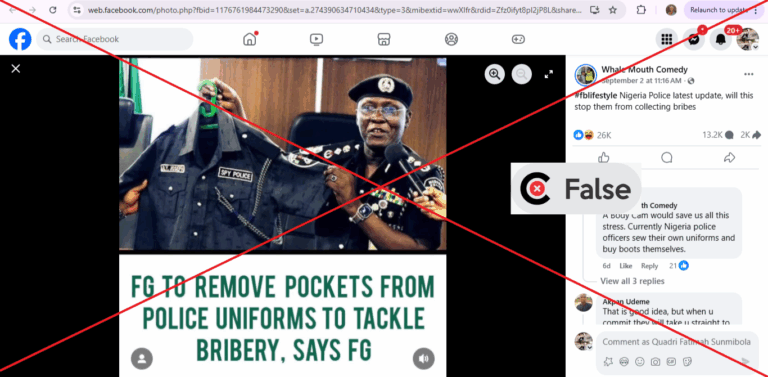
A claim is circulating online that the Federal Government has decided to remove pockets from police officers’ uniforms.
The claim was posted on Facebook by a user under the name Whale Mouth Comedy.
The post read:
Nigeria Police latest update, will this stop them from collecting bribes. A Body Cam would save us all this stress. Currently, Nigeria police officers sew their own uniforms and buy boots themselves.
Since the inception of the post on Tuesday, September 2, 2025, it has garnered over twenty thousand views, 13,200 comments, and 2000 likes.
A scan of the comments section of the post showed that the majority of the users thought the post was real, thereby prompting The FactCheckHub to verify the veracity of the claim.
Shedrack Gani wrote:
Even if police wear boxers they will collect bribe, is in their blood.
Another user Samuel Oluwarotimi wrote:
Is it the pocket that’s collecting the money or the personnel on the uniform!
Ernest Madu wrote in pidgin :
pocket keh na only police for road dey use pocket … review their salary then make it a dismisable offense to collect bribe
CLAIM
FG to remove pocket from police uniforms to tackle bribery
THE FINDINGS
Findings by The FactCheckHub show that the claim is FALSE!
Screenshot of The Claim; Insert FALSE Verdict
At first glance, the claim appears to be some form of satire from the author, considering his username. But a look at his supporting statement, which read thus, cleared doubts:
A Body Cam would save us all this stress. Currently, Nigeria police officers sew their own uniforms and buy boots themselves
When we ran a keyword search for the phrase “Pockets Police Uniform,” it only returned search results showing instances of the claim on other platforms.
There were no reports or press releases from either the presidency, the Nigeria Police Force, or credible media outlets stating that the federal government had taken such a measure.
When The FactCheckHub reached out to PRO of the FCT police command, Josephine Adeh, she stated that she was not aware of such developments, while branding it as lies.
“I’m not aware of such claims, ma. Lies”, Adeh told The FactCheckHub
THE VERDICT
The claim that the FG plans to remove pockets from police uniforms to tackle bribery is false; media outfits across the country would widely report such a move.
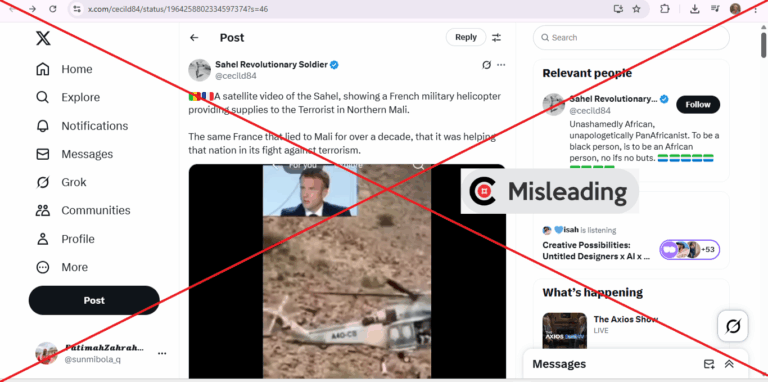
A claim that a video shows a French helicopter providing supplies to terrorists in Mali is circulating on X.
The claim, which was contained in a video post shared on the X app by user @cecild84.
The over two-minute video showed a helicopter descending toward a hilly area, where people were gathered. Uniformed personnel could be seen rappelling from the aircraft to rescue someone, after which the helicopter ascended back into the sky
The post had a caption alongside that read:
“A satellite video of the Sahel, showing a French military helicopter providing supplies to the Terrorist in Northern Mali. The same France that lied to Mali for over a decade, that it was helping that nation in its fight against terrorism.”
Since the inception of the post on Saturday, September 6, 2025, it has generated an impression of over thirty-two thousand views, 1,300 likes, and 825 reposts.
CLAIM
Video shows a French helicopter providing supplies to terrorists
THE FINDINGS
Findings by The FactCheckHub show that the claim is MISLEADING!
Screenshot of the claim from X; Insert MISLEADING Verdict
A Google reverse image search on screenshots from the video traced it to a clearer, over four-minute version uploaded on YouTube in 2024 by an Arabic channel, العهد الجديد (al-ahad al-jadid in transliteration).
The clip shared on X corresponds to the portion of the YouTube video that begins at the 2:06 timestamp and runs until the end.
The caption and headline of the video, originally in Arabic, translated to:
“The strongest rescue operation in the Sultanate of Oman.”
The description added:
“A man from Samail fell into Wadi Al-Jinn, but the men of Oman, Mashallah, managed to go down and rescue him despite the difficult terrain. May God protect Oman, its ruler, and its people, and bless their fruitful cooperation.”
Using keywords from the caption led to news reports, as seen here, that confirmed the incident occurred a year ago in Oman, a country located on the southeastern coast of the Arabian Peninsula in West Asia and the Middle East.
THE VERDICT
The claim that a video shows a French helicopter providing supplies to terrorists is misleading; the footage is from a rescue operation by the Oman Police from a year ago.
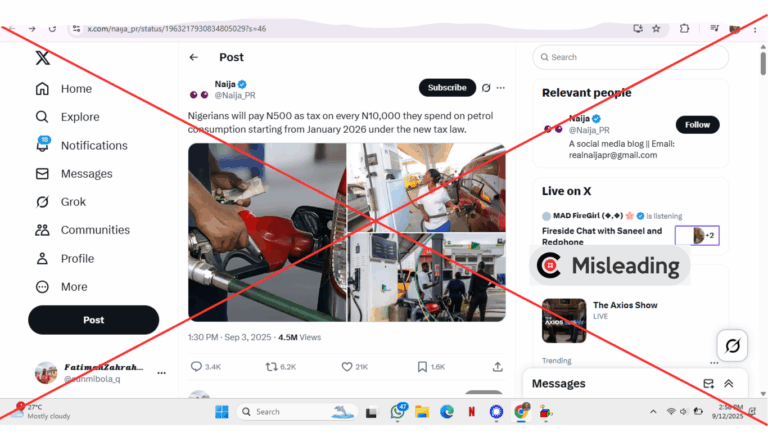
A claim that under a new tax law, Nigerians would pay N500 as tax on every 10,000 spent on fuel has been circulating on the internet.
The claim has been circulating on the internet since the announcement of the 5 per cent tax on petrol and diesel.
The regulation requires that the surcharge be applied to every supply or sale of refined fossil fuel products in Nigeria, whether locally produced or imported, with the money collected at the point of purchase. Cleaner fuels, such as renewable energy sources, household kerosene, cooking gas (LPG), and compressed natural gas (CNG), are exempt.
A post on X by Naija Pr retrieved by our researcher reads:
Nigerians will pay N500 as tax on every N10,000 they spend on petrol consumption starting from January 2026 under the new tax law.
Since the post’s inception on Wednesday, September 3, 2025, it has garnered over four million views, 21,000 likes, 6,200 reposts, and 3,400 comments.
While the claim of the 5 per cent tax is undeniable, there are doubts as to whether this is a new tax law. Due to the Veracity of the claim, The FactCheckHub decided to fact-check it.
CLAIM
The new tax law introduces a 5 per cent tax on petrol purchases from January 2026.
THE FINDINGS
Findings by The FactCheckHub show that the claim is MISLEADING!
Screenshot of the claim; INSERT Misleading Verdict
The levy originates from the newly enacted Nigeria Tax Administration Act, one of four tax reform bills signed into law by President Bola Tinubu on June 26, 2025.
According to the Act, a five per cent surcharge will be applied to chargeable fossil fuel products produced or supplied in Nigeria. The law stipulates that: the surcharge must be collected at the point of sale; it will be calculated based on the retail price of petrol and diesel; the Minister of Finance must formally announce its commencement date through an official Gazette; and it will not apply to kerosene, LPG, CNG, or renewable energy.
The surcharge is not entirely new — a similar provision is contained in the Federal Roads Maintenance Agency (FERMA) Act of 2007, which introduced a fuel levy to fund road maintenance.
According to the substituted Section 14 of the Principal Act, the Fund of the Agency is to be financed through several sources: a take-off grant and annual subventions from the Federal Government; loans and grants from federal, bilateral, and multilateral agencies; internally generated revenues such as rents, fees, and service charges; toll gate collections; proceeds from road concessions; and other sums accruing to the Agency.
It also provides for a 5 per cent user charge on the pump price of petrol and diesel—40 per cent of which is allocated to FERMA and 60 per cent to State Road Maintenance Agencies—as well as international vehicle transit charges determined by the Minister of Transportation
In essence, the Tinubu administration has not introduced a new tax, but rather reactivated an existing provision that had long remained unenforced.
The ICIR also reports that the Minister of Finance, Wale Edun, clarified that the surcharge is not new, while stating that it is not commencing soon.
THE VERDICT
The claim that a new tax law introduces 5 per cent on petrol purchases from January 2026 is misleading; the surcharge is not new, and there is currently no date for its commencement.
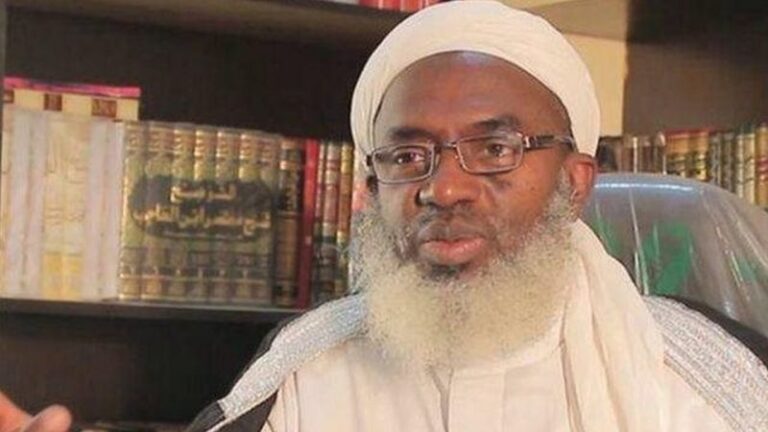
POPULAR Nigerian Islamic cleric, Sheikh Ahmed Gumi, has posted a video showing a helicopter descending in a bush with a claim that it shows bandits receiving support in Nigeria.
He posted the claim with a caption :
“The truth has come out!
(The slogan: let them kill themselves)
Here are the bandits enforcing their support. They are not politicians, they are people of Ketare. We are fools, we are just wasting away our brothers’ blood, and we are burning the fire of war. The solution to this is to save the people being used; we show them brotherhood through reconciliation, not war.”
The post has generated over 5000 likes and more than 2000 shares on Facebook as of September 12, 2025.
Video does not show bandit reinforcement in Nigeria.
screenshot of the viral post
FINDINGS
Findings by The FactCheckHub show that the claim is MISLEADING.
For over a decade, bandits have terrorised many states in northwestern Nigeria, sacking villages, sexually assaulting women, imposing levies on communities, killing locals, and running a multi-million-dollar kidnap-for-ransom enterprise to sustain their operations.
Since their activities escalated in 2010, more than 13,000 people have been killed. The crisis has also displaced over 600,000 people across Kaduna, Kebbi, Sokoto, Zamfara, Katsina, etc.
The FactCheckHub subjected the keyframes in the viral video to Google Reverse Image search, and the result shows that the video emanates from Sudan.
Several Sudanese pages, such as here and here, had posted the video with the Arabic caption, which reads: “شاهد منهم ينزلون من هليكوبتر في دارفور” and translates to: “Watch them getting off a helicopter in Darfur.”
Darfur is a large region in western Sudan, in northeast Africa.
The region has been one of the hardest-hit regions in the war between the Sudanese Armed Forces (SAF) and the Rapid Support Forces (RSF) since April 2023. The RSF controls much of the region, while El Fasher, the capital of North Darfur, remains under siege as one of the last major SAF strongholds.
Fighting has devastated civilian areas, with displacement camps, markets, and hospitals repeatedly shelled or bombed. Massacres, sexual violence, and ethnically motivated attacks by RSF and allied militias have been widely reported, raising alarms about possible war crimes.
VERDICT
The claim that the video shows the security situation in Nigeria is MISLEADING. Findings showed that the video emanated from Sudan.