Home Blog Page 20

No, Dangote Refinery not up for $30bn sale

0

A viral post circulating on social media platforms claims that Africa’s richest man, Aliko Dangote, is selling his 650,000 barrels per day refinery to the Adeleke family for $30 billion. 

The post alleges that reports were churned out and has already attracted several foreign buyers, with the Adeleke family currently leading the race to buy the refinery.

A verified x user @ykbprst made the post on March 8 2026, with that caption:

“JUST IN: Africa’s richest man, Aliko Dangote, has reportedly put his Dangote Refinery up for sale for about $30 billion.

Reports say the news has already attracted several foreign buyers, with the Adeleke family currently leading the race to buy the refinery.”

As of March 9, the post has garnered over 316000 views, 7000 likes, and over 500 comments.

READ: Dangote refinery no dey sell fuel for Naija markets for dollars

CLAIM

Aliko Dangote is selling his refinery for $30 billion, and Adeleke family are on the front row for the purchase.

screenshot of the viral post on x

Findings by The FactCheckHub show that the claim is FALSE. There is no official statement from the Dangote Group or any credible financial news outlet indicating a sale to the Adeleke family or any foreigners at that.

In addition, The FactCheckHub reached out to the Dangote Representative, Tony Chiejina, who asserted that the post is false.

READ ALSO: No! Dangote refinery is NOT the biggest in the world

The $30 billion figure cited in the post is a misrepresentation of a corporate milestone. Business Insider Africa reported that the Dangote Group, which projects total annual revenue across all sectors, including cement, sugar, and fertiliser, is on track to hit $30 billion by the end of 2026. This refers to the group’s earnings, not a valuation for a sale.

Furthermore, in February 2026, Aliko Dangote officially announced that the refinery would be listed on the Nigerian Exchange (NGX), This Day reported. This public listing is intended to allow ordinary Nigerians and institutional investors to buy shares in the facility, contradicting the claim that it was a private sale to a single family.

VERDICT

The claim that Aliko Dangote is selling his refinery to the Adeleke family for $30 billion is FALSE. The figure represents the group’s projected annual revenue, and the company is moving toward a public stock listing rather than a private divestment.


Online image of El-Rufai with ‘wiretapping device’ AI generated

AN image purportedly showing former Kaduna State governor, Nasir El-Rufai, being caught with a wiretapping device during a raid by the Independent Corrupt Practices and Other Related Offences Commission (ICPC) has surfaced online.

An X user, @MasterBolaji, posted the image with the caption:

“So, El-Rufai was really serious. He actually wire tapped the NSA calls. Wow!”

READ : False claims that El-Rufai defects to PDP circulate on X

As of March 2, 2026, the post had generated over 200 reposts and more than 900 likes.

CLAIM

The image shows El-Rufai with a wiretapping device during the ICPC raid on his residence.

screenshot of the viral post

THE FINDINGS

Findings by The FactCheckHub show that the claim is MISLEADING.

In February 2026, the Independent Corrupt Practices and Other Related Offences Commission (ICPC) carried out a raid on El-Rufai’s Abuja residence as part of an investigation into alleged corrupt practices and security-related infractions.

According to court filings, operatives executed a search warrant on February 19 at his Asokoro residence, accompanied by officers of the Nigeria Police Force. The agency told the Federal Capital Territory High Court that it recovered electronic equipment allegedly capable of intercepting communications, as well as sensitive documents. It also obtained a 14-day remand order for further investigation.

READ ALSO :No, Kaduna has generated foreign investment since El-Rufai left office

However, El-Rufai and his family have denied the allegations. His wife, Hadiza Isma El-Rufai, publicly rejected claims that any wiretapping devices were found in their home, describing the allegations as false.

Meanwhile, analysis of the viral image shows clear indicators that it was generated using Artificial Intelligence (AI). The image carries a visible Gemini logo watermark, suggesting it was produced using Google’s AI image generation tool.

Further checks conducted by The FactCheckHub using AI-detection tools, including Hive Moderation and “Is It AI,” indicate a 99% probability that the image was AI-generated.

result from hive moderation

There is no credible evidence showing that the image is an authentic photograph taken during the ICPC raid.

VERDICT

The claim that the image shows El-Rufai caught with a wiretapping device during the ICPC raid is MISLEADING. The image was generated using Artificial Intelligence and does not depict a real event.

No, Seyi Tinubu didn’t donate mats to bury victims of terrorist attacks in north

0

A viral post circulating on social media platforms claims that Seyi, son of President Bola Tinubu, donated mats to northern Nigeria specifically due to a shortage of mats for Muslims to lay the corpses of their loved ones following massive killings by terrorists. 

The post further alleges that he intends to donate diggers and shovels for graves. The post gained traction due to the ongoing attack by terrorists in northern Nigeria.

A verified x user, @DEGE07 made the post on March 3, 2026, with the caption: “Special Appreciation to Seyi Tinubu (Please, type “Thank You Seyi” before reading).

Considering the massive killings in Northern Nigeria, it has been reported that there is a shortage of mats for the Muslims to lay the corpses of their loved ones.

This prompted the son of the traveling president to donate mats to these families and mosques as the killing continues, to avail them with enough mats for prayers before burial.

It is alleged that he will donate diggers and shovels soon.”

As of March 4, the post has generated over 75,000 views, 1200 likes, and 487 reposts, with half the commenters believing the claim to be true.

CLAIM

READ: No, Seyi Tinubu did not rebrand stolen COVID-19 palliative packages

The post claims that Seyi Tinubu donated prayer mats to Northern Nigeria specifically to be used for laying out the corpses of victims of terrorist attacks.

screenshot of the viral post on x

FINDINGS

Findings by The FactCheckHub show that the claim is MISLEADING.

While a large-scale donation of mats did occur in February and March 2026, the context provided in the viral post is a deliberate misrepresentation of a religious humanitarian gesture.

A reverse image search conducted by The FactCheckHub traced the circulating photo to a post made on a Facebook page by ATP Hausa, and a report made by Nasarawa Daily News’s Post on Saturday, February 28, 2026. It revealed that the donation was part of a nationwide Fasting Relief Package launched by the City Boy Movement and the One North Movement, for which Seyi Tinubu serves as Grand Patron.

READ ALSO: Doctored image shows Peter Obi conversing with Seyi Tinubu

Nasarawa Daily News Post reported that the mats were distributed to over 5,000 mosques and various religious centres to enable the Muslim community to carry out their worship in cleanliness and peace.

During Ramadan, mosques experience a surge in attendance for the night prayer known as Taraweeh and Tahajjud, often leading to a need for more prayer space.

The initiative was timed to coincide with the 2026 Ramadan to support worshipers during a period of increased religious activity.

The claim that the mats were intended for corpses and would be followed by diggers and shovels is not supported by any official statement or credible news report.

While the images are real, the caption is purposely written to incite.

VERDICT

The claim that Seyi donated mats to bury the terrorist victims is misleading. The mats donation by Seyi was a philanthropic gesture for people observing fasting to improve comfort in mosques across Nigeria as reported by Facebook pages. There is no evidence that the donation was related to the burial of victims of terrorist attacks.

True! Dove soap, other cosmetic products banned in 2022 for cotaining toxic chemicals

A viral post on Instagram claims that the chemical Butylphenyl Methylpropional (BMHCA), also known as Lilial, was banned in Europe, Nigeria, and other countries in 2022.

The post further alleges that despite this ban, the substance remains present in various cosmetic products being sold in 2025 and 2026 and issued a warning to the users to be watchful of the products they use.

An Instagram user @learnwithhadithya shared a video on February 17, 2026 with that caption:


“BMHCA, also known as Lilial, was banned in Europe in 2022.

It is classified as an endocrine disruptor that may affect fertility.

Multiple Dove soap batches have been recalled in Nigeria and Europe for containing this chemical.

But in India? No regulation. No recall. Still available.

Check your soap ingredients for Fragrance, Lilial, BMHCA, or Butylphenyl Methylpropional.

Stay safe!”


As of February 24, the post has generated over 3.5 million views, 913 comments and over 4500 reposts, with people expressing their fears in the comment.

READ:Do condoms contain harmful chemicals?

CLAIM

Post claims that the fragrance chemical Butylphenyl Methylpropional (BMHCA/Lilial) was banned in 2022 but remains present in cosmetic products in 2025 and 2026.

screenshot of the viral post on instagram

FINDINGS

Findings by The FactCheckHub show that the claim is TRUE.

While a global ban was indeed implemented in 2022, regulatory agencies continue to identify and recall products containing the prohibited substance through 2025 and 2026.

Butylphenyl Methylpropional (BMHCA) is a synthetic fragrance compound used for its intense floral scent, often compared to Lily of the Valley. It was once a common ingredient in soaps, shampoos, and perfumes. However, the European Union officially banned Lilial on March 1, 2022, after it was reclassified as a Carcinogenic, Mutagenic, or Reprotoxic (CMR 1B) substance.

According to official safety reports, the chemical is a reproductive toxicant that can harm fertility and the health of an unborn child. It is also a known skin sensitizer that can cause contact dermatitis and severe allergic reactions.

READ ALSO: How true is that claim that washing wounds from dog bite with soap and water is effective against rabies?

Keyword searches conducted by The FactCheckHub revealed that products containing BMHCA are still being detected in the market. In April 2024, the National Agency for Food and Drug Administration and Control (NAFDAC) issued Public Alert No. 012/2024, banning the sale of Dex Luxury Bar Soap (No. 6 Mystic Flower) because it was found to contain the prohibited chemical. Later that year, in August 2024, NAFDAC issued Public Alert No. 035/2024 for the recall of a batch of Dove Beauty Cream Bar Soap for the same reason.

The detection of these products has continued into the current year. On June 2, 2025, NAFDAC released Public Alert No. 018/2025, notifying Nigerians that European Union authorities had banned certain Dove Hand Soap and Deodorant products for containing prohibited BMHCA.

The FactCheckHub urges its readers and everyone at large to always check soaps or cosmetics ingredients before use. If it contains Lilial, any of the shortened forms of Butylphenyl Methylpropional, do not use it.


VERDICT

The claim is TRUE. Although BMHCA was officially banned in the EU and Nigeria in 2022, it is still being detected in cosmetic products like Dex and Dove soaps in 2024, 2025, and 2026, leading to ongoing public health alerts and recalls.

No, Video does not show Putin paying respect to Khamenei

A video showing Russian President Vladimir Putin laying flowers in front of a grave has surfaced online with claims that it depicts him mourning Iran’s late Supreme Leader, Ali Khamenei.

A Nigerian X user, Nuhu Sadah, shared the clip with the caption:

“Heavy mourning worldwide Russian President Vladimir Putin places flowers in Moscow to honor Iran’s Supreme Leader Ayatollah Ali Hosseini Khamenei.”

As of February 2, 2026, the post had generated over 6,000 reposts and more than 45,000 likes.


CLAIM

The video shows Putin paying respects to Khamenei after his death.

THE FINDINGS

Findings by The FactCheckHub show that the claim is MISLEADING.

In late February 2026, reports emerged that Khamenei had been killed in a joint U.S.–Israeli airstrike on Tehran, significantly escalating tensions in the Middle East. Following the reports, Putin publicly condemned the strike, describing it as a “cynical violation” of international law. Iran and Russia have maintained close diplomatic and strategic ties in recent years, including a 2025 cooperation treaty covering political and military collaboration.

However, the circulating video does not show Putin visiting Khamenei’s grave.

A review of the footage shows that it was recorded on January 27, 2026, at the Piskaryovskoye Memorial Cemetery in St. Petersburg. The event marked the anniversary of the lifting of the Siege of Leningrad during World War II.

During the ceremony, Putin laid a wreath at the “Mother Motherland” monument in honour of victims of the 872-day blockade. He bowed his head briefly, while an orchestra played commemorative music. A minute of silence was also observed.

He also laid flowers at one of the mass graves where his brother, Viktor, who died during the siege in 1942, is buried.

There is no evidence linking the footage to Khamenei’s reported death or any mourning ceremony related to Iran.


VERDICT

The claim that the video shows Putin mourning Khamenei’s death is MISLEADING. The footage is from a January 27, 2026 memorial event in St. Petersburg commemorating victims of the Siege of Leningrad, not a tribute to Iran’s Supreme Leader.

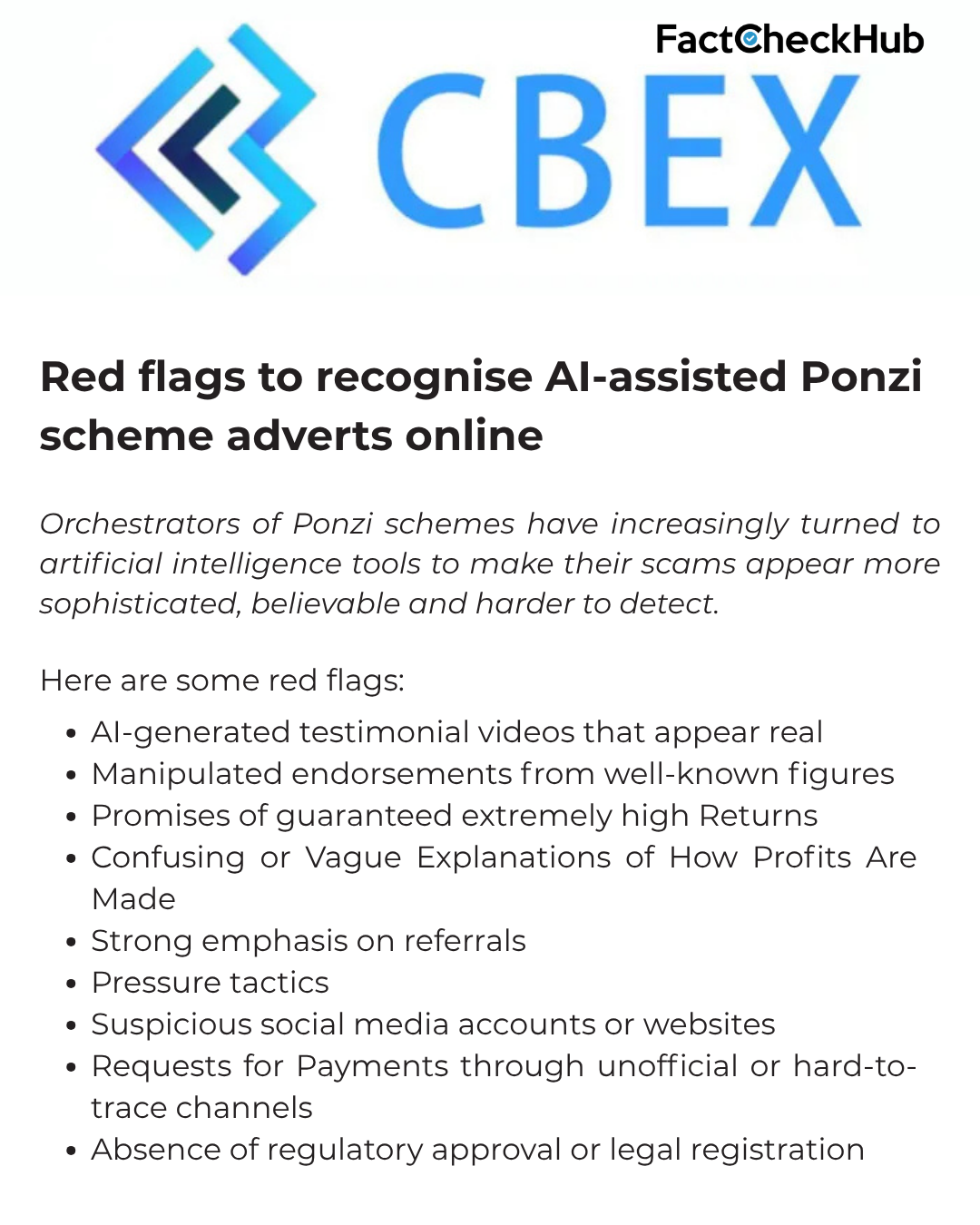
Red flags to recognise AI-assisted Ponzi scheme adverts online

ORCHESTRATORS of Ponzi schemes have increasingly turned to artificial intelligence tools to make their scams appear more sophisticated, believable and harder to detect.

With AI now able to generate realistic human faces, clone voices, and produce professional-looking videos within minutes, fraudsters no longer need real investors or legitimate businesses to attract victims. Instead, they manufacture trust digitally and push it aggressively across social media platforms.

Nigeria has repeatedly witnessed the destructive impact of Ponzi schemes on individuals and families. The collapse of CBEX recently remains one of the most recent popular examples, wiping out billions of naira belonging to millions of participants who believed they were investing in a peer-to-peer donation system. Many victims lost school fees, rent money and business capital, plunging households into financial distress.

Before CBEX, several similar schemes had emerged in the past, each repackaged with new branding but operating the same fraudulent model. Platforms such as MMM, Loom, Ultimate Cycler, Racksterli and numerous online “investment clubs” promised quick wealth while quietly depending on continuous recruitment to survive. Once new members slowed down, the platforms collapsed, leaving late participants with nothing.

What has made these scams far more dangerous is the integration of artificial intelligence. With AI, fraudsters can create realistic human faces, generate convincing voices and produce news-style videos that mimic legitimate financial announcements. These tools allow them to fabricate credibility at a scale never seen before.

Red flags to recognise AI assisted ponzi schemes

As economic hardship pushes many people to search for quick income opportunities, these AI-powered scams thrive. Recognising the warning signs is now essential for protecting personal finances.

  1. AI-generated testimonial videos that appear real

Many Ponzi adverts now feature individuals confidently claiming they earned huge profits within days or weeks. These videos are often created using AI technology, meaning the people shown may not exist at all. Although they look convincing, small details such as stiff facial movements, unnatural blinking or robotic voice tones can reveal that the content is artificially produced.

These fabricated success stories are designed to replace real customer experiences that the scammers do not have.

Our earlier investigation exposed how a YouTube advertisement targeting Nigerians was launched in June 2025. The video showed a man dressed in a shirt and an overused false ‘African accent’, encouraging people to join Quantum AI, another AI-powered Ponzi platform. Looking at how the man in the video looks like a real human, some people may not know it is AI.

  1. Manipulated endorsements from well-known figures

Another common tactic is the cloning of respected public figures to falsely promote investment platforms. Through AI, scammers replicate the face and voice of pastors, entrepreneurs, media personalities or influencers, making it appear as though these individuals are recommending the scheme. This creates instant trust among viewers who recognise the figure, even though the endorsement is completely fake and unauthorised.

An earlier investigation by The ICIR shows how AI-generated videos of public figures like 2023 presidential candidate of the Labour Party, Peter Obi, and Nigerian lawmaker Saliu Mustapha were used to promote Ponzi scams.

In the AI-generated video, the voice of Mustapha, a popular philanthropist in Nigeria, was cloned to appear as if he had said the scheme has an AI-powered analytical function, which allows it to predict trends, and subscribers could invest N395,000 to earn N1,580,000 per week.


While Obi was purportedly telling people to invest in a Ponzi platform and earn a sum of “N7 million” every month. The former LP presidential candidate reportedly stated that the investment platform was created with his backing and the support of the federal government. However, findings by The ICIR show that neither video is genuine.

  1. Promises of guaranteed extremely high Returns

AI-driven Ponzi adverts consistently promote unrealistic profits, often claiming that investors can double their money quickly or earn a fixed daily income without risk. These promises contradict the realities of legitimate investing, where returns fluctuate, and losses are possible. The certainty of profit is deliberately used to remove doubt and attract people who may be financially desperate.

For instance, CBEX, which wiped out the money of many people in Nigeria, promised a 100 per cent return on investment in just thirty days.

  1. Confusing or Vague Explanations of How Profits Are Made

Rather than clearly explaining business operations, Ponzi schemes rely on buzzwords related to artificial intelligence, cryptocurrency or automated trading systems. The explanations are often overly technical or intentionally unclear, making it difficult for potential investors to understand where money actually comes from.

This lack of transparency helps hide the fact that profits are usually paid from new participants’ deposits.

  1. Strong emphasis on referrals

Participants are frequently encouraged to invite others to earn more money. The focus shifts away from any real product or service and toward building a network of new investors. This structure ensures that funds flow from newcomers to earlier participants, which is the classic Ponzi model that inevitably collapses when recruitment slows.

For instance, MMM and CBEX offered 10 per cent referral bonuses before their collapse. To maximise these bonuses, participants often register multiple accounts for themselves using their referral links.

  1. Pressure tactics

Many adverts are scripted to make people feel they must act immediately. They often suggest that the opportunity is about to close or that only a few slots remain, pushing viewers to invest quickly without researching. This emotional pressure is a common scam technique designed to prevent careful thinking.

  1. Suspicious social media accounts or websites

These adverts are usually posted from newly created pages or profiles with little history. The accounts or websites often display repetitive praise comments that look automated or fake.

Genuine investment companies typically have established online presence, clear contact information and verifiable reviews, while scam pages disappear once the scheme collapses.

  1. Requests for Payments through unofficial or hard-to-trace channels

Instead of using recognised financial institutions or registered corporate accounts, scammers often ask victims to send money directly to personal accounts, digital wallets or other informal payment methods. This makes it extremely difficult to recover funds once the scheme shuts down, allowing fraudsters to disappear without a trace.

  1. Absence of regulatory approval or legal registration

Most Ponzi schemes operate without authorisation from financial regulators such as Nigeria’s Securities and Exchange Commission. When asked for proof of legitimacy, promoters may avoid the question or present questionable documents.

Legitimate investment firms are always properly registered and transparent about their regulatory status.

This story was supported by the Pulitzer Centre

You can read the earlier investigation on AI-assisted Ponzi schemes here.

Quick steps to verify online investment platforms in Nigeria

0

PONZI schemes continue to resurface in Nigeria, often presenting themselves as legitimate investment opportunities that promise fast and effortless profits. Over the years, platforms such as MMM and CBEX attracted thousands of participants with assurances of high returns, only to collapse and leave investors counting heavy losses.

What makes these schemes particularly dangerous is how quickly people can commit funds. Within minutes of seeing an advert on social media or receiving a referral link from a friend, an individual can register, transfer money and become part of a system that may soon disappear.

Financial experts and regulators have repeatedly warned that most Ponzi schemes share common characteristics. The good news is that verifying whether an investment platform is legitimate does not require specialised knowledge or hours of investigation. These few simple steps can help you to verify whether the investment is genuine before you put your money.

Verify through regulatory agencies’ databases

The first and most important step is to confirm whether the investment company is registered with Nigeria’s Securities and Exchange Commission (SEC). The SEC maintains an online portal where members of the public can verify licensed capital market operators, fund managers, brokers, and investment platforms.

If a company does not appear on this database, it is not legally authorised to collect investments in Nigeria, regardless of how professional its website or adverts appear. Many platforms involved in recent Ponzi collapses, including those marketed as AI-powered trading systems, were never registered with the SEC.


You may also want to check other regulatory agencies like the Central Bank of Nigeria (CBN) for banks, fintech, and lenders, the Corporate Affairs Commission (CAC) to verify that a company is officially registered in Nigeria and the Nigerian Exchange (NGX) for listed trading securities and public companies.

Do not depend solely on certificates or documents presented by the investment company. Always use official regulatory portals to independently confirm the firm’s name, licence status and registration details. If a company claims to be authorised, verify the claim yourself. Failure to find its details in any recognised database is a serious warning sign.

Examine the profit promises carefully

Legitimate investments never guarantee fixed or extremely high returns within short periods. Platforms that promise to double money within weeks, pay daily profits, or offer “risk-free” earnings are displaying classic Ponzi characteristics.

READ : Timeline of Ponzi schemes in Nigeria: A decade of financial fraud, deception

Real financial markets fluctuate. Profits depend on market performance, economic conditions and risk exposure. When a platform presents profits as automatic and certain, often using phrases like “AI never loses”, it is usually a warning sign of fraud. If the returns sound too good to be true, they almost always are.

Investigate the Company’s online presence and history

A quick look at how long a platform has existed can reveal a lot. Many scam investment websites are newly created and registered for short periods, often with ownership details hidden.

Fraudulent platforms typically appear suddenly, run aggressive promotions for a few months, then disappear after collecting large sums. A legitimate investment company usually has years of verifiable history, transparent ownership information, physical office addresses, and consistent operations. Short lifespan and hidden ownership are common red flags.

Look for clear business operations and transparency

A trustworthy investment platform explains plainly how it makes money. It provides details about trading strategies, assets involved, risks, fees, and performance history.

Ponzi schemes often hide behind buzzwords like artificial intelligence, crypto automation or secret algorithms without explaining real business processes. The more vague and technical the explanation sounds, the more likely it is designed to confuse rather than inform.

Watch out for referral-driven income structures

When a platform strongly encourages recruiting new members with bonuses or commissions, it is usually relying on fresh deposits to pay earlier participants.

This recruitment-based structure is the backbone of Ponzi schemes. While some legitimate businesses use referral marketing, investment profits should never depend mainly on bringing in new investors.

If income grows more through recruitment than through actual investment performance, you need to be careful.

READ ALSO : Meta’s moderation gap: how AI misinformation from Africa goes unchecked

Search for regulatory warnings and user complaints

A quick online search of the platform’s name alongside words like “scam,” “warning,” or “SEC” can reveal important information. Many fraudulent platforms are already flagged by regulators in Nigeria or other countries before they collapse locally.

Victims often share experiences on social media, forums and review websites. Repeated complaints about blocked withdrawals, vanished accounts, or pressure to reinvest are strong indicators of fraud.

Examine how payments are collected

Legitimate investment firms usually use regulated banking channels, corporate accounts and clear transaction records. Ponzi schemes often request funds through personal bank accounts, digital wallets, or informal payment methods that are difficult to trace.

When a platform avoids transparent payment systems, it is often to make fund recovery impossible after collapse.

Secure financial systems are a hallmark of lawful operations.

Seek independent professional advice

Most importantly, before committing your money to any investment platform, it is wise to consult qualified professionals who can provide an objective assessment of the opportunity and its associated risks, especially if the investment requires a large amount of money.

A licensed financial adviser can help you determine whether the promised returns align with market realities and your personal risk tolerance. They can also explain technical terms, identify unrealistic projections, and compare the offer with regulated alternatives available in the market.

For larger investments or platforms using complex structures, engaging a legal practitioner is especially important. Contracts and terms of service may contain clauses that limit your rights, waive liabilities, or make fund recovery difficult. Legal experts can review agreements to identify hidden conditions, withdrawal restrictions, dispute resolution clauses, or jurisdictional loopholes that may expose you to loss.

In addition, accountants or tax professionals can clarify the tax implications of an investment, assess whether reported returns are sustainable, and determine whether the company’s financial claims appear credible.

Try to take time to consult experts even when an offer appears straightforward, but it can prevent costly mistakes and provide clarity before funds are transferred.

This story was supported by the Pulitzer Centre

You can read the earlier investigation on AI-assisted Ponzi schemes here.

No, photo does not show Malami’s recent Umrah trip amid probe

0

AN image circulating on social media claims that the embattled former Attorney General of the Federation, Abubakar Malami, travelled to Saudi Arabia for Umrah and would spend the rest of Ramadan amid his ongoing trial.

The claim was made, accompanied by a photo showing Malami seated on an aircraft with a woman believed to be his wife.

The post surfaced amid ongoing public discussions about Malami’s legal troubles.

A verified x user, @NuhuSada0 shared on February 23 2026, with the caption:

“Breaking: Haters: Abubakar Malami SAN Travels to Saudi Arabia for Umrah Nothing, Not Even the 001, Can Stop Him! He Will Spend the Rest of Ramadan There…. See More”

As of February 23, the post has generated over 140,000 views, 750 likes, and 53 reposts.

READ: Old report on female kidnapper’s arrest resurfaces online

CLAIM

Post claims that Abubakar Malami recently travelled to Saudi Arabia for Umrah and will spend the rest of Ramadan there.

screenshot of the viral post on x

FINDINGS

Findings by The FactCheckHub show that the claim is MISLEADING.

The Economic and Financial Crimes Commission is prosecuting the former AGF on a 16-count charge bordering on money laundering.

The anti-graft agency had, in December 2025, said it traced properties worth N212 billion to Malami as part of an investigation into his tenure in office.

The assets, reportedly including hotels, residential buildings, schools, land and a printing press, are located in Kebbi, Kano and the Federal Capital Territory (FCT).

A reverse image search conducted by The FactCheckHub traced the circulating photo to a post made on Instagram by the user @fatimamalamiwomensupport on May 24, 2024, congratulating Malami and his wife as they departed for Hajj.

This indicates that the image predates his subsequent legal issues.

READ ALSO: Malami joins Nigerians to defy ban, access Twitter using VPN

Punch reported on January 19 that the ex-AGF was re-arrested by operatives of the Department of State Services immediately after being released on bail from the Kuje Correctional Centre, Abuja, where he had been remanded.

There is no credible evidence showing that he recently travelled to Saudi Arabia for Umrah or that the image reflects a current trip. The photo being circulated is from May 2024 and relates to a Hajj pilgrimage, not a Ramadan Umrah trip in 2026.

VERDICT

The claim that Abubakar Malami recently travelled to Saudi Arabia for Umrah and will spend the rest of Ramadan there is MISLEADING. The image used was first posted in May 2024 and it predates his reported arrest and remand at Kuje Correctional Centre. There is no evidence that he is currently in Saudi Arabia.

Will Nigeria replace Naira with Eco currency in 2027?

0

A viral claim circulating widely on WhatsApp, TikTok and other social media platforms suggests that Nigeria will abolish the naira and replace it with a regional currency called the “Eco” in 2027. 

According to the claim, this change is imminent and will coincide with Nigeria’s 2027 general elections. The claim has generated anxiety, debate and confusion among Nigerians.

But is there any truth to this claim? The short answer is no, at least not in the way it is being presented online. There is a grain of truth behind the broader topic, because West African countries have for decades discussed a regional currency named the Eco.

To understand why this claim is misleading and what the real story is about the Eco, we need to unpack the facts.

What is Eco currency?

The Eco (short for the Economic Community of West African States single currency) is a proposed common currency that West African countries plan to adopt in place of separate national currencies.

It is being developed by the ECOWAS to make trade and business easier among its member countries. The idea is that if countries like Nigeria, Ghana, Senegal, and others use the same currency, it would reduce exchange rate problems, lower transaction costs, and strengthen economic cooperation in the region.

The idea of a single regional currency in West Africa, originally called the “Eco”, has been around for decades. It stems from a long-standing policy goal of ECOWAS to foster deeper economic integration among its 16 member states, including Nigeria, Ghana, Senegal, Togo, Sierra Leone and others.

A common currency is intended to make trade easier, reduce transaction costs, enhance monetary stability and strengthen the economic ties across the region.

To accelerate the regional integration, on April 20, 2000, the Heads of State of five West African countries (Gambia, Ghana, Guinea, Nigeria and Sierra Leone), decided to establish the West African Monetary Zone (WAMZ) in Accra by signing the ‘Accra Declaration’ which defined the objectives of the Zone as well as, an action plan and institutional arrangements.

It is planned to merge this zone with the West African Economic and Monetary Union (WAEMU) to form a single monetary zone in West Africa. The eight (8) French-speaking members of WAEMU are using the CFA franc since 1945.

In the early 2000s, leaders of the bloc proposed monetary union as a step toward these goals. Over the years, various plans, frameworks and convergence criteria were agreed upon to guide the process.

Part of that plan included meeting specific economic conditions, such as low inflation, controlled fiscal deficits and stable foreign reserve positions, collectively known as convergence criteria. These are designed to ensure that nations joining a single currency have sufficiently aligned economic fundamentals.

The West African single currency was initially planned to be launched in January 2003. However, this was postponed several times, to 2005, 2010, 2014 and now 2027 due to Member States’ inability to maintain a single digit inflation rate at the end of each year; a fiscal deficit of no more than 4% of the GDP; a central bank deficit-financing of no more than 10% of the previous year’s tax revenues and a gross external reserves that can give import cover for a minimum of three months as the four primary criteria for the single currency to be implemented.

At the 11th ECOWAS Convergence Council in Abuja in March 2025, Wale Edun, Nigeria’s finance minister and coordinating minister of the economy, emphasised the need for monetary and fiscal discipline, citing security challenges, inflation, and global economic disruptions as hurdles to the region’s monetary convergence.

“This is our opportunity to shape the future of our region. We must work together to drive economic stability, growth, and prosperity,” Edun stated.

According to him, the successful implementation of the Eco currency will not only enhance regional integration but also position West Africa as a major global economic player, driving growth and innovation for generations to come.

However, it is important to note that this timeline was always conditional, not automatic. It depends on countries meeting economic criteria and finalising operational frameworks such as how the currency would be governed, managed and introduced without causing financial disruption.

These conditions have proven difficult to meet consistently, and they remain a key part of the discussion.

Misconceptions in the viral claim

Despite the 2027 timeline mentioned in some official plans, none of the following is true:

1. Nigeria will not automatically abolish the naira in 2027

There is no official statement from the CBN, the Federal Government or ECOWAS declaring that the naira will cease to be legal tender in 2027. The claim circulating online misrepresents the status of the Eco project.

READ : Viral video does not show bundles of naira notes in warehouse

2. Nigeria’s adoption of the Eco is not guaranteed

Even if the Eco were introduced, Nigeria, like other member countries, would have to meet defined convergence criteria and voluntarily agree to join the monetary union as part of the larger ECOWAS framework. Adoption would not be automatic or unilateral.

3. The 2027 target date is a goal, not a legal deadline

While ECOWAS leaders reaffirmed a push to have the Eco introduced in 2027, this is a target date tied to long-term monetary planning and has been delayed in the past. Previous launch timelines for the Eco were postponed because member states failed to achieve the convergence benchmarks required for a smooth rollout.

For instance, the proposed Eco currency has had multiple launch dates since the early 2000s, 2003, 2005, 2009, 2015, 2020, and all were postponed due to failure to meet economic convergence criteria and policy disagreements. It is now tentatively targeted for 2027.

4. No official communication confirms the immediate end of the naira

Neither the presidency nor the Central Bank of Nigeria has released a policy statement indicating that the naira will be replaced by any single currency in 2027. The viral claims have no basis in official announcements or legally binding policy documents.

In essence, the viral claim takes an ongoing regional economic integration plan and reframes it as an imminent national policy, which it is not.

What the Eco plan really means and what it doesn’t

1.It’s still a project, not a switch-over date

The plan for a single currency has been evolving for years and requires extensive policy alignment among ECOWAS members. Recent meetings of finance ministers and central bank governors, including those involving Nigeria, reaffirmed the intention to continue working toward the Eco’s introduction by 2027. These discussions emphasise macroeconomic reforms, fiscal discipline and institutional preparation, not abrupt currency replacement.

2.It depends on meeting economic benchmarks

Before any common currency can be launched sustainably, countries must meet agreed convergence criteria covering inflation, fiscal deficits, external reserves and other economic indicators. Progress has been uneven across the region, with some countries lagging. Achieving these benchmarks is considered essential to avoid destabilising any potential unified currency system.

For context, Wale Edun clarified that to launch the Eco currency, each ECOWAS Member State must meet specific convergence criteria (four primary and six secondary) as set by the West African Monetary Institute (WAMI), some decades ago.

The primary criteria include a single-digit inflation rate at the end of each year; a budget deficit of not more than 4% of GDP; Central bank deficit-financing limited to 10% of the previous year’s tax revenues; and Gross external reserves sufficient to cover at least three months of imports.

The Secondary Criteria are, prohibition of new domestic debt arrears and liquidation of existing ones; tax revenue equal to or greater than 20% of GDP; wage bill to tax revenue ratio of 35% or less; public investment financed from internal resources equal to or greater than 20% of tax revenue; a positive real interest rate; and a stable real exchange rate.

According to WAMI, meeting these criteria is essential for achieving macroeconomic stability and facilitating the successful adoption of the single currency.

3.It would require institutional frameworks

A shared currency requires governance structures, for example, a regional central bank or monetary authority to manage policy and stabilise the currency. None of these institutional arrangements is fully in place yet, and they require careful negotiation and legal groundwork.

4.Its introduction, if it happens, would be phased

Even discussions around the Eco acknowledge that rollout might happen in phases, such as first among a subgroup of countries forming a West African Monetary Zone (WAMZ). The process would not be a single event on one date, but a gradual integration requiring coordinated implementation efforts.

READ ALSO : Dangote refinery no dey sell fuel for Naija markets for dollars

5.Participation may be voluntary

Not all ECOWAS members have historically fully embraced the Eco plan at the same pace. In 2020, Nigeria and several other countries even objected to unilateral actions around the currency before a comprehensive roadmap was agreed.

What this means for the Naira

For now, the naira remains Nigeria’s official currency and legal tender. The CBN continues to manage monetary policy, issue banknotes and regulate the financial system under the existing framework. There is no policy directive from the CBN or the Federal Government indicating an imminent replacement of the naira.

Economic discussions around the Eco are part of a long-term regional integration goal, not an immediate threat to the naira’s existence in 2027.

#FCTDECIDES2026 : QUICK media & information literacy for FCT area council elections 2026

0

Topic 2 : 5 Steps to Protect Your Vote After Casting It

Voting is just the beginning. In the FCT Area Council elections, your participation doesn’t end once you drop your ballot. Staying engaged after voting helps ensure transparency, protects your vote, and strengthens democracy.

Here are five things every voter should do after casting their vote:

1. Monitor the Election at Your Polling Unit
After voting, stay around your polling unit and observe activities peacefully. Monitoring the process ensures that votes are handled correctly and protects the integrity of the election.

2. Verify the Ballot Box and Materials
Check that the ballot box is properly sealed and that all election materials are accounted for. Ensuring these safeguards are in place prevents tampering and strengthens the credibility of the election in your polling unit.

3. Wait for Results Collation
Observe how votes are counted and collated at the polling unit. Tracking the results helps ensure transparency and allows you to verify that your vote is properly recorded. You can also take note of the official results sheet (Form EC8A) for reference.

4. Report Irregularities Immediately
If you notice ballot mishandling, intimidation, or procedural violations, report them promptly to security officials, accredited election observers, or trusted media outlets. Quick reporting helps protect your vote and prevent fraud.

5. Engage and Stay Updated After the Election
Even after the winner is announced, your civic role continues. Follow official announcements, track complaints, and support accountability measures in your Area Council. Active citizens help build a culture of transparency and ensure that democracy is strengthened.


Topic 1 : How to Locate Your Polling Unit in the FCT Using INEC’s Polling Unit Locator

As voting begins in the FCT, some residents say they are struggling to locate their polling units. To avoid last-minute confusion and delays, here’s a quick step-by-step guide to finding your polling unit using the INEC Polling Unit Locator:

Step 1: Go to the official INEC Polling Unit Locator website via : https://pollingunitlocator.inecnigeria.org/

Step 2: Select Your State e.g FCT

Step 3: Select Your Local Government Area (LGA) known as Area Council e.g., Municipal, Bwari, Gwagwalada, etc.

Step 4: Select Your Registration Area (Ward)

Step 5: Scroll to find and select your specific polling unit.

Step 6: Click the green “Get Directions” button to see the approximate location and map directions.