Please note that the FactCheckHub has not obtained any right from the authors or copyright owners of all third-party contents from embedded links and shall incur no liability in this regard.
Please note that the FactCheckHub has not obtained any right from the authors or copyright owners of all third-party contents from embedded links and shall incur no liability in this regard.
Please note that the FactCheckHub has not obtained any right from the authors or copyright owners of all third-party contents from embedded links and shall incur no liability in this regard.
Please note that the FactCheckHub has not obtained any right from the authors or copyright owners of all third-party contents from embedded links and shall incur no liability in this regard.
Misinformation can come in the form of texts, audio, or visuals.
These visuals could be an old video circulated as new or even doctored.
As such content verification skill is required for a fact-checker.
One of the ways to verify videos is through the WeVerify open-source content verification browser plugin.
To use this, visit website of WeVerify designed by InVID. In most cases, it displays as an extension.
Follow the instruction to add the application (software) as an extension to your internet browser (Google Chrome recommended).
Once this is added, launch the application and click on “Key frames”. This breaks the footage in to frames -snapshots.
These shots enable the user to deploy the reverse image tool.
The next step is to download the video footage and upload from the computer by clicking on the “Local File,” then click “Submit”.
On the contrary, if you choose not to download the video, simply copy the video’s URL, paste in the “Insert Video URL” space, then click the “Submit” button.
The next page displays video key frames of the fragmented footage. At this stage, users can select each of the frames and conduct google reverse image search.
To deploy multiple images, simply right click on the image of your choice, select reverse image search in the drop-down menu, then click all search engines.
Browse through the search results and trace the video.
From the search results, users could determine and trace the date such video was uploaded on YouTube, websites or other video channels.
Hope you found this useful? Kindly drop a comment if you do or if you need further clarification.
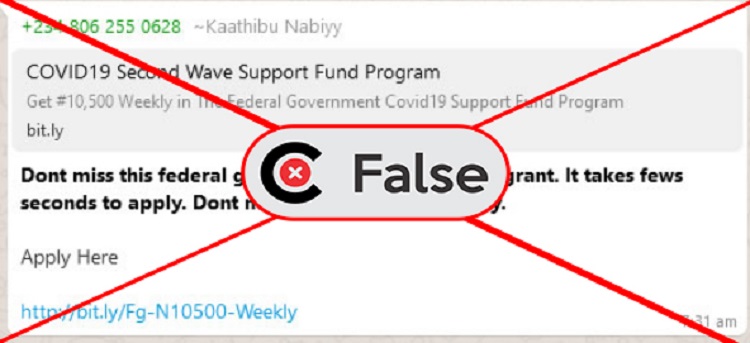
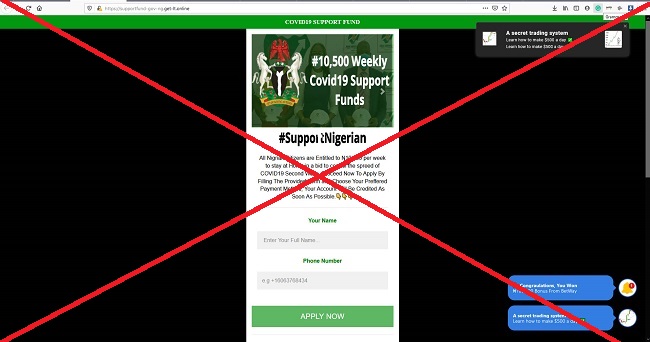
ON Saturday, January 30, 2021, a viral claim circulating on WhatsApp says the Nigerian Government is giving out N10,500 weekly funds to Nigerians.
The assistance, titled “COVID-19 second wave Support fund programme” encouraged members of the public to take advantage of the funding opportunity by submitting an application through a website.
It reads:
“Don’t miss this federal government N10,500 weekly grant. It takes few seconds to apply. Don’t miss this great opportunity. Apply here
Due to COVID-19 second wave, the Federal Government is giving out a weekly grant of N10, 500 to support Nigerians.
THE FINDINGS
Findings by the FactCheckHub show that the claim is FALSE.
The FactCheckHub observed that the website on the forwarded post, even though it had photos of the Minister of Humanitarian affairs, Disaster management and Social development (FMHDS), Sadiya Umar Farouq, it is different from that of the ministry.
The website in the claim seeks to gain traffic by prompting people to share. For instance, after filling the questionnaire, it says “share until the blue bar is full”.
The website is also riddled with several pop-up advertisements for dating sites, bitcoin trading etc. It is unusual for government websites to have commercially driven adverts.
The website prompting people to share.
In addition, the website is not secure as it does not have “S” after the “HTTP”, neither does it have the padlock symbol at the URL.
Another red flag the FactCheckHub discovered is that the social media icons attached to the website do not redirect to any social media account; it rather refreshes back to the website.
More so, the contact button found on the website is also inactive; thus, questions the credibility of the support fund.
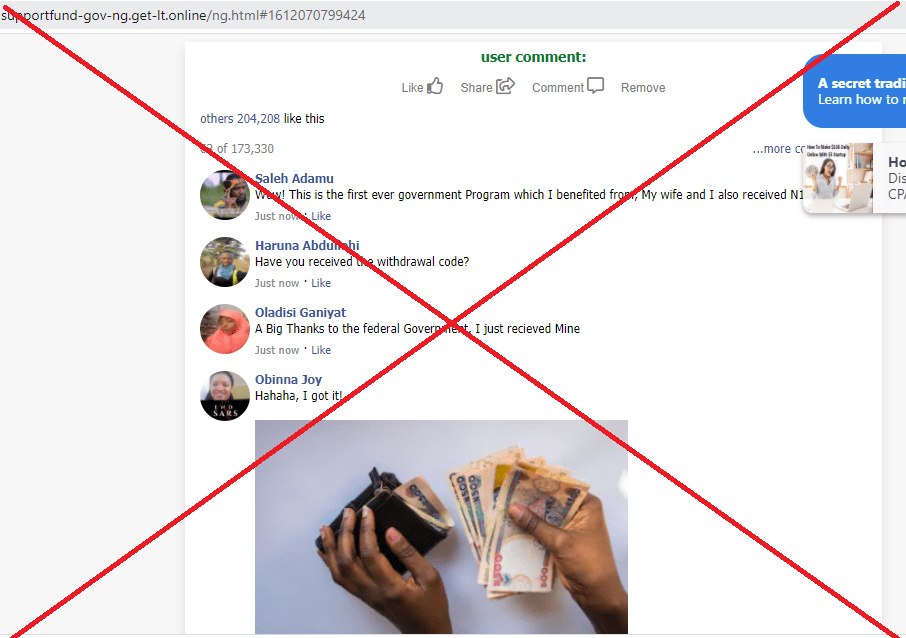
The website also has a comment section – mimicking a Facebook comment plugin. This is also phony as it does not redirect to Facebook as the plugin is expected to work.
The comment section mimicking a Facebook comment plugin.
Furthermore, The FMHDS which coordinates support schemes on behalf of the Nigerian government has no such information on its official website or social media accounts.
The ministry, however, has special funds such as the N75 billion Nigerian Youth Investment Fund (N-YIF) partly managed by the Federal Ministry of Youths and Sport initiated by the Federal Government and the Micro, Small and Medium Enterprises (MSME) Survival Fund.
They are all part of the Nigeria Economic Sustainability Plan (NESP) designed by the Federal Government under the leadership of the Vice President Yemi Osinbajo to reduce the impacts of COVID-19 on the nation’s economy.
Not the first time
This is not the first time that the FactCheckHub is debunking similar claims. The FactCheckHub has debunked similar claims that the Nigerian government is giving out free N50,000 lockdown funds, the National Identity Management is giving out 5GB free data, the Nigerian government is giving N25,000 relief funds , FG giving out grants to support Nigerians etc.
All these claims were false.
They all have the same script of broadcasting the claims via WhatsApp, putting out a phony website link, and asking for multiple shares.
The page the link in the claim directs too.
The FactCheckHub had reported that such claims that masquerade as what they are not, usually target topics and areas that a lot of people are interested in, like relief funds, recruitment, free data.
Sometimes, such websites are set up to obtain people’s information for nefarious purposes or to get traffic so that they can sell advertisements.
Going to the government, institution, agency or a company’s social media handles to see if they have such claims can help one avoid falling victim.
A number of such institutions that attract public interest are verified on social media. Such social media handles usually have the website included in the bio.
In addition, Google-searching information using keywords is another way of verifying claims like this; if it is legit, it may have been reported as news.
THE VERDICT
From the findings presented above, the claim that alludes that due to COVID-19 second wave, the Federal Government is giving out a weekly grant of N1o, 500 to support Nigerians is FALSE.
A video claiming that computer magnate, Bill Gates said that the world should be depopulated starting from the elimination of Africans has resurfaced online and gone viral.
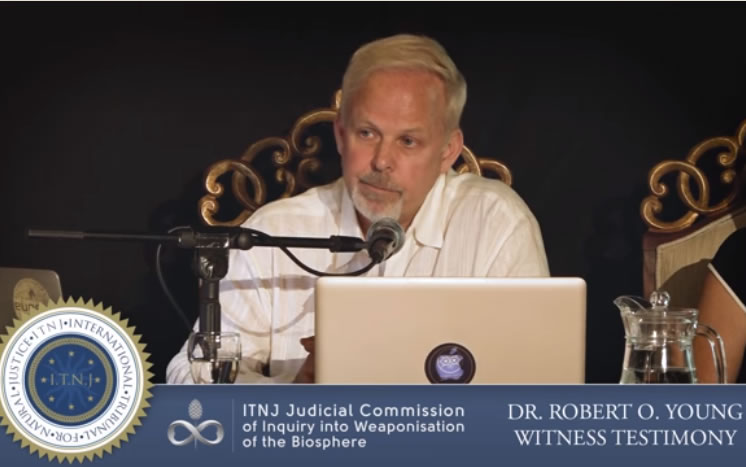
The claim was made by Robert Young, an alternative medicine practitioner.
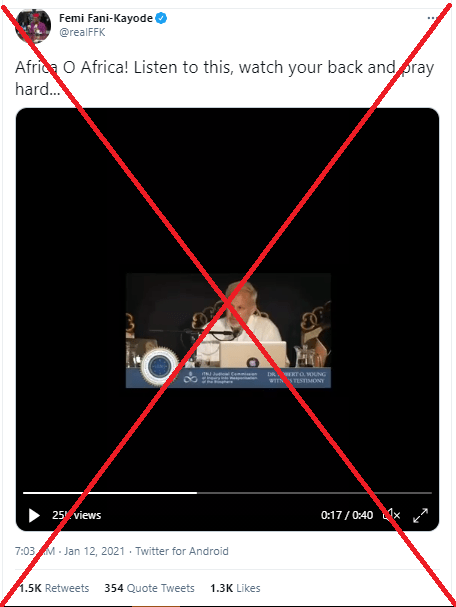
The video was shared on Twitter by Femi Fani-Kayode, a former Minister of Aviation in Nigeria.
He shared it with the caption:
Africa O Africa! Listen to this, watch your back and pray hard…
Fani-Kayode has over 959,000 followers and the video has since garnered over 21,000 views, shared over 1,400 times and liked more than 1,200 times.
The video was also shared on other social media platforms such as Facebook and YouTube.
THE CLAIM
Bill Gates said the world should be depopulated by three billion people, starting with the elimination of Africans.
The tweet by Femi Fani-Kayode.
THE FINDINGS
Did Dr. Young made this assertion or is it a doctored footage?
Through WeVerify, the 40 seconds clip shared by Fani-Kayode was split into frames; while these frames were used in a Google Reverse Image search.
The clip is part of over an hour long video shared by the ITNJ in 2019.
Young made the assertions before the ITNJ Judicial Commission of Inquiry on Weaponisation of the Biosphere.
The panel include: Dr. Nancy Ash, ITJN Trustee; Sacha Stone, ITJN Trustee Emeritus and Sir John Walsh of Brannagh, the ITJN Chief Justice.
Other members of the panel are Bishop Riah Abu El Assal, ITJN Commissioner and Thomas Brown, ITJN Trustee.
Young made the controversial comment when responding to a question from Stone, one of the panelists on if synthetic molecule could be used for human treatment.
He said in part:
For the purpose of sterilisation and population control, there are too many people on the planet that we need to get rid of. In words of Bill Gates, at least 3 billion people need to die. So, we will just start off in Africa.
We start doing our researches there, eliminates most of the Africans because they are deplorable, they are worthless, they are not part of this world economy, so they have their rights taken away, they are suppressed and they are experimented.
Did Gates call for world depopulation by three billion people, starting with the elimination of Africans?
A search on the internet did not produce any result of Gates making the assertion.
Young had said “These are Bill Gates words. Just Google Bill Gates and depopulation and sterilisation. You’ll hear out of his own mouth the plan”.
Gates has been the subject of misinformation and conspiracy theories especially in areas of health, COVID-19 vaccine, population control and 5G network.
This is likely due to his work in Public Health. He has long been a proponent of population control to target the roots of poverty and unrest with a focus on contraception.
On COVID-19, Gates shared concern on the possible rate of transmission due to existing medical issues, weak health facilities, testing capacity among others.
“Poor countries may not be able to reduce the rate of spread unlike the rich countries,” – he told CNBC News in an interview.
In another interview with the Financial Times, Gates expressed optimism that the COVID-19 vaccine maybe made available to everyone globally.
Several claims on Gates linked with depopulation and vaccine have been previously debunked by other fact-checking organisations such Politifact, Snopes, and Reuters.
THE VERDICT
From the findings above, the claim that Bill Gates said that the world should be depopulated by three billion people, starting with the elimination of Africans is FALSE.
A post circulating on social media claims that the National Identity Management Commission (NIMC) is giving out free internet data.
The NIMC is an agency that operates and regulates matters of national identity in Nigeria.
The post retrieved from a WhatsApp group on January 27, 2021 directed people to claim the data via a link.
The post reads:
NIN VERIFICATION Check if Your number have been chosen by NIN to receive 5GB As Part of Verification REWARD Program For Who have been using the SIM for more than three months FOR ALL NETWORK USERS Deadline: 30-01-2021 Click:
THE CLAIM
The National Identity Management Commission (NIMC) is giving out 5GB of data to those who have verified their National Identification Number (NIN).
THE FINDINGS
Checks by the FactCheckHub show that the claim is FALSE.
The FactCheckHub observed that the website attached to the claim is different from the official website of the NIMC.
The website in the claim seeks to gain traffic by prompting people to share.
For instance, the first page of the website asked people to click a link to check if they have been selected for the 5GB NIN data.
The following page asked for mobile numbers, after which it directs people to another page asking them to share the post in 12 WhatsApp groups before having access to the data.
The page directing people to share the post multiple times.
The FactCheckHub also reached out to Kayode Adegoke, Head of Corporate Communications, NIMC, who confirmed that the claim is false.
“This is fake,” he replied to The FactCheckHub’s enquiry via a telephone conversation.
In addition, the FactCheckHub had earlier fact-checked and debunked a similar claim asking people to visit a phishing website.
Such claims masquerade as what they are not, usually target topics and areas that a lot of people are interested in, like relief fund, recruitment, free data.
The objective is often geared towards driving traffic to a website – as it often asks for a link to be shared multiple times.
It could also be a survey website getting people to fill out questionnaires under false pretense.
Sometimes such websites are set up to obtain people’s information for nefarious purposes.
In order to avoid falling victims to such false claim, it is important to verify the information by going to the government, institution, agency or company’s social media handles.
A number of such institutions that attract public interest are verified on social media. Such social media handle usually have the website included in the bio.
Google searching information using keywords is another way of verifying claims like this.
THE VERDICT
The claim that the National Identity Management Commission (NIMC) is giving out 5GB of data to those who have verified their National Identification Number (NIN) is FALSE.
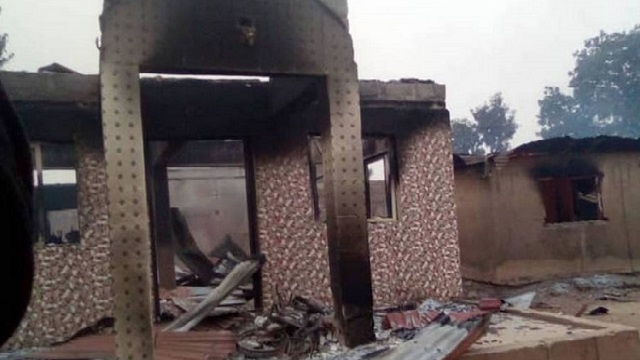
ON January 23, 2021 several images depicting the charred remains of burnt buildings were circulated online. The buildings were said to belong to the Seriki Fulani of Oyo state, Saliu Abdulkadir.
A Twitter user with the handle @MFaarees_ also shared the photos while making a similar claim.
The tweet had over 2,000 likes and shared over 772 times in less than 72 hours.
THE CLAIM
Viral images depict burnt buildings belonging to Seriki Fulani of Oyo state, Saliu Abdulkadir in Igangan, Ibarapa North Local Government of Oyo State.
THE FINDINGS
In Southwest Nigeria, there have been multiple cases of killings and kidnappings for ransom on highways and farmlands. A number of the victims who regained their freedom had reported that their abductors were herders of the Fulani descent.
The Governor of Ondo State, Rotimi Akeredolu, had ordered herders to vacate the forest reserve in the state. This was swiftly countered by the Nigerian Presidency.
Amidst this, Sunday Adeyemo, a promoter of Oduduwa nation had raised alarm over continuous attacks on the Yoruba communities by persons alleged to be herders in the South-west.
Sunday, who is also known as Sunday Igboho, issued a seven-day ultimatum for the herders – who are mainly Fulani – domiciled in Igangan community, Ibarapa North local government area (LGA) to vacate the state.
After his visit to Igangan community, the Seriki Fulani’s house was set ablaze.
This was reported by Sahara Reporters which shared the pictures in question.
In addition, Daily Trust newspaper on Sunday, January 24, also published similar photographs in a report about the crisis in the community.
By Monday, January 25, 2021, Channels Television in a report on the crisis showed footage of Ngozi Onadeko, the new Commissioner of Police, Oyo State Command, during her fact-finding visit to the town. Similar photos were shown in the report.
Three days after the incident, on January 26, Sunday Igboho’s house was set ablaze by unidentified hoodlums, says the Police.
THE VERDICT
The claim that the images depict burnt house of Seriki Fulani of Oyo State, is TRUE.
A photo of what appears to be Nigerian soldiers taking down a flag hoisted by Boko Haram insurgents was shared on social media as taken this year – 2021.
Replacing Boko Haram flag with Nigerian flag, after Boko Haram lost Marte, one of their strongholds. Congratulations brave soldiers of Nigeria.
The tweet which was shared over 1,500 times and liked 6,600 times alludes that the image depicts a recent event where the troops successfully laid ambushed and attacked insurgents at Marte, a town in North-Eastern region of Nigeria.
The photo with similar captions was also shared by other social media users.
@Edrees4P also tweeted the photo with the following captions:
Replacing Boko Haram flag with Nigerian flag, after country’s soldier succeeded the terrorist’s troops in the heart of Sambisa Forest.
THE CLAIM
Photo depicts Nigerian soldiers taking down insurgents’ flag after defeating them in January 2021.
The photo (and claim) as posted on Twitter.
THE FINDINGS
The photo was not taken in 2021. It was also not showing the troops after successfully repelling an attack in Marte this year.
The photo is from 2020, but it however, depicts soldiers removing a hoisted insurgents flag after a successful operation.
Using the Google Reverse Image search, the FactCheckHub traced the photo to a post made in May 2020 on the official Facebook page of the Nigerian Army.
The post also had photos of rescued women, an Armoured Personnel Vehicle, and a deceased Boko Haram Commander, among others.
Picture originally found on verified Facebook account of the Nigerian Army posted in May 2020.
The Army as of May 28, 2020, had released a press statement titled – Terror War: Remarkable Victory for Nigerian military as troops continue to dislodge terrorist camps in the North-East.
In the report, 20 terrorists were neutralised while 241 abductees were rescued. It reads in part:
“During the operation, contact was made with the terrorists which led to an exchange of fire which resulted in the extermination of five (5) terrorists and the capture of the following items: 2 x motorcycles, 2 x bicycles, 1 x amplifier, 1 x battery, 2 x sewing machines and 4 x BHTs’ flags,” the post reads.
“Additionally, the troops moved further to a recently identified Boko Haram terrorists’ infested settlement – Mudu village where 241 kidnapped victims – comprising of 105 women and 136 children were rescued from terrorists’ captivity. The village and other surrounding terrorists’ camps were equally destroyed by the courageous troops.”
Heroes of Nigeria, a dedicated social media platform managed by a non-governmental organisation, shared the photo via its Facebook page on May 28, 2020.
This was also reported by media organisations last year.
THE VERDICT
The findings above show that the claim is MISLEADING. The photo was not taken in 2021. It is also not showing the troops after an operation in Marte. It’s from 2020. However, it depicts the Nigerian soldiers taking down a Boko Haram flag.
THE Punch newspaper on Tuesday, January 19, 2021 reported that the Federal Government of Nigeria told subscribers yet to do the Subscriber Identification Modules (SIMs) linkage with valid National Identity Numbers (NINs) to prepare to face the consequences.
The government had ordered telecommunications companies to deactivate the telephone lines of subscribers who failed to link their SIMs with valid NINs.
January 19 and February 9 were given as deadline for those with and without NINs respectively.
The Punch, in the report published on their website, but now deleted said all SIMs not linked with valid NINs would be blocked following the January 19 deadline. (See the Google cached version of the report here).
THE CLAIM
The National Identity Management Commission (NIMC) threatens Nigerians yet to do the NIN-SIM linkage to prepare for consequences as deadline comes to a close.
Screenshot of the report, which was later deleted by the newspaper.
THE FINDINGS
Findings by the FactCheckHub show that the newspaper relied on information provided by a parody Twitter account of the NIMC in writing the news report.
The report read in part:
The National Identity Management Commission says Nigerians who have not registered and obtained their National Identity Numbers should be ready to face the consequences.
NIMC stated this in a tweet on Tuesday.
“By order of the Federal Government, today is given as the last chance to register your NIMC or face the wrath of what comes next,” NIMC tweeted.
Kayode Adegoke, Head, Corporate Communications, NIMC told the FactCheckHub that the news in circulation is false.
“The news did not emanate from us,” Adegoke said via telephone conversation.
The NIMC has also disclaim the page on its authentic Twitter handle.
Ikechukwu Adinde, the Director of Public Affairs at the Nigerian Communications Commission also stated in a press release obtained by the FactCheckHub that the NIN-SIM linkage has been extended to February 9, 2021.
“At the end of a review meeting on 18th January 2021, the Technical Implementation Committee under the Ministerial Task Force has reported significant progress in the ongoing NIN-SIM linkage exercise.
“So far, a total of 47.8 million NINs have been collected by the mobile operators. At an average of three to four SIMs per subscriber, this means many millions will be linked up before the deadline in February 2021,” he said.
THE VERDICT
The report which claimed that the National Identity Management Commission (NIMC) threatens Nigerians yet to do the SIM-NIN linkage is FALSE because the media house relied on a parody account as the basis for the report.
However, January 19, 2021 was the deadline given for telecommunication companies to deactivate subscribers who failed to link their SIMs with NIN, whereas February 9, 2021 is the deadline for subscribers without NINs.
A message shared on WhatsApp as seen on Friday, January 15, 2021 says experts have confirmed that consumption of palm oil can help curb the spread of Coronavirus (COVID-19).
The claim was attributed to the World Health Organisation (WHO).
It specifically claimed that drinking two spoonful of palm oil every morning would help curb the spread of the virus.
THE CLAIM
WHO says consumption of palm oil can curb the spread of COVID-19.
A screenshot of a claim circulated online that WHO says consumption of palm oil can help stop the spread of coronavirus.
THE FINDINGS
Findings show that the claim is FALSE.
The COVID-19 is a pandemic.
On December 31, 2019, the WHO Country Office in China became aware of the ‘viral pneumonia’ in Wuhan city. The Wuhan Municipal Health Commission issued a media statement on the disease outbreak.
The WHO says it took 98 days for the virus to infect 100, 000 people in Africa and just 18 days thereafter to hit 200, 000 cases.
As of January 15, 2021, 91,816,091 have been infected with 1,986,871 deaths recorded.
On October 22, 2020, the United States Food and Drug Administration announced approval of an antiviral drug Veklury – remdesivir. The drug is the first vaccine for COVID-19 treatment to receive the FDA approval.
By December 31, 2020, the WHO listed Pfizer/BioNTech vaccine as first emergency use for the virus.
“This is a very positive step towards ensuring global access to COVID-19 vaccines. But I want to emphasize the need for an even greater global effort to achieve enough vaccine supply to meet the needs of priority populations everywhere,” Dr. Mariangela Simao, WHO Assistant Director General for Access to Medicines and Health Products stated.
The claim in circulation did not reference any expert or source that can be validated
In addition, the manner at which the message was constructed also defies WHO’s communication pattern.
Charity Warigon, Head of Communication, WHO Nigeria, dismissed the message and distanced the WHO from it.
“This is definitely not a WHO recommendation,” she told The FactCheckHub via a text message.
“In fact, for someone who is coughing, it could be dangerous as they could inhale oil which would be worse off.”
She queried if the claim was ever supported by any data.
“WHO will not make a recommendation without backing it by evidence,” Warigon adds.
She described the post as “another fake news.”
Professor Adebola Olayinka, WHO Infection, Prevention and Control Expert, also shared same position with Warigon.
“No, not true. Another fake news,” she said.
This will not be the first time that a message will be falsely attributed to WHO.
WHO did not send out the message circulating on WhatsApp which recommends that drinking two spoonful of palm oil can curb the spread of COVID-19.
In addition, there is no evidence to back the claim that drinking two spoonful of palm oil can curb the spread of COVID-19; on the contrary, it might aggravate a situation where a person is coughing.
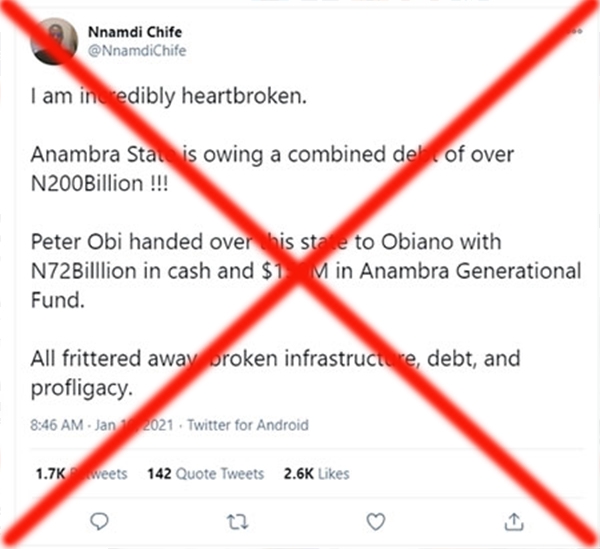
A VIRAL post on Twitter claimed that Anambra State owes a combined debt of over N200 billion.
The claim was made by a Twitter user with the handle @NnamdiChife on January 10, 2021.
The handle currently has over 15,100 followers.
The tweet also stated that the former Anambra State Governor, Peter Obi, handed over N72 billlion in cash and $150 million in Anambra Generational Fund to his successor, Willie Obiano.
The tweet reads: “I am incredibly heartbroken. Anambra State is owing a combined debt of over N200 billion!!! Peter Obi handed over this state to Obiano with N72 billion in cash and $150M in Anambra Generational Fund. All frittered away, broken infrastructure, debt, and profligacy.”
The tweet, which also appeared on a blog here, has been retweeted more than 1,900 times and liked more than 2,700 times as of 8 p.m. on January 10.
A screenshot of the tweet.
THE CLAIMS
From the tweet, these two claims were established:
Anambra State has a combined debt profile of over N200 billion.
Former Governor Peter Obi handed over N72 billion in cash and $150 million to Governor Willie Obiano.
THE FINDINGS
CLAIM 1: Did Anambra State have a combined debt profile of over N200 billion?
Data shows that this claim is FALSE.
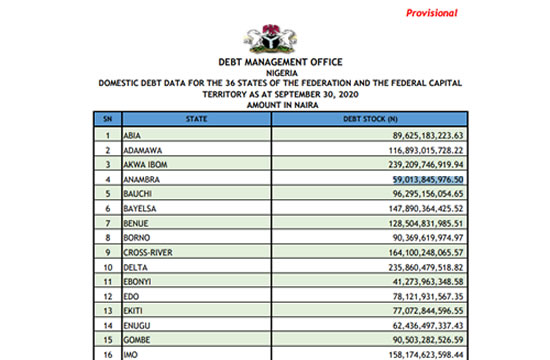
The FactCheckHub checked Nigeria’s Debt Management Office (DMO) website; the government agency in charge of collating the total debts owed by the Federal Government of Nigeria, as well as each state of the Federation.
According to the latest data released by the DMO on 31st of December, 2020 for the domestic debt, Anambra State owed a little over N59 billion (N59,013,845,976.50) as of September 30, 2020.
Screenshot of domestic debt. Source: DMO
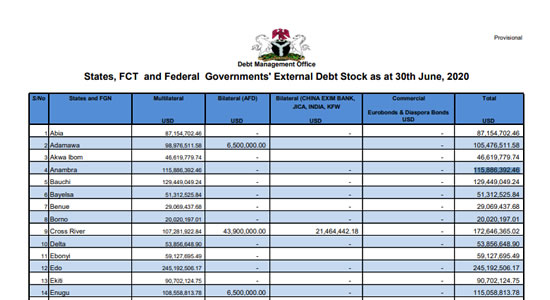
Also, according to the latest data released by the DMO on September 9, 2020, for external debt, Anambra State owed $115,886,392.46 as of 30th June 2020.
Screenshot of external debt. Source: DMO
In a bid to quantify in Naira the total external debt owed be Anambra State, the FactCheckHub converted the total external debt owed by the state, which was in Dollars to Naira.
As of June 30, 2020, the official exchange Dollar to Naira rate was N360 to a dollar. $115,886,392.46 multiply by N360 equals to N41,719,101,286.
The FactCheckHub then add the total domestic debt owed together with the total external debt. (N59,013,845,976.50+N41,719,101,286 = N100,732,947,262).
From the findings, the total debt owed by the Anambra State currently stands at N100,732,947,262.
CLAIM 2: Did Peter Obi hand over N72 billion in cash and $150 million in Generational Fund to Willie Obiano?
It would be recalled that Peter Obi handed over the leadership mantle of Anambra State to Willie Obiano on March 17, 2014.
While there is no publicly available data or document that shows that former Anambra State governor, Peter Obi handed over N72 billion in cash and $150 million in Anambra Generational Fund to his successor, there have been several controversies surrounding the actual amount Peter Obi handed over to Willie Obiano.
For instance, in a report published here, Prof Solo Chukwulobelu, the Secretary to the Anambra State Government stated that the rumour that Peter Obi handed over N75 billion to Willie Obiano is far from the truth.
He said “The N75 billion was not there; it was not handed over to anybody. At best, it can be half-truth”.
Chukwulobelu stated that what Obiano’s administration inherited from Obi was N9 billion cash and N26 billion near cash.
In addition, in 2015, Willie Nwokoye, the Principal Secretary to Governor Obiano said the amount in question included quoted stocks, state counterpart fund, long term investments that are non-earning, refund from the federal government for road construction which was still an IOU, among others.
In the article titled: Dissecting The N75 Billion Handover Brouhaha In Anambra where he gave a breakdown of the items in the hand over note, Nwokoye said “The nearest to cash in the foregoing is item 20, which is a USD 155 million investment in Eurobond and other foreign currency-denominated securities made by the previous administration (Peter Obi) at its twilight. In naira terms, this was worth N26.5 billion at handover.”
In response, Valentine Obienyem, the media aide to Peter Obi said that the former governor handed over N75 billion in cash and investment to his successor.
He stated that the breakdown is as follows: N27 billion in local currency investment; N26.5 billion in foreign currency investment and N28.1 billion in certified state/ MDS balances.
Also, the data from Nigeria’s Debt Management Office (DMO) website revealed that as at December 2013, Anambra State under the leadership of Peter Obi owed N3,025,797,046.67 in domestic debt and a total sum of $30,323,574.40 in external debt.
Why it is difficult to ascertain which of the two parties are right, it is easy to conclude that the claim is MOSTLY FALSE, as the amount in contention has always been N75 billion and not N72 billion as stated in the claim.
In addition, from the reactions of the two parties it can be surmised that the amount in question is made up of cash and long term investments, which the Obiano camp said they are mostly non-earning yet.
THE VERDICT
The claim that Anambra State has a combined debt profile of over N200 billion is FALSE.
The claim that Peter Obi handed over N72 billion in cash and $150 million in Generational Fund to Obiano is MOSTLY FALSE.
SOME media platforms on Thursday, January 7, 2021 reported that Atiku Abubakar, a former Vice President of Nigeria is the first Nigerian to receive the Pfizer-BioNTech COVID-19 vaccine.
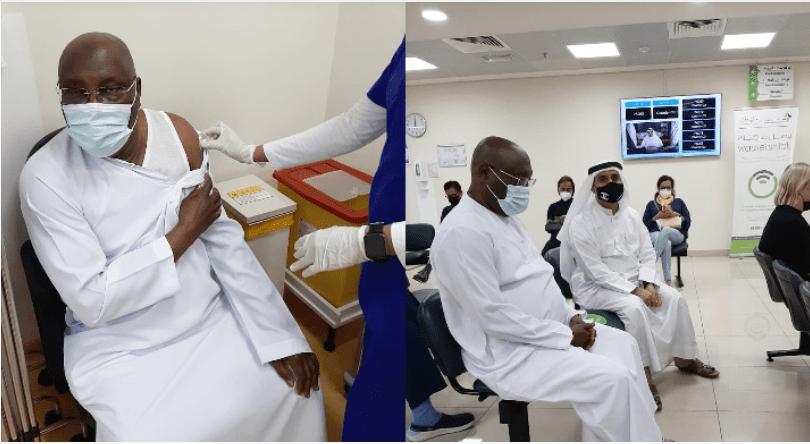
The reports were published alongside a photo of Atiku getting a shot.
However, there were other platforms that reported the news without suggesting that the prominent politician was the first Nigerian to take the vaccination.
The report that Atiku is the first Nigerian to get the Pfizer COVID-19 vaccination generated a lot of discussion online and offline.
THE CLAIM
Atiku Abubakar is the first Nigerian to receive Pfizer COVID-19 vaccine.
A screenshot of a report claiming Atiku Abubakar is the first Nigeria to get Pfizer COVID-19 vaccine.
THE FINDINGS
Findings by the FactCheckHub show that the claim is MISLEADING.
Atiku Abubakar got a shot of the Pfizer COVID-19 vaccine. Dele Momodu, the publisher of Ovation Magazine confirmed the vaccination. So also is Paul Ibe, Atiku’s media aide.
“The importance of the COVID-19 vaccine in mitigating the effect of coronavirus cannot be overstated, particularly in Africa and Nigeria. On Wednesday, as part of the mass vaccination programme, Atiku Abubakar received the Pfizer-BioNTech COVID-19 vaccine,” Ibe stated.
Atiku Abubakar gets vaccinated against COVID-19. PHOTO CREDITS: Dele Momodu.
Following the outbreak of COVID-19 in Wuhan, China in 2019, the disease within a short period was designated a pandemic.
Amidst increasing causalities globally and devastating effects on the global economy, the need to find a cure became a matter of urgency.
In February 2020, the World Health Organisation (WHO) set up a Global Research and Innovation Forum on the virus, with over 300 experts and funders from 48 countries.
It was to ‘identify and fund priority research’ to end the pandemic and prepare for likely future reoccurrence.
In April of the same year, the World Bank joined in the race to strengthen developing country responses to the pandemic.
By November 9, 2020, Pfizer and BioNTech announced a vaccine which was said to be more than 90 per cent effective in preventing the COVID-19 virus.
“This is a very positive step towards ensuring global access to COVID-19 vaccines,” Dr. Mariangela Simao, WHO Assistant Director-General for Access to Medicines and Health, stated in a statement.
This encouraged some countries including the United States to adopt the vaccine, especially for emergency situations.
The European Union (EU), for instance, recently ordered 300 million more vaccines, after its initial 300 million purchase.
The United Arab Emirate (UAE) also adopted Pfizer-BioNTech vaccine and Sinopharm for public use.
“Residents in the capital can book for the vaccine now, free of charge,” health service operator told AFP.
It was against this backdrop that Atiku got vaccinated on Wednesday, January 6, 2021 in Dubai.
Prior to that, Dr. Adaora Okoli, a Nigerian had tweeted a picture of herself getting vaccinated. This was on December 16, 2020.
A screenshot of tweets from Dr Adaora Okoli’s Twitter handle @DrAdaora.
She also tweeted another picture of her taking her second dosage on January 6, 2021.
She tweeted with the hashtag #PfizerCovidVaccine: “As I see more COVID-19 patients, I know I am protected and can give my best to them”.
Okoli survived Ebola. She was infected in Lagos while treating one of the first Nigerian cases of the deadly virus. After recovery, she went to the US to study infectious diseases.
Although, the vaccine is not yet in Nigeria, but Nigerians like Okoli in the countries where the vaccines are available are getting vaccinated.
Okoli’s vaccination pre-dates Atiku’s, as such those media reports that claimed Atiku was the first Nigerian to be vaccinated are misleading.
THE VERDICT
The claim by some media platforms that Atiku Abubakar is the first Nigerian to take the Pfizer COVID-19 vaccine is MISLEADING.