Please note that the FactCheckHub has not obtained any right from the authors or copyright owners of all third-party contents from embedded links and shall incur no liability in this regard.
Please note that the FactCheckHub has not obtained any right from the authors or copyright owners of all third-party contents from embedded links and shall incur no liability in this regard.
Please note that the FactCheckHub has not obtained any right from the authors or copyright owners of all third-party contents from embedded links and shall incur no liability in this regard.
Please note that the FactCheckHub has not obtained any right from the authors or copyright owners of all third-party contents from embedded links and shall incur no liability in this regard.
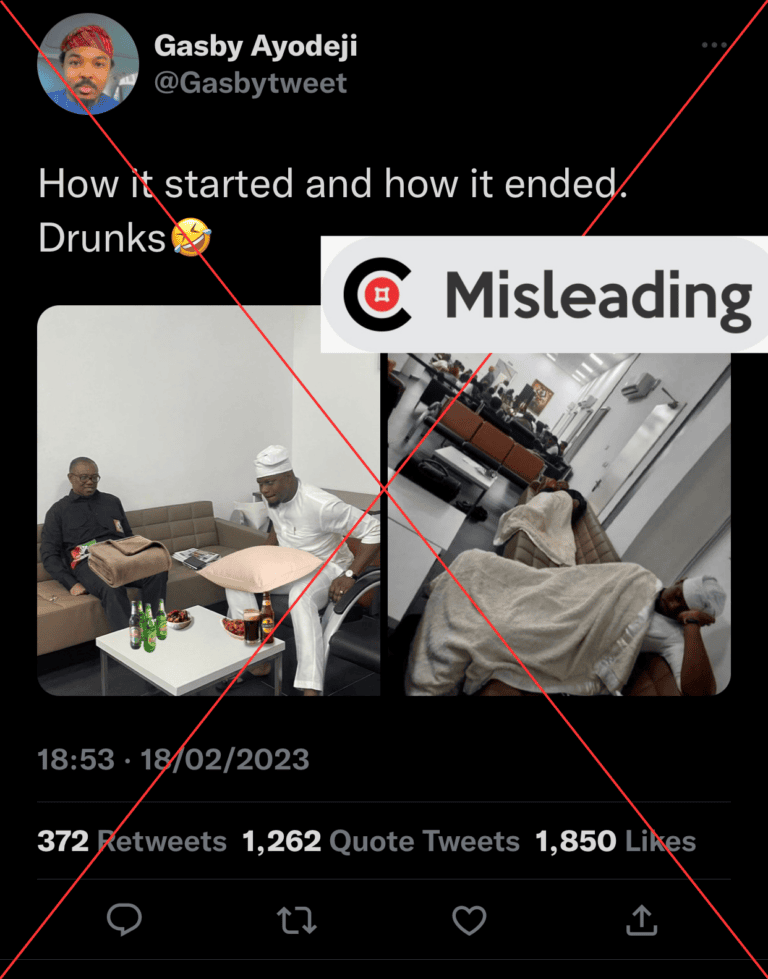
A photo showing the Labour Party’s presidential candidate in Nigeria’s 2023 general election, Peter Obi and the gubernatorial candidate of the party in Lagos State, Gbadebo Rhodes-Vivour, with alcoholic drinks on their table has surfaced online.
The photo is circulating alongside another one which showed the duo taking a nap at the Ikeja Airport in Lagos, with a claim that both of them were drunk and caught sleeping at the Airport.
The image shows four bottles of Hero beer directly in front of Obi and a bottle of Heineken and a glass cup in front Rhodes-Vivour on the shared table.
A Facebook user, Zara Onyinye posted the photo with a caption thus:
HOW IT STARTED AND HOW IT ENDED
PICTURE NO DEY LIE
OBI NA 419
My uncle Obi was not sleeping at all. It was all stages managed
This Man started staging this film after he took his hero beer and got high somehow …
No amount of this yahoo yahoo strategies, campaigns on ethnicity, and religious bigotry can make him the next President of Nigeria.
I did not hate you but his lies is just so much
I sympathize with those covering under race and ecclesiastical small-mindedness supporting Peter Obi and asserting he will be the messiah to unravel Nigeria’s difficulty, records of Peter Obi’s divisiveness, looting from the treasury, and ineptitude then as Governor of Anambra are intact
CLAIM
Photo shows Peter Obi and Gbadebo Rhodes-Vivour with alcoholic drinks on their table.
THE FINDINGS
Findings by The FactCheckHub show that the claim is MISLEADING.
When the FactCheckHub conducted a Google Reverse Image search on the photo, the result shows that the image has been manipulated.
Further checks show that the original image had been shared online, among several others, by a Twitter user, Pearls on February 17, 2023 with a caption thus:
“BREAKING: The Incoming President of Nigeria, HE Peter Obi, is currently meeting with the Incoming Governor of Lagos, Gbadebo Rhodes-Vivor at Ikeja Airport!”
Another Tweep, @Morris_Monye tweeted the original images same day with a caption that read: “Happening now at Lagos Airport. Peter Obi in a chit-chat with Gbadebo Rhodes-Vivour (Incoming Governor of Lagos state under LP).”
In the original image, no bottle was seen on the table of the duo contrary to what the doctored version looked like.
THE VERDICT
The claim that the photo shows Obi and Rhodes-Vivour with alcoholic drinks on their table is MISLEADING; findings revealed that the image has been doctored.
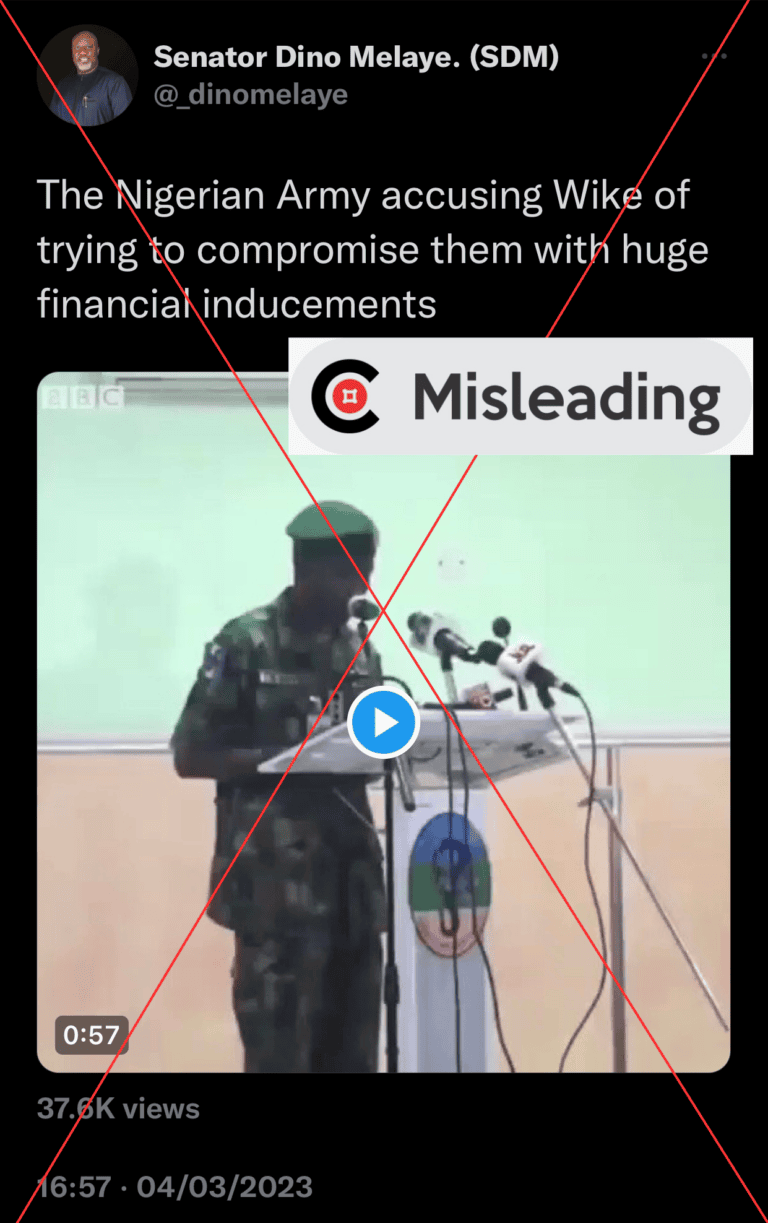
A former Nigerian lawmaker and spokesperson for the Peoples Democratic Party Presidential Campaign Council, Senator Dino Melaye, has tweeted a video with a claim that the Nigerian Army accused Nyesom Wike, Rivers state governor, of attempting to bribe the military to compromise the 2023 general election.
The video shows an army official on podium saying Wike made an attempt to compromise security officials with large sums of money to influence the outcome of the election.
Melaye tweeted the video on March 4, 2023 with a caption that read:
“The Nigerian Army accusing Wike of trying to compromise them with huge financial inducements.”
The tweet has generated over 1,200 retweets and more than 2,700 likes as of Sunday, March 5, 2023.
The video, which has been circulated on several social media platforms including WhatsApp groups, was also tweeted by many Nigerians on Twitter.
A social media influencer, @drpenking tweeted the video with a caption thus:
“The Nigerian Army reportedly accused Wike of attempting to bribe them during the recent presidential election.”
The video posted by @drpenking has been viewed by over 81,000 tweeps on his account and the tweet has also generated over 1,000 retweets and 3,000 likes as of Sunday, March 05, 2023.
A Twitter user, @MorrisMonye, also tweeted the video with a caption thus: “They are waiting for Wike.”
The tweet has also generated over 1,000 retweets and 2,000 likes and viewed by 47,000 tweeps via his account.
CLAIM
Nigerian Army recently accused Governor Nyesom Wike, Governor of Rivers State of attempting to compromise election.
THE FINDINGS
Findings by The FactCheckHub show that the claim is MISLEADING.
When The FactCheckHub subjected the keyframes of the video generated with InVID to multiple reverse image search, the results show that the video has been online since 2019.
In the full video obtained by The FactCheckHub, the Nigerian Army through her then Director of Public Relations Officer, Aminu Ilyasu accused the governor of Rivers State, Nyesom Wike, of making an attempt to bribe security agencies to comprise the 2019 general elections.
Several media outfits such as Sahara Reporter also reported the Army’s allegation against Wike in 2019.
THE VERDICT
The claim that the Nigerian Army recently accused the Rivers State governor, Nyesom Wike, of attempting to compromise the 2023 general election is MISLEADING as the purported video has been online since 2019.
Nigeria’s February 25, 2023 presidential and national assembly elections were the freest and fairest with only a few glitches, according to Ajuri Ngelale, President Muhammadu Buhari’s senior special assistant on public affairs.
Ngelale said this on 1 March 2023 in an interview with Zain Asher, an anchor for the US news channel CNN.
Ngelale, who is also a spokesperson for the APC presidential campaign, likened the failure to upload the results of the polling units to Inec’s results portal to the first-day crash of the Obamacare website in 2013. Obamacare is a term used to refer to the United States’ Affordable Care Act, signed into law by then president Barack Obama to make it easier for US citizens to obtain health insurance.
He also played down the impact of violence on election day.
We fact-checked three claims he made in the interview.
Claim 1
“Political parties are not disputing the actual results.”
In his interview on CNN, Ngelale claimed that the political parties were not disputing the actual results but were only unhappy that the collated results were not displayed on the screen.
However, according to several media reports, political parties are contesting the results of the presidential election on the grounds that they were manipulated.
The PDP, the Labour Party and the NNPP have rejected the results of the presidential election.
Agents of these parties walked out of the national collation centre and refused to sign the presidential result sheet.
They also rejected the declaration of Tinubu as president-elect and accused Inec of compromising the electoral process. These leading opposition parties want the election annulled and a fresh vote held.
Peter Obi, the Labour Party candidate, has said he will challenge the result through “legal and peaceful means”.
Ngelale’s claim is false.
Claim 2
“Election results are supposed to be uploaded to the iRev portal after they have been collated at the ward, local government and state levels.”
Verdict
INCORRECT
Ngelale said the process is that all political party agents sign the polling unit result sheet and “once that result sheet is collated at the ward centre, the local government collation centre and the state centre, it is now sent into that iRev portal”.
iRev is a web portal developed by Inec to enable its staff to upload election results from 176,846 polling units across Nigeria.
The process described by Ngelale is contrary to the plans laid out by the chairman of Inec, Mahmood Yakubu, before the election.
Inec repeatedly promised that polling unit results would be transmitted to the iRev portal on election day, and denied claims that it had abandoned the plan.
Claim 3
“The incident of a woman who voted after her eye was injured during an attack on a polling unit occurred in the South-East.”
Verdict
INCORRECT
CNN anchor Asher, who is British Nigerian, argued that the level of violence recorded on election day affected the credibility of the election.
She referred to a viral video of a woman who returned to vote after receiving first aid for an injury to her right eye when thugs attacked her polling unit.
“Interesting, the example you cited with the woman with her eyes shot. That was actually a vote that took place in the southeastern part of the country, where you are from, that Peter Obi won massively. Labour Party won 90% of the South-East,” he said.
The News Agency of Nigeria, a federal government news agency, reported that the thugs injured Jennifer Seifegha at the Nuru/Oniwo Ward, Polling Unit 065, in Surulere, Lagos, while she was waiting to vote.
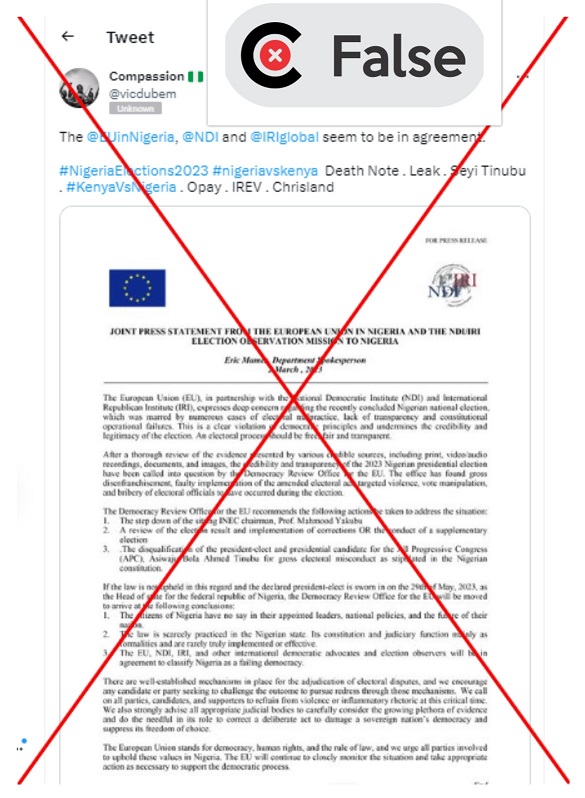
A joint press statement attributed to the European Union (EU) delegation and the NDI/IRI Election Observation Mission to Nigeria calling for the stepping down of the INEC chairman, Professor Mahmood Yakubu and a review of the results of the just-concluded Nigeria’s 2023 presidential and national assembly elections has circulated online.
The statement, attributed to the EU in Nigeria, also called for the disqualification of Bola Ahmed Tinubu, who was the presidential candidate of the All Progressives Congress (APC) in the election, days after the electoral umpire declared him as the President-elect.
The press release stated that if the President-elect is sworn-in, the citizens of Nigeria would have no say in their appointed leaders’ national policies and the future of their nation and the EU, NDI, IRI and other international democratic advocates and election observers will be in agreement to classify Nigeria as a failing democracy.
The statement has been circulating on various social media platforms including Twitter, WhatsApp and Facebook.
A tweep, @vicdubem, tweeted the alleged press statement on March 3, 2023 with a caption thus:
The @EUinNigeria, @NDI and @IRIglobal seem to be in agreement.
CLAIM
The European Union issued a joint press statement with NDI and IRI calling for sanctions on the INEC chairman and the President-elect following the conduct of Nigeria’s 2023 presidential election.
Screenshot of a tweet with the press statement falsely attributed to the EU in Nigeria and NDI/IRI election observers.
THE FINDINGS
Findings by the FactCheckHub show that the claim is FALSE.
A close look at the press statement shows that it wasn’t duly signed by any relevant official – either the Chief Observer or the EU press officer.
In a brief response to the FactCheckHub inquiry on Friday, Agnes Doka, the Press Officer to the Delegation of the European Union to Nigeria and ECOWAS, debunked the claim.
The claim that the EU issued a joint statement with NDI and IRI calling for sanctions on the INEC chairman and Nigeria’s President-elect is FALSE; the EU delegation debunked it.
There has been a surge in misinformation and disinformation as the collation of results of Nigeria‘s 2023 Presidential and National Assembly Elections conducted on Saturday, February 25, 2023 entered the third day.
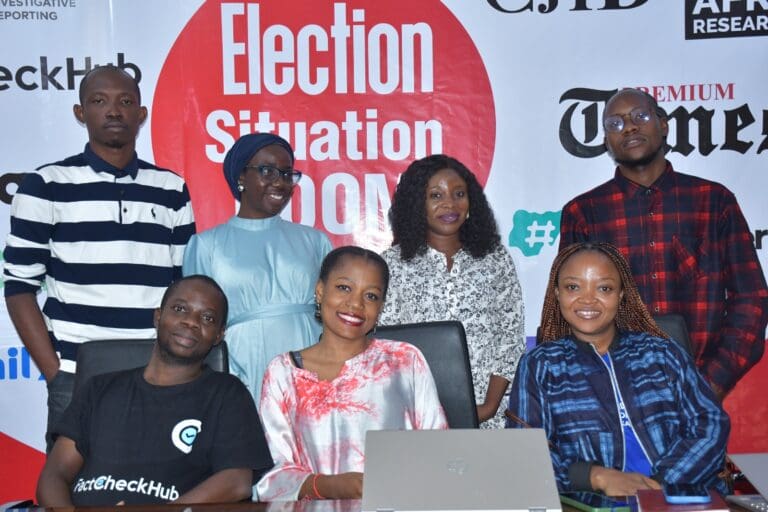
Our team of researchers, fact-checkers, social media monitors, editors, misinformation & disinformation experts drawn from the coalition partners, are working from the Nigerian Fact-checkers’ Coalition’s (NFC) Election Situation Rooms located in Abuja, Lagos and UK, to debunk election-related misinformation and disinformation contents targeted at spreading fake election results, inciting violence or influencing the outcome of election in general.
CLAIM: A breaking news headline posted on Facebook by Page 36 News claims that the PDP’s Atiku Abubakar has become the first 2023 presidential candidate to meet the mandatory 25% requirement of votes cast in at least 24 states.
THE FINDINGS: The Facebook post made on 26 February 2023 provided no evidence. The report differs from the headline. It says Abubakar was “projected to become the first candidate to meet the mandatory 25% requirement of votes cast in at least 24 States”. However, as of 7a.m. on Monday, February 27, 2023, INEC had declared presidential election results from less than 20 states.
VERDICT: INCORRECT
SOURCES: Stears, Channels TV
Claim 2
CLAIM: A Twitter user (@LPLagosInfo) on Monday night claimed that Peter Obi, the Labour Party’s (LP) presidential candidate, has won Anambra State with high margin.
THE FINDINGS: Checks by the NFC on credible media platforms such as ICIR, Punch and Premium Times did not show that there has been an official announcement of the presidential election results from Anambra State as collation of results is still ongoing as of Tuesday morning (February 28).
CLAIM: A Twitter user, #BBTitans (@chiboyskits) claims that INEC chairman, Professor Mahmood Yakubu was feasting at Tinubu’s house a day before the presidential election.
THE FINDINGS: Analysis conducted by the NFC reveals that the alleged video was shared two months ago on CocoTv YouTube channel and other platforms. It originally depicts moments Tinubu and his team were having dinner after his Chatham House appearance on December 5. 2022. Other extended clips from the scene also show that the man in the footage is not the INEC chairman.
VERDICT: INCORRECT
SOURCES: CocoTV and GoldmyneTV (YouTube Channels)
Claim 4
CLAIM: Social media users claim that INEC uploaded election results from Kano for Kaduna Polling Unit on iReV.
THE FINDINGS: Our findings showed that the result uploaded on the INEC iReV portal for PU 18/10/03/015 in Kakuri Gwari Ward/RA in Kaduna South LGA was actually from one of the polling units in Dawaki Tofa LGA of Kano State.
The NFC also observed the same act was replicated in some other PUs in Lagos, Imo and Rivers states where results from some PUs in the North were uploaded instead.
VERDICT: CORRECT
SOURCE: INEC iRev portal
Claim 5
CLAIM: A Twitter user @Naija_Activist tweeted a photo of Babatunde Fashola, Minister of Works and Housing, with the narrative that he’s manipulating results on INEC’S portal.
THE FINDINGS: A Google image lens search shows that the dashboard on the screen is not INEC’s iRev but the Civic Hive’s 2023 election portal. Civic Hive is a Lagos-based civic-tech organisation.
VERDICT: MISLEADING
SOURCE: Google Reverse Image search , Google Lens.
Claim 6
CLAIM: A Twitter user @uchePokoye tweeted a claim that the Labour Party won 40 % of the votes cast nationwide from the polling units gathered across the country.
THE FINDINGS: Results of the presidential election from all the 36 states and the FCT are yet to be announced as the collation is still ongoing as of 11am on Tuesday, February 28, 2023.
VERDICT: INCORRECT
SOURCES: Multiple media reports
Claim 7
CLAIM: A Twitter user Doctor Penking (@drpenking) claims that the INEC scored Labour Party (LP) 0 votes in Obot Akara LGA of Akwa Ibom State meanwhile LP had 135 votes in just 1 polling unit in Obot Akara (Village Hall, Mbakpo Nkap in Nto Edino IV ward).
THE FINDINGS: The tweet includes a screenshot of presidential election result update for Obot Akara local government area, which has 4,477 recorded for the All Progressives Congress (APC) and 8,029 for the Peoples Democratic Party (PDP) in the first two rows. Votes for Labour Party (LP) in the third row and other party listed were yet to be inputted. The completed presidential election results show APC and PDP got the exact number of votes recorded on the screenshot and LP got 2,542 votes.
VERDICT: INCORRECT
SOURCES: Stears, Vanguard
Claim 8
CLAIM: A Twitter user, Adetutu Balogun (@tutsy22) claimed that a University lecturer presented a wrong result at a collation centre.
THE FINDINGS: An extensive Google search revealed that the screenshot shared by Adetutu shows the presidential election results for Oyo State presented by the state collation officer, Professor Olusola Babatunde Kehinde. However, the screenshot of the excel sheet that she tweeted does not capture all the figures in the column which sum up to give the overall results for each political party.
VERDICT: INCORRECT
SOURCES: Channels TV, Daily Trust
Claim 9
CLAIM: A Twitter user Melinda (@frederi63) claims that a polling unit results from Sokoto state was uploaded on INEC result viewing portal (iRev) for a polling unit in Oyigbo Central ward in Rivers state.
THE FINDINGS: The screenshot in the tweet shows the Twitter user referred to the Mayor’s Comp Open Space polling unit in Oyigbo Central ward in Rivers State. We viewed the result uploaded for the polling unit on INEC iRev and confirmed that the uploaded result is from Sokoto State. The polling unit result posted at about 6:27pm on 27 February 2023 is of Kaura Kimba polling unit in Wamakko local government area of Sokoto State.
VERDICT: CORRECT
SOURCE: INEC iRev
Claim 10
CLAIM: A Twitter user @Charles91253085 claimed that there was a protest at INEC office in Abuja on Monday, February 27 following alleged manipulation of the election results.
THE FINDINGS: Using InVid, the NFC discovered that the video had been shared by a Twitter user since Saturday, February 25, 2023 (on the election day).
But contrary to the claim, the incident happened in Warri, Delta State. The protesters were said to have stormed the INEC office in Warri chanting “We must vote”.
The protest was also reported by Punch Newspaper on the same day. Also, there were no media reports of a protest at the INEC office in Abuja by voters on that Monday.
VERDICT: INCORRECT
SOURCES: Punch Newspaper, InVid, Twitter
Claim 11
CLAIM: A Labour Party supporter on Twitter, T. Jay (@Rich_Dawg1), on Tuesday, February 28, tweeted a video with claims that an INEC official is thumb-printing ballot papers.
THE FINDINGS: The alleged video has been online since 2015. It was also reshared during the 2019 elections. Although there is no full context to the clip, the footage does not relate to the ongoing Nigeria’s 2023 elections.
VERDICT: INCORRECT
SOURCE: YouTube (Alex Reports TV )
Claim 12
CLAIM: Former presidential aide, Reno Omokri tweeted that a pastor ‘loyal’ to Labour Party candidate, Peter Obi, is calling for a coup after the elections.
THE FINDINGS: Our findings showed that the said pastor, Prophet Ezenwa Ritabbi, founder of Christ as of Old Ministry in Plateau state, preached with regards to the election on Sunday February 26. The pastor was heard urging his congregation to allow things go as God permits stressing that Nigeria is not worth dying for. On his Twitter page, the pastor also called on INEC to ensure fair collation of the Nigerian election results, warning that doing otherwise may be the end of Democracy in Nigeria. The pastor did not call for a coup at any time.
VERDICT: MISLEADING
SOURCES: YouTube (Prophet Ritabbi- God of now now TV), Twitter.
Claim 13
CLAIM: Some social media users claim that a presidential candidate must secure 25% of votes cast in the FCT before he can be declared a winner.
THE FINDINGS: Section 134 (2) of the Electoral Act 2022 says a candidate must have the majority of votes cast and secure at least 25% of votes cast in at least 24 states in the Federation and the Federal Capital Territory. What this provision means, according to legal experts, is that FCT is included among the 24 states (two-third) hence securing 25% of votes cast in the FCT is not compulsory to deem a presidential candidate winner.
VERDICT: INCORRECT
SOURCE: Electoral Act 2022
Claim 14
CLAIM: A viral WhatsApp video allegedly shows Bola Tinubu, the presidential candidate of the APC, condemning party members in some parts of Lagos over their failure to win their Local Government Areas (LGAs).
THE FINDINGS: An InVid analysis shows the video is unrelated to the current election. NFC found a version that was posted four years ago on LinkedIn.
VERDICT: INCORRECT
SOURCE: LinkedIn
Claim 15
CLAIM: A video sourced from Arise TV and shared by a Twitter user (@princejoseph0), shows the PDP chairman, Iyorchia Ayu, saying Bauchi and Gombe States have exactly the same results.
THE FINDINGS: Live results published by Civic Hive, and Dataphyte, collated from the iREV and declared at the National Collation Centre, shows Bauchi and Gombe do not have the same results. In Bauchi, APC had 316,694; PDP 426,607; NNPP 72,103, and LP 27,373.
APC had 146,977, PDP-319,123, NNPP-10,520 and LP-26,160 in Gombe.
Live results from Gombe State collation centre support this finding.
CLAIM: A Facebook user claims president Muhammadu Buhari has approved former president Olusegun Obasanjo’s letter to cancel the election.
THE FINDINGS: Former president Olusegun Obasanjo, issued a statement on 27 February, appealing to President Muhammadu Buhari to cancel elections that do not pass the credibility and transparency test. Responding to this, a statement by the Minister of Information and Culture, Lai Mohammed, said Obasanjo’s letter was a “willful incitement of violence” and asked him not to truncate the elections with his “inciting, self-serving and provocative letter”. The statement added that anyone dissatisfied with the outcome of the elections should follow the necessary legal procedures. At no point did President Buhari approve President Obasanjo’s request to cancel the election.
VERDICT: INCORRECT
SOURCE: Federal Ministry of Information and Culture
Claim 17
CLAIM: A Facebook user, Sagacious Bello Lukman, claims that the Labour Party (LP) candidate Peter Obi won the presidential election in all six area councils in the Federal Capital Territory, Abuja.
THE FINDINGS: The Facebook post got the number of votes pulled by the top contenders right. However, it was incorrect to claim that Obi won all six area councils in the FCT. Media reports of the results announced by the Independent National Electoral Commission (INEC) show that Obi won in four area councils while the candidate of the ruling All Progressives Congress (APC), Bola Tinubu, won in two LGAs.
VERDICT: INCORRECT
SOURCE: Premium Times
READ NIGERIA’S 2023 GENERAL ELECTION LIVE-CHECKS BELOW:
*This live-check was jointly researched and written by members of the Nigerian Fact-Checkers’ Coalition (NFC): Nurudeen Akewushola, Faith Abeka, Fatimah Quadri (FactCheckHub); Rosemary Ajayi (Digital Africa Research Lab); Daniel Adaji (The Insight); Elizabeth Ogunbamowo, Lois Ugbede, Cole Praise, Silas Jonathan, Temilade Onilede, Lateef Sanni (Dubawa); Catherine Adeniyi, Motunrayo Joel, Allwell Okpi, Seyi Awojuyigbe, Fatimah Abubakar, Abisola Olasupo (Africa Check); Rejoice Ewodage, Hannah Ajakaiye (FactsMatterNG), Shehu Olayinka and Bamas Victoria (ICIR).
It was edited and approved for publication by Kemi Busari, Caroline Anipah, Simbiat Bakare (Dubawa), David Ajikobi (Africa Check), Ajibola Amzat, and Opeyemi Kehinde (FactCheckHub).
Since Nigeria’s 2023 Presidential and National Assembly Elections were conducted on Saturday, February 25, 2023, there have been many claims circulating online and on some traditional media as results are being collated from various polling units across the country.
Our team of researchers, fact-checkers, social media monitors, editors, misinformation & disinformation experts drawn from the coalition partners, are working from the Nigerian Fact-checkers’ Coalition’s (NFC) Election Situation Rooms located in Abuja, Lagos and UK, to debunk election-related misinformation and disinformation contents targeted at spreading fake election results, inciting violence or influencing the outcome of election in general.
You may also read our prime Election Day LIVE-CHECKS here
This page is constantly being updated with verified checks. Kindly scroll downward to read them.
Here are the live-checks:
Claim 1
CLAIM: Peoples Gazette headline reads that soldiers shoot ‘Oluomo’ dead at collation centre.
THE FINDINGS: From the comment section, the NFC observed that some social media users were curious about which Oluomo was actually killed. Although the report states that PDP supporter Akinlabi Akinnaso, also known as Oluomo, was shot dead, reactions from commenters indicate confusion, prompting our check. The deceased is not the popular Lagos State NURTW chairman, MC Oluomo.
VERDICT: MISLEADING.
SOURCES: Vanguard Newspaper, Punch Newspaper
Claim 2
CLAIM: A Twitter user @drpenking tweeted an image that showed the Labour Party got 29,568 votes in Agege and claimed INEC switched the results to APC and reduced the numbers for Labour Party to 13,270.
THE FINDINGS: Updates from various news outlets shows that APC won the Labour Party by a landslide in Agege local government area. We collated the results for each party and found that APC actually had 29,568 votes while Labour Party had a lesser total number of votes.
VERDICT: INCORRECT
SOURCES: Multiple media reports
Claim 3
CLAIM: The headline of a news report on ejesgist.ng claims that the presidential candidate of the Peoples Democratic Party (PDP), Atiku Abubakar, defeated the All Progressives Congress (APC) candidate, Bola Tinubu, to win all 20 local government areas in Osun State.
THE FINDINGS: Osun State has 30 local government areas. INEC result viewing portal shows that polling unit results of the 2023 presidential election have been uploaded from all 30 local government areas. The results declared at the national collation centre show that Atiku won 20 local governments while Tinubu won the remaining 10 LGAs.
VERDICT: MISLEADING
SOURCES: INEC IRev portal, Multiple media reports
Claim 4
CLAIM: Bashir Ahmad, Special Assistant on Digital Communications to Nigerian President Muhammadu Buhari, on his Twitter handle, claims that APC has won the elections in 14 states, PDP in 7, LP in 4 and NNPP in 1.
THE FINDINGS: Reports by credible media platforms such as Channels TV and Premium Times reveal that INEC has declared the results of only one state, Ekiti, out of the 36 States in Nigeria as of 9am on Monday.
VERDICT: INCORRECT
SOURCES: Channels TV, Premium Times
Claim 5
CLAIM: Social media users say the image uploaded on INEC’s IReV for Ekiti polling unit, not the result sheet.
THE FINDINGS: NFC’s visit to the INEC IReV portal confirms the report to be true. The image uploaded on the portal, as of 10am on Monday, February 27, differed from the INEC result sheet for the polling unit with code 13/01/02/001 under Ado ‘B’ Inisa Ward/RA in Ado Ekiti local government area. It rather contained the image of a young lady in a room.
VERDICT: CORRECT
SOURCE: INEC IReV Portal
Claim 6
CLAIM: A Twitter user, @NajibHaruna_, claimed that Ibrahim Bello Muhammad, 27, the newly elected House of Reps member in Kebbi State is the youngest federal lawmaker in Nigeria’s history.
THE FINDINGS: Findings show that Gabriel Saleh Zock of the APC, a first-term member representing Kachial/Kagarko Federal Constituency of Kaduna State is currently the youngest lawmaker in the House of Representatives. Gabriel was born on November 20, 1985. He became a lawmaker at the age of 34. If Bello is sworn in, he would break the record.
VERDICT: CORRECT
SOURCES: Multiple media reports
Claim 7
CLAIM: A post shared on Facebook claimed that thugs have set fire to shops owned by Igbo traders in Ladipo market in Lagos. The post has also been circulated on WhatsApp.
THE FINDINGS: Checks showed that the video was from a 2022 fire incident in the market. Nosa Okunbor, the public relations officer of the Lagos State Emergency Management Agency (LASEMA), also said he has not received a report of any fire incident in the market as of Monday, February 27, 2023.
VERDICT: INCORRECT
SOURCES: LASEMA, Google reverse image search
Claim 8
CLAIM: Social media users claimed that Peter Obi, the Labour Party’s (LP) presidential candidate, has polled over 1 million votes in Plateau State.
THE FINDINGS: The result is yet to be announced officially by the Independent National Electoral Commission (INEC) as of 2.30 p.m. on Monday, February 27, when this report was filed. However, TheCable’s report on votes polled in Plateau State showed that Mr Obi had so far won eight LGAs while PDP won 2 LGAs out of the 17 LGAs in the state. In total, the LP presidential candidate polled 301,905 votes in Plateau state.
VERDICT: MISLEADING.
SOURCE: TheCable Newspaper
Claim 9
CLAIM: A one-minute and 38 seconds TikTok video circulating on WhatsApp claims that “Ekiti election 2023 is fake results.”
THE FINDINGS: The original video, which is 22 minutes long, was posted on YouTube nearly eight years ago, precisely on March 31, 2015. It shows the moment a former minister of Niger Delta, Godsday Orubebe, who was an agent of the Peoples Democratic Party (PDP) disrupted the national collation and announcement of the 2015 presidential election results on the same day the video was posted online.
VERDICT: INCORRECT
SOURCES: YouTube, Premium Times, Punch newspaper
Claim 10
CLAIM: A Twitter user, Senior man (@her_genie) made a post with a pictorial chart of Premium Times’ election result dashboard revealing several numbers of votes scored by the top four candidates in the presidential election on Monday, February 27, 2023.
THE FINDINGS: The Premium Times official dashboard shows that the votes for the Labour Party, PDP, APC and NNPP had been doctored in the graphic shared by the Twitter user. Also, the chart in the post had also been rearranged by political parties with PDP first, followed by APC, LP and then NNDP instead of LP, PDP, APC and then NNDP.
Another detail that was excluded in the doctored chart is the total votes by states and the total votes by percentage (%), which is seen in the Premium Times dashboard. The graphic also missed the mark on the votes of senatorial district measured, which was 5,000, instead of 500,000 on the newspaper’s dashboard.
VERDICT: INCORRECT
SOURCE: Premium Times
Claim 11
CLAIM: A viral WhatsApp claim has circulated challenging the authenticity of Labour Party’s (LP) votes (11,397) in Ekiti state.
THE FINDINGS: According to the ICIR‘s report on the presidential election results in Ekiti state, the total vote cast was 314,472 and the valid vote cast was 308,171. In the report, APC had 201,494 votes; PDP had 89,554 while LP had 11,397.
Thus, if you subtract 302,445 from 308,171, you will get 5,726. Therefore, the total number of votes from the remaining parties was 5,726. The total number of accredited votes according to the claimant is inaccurate.
VERDICT: INCORRECT
SOURCE: ICIR
Claim 12
CLAIM: An Instagram post by Tunde Ednut (@mufasatundeednut) asserts that the presidential candidate of the Labour Party, Peter Obi, won Owerri West Local Government Area (LGA) in Imo state and Ndola West LGA in Delta state.
THE FINDINGS: So far, no comprehensive report is available for both LGAs. In Imo state, INEC started collation of the presidential election results from the 27 local government areas of the state and later suspended collation in Nkwerre/Nwangele/ Njaba/ Isu Federal Constituency of Imo State.
A report by ThisDay also noted that INEC rejected election results presented at the commission’s state office in Asaba for Ika North-east Local Government due to discrepancy in the figures presented.
VERDICT: INCORRECT
SOURCES: Punch and ThisDay newspapers
Claim 13
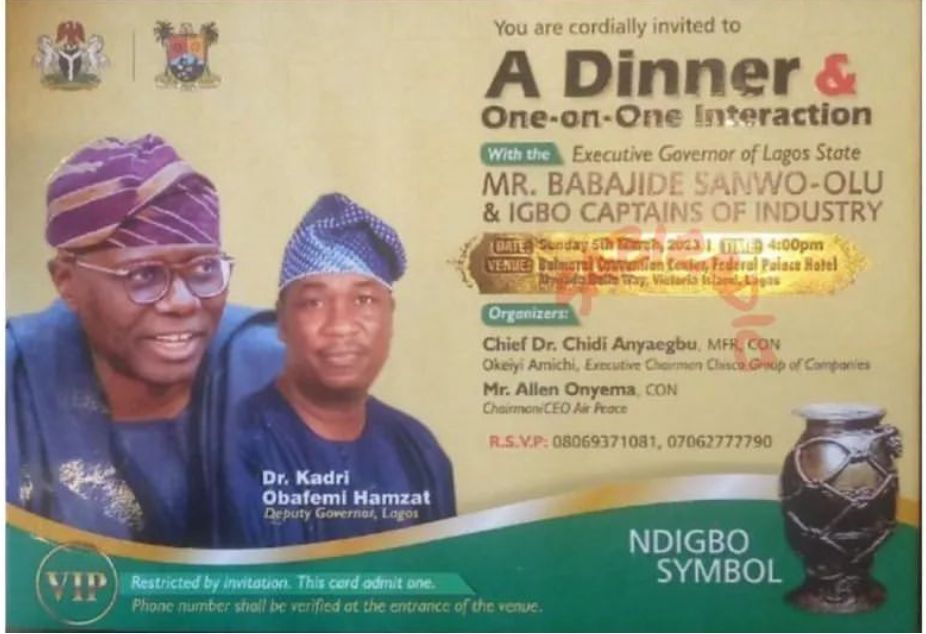
CLAIM: An invitation card with a claim that Babajide Sanwo-Olu, the Lagos state governor is holding a dinner and one-on-one conversation with the Igbo captain of industry is doing rounds on WhatsApp.
THE FINDINGS: As Bola Tinubu lost Lagos state, his historical stronghold, to the Labour Party (LP) following Saturday’s presidential election, there are speculations that the Lagos state governor is trying to get the Igbos in the state to vote for him in the forthcoming March 11 governorship election. Jubril Gawat, Sanwo-Olu’s senior special assistant on new media, debunked the claim in a tweet with a version of the invitation card stamped with “Fake News” on Monday, February 27, 2023.
VERDICT: INCORRECT
SOURCE: Jubril Gawat, senior special assistant to the Lagos state governor on new media.
*This live-check was jointly researched and written by members of the Nigerian Fact-Checkers’ Coalition (NFC): Nurudeen Akewushola, Faith Abeka, Fatimah Quadri (FactCheckHub); Rosemary Ajayi (Digital Africa Research Lab); Daniel Adaji (The Insight); Elizabeth Ogunbamowo, Lois Ugbede, Cole Praise, Silas Jonathan, Temilade Onilede, Lateef Sanni (Dubawa); Catherine Adeniyi, Motunrayo Joel, Allwell Okpi, Seyi Awojuyigbe, Fatimah Abubakar, Abisola Olasupo (Africa Check); Rejoice Ewodage, Hannah Ajakaiye (FactsMatterNG), Shehu Olayinka and Bamas Victoria (ICIR).
It was edited and approved for publication by Kemi Busari, Caroline Anipah, Simbiat Bakare (Dubawa), David Ajikobi (Africa Check), Ajibola Amzat, and Opeyemi Kehinde (FactCheckHub).
RESULTS from various polling units across the country have started trickling in from several collation centres following the conduct of Nigeria’s 2023 Presidential and National Assembly Elections on Saturday, February 25, 2023.
Our team of researchers, fact-checkers, social media monitors, editors, misinformation & disinformation experts drawn from the coalition partners, are working from the Nigerian Fact-checkers’ Coalition’s (NFC) Election Situation Rooms located in Abuja, Lagos and UK, to debunk election-related misinformation and disinformation contents targeted at spreading fake election results, inciting violence or influencing the outcome of election in general.
It will be recalled that 18 candidates are seeking to succeed Nigeria’s current president, Muhammadu Buhari, through the ballot while 4,223 candidates are contesting for 469 federal legislative positions as announced by the INEC for the Senatorial and House of Representatives elections.
This page is constantly being updated with verified checks. Kindly scroll downward to read them.
Here are the live-checks:
Claim 1
CLAIM: An APC supporter with the Twitter username @DOlusegun claimed TheCable’s report on LP performance at Gbajabiamila’s polling unit is false.
THE FINDINGS: Our findings showed that the result uploaded by TheCable Newspaper is for the presidential election in which the Labour Party polled 89 as against the APC’s 69. A journalist affiliated with the Center for Journalism Innovation and Development (CJID) confirmed this to the NFC.
The social media user mistook it for the result of the Senatorial election, where the APC topped the chart.
VERDICT: MISLEADING.
SOURCE: Media Observer, News report.
Claim 2
CLAIM: An APC supporter with the Twitter username @Tinubufrontier claimed Bola Tinubu had won about seven local government areas in Yobe State.
THE FINDINGS: Anna Charles, a media observer affiliated with the Center for Journalism Innovation and Development (CJID), told the NFC that the results bandied around on social media were false as official results had yet to be compiled at the collation centre.
VERDICT: INCORRECT.
SOURCE: CJID Observer
Claim 3
CLAIM: A Twitter user, Comrade Moh (@I_Am_marwa), claims Senator Datti Baba-Ahmed, Labour Party’s VP candidate, was voted only by his wife and children at his polling unit.
THE FINDINGS: The Labour Party’s VP polling unit is 021 at Tudun Wada ward in Zaria Local Government Area of Kaduna State. Based on reports by the Punch Newspaper and TheCable, there were 272 accredited voters at the polling unit.
PDP won the polling unit with 102 votes, followed by the APC with 98 votes, while LP came third with 54 votes, and the NNPP secured 11 votes.
VERDICT: INCORRECT.
SOURCE: Punch and TheCable Newspapers
Claim 4
CLAIM: A claim circulates on WhatsApp with results that APC and PDP are leading in Kwara, Ekiti, Osun, Ogun and Oyo states with 6,111,796 and 4,367,845, respectively.
THE FINDINGS: Results in the aforementioned states are still being collated, and the final results are yet to be announced as of 11.25a.m. of Sunday, February 26, 2023. Also, updates from multiple news platforms did not support this claim.
VERDICT: MISLEADING.
SOURCE: Multiple news sources
Claim 5
CLAIM: A viral claim circulated by social media users on WhatsApp and Twitter claims that INEC has extended elections in 16 states.
THE FINDINGS: Rotimi Oyekanmi, Chief Press Secretary to the INEC chairman clarified that the news is not from the commission.
Additionally, INEC’s national chairman on voter’s education, Festus Okoye, debunked the news as fake. He stated that “INEC did not extend the voting period in 16 States. The narrative is fake and the public should disregard it entirely.”
VERDICT: INCORRECT
SOURCE: INEC
Claim 6
CLAIM: A Twitter parody account with the name Niyi Akinsiju and the username @Agbaakinlmodoye claimed APC has won four local government areas in Lagos state.
THE FINDINGS: A check on the INEC IReV portal by the NFC shows that the results posted by Akinsiju were misleading as the electoral body is yet to collate results for all the Wards/RA in the mentioned local government areas: Alimosho; Ikeja; Ajeromi-Ifelodun and Amuwo Odofin.
VERDICT: MISLEADING.
SOURCE: INEC IReV portal, Media Observer.
Claim 7
CLAIM: A viral report claimed operatives of the Economic and Financial Crimes Commission (EFCC) stormed the residence of Peter Obi, presidential candidate of the Labour Party (LP), during the elections.
THE FINDINGS: When contacted, Wilson Uwajuren, the spokesperson of the EFCC, told the NFC that the agency only deployed officials to the polling stations to monitor the elections and did not visit the house of any candidate. Also, Labour Party spokesperson, Yunusa Tanko, debunked the claim. We also found that the photo was that of EFCC officials’ visit to Ward C, PU 085 Alausa, Ikeja, on Saturday.
VERDICT: INCORRECT.
SOURCE: EFCC’s spokesperson, LP PCC spokesperson, Media report.
Claim 8
CLAIM: There have been viralclaims that Prof Pat Utomi, a Labour Party Chieftain, was held hostage by thugs at a collation centre in Victoria Island, Lagos state.
THE FINDINGS: Labour party spokesperson, Yunusa Tanko, has debunked the claim. Similarly, PPRO Police State Command, Benjamin Hundeyin, told the NFC that he is unaware of the situation. Prof. Pat Utomi also confirmed that “he is fine” and described the claim as false.
VERDICT: INCORRECT
SOURCE: Prof. Pat Utomi, Yunusa Tanko, Benjamin Hundeyin
Claim 9
CLAIM: A Twitter account, PDP New Media (PDP_NEWMEDIA) claimed that the PDP presidential candidate, Atiku Abuubakar, has secured 25% in about 25 states.
THE FINDINGS: There has not been an official announcement of results by INEC at the national collation centre in Abuja, Nigeria’s capital. At state level, only results from Ekiti State have been announced so far as of 2.15p.m. when this fact check was filed.
VERDICT: INCORRECT
SOURCES: Media reports
Claim 10
CLAIM: Reno Omokri posted a graphic on his Instagram page claiming the PDP presidential candidate, Atiku Abubakar, is leading with 25% in 25 states.
THE FINDINGS: INEC is yet to post conclusive results on the presidential elections. INEC’s National Commissioner, Festus Okoye, told Channels TV at 3:45 pm on Sunday, February 26, 2023 that the electoral body will announce the full presidential election results at the national collation centre in Abuja.
VERDICT: MISLEADING
SOURCES: INEC, Channels TV
Claim 11
CLAIM: An online post claims that the Labour Party (LP) has called for the cancellation of the ongoing presidential election as INEC cannot upload results from the polling units into its server.
THE FINDINGS: LP, in a press release on its website, condemned the delay, but the party did not seek cancellation of the results.
VERDICT: INCORRECT
SOURCE: Labour Party’s website.
Claim 12
CLAIM: A Twitter user, Quinn (@Quinn_Tweets), shared an image showing the Labour Party is leading the polls by 36%, followed by the PDP by 27% and the APC by 24%.
THE FINDINGS: A reverse image search shows it is a screenshot of an opinion poll conducted on January 27, 2023, by Nextier. The viral image was shared after cropping parts showing it is a pre-election poll. The poll was shared by Nextier on Twitter on February 5, 2023. Figures from INEC’s Result Viewing Portal (IReV) show otherwise.
VERDICT: INCORRECT
SOURCE: Nextier
Claim 13
CLAIM: A Twitter user, Chigoziel Alex (@ChigozielAlex), claimed that the election did not hold in Awo-Omamma, Oru East Local Government Area of Imo State, yet election results have been uploaded.
THE FINDINGS: The CODE Observer in Imo State, Chigoziri Osuji, confirmed to NFC that the claim is true as no election was conducted at the location; however, results were uploaded. CJID Observer, Igwe Ugochukwu, in Imo State also confirmed that the election didn’t occur due to a sit-at-home order.
VERDICT: CORRECT
SOURCES: CODE and CJID Observers
Claim 14
CLAIM: A WhatsApp message that has gone viral and published by Igbo Times Magazine on Facebook claims that former Nigerian President, Olusegun Obasanjo, stormed INEC’s collation centre in Abuja with election results from the 36 states in Nigeria.
THE FINDINGS: A Premium Times reporter at the collation centre, Qosim Suleiman, noted that the former president was not there. He also shared picture evidence of what the collation centre looks like as of 7p.m on Sunday night, revealing those present.
A reverse image search also showed one of the images shared via Twitter was from a meeting between Atiku and Obasanjo reported by Channels Television in 2019. The collation of results is still ongoing.
VERDICT: INCORRECT
SOURCES: Premium Times reporter and Google reverse image search
Claim 15
CLAIM: Viral video shared by Blessing Okagbare (@mountain214), a Nigerian professional Athlete, claimed that INEC erased election results as of 7am on Sunday, Feb. 26 from their portal.
THE FINDINGS: NFC visited INEC’s Result Viewing Portal (IReV) and found election results are still available on the portal. The current figure shows 45,886 results have been submitted for 176,846 polling units.
VERDICT: INCORRECT
SOURCE: INEC IReV
Claim 16
CLAIM: A Twitter user DrUmaru_AJ (@Princeujay), alleged Ekiti election results were uploaded as far back as February 20.
THE FINDINGS: Election result details seen on INEC’s Result Viewing Portal (IReV) show the result for Ekiti was uploaded on Sunday, February 26, 2023.
We also observed that the image shared with this tweet does not look like INEC’s IReV portal.
VERDICT: INCORRECT
SOURCE: INEC IReV
*This live-check was jointly researched and written by members of the Nigerian Fact-Checkers’ Coalition (NFC): Nurudeen Akewushola, Faith Abeka, Fatimah Quadri (FactCheckHub); Rosemary Ajayi (Digital Africa Research Lab); Daniel Adaji (The Insight); Elizabeth Ogunbamowo, Lois Ugbede, Cole Praise, Silas Jonathan, Temilade Onilede, Lateef Sanni (Dubawa); Catherine Adeniyi, Motunrayo Joel, Allwell Okpi, Seyi Awojuyigbe, Fatimah Abubakar, Abisola Olasupo (Africa Check); Rejoice Ewodage, Hannah Ajakaiye (FactsMatterNG), Shehu Olayinka and Bamas Victoria (ICIR).
It was edited and approved for publication by Kemi Busari, Caroline Anipah, Simbiat Bakare (Dubawa), David Ajikobi (Africa Check), Ajibola Amzat, and Opeyemi Kehinde (FactCheckHub).
As Nigerians head to the poll on Saturday, February 25, 2023, for Nigeria’s 2023 Presidential and National Assembly Elections, the Nigerian Fact-checkers’ Coalition (NFC) brings you live-check of election-related misinformation and disinformation spreading online and on television on Election Day.
Do you have any election-related claim you want us to fact-check?
This page is constantly being updated with verified checks. Kindly scroll downward to read the latest checks.
Eighteen candidates are seeking to succeed the nation’s current president, Muhammadu Buhari, through the ballot. Those cleared by the Independent National Electoral Commission (INEC) include Asiwaju Bola Ahmed Tinubu of the All Progressives Congress (APC); Atiku Abubakar of the Peoples Democratic Party (PDP); Peter Obi of the Labour Party (LP); Osita Nnadi of the Action Peoples Party (APP); Abiola Kolawole of the Peoples Redemption Party (PRP); Rabiu Musa Kwankwaso of the New Nigeria People’s Party (NNPP); Yabagi Sani of the Action Democratic Party (ADP); and Ado-Ibrahim Abdulmalik of the Young Progressives Party (YPP).
Others are: Omoyele Sowore of the African Action Congress (AAC); Ojei Chichi of the Allied Peoples Movement (APM); Peter Umeadi of the All Progressives Grand Alliance (APGA); Oluwafemi Adenuga of the Boot Party (BP); Daniel Nwanyanwu of the Zenith Labour Party (ZLP); Dumebi Kachikwu of the African Democratic Congress (ADC); Hamza Al-Mustapha of the Action Alliance (AA); Adebayo Adewole of the Social Democratic Party (SDP); Okwudili Anyajike of the National Rescue Movement (NRM); and Christopher Imumolen of the Accord Party (AP).
Similarly, 4,223 candidates contesting for 469 federal legislative positions were earlier cleared by the INEC for the Senatorial and House of Representatives elections holding today.
Our team of researchers, fact-checkers, social media monitors, editors, misinformation & disinformation experts drawn from the coalition partners, are working from the coalition’s Election Situation Rooms located in Abuja, Lagos and UK, to debunk misinformation and disinformation contents targeted at inciting violence and voter’s apathy on Election Day or influencing the outcome of election.
Here are the live-checks:
Claim 1
CLAIM: The presidential candidate of the Labour Party (LP), Peter Obi, has withdrawn from the race and has asked his supporters to vote for Atiku Abubakar of the Peoples Democratic Party (PDP).
THE FINDINGS: The chief spokesperson of the Labour Party’s Presidential Campaign Council, Dr Yunusa Tanko, has debunked the viral claim in a press conference. He said Obi is still in the race. Also, a search on the official Twitter handle of the LP presidential candidate showed he is still contesting as he urged his supporters to cast their votes in his favour.
VERDICT: INCORRECT.
SOURCE: Dr. Yunusa Tanko
Claim 2
CLAIM: Some social media users claim the Boko Haram terrorist group has taken over INEC offices in Kaduna and Kano states.
THE FINDINGS: The images attached to the posts are old and are from unrelated incidents in the past. One of them is as old as 2016. The spokesperson of the Kaduna State Police Command, Mohammed Jalige, debunked the report noting that the INEC office has not been, and was not under any form of attack. Also, the Kano state police spokesperson, Haruna Abdulahi said it is a fake report.
VERDICT: INCORRECT.
SOURCES: Kano State Police Command, Kaduna State Police Command.
Claim 3
CLAIM: Twitter users claim the Accord party has merged with Labour Party (LP).
THE FINDINGS: The National Chairman of the Accord Party, Reverend Issac Adeniyi, confirmed to the Nigerian Fact-checkers Coalition (NFC) that the party has merged with Labour Party and has declared its support for the party’s presidential candidate, Peter Obi.
VERDICT: CORRECT
SOURCE: Accord Party’s national chairman.
Claim 4
CLAIM: A viral SMS claims voters can locate their polling units by sending their PVC 9-digit codes to 8014.
THE FINDINGS: Our findings show this to be false. The Commissioner for Information and Voter Education at INEC, Festus Okoye, has also clarified that the alleged code is not from the Commission. He advised voters to stick to the official contact information released by the INEC.
VERDICT: INCORRECT
SOURCE: Independent National Electoral Commission (INEC).
Claim 5
CLAIM: A viral audio clip purports the presidential candidate of the Peoples Democratic Party (PDP), Atiku Abubakar, his running mate Ifeanyi Okowa, and Aminu Tambuwal of Sokoto State, are plotting to rig the general election.
THE FINDINGS: An analysis of the audio note shows that the voices of the trio were cut from previously recorded speeches and joined to create the recording of the conversation. The audio has been doctored, hence it is fake.
VERDICT: INCORRECT
SOURCE: OSINT
Claim 6
CLAIM: A graphic circulating on election morning claims the People’s Democratic Party presidential candidate, Atiku Abubakar, has withdrawn from the presidential race and declared his support for Labour Party’s candidate, Peter Obi.
THE FINDING: The claim is not supported by any evidence. Such a major development would have been widely reported by local and international media, but credible media has reported such. Abubakar voted in his home state, Adamawa, north-east Nigeria at about 9am and told journalists he is confident of winning the election. In a phone call, Paul Ibe, Atiku’s media aide, also debunked the claim.
VERDICT: INCORRECT
SOURCES: Multiple news sources, Atiku’s media aide.
Claim 7
CLAIM: A Twitter user, (@Naija_PR) claims the Labour Party (LP) logo is missing on the ballot papers sent to Ondo State.
THE FINDINGS: The pictures of the alleged ballot papers the claimant shared were from 2015. However, a report published by Punch Newspaper confirmed the omission of the LP logo on ballot papers sent to Ondo State to be true but only affected that of the Senate and House of Representatives.
VERDICT: MOSTLY CORRECT
SOURCE: Punch Newspaper
Claim 8
CLAIM: A blog site, litepawa.org published a report on how Ganduje’s supporters attacked the supporters of Kwankwaso in Kano State.
THE FINDINGS: Aside from the fact that the blog site lacks all the qualities of a reliable news organization, like an about us page or contact us, the link to the alleged video that depicts the bloody clash was merely a link to an advert. Additionally, there is no report elsewhere that hints on the acclaimed bloody clash in Kano.
VERDICT: INCORRECT
SOURCE: OSINT
Claim 9
CLAIM: Katsina State Police Command arrested party agents for attempting to hack into INEC server
THE FINDINGS: The spokesperson of Katsina Police Command, Gambo Isah, when contacted, confirmed the arrest of some party agents. He, however, stated that after an in-depth investigation, it was discovered that the intention of the political party involved was to set up a situation room, using an application software and not to hack INEC servers. He also confirmed the same in a press release.
VERDICT: INCORRECT
SOURCE: Katsina State Police Command.
Claim 10
CLAIM: Gbadebo Rhodes-Vivour, the Labour Party governorship candidate in Lagos State, said over six million new permanent voter cards were collected in the state.
THE FINDINGS: Voter card collection data published by the Independent National Electoral Commission shows this is incorrect. INEC’s data released on February 23, 2023, shows the total number of previously and newly collected voter cards in Lagos is 6.2 million. If Mr Rhodes-Vivour had referred to both old and new, he would have been correct.
VERDICT: INCORRECT
SOURCE: INEC
Claim 11
CLAIM: A video showing electoral violence in Nigeria’s 2023 elections has gone viral on social media.
THE FINDINGS: The video was shot in Ghana during a military drill ahead of the country’s 2020 general election. The latest version of the video the NFC found on social media was dated December 2020. It was also found here. A Ghana-based news outlet, Thedistin, also published the video in November 2020.
VERDICT: INCORRECT.
SOURCE: The Distin, Instagram, Twitter.
Claim 12
CLAIM: Economic and Financial Crimes Commission (EFCC) storms Tinubu’s polling unit in Alausa, Lagos.
THE FINDINGS: Some media reports confirmed that the operatives of the Economic and Financial Crimes Commission (EFCC) were at PU 085, Ward 3, Sunday Adigun, Alausa, Ikeja, Lagos where the APC presidential candidate, Bola Ahmed Tinubu, voted. The ICIR reporter who was present at the polling unit also confirmed the EFCC’s visit. But the voting process was not disrupted by their visit.
CLAIM: A Twitter user, Baron Chymaker (@chymaker) urged supporters of the Labour Party presidential candidate, Peter Obi, to vote overwhelmingly in Abuja. The claimant stated that the presidential candidates of APC’s Bola Tinubu and PDP’s Atiku Abubakar wouldn’t be declared president if they failed to get 25% in the FCT.
THE FINDINGS: Section 133 of the Nigerian Constitution stipulates that a presidential candidate shall be deemed to have been duly elected if he has a majority of votes cast and “has not less than one-quarter of the votes cast at the election in each of at least two-thirds of all the States in the Federation and the Federal Capital Territory, Abuja.”
The law doesn’t state winning 25% of votes in Abuja is a condition for winning the presidential election. Senior Advocate of Nigeria, Femi Falana, said in an interview on Channels TV, “You don’t have to win the FCT; if you meet the requirement; that is two-thirds of the majority of states in the country.” He said courts have ruled that the FCT should be treated as a state.
VERDICT: MISLEADING
SOURCE: The Nigerian Constitution
Claim 14
CLAIM: A Twitter user, @Harmless12345 claimed that Buhari’s vote is void.
THE FINDINGS: His post has recorded nearly 80, 000 views on Twitter. Several media reports, however, show that President Muhammadu Buhari displayed his ballot paper publicly after casting his vote for APC in his hometown, Daura, Katsina State. A critical look at the displayed Buhari’s thumbprint shows that it is properly placed and doesn’t exceed beyond the box.
VERDICT: INCORRECT
SOURCES: Premium Times, TheCable, Voice of Nigeria and others.
Claim 15
CLAIM: Simon Ekpa, a pro-Biafran agitator, claims voters are not out in Igweocha part of Rivers State to vote due to the IPOB’s sit-at-home order.
THE FINDINGS: An election observer affiliated with the Center for Journalism Innovation and Development (CJID) present at the Igweocha area debunked the news and confirmed that voting is currently ongoing in the area. NFC obtained visual evidence showing that election was ongoing.
VERDICT: INCORRECT
SOURCE: CJID Observer
Claim 16
CLAIM: A video that is circulating on social media showed the moment President Muhammadu Buhari voted for the presidential candidate of the Labour Party, Peter Obi.
THE FINDINGS: President Muhammadu Buhari voted earlier today at Daura, Katsina state and had showed off his ballot papers. Screenshots from the video obtained by the NFC showed that the president actually voted for the candidate of the All Progressives Congress. The clearer versions of the pictures were also found here and here.
Also, in a tweet by the presidential spokesperson, Garba Shehu, Mr Buhari said he voted for Bola Tinubu, the presidential candidate of the APC.
VERDICT: INCORRECT
SOURCES: Punch, The Cable, Premium Times
Claim 17
CLAIM: Former senator representing Kogi West Senatorial District, Dino Melaye, in a Facebook post, claimed that thugs of the All Progressives Congress (APC) had been arrested in Kogi Central Senatorial district by soldiers.
THE FINDINGS: A Connected Development (CODE) observer on the field, Umar Mohammed, confirmed the incident occurred in Kogi Central around 11 am. He also noted that one of the men arrested is an appointee of the APC government in Kogi State.
A reverse image search did not suggest the image is recent or existed earlier than February 25, 2023.
CLAIM: A Twitter user claims that voting is yet to commence in some parts of Bayelsa at about 4 pm.
FINDING: NFC contacted an observer from Connected Development (CODE), Tare Amananaghan, who confirmed the report and added that the HOD of INEC’s Voter Education Publicity (VEP), Wilfred Ifogah, had informed earlier that the situation was due to a shortage of ballot paper. As of 5 p.m, Ms Amananaghan confirmed voting had commenced in many polling units affected.
CLAIM: An online report has announced the death of the party chairman of Labour Party, representing Karshi District of the Federal Capital Territory (FCT), Mr. Valentine Onuigbo. The chairman reportedly died in his sleep in the wee hours of Saturday, February 25, 2023.
THE FINDINGS: Spokesperson of the Labour Party, Mr. Yunusa Tanko, has confirmed the incident. Newspapers such as Tribune, Vanguard and Prime Business Africa among others, have also confirmed the death.
VERDICT: CORRECT
SOURCES: Tribune, Vanguard, Prime Business Africa and Labour Party Spokesperson.
READ NIGERIA’S 2023 GENERAL ELECTION LIVE-CHECKS BELOW:
*This live-check was jointly researched and written by members of the Nigerian Fact-Checkers’ Coalition (NFC): Nurudeen Akewushola, Faith Abeka, Fatimah Quadri (FactCheckHub); Rosemary Ajayi (Digital Africa Research Lab); Daniel Adaji (The Insight); Elizabeth Ogunbamowo, Lois Ugbede, Cole Praise, Silas Jonathan, Temilade Onilede, Lateef Sanni (Dubawa); Catherine Adeniyi, Motunrayo Joel, Allwell Okpi, Seyi Awojuyigbe, Fatimah Abubakar, Abisola Olasupo (Africa Check); Rejoice Ewodage, Hannah Ajakaiye (FactsMatterNG), Shehu Olayinka and Bamas Victoria (ICIR).
It was edited and approved for publication by Kemi Busari, Caroline Anipah, Simbiat Bakare (Dubawa), David Ajikobi (Africa Check), Ajibola Amzat, and Opeyemi Kehinde (FactCheckHub).
The International Centre for Investigative Reporting (ICIR) in collaboration with the FactCheckHub has launched an online trivia game to checkmate the spread of misinformation as Nigeria holds its 2023 general election.
A press release signed by the Editor, ICIR, Victoria Bamas, disclosed that the game portal was launched on Monday, February 20, to enable Nigerians checkmate election misinformation and disinformation in an exciting but educative manner.
The ICIR is an independent, non-profit news agency with a mission to promote good governance, transparency and accountability through balanced and objective investigative reporting.
The Editor, FactCheckHub, Opeyemi Kehinde, said the online trivia game will help the public to identify and avoid sharing false information.
“As the election approaches, one of the issues of great concern in the civic space is the proliferation of false information.
“During the election season, there has always been an increase in misinformation from politicians and their supporters aimed at discrediting opposition candidates or parties or dissuading voters.
“The trivia game launched for the public this week will help the Nigerian public to be able to identify election misinformation spreading on various social networks, thus helping them to avoid sharing such false information and providing them with accurate information on their voting rights for election day,” Kehinde stated.
According to data retrieved from the game platform, players agree that the ‘answer’ statements were reliable.
Since the distribution of the game commenced on Monday, it has reached 951 players with 489 players completing the game in full.
Nigerians are encouraged to click here to play the game.
THE Nigerian Fact-Checkers’ Coalition (NFC) has unveiled its situation rooms to combat misinformation ahead of the 2023 general elections starting on Saturday, February 25.
The NFC election situation rooms located in Abuja, Lagos and the United Kingdom, will monitor the spread of election misinformation and disinformation targeted at inciting violence, promoting voter apathy, undermining trust in the electoral process and influencing the outcome of election.
The Abuja NFC situation room, which is linked virtually to others, is domiciled at The ICIR office in Abuja which also doubles as the coalition’s secretariat.
Opeyemi Kehinde, Editor at the FactCheckHub and NFC’s Coordinator, said the situation room is poised to monitor ‘fake news’ (misinformation and disinformation) purveyors, noting that Thursday’s dry run, held in Abuja, was to ensure effective work flow.
“One of the things that we have put in place is to collapse our staff from most partner organisations into the coalition’s situation rooms where every person representing various partners will monitor and debunk ‘fake news’ that’s spreading on election day until the final results are announced by the Independent National Electoral Commission (INEC).
“The role of the coalition in ensuring the election integrity is very significant because we understand the dangers that lurk around when misinformation is allowed to have its way in the electoral process,” Kehinde said.
Caroline Anipah, Deputy Director at the Centre for Journalism Innovation and Development (CJID) commended the NFC for its work.
“The NFC has been doing a tremendous work holding political candidates and their followers accountable since it was set up. It has been heavily involved in live presidential debate fact-checking, among others.
“From the public reception of our work, we know we are doing things right, making a difference, and contributing to a cleaner information space – one devoid of the volume of misinformation that would have circulated without our work,” Anipah said.
The coalition, which was officially launched in June 2022, has observed various trends of misinformation and disinformation over the months running into the election.
“Some of the trends we have observed include the use of impersonation and digital mercenaries to insert certain narratives into mainstream conversation by manipulating Twitter’s Trending Topics,” Rosemary Ajayi, founder and lead researcher of Digital Africa Research Lab says.
“We have also documented the use of live video on Facebook and YouTube to stoke ethnic tensions and call for violence against certain ethnic groups on Election Day.
“We’ve also seen the politicisation of fact-checks published by the NFC. But a very interesting trend is the politicisation of Twitter Blue where savvy political actors subscribe to Twitter’s blue tick scheme to exploit the increased visibility it affords. It’s a worthwhile investment as subscribers’ Tweets are given prominence. I am keen to see how many will continue to subscribe after the elections,” Ajayi added.
Also commenting on the coalition’s preparedness for the election, Kemi Busari, DUBAWA Nigeria Editor, said: “The NFC is set to do a live fact-checking of election-related misinformation. We enjoin the public to send us claims and ensure they confirm any information before passing it on.”
Busari urged members of the public to always verify information before sharing on social media platforms. He encouraged the public to send any suspicious post, images or video that they want verified on Election Day to the coalition’s WhatsApp number: +2349030785265.
“We will provide voters and the general public with accurate information – verified and fact-checked, to help them make all the important decisions they must make during the elections,” Anipah said.
NFC comprises of leading Nigerian newsrooms, fact-checking organisations and civil society actors such as FactCheckHub, International Centre for Investigative Reporting (ICIR), Premium Times, TheCable, Africa Check, Centre for Democracy and Development (CDD), Centre for Journalism Innovation and Development (CJID), Daily Trust, Digital Africa Research Lab, Dubawa, FactsMatterNG, and The Insight.
The NFC consists of researchers, fact-checkers, social media monitors, editors, misinformation and disinformation experts drawn from the coalition partners.