Please note that the FactCheckHub has not obtained any right from the authors or copyright owners of all third-party contents from embedded links and shall incur no liability in this regard.
Please note that the FactCheckHub has not obtained any right from the authors or copyright owners of all third-party contents from embedded links and shall incur no liability in this regard.
Please note that the FactCheckHub has not obtained any right from the authors or copyright owners of all third-party contents from embedded links and shall incur no liability in this regard.
Please note that the FactCheckHub has not obtained any right from the authors or copyright owners of all third-party contents from embedded links and shall incur no liability in this regard.
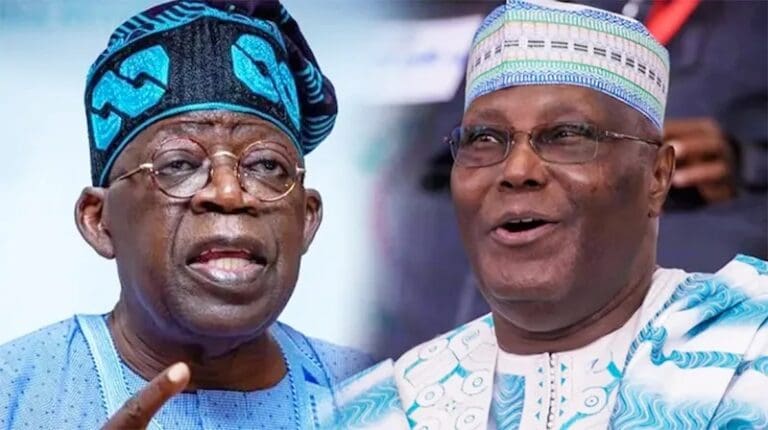
THE presidential candidate of the All Progressives Congress (APC), Bola Ahmed Tinubu, on Monday, January 30, 2023, referred to his counterpart, Atiku Abubakar of the Peoples Democratic Party (PDP) as a Senate President.
He stated this at the campaign rally of the APC in Uyo, Akwa Ibom state, while calling on the electorate to sweep out the opposition parties at all levels of governance, and promising a better living standard for all Nigerians if elected into office on February 25.
While discrediting other candidates, Tinubu said in Pidgin English:
“They don’t have a mandate; what they have na ice cream. E melt quick. You gave me their yeye people… Atiku, when we make am senate president, haba! You sell this, you sell that assets, our common wealth…everything that we have.”
The video trended for days on social media platforms in Nigeria, especially Twitter.
CLAIM
Tinubu claimed that Atiku Abubakar was a Senate President.
THE FINDINGS
Findings by The FactCheckHub show that the claim is FALSE.
Atiku Abubakar, one of the front-runners in the 2023 presidential election, is a former Nigerian Vice President during the democratic regime of Chief Olusegun Obasanjo (1999 – 2007) and a retired Officer of the Nigerian Customs Service (NCS).
He ran as governor of Adamawa State four times before becoming Obasanjo’s running mate in 1999 and served two-term as his VP.
Since 1993, Atiku has continued to eye the presidential seat and is set to battle it with other contenders on February 25, 2023.
In 1993, he contested the Social Democratic Party (SDP) presidential primaries and lost to Moshood Abiola. Also, in 2007, he was a presidential candidate for the Action Congress.
In 2011, he also contested the presidential primaries of the PDP and lost to Goodluck Jonathan who was the incumbent. In 2014, he joined the APC and lost to Muhammadu Buhari at the party’s primaries. Also, in 2019, he contested under the platform of the PDP, and lost again to the incumbent President Buhari.
However, Abubakar has denied ever being a Senate President, The Guardian reported.
THE VERDICT
Tinubu’s claim that Atiku was a senate president is FALSE; findings show that Atiku Abubakar was never a lawmaker in the National Assembly throughout his political career till date.
ON August 20, 2022, the presidential candidate of Accord Party, Christopher Imumolen said Nigeria has about 350,000 police personnel while speaking about his plan to tackle insecurity in Nigeria when he becomes the president.
A Nigerian fact-checker, Ikulajolu Adesola, intended to verify the claim but after rigorous search on the websites of the National Bureau of Statistics and Nigeria Police Force, among others, Adesola couldn’t find a reliable data to verify it. As a result, he couldn’t forge ahead with the fact-check.
“INTERPOL Nigeria data says Nigeria has about 350,000 police personnel. Dataphyte and ThisDay reports say 372,300 police personnel. We needed to confirm and even the police PPRO did not respond to our mail,” said Adesola.
“We resorted to using several other data available and try to compare and contrast – but a data from NBS or Nigerian Police Force would have given the fact in what we needed to use it for.”
The challenge of Adesola mirrors frequent difficulties facing many Nigerian fact-checkers in accessing data to ensure that the public consumes accurate information.
Inconsistent open data
According to the Centre for Democracy and Development (CDD) the proliferation of electoral disinformation, misinformation and the weaponisation of fake news poses the biggest threat to Nigeria’s 2023 election.
As widespread misinformation continues to threaten the forthcoming general elections in Nigeria, fact-checkers have been working tirelessly to stem the tide but access to credible data has proved to be one of the stumbling blocks to achieving productive political conversations and credible polls.
Findings have shown that several government agencies and organisations in Nigeria do not make government data readily available for citizens on their websites.
This, according to research, is due to of lack of political will, poor ICT infrastructure and a lack of highly skilled personnel in Nigerian government agencies.
Level of Responsiveness to requests for information and;
Level of Disclosure.
Proactive disclosure ranks public institutions based on the level of information made available for public consumption on their official websites.
This includes information relating to the receipt or expenditure of public or other funds of the institution, names, salaries, titles, and dates of employment of all employees and officers of the Institution, name of every official and the final records of voting in all proceedings of the institution, file containing applications for any contract, permit, grants, licenses or agreement.
Other details are reports, documents, studies, or publications prepared by independent contractors for the institution, a description of the organisation and responsibilities of the institution including details of the programme and functions of each division, branch and department of the institution, materials containing information relating to any grant or contract made by or between the institution and another public institution or private organization, details of FOI Desk Officers, details of FOI Trainings and FOI Annual Report.
According to the 2022 ranking by the coalition, out of the 250 public institutions ranked, 231, representing 92 per cent were not fully proactive, which is a 16 per cent increase compared to 199 recorded in 2021. This shows that many Nigeria’s public institutions do not make critical information available on their websites.
Infographic showing the level of proactive in MDAs
This challenge has been a source of concern for journalists, researchers and fact-checkers who need credible data to enlighten citizens on the state of the nation. It also makes it hard for fact-checkers to hold politicians accountable for their claims.
Expressing her ordeals in navigating around this difficulty, Lois Ugbede, a fact-checker and researcher with Dubawa, said, “It is almost useless when the statistics for 2020 is what is available in 2022.
“It’s crazy fact-checking a claim in 2022 with data from 2020. So, most times, you must use the data you have to make the context clear just to save yourself from any backlash or pair the data with other sources.”
She recalled working on a claim about the unemployment rate in the country, and she couldn’t find recent data from the NBS to verify the claim except its unemployment report published in 2021.
“This (challenge of obsolete/non-available statistics) makes the job more tasking and frustrating,” she lamented.
Adesola warned that this deficiency could expose citizens to misinformation as fact-checkers would not be able to debunk misinformation coming out from Nigerian politicians and their supporters ahead of the 2023 elections.
“The implication of lack of access to credible data is that candidates will continue to churn out obsolete data or, better still, rely on other sources which might not be accurate.
“This will also not give candidates insights into certain sectors of importance. If data says there are 3 million out-of-school children, whereas the number had tripled, then campaign plans will be tailored towards the 3 million figure, making it look as if it isn’t a thing of huge concern.
“We will only have more misinformation because the agency to feed us with accurate data based on their wide reach and parameters, is not up to date,” Adesola told The FactCheckHub.
NBS outdated dataset
Lack of access to consistent data has always led to controversy and confusion in political conversations. For instance, the data of unemployment rate in the country elicited controversy online after the presidential candidate of the Labour Party, Peter Obi, tweeted that Nigeria’s poverty rate stood at 35 per cent – nearly two points higher than the official statistics given by the NBS.
Findings by The FactCheckHub show that the National Bureau of Statistics (NBS) used to be consistent in releasing the reports on quarterly basis until about two years ago. The last “Labour Force Statistics” was released in May, 2021. The report details the national and sub-national unemployment index as of the fourth quarter of 2020.
Screenshot of Labour Force Reports by NBS
Even though Obi later corrected himself in his subsequent speeches, many still believe that the figure might have gone higher. This is due to the fact that report which was published two years ago cannot be used to appraise the present realities.
‘Many government agencies do not have modern websites’
Meanwhile, the Statistician General of the Federation and Chief Executive Officer of the NBS, Semiu Adeniran disclosed that the new Nigerian Labour Force Survey (NLFS) will be published in the first quarter of 2023.
Similarly, the presidential candidate of the Peoples Democratic Party (PDP), Atiku Abubakar, made a claim about the number of social media users in Northern Nigeria.
The claim elicited mixed reactions online, but again, there was no direct evidence to corroborate or debunk Atiku’s claim as the data on the actual number of social media users – state by state is nowhere to be found.
A researcher and head of investigation at Humangle, Kunle Adebajo, argued that Nigerian government agencies have not been performing well in making essential data and information available on their websites.
“Many government agencies do not have modern websites, some of them their websites are not consistent and accessible. Some of them that have websites, when you go to the resources and downloads section, it’s usually very scanty. Sometimes there might be information there but it would be outdated. For instance, you need a report from 2022 but the last time they updated it was 2017. These are the challenges,” he said.
According to him, there have been improvements as well, such as the introduction of project monitoring applications launched by the Federal Government, among others.
On his part, Yusuf Akinpelu, a fact-checker and data journalist with BBC, noted that there have been improvements in proactive disclosure as a result of advocacy by Civil Society Organisations.
“I would say because of advocacy, there have been increase openness by government agencies to churn out data. You can imagine that from the open treasury portal that keeps records of government daily expenses that exceed certain limit. For the first time in long time, the NNPC yearly audit was released. We are not where we were before though it can be better,” Akinpelu said.
He further pointed out the need for fact-checkers to be equipped with the knowledge of interpreting the existing data and utilising it to inform the public.
“For instance, when NNPC released its audit, there were certain part of it that ordinarily, it’s not common knowledge among people, including journalists. As a journalist, we should seek knowledge of what we don’t know to inform the public better. ”
Akinpelu said there’s need for more advocacy to push the government to be more open and make the data more readily available and understandable for the public.
Poor response to information requests
Since the return to democratic government in Nigeria in 1999, active citizens and civil society organisations have been deeply engaging government to achieve transparency and accountability.
In 2011, President Goodluck Jonathan signed into law the Freedom of Information Act to allow access to public records and information.
The law gives a person, group, association or organization the right to access information from Government Agencies, Parastatals, Federal Civil Service, Private and Public sector organizations providing public services.
It provides a platform to hold leaders accountable and aids the decision-making process but public institutions have continued to disregard the provisions of the law.
When the information required to fact-check a claim is not publicly available, fact-checkers make use of this channel to request for the needed information.
The FOI law mandates the agencies involved to supply such a piece of information within seven working days; however, Nigerian public institutions have remained unresponsive to Freedom of Information Requests.
According to the 2022 ranking by the FOI cohort, only seven public institutions scored 50 points and above out of the 250 institutions assessed in the FOI compliance ranking.
The report stated that only 28 institutions responded to FOI requests within 0-14 days, 48 took longer than that while 183 failed to respond.
Infographic showing level of responsiveness to information requests by MDAs.
More notorious for poor responses to information request are the state public institutions that feel they are not bound by the law.
Several Nigerian states are yet to domesticate it or create similar mechanisms that serve to promote transparency and accountability in government while some states are also taking advantage of conflicting judicial pronouncements to evade the law.
The way forward…
Recently, the ICIRreported how stakeholders expressed concern over the failure of ministries, departments and agencies (MDAs) to honour the Freedom of Information Act (FOIA) noting that it could hamper accountability governance in Nigeria.
The FOIA National Coordinator at the Ministry of Justice, Ayobamidele Bakare noted that the law mandates public servants to provide information upon request by the citizens because it is their right.
Bakare said that though the law makes provisions for certain information not to be disclosed without authorisation, the law also mandates public institutions to provide information proactively to the public via their websites according to Section 2 (3) a-f.
He, frowned at how MDAs still withhold some “ridiculously basic information”.
Similarly, the Executive Director, Centre for Transparency Advocacy, Faith Nwadishi, at the FOI ranking event held in September 2022, noted that various basic pieces of information like addresses were still absent on government websites.
Nwadishi urged citizens to demand more accountability from government agencies.
“If you look at the effort put into having the FOI law in place, we are not reciprocating that by demanding. You can only get accountability when you demand it. Nobody comes to give you an account of anything if you don’t demand it. So on the citizens and civil societies’ part, we need to do much more,” she said.
Adebajo, the researcher and head of investigations at Humangle, called for sanctioning of public institutions that fail to comply with the law in order to ensure adequate compliance.
“There should be sanctions for agencies that are found defaulting otherwise, people would think they can go on without adequate transparency.”
On his part, Akinpelu, the data journalist with the BBC, advised journalists to seek the support of civil society organisations that offer legal aid support to journalists willing to sue any institution that refuses to comply.
AHEAD of Nigeria’s 2023 elections, Meta has announced steps it is taking to “help preserve the integrity of the general elections.”
Adaora Ikenze, Head of Public Policy for Anglophone West Africa at Meta, disclosed this in a blog post on Thursday.
“This work will continue in the lead-up to, during and after the vote. It is grounded in long-running investments we have made in people, technology and partnerships to help reduce the spread of misinformation, detect and remove hate speech, improve digital literacy, help make political advertising more transparent and ensure the safety of people using our platforms.” she wrote.
Some of the steps the Facebook parent company is taking include: increasing transparency of political advertising, fighting misinformation and false news, combating election interference, addressing viral messaging on WhatsApp and keeping people safe from harmful contents on its platforms, among others.
According to Meta, advertisers on politically related issues must undergo a verification process for identification and ensure compliance with the new policy.
“Every political ad in Nigeria will also be labeled with ‘a paid for by’ disclaimer to show who is behind the ad,” Ikenze stated.
She added that steps are being taken to combat the spread of false news on all Meta platforms – Facebook, Instagram and WhatsApp etc.
“We are taking aggressive steps to fight the spread of false news on Facebook and Instagram.”
“We’ll also have an “I Voted” sticker on Instagram. And on Election Day, we’ll remind people in the country that it’s time to vote with a notification on top of their Facebook Feed as well,” she said.
While reiterating it’s commitment to ensure election integrity in the forthcoming general elections, she emphasized that “at Meta, we know we have an important responsibility when it comes to helping people participate in safe, secure and free elections”.
“As we approach Election Day, we will activate our Elections Operations Centre to identify potential threats in real time and speed up our responses.”
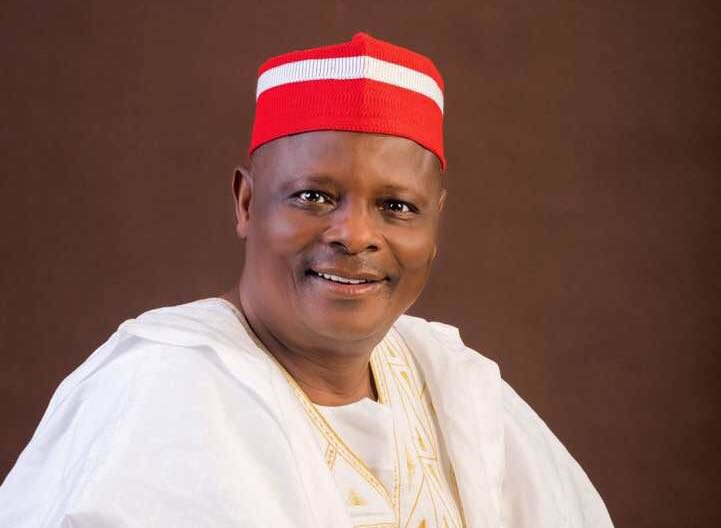
THE presidential candidate of the New Nigeria Peoples Party (NNPP), Rabiu Musa Kwankwaso, on Wednesday, January 18, 2023 made several claims on Nigeria’s current situation and his plans for Nigerians if elected president on February 25.
Kwankwaso, a former governor of Kano State is the third candidate who spoke at Chatham House in London, United Kingdom after Bola Ahmed Tinubu of the All Progressives Congress (APC) and Peter Obi of Labour Party, respectively.
In this fact-check, The FactCheckHub examines the veracity of some of his claims.
CLAIM 1
Over 133 million Nigerians according to the NBS are living in abject poverty.
THE FINDINGS
According to a recent report by the National Bureau of Statistics (NBS) on multi-dimensional poverty, about 133 million people in the country, representing 63 per cent of the population, are living in different categories of poverty.
The report stated that 65 per cent of the poor (86 million people) live in the North, while 35 per cent (nearly 47 million) live in the South.
THE VERDICT
The claim is TRUE, according to the National Bureau of Statistics.
CLAIM 2
Kwankwaso claimed that he would increase the military active personnel from 223,000 to 1 million (take note of 223,000).
THE FINDINGS
According to data by the World Bank, the number of Nigeria’s military personnel stood at 223,000 as of 2019.
However, data from Global Firepower, an organization that ranks nations of the world based on current available firepower shows that the Nigerian military stands at 215,000 out of which 135,000 are active personnel while 80,000 are in the paramilitary. For 2023, Nigeria is ranked 36 of 145 out of the countries considered for the annual Global Firepower review.
THE VERDICT
The claim is FALSE; as latest data shows that the number of active military personnel stands at 135,000.
CLAIM 3
There are 20 million out-of-school children in Nigeria.
According to the data, India, Nigeria, and Pakistan have the highest figures for out-of-school children globally.
UNESCO’s Global Education Monitoring (GEM) report shows that Sub-Saharan Africa remains the region with most children and youths out of school.
The report stated that 244 million children and youth between the ages of 6 and 18 worldwide are still out of school.
THE VERDICT
The claim is TRUE, according to UNESCO data.
CLAIM 4
About 3.4 million Nigerians are living with HIV/AIDS.
THE FINDINGS
Data from the United Nations Programme on HIV/AIDS (UNAIDS) shows that an estimated 1.9 million Nigerians are living with HIV/AIDS as of 2021.
Similarly, a 2018 data from the Nigeria HIV/AIDs Indicator and Impact Survey (NAIIS) shows that about 1.9 million people in Nigeria are living with HIV/AIDs.
Nigeria accounts for more than 9 per cent of the global HIV burden.
THE FINDINGS
According to the United Nations Programme on HIV/AIDS (UNAIDS), about 38.4 million [33.9 million–43.8 million] people globally are living with HIV as of 2021. When this is compared to Nigeria’s population living with HIV, that’s about 5 per cent.
THE VERDICT
Thus, the claim by Kwankwaso that Nigeria accounts for 9 per cent of the global population of people living with HIV is FALSE.
CLAIM 6
53.3 per cent of Nigeria’s population are of age 15 and above the total number of children under the age of 5 is nearly 36 million.
THE FINDINGS
A Statista data on the age structure in Nigeria from 2011 to 2021 shows that the country’s total population in the age group 15-64 years stood at 53.73 per cent in 2021. This was also reported here.
The claim by Kwankwaso that 53.3 per cent of the country’s population are of age 15 and above is MOSTLY TRUE whereas his claim that about 36 million of children are under the age of 5 is FALSE.
CLAIM 7
More than seven million babies are born each year.
THE FINDINGS
A data on UNICEF’s website show that at least seven million babies are born each year in Nigeria.
THE VERDICT
The claim is TRUE.
CLAIM 8
Women’s childbearing age in Nigeria is between 15 – 49 years and they are over forty million.
THE FINDINGS
UNICEF reports that 40 million women of childbearing age in Nigeria are between the ages of 15 and 49 years, adding that they suffer a disproportionately high rate of health issues surrounding birth.
More than half of the Children under the age of 5 die from malaria, pneumonia and diarrhoea.
THE FINDINGS
Findings by the FactCheckHub show that the claim is TRUE.
According to UNICEF, infant mortality currently stands at 69 per 1000 live births while for under five, it rises to 128 per 1000 live births. More than half of the under five deaths results from malaria, pneumonia or diarrhoea
In 2018, Nigeria made up the highest number of those who died with an estimated 162,000 deaths from pneumonia
According to the World Health Organisation (WHO), the leading causes of death in children under 5 years are preterm birth complications, birth trauma, pneumonia, diarrhoea and malaria all of which can be prevented or treated.
THE VERDICT
The claim is TRUE.
CLAIM 10
As of 2015, 57 million Nigerians lack access to improved water supply.
THE FINDINGS
Findings by the FactCheckHub show that the claim is TRUE .
Poor access to water, sanitation and hygiene remains a major challenge, contributing significantly to high levels of diarrhoea-related deaths in Nigeria.
As of 2015, 57 million Nigerians were without access to improved water sources, while 130 million people were without access to improved sanitation, according to UNICEF.
Women and girls suffer disproportionately from the lack of adequate WASH services. They bear the burden of water collection over long distances, which has been associated with negative effects on well-being, school attendance, and a higher risk of gender-based violence (GBV), according to a World Bank report in 2021.
THE VERDICT
The claim is TRUE.
CLAIM 11
2023 would be the first time in 20 years that the incumbent President Muhammadu Buhari won’t be a presidential candidate.
THE FINDINGS
Findings by the FactCheckHub show that the claim is TRUE.
According to Nigeria’s State House publication on the biography of the President, Muhammadu Buhari ran for the Nigerian Presidency in 2003 and 2007 under the All Nigeria People’s Party (ANPP).
He left ANPP in March 2010 for the Congress for Progressive Change (CPC) and ran against the then President, Goodluck Jonathan, of the People’s Democratic Party (PDP) in 2011.
He emerged as the presidential candidate for the All Progressives Congress (APC) in 2014 and won the 2015 presidential election defeating President Jonathan.
Nigeria’s 1999 Constitution stipulates the tenure of office of the President. Buhari he will be ending his two-term tenure as a democratically-elected Nigerian President in May 2023 and will no longer be eligible to contest for same position again. The Nigerian Presidency reiterated same in an October 2019 tweet here.
THE VERDICT
The claim is TRUE.
CLAIM 12
Nigeria represents 2.8 per cent of the world’s population, contributes 10 per cent of global deaths for pregnant women.
THE FINDINGS
Nigeria is one of the most densely populated countries in Africa and ranks 7 on the list of countries by population.
The United Nations Department of Economic and Social Affairs said that Nigeria’s population has reached 216 million in 2022, accounting for 2.7 per cent of the global population, The Punch reported.
Latest statistics from the World Health Organisation (WHO) show that Nigeria accounts for nearly 20 per cent of global maternal deaths, while the lifetime risk of dying during pregnancy, childbirth, postpartum, or after an abortion for a Nigerian woman is 1 in 22, compared to 1 in 4,900 in developed countries.
As of November 2022, the Gynaecology and Obstetrics of Nigeria also lamented the high rate of maternal death in the country, saying Nigeria is nowhere near achieving the Sustainable Development target of reducing the global maternal ratio to less than 70 per 100,000 live births by 2030.
THE VERDICT
The claim that Nigeria represents 2.8 per cent of the world’s population is MOSTLY TRUE; findings show that Nigeria accounts for 2.7 per cent. Meanwhile, the second part of the claim is FALSE, as Nigeria contributes nearly 20 per cent of global maternal deaths.
A chieftain of the All Progressives Congress (APC), Adamu Garba, has shared an image of Peter Obi, the Labour Party’s presidential candidate dining with two beer bottles on his table.
Adamu, who was once a presidential aspirant under the ruling APC, tweeted the image on Tuesday, 24th of January, 2023.
“Too much pleasure dey worry this wuna presidential aspirant. Double hero beer with Biafra trademark and isiewu full time.”
The tweet has garnered over 700, 000 views, more than 150 retweets and over 1,000 likes as of 30th of January, 2023.
CLAIM
Photo shows Obi drinking beer which has a Biafran trademark.
Screenshot of the tweet.
THE FINDINGS
Findings by The FactCheckHub show that the image has been distorted.
Hero beer is a popular beer launched in 2012 and brewed in Onitsha, Anambra state in South-Eastern Nigeria.
Each beer bottle has an 11-pointed star which beams yellow, orange, and red placed upon a dark green which appears similar to the symbol of proscribed Indigenous Peoples of Biafra (IPOB), a secessionist group.
A closer look at the image shows some distortion around Peter Obi’s neck indicating that his head was doctored in the photo and the beer bottles on the table also appear photo-shopped.
A Google Reverse Image search on the internet shows that the original picture was tweeted online by one Twitter user, @Jaiynaija, on the 23rd of January, 2023 before it was photo-shopped and later tweeted by Adamu Garba the following day.
THE VERDICT
The claim that the image shows Obi drinking a beer which has a Biafran trademark is FALSE; findings show that the person in the original photo is not Peter Obi.
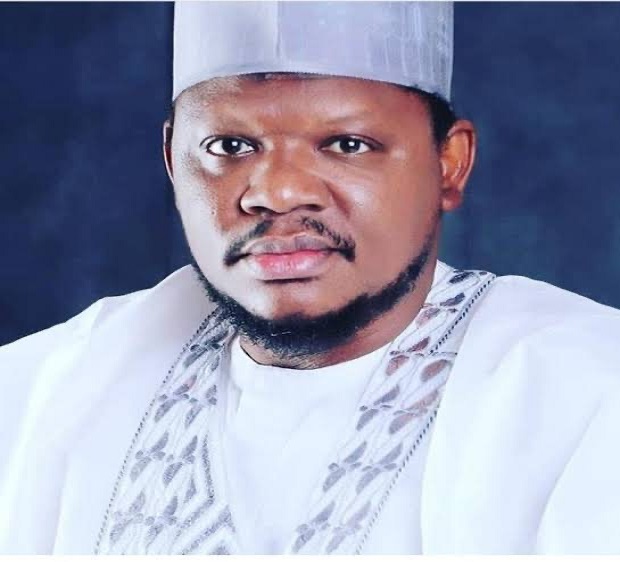
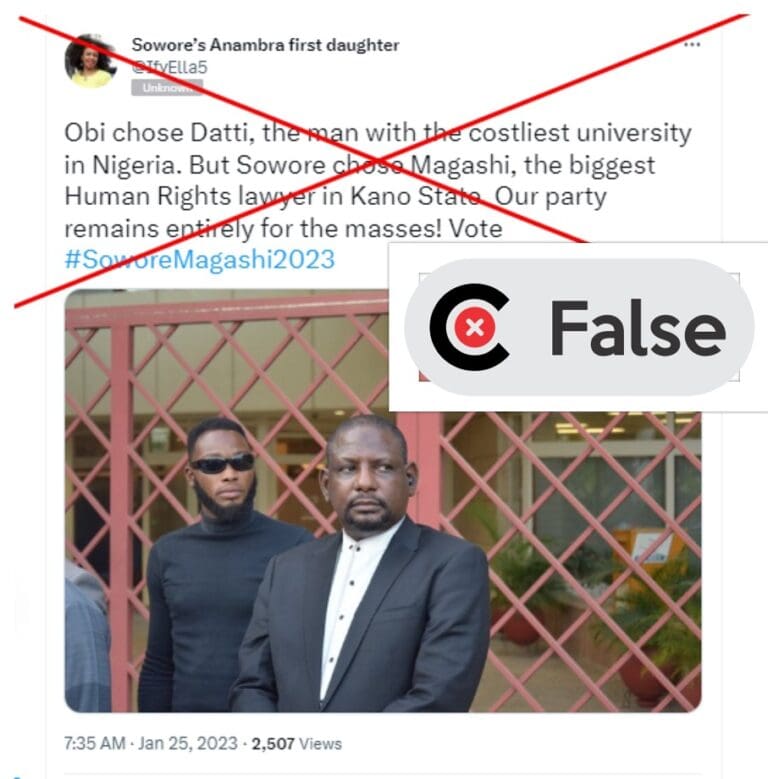
A tweep simply identified as Ify Ella has claimed in a tweet archived here that Baze University owned by Yusuf Datti Baba-Ahmed is the costliest university in Nigeria.
This was in an attempt to promote the presidential candidate of the African Action Congress (AAC), Omoyele Sowore, and his running mate, Haruna Magashi ahead of the February 25 election.
The tweet reads:
“Obi chose Datti, the man with the costliest university in Nigeria. But Sowore chose Magashi, the biggest Human Rights lawyer in Kano State. Our party remains entirely for the masses! Vote #SoworeMagashi2023.”
The post made on Wednesday, January 25, 2023, has since garnered over 2,000 views, and more than 90 likes as of when it was retrieved on Saturday, January 28, 2023.
Datti’s university, Baze University, is the costliest in Nigeria.
THE FINDINGS
Findings by The FactCheckHub show that the claim is FALSE.
An assessment of the rankings of Nigerian universities by multiple platforms revealed that Baze university was not the most expensive university in the country.
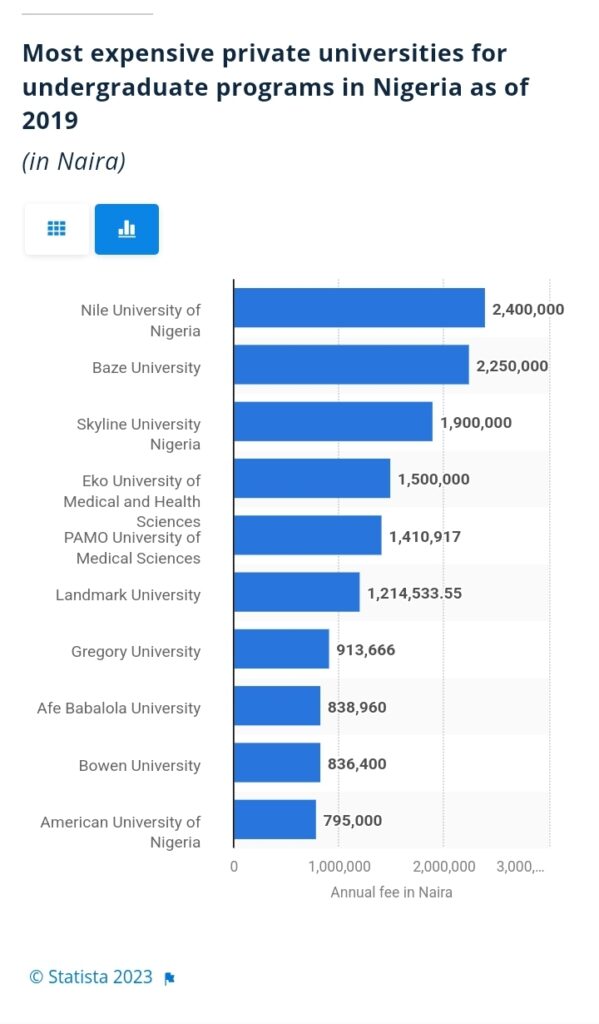
A report published by Statista in September 2022 on the average annual undergraduate tuition fees at private Nigerian universities in 2019 put Nile University of Nigeria as the most expensive, with Baze University coming second on the list.
The report shows that the average annual tuition fee for bachelor’s degree programmes at Nile University and Baze University stood at ₦2.4 million (about 5,800 US dollars) and ₦2.3 million (about 5,500 US dollars) in 2019 respectively.
Screenshot of the 2022 report by Statista.
Also, in a rating by Legit NG published in October 2022, Nile University of Nigeria was ranked ahead of Baze University in terms of tuition fees.
The fees range at Nile University stood between ₦2,400,000 and ₦5,750,000 while that of Baze was between ₦2,722,500 and ₦3,025,000, according to the report.
In another report published by Inside OAU in December 2022, Baze University was put at number 3 on the list of top ten most expensive private universities in Nigeria.
THE VERDICT
The claim that Datti’s university, Baze University, is the costliest in Nigeria is FALSE; multiple reports show it is not.
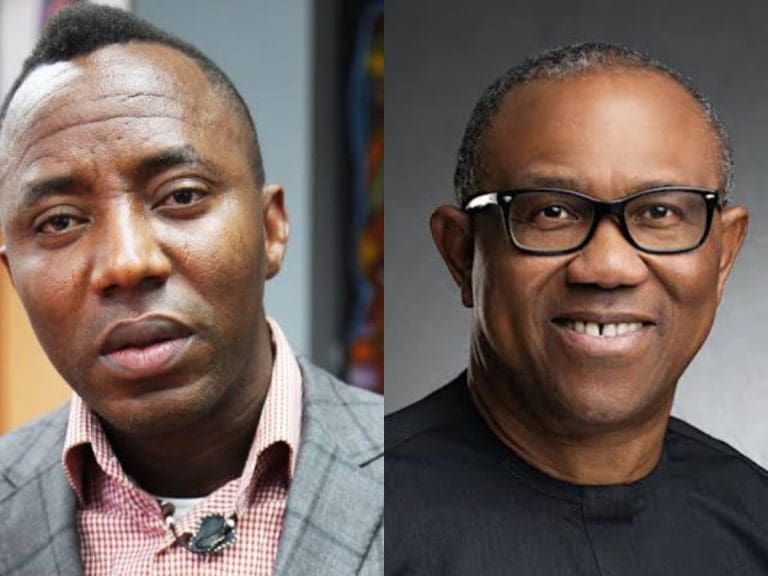
A fake quote attributed to the presidential candidate of the African Action Congress (AAC), Omoyele Sowore applauding his counterpart Peter Obi of the Labour Party has surfaced online.
According to the quote, Sowore described Peter Obi as a humble man despite him being from an opposition party in this year’s Nigerian election.
The quote reads:
“Whenever other presidential candidates see me, they will ignore me as nobody because I have no money.
Peter Obi always walks to me to greet me anytime he sees me. Even though he is my opponent, I will not deny the fact that he is a humble man.”
A Twitter user, @UzomaPreciousF1 tweeted the quote and it has generated more than 1,300 retweets and over 5,000 likes as of Saturday, 28th of January, 2023.
A Facebook Page, South East Nigeria also posted the claim and it generated more than 500 likes, over 60 shares and more than 50 comments as of Saturday, 28th of January, 2023.
Another Twitter user, @IgweOdysse also tweeted the claim.
CLAIM
Sowore authored quotes praising Peter Obi for being a humble man.
Screenshot from one of the posts.
THE FINDINGS
Findings by FactCheckHub show that the quote was fabricated.
The FactCheckHub observed that none of the social media users who posted the texts referenced their source(s) publicly, thus raising a red flag.
Also, a keyword search on Google Search did not reveal anywhere or when Sowore made the statement.
Moreover, no credible media organisation in the country reported the quote attributed to Sowore.
TITI Abubakar, one of the wives of Atiku Abubakar, the presidential candidate of the Peoples Democratic Party (PDP) in this year’s election has made a claim about the office of Nigeria’s First Lady.
Titi, while speaking during the party’s campaign rally in Abeokuta, the Ogun state capital on Wednesday, 18th of January, 2023 asked people to vote for her husband in the coming election.
According to her, since the adoption of First Lady in Nigeria’s Presidency, no Yoruba woman has had the opportunity to occupy the seat to bear the title.
She added that she would be the first Yoruba First Lady should Atiku win in the 2023 general election.
She said in Yoruba language (one of the major Nigerian languages), “Lati’gba ti won ti se presidency ti won ni won se First Lady, omo Yoruba o se iyawo president ri. Mo be yin l’okurin l’obirin, e wa je ki temi se akoko.”
This was translated into English to mean that, “No Yoruba woman has had the opportunity to be a first lady. I beg you, men and women, make me to be the first.”
While there are no constitutional provisions backing the creation of office of the First Lady in Nigeria, the title has gained wide recognition in the country’s political space over the years, with wives of elected presidents and governors given the title to perform ceremonial functions in governance.
CLAIM
No Yoruba woman has bore the title of First Lady in Nigerian Presidency.
THE FINDINGS
Findings by The FactCheckHub show that the claim is FALSE.
Since 1963, during the administration of the country’s first president, Nnamdi Azikwe till date, Nigeria has had 15 First Ladies in the Presidency.
They include: Flora Azikiwe (1963-1966), Victoria Aguiyi-Ironsi (1966-1966), Victoria Gowon (1966-1975), Ajoke Muhammed (1975-1976), Esther Oluremi Obasanjo (1976-1979, Hadiza Shehu Shagari (1979-1983), Safinatu Buhari (1983-1985), and Maryam Babangida (1985-1993).
Others are Margaret Shonekan (1993), Maryam Abacha (1993-1998), Fati Lami Abubakar (1998-1999), Stella Obasanjo (1999-2005), Turai Yar’Adua (2007-2010), Patience Jonathan (2010-2015), and Aisha Muhammadu Buhari (2015 till date).
In the last 59 years, Nigeria has had at least three First Ladies from the Yoruba ethnic group.
The Yorubas among the past First Ladies include Ajoke Muhammad, wife of the (late) General Muritala Muhammad; Esther Oluremi Obasanjo, wife of Chief Olusegun Obasanjo (now ex-wife); and Margaret Shonekan, wife of the (late) Chief Earnest Shonekan.
This shows that 2023 would not be the first time that Nigeria will be having a Yoruba First Lady, contrary to the claim by Atiku’s wife, Titi.
THE VERDICT
Titi Abubakar’s claim that no Yoruba woman has bore the title of First Lady in Nigerian Presidency is FALSE; findings show that Nigeria has had three First Ladies from the Yoruba ethnic group since 1963 till date.
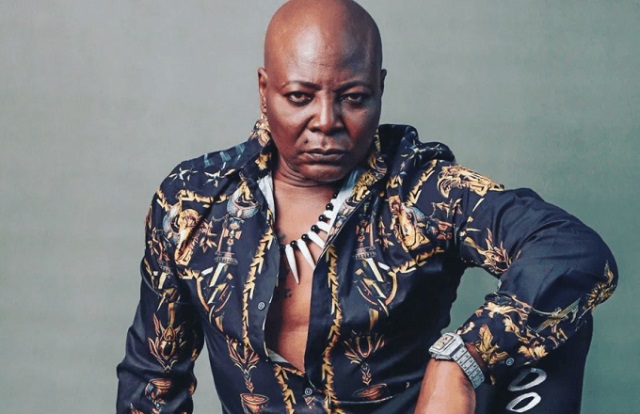
NIGERIAN music artiste, Charles Chukwuemeka Oputa, has tweeted quote attributed to the former Emir of Kano, Sanusi Lamido Sanusi, saying tribalism is the problem of Nigeria.
According to the quote, Sanusi accused the Yoruba tribe of supporting the presidential candidate of the All Progressives Congress (APC), Bola Tinubu due to ethnic sentiment.
“In 2019, Yorubas wanted President Buhari to resign and handover power to Vice President Osibanjo due to his health.
In 2023, the same Yorubas are supporting Bola Tinubu whose health is worse than President Buhari’s health.
2023 general election has shown that North is not the problem of Nigeria but tribalism.”
CLAIM
Sanusi authored a quote saying North is not the problem of Nigeria but tribalism.
Screenshot of Charly Boy’s tweet showing quote falsely attributed to Sanusi.
THE FINDINGS
Findings by The FactCheckHub show that the quote was fabricated.
Further checks revealed that the quote started making round on internet since two weeks ago as seen here and here.
However, the FactCheckHub observed that none of the social media users who posted the same quote disclosed their source(s) publicly, thus raising a red flag.
Also, a keyword search on Google did not reveal anywhere or when the former Emir made the statement.
Moreover, no credible media organisation in Nigeria reported the quote attributed to Sanusi.
This is not the first time a false quote would be attributed to Sanusi. For instance, the FactCheckHub had earlier debunked a quote attributed to him, where he was purportedly analyzing the uniqueness of at least three presidential candidates contesting Nigeria’s 2023 election.
When contacted, Imam Murtala Gusau, a regular Islamic columnist and a close friend of Sanusi confirmed to FactCheckHub that the quote was not from the former Emir.
Charly Boy is a regular purveyor of disinformation who has been fact-checked several times by The FactCheckHub. He wields strong influence online and has over 185,000 followers on Twitter.
For instance, the FactCheckHub had earlier reported how he shared a misleading video with a claim that it showed Peter Obi’s supporters in boats holding a campaign rally in riverine areas.
The FactCheckHub also reported how he made a false claim about the electronic transmission of election results by the Independent National Electoral Commission (INEC).
He also tweeted a misleading photo showing the presidential candidate of the All Progressives Congress (APC), Bola Ahmed Tinubu, watching Peter Obi, on a television screen in an aircraft.
THE VERDICT
The claim that the former Emir of Kano authored the viral quote attributed to him is FALSE; findings revealed that it is fake.
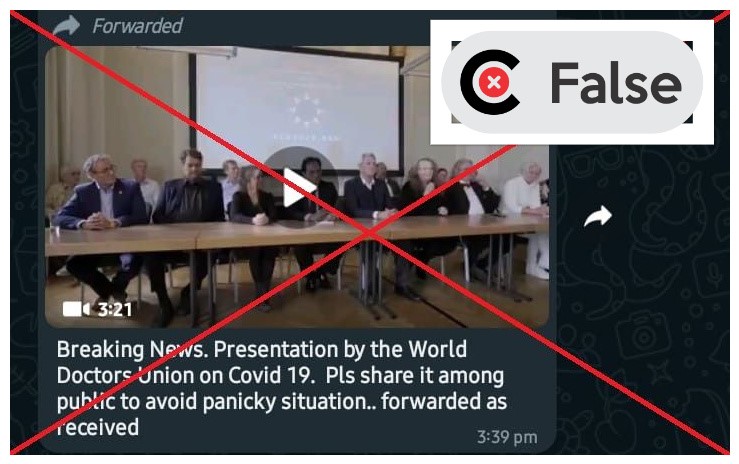
A video of a press conference where a European-based group of medical practitioners were seen discrediting the COVID-19 pandemic has resurfaced on social media.
The video is being circulated on WhatsApp as ‘breaking news’ with the claim implying that the global doctors’ union recently held a public event on the Coronavirus.
The caption shared alongside the viral video reads:
“Breaking News. Presentation by the World Doctors Union on Covid-19. Pls share it among public to avoid panicky situation. Forwarded as received.”
The 3:21 minute clip shows how the group of medical practitioners was equating Covid-19 with flu virus.
One of the said doctors, who identified herself as the President of the World Doctors Alliance, said that Covid-19 is a seasonal viral infection.
“We are here to say that there is good news. The coronavirus is a seasonal virus that causes illness and symptoms from December to April.
“There is no need for lock-down, there is no need for fear, there is no need for mask, for social distancing, or for quarantining people. They are locking people in their homes for last year flu,” parts of her statement read.
Towards the end of the clip, a male member of the group claimed that there was no evidence of a medical pandemic.
“We see no evidence of a medical pandemic. So, it looks like a plandemic. And we all together say we don’t want this new normal,” he opined.
CLAIM
World Doctors Union meet and held a conference on the COVID-19 pandemic recently.
THE FINDINGS
Findings by The FactCheckHub show that the claim is FALSE.
Our researcher traced the footage to the ACU2020 website, where the full and original version of the video was found.
ACU2020 is a German acronym used by a group headed by a German physician, Heiko Schöning.
The footage, uploaded on November 13, 2020, was titled “official video of the founding of the WDA- World Doctors Alliance”. It was tagged “A better normal, not a new normal.”
This shows that the resurfaced footage has been on the internet since 2020, during the ‘pandemic year.’
Further checks revealed that various claims made by the group on Covid-19 pandemic in the video have been debunked by several credible fact-checking organisations and media platforms including the Associated Press, Voice of America, The Guardian, and FactCheck.org etc. Other debunks on the footage can also be seen here, here, and here.
THE VERDICT
The claim that the World Doctors Union recently held a conference on the Covid-19 pandemic is FALSE; findings show that the viral footage is an old video from over two years ago.