Please note that the FactCheckHub has not obtained any right from the authors or copyright owners of all third-party contents from embedded links and shall incur no liability in this regard.
Please note that the FactCheckHub has not obtained any right from the authors or copyright owners of all third-party contents from embedded links and shall incur no liability in this regard.
Please note that the FactCheckHub has not obtained any right from the authors or copyright owners of all third-party contents from embedded links and shall incur no liability in this regard.
Please note that the FactCheckHub has not obtained any right from the authors or copyright owners of all third-party contents from embedded links and shall incur no liability in this regard.
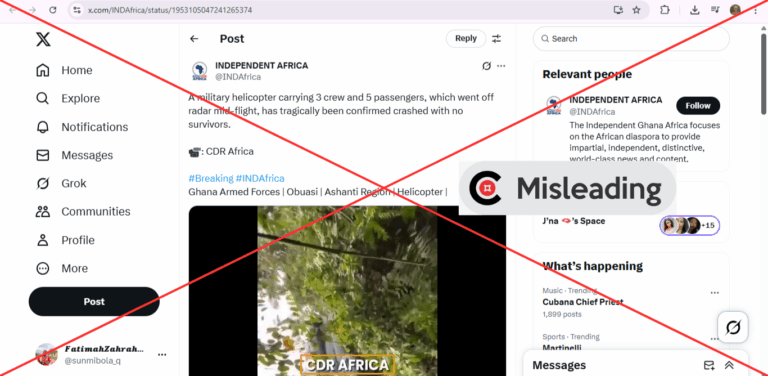
Since the post was made on August 6, 2025, it has gotten over 13,000 views.
CLAIM
Video shows recent helicopter crash in Ghana
THE FINDINGS
Findings by The FactCheckHub show that the claim is MISLEADING!
Screenshot of the claim; Insert MISLEADING Verdict
Using Google reverse image search on screenshots from the video’s keyframes, it was traced to another version, captured from a different angle by UTV on March 19, 2024, and shared on both TikTok and X.
The footage captured the aftermath of a Ghana Air Force helicopter crash in Bonsukrom, Western Region.
The 2024 incident involved a military aircraft that went down during a routine operation. While it drew national attention at the time, there were no fatalities, unlike this year’s tragedy.
The recirculated video is unrelated to the August 6, 2025, crash and depicts a separate event from March 2024.
Context: On August 6, 2025, Ghana’s Chief of Staff confirmed that eight people, including Defence Minister Edward Omane Boamah and Environment Minister Ibrahim Murtala Mohammed, died in a helicopter crash in the Ashanti Region. Other victims included senior government officials and three crew members.
THE VERDICT
The claim that the video shows the August 2025 helicopter crash in Ghana is MISLEADING; the video in circulation is from March 2024.
A claim that Kano Pillars midfielder Rabiu Ali has been nominated for the Ballon d’Or has surfaced on the internet.
A Facebook acccount, Nigeria Premier League, posted the story with a caption: “𝗢𝗙𝗙𝗜𝗖𝗜𝗔𝗟: Rabiu Ali has been Nominated for the Ballon d’Or!. This comes after an impressive outing with Kano Pillars FC500 likes for Him#kanopillars#NPFL#FIFAADMIN General.”
Since the claim was posted on Thursday, August 7, 2025, it has garnered 2,000 views and 56 comments.
Rabiu Ali is a Nigerian Football player who currently plays for Kano Pillars and is the captain of the Nigerian football club.
CLAIM
Rabiu Ali has been nominated for the 2025 Ballon d’Or award.
THE FINDINGS
Findings by The FactCheckHub indicate that the claim is FALSE!
Screenshot of the claim; Insert FALSE verdict
A quick look at the photo used to announce the alleged shortlist of players appeared blurry, raising questions about its authenticity. The Ballon d’Or, an annual football award presented by France Football since 1956, celebrates the best male and female footballers in the world based on their performances over the past year.
On Thursday, the organisers officially unveiled the shortlist for the 2025 edition, highlighting players who have delivered exceptional performances on the global stage.
Several Nigerian media outlets reported that Chiamaka Nnadozie, goalkeeper of Nigeria’s national team, the Super Falcons, and the team’s coach, Justine Madugu, were the only Nigerians who made the shortlist.
Contrary to the purported claim, a check on the Ballon d’Or’s official X page revealed that the men’s shortlist did not include Rabiu Ali or any other male footballer of Nigerian descent.
THE VERDICT
The claim that Rabiu Ali was nominated for the Ballon d’Or is FALSE; his name does not appear on the official shortlist, which features only two Nigerians Chiamaka Nnadozie and Justine Madugu, from the women national team.
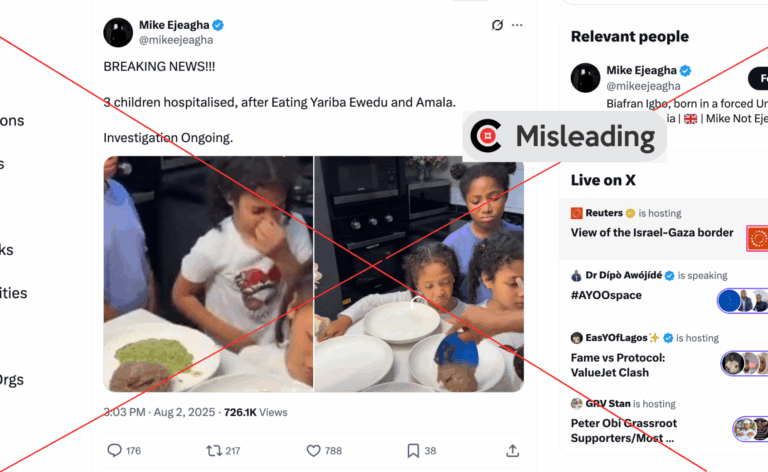
IMAGES showing three children seated in front of plates of food have been shared online with claims they depict Nigerian children hospitalised after eating ewedu and amala, a popular Yoruba delicacy.
The photos, widely circulated on X, were posted on August 2, 2025, by a user identified as “Mike Ejeagha,” who claimed:
“BREAKING NEWS!!! 3 children hospitalised, after Eating Yariba Ewedu and Amala. Investigation Ongoing (sic).”
The post, used “Yariba”, a derogatory term for Yorubas and has been shared more than 500 times.
Ewedu is a soup made from jute leaves, while amala is a yam-flour-based dish often eaten with soups and stews, especially in Nigeria’s South West.
CLAIM
The photos show Nigerian children hospitalised after eating Ewedu and Amala.
screenshot of the viral post
THE FINDINGS
Findings by The FactCheckHub show that the claim is MISLEADING.
A reverse image search using Google Lens traced the images to a YouTube Short posted on August 1, 2025, by Lagos-based content creator Adejoke Adekoya.
The full three-minute video shows Adekoya serving three children, identified as her own, amala and okro soup at home. There is no sign of illness or hospitalisation in the video.
In the clip, the children express mild displeasure as their mother serves the meal, prompting her to joke that they should “lick the plate” because of its sweetness. Hashtags such as #amala, #nigerianfood, and #momlife indicate the video is personal lifestyle content.
On her channel, Adekoya states that the channel is dedicated to sharing her “daily lifestyle, fashion, mum life, family time and hair care.”
A review of Adekoya’s channel reveals numerous similar family videos, including several uploaded after this one. There is no evidence linking the children to any food poisoning incident.
Further checks on the channel show she has posted many other lifestyle videos featuring her children, including several uploaded after this one.
Context:
The FactCheckHub has previously documented ethnic fault lines on X, where misinformation exploiting these divisions has spread widely. Such content as seen here, here and here often misrepresents outdated events to inflame ethnic sentiments.
Such misinformation trends were previously projected to impact Nigeria’s information ecosystem in 2025.
This claim fits this pattern: it misrepresents content created for entertainment on YouTube and frames it within a false ethnic narrative.
THE VERDICT
The claim that the photos show Nigerian children hospitalised after eating Ewedu and Amala is MISLEADING. The images were taken from a family video posted online by the children’s mother and have no connection to any food poisoning incident.
A Facebook user, @Historiadevuda, shared some photos with the claim that Cristiano Ronaldo, the footballer, was purchasing shares in Manchester United.
The post included several images of the player in suit signing documents and speaking at a venue resembling Manchester United’s stadium and offices.
The caption read:
Cristiano Ronaldo receives a warning about the possible purchase of Manchester United shares and responds firmly.
Since the claim was made, it has garnered 16,000 likes, 216 comments, and 69 shares.
CLAIM
Images show Cristiano Ronaldo acquiring Manchester United shares.
THE FINDINGS
Findings by The FactCheckHub show that the claim is FALSE!
Screenshot of an appearance of the claim on Facebook; Insert FALSE verdict
When the image was analysed using Google Lens, it returned results showing similar versions shared by another Facebook user and one on Instagram, where a man in the image appeared alongside Elon Musk. That man was identified as Manchester United co-owner Jim Ratcliffe.
Upon close examination, several indicators suggest that the images purportedly showing Cristiano Ronaldo signing documents at Manchester United’s stadium are AI-generated. Notably, Ronaldo’s hands appear distorted and unnaturally shaped, an error commonly associated with AI tools.
The skin textures look overly smooth and lack realistic facial details, while the lighting and shadows across the images are inconsistent with natural photography. In some frames, official logos like the Manchester United badge appear slightly warped or blurred, and the characters’ facial expressions seem frozen or unnaturally symmetrical.
These visual inconsistencies, combined with repetitive and overly polished poses, point to synthetic creation.
A scan of the image using the AI-detection tool, Illuminarty, by our fact-checker further confirms this, showing a 95.7 perf cent likelihood that the image is AI-generated.
In addition, no credible sports media outlet or Manchester United’s official platforms have reported any plans Ronaldo to acquire shares in the club. A move of this scale would typically attract widespread media attention, yet there is no such coverage, casting doubt on the claim’s authenticity.
THE VERDICT
The claim that the image shows Cristiano Ronaldo acquiring Manchester United shares is false; the images are AI-generated and there is no publicly available data to support it.
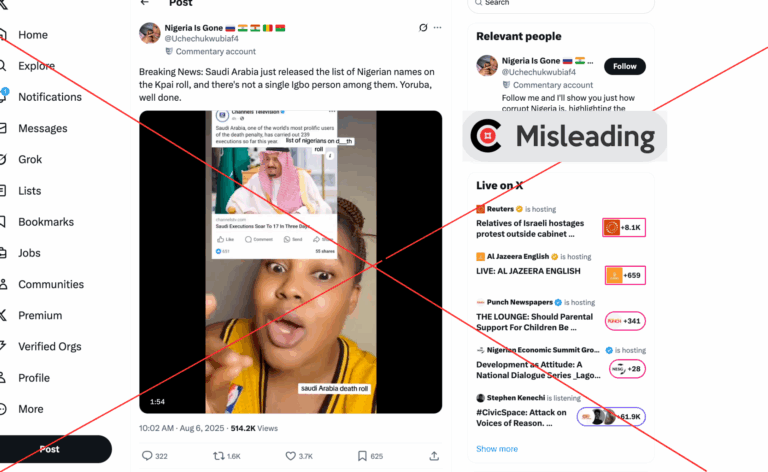
A video circulating on social media claims that Saudi Arabia recently released a list of Nigerians sentenced to death for drug-related offences and that no Igbo name appeared on the list.
The clip, posted by X user @uchechukwubiaf4, features an unidentified woman displaying screenshots of news reports to support her claim.
It was captioned: “Breaking News: Saudi Arabia just released the list of Nigerian names on the Kpai roll, and there’s not a single Igbo person among them. Yoruba, well done.”
As of August 6, 2025, the post had attracted over 1,600 reposts and more than 3,000 likes. The claim was also amplified by another X user, Ozorbig.
Saudi Arabia recently released a list of Nigerians on death row for drug offences.
screenshot of the viral post
THE FINDINGS
Findings by The FactCheckHub show that the claim is MISLEADING.
A reverse search of one of the screenshots in the video traced it to a report by TheCable originally published the report in April 2019. The story, also previously reported by Sahara Reporters, stated that 23 Nigerians were on death row in Saudi Arabia for drug-related offences.
The report said they were convicted under Saudi Arabia’s Narcotic and Psychotropic Substances Control Law, which carries the death penalty. They were arrested between 2016 and 2017 at King Abdul-Aziz International Airport, Jeddah, and Prince Muhammad bin Abdulaziz International Airport, Madinah, for attempting to smuggle banned substances concealed in their bodies.
Another screenshot used in the video, titled “Saudi Executions Soar To 17 In Three Days”, was sourced from a recent Channels TV report. However, that report did not indicate whether any of those executed were Nigerians or mentioned their ethnicities.
There is no official or credible evidence that Saudi authorities released any new list of Nigerians on death row recently, or that the names or ethnicities of such individuals were made public.
Context:
The FactCheckHub has previously documented ethnic fault lines on X, where misinformation exploiting these divisions has spread widely. Such content as seen as seen here, here and here often misrepresents outdated events to inflame ethnic sentiments.
Such misinformation trends were previously projected to impact Nigeria’s information ecosystem in 2025.
The viral video fits this pattern: it misrepresents a six-year-old report as current and frames it within a false ethnic narrative.
VERDICT
The claim is MISLEADING because the list referenced is from 2019 and is being misrepresented as new.
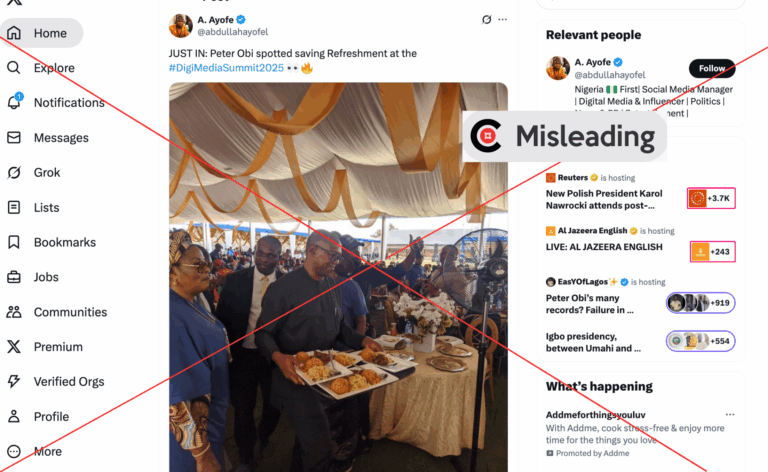
A photo showing Peter Obi, the Labour Party’s 2023 presidential candidate, carrying a tray of food has been circulated on social media with the claim that it was taken at the 2025 Progressive Digital Media Summit.
An X user, @abdullahayofel, shared the photo on August 6, 2025, with the caption:
“JUST IN: Peter Obi spotted serving Refreshment at the #DigiMediaSummit2025(sic).”
The post, which has garnered over 60 reposts and 350 likes, implies that Obi participated in the event by serving food to attendees.
The Progressive Digital Media Summit, organised by President Bola Tinubu’s Special Assistant on Social Media, Dada Olusegun, in collaboration with the All Progressives Congress (APC), brought together influencers, media experts, and policymakers in Abuja.
CLAIM
Photo shows Peter Obi serving food at APC’s Digital Media Summit.
screenshot of the viral posts showing Peter obi serving food
THE FINDINGS
Checks by The FactCheckHub show the claim is MISLEADING.
Findinhs showed that the photo was not taken at the Digital Media Summit. Instead, it was captured during a private charity event tagged “Jubilee of Hope” held in Imo State in late July 2025.
Peter Obi addressed the viral photo in a statement posted via his official X handle on Sunday, July 13, clarifying that the event was not political and that he did not invite the press. He explained that the charity event was aimed at rekindling compassion and the spirit of service in leadership.
“Let me be clear, that event was not about me. It was called the Jubilee of Hope, and its purpose is straightforward, to remind us all that true leadership is service, and that those who have must never forget those who do not,” Obi stated.
He added that third parties independently shared photos and videos online and that the act of serving food was symbolic of humility and responsibility.
Obi also noted that several other prominent Nigerians, including Cardinal John Onaiyekan and former Seplat Chairman A.B.C. Orjiako, participated in serving food at the event.
VERDICT
The photo showing Peter Obi serving food was taken at a private charity event in Imo State, not at the Digital Media Summit as claimed. The claim is MISLEADING.
When Olayinka*, a fact-checker, was scanning Facebook for health-related misinformation, he noticed something odd. Two different wellness brands, Eco Puzzling and Laut Product, were running nearly identical ads.
He observed that both ads featured AI-generated visuals of public figures endorsing wellness brands: Laut Products, registered in India, and Eco Puzzling, which listed its address in Ajah, Nigeria. But while Meta swiftly removed Laut’s content, Eco Puzzling’s ad remained live for days, until the creator took it down themselves.
“I reported both accounts to Facebook, and I got no response. I also reported this year, but I never got any response. I noticed that Laut Products has stopped operating, but Eco Puzzling is still operating because Laut Products was targeting Europe, but Eco Puzzling is still operating because the website links are also operating,” Olayinka told The FactCheckHub.
Screenshot from Eco Puzzling Ad
It wasn’t the first time he had seen this pattern. And he’s not alone. Across Africa, digital rights advocates and fact-checkers have raised growing concerns about what they see as Meta’s gap in moderating AI-generated misinformation.
While the tech giant claims to be investing heavily in automated detection tools and human reviewers, African users say they are being left behind, with content takedowns slower, flags ignored, and scams left to circulate widely.
A review by The FactCheckHub revealed that both Eco Puzzling and Laut Products were inactive, with their last posts dating back to 2023 and 2022, respectively. Still, their content was resurfacing, often targeted at distinct audiences. Laut Products catered to a non-Nigerian base, while Eco Puzzling’s ads were directed at Nigerian users.
Screenshot of Eco Puzzling followers
This moderation gap is becoming more dangerous as AI-generated content floods platforms like Facebook and Instagram, often impersonating trusted figures and institutions.
The discrepancy highlights a wider pattern of weak content moderation across Africa, where AI-generated misinformation and scam ads often go unchecked for extended periods.
Digital rights advocates say Meta’s approach points to a global moderation gap, where harmful content aimed at African users receives less scrutiny, slower response times.
Take, for instance, a Facebook video ad The FactCheckHubspotted in May (archived here) showed a TVC News anchor endorsing a trading platform Kai Traders while usingCBex platform that had already collapsed months earlier, as an example of why people should trust Kai Traders. The presenter’s face and voice seemed real, but a closer look revealed signs of AI generation: unnatural eye movement, misaligned lip-syncing, and distorted transitions between frames. The FactCheckHub identified the presenter to be made to look like Olamide Odekunle.
The video, posted on May 22, garnered over 18,000 views. Comments beneath it quickly identified the video as fake and flagged it as a financial scam. Yet, as of mid-July, the post remained online, unflagged by Meta’s moderation systems. It is pertinent to note that earlier in the same month, TVC launched it’s first AI news anchors as a new method of telling stories.
The presenter’s face and voice seemed real, but a closer look revealed signs of AI generation
When The FactCheckHub reached out to Odekunle, she noted that she did not give her consent for her likeness to be used in the video in question.
“As you know, I am one of the AI anchors for TVC news, and when we launched this feat, there was immense pushback because of the fears surrounding AI. Please note that I did not give my consent to be used for the video [ad video] in question,” she stated.
In another instance, a video ( archived here) featuring Tony Elumelu, the CEO of the United Bank for Africa, circulated on Facebook in late May. In the clip, Elumelu appeared to be endorsing a government investment scheme that allegedly offered ₦1 million in weekly returns on a ₦400,000 deposit — a promise too good to be true. The voice and mannerisms were synthetic, a product of AI voice cloning and facial synthesis. Yet, despite hundreds of comments calling it a scam and the link in the post returning an error page, the paid ad remained live.
In the clip, Elumelu appeared to be endorsing a government investment scheme that allegedly offered ₦1 million in weekly returns on a ₦400,000 deposit
The FactCheckHub and some other fact-checking organisations have previously flagged dozens of similar AI-generated ads, especially ones using the likenesses of public figures, influencers, celebrities, and government officials to promote fake investment platforms and crypto scams. Meta’s failure to act on many of these, even after reports, highlights a persistent accountability gap.
Beyond financial scams, AI-manipulated content is also being used to spread dangerous health misinformation, amplifying false medical claims under the guise of credibility. These doctored videos often feature trusted media personalities or fabricated experts, misleading vulnerable audiences.
In 2023, The FactCheckHub investigated a viral video claiming a Nigerian doctor had discovered a cure for high blood pressure. Findings revealed the footage was manipulated using AI, falsely featuring Kayode Okikiolu, a Channels TV presenter, and a fabricated testimonial.
Okikiolu, said he first became aware of the manipulated content when a colleague sent him a link. According to him, the impersonation began with sex enhancement drugs but quickly spread to include hypertension treatments and even Ponzi schemes.
“It was a colleague that sent me a link to one of the posts. She said Kayode, have you seen this? She thought I had signed a deal or contract to advertise some sex enhancement drugs, and it graduated to hypertension drugs and then to games and Ponzi schemes. Quite a number of different schemes.
“A top government official called me and said ‘Kayode, I saw this thing you did about the hypertension drug, ’ and he wanted it. That was when I discovered the hypertension one,” he said.
Just days after the death of former President Muhammadu Buhari on July 13, 2025, a fake X post surfaced online, allegedly from his widow, Aisha Buhari. The post falsely claimed that the former president had actually died in 2017 and that Nigerians had been deceived ever since. Despite several users calling out the post as fake in the comments, it remained visible.
The FactCheckHub’s investigation revealed that the screenshot of the post was generated by AI. The profile picture and username did not match any real accounts associated with Aisha Buhari. Searches across X, Facebook, and Instagram yielded no official pages linked to her — only parody accounts. Nonetheless, the manipulated image spread quickly, stoking confusion during an already sensitive national moment.
Experts say this failure to promptly remove harmful AI-generated misinformation is a systemic problem. While Meta says its moderation systems are improving and that it has invested in AI detection tools, critics argue these tools are not sufficiently adapted to African languages, cultural nuances, or political dynamics.
Reflecting on the first time he saw the manipulated videos, Okikiolu described a wave of confusion, fear, and anger.
“It was scary at first, and I was trying to ask myself if I said it. It looks and sounds like me. So maybe I actually said or did this. And it turned to anger that this is unfair, then someone mentioned at least people are seeing your face, there’s nothing like bad publicity, so I was almost thinking maybe it’s not bad,” Okikiolu noted
The emotional toll deepened as he grappled with the unfairness of being used to mislead others.
“I was more afraid at some point cause you had people saying, I saw what you advertised, I tried it, tried the game, and they almost want to blame you, particularly the ones that were cheated or swindled by it.”
Speaking with The FactCheckHub, the executive director of Human Rights Journalists Network of Nigeria, Kehinde Adegboyega, stated that Meta faced backlash for scaling back fact-checking in Africa, replacing verified systems with crowdsourced notes, despite warnings that this would weaken the fight against misinformation in countries like Nigeria and Kenya.
“In many African countries, Meta had already begun phasing out its third‑party fact‑checking partnerships in favour of a crowdsourced “Community Notes” system. That shift echoed a broader decision announced in early 2025, which experts and local coalitions warned would drastically weaken the region’s ability to counter misinformation.
In contrast, Meta’s operations in the Global North and countries like South Africa have remained comparatively robust,” Adegboyega stated.
He added that “Ahead of South Africa’s 2024 elections, Meta launched a dedicated Election Operations Centre, partnered closely with the Electoral Commission of South Africa (IEC), and backed multilingual fact-checking efforts with teams handling languages like English, Zulu, Sotho, Afrikaans, and Setswana. That infrastructure was complemented by digital literacy programmes and local civil society outreach
In many cases, the only barrier standing between users and digital deception are local fact-checkers and civil society groups, under-resourced, understaffed, and often ignored by the platforms they monitor.
Olayinka observed a noticeable gap in how Meta handles flagged content across regions. “There’s a clear disparity. Content flagged in Europe or the U.S. often gets reviewed and removed within hours. But here, we wait days or weeks, if anything happens at all.
“It often feels like Meta follows stricter laws in Europe, while in Africa, there’s little accountability for the digital manipulation happening on its platforms. I came across a report about scammers using Facebook, and it showed how authorities in Europe were able to communicate with Meta to get those pages taken down. But in Africa, it’s a constant struggle, reaching Meta or getting a response about harmful content targeting our region is incredibly difficult.” Olayinka said
He added that the only content he sees flagged on Facebook is content reviewed by third-party fact-checkers in partnership with Meta through the third-party fact-checking programme.
Okikiolu shares the same stance. He escalated the issue to his legal team. But what followed was a frustrating and disheartening journey. He reached out to the platforms, only to be met with silence or slow responses.
“A lot of them don’t have fact-checking departments and mostly have to rely on third-party fact-checking platforms. At least a lot of my videos were debunked or flagged as fake by some of these third-party fact-checking platforms. Facebook picked that and flagged some of them, but there were dozens more videos that they didn’t do anything and I still get these videos sent to me,” he stated.
This underscores Meta’s dependence on external partners for content moderation, especially in regions like Africa, where enforcement from the platform itself is often inconsistent. Yet, despite this reliance, Meta has begun phasing out these partnerships, starting with the U.S, signaling plans to eventually discontinue its Third-Party Fact-Checking Programme globally.
Meta goes against its rules in Africa
According to Meta’s own AI Terms of Service, users are prohibited from using its AI tools to create or promote harmful, deceptive, or misleading content. Specifically, the terms ban:
Generating or disseminating content that causes emotional harm or discrimination.
Using AI to mislead, including scams, phishing, and disinformation.
Violating others’ rights, including privacy and intellectual property.
Meta also outlines in its Community Standards and Transparency Center for misinformation that it prohibits fake accounts, fraud, and coordinated inauthentic behavior, practices often tied to AI-driven misinformation.
With regard to manipulated media, Meta says it will remove AI-generated videos that falsely depict someone saying or doing things they never did, especially when such edits aren’t obvious to the average viewer. This includes technical deepfakes that blend or superimpose content in misleading ways.
However, a review of several AI-manipulated videos spreading scams or health misinformation on Facebook, many of which violate these terms, shows they remain online and unflagged. This raises concerns over Meta’s uneven enforcement, particularly in African countries where moderation infrastructure has been deprioritised or dismantled.
Adegboyega stated that Meta’s response to AI-driven misinformation in Africa has been inconsistent and reactive, unlike its more robust approach in the U.S. and Europe.
He noted that while the platform showed some readiness during South Africa’s elections, its withdrawal of funding and moderation in other regions has allowed harmful content to spread unchecked.
“Where Meta withdrew funding or outsourced moderation, misinformation in African languages and contexts slipped through the cracks, with real consequences during elections, conflicts, and social unrest. To protect African users equally, Meta must rebuild fact-checking partnerships, invest in language-aware moderation, activate proactive election-centre contingency, improve labour conditions, and open its process to local oversight and transparency,” Adegboyega finalised.
This report was produced with support from the Centre for Journalism Innovation and Development (CJID) and Luminate
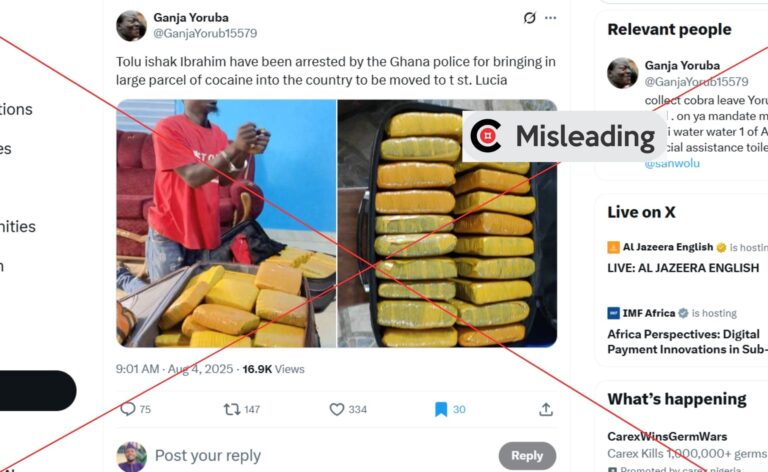
A photo showing a handcuffed man in a red shirt has surfaced online with a claim that it shows a Nigerian man of Yoruba descent, identified as Tolu Ishak Ibrahim, arrested by Ghanaian police for drug trafficking.
The image has gone viral on X, where users are claiming that the man was apprehended while smuggling cocaine into Ghana.
An X user, @GanjaYorub15579, posted the photo with the caption:
“Tolu Ishak Ibrahim have been arrested by the Ghana police for bringing in large parcel of cocaine into the country to be moved to St. Lucia.”
As of August 4, 2025, the post had garnered over 100 reposts and more than 300 likes.
Another X user, @trigottista, shared the same image with the caption:
“Tolu arrested in Ghana for bringing in this consignment of drugs (cocaine).”
That post had generated over 400 reposts and more than 1,000 likes as of August 5, 2025.
The image has been widely circulated, sparking outrage and reinforcing negative ethnic stereotypes online.
CLAIM
The photo shows Tolu Ishak Ibrahim, a Nigerian man of Yoruba descent, who was arrested in Ghana for drug trafficking.
screenshot of the viral post
THE FINDINGS
Findings by The FactCheckHub show that the claim is MISLEADING.
Checks on the image and claim traced the original source of the arrest to an official post by the Ghana Police Service on their verified X account.
According to the post dated August 3, 2025, the man in the viral image is Daniel Yeboah, a 23-year-old Ghanaian, who was arrested in the Western Region of Ghana for possession of 66 parcels of suspected narcotic drugs.
The arrest took place on Thursday, July 31, 2025, at the Samreboi-Tanokrom snap checkpoint, where Yeboah was stopped while transporting the suspected drugs on a tricycle, locally known as Pragia. The drugs were concealed in two travel bags.
Yeboah reportedly told the police that a woman in Wenchi had paid him GH₵5,000 to deliver the drugs to her at Mumuni Camp, near Samreboi. The Ghanaian police have since launched an investigation to track down the said woman.
At the time of filing this report, Daniel Yeboah remains in police custody and is expected to appear in court in August 2025.
There is no mention of any Nigerian national or a person named Tolu Ishak Ibrahim in any of the official police statements or credible media reports.
THE VERDICT
The claim that a Nigerian man named Tolu Ishak Ibrahim was arrested in Ghana for drug trafficking is MISLEADING. The individual in the viral photo is actually Daniel Yeboah, a Ghanaian national. The image and accompanying narrative were falsely attributed.
WHAT you see online may not be true, in the age of AI, it can fool you.
With artificial intelligence evolving rapidly, the internet is flooded with videos that look real but aren’t. From fake interviews to synthetic news reports, deepfakes have become harder to detect, no longer giving themselves away with just awkward smiles or stiff gestures. They are now so convincing that spotting them takes more than just noticing a twitchy eye or a strange smile.
Tools such as DALL·E and Veo 3 can generate stunning visuals and cinematic videos with just a prompt. While this technology opens up new creative possibilities, it also poses significant risks.
The challenge? These videos often look indistinguishably real.
For instance, a close observation of the video posted by an X user in June, which showed a female journalist reporting about a flood in Abeokuta, reveals subtle but telling signs of AI generation. Despite the human-like movements and natural-sounding speech, some inconsistencies gave it away. For instance, during a quick turn by the presenter, an umbrella suddenly appears in her hand, though it wasn’t there moments earlier.
Screenshot of the video from X
Additionally, her emotionless reaction to someone falling nearby, an incident that would typically prompt concern, further suggests the video contains inauthentic human behaviour. There are various instances of such videos that have gone viral.
Another example is this video showing a collapsing flyover bridge. While the scenery and structure appear realistic, the behaviour of the white car driving toward the collapsed section is implausible, not the expected behaviour in the face of danger.
Screenshot of the video from Facebook
As a viewer, journalist, or active digital citizen, spotting AI-generated content isn’t just a helpful skill; it’s a critical one.
This tutorial will walk you through how to recognise videos created with tools like DALL·E (which generates images often edited into video sequences) and Veo (which produces entire video scenes from a prompt).
Look for visual anomalies
AI-generated videos, though increasingly sophisticated, often reveal their artificial nature through subtle glitches and inconsistencies. Watch for odd lighting or mismatched shadows, distorted hands or fingers (common in still-to-video conversions like DALL·E hacks), unnatural eye movements or blinking, and warped or melty objects in the background.
In tools like Veo 3, robotic body movements, overly smooth transitions, altered or incoherent subtitles, and audio that sounds too perfect or lacks ambient noise can all signal synthetic content. Even complex scenes may feature objects that are inconsistently placed or lit, making careful observation essential.
Flawless, yet fake
Veo, especially in its latest version (Veo 3), can generate cinematic scenes with hyperrealism, but the results often come with subtle giveaways. Look out for over-perfect environments like spotless skies, mirror-smooth water, or unnaturally fluid motion.
Transitions between scenes or camera angles may also feel jarring or robotic. The actors themselves might not blink, breathe, or move quite naturally, giving off an uncanny vibe. Veo 3 can even create scenarios that defy logic or physics, think improbable events, flawless characters, or backgrounds with strange, repeating patterns that don’t belong in real-world settings.
Context is equally important. Veo 3, for instance, is a paid tool, so a sudden flood of short, high-quality videos around breaking news could signal AI involvement.
A recent example is the flyover bridge accident in Nasarawa, where AI-generated images were circulated to support the claim. However, The FactCheckHub found these visuals to be misleading.
Similarly, if a video claims to show a major event but isn’t reported by any reputable outlet, that’s might be a red flag.
Scrutinise metadata
Tools like InVID can help verify video authenticity by extracting metadata such as timestamps, GPS coordinates, and device information. AI-generated videos often lack this data or include vague, generic tags. If you have access to the original video file, inspect its metadata for signs like “Veo,” “Gemini,” or “Google AI.”
Keep in mind that metadata can be stripped or altered, so it shouldn’t be your only line of verification.
Several tools can help detect AI-generated or manipulated media. Deepware Scanner is designed to spot deepfake facial alterations, while Hive Moderation uses AI detection to flag likely synthetic images or video frames. InVID is especially useful for verifying videos, allowing frame-by-frame analysis and metadata extraction. Another handy tool is AI or Not, which helps determine whether an image or video was created using artificial intelligence.
The FactCheckHub has used one or more of these tools to verify images or videos in our previous fact-checks, as can be seen here and here.
Look for disclosures
Some creators voluntarily tag or watermark AI-generated content, so it’s worth looking closely. Check for phrases like “generated with AI,” “created using DALL·E,” or “Veo3” in captions, file names, or project descriptions, especially if they include prompt-style language.
Google embeds both visible and invisible watermarks in every Veo 3 video. You might spot small logos or “AI-generated” text within the frame. More subtly, Veo 3 videos contain SynthID an invisible digital signature detectable only with specialised tools. While the general public can’t access SynthID scanners, certain fact-checkers and organisations can use them to verify the origin of a video.
In conclusion, detecting AI-generated content is becoming more complex as the technology continues to advance. However, by combining keen observation with the right tools and questioning content that lacks credible context or sources, we can stay a step ahead of AI-driven misinformation. Remember, staying informed isn’t just about consuming content; it’s about verifying it.
A claim that the Independent National Electoral Commission (INEC) has confirmed Nenadi Usman as the chairperson of the Labour Party has gone viral online.
An X user, @TheoAbuAgada, posted the claim with the caption:
“Peter Gregory Obi’s ally, Nenadi Usman, has been confirmed as the authentic Chairperson of the Labour Party by INEC. “All of a sudden”. Peter, until this moment, has refused to resign from the Labour Party. If this does not tell you anything, I don’t know what else will. I repeat, Peter is not with the coalition and he is working to bring Tinubu back.”
The post had generated over 150 reposts and more than 500 likes as of August 1, 2025.
Another X account, @ADCNews_, also posted the claim with the caption:
Just In. INEC has confirmed Sen Nenadi Usman as Acting Chairman of Labour Party. At this rate. Tinubu is confused on where to set his trap. ADC or LP
The post had generated over 500 reposts and more than 2,000 likes as of August 1, 2025.
CLAIM
INEC confirms Nenadi Usman as Labour Party chairperson.
Screenshot of the viral post
THE FINDINGS
Findings by The FactCheckHub show that the claim is FALSE.
Since the conclusion of Nigeria’s 2023 presidential election, the Labour Party (LP) has been mired in a prolonged leadership crisis, largely revolving around competing claims to the chairmanship of the party.
Julius Abure, who led the party through the 2023 general elections, has faced opposition from various internal factions, especially the Nigeria Labour Congress (NLC), which accused him of financial impropriety and high-handedness. These disputes culminated in the controversial national convention held in Anambra in March 2024, where Abure was re-elected as chairman, a move rejected by several party organs.
To stabilise the party and restore credibility, a coalition of LP stakeholders, including the NLC and some state chapters, appointed Nenadi Usman as chairperson of a caretaker committee in late 2024.
Usman was seen as a neutral figure capable of uniting the fractured party. Her emergence received a significant boost in April 2025 when the Supreme Court ruled that Nigerian courts lacked jurisdiction to decide internal party leadership matters, a verdict that effectively voided Abure’s standing and empowered the coalition-backed caretaker leadership.
Despite the judicial ruling, the Independent National Electoral Commission (INEC) has not publicly confirmed or published Nenadi Usman’s name as the authentic chairperson of the Labour Party, as required by law.
INEC’s role in party leadership matters is administrative and reactive. It can only recognise and publish names submitted to it in line with party constitutions and after the proper legal and procedural processes.
As of August 1, 2025, the commission’s official records still reflect Julius Abure as the National Chairman, and no official bulletin or document affirms Nenadi Usman as the recognised national chairperson of the LP.
When contacted by The FactCheckHub, Rotimi Oyekanmi, the Chief Press Secretary to the INEC Chairman, Mahmoud Yakubu, debunked the claim and confirmed that Abure remains the chairman of the party.
“The news [that Nenadi Usman has been confirmed as LP chairman] is not true. There’s nothing like that. There’s no confirmation. The situation remains the same. To be sure, go to our website, click on political parties — the names of the chairmen and secretaries are all there. What you find there is what the situation is at the moment,” he said.
VERDICT
The claim that the Independent National Electoral Commission (INEC) has confirmed Nenadi Usman as the chairperson of the Labour Party is FALSE, as findings showed that Julius Abure still remains the recognised chairperson of the party as of August 1, 2025.