Home Blog Page 22

Video of river crossing with a rope from Sudan, NOT Nigeria

0

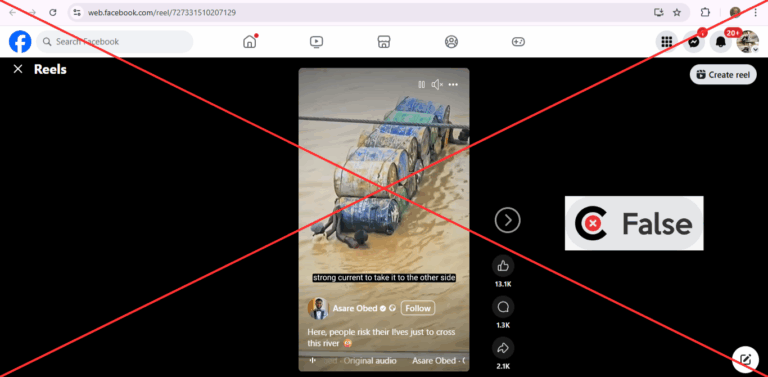
A Facebook user, Asare Obed, shared a video of a woman crossing a river with the aid of a rope, claiming the video is from Nigeria.

The audio of the video asserts that the situation was happening in Nigeria.

The  audio transcribed read:

This is not a scene from a movie; this is the harsh reality of Nigeria. Every day, people cross this river, risking their lives. There is no bridge, only a weak rope to support them. The situation is so dire that to get from the village to the city, one must hang onto that rope, swinging between hope and death.

READ : Remembering Buhari’s repeated death rumours and ‘Jibril of Sudan’ conspiracy

The post was also shared alongside a caption that reads:

Here, people risk their l!ves just to cross this river 😲
As at the time of filing this report, the post had garnered a traction of over 13,000 likes, 1,300 comments and 2,100 reshares.

CLAIM

Video shows people crossing river with a rope in Nigeria

Screenshot of an appearance of the claim INSERT; False verdict

THE FINDINGS

Findings by The FactCheckHub shows that the claim is FALSE!
When screenshots from the video were subjected to a Google Reverse Image Search, we found that the footage was from September 2024, not in Nigeria, but in Sudan.

Médecins Sans Frontières (MSF) Sudan had confirmed the incident, posting photos of the collapsed bridge on its X handle as far back as August 12, 2024.

The video, which showed civilians using ropes to cross a river, happened after the collapse of the Morni Bridge, which links South and Middle Darfur.

A clip taken from a different angle was shared on September 7, 2024, by the Sudan International Human Rights Organisation (SIHRO) on its X handle.

READ ALSO : No! Video does not show women being attacked in Sudan

The organisation had noted that the collapse of the Morni Bridge in Darfur had cut off civilians from essential services, forcing them to risk their lives crossing the river with ropes, describing it as a grave human rights violation that required urgent action from authorities and the international community.

THE VERDICT

The claim that the video shows people crossing a river with a rope is false; the video is from Sudan, it is from a year ago.

No, video does not show Nigerian soldiers recently attacking civilians in Imo

0

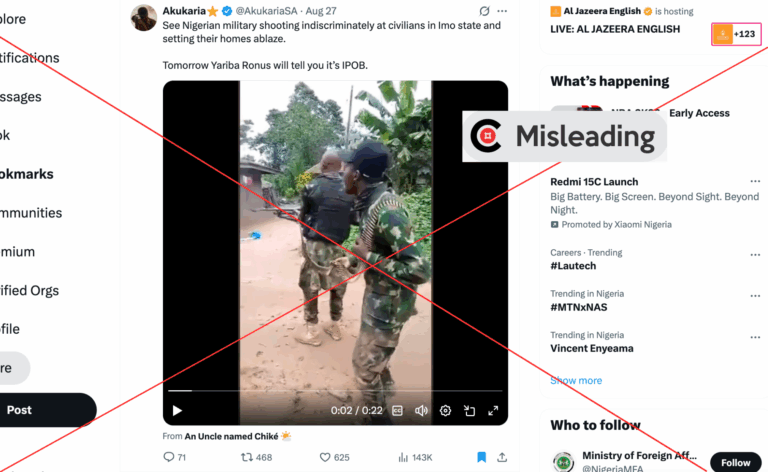
A video showing military men shooting at houses in a rural community has resurfaced online. The video was shared by an X user, Akukaria, who claimed that it shows Nigerian soldiers attacking civilians in Imo State.

READ : Video does not show recent army mobilization against Turji-led bandits in Sokoto

His post reads: “See Nigerian military shooting indiscriminately at civilians in Imo state and setting their homes ablaze. Tomorrow Yariba Ronus will tell you it’s IPOB.”

The post quickly gained traction, generating more than 400 reposts and over 500 likes as August 28, 2025.

CLAIM

Video shows Nigerian soldiers recently shooting indiscriminately at civilians in Imo and burning their houses.

screenshot of the viral post

FINDINGS

Checks by The FactCheckHub show that the claim is MISLEADING.

A reverse search of keyframes from the footage traced the video to November 2021, when it first appeared online as can be seen here.

At the time, it was reported in connection with an alleged military raid in Mgbowo community, Awgu Local Government Area of Enugu State, not Imo.

According to the Punch, soldiers of the Nigerian Army invaded Isingwu, a hamlet in Imama Village, Mgbowo in Awgu Local Government Area of Enugu State and burnt houses, with an undisclosed number of youths killed for yet to be identified reasons.

Some sources claimed the soldiers were in the community to arrest an alleged leader of the Eastern Security Network, the security arm of Indigenous People of Biafra, who hailed from the community.

READ ALSO : Simon Ekpa shares fake images of alleged Biafrans’ assault on Nigerian Army vehicle

The said suspect, known as Chocho, was said to be at large when the military personnel invaded the community at about 5:am and started shooting indiscriminately, burning houses, including the family house of the said suspect.

In 2021, the Nigerian Army’s 82 Division in Enugu also issued a statement denying that soldiers shot at or burnt houses in the area. The army explained that it had only raided a suspected Indigenous People of Biafra/Eastern Security Network (IPOB/ESN) hideout, leading to the arrest of two suspects.

VERDICT

The claim that the video shows a recent military attack on civilians in Imo State is MISLEADING. The footage is an old clip from November 2021 in Enugu State, recycled online to create a false impression of a new incident.

Prebunking vs. debunking: what’s the difference?

0

IN today’s information age, false claims can quickly cause real harm, such as shaping elections, fuelling health crises, and eroding trust in public institutions.

To address this, fact-checkers and actors in the disinformation space often turn to two key strategies: prebunking and debunking.

While the terms may sound alike, their timing and impact differ significantly, and understanding this distinction is vital to strengthening a resilient information ecosystem.

READ: Doxxing explained: what it is and how to stay safe

What is Debunking?

Debunking is the process of correcting misinformation after it has already spread and gained traction. It’s reactive, meaning fact-checkers or journalists step in once a false claim is circulating, investigate it, and provide credible evidence to set the record straight.

Debunking can be understood as a form of damage control. Once a falsehood has already circulated and gained traction, the objective is to minimise further harm by exposing the truth and providing accurate information.

Clear examples include the spread of misinformation and disinformation during Nigeria’s 2023 general elections, many of which were debunked by The FactCheckHub [see here, here, and here].

Similarly, in 2020, during the COVID-19 pandemic, The FactCheckHub fact-checked numerous claims ranging from supposed cures for the virus to vaccine-related falsehoods designed to discourage uptake once vaccines became available.

Citing the World Health Organization (WHO), our researchers demonstrated that these claims lacked any scientific basis. This too was debunking correcting falsehoods only after they had already circulated widely.

What is Prebunking? 

Prebunking, in contrast, is proactive. It anticipates the types of misinformation likely to appear and equips people with the knowledge to spot and resist them.

Think of it like a vaccine; instead of waiting until people are infected by false information, prebunking prepares them in advance.

Ahead of elections, fact-checkers can write tutorials and explainers that would educate the electorate ahead of the day and how to identify potential misinformation.

In health, prebunking is equally powerful. Ahead of vaccination campaigns or outbreaks, organisations might warn that common misinformation, such as claims that vaccines cause infertility, etc, will circulate online. When people later encounter such posts, they are more likely to reject them because they were already warned.

READ ALSO: How to use Google Fact Check Explorer for crosschecking information

By doing this, prebunking helps citizens become more sceptical of suspicious content before they even encounter it. 

Both approaches are essential, but their effectiveness differs. According to the American Psychological Association, prebunking can reduce the spread of falsehoods by making people more resistant to them in the first place. Debunking, while necessary, often struggles because misinformation travels faster than corrections and tends to leave lasting impressions even after it has been disproven.

No, video does not show dilapidated house of late Herbert Wigwe

0

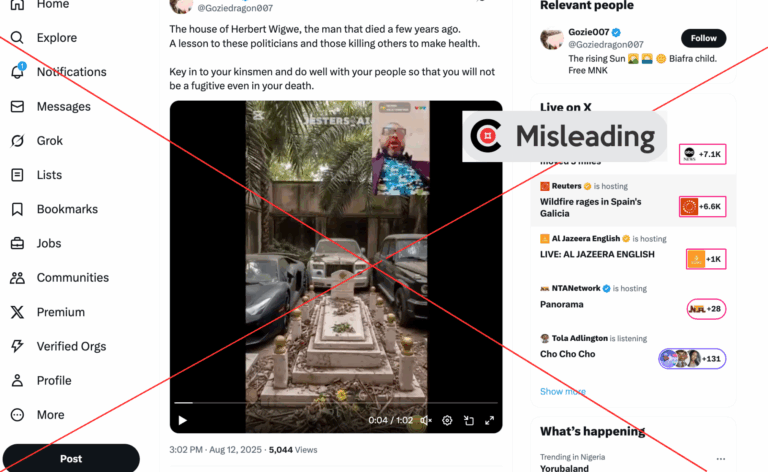
A video showing an abandoned house and properties has surfaced online with a claim that it belongs to the late Access Bank chief executive, Herbert Wigwe.

The video was posted by an X user, @Gozoedragon∅∅7, with the caption:

“The house of Herbert Wigwe, the man who died a few years ago. A lesson to these politicians and those killing others to make health. Key into your kinsmen and do well with your people so that you will not be a fugitive even in your death.”

As of August 19, 2025, the post had garnered over 5,000 views and more than 80 reposts.


CLAIM

Video shows the current condition of the late Herbert Wigwe’s house and properties.

screenshot of the viral post

THE FINDINGS

Findings by The FactCheckHub show that the claim is MISLEADING.

Herbert Wigwe, the former managing director of Access Bank, died in February 2024 alongside his wife, son, and former Nigerian Stock Exchange chairman, Abimbola Ogunbanjo, in a helicopter crash in the Mojave Desert, California.

Keyframes from the video circulating online were subjected to Google Reverse Image search, and the result shows that the video was created and posted by a comedian, Classy Jesters, on Facebook.

The user posted the video with a caption: “What’s the purpose of life vanities”. There is no indication in the post that the properties belong to Wigwe.

Further checks also revealed a watermark labelled “Jester AI” on the video. A Google search confirmed that Jester AI is an AI-powered application used to generate social media images and captions—further evidence that the visuals were fabricated. The user has used the tool to generate hyper-realistic AI videos in the past for entertainment purposes, as can be seen here and here.

Additionally, archived videos of Herbert Wigwe’s actual residence, shared on YouTube and X in 2024 shortly after his death, show a completely different property from the one depicted in the viral video.

This indicates that the video circulating on X was manipulated with AI tools and does not reflect the real condition of Wigwe’s home or properties.


VERDICT

The claim that the viral video shows the dilapidated house of the late Access Bank CEO, Herbert Wigwe, is MISLEADING, as findings show the video was AI-generated.

No, video does not show Biafrans taking over Anambra State

0

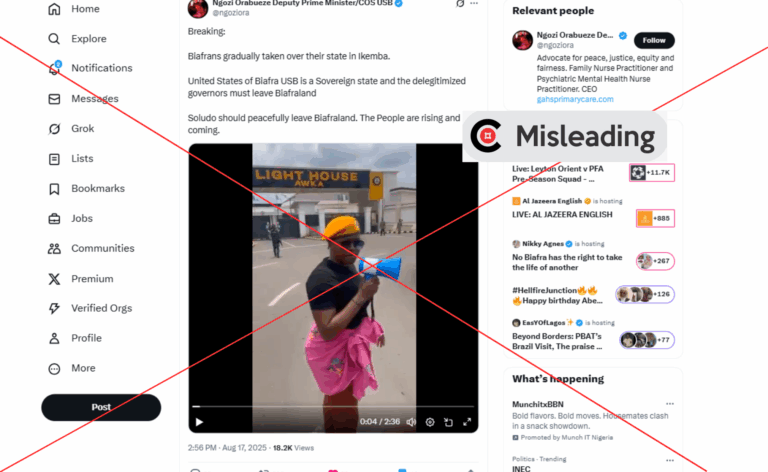
A video showing people protesting in front of the government house in Anambra has circulated on X with a claim that Biafrans are gradually taking over the State.

The video, posted on August 17, 2025, by Ngozi Orabueze, a self-acclaimed Prime Minister of the “United States of Biafra,” shows a woman with a megaphone leading a protest while others marched behind her carrying a banner.

The post was captioned: “Breaking: Biafrans gradually taken over their state in Ikemba. United States of Biafra USB is a Sovereign state and the delegitimized governors must leave Biafraland. Soludo should peacefully leave Biafraland. The People are rising and coming.”

As of the time of filing this fact-check, the post had garnered over 500 reposts and more than 700 likes.

CLAIM

The video shows Biafrans gradually taking over Anambra State.

screenshot of the viral post

THE FINDINGS

Findings by The FactCheckHub show that the claim is MISLEADING.

Screenshots from the video were analysed using Google Reverse Image Search. Results traced the video to a Facebook post published on August 15, 2025. The accompanying caption explained that the protest was led by Chioma Grace Ifemeludike, the African Action Congress (AAC) governorship candidate in Anambra State.

According to the Facebook post, Ifemeludike had attempted to enter the Anambra State Government House known as the Light House but was restricted by security operatives. She had demanded to see Governor Charles Soludo to present her concerns about insecurity in the state.

Further keyword searches confirmed that Chioma Ifemeludike is indeed the AAC governorship candidate. She also introduced herself as such in the video. Ifemeludike has consistently spoken against alleged human rights abuses and criminal activities by the state-backed Agunechemba security network, and had previously threatened to lead a protest if reforms were not carried out.

A closer look at the protest banner in the video reveals that it does not reference Biafra. Instead, it condemned the killing of a man named Emmanuel, reportedly murdered by kidnappers after refusing to sexually assault his sister.

This shows that the protest was tied to insecurity and governance issues in Anambra State, not to any Biafra secessionist movement.

VERDICT

The claim that the video shows Biafrans taking over Anambra State is MISLEADING. The footage actually depicts a protest led by Chioma Ifemeludike, the AAC governorship candidate, over insecurity and human rights concerns in Anambra.

Video does not show Somali ambassador drinking from jug

0

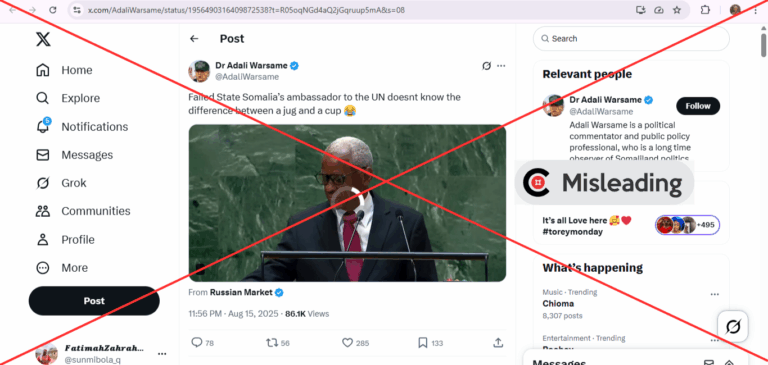
A claim that a video shows a Somali ambassador drinking water from a Jug has surfaced on the internet with a claim that he does not know the difference between a Jug and Cup.

An X user, @adaliwarsame, posted the video, which was less than 30 seconds with a caption that reads :

“Failed State Somalia’s ambassador to the UN doesnt know the difference between a jug and a cup.”
Since the inception of the claim on Friday, August 15 2025, it has gained traction with over 80,000 views, 285 likes and 56 reposts.
The FactCheckHub decides to verify this claim because it has gone viral and generated significant engagement online, attracting over 80,000 views within a short period.

CLAIM

Video shows Somali ambassador drinking from a jug.

THE FINDINGS

Findings by The FactCheckHub show that the claim is MISLEADING!

Screenshot of the claim as seen on X; Insert MISLEADING Verdict

A Google Lens search of the viral screenshot revealed that the man in the video is not a Somali ambassador, as widely claimed, but Edgard Leblanc Fils, who was the Haitian Transitional President from April to October 2024.

The clip originated from an incident in September 2024 during the United Nations General Assembly.

While delivering a speech calling for international support for peacekeeping efforts in Haiti, Leblanc attempted to drink from an oversized water jug but accidentally spilt it on himself. The light-hearted mishap was caught on camera and quickly went viral, spawning a flurry of memes online.

At the time, several international media outlets reported on the moment, framing it as a humorous interruption to a serious appeal for global solidarity with Haiti.

THE VERDICT

The claim that the video shows a Somali ambassador drinking from a jug is misleading; the man in the video is Haitian transitional president, Edgard Leblanc Fils.

Fact-checkers to gather in Lithuania for GlobalFact 2026

THE world’s fact-checking community will converge in Vilnius, the capital of Lithuania, in June 2026 for the 13th edition of the GlobalFact summit.

Organised by the International Fact-Checking Network (IFCN) at Poynter, GlobalFact is regarded as the largest gathering of professional fact-checkers globally.

The annual conference serves as a platform for journalists to tackle challenges confronting the industry, share best practices, and build partnerships to strengthen the fight against misinformation.

The 2026 summit will feature keynote sessions, interactive workshops, and networking opportunities, with discussions expected to focus on artificial intelligence, online disinformation, and information integrity.

This year’s event is being hosted in partnership with Delfi, Lithuania’s leading media platform and home to the IFCN and EFCSN-certified fact-checking unit, Melo detektorius (“Lie Detector”), known for its fact-checks, media literacy programmes, and AI-driven tools against disinformation.

“Lithuania is on the frontline of the global fight for facts,” IFCN Director, Angie Drobnic Holan, said. “We are proud to partner with Delfi, whose resilience and sophistication in tackling disinformation make them an ideal host.”

Aistė Meidutė, editor of Melo detektorius, described the hosting as an honour, stressing Lithuania’s history of defending press freedom and democratic values.

Since its debut in 2014, GlobalFact has attracted more than 4,000 participants across major cities, including London, Cape Town, Buenos Aires, Rome, Seoul and Rio de Janeiro. The summit has also birthed initiatives such as International Fact-Checking Day and IFCN’s Code of Principles.

Ahead of the 2026 edition, IFCN has unveiled GlobalFact Virtual, a year-round webinar series for fact-checkers unable to attend in person.

Details on the summit’s exact dates, registration, and speaker applications will be announced in the coming months via its new website: globalfactconference.org.

Old footage of Ibom Air flight disruption misrepresented as recent

0

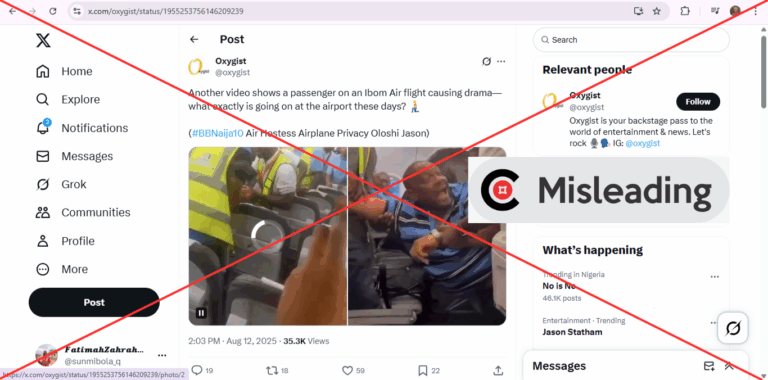
A video circulating on X shows a passenger on an Ibom Air flight being confronted by security personnel attempting to remove him from the aircraft. The clip is being shared alongside claims linking the incident to the recent controversy involving Comfort Emmanson and an Ibom Air staff member, as well as a separate altercation involving popular Fuji musician Wasiu Ayinde, also known as KWAM 1.

READ ALSO: Old video of stranded Ibom Air passengers falsely tied to KWAM 1 case

An X user, @Oxygist, posted the video with the caption:

Another video shows a passenger on an Ibom Air flight causing drama— what exactly is going on at the airport these days?

As of August 15, it had gained an impression of 30,000 views.

On August 5, 2025, KWAM 1 was reported to have disrupted a ValueJet flight at Abuja’s Nnamdi Azikiwe International Airport after a confrontation with airline staff. Following the incident, the Nigerian Civil Aviation Authority (NCAA) suspended the pilots involved, while ValueJet placed the musician on a no-fly list.

A few days later, on August 10, another viral incident occurred when passenger Comfort Emmanson was involved in an altercation on an Ibom Air flight from Uyo to Lagos, which escalated into violence.

CLAIM

Video shows another recent Ibom Air occurrence

THE FINDINGS

Findings by The FactCheckHub show that the claim is MISLEADING!

Screenshot of the claim; Insert Misleading verdict

A reverse image search on keyframes from the video circulating on social media traced it back to 2023.

According to multiple reports, the incident involved a passenger standing between seats in the middle of an aircraft, threatening that President Bola Tinubu must not be sworn in as Nigeria’s president in May 2023.

Reports on March 31, 2023, stated that security operatives at the Nnamdi Azikiwe International Airport in Abuja arrested a man shouting that “Tinubu can’t be sworn in” and “Obidients,” disrupting an Ibom Air flight from Abuja to Lagos.

While the man was never identified, Ibom Air issued a statement clarifying the incident and apologising to other passengers on board.

READ : False claim on presidential aircraft attributed to Akpabio circulates online

This case occurred in 2023, not recently after the KWAM 1 and Comfort Emmanson incidents in August 2025.

THE VERDICT

The claim that the video shows another recent Ibom Air occurrence is misleading; the video is from 2023.

Old video of stranded Ibom Air passengers falsely tied to KWAM 1 case

0

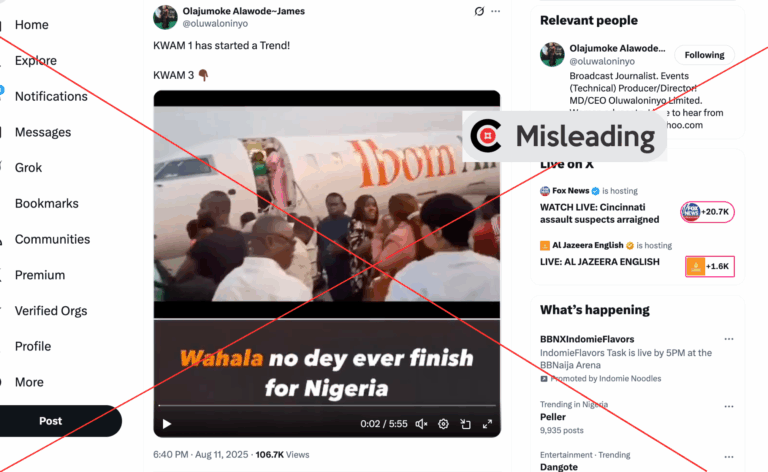
A video circulating on X shows Ibom Air passengers being disembarked from a plane as security operatives arrest a woman. The clip is being shared alongside claims that the incident followed the recent controversy involving popular Fuji musician Wasiu Ayinde, also known as KWAM 1.

An X user, @Oluwanyo, posted the video with the caption:

 “KWAM 1 has started a Trend!”

As of August 13, 2025, the post had generated over 700 reposts and 900 likes.

CLAIM

The video shows chaos on an Ibom Air flight following the KWAM 1 incident.

screenshot of the viral post

THE FINDINGS

Findings by The FactCheckHub show that the claim is MISLEADING.

On August 5, 2025, KWAM 1 was reported to have disrupted a ValueJet flight at Abuja’s Nnamdi Azikiwe International Airport after a confrontation with airline staff. Following the incident, the Nigerian Civil Aviation Authority (NCAA) suspended the pilots involved, while ValueJet placed the musician on a no-fly list.

Just days later, on August 10, another viral incident occurred when passenger Comfort Emmanson disrupted an Ibom Air flight from Uyo to Lagos by not switching off her phone which escalted into violence.

However, a reverse image search on keyframes from the video circulating on social media traced it back to January 8, 2025. According to multiple reports, including TheCable, the January incident involved a passenger who refused to allow an Ibom Air flight from Uyo to Abuja to depart after discovering her luggage had not been loaded due to weight constraints.

Despite interventions from airline staff, Aviation Security (AVSEC) personnel, and the pilot, the woman blocked the aisle and insisted her bag be loaded before departure. The flight was eventually cancelled when Uyo airport’s airspace closed at sunset, leaving 89 passengers stranded.

The NCAA later confirmed the disruption and said the passenger would face prosecution.

This January case is entirely separate from both the KWAM 1 and Comfort Emmanson incidents in August 2025.

THE VERDICT

The claim is MISLEADING. The video does not show chaos on an Ibom Air flight linked to the KWAM 1 saga. It is footage from a January 8, 2025, incident in Uyo, when a passenger’s refusal to fly without her luggage caused a flight cancellation.

Old video of flood-damaged Gombe–Adamawa road recirculates as recent

0

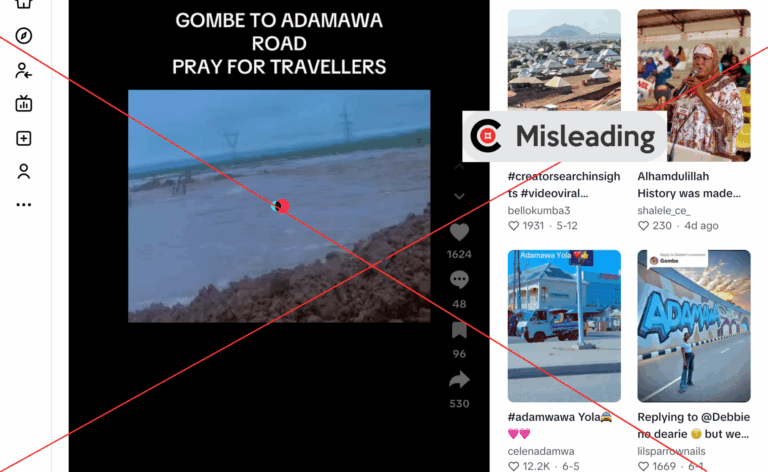
A TikTok user has posted a 15-second video claiming that a bridge linking Gombe to Adamawa State collapsed on August 5, 2025, due to heavy rainfall.

The clip shows a section of the road split by flowing water, with stranded travellers calling for help. A voice speaking in Hausa can be heard saying:

“People on TikTok should pray for us, we cannot cross as heavy rain destroyed the road that links Gombe to Adamawa.”

The video also carries the inscription: “GOMBE TO ADAMAWA ROAD PRAY FOR TRAVELLERS.”

As of August 11, 2025, the post had reached about 115,000 views, with over 1,500 likes and more than 500 shares.

CLAIM

A bridge on the Gombe–Adamawa road was washed away by heavy rainfall in August 2025.

Screenshot of the viral video

THE FINDINGS

Findings by The FactCheckHub show that the claim is MISLEADING.

A reverse image search traced the footage to a September 2024 report by Trust TV, which covered flooding on the Numan–Gombe section of the Gombe–Adamawa road.

At the time, severe flooding caused the collapse of a bridge in Boshikiri community, halting vehicular movement and stranding commuters. In October 2024, a temporary alternative route was also washed away, further isolating travellers.

The Gombe–Adamawa–Taraba road, also known as the Numan–Gombe Federal Road, spans about 245 kilometres and is a critical route for passenger and goods transportation in the northeast.

The road, which is under construction, is one of the North-eastern roads that the Senate asked the federal government to include in the newly approved superhighway project.

THE VERDICT

The claim that the video shows a recent road collapse due to flooding is MISLEADING. The video is from September 2024, not a recent incident in August 2025.