Home Blog Page 154

FACT CHECK: Does Ghana have 200 cases of Coronavirus?

0

A RECENT post shared on Twitter by a user who goes by the name Jeremy Weate, with over 13,000 followers on the micro-blogging platform, claiming that Ghana has up to 200 cases of Coronavirus has added another twist to series of fake information about the novel virus.

In his now deleted tweet, Weate, whose Twitter bio shows as someone with interest in natural resource governance and mainstreaming psychedelic healing, shared a link to a report by Bloomberg which focuses on the decisive measures being taken by Ghana to prevent the spread of Coronavirus in the country.

However, in captioning the report, Weate, stated that Ghana now has up to 200 cases of Coronavirus and travelers from overseas are required to self-isolate for 14 days.

Jeremy Weate’s tweet
Photo: Twitter

Weate’s tweet is a direct contrast from the report which he shared as his source of information.

In its report, Bloomberg revealed that Ghana has shut its borders especially against countries that have over 200 confirmed cases of the Coronavirus, in attempt to arrest the spread of the virus in the country.

“Ghana is closing its borders to travelers from countries with more than 200 cases of the coronavirus as the West African nation seeks to prevent contagion of the disease,” the report stated.

Currently, according to World Health Organisation (WHO), Ghana, has only two confirmed cases of Coronavirus and both cases are imported.

On March 12, Ghana’s ministry of health released a press statement in which he revealed that the country had gotten two confirmed cases of the virus.

In the statement, it was stated that the two patients had come from Norway and Turkey, and had tested  positive to the virus following a test carried out at the Noguchi Memorial Institute for Medical Research centre.

So far, 17 African countries have recorded confirmed cases of COVID-19, with South Africa, Algeria and Senegal having the highest number of cases; 38, 37 and 21, respectively.

FACT CHECK: Does drinking bleach, snorting cocaine cure coronavirus?

0

SINCE the outbreak of coronavirus, a respiratory disease which was first recorded in Wuhan, China, became an epidemic and graduated to becoming a pandemic, it has triggered panic across the world.

Given the nature and spread of the virus which has now infected over 100,000 globally and killed 3,800 people, the absence of a known cure or vaccine has led many to result to taking drastic measures in attempt to ward off the deadly virus.

As such, a lot of misinformation and myths have been raised and the predominant tool of dissemination has been social media platforms.

There are statements being shared on Twitter, Facebook, Instagram which have garnered thousands of likes and re-shares, claiming that alcohol, garlic, bleach and even cocaine can avert or ‘cure’ the virus.

These suggested ‘cures’ have caused scores of deaths and more worrying, fake news about the virus keeps spreading at the speed of light.

Does cocaine kill coronavirus?

On Twitter, a verified account owned by a Nigerian music and entertainment developer with more than 190,000 followers identified as Bizzle Osikoya, tweeted a doctored image from a television breaking news segment, proposing that cocaine can cure coronavirus now known as COVID-19.

Bizzle Osikoya shares tweet purporting cocaine can cure coronavirus
Photo: Twitter

Osikoya’s tweet which was posted on February 3, has remained for over a month and has also been retweeted over 2,700 times and liked over 5,500 times, with no warning that the content is false.

According to the National Institute on Drug Abuse, cocaine is a powerfully addictive stimulant drug and some of the side effects include; constricted blood vessels, dilated pupils, nausea, raised body temperature and blood pressure, fast or irregular heartbeat, tremors and muscle twitches.

Another tweet with similar viral effect was shared by one Sam Whyte, who has over 9,000 followers. In her tweet, Whyte, submitted that to combat coronavirus, cocaine, masturbation, staying in, and hand sanitiser were effective.

Sam Whyte’s tweet
Photo: Twitter

Her tweet generated over 4,000 likes and hundreds of retweets. However, unlike Osikoya, Whyte posted a disclaimer, stating that her tweet are barely ever factual, however her rebuttal got just 20 likes.

Sam Whyte’s tweet
Photo: Twitter


French Government disclaims cocaine as cure to COVID-19

To suppress the false information, the French Ministry of Health shared a tweet, saying “No, cocaine does not protect against COVID-19. Cocaine is an addictive stimulant drug. Using it can seriously harm people’s health and create undesirable effects.”

It as a myth, chlorine dioxide cannot kill virus in your body — WHO

Another major misinformation declared that drinking beach or chlorine dioxide (aka ‘MMS’) can ‘cure’ coronavirus.

In a tweet by Jordan Sather, which also attracted nearly 3,000 likes and nearly 2,000 retweets, Sather, a Youtuber with over 121,000 followers, submitted that: “Not only is chlorine dioxide (aka ‘MMS’) an effective cancer cell killer, it can wipe out coronavirus too, Big Pharma wants you ignorant,” his tweet read.

Jordan Sather tweet
Photo: Twitter
According to World Health Organisation (WHO); “spraying alcohol or chlorine all over your body will not kill viruses that have already entered your body.


The organisation classified it as a myth and stated that; “spraying such substances can be harmful to clothes or mucous membranes (i.e. eyes, mouth).”


It also stated that “garlic is a healthy food that may have some antimicrobial properties. However, there is no evidence from the current outbreak that eating garlic has protected people from the new coronavirus.”


Just recently,  44 people in Iran were declared dead over alcohol poisoning. According to reports, the victims had attempted to use alcohol to avert the virus following rumours that it could ‘cure’ the virus.


WHO has shared preventive measures that can be adopted to protect one from contracting coronavirus. According to the organisation, frequent hand washing with soap and water, avoidance of direct contact with an infected persons, among many other things are the most effective ways of preventing an infection.

FACT-CHECK: Presidential spokesperson exaggerates figure of people killed by Malaria in Nigeria

CLAIM: 822 people killed by malaria daily in Nigeria

GARBA Shehu, Senior Special Assistant on Media and Publicity to President Muhammadu Buhari on Sunday expressed dissatisfaction with the media blitz on Coronavirus.

The presidential aide wondered why the media would focus attention on the disease outbreak rather than other illnesses killing Nigerians.

“This morning’s newspapers, all of them have Coronavirus as the lead, cover story,” Shehu tweeted, then the said, “When will they bring the spotlight to bear on 822 who are killed by malaria every day in Nigeria?”

It could be recalled that Nigeria’s first COVID-19 case was officially announced by the Federal Ministry of Health and the Lagos State Government on Friday.

However, since he made the post, the claim has made headlines in major Nigerian newspapers.

The tweet in less than 24 hours has gathered over 2,400 likes and 716 retweets as many Nigerians now asking President Muhammadu Buhari-led administration to prioritise the country’s health sector.

The ICIR, however, put a call through to Shehu to validate his claim that 822 Nigerians were killed by malaria every day, but he did not respond to his call. Text messages were sent but he is yet to reply as at the time of filing this report. This reporter further sent a tweet to him but he is also yet to respond.

Our Findings  

Though, Nigeria has truly recorded the highest cases of Malaria in the world and mostly followed by the Democratic Republic of Congo (DRC) in recent years, according to the World Health Organisation Global Malaria Programme (GHP) – WHO’s coordinating unit that controls and eliminates malaria.

Moreover, children under age five are most vulnerable to the disease, and often fall victim.

For instance, the World Health Organisation (WHO) in its 2018 report says 15 countries in sub-Saharan Africa and India accounted for almost 80 percent of the global malaria burden put at 219 million cases.

Out of five countries that reflected nearly half of these 219 million global cases, Nigeria had 25 percent, followed by DRC with 11 percent, Mozambique also had five percent share while India and Uganda accounted for four percent respectively.

But in terms of deaths recorded as a result of the disease, it is not true that “822 are killed by malaria every day in Nigeria,” as claimed by the Presidential aide.

Based on the 2018 World Malaria Report published by the WHO, and forwarded by Dr. Tedros Ghebreyesus, 435,000 people died due to Malaria disease globally in the year under study.

From this figure, Nigeria recorded an estimated figure of about 43,700 deaths which accounted for 19 percent among seven countries that had more than 50 percent of the global deaths in 2017.

“Nearly 80% of global malaria deaths in 2017 were concentrated in 17 countries in the WHO African Region and India; seven of these countries accounted for 53% of all global malaria deaths: Nigeria (19%), Democratic Republic of the Congo (11%), Burkina Faso (6%), United Republic of Tanzania (5%), Sierra Leone (4%), Niger (4%) and India (4%),” it stated as at the time the report was released in 2018.

A further breakdown of 43, 700 deaths recorded in 2017, therefore simply implies that 120 deaths were recorded daily in Nigeria.

Percentage of estimated Malaria deaths attributed to 21 nations with nearly 25 per cent deaths globally
Source: WHO

Moreover, the latest World Malaria Report, which was published on 4th December, 2019 also accounted for 228 million malaria cases in 2018.

19 countries in the Sub Saharan and India had almost 85 percent of the global burden.

Nigeria particularly recorded about 25 percent among six nations which accounted for more than 50 percent of global malaria cases.

But in terms of deaths, it accounted for an estimated figure of about 405, 000 casualties globally. From these deaths due to Malaria parasite, Nigeria reportedly accounted for almost 24 percent which is about 97,200 casualties.

“Nearly 85% of global malaria deaths in 2018 were concentrated in 20 countries in the WHO African Region and India; Nigeria accounted for almost 24% of all global malaria deaths, followed by the Democratic Republic of the Congo (11%), the United Republic of Tanzania (5%), and Angola, Mozambique and Niger (4% each).”

Again, from the same report subtitled, High Burden to High Impact Approach (HBHA), it stated that “Malaria deaths reduced from about 400 000 in 2010 to about 260 000 in 2018, the largest reduction being in Nigeria, from almost 153 000 deaths in 2010 to about 95 000 deaths in 2018.”

So, to be modest, if we are to adopt the quoted figure of 95,000 deaths in 2018, it means 260 deaths were recorded daily due to malaria.

Verdict

Based on these findings from the WHO, a United Nations health agency, the claim by the presidential spokesperson is false.

Contrary to the 822 daily deaths bandied by Shehu, the estimated figure of 95,000 when divided by 365 days equals 260 deaths – a figure, three times lower than his claim.

FACT-CHECK: Ganduje says Kano is the safest state in Nigeria but he lied

0

CLAIM: Kano is the most peaceful state in Nigeria

ON Saturday 8th February, Abdullahi Ganduje, the Kano State Governor reportedly boasted of the state as being the safest in Nigeria.

The governor made the claim during his meeting with President Muhammadu Buhari at the Villa in Abuja. From that period to date, the claim has spread across the media outlets including Channels Television where it had over 1,200 shares on Facebook.

Though, this claim is not his first. Ganduje had made similar claims in the past scoring his state higher on security index.

“Kano state, as of today, is the most peaceful state in the country,” Ganduje declared. “No armed robbery, no banditry, no tribal conflict, no religious conflict, even the few cases of kidnapping, the kingpins have been arrested,” he claimed.

He attributed the feat to community policing and the cooperation among the security operatives, through what he described as a command and control centre where all the security architecture is able to effectively communicate across the 44 local government areas.

“There is full cooperation among the security agencies and Kano state is providing an enabling environment for the security agencies, especially in terms of community policing. Also, we have succeeded in establishing a very powerful command and control centre where all security agencies, their representatives, do communicate with each other. And from that centre, the security agencies are being able to communicate with all the DPOs across the 44 local government areas of the state.”

Casualty Figure of Killings in the Northern States of Nigeria Infogram By Olugbenga Adanikin, The ICIR

Findings

But contrary to his claim, Kano is considered unsafe as Adamawa, Kaduna, and Bauchi States based on the latest rating of the United States government. This was as at 29th October, last year.

The US government will often issue travel alerts to its citizens abroad on the concerned security situation in the country of visit. This is to discourage travellers from visiting the locations identified in the travel alert.

In its regular warnings, Nigeria was placed on Level 3, which implies American citizens should reconsider their travel plans to Nigeria.  Among the states considered risky is Kano.

Though, Borno, Yobe and Northern Adamawa were classified unsafe due to terrorist attack, Kano made the same list of risky states due to ‘kidnapping.’

Figure from the Nigerian Security Tracker, an initiative of the Council on Foreign Relations (cfr) also proved wrong the claim attributed to the governor.

Data collected from May 2011 to February this year further showed that 1,052 deaths were recorded in Kano during the period. In fact, this figure is much lower to what was recorded in Sokoto which had 258 casualties, Jigawa recorded 32 deaths, Gombe also recorded 471 casualties.

More so, Bauchi witnessed (480) deaths, Niger (479), Katsina (661), Kebbi recorded 28 deaths.

A recent report released by Global Rights, rights Non-Governmental Organisation last week ranked Kano number six on the list in its Mass Atrocities Casualties Tracking study (2019). While Abia state only had one casualty, Kano recorded nine deaths in the year under review.

The National Bureau of Statistics (NBS), in its 2017 Crime Statistics released June 2018, revealed that based on reported offences by offence type and the concerned states, Kebbi recorded the lowest percentage share of total reported cases pegged at 205 (0.5 per cent), followed by Kogi 282 (0.20 per cent) and Bauchi states 386 (0.30 per cent) respectively.

Kano recorded a total of 5, 705 reported cases ranking 4th on the list according to the crime statistics under review. This represents 4.2 per cent of the total reported case nationwide put at 134, 663.

Verdict:  

Based on the available evidence, Kano is not the safest state in Nigeria. It has recorded killings as well as other forms of criminalities, except that the crime level is not as high as other states in the northern region like Borno, Yobe and Adamawa, particularly recorded deaths caused by violent attacks.

As such, the claim made by Ganduje about Kano being the safest state in Nigeria is inaccurate.

CHECK: Did Lai Mohammed describe Nigeria as the world’s ‘safest’ country to live in?

0

THOUGH news reports published on Monday quoted the Information Minister Lai Mohammed, saying Nigeria is the “safest and freest country” to live in the world, there is no record showing he made this statement.

“Nigeria is safest country to live in the world – Lai Mohammed,” Daily Post’s headline read before replacing “safest” with “freest”.

“The Minister of Information and Culture, Alhaji Lai Mohammed, has described Nigeria as the freest country to live in the world,” the online paper reported, stating that the comment was made while the minister received Jyrki Pulkkimen, the Finnish Ambassador to Nigeria and his team.

A similar report was published by Pulse. “Despite the increasing insecurity situation in Nigeria, the Minister of Information and Culture, Lai Mohammed, has described Nigeria as the safest country to live in the world,” Pulse reported.

The Nation also credited the minister with this statement. But it has pulled down the publication, though the link is still on its social media platforms. While it has been liked 210 times and retweeted by 73 users on Twitter, on Facebook it gathered over 3,200 comments, was shared by over 2,800 users, and liked by over 1,800.

None of the reports provided a direct quote from Mohammed’s speech, and checks by The ICIR show that he did not in fact describe Nigeria as the safest and freest country in the world. At least, these descriptions were not contained in a press statement released yesterday by Segun Adeyemi, the special assistant to the president under the office of the minister of information and culture.

The ICIR also obtained a complete recording of the minister’s speech at the meeting and saw the only time he mentioned safety was with respect to the social media.

“If we want to stifle the media, we want to violate everybody’s human rights, we are not going to call the same stakeholders in human rights, media to a roundtable conference on how do we go about sanitising the social media; because as we speak today we will be meeting later in the month with leaders of the media, civil society, security and other stakeholders on how do we sanitise our social media and make our social media safe for all,” he said.

He also did not say Nigeria is the freest country but “one of the freest countries to live in the world”.

Joe Mutah, chief press secretary to the information minister, told The ICIR, the reports are a “practical example” of misrepresentation in the media.

He said the context of Mohammed’s comments was press freedom, not security.

“The minister said Nigeria has the freest environment to operate as journalists,” he said.

“We are not talking about security, we are talking about press freedom. It is a discussion about the government not going out of its way to gag the press. Let the country have a free press; isn’t that the expression we use?”

Meanwhile, Nigeria is neither one of the safest places to live nor one of the freest countries in the world for journalists. Rather, it qualifies more appropriately as one of the worst-performing.

The 2019 Global Peace Index, which measures societal safety, security, and conflict, ranks Nigeria 148th out of 163 countries. And, according to the 2019 World Press Freedom Index, the country is ranked 120th out of a total of 180 countries.


Below is the information minister’s full speech:

Your Excellencies, it’s quite a pleasure to want to receive the Finland Ambassador to Nigeria… You will be wondering why do I have the entire gamut of my information and creative industry, for the simple reason that this platform is about innovation. It’s about the creative industry, it’s about information, and that is why I brought the CEOs of the various creative industry, information to witness this particular courtesy visit.

My understanding of the Freedom Online Coalition is that it is a coalition of a body of countries, like-minded, and whose objective is actually human rights, privacy, security, and trust. And as of today there about 31 members and only three so far from Africa, Tanzania, Ghana, and I think Tunisia. I don’t know what yardstick was used to describe Nigeria as not a like-minded country, I think {inaudible} explain to us.

When I look at the objectives of the FOC, I think you’ve come to preach to the converted already. When it comes to innovation, this administration, and I am glad that the ambassador has also confirmed that when it comes to innovation, Nigeria is probably the African hub for innovation. And this is not by accident, because we have a pool of very young, talented, and ambitious young people in Nigeria. And I think as recently as three months ago, in Dubai, a Nigerian came first in innovation.

We intend to push this because when you look at the creative industry in particular which is the fastest-growing part of the economy, which employs the second largest number of people after agriculture, you can see why innovation and technology is very important to this administration. And we have put together legislation and other incentives to encourage young men and women in innovative technology.

Now, I know that the ambassador said whatever is going to be tolerated, you know, offline should be tolerated online, and that’s why the issue of human rights has come. I think for us in Nigeria, respect for human rights is a cardinal principle of not just our constitution but day-to-day governance. And I am yet to see any country with the kind of population we have, with the kind of multi-values, multi-culture, multi-religion, that has at the same time striven to balance, you know, national security with freedom of the press and freedom of the media.

I make bold to say that this administration, in particular, has no intention and does not tamper with the freedom of speech or freedom of individuals. But more often than not, we do confuse activists and politicians, we confuse them with journalists. And this is the point we made everywhere we went, that there is a difference between journalists and activists. At the same time, every country in the world, the first preoccupation of that country is the preservation of the people. So, yes, once in a while, there might be need to draw that gap, let there be a balance between national security and the freedom of the press or of the individual. But I make bold to say that Nigeria is one of the freest countries to live in the world. 

I know you spoke about freedom and human rights. Yes, it is true that we especially in this ministry, we’ve watched with some trepidation the social media front, and we see how some people have tried to abuse the new technology to cause disaffection, especially pushing fake news and hate speech. In a country where you have many religions, many ethnicities, many ethnic groups, many values, the government cannot fold its arms and see some unguarded individuals trying to take advantage of the differences in values to cause disharmony; and this is why this ministry, in particular, decided that it is important to sanitise the social media scene.

Sanitisation does not necessarily mean legislation, and it does not mean by any imagination stifling of the press or the media, no. We are going to have a media as free as anywhere in the world, but we must have a responsibly free media and that is our goal. Hate speech, fake news, disinformation have done more to destabilise the globe than any plague in recent times. And examples abound within Nigeria and outside Nigeria. Outside Nigeria, the classic case is the Rwandan genocide, where over 800,000 lives were lost within a short period just to hate speech, false news, fake news, and disinformation. So our attempt to sanitise the social media is not at all an attempt to stifle the media. I want to make this very clear.

If we want to stifle the media, we want to violate everybody’s human rights, we are not going to call the same stakeholders in human rights, media to a roundtable conference on how do we go about sanitising the social media; because as we speak today we will be meeting later in the month with leaders of the media, civil society, security and other stakeholders on how do we sanitise our social media and make our social media safe for all. How do we ensure that people do not {inaudible} to cause disharmony in the country; so that is all that is about our social media regulation. It is not about stifling the media, it is not about violating anybody’s human rights. But it’s out own response to a responsible social media and we are not alone in this; I know that France, I know that the UK, I know that Pakistan, China, Japan all have one way or the other trying to regulate the social media, without necessarily tampering with the freedom of the individual or the media. 

And just like a parliamentarian said in France, whatever is not tolerated on the streets should not be tolerated online, which is the reverse of what the ambassador talked about human rights. So we are very concerned, very committed about sanitising the social media. Now, I said at the beginning that you’ve come out here to preach to the converted. Just before we came in, in our private meeting, he expressed his fears of exactly what the world is going through, disinformation, fake news, and hate speech. And I want to say here that, long before it became popular, this administration started fighting hate speech and fake news. We started in 2017, and we devoted an entire national conference on information to address the issue of hate speech because we saw it very early that it is probably the biggest threat the military of this country will face.

We’ve also, since 2018, launched the national campaign on fake news by going to various news organisations, media houses, and signing them on to join us in our fight against fake news. And interestingly enough, when I was discussing with the Ambassador for Innovation, he says another aspect which bothers the Freedom Online Coalition is the deliberate denial online about the existence of climate change, and I said that is strange to us here because we are the victims of climate change. We are the victims of climate change, not just because it affects our environment but it also affects our economy, it affects the peace and stability of the country, it affects social interaction.

Look at Lake Chad, some 50 years ago, it covered some 25,000 square km, and supported livelihood in seven countries. But today, the same Lake Chad has shrunk by 90 per cent, and that means that all those about 50 major tribes that were dependent on the Lake Chad now have to look elsewhere for sustenance. And part of the conflicts we witness in Nigeria, with herdsmen-farmers clash, was directly also traceable to the dwindling water vapour in the Lake Chad, because it meant then that those pastoralists that depended on the Lake Chad to rear their cattle had to look elsewhere in the South and in the process there were this conflicts. So for us in Nigeria, climate change is real because it has affected our economy, it has affected our environment, it is affecting our politics and our stability; and we would join hands with the Freedom Online Coalition to ensure that those denialists on climate change that we tackle them robustly because we have seen, we have been victims of climate change and we know it is real. 

Of course, we have established the fact that our creative industry, especially the film and music industry, film, music, fashion, photography, and innovative technology are the fastest moving sectors of our economy. And today the film industry alone employs about one million people and contributes about 1.4 per cent of our GDP, but we look forward to next two, three years when another one and a half million people will be employed by the same sector and they will be able to contribute about 3.5 per cent to the GDP.

But the most important thing about our creative industry is its ability to employ more people. Like I said, after agriculture, it employs the largest number of people, and mostly the young. This is a great country for anybody to come and invest in the creative industry. In 2014, we had just about 23 cinema houses and they were about 51. Today, we have about 100 screens; but a population of 200 million people, we need a minimum of 1000 cinema houses and about 16,000 screens. So this is an area where we will be looking for investment and the investors will actually smile to the bank. 

Our music industry has also grown amazingly from $23 million revenue in 2014 and by 2021 we will be looking at recouping about $56 million in revenue. Our fashion industry is probably one of the most expansive in the world. That is another area we can look forward to collaboration from other countries.

So, once again, I welcome the two ambassadors. I pledge our preparedness to work with the Freedom Online Coalition and we stand shoulder-to-shoulder with you in your fight against disinformation and in your fight against fake news and in your fight against hate speech. I thank you very much.

FACT CHECK: No social media bill before NASS and three other recent lies from Lai Mohammed

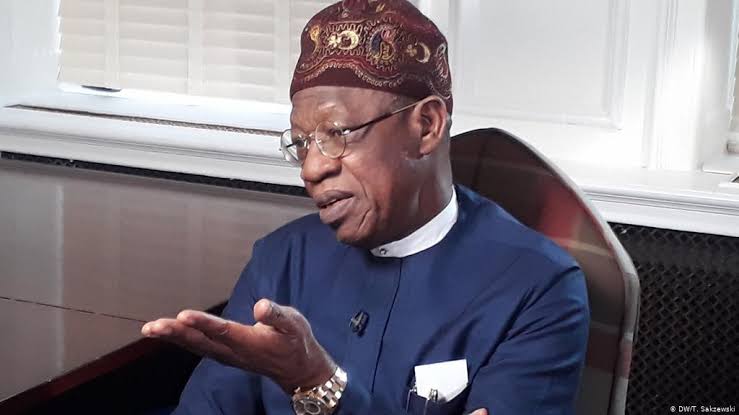
NIGERIA’s information and culture minister Lai Mohammed, during a recent visit to London, was featured by Deutsche Welle (DW) in an half-hour-long interview the German news channel shared on Wednesday.

The minister responded to questions on a number of allegations against the country, including human rights violations, extrajudicial killings, corruption, lack of transparency in the extractive sector, and lack of press freedom.

He insisted, despite several reports to the contrary, that Nigeria has been cooperating with the International Criminal Court and United Nations, in terms of providing needed information about the cases of rights violation. But on Friday, the US government banned Nigerians from obtaining certain visas based on a similar allegation: not complying “with the established identity-management and information-sharing criteria”.

In this fact-check, The ICIR takes a look at four claims made by Mohammed, which we have found to be false and misleading.

UN report on extrajudicial killing gave no examples

DW’s Tim Sebastian asked Mohammed about a 13-page report released last September by Agnes Callamard, the UN Special Rapporteur on extrajudicial, summary or arbitrary executions. Callamard had talked about “country-wide patterns of abuses, including the police and military’s excessive use of lethal force and violation of international standards”.

Reacting to findings of the report, the information minister, who confirmed reading it, said he “would have been much more impressed if examples are giving”.

But, contrary to his suggestion, examples were in fact given by Callamard—at least 12 of them. On page 7, the UN highlights allegations of human rights violations in the Middle Belt, including that:

  • On 4 December 2017, Nigeria’s air force fired rockets at villages of Lawaru, Dong, Kodomti, Shafaron and Nzuruwei as a “warning” to deter spiraling communal violence, causing dozens of deaths.
  • In 2018, 86 persons were killed in the villages of Palang, Tisan, Nghar, Ruku, Exlan in the State of Plateau, while Military officers were present and refused to engage with the attackers.
  • In October 2017, regarding an attack of Mkievowro in Plateau State, witnesses reported that “soldiers present were bribed by Fulanis Herdsmen”, and that attack resulted in the killing of some 29 people who sought safety in a school.

The report also mentioned instances of government crackdown against the Islamic Movement of Nigeria (IMN) as well as arbitrary killings of the members of the Indigenous People of Biafra (IPOB).

No social media bill before the National Assembly

Sebastian asked the information about the Protection from Internet Falsehood and Manipulation Bill, which he said carries draconian provisions and through which journalists could be imprisoned.

“And who is the author of that bill?” Mohammed interjected. “I am not even aware of that bill,” he said when DW asked for his position.

“It’s causing an outcry internationally and you are the minister of information and you know nothing about it?” Sebastian asked.

Mohammed then replied emphatically, “There is no such bill before the House. I can say that authoritatively. There is no such bill before the House.”

But the Protection from Internet Falsehood and Manipulation and Other Related Matters Bill is the short title given to a bill introduced in November by Mohammed Sani Musa, the lawmaker representing the Niger East senatorial district.

Also known as the social media bill, it has already passed first and second reading and has been referred to the Senate Committee on Judiciary, Human Rights and Legal Matters—despite widespread condemnation.

No other govt. has convicted high-profile politicians

According to Mohammed, “No government has ever succeeded in securing the conviction of high-profile politicians like this administration, especially those of them who belonged to the ruling party. We continue to fight corruption.”

But the records show otherwise.

In 2009, the Lagos State High Court convicted Olabode George, former chairman of the Nigerian Ports Authority, of contract splitting and inflation, and sentenced him and four others to a 28-year jail term. The Court of Appeal upheld this verdict. The Economic and Financial Crimes Commission (EFCC) had indicted George when Nuhu Ribadu was chairman, but the prosecution started in 2008 with Farida Waziri heading the commission.

George was a chieftain of the People’s Democratic Party (PDP), which only ceased being in power at the federal level in 2015. At various times between 2001 and 2008, he was national vice-chairman in the southwest zone, deputy national chairman (South) and head of the national disciplinary committee.

Though later pardoned by former President Goodluck Jonathan, late Diepreye Alamieyeseigha was convicted in 2007 for money laundering and not declaring his assets and was sentenced to two years imprisonment. Until his impeachment in 2005, he was a two-time governor of Bayelsa State and member of the PDP.

Another member of the (then ruling) PDP, former Edo governor Lucky Igbinedion was fined in December by a Federal High Court in a N25 billion financial fraud case.

Other high-profile corruption cases concluded in Nigeria, as compiled by TheCable, involved former IGP Mustapha Balogun and former assistant director in the federal civil service John Yusuf. The criminal prosecution of former Plateau governor Joshua Dariye and former Abia governor Orji Uzor Kalu, who were respectively convicted in 2018 and 2019, was also set in motion during the rule of PDP.

No missing oil money since 2015

The information minister was asked about a report from Global Witness that said most Nigerians live in poverty despite a 50-year oil boom and an estimated $400 billion has gone missing from state coffers. He replied that, under the watch of the current administration, allegations of embezzlement cannot be substantiated.

“I can say categorically that between 2015 and today, nobody can talk about oil money missing,” Mohammed said right before the DW interview ended.

There have, however, been such allegations under the Muhammadu Buhari-led government.

A 2016 report published by the Natural Resource Governance Institute stated that, within the first six months of Buhari’s presidency, the Nigerian National Petroleum Corporation (NNPC) withheld over N824.7 billion from a total revenue of N1.24 trillion got from crude oil sales — “about 14 per cent more than the amount withheld by the corporation under the Goodluck Jonathan administration in the first half of 2015”.

In 2018, Dino Melaye, then the lawmaker representing Kogi West senatorial district, alleged “monumental corruption” at the NNPC involving an account unlawfully operated under a commercial bank and used to siphon millions of dollars.

The following year, the NNPC itself admitted there is still corruption in its operations and disclosed that it recovered $1.6 billion from companies “who were fleecing the NNPC subsidiary, the NPDC”.

EXTRA: DW cites outdated information on extractive sector

It is not only the information minister who made misleading statements during the interview, DW’s Sebastian also blundered.

Besides wrongly claiming Nigeria’s hate speech bill was sponsored by the executive arm, he cited a report from the National Resources Institute which, “based on data from 2017,  you have failed to regularly to disclose publicly the financial interests of government officials in the extractive sector, all the identities of beneficial owners in extractive companies despite making public commitments to do so”.

Mohammed appeared to have misinterpreted the question as he instead talked about assets declaration by public officials as regulated by the Code of Conduct Bureau.

But then, the latest development is that this trend in the extractive sector has been reversed. Two weeks after promising publicly to do so last November, the Nigerian Extractive Industries Transparency Initiative (NEITI) released a register of beneficial owners of oil assets and companies.

Data from its web portal, accessed on Friday by The ICIR, has names of 181 and 92 beneficial owners in the oil & gas and solid mineral industries respectively.

FACT CHECK: Femi Adesina exaggerated, there weren’t 10 bombings a day before Buhari

0

FEMI Adesina, spokesman to President Muhammadu Buhari said there were as many as 10 bombings in a single day before Buhari’s administration started in 2015.

This is not true, according to checks by The ICIR.

Adesina made the claim, on Sunday, during an interview aired on Channels Television while reacting to recent terrorist attacks, including a bomb blast in Borno state that morning.

He said, though the attacks were regrettable, the state of insecurity in the country is not as bad as the host made it seem “because we know what the situation was as of 2015 and we know what it is today”.

“Despite the reversals in security, it is still not as bad as it used to be in this country. There was a bombing or two today,” he said.

Raising his voice for emphasis, the special adviser on media and publicity added, “There was a time that there were five, six, 10 bombings in a day in this country.

“If you hear Nigerian media, if you hear social media particularly, even if you hear some international agencies, you will think that it is all over in the Northeast. It is not. The people living there will tell you that the difference between now and 2015 is the difference between heaven and hell.”

But while Adesina accused the media of downplaying the current administration’s achievements, The ICIR found that he was guilty of exaggerating the level of insecurity prior to 2015.

Nigeria has never recorded 10 bombings a day

Even though there have been fewer fatalities since 2015 compared to the previous five years, it is not true there ever was a time when Nigeria recorded as many as 10 bomb explosions in a day.

The Armed Conflict Location and Event Data (ACLED) Project records extensive data on political violence and killings in over 100 countries and is described as the “highest quality, most widely used, real-time data and analysis source on political violence and protest around the world”.

As of January 16, the platform has recorded over 200,000 violent incidents from Africa alone since 1997, nearly 16,000 out of which took place in Nigeria.

We went through the data set and filtered out events between 2009 when the Boko Haram uprising started in Bauchi, and May 2015, when Buhari was sworn in as President. There are six different categories of attacks, so we extracted only data relating to explosions and remote violence.

We further removed all data relating to attacks perpetrated by government actors such as the police and military forces. What we were left with were 301 incidents of explosion orchestrated mostly by Boko Haram, the Islamic State (West Africa), Fulani ethnic militia, Movement for the Emancipation of the Niger Delta (MEND), and unidentified armed groups.

The statistics show that between 2009 and May 29, 2015, there have been 41 days during which there were more than one bomb explosions. On 31 days, two explosions each were recorded and on five days, there were three explosions. There were four explosions recorded on three days, five explosions recorded on a day (December 25, 2011), and six explosions on another day (June 17, 2012).

From May 30, 2015, to January 2020, on the other hand, explosions numbering over one have taken place on 23 days, and only once were they up to three—on October 22, 2017.

The data also shows that explosions that occurred between 2009 and 2015 led to the death of 2,634 people, while those that took place since 2015 (237 of them) have killed up to 2,307 people.

Conclusion

While it is true that on two different occasions, Nigeria recorded up to five and six explosions within a 24-hour period, there was no day when there were up to 10 as claimed by the president’s spokesman.

Buhari, Osinbajo misguided on Disability Rights Bill at town hall meeting

0

CHECKS conducted by The ICIR have indicated that President Muhammadu Buhari and his running mate, Vice President Yemi Osinbajo, were mistaken about the Discrimination against Persons with Disabilities (Prohibition) Bill yesterday at The Candidates, a presidential town hall meeting co-produced by Daria Media and Nigerian Television Authority.

“I think we sent [it] to the National Assembly,” Buhari said after the host, Kadaria Ahmed, repeated the question on why the bill has not been assented to since its passage.

When Ahmed informed him that the instrument, more commonly referred to as the Disability Rights Bill, has been returned to the presidency, Osinbajo interjected to say he is not aware of that taking place.

“Even as of Wednesday, there was a demonstration in front of the National Assembly where they were saying that they were giving the National Assembly seven days to transmit the bill to us, to the presidency. I am not aware of that. We are not aware,” he said.

There are however no available reports of this demonstration. The last time such protest was reportedly held at the National Assembly by the disability community, to mount pressure on lawmakers into transmitting the bill, was on October 8, 2018 — coincidentally a Wednesday too.

It was at this demonstration that protesters, under the body of the Coalition of Disability Organizations, issued a seven-day ultimatum to the National Assembly.

On December 18, the bill was finally transmitted to the president for assent. This was revealed by David Anyaele, Executive Director of the Centre for Citizens with Disabilities (CCD).

Anyaele had, in November, said the bill had issues with certain clauses that needed to be added and commended the federal legislative houses for completing action on the document. “Now that the National Assembly has completed action on the bill, the focus of our campaign is on the office of the President of the Federal Republic of Nigeria for his assent,” he said.

Last Friday, in Nasarawa, coordinator of the Joint National Association of Persons Living with Disability, Yusuf Iyodo, still urged Buhari to sign the bill into law before the general elections.

‘Buhari’s claim is incorrect’

Irene Patrick-Ogbogu, Executive Director of the Disability Rights Advocacy Centre, has explained that what the president made reference to was the bill’s return to the National Assembly months ago.

“It is not correct,” she said about the claim that the bill is not with the presidency. “The president was referring to a couple of months ago when the bill was returned to the National Assembly and the National Assembly has since effected whatever corrections that were raised by the presidency and transmitted it back to the president. It was transmitted back to the presidency on the 18th of December last year.”

She said she does not understand why the president and the vice seem not to know about this and are passing the buck to the National Assembly.

“We know for a fact that the bill is not with the National Assembly anymore,” she added.

“It’s been transmitted to the president. I think the presidency have to look into their processes and procedures of managing bills or communication from the National Assembly because the bill is there. It just requires assent. My recommendation is for them to look into it immediately, find the bill and sign it into law.”

The lawmaker who sponsored the bill at the House of Representatives, Idagbo Ochiglegor, also said he is surprised the president could not intelligently address why he has not signed the bill into law though it has been transmitted to him. He suggested that Buhari could have rejected the bill without reading it, because he took exception to other bills sent to him at the same time.

“The problem I think is that most of the bills that are transmitted to him are transmitted not as single bills but in batches; and when he has an issue with any particular bill, he does not attend to any other of them,” he said in a phone conversation with The ICIR.

“I think that yesterday’s programme was a wake-up call for him, and I think he should single out the Persons With Disability Bill and sign it into law.”

He said the Vice President does not have the relevant facts as the National Assembly already handled the protest he referred to at the programme. The lawmaker lamented that Nigeria is one of few countries in Africa without a law to protect persons with disability, and added that the bill, when signed, will not only help a lot of people who are disabled, it will also aid Buhari’s aspiration for a second term.

“It makes him popular even before election…, and the disabled people are waiting on the bill to vote for him if they find him worthy,” he said.

The CCD has also made signing the bill a requirement for supporting the Buhari/Osinbajo campaign. The bill has been at the National Assembly since 2000 and it was because the All Progressive Congress promised to expedite its passage in 2015 that its members voted massively for it in the last elections, the group said in 2017.

Presidency asks to comment ‘much later’

The presidency asked not to give a comment immediately about the discrepancy. “You can talk to me much later, not now sir,” Ita Enang, former senator and Senior Special Assistant to President Muhammadu Buhari on National Assembly Matters, curtly replied after he was asked for an explanation.

When our reporter asked for a specific time to call again, he did not say. A subsequent call to his phone was not answered.

Akeredolu’s govt lies about reducing debt

0

Ondo’s debt profile has increased by 17 per cent since 2016.

THE ONDO State Government led by Rotimi Akeredolu claimed it inherited a total debt of N220 billion from the previous administration of Olusegun Mimiko. The government also claimed it has reduced the debt by half since the inauguration of Akerodolu in 2016. The two claims are false, according to checks carried out by The ICIR.

Donald Ojogo, the state commissioner for Information and Orientation, made the claims on Monday during an interview with  Sunrise Daily, a current affairs programme aired by ChannelsTV. Ondo government’s official website later published Ojogo’s statements shortly after.

According to the commissioner, Akeredolu’s administration has reduced the debt inherited from the previous government (N220 billion) by 50 per cent and has increased “the Internally General Revenue (IGR) of the state from the N700 million inherited from the PDP [People’s Democratic Party] administration to over N1 billion monthly.

“Our resolve as a government is that by the time we leave office in the next five years, I said in the next five years because Mr Governor is going to recontest and win by God’s grace, we hope to leave the government without debt for the incoming administration after our two terms,” he said.

N68.3 billion inherited

Ojogo’s claim about Ondo State’s inherited debt from the PDP-led government is off-target. Data from the Debt Management Office (DMO), in fact, revealed that the state’s debt profile has increased since 2016.

Akeredolu was declared governor of Ondo State in November 2016 and was sworn in  February.

DMO statistics reveal that as of December 2016, the state’s domestic debt was N53.2 billion while its external debt was $49.5 million (N15.1 billion). Altogether, its debt was N68.3 billion.

This is only 31 per cent of N220 billion claimed by the state.

By December 2017, the state’s debt had increased to N73.9 billion. A year later the debt came down to N73.6 billion but again increased to N79.8 billion as of June 2019.

Therefore, rather than supposedly reduce by 50 per cent between 2016 and 2019, Ondo State’s debt increased by 16.85 per cent.

Line chart showing the trend of Ondo State’s domestic and external debts between 2016 and 2019. Source: DMO.

IGR figure understated

The state commissioner distorted facts not only about the present administration’s debt reduction performance but his claim on internally generated revenue is also grossly understated, check by The ICIR has revealed.

He said the government inherited by Akeredolu’s administration was IGR of N700 million per month and this has improved to “over N1 billion monthly”.

According to the National Bureau of Statistics, Ondo State generated total internal revenue of N8.68 billion in 2016, which is the same as N723 million per month. But the state’s IGR has improved beyond the commissioner’s modest assessment.

Latest NBS statistics show that the state currently generates an average of N3.2 billion in a month.

Ondo’s total IGR was N19 billion in the first two quarters of 2019. The total IGR for all four quarters in 2018 was N24.8 billion, equalling an average monthly IGR of N2 billion.

In the last two quarters of 2017, the average monthly IGR was N975 million. It crossed the one billion naira line in the first quarter of 2018 when the state generated N1.2 billion per month. And, by the last quarter of that year, it had increased to N3.4 billion per month.

Line chart showing the trend of Ondo State’s average monthly IGR between 2012 and 2019. Source: NBS.

The Fact

Our finding: The Ondo Commissioner for Information’s claim about the state’s inherited debt profile is false. Akeredolu inherited N68.3 billion as debt, not N220 billion. Also, the state’s debt has increased to N79.8 billion in the last three years and not reduced by 50 per cent as claimed.

In addition, while Ojogo’s claim about IGR generated under the immediate past administration is fairly accurate, the figure he gave about the improvement in the IGR is understated.

FACT CHECK: Did a news report describe Sowore as gravely ill?

0

THE CIRCUMSTANCES of former presidential aspirant Omoyele Sowore’s rearrest on Friday have led many to speculate that the Department of State Services (DSS) intends to cause him harm—or that it already has. But there is no reliable information backing any of these claims.

“Watch this video and repeat it over and over again then you will know that Sowore has been poisoned via injection inside the courtroom,” a Twitter user, @Napalivia, wrote assuredly on Saturday. “After the DSS undercover agent successfully injected the poison in Sowore, the very guy that pinned him down quickly released him.”

But not all insinuations about Sowore’s health condition were based strictly on an analysis of the videos. Also on Saturday, Farooq Kperogi, a columnist and Assistant Professor of Communication at Kennesaw State University, wrote that Sahara Reporters (SR), a news agency started by Sowore in 2006, confirmed that its founder is gravely ill.

“Omoyele Sowore MUST NOT DIE in Buhari’s gulag! There’re indications that he was injected with poison in the court yesterday,” Kperogi wrote on Facebook. “Video clips affirm this. Sahara Reporters also said he’s gravely ill now. People of conscience should insist that the DSS bring him out to ascertain his state of health NOW.”

His post has attracted 383 reactions, 46 comments, and has been shared 117 times. It has also been reposted by others on platforms such as Twitter and a news blog.

No such claim in report

Sahara Reporters had, on Friday, reported that there are “renewed fears over Sowore’s safety as strange man hits journalist in neck with unknown substance in courtroom.” This is the closest publication to the attribution made but a read through showed that it does not describe Sowore as gravely ill.

The online newspaper only recounted the events inside the courtroom after the proceedings as captured in various videos, reported that there is growing fear over Sowore’s state of health, and repeated Sowore’s earlier allegation about plans to kill him.

An advanced search through Sahara Reporters’ Twitter account also revealed that, from the beginning of December, the word “poison” has appeared only once from an unrelated report published on the 4th, “sick” has appeared once in an op-ed written by Erasmus Ikhide, and neither “gravely” nor “ill” have been used recently.

SR editor: Sowore in good condition but … 

The editor of Sahara Reporters, Eric Dumo, told The ICIR on Monday that the information available to him, in fact, is that Sowore is currently in good condition. He also said the media organisation, like everyone else, cannot confirm claims that he was poisoned.

“No, the report wasn’t about him being ill,” he said.

“There were fears about his safety. We published that story because, from that video that has gone viral, if you look at it, you see there is a man struggling under him in the court and somebody, we don’t know who that person is, from behind hit Sowore on the neck and immediately Sowore sprung up and was asking him, ‘Why did you hit me? What did you hit me with?’

“So, that raised some fears that he could have been injected with some unknown substance. But we cannot also verify. We cannot also completely or 100 per cent say this is the fact, but that video raised fears among his supporters, family members.”

He said Sowore is fine “for now” and is not under any threat.

“That report was just reacting to that incident. The report didn’t confirm that we are so sure he was injected… Nobody can confirm that indeed he was injected with any dangerous substance. But as we speak he is in a very good condition. He is not sick or under threat.”

The Sahara Reporters editor, however, stressed that Sowore nevertheless needs medical attention having been in detention for very long.

“This is a man who has been in detention for over 126 days and he has not had access to any doctor or any form of medical care. So it is natural that his health may not be in top shape,” he said.

“But we don’t have any report of his medical state at this time, but from all we have seen it is obvious that the man will need a lot of medical attention having been in detention for that long.”

While Sowore may be safe and sound though, his prolonged detention by the DSS despite court orders granting him bail may have worsened the health condition of his mother, Esther Sowore.

“My mind is disturbed that he has not been allowed to go for medical care since August,” she said in an interview with Objective Media TV last week.

“I am a widow, release my son. I cannot eat, I cannot sleep and it is affecting my health. Please release Omoyele Sowore, my son. He is not a criminal.”

Verdict

It is incorrect that Sahara Reporters said Sowore is “gravely ill now”. This claim was not made in any of its recent reports and has been denied by the online paper’s editor.