Home Blog Page 14

Misleading claim about private jets in South-East circulates online

0

 AN X user, @VivianIfeomaOj, has posted three images showing a private jet parked at an airport claiming it’s owned by people from South-East, Nigeria. 

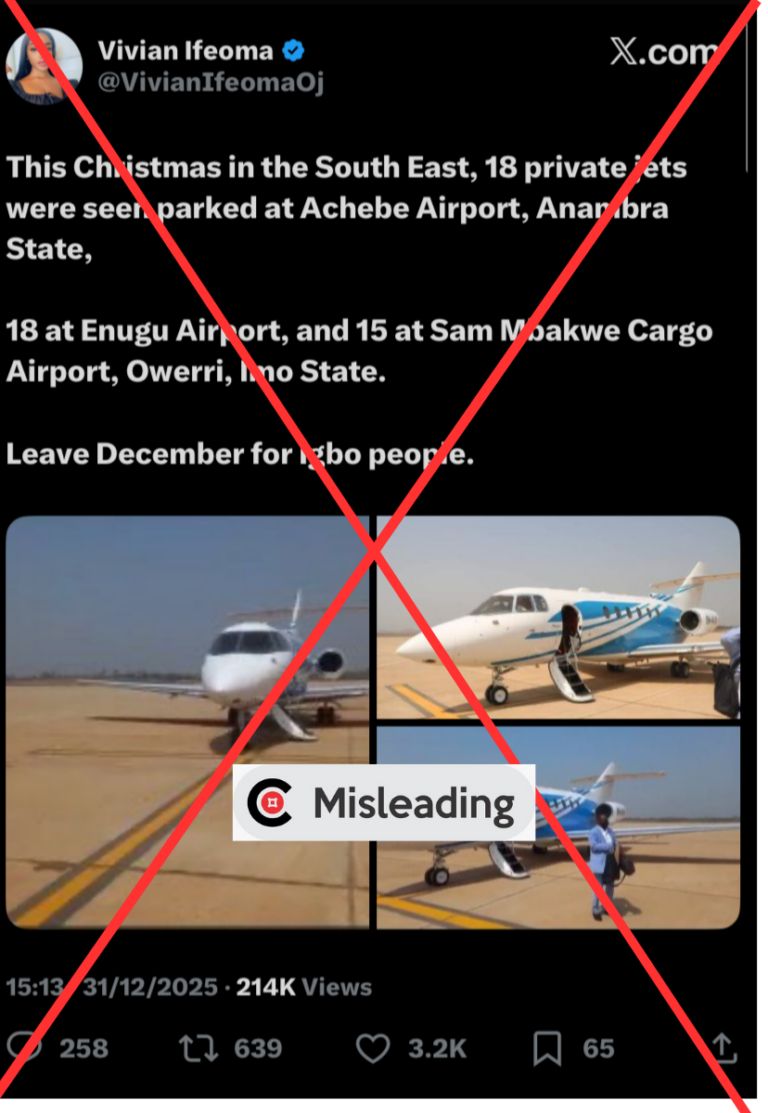
The account posted the images with a caption:

“This Christmas in the South East, 18 private jets were seen parked at Achebe Airport, Anambra State,18 at Enugu Airport, and 15 at Sam Mbakwe Cargo Airport, Owerri, Imo State.Leave December for Igbo people.”

READ ALSO: AI-generated video of man constructing wooden aircraft circulates online

Since the post was made on Wednesday, 31st December 2025, it has generated an impression of over 200,000 views, 3,400 likes and 689 reposts.

The claim has also appeared here and here.

CLAIM

The image shows private jets during 2025 Christmas in South-East Nigeria.

THE FINDINGS

Findings by The FactCheckHub indicate that the claim is MISLEADING!

Screenshot of the claim; Insert Misleading verdict

When the images were run through a Google lens search, it provided search results of previous appearances of the images.

One of such posts was a 2021 Facebook Post by APGA Interactive Forum, where a user had posted that Andy Uba, a gubernatorial aspirant for Anambra state that had contested under APC in 2021 had landed at the then Newly commissioned Anambra airport.

The post contained the same three pictures posted by the claimants alongside other pictures posted by the user on Facebook

“At exactly 11:12am today, the self acclaimed candidate of APC in the just concluded Anambra Governorship election, Sen. Andy Uba aboard a private jet, 5N- ALG arrived at the newly commissioned Anambra International Airport Nteje-Umueri,” the post read in part.

Another post, also on Facebook, posted on the same date as the one seen earlier, December 30, 2021 had the same photos and also attributed it to the same event of Ubah landing at the commissioned airport.

READ: False claim on presidential aircraft attributed to Akpabio circulates online

THE VERDICT

The claim that the image shows private jets during 2025 Christmas in South-East Nigeria, is misleading; the image has been online since was from 2021.

Old footage from Côte d’Ivoire used to depict US Christmas military strike in Sokoto

A video circulating on social media falsely claims to show footage from a United States military strike carried out in Sokoto State, targeting terrorists on Christmas Day.

The clip, which shows a missile strike and destruction of buildings, has been widely shared alongside captions suggesting it captures a recent U.S. military operation ordered by President Donald Trump in response to attacks on Christians in northern Nigeria.

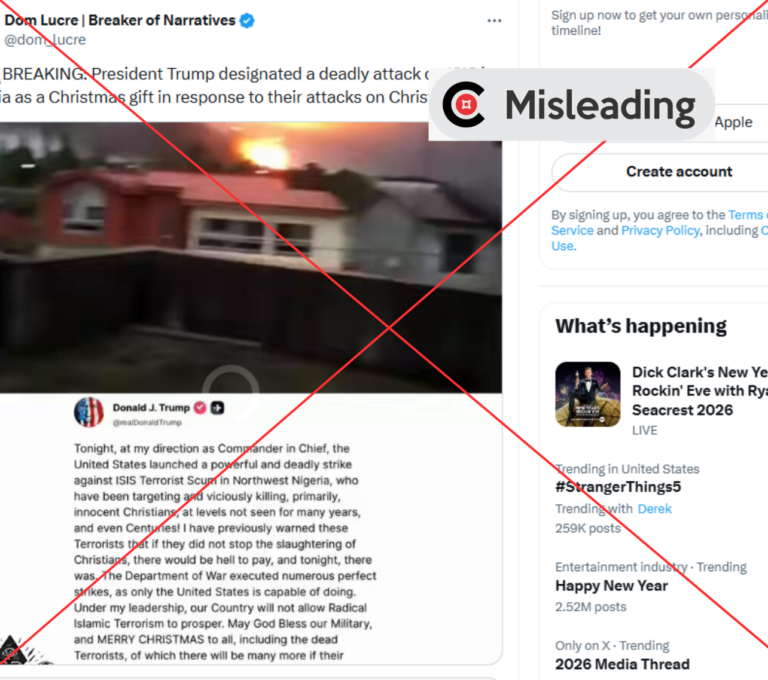
On December 25, 2025, an X user, dom_lucre who has over 1.6 million followers, posted the video with the caption:

“BREAKING: President Trump designated a deadly attack on ISIS in Nigeria as a Christmas gift in response to their attacks on Christians.”

As of December 31, 2025, the post had generated over 4000 reposts and more than 30,000 likes.

READ : Old image falsely used to depict airstrike in Kwara

Similar versions of the video were also circulated on X accounts such as here, where many users praised the alleged action and expressed support for the U.S. president.

CLAIM

Video shows footage from a US military trike carried out in Sokoto on December 25, 2025.

screenshot of the viral post purportedly showing military airstrike in Sokoto

FINDINGS

Findings by The FactCheckHub show that the claim is MISLEADING.

A review of the footage reveals that it is not recent and does not show any military operation in Nigeria. Reverse image and video searches traced the clip to earlier uploads on YouTube dating back to 2011. One version was published by Abidjan.netTV while another appeared on AFP.

The footage was linked to political unrest in Côte d’Ivoire following the disputed 2010 presidential election between Laurent Gbagbo and Alassane Ouattara.

READ ALSO : No, viral video does NOT show U.S. military strike on terrorist targets in Sokoto

There is no evidence that the video is connected to any US military operation in Nigeria. The visuals predate the alleged Sokoto strike by more than a decade and were taken in a different country altogether.

VERDICT

The claim that the video shows a US military trike in Sokoto State or any recent military action in Nigeria is MISLEADING. It was filmed during the 2011 post-election crisis in Côte d’Ivoire and has been falsely linked to current events.

No, viral video does NOT show U.S. military strike on terrorist targets in Sokoto

0

FOLLOWING the recent launch of a military strike by the United States on terrorists in Sokoto, a grey-coloured video showing a missile strike began circulating widely on social media.

The video emerged after a post by the U.S. President Donald Trump on his Truth Social platform announcing that he had directed the U.S. military to strike ISIS targets in Nigeria.

The statement sparked widespread reactions online, with users sharing images and videos purportedly showing the strike.

Amid this heightened attention, several X users shared a video showing a missile hitting targets described in the audio as “greenhouses,” presenting it as footage of the reported U.S. operation in Nigeria.

On December 27, an X user, @Gen_Buhar, posted the video with the caption claiming that U.S. Africa Command (AFRICOM), in coordination with Nigerian authorities, conducted airstrikes on ISIS targets in Sokoto State.

The account posted: “Full Footage of the airstrike from the combine US military/NAF  on the iswap and bokoharam hideout in Sokoto on the 24th/12 / 2025.”

The post has generated over 400 reposts and more than 1,000 likes as of December 29, 2025.

CLAIM

Video shows a U.S. missile or drone strike carried out against ISIS militants in north-west Nigeria on Christmas Day.

screenshot of the viral post purportedly depicting airstrike in Sokoto

THE FINDINGS

Findings by The FactCheckHub show that the claim is MISLEADING.

First, The FactCheckHub discovered that the video was recycled by an Asian X account, RedlineGeoX, to illustrate the incident before various Nigerian X accounts reshared it. However, the account clarified that the video is “for illustrative purposes only and does not depict the actual event.”

A reverse image search conducted on keyframes from the video traced the footage to at least April 2019. The video was found on Chomikuj.pl, a Polish file-hosting website, where it was linked to Afghanistan.

The on-screen text that precedes the video states that coalition ground forces came under small-arms fire, heavy machine-gun fire, and rocket-propelled grenade (RPG) attacks from enemy fighters positioned inside nearby buildings. In response, Apache helicopters, advanced military attack helicopters used primarily by the United States Army and some allied forces, were deployed to provide close air support.

The helicopters first targeted one structure using a Hellfire missile, a precision-guided weapon commonly used to neutralise fortified positions. When hostile fire continued from additional buildings, the Apaches struck a second structure with another Hellfire missile.

The note further explains that the engagement escalated as enemy fire persisted, prompting the helicopters to use multiple weapons systems, including Hellfire missiles, unguided rockets, and 30mm cannon rounds. This layered response is typical of U.S. military combat operations where aircraft suppress hostile positions to protect ground troops.

Crucially, the video is clearly dated January 5, 2007, references Task Force Marmo, and carries a LiveLeak hosting watermark, all of which indicate it is archival combat footage from a Middle East conflict, not evidence of a recent airstrike in Nigeria.

VERDICT

The claim that the video shows U.S. airstrikes on ISIS targets in north-west Nigeria is MISLEADING. The footage is old, originated outside Nigeria, and has been falsely linked to recent security developments.

Cyber threats to surge in 2026 as AI, hacktivists step up

0

SECURITY analysts warn that 2026 is likely to bring a significant increase in advanced cyberattacks against governments and critical infrastructure, driven by the growing use of artificial intelligence and the expansion of threat actor networks, according to IT Brief UK.

A recent multinational advisory, Cybersecurity Dive showed that pro-Russia hacktivist groups are increasingly targeting operational technology in sectors such as energy and water, marking a shift from predominantly state-led cyber operations to a broader mix that includes criminal groups and opportunistic hacktivists.

A hacktivist is a hacker who carries out cyberattacks for political or ideological reasons, using tactics such as malware, botnets, and distributed denial-of-service (DDoS) attacks to disrupt or pressure individuals, institutions, or organisations they oppose.

READ ALSO : How AI made deepfakes harder to detect in 2025

The lead Product Manager at NCC Group, Floris Dankaart said the widening scope of attacks shows that all major threat actor categories have bridged the IT–OT gap, warning that exposed remote access tools such as VNC offer simple but dangerous entry points capable of disabling safety systems.

At the same time, artificial intelligence is expected to intensify cyber-enabled fraud through deepfakes and automation, with Senior Threat Researcher at Infoblox, John Wojcik forecasting a significant acceleration in such attacks, particularly targeting regions like Australia.

In response, vendors predict a shift toward human-supervised AI, expanded threat-intelligence sharing, and greater platform consolidation.

SentinelOne’s Gregor Stewart notes that countering threats such as deepfakes will require a fundamentally different approach to identity verification, moving beyond reliance on single-layer defences.

Doctored image of female fans at AFCON 2025 circulates online

0

AN image showing two identical women among football fans has surfaced online with a claim that they are female supporters at the 2025 Africa Cup of Nations (AFCON).

An X user, @AJSilverCFC posted the image with a caption which has generated over 1,000 reposts and more than 29,000 likes as of December 12, 2025.

According to the post, the image showed fans showing their support during the match between Mali and Zambia.

CLAIM

Image shows female fans at AFCON 2025.

Screenshot of the viral post. The picture on the right hand side is misleading

FINDINGS

Findings by The FactCheckHub show that the claim is MISLEADING.

The 2025 Africa Cup of Nations (AFCON) officially kicked off in Morocco on December 21, 2025, marking the start of the 35th edition of Africa’s premier men’s football tournament.

This edition features 24 teams drawn into six groups, with matches scheduled across nine stadiums in six cities until the final on January 18, 2026.

The FactCheckHub subjected the image to reverse image search and the result showed that the image is doctored.

An earlier version of the image showed that of the image was posted by Football and News and The Touchline. The screenshot was taken from the match between Mali and Zambia which ended 1-1.

Original image

However, the two women have been inserted into the picture using digital technology.

VERDICT

The claim that the image shows female fans showing their support during the African Cup of Nations is MISLEADING. The image is doctored.

Buhari’s death, Trump’s inauguration… how misinformation shaped events in 2025

0

THE year 2025 was marked by misinformation involving Nigerian public figures, international events, and high-profile incidents across politics, economics, and social issues.

As social media continues to play a dominant role in information dissemination, statements, videos, and images shared online are increasingly scrutinised for accuracy.

Prominent among the fact-checked issues this year were the deluge of misinformation that followed remarks by former U.S. President Donald Trump, who designated Nigeria as a “Country of Particular Concern” over alleged persecution of Christians. 

His statements prompted widespread reactions, generating numerous misleading claims that attributed false statements and actions to Nigerian officials, political actors, and other personalities. Videos, photos, and posts were shared out of context or manipulated to suggest responses that never occurred.

Domestic political developments also fuelled misinformation. President Bola Tinubu’s tax reforms, clashes involving FCT Minister Nyesom Wike, disruptions on Ibom Air flights, and narratives surrounding former President Muhammadu Buhari’s health were all targets of false or misleading online stories. International events, such as the sudden death of footballer Diogo Jota, the Ivory Coast coup rumours, and Donald Trump’s inauguration, were also misrepresented for local audiences, further complicating the information landscape.

This report highlights some of the most notable verifications conducted by The FactCheckHub in 2025. It covers cases where videos, quotes, and images were misrepresented, recycled, or fabricated, resulting in false impressions among the public. The following list is presented in no particular order and provides insights into the claims that gained traction online.

1. Christian Genocide allegation and Donald Trump’s remarks on Nigeria

Following former U.S. President Donald Trump’s pronouncements about Nigeria being a “Country of Particular Concern” over alleged persecution of Christians, multiple misleading posts circulated online, attributing statements and actions to Nigerian officials and political figures.

A video shared on X by @IMC_BRGIE showed President Bola Tinubu saying, “We have no fear of whatever Trump is doing,” and was captioned: “Nigerians have no fear of whatever Trump is doing.” The clip, which gained over 1,000 views and 80 reposts, was presented as a response to Trump’s threat of possible U.S. military action.

FactCheckHub’s analysis revealed the video predates Trump’s November 2 remarks by two months. The full version, uploaded to YouTube on September 2, 2025, was about Nigeria’s economic achievements, not U.S. foreign policy. The claim was therefore misleading.

Similarly, a widely shared photo showing National Security Adviser Nuhu Ribadu meeting with service chiefs was falsely linked to Trump’s threat. The image, circulated by X user @whitenigerian, implied the meeting was convened in response to the U.S. president’s statement.

Reverse image searches showed that the photo predates Trump’s October 31 declaration, having been posted on October 28, 2025, and previously used in news coverage. In reality, the meeting concerned routine coordination among newly appointed service chiefs, unrelated to Trump. This claim was also misleading.

Another claim alleged that Trump had revoked 80,000 visas exclusively for Nigerians. The X post by @MasterBolaji was widely shared, but FactCheckHub found that the U.S. Department of State revoked visas for citizens of multiple countries, including Nigeria, as part of a broad enforcement initiative. This claim was therefore misleading.

A TikTok video showing women wailing in front of a burning building circulated with the caption that it depicted a church set ablaze by Islamic extremists in northern Nigeria. Investigation revealed that the video actually showed a fire at Kwapong Nursing Training College in Ghana, not Nigeria. The claim linking the footage to Nigeria was misleading.

Finally, a claim that former Kano State governor and NNPP presidential candidate Rabiu Kwankwaso deleted his X post reacting to Trump’s comments was found to be false. The post remains visible on his verified X account (@KwankwasoRM) and clearly addresses Trump’s remarks, urging cooperation rather than confrontation.

2. Wike – Yerima altercation

A video circulating on social media suggested that President Bola Tinubu praised FCT Minister Nyesom Wike following a clash with Nigerian Navy officer Lieutenant Ahmed Yerima. The clip, shared by a Facebook page Progressive Nigerian Politics, showed Tinubu saying, “Wike is a good man and a performing minister,” and was captioned as the president backing Wike over the military.

The FactCheckHub review revealed the video predates the November 11, 2025, incident by nearly a year. The full clip, originally published in December 2024, captured Tinubu addressing journalists in Lagos about Wike’s performance as a minister, not a response to any naval altercation. This claim was therefore misleading.

A related claim misrepresented a quote attributed to Tinubu, saying “They put their lives on the line to defend the sovereignty of this country”, as his reaction to the Wike-Yerima clash. The statement was shared by a Facebook user, Nigeria News- Headline Today, suggesting the president sided with the military over Wike.

The FactCheckHub found that the comment was made in the context of the Nigerian Guild of Editors conference on November 12, 2025, addressing the broader role of the military in protecting citizens and combating terrorism and banditry. The quote had no connection to the FCT land dispute, making the claim misleading.

3. Misleading claims about President Tinubu’s new tax reforms

Following the signing of Nigeria’s new tax reforms by President Bola Tinubu in June 2025, several misleading claims circulated online. Social media posts suggested that starting January 2026, Nigerians earning ₦800,000 and above annually would be subjected to personal income tax rates of 11 to 20 per cent, while another claim stated that Nigerians would pay ₦500 for every ₦10,000 spent on petrol under the new law.

A post on X by Naija PR, for instance, stated that the surcharge on petrol would apply from January 2026, gaining over four million views. While a 5 per cent levy on fuel is stipulated in law, FactCheckHub clarified that this was not a new tax.

The Nigeria Tax Administration Act 2025, signed on June 26, revives an existing provision, requires official commencement via the Gazette, and exempts cleaner fuels such as kerosene, LPG, and CNG. There is also no confirmed start date for the surcharge, and the rate has been in effect in a similar form since the Federal Roads Maintenance Agency Act of 2007.

Similarly, posts claiming that President Tinubu would introduce a 20 per cent tax on anyone earning ₦800,000 or more annually misrepresented the law. In reality, the personal income tax system under the 2025 Act is progressive:

  • First ₦800,000: 0%
  • Next ₦2.2 million: 15%
  • Next ₦9 million: 18%
  • Next ₦13 million: 21%
  • Next ₦25 million: 23%
  • Above ₦50 million: 25%

The viral claims erroneously treated ₦800,000 as a monthly income rather than the annual threshold set by the law. Individuals earning ₦800,000 or less per year remain fully exempt, while the rates progressively increase for higher earners.

Dada Olusegun, Special Assistant to the President, confirmed that the new tax framework is progressive and fair, with low-income earners paying little or nothing and higher earners paying proportionately more.

4. Flight disruption

In August 2025, videos circulated on X showing passengers on Ibom Air flights being confronted by security operatives, with claims linking them to the recent controversies involving Fuji musician Wasiu Ayinde (KWAM 1) and passenger Comfort Emmanson. One video, shared by @Oluwanyo with the caption “KWAM 1 has started a Trend!”, had over 700 reposts and 900 likes by August 13.

Fact-checking revealed that the footage was misleading. Reverse image searches traced the video back to January 8, 2025, when a passenger refused to board an Ibom Air flight from Uyo to Abuja after discovering her luggage had not been loaded. The standoff escalated until the flight was eventually cancelled, leaving 89 passengers stranded. This incident was entirely separate from both the KWAM 1 and Comfort Emmanson occurrences in August 2025.

Another video, shared by @Oxygist, showing a passenger being confronted on a flight, was also falsely tied to recent events. In reality, the clip originated from March 31, 2023, when a man disrupted an Ibom Air flight from Abuja to Lagos by shouting political slogans about President Bola Tinubu. Security operatives removed the passenger, and Ibom Air issued a statement clarifying the incident.

5. False claims about former President Muhammadu Buhari’s health and death

Amid viral rumours in 2025 that former Nigerian President Muhammadu Buhari was critically ill, multiple videos and posts circulated online, claiming he had passed away. One video showed Northern dignitaries at a funeral and was shared as evidence of Buhari’s burial. The post, widely shared on X and Facebook, claimed: “They finally unveil the death of Muhammad Buhari.”

Fact-checking revealed that the video was misleading. Reverse image searches and verification of key frames showed that it actually depicted the funeral of Safara’u Umar Radda, mother of Katsina State Governor Dikko Umaru Radda, held on March 23, 2025. Multiple news outlets confirmed the event, which was attended by local governors and dignitaries.

Another viral claim suggested that Buhari had died in London, comparing it to the death of former President Umaru Musa Yar’Adua abroad in 2010. This claim was false. Yar’Adua had been treated in Saudi Arabia and Germany for health complications, but was brought back to Nigeria before he died in Abuja. Buhari himself was alive, and no credible reports confirmed his death in 2025.

A further claim falsely attributed to Aisha Buhari, former First Lady, stated that her husband had died in 2017. Fact-checkers determined this was also false. The post originated from impersonation accounts, and no verified social media or official sources confirmed such a statement. The image itself showed signs of digital manipulation.

A TikTok video showing a patient being wheeled through a hospital was circulated as Buhari’s final moments. Analysis revealed the footage was originally from March 2023, depicting a U.S. hospital farewell ceremony for Mercedes Castañeda, a brain-dead Colombian woman about to donate her organs. The visuals and music were unrelated to Buhari.

6. Diogo Jota’s Death

Following the sudden death of Portuguese footballer Diogo Jota in a car accident on July 3, 2025, social media was flooded with tributes and reactions. Amid the outpouring of grief, several videos went viral, generating misinformation.

One video showed a group of Liverpool supporters marching on a street, which some users claimed depicted Nigerian fans mourning Jota. In reality, careful examination revealed that the footage was from Gulu, northern Uganda, as indicated by banners reading “NORTHERN UGANDA LIVERPOOL FANS,” and local reporting confirmed the march took place there.

Another video falsely claimed that Rihanna had released a tribute song for Jota. Analysis by fact-checkers showed the clip was AI-generated and digitally manipulated, with no official release or verification from the singer’s channels. Audio recognition tools and platform checks confirmed the content was synthetic.

7. A coup that never occurred

Another major misinformation wave this year centred on viral posts claiming that the Ivory Coast had experienced a military coup. Several X users circulated videos and alarming captions alleging gunfire in Abidjan, the disappearance or death of President Alassane Ouattara, and buildings being set ablaze as part of the supposed uprising. Some of these posts garnered hundreds of thousands of views.

The FactCheckHub investigations, supported by multiple journalists in Abidjan, confirmed that no coup took place. President Ouattara was publicly active during the period, including participating in the UNESCO Félix Houphouët-Boigny Prize ceremony and chairing a council of ministers meeting. Local reporters also noted that daily life in Abidjan remained normal, with no unusual military activity.

One widely circulated video showing a burning building was also misrepresented. A reverse image search revealed that the footage came from a February 5, 2025, fire at the Adjamé Château shopping centre in Abidjan and had no connection to any political unrest.

Despite a regional backdrop where several West and Central African countries have experienced coups since 2020, fact-checkers found no credible evidence of a similar event in the Ivory Coast. The claims were either false or misleading, driven by recycled footage and sensational social media narratives.

8. Trump’s inauguration

One of the biggest events that occurred in 2025 was the inauguration of Donald Trump as the 47th president of America. The development led to a series of misinformations regarding the event.

The ceremony, held in the US Capitol Rotunda because of freezing weather, was attended by figures such as Joe Biden, Kamala Harris, Barack Obama, political allies, and thousands of supporters. His return sparked concern among immigrant communities due to his tough immigration policies.

The inauguration also triggered a wave of misinformation online, especially among Nigerian and African audiences.

One viral claim falsely alleged that Nigeria’s Labour Party presidential candidate, Peter Obi, was invited to Trump’s inauguration. FactCheckHub’s investigation showed that this was false, as he did not appear on any official guest list. The misleading story originated from a pro-Obi platform that only referenced an X post by Nenadi Usman, who attended on behalf of the Labour Party.

Another false claim circulated that Burkina Faso’s military leader, Ibrahim Traoré, rejected a personal invitation from Donald Trump. Fact-checking revealed that Traoré was never invited, and his name did not appear in the official list of foreign guests.

Media reports from outlets like the Associated Press and Al Jazeera confirmed that only a small number of foreign leaders were invited to the ceremony, including China’s Xi Jinping, Argentina’s Javier Milei, Italy’s Giorgia Meloni, France’s Emmanuel Macron, and others. Historically, foreign heads of state rarely attend U.S. presidential inaugurations.

In both cases, fact-checkers found no credible evidence supporting the viral claims, concluding that the stories were false and based on misleading social media posts.

9. Anambra election

On November 8, residents of the state went to the polls to elect their next administrator. Despite high expectations for a transparent electoral process, the campaign period, election day, and the aftermath were characterised by a flurry of unverified claims and viral content designed to confuse voters and undermine the electoral process.

Reports circulated online claiming that a certain candidate had won, violent incidents occurred, that officials were caught with cash, and that voting malpractices were rampant. Many of these stories, however, were found to be false or misleading, fact-checks by the Nigerian Fact-Checkers’ Coalition (NFC) later revealed.

Over the three days, the coalition fact-checked multiple claims but was able to conclude on a total of 28 claims. Out of these, six were verified as correct, 14 as incorrect, seven as misleading, and one as unproven.

How emotion drives misinformation online

0

ACROSS the digital spaces, from WhatsApp closed groups to Facebook pages, false content often spreads not because it looks believable, but because it feels plausible.

Whether it’s fear about insecurity, anger at political leaders, or religious solidarity, misinformation thrives when emotions take the driver’s seat.

For instance, messages framed around threats, betrayal, or moral outrage are carefully designed to feel urgent and personal. Once that emotional spark is lit, misinformation spreads quickly.

READ ALSO: How information disorder heightens tension, confuses public during crisis

A study published in the National Library of Medicine found that people who rely on emotions are more likely to believe fake news. Across experiments involving 3,884 participants, researchers showed that heightened emotional responses increased susceptibility to false stories, while reliance on reason reduced it. The findings highlight how emotional processing makes individuals particularly vulnerable to misinformation.

The American Psychological Association (APA) also highlighted that one of the three main reasons why misinformation spreads is ’emotions’, the others being Illusory truth and Social engineering.

Emotional manipulation in misinformation often follows familiar patterns. Some of the most common as observed by FactCheckHub include:

Fear and panic: Claims about insecurity, health crises, or impending attacks often appeal to survival instincts. For example, during disease outbreaks, false cures and warnings spread faster than official health updates.

Religious solidarity: Nigeria’s deeply religious society makes it easy for misinformation to exploit faith. Posts claiming persecution of a religious group often go viral because they appeal to empathy and shared identity.

Anger and outrage: Emotionally charged posts targeting political leaders or ethnic groups frequently go viral on X and Facebook. Anger motivates engagement even when the information is false.

Hope and curiosity: Fake miracle discoveries, job opportunities, or financial giveaways also use emotional triggers, preying on people’s optimism and need for relief.

Trigger phrases to watch out for

Many false posts use repetitive language to heighten urgency or secrecy. Phrases such as: “Forward quickly before it’s deleted!” “They don’t want you to know this truth.” “Only the wise will understand.” “Share with 10 people and save a life.”

These expressions aren’t just dramatic, they are strategic. They appeal to fear of missing out (FOMO) and the desire to belong to an informed group.

How to resist emotional manipulation

Recognising emotional manipulation is the first step to resisting it. Here’s how to stay grounded:

Pause before reacting: When a post makes you feel angry, scared, or shocked, take a moment to pause. That emotional rush is often intentional. Misinformation and manipulative content are designed to trigger strong reactions so you share without thinking. Taking a moment to breathe, re-read, and assess the claim helps you avoid being pulled into false or exaggerated narratives.

Cross-check the claim: Before sharing, run a quick verification. Search reputable fact-checking platforms like The FactCheckHub to see if the claim has already been investigated. If nothing comes up, try different keywords or reverse-image search any attached photos. Always confirm that the fact-check matches the exact claim and check the date, evidence, and sources used. If you still can’t verify it, treat the claim as unconfirmed and avoid amplifying it.

Search key phrases online: Copy a unique part of the message, a name, a location, a quote, or a statistic, and search it on Google or X. This helps you see if the claim has appeared before. Many false stories recycle old rumours, old photos, or previously debunked narratives. If your search brings up earlier fact-checks, news reports, or warnings from credible sources, that’s a strong sign the message may be misleading. Even if you don’t get an exact match, scanning related results can help you understand the context and spot red flags.

Verify visuals: Misinformation often relies on old or unrelated photos and videos to create a false impression. Before believing or sharing any visual, use tools like Google Lens, TinEye, or InVID to trace where the image or video first appeared. These tools can show you older versions, different captions, or previous incidents the content was taken from. If the visual predates the claim, comes from another country, or appears with conflicting information, that’s a strong sign the post is misleading.

READ ALSO: How disinformation actors propagate divisive narratives on X

Ask critical questions: Before engaging, pause and interrogate the post. Who benefits from this message being shared? Is there a clear, credible source or official confirmation? Why is it trying to provoke an immediate reaction? And remember, don’t reshare unverified posts “just to ask.” Every share, even well-intentioned, helps misinformation spread.

Every repost increases the reach and credibility of misinformation, even when shared with doubts or disclaimers. Instead of amplifying it, verify first, consult fact-checkers, or privately ask someone knowledgeable. Reducing the spread is one of the most effective ways to slow down misinformation.

How AI made deepfakes harder to detect in 2025

0

As of 2023, most deepfake videos had red flags like blurred ears, odd lip-syncing, and glitchy shadows that made them detectable.

By 2025, these flaws had all but disappeared. Advancements in AI image generation and real-time face-swapping tools have made manipulated videos almost indistinguishable from real footage, turning simple smartphone clips into powerful misinformation weapons.

This year, AI-created images and deepfake videos blended so seamlessly into political debates, celebrity scandals, and even breaking news events that spotting what was fake often required forensic analysis, not intuition.

What used to be the domain of specialised creators suddenly became mainstream. Political actors, scammers, and propagandists quickly took advantage.

READ ALSO:Can AI save truth? exploring ethical pathways for fact-checking in the age of deepfakes 

Here are some of the major deepfake videos and AI-generated videos that we fact-checked in 2025

AI-generated R. Kelly song

In January, a viral video claimed that jailed singer R. Kelly had released a new song titled My Soul Cries Out. The clip showed a man resembling R. Kelly performing in a prison jumpsuit and quickly spread on social media.

Upon fact-checking, we found the claim to be false. The video showed signs of AI generation, including unnatural movements, inconsistent facial features, poor lip and hand synchronisation, and even spelling changes on the prison uniform. Audio checks also failed to link the song to any official release.

The original video was traced to a YouTube user who disclosed that both the song and visuals were created using AI tools. The creator had a history of producing AI-generated music attributed to R. Kelly.

Image depicting Wole Soyinka as a hunter

In February, a viral image shared on X claimed to show a Nobel Laureate, Wole Soyinka dressed as a local hunter in Ogun State. The image resurfaced amid growing concerns about digitally altered visuals online.

Findings by The FactCheckHub showed the claim was misleading. Reverse image searches traced the photo back to 2014, when it first appeared on internet forums as a “funny” image. Visual analysis revealed blurring around the neck area, indicating digital manipulation. Further checks using TinEye confirmed that the original image does not depict Soyinka.

Video showing Kwankwaso and Ganduje in a fight

A viral Facebook video claimed to show former Kano State governors Rabiu Musa Kwankwaso and Abdullahi Ganduje exchanging punches after a photoshoot. The clip, widely shared in early 2025, appeared dramatic and resembled a Kung Fu-style fight, further fuelling existing political tensions between supporters of both men.

When we analysed the video, it was evident that it was AI-generated. A reverse image search traced the original image used to create the clip to a 2012 photo of Ganduje presenting an award plaque to Kwankwaso in Abuja. Further analysis revealed watermarks linked to an AI tool commonly used to animate still images into fake fight scenes. The claim was therefore misleading, with the viral video identified as a deepfake created from an old photograph.

Salah quitting Liverpool

A viral TikTok video posted in March claimed that Egyptian football star Mohamed Salah announced he would leave Liverpool at the end of the season, blaming teammates Darwin Núñez and Diogo Jota. The clip, shared in March 2025, quickly gained traction with hundreds of thousands of engagements and was framed as a post-match reaction after Liverpool’s Champions League exit.

Checks showed the claim was false. The video’s visuals were traced to a genuine January 2025 post-match interview with Salah after Liverpool’s win over Lille, where he spoke only about his goal record and the team’s performance. The TikTok version was digitally altered: it was mirrored, had manipulated audio, and carried a disclaimer admitting it was edited using an AI tool. The misleading clip highlighted how AI-generated and doctored videos increasingly fuel sports misinformation in 2025.

Wizkid’s ‘free school’

A Facebook post that circulated in early 2025 claimed that Afrobeats star Wizkid built and owns a “Wizkid FC School” offering free education as part of a philanthropic initiative. The image of the building, widely shared across Facebook pages and blogs, was presented as evidence of the project.

The FactCheckHub found the claim to be false. The image was AI-generated, bearing a Meta AI watermark and scoring 98 per cent AI-generated on detection tools. Visual errors, including misspellings on the building signage, further raised red flags. Searches across news reports, public records, and Wizkid’s official channels found no evidence that the singer owns or operates any school.

Burkina Faso tax-free under Traoré

In April, a video circulating on TikTok claimed that Burkina Faso’s military leader, Ibrahim Traoré, had declared the country tax-free, lifting all taxes on salaries, businesses, and foreign investments. The video featured a scripted newscast-style voiceover over unrelated footage, and gained over 150,000 likes and 14,000 shares.

Fact-check by The FactCheckHub found the claim to be false. The video was partially AI-generated, with visual and audio inconsistencies such as staccato movements and out-of-sync speech. A key clip of Traoré was traced to his speech at the 2024 Academic Excellence Day, not an announcement of a tax-free policy.

Official records and credible media sources show no such tax-free regime exists. In fact, Burkina Faso’s 2025 Finance Act, passed in December 2024, expanded the country’s tax base, including e-commerce taxation.

Rihanna’s tribute to Diogo Jota

In July, A viral video claimed that Barbadian singer Rihanna released a tribute song for the late Liverpool footballer Diogo Jota. The 3-minute, 48-second clip showed a woman purported to be Rihanna in gardens, fields, and churches, with fast, staccato movements and inconsistent hand gestures.

The FactCheckHub confirmed the claim is false. The video and audio were digitally manipulated and AI-generated. Rihanna’s last solo release was Lift Me Up in October 2022, and the viral video does not appear on her verified channels. A nearly identical version on YouTube included a disclaimer noting it was created with synthetic media.

READ ALSO: Meta’s moderation gap: how AI misinformation from Africa goes unchecked

Nasarawa flyover collapse

A viral collage claimed that a newly constructed N10 billion flyover in Lafia, Nasarawa State, collapsed barely three weeks after commissioning. Checks by The FactCheckHub show the claim is misleading. The images were traced to an AI-generated video posted by a Facebook page known for its synthetic content, featuring clear visual distortions typical of generative AI.

The false claim gained traction following a real but separate incident in Keffi, Nasarawa State, where part of a flyover was damaged on July 18, 2025, after an overloaded truck struck a beam. No credible media report or official statement confirms a flyover collapse in Lafia.

Lekki flooding and Herbert Wigwe ‘s home

In August, a hyper-realistic AI-generated video shared by X user @classy_jesters sparked wide attention after appearing to show luxury cars being ferried through floodwaters in Lekki, Lagos. The 19-second clip was labelled as AI-generated satire but still amassed nearly one million views within days.

Despite the disclosure, the video’s realism led some viewers to believe it showed a real flooding incident—an assumption made more plausible by Lekki’s history of severe flooding. Comments revealed a split audience: while many recognised the satire, others took it at face value, raising concerns about how easily AI visuals can mislead.

The episode highlights a broader issue: older and less digitally literate audiences often struggle to interpret AI labels or may not understand what “AI-generated” means.

Later the same month, A viral video showing an abandoned house was claimed to depict the late Access Bank CEO Herbert Wigwe’s home. Findings by The FactCheckHub show the claim is misleading. Reverse image searches traced the video to a Facebook post by a comedian, Classy Jesters, who shared it as a generic, philosophical skit with no reference to Wigwe.

The video also carries a “Jester AI” watermark, confirming it was generated using an AI tool commonly used for hyper-realistic content. Archived footage of Wigwe’s actual residence, published after he died in 2024, shows a completely different property, confirming the viral video does not represent his house or assets.

What were some of the AI-generated, and deep fake videos you encountered in 2025?, let us know in the comment section.

Video showing U.S military announcing takeover of Nigerian army is AI-generated

0

A video purportedly showing a United States military officer announcing that the U.S. military would “take over” the Nigerian Army to help end terrorism in the country has surfaced online.

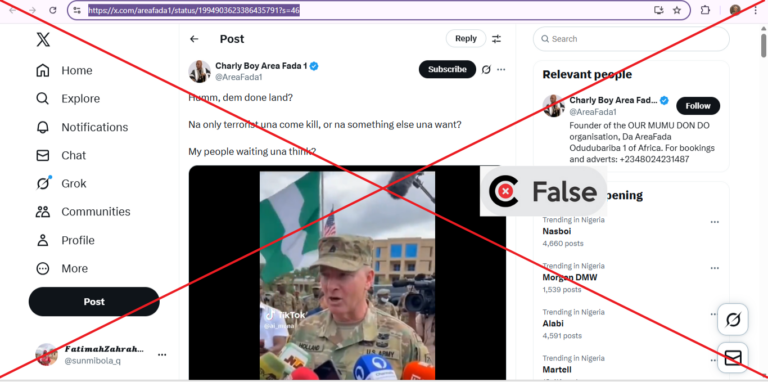
The video, posted by singer and activist, Charles Chukwuemeka Oputa, also known as Charly Boy, shows a man dressed in a U.S. military uniform who appears to be giving an interview. In the clip, the individual is heard saying:

“The U.S. military will take it from the Nigerian Army, and they will do their best to end Boko Haram terror.”

ALSO READ: Charly boy’s 2024 comment falsely attributed to Emir Sanusi

The speaker also encouraged viewers to like and follow the page to “support” the alleged mission.

The accompanying caption read:

Humm, dem done land? Na only terrorist una come kill, or na something else una want? My people waiting una think?

Translated, this suggests that foreign troops may have arrived and questions whether their mission is limited to fighting terrorists or driven by other motives.

As of Thursday, December 18, 2025, the video had garnered over 300,000 views, 1,500 likes, 768 comments, and 675 reposts.

The post triggered concern among users, with many questioning the motive behind the purported U.S. intervention. Some interpreted the video as evidence of possible foreign interference in Nigeria’s security affairs.

One user, @pardox121, commented, “America is literally funding those terror groups. They are not doing that for free; they are definitely going to demand something from Nigeria later. Nothing is ever free.”

However, other users dismissed the claim, describing the video as fabricated.

Given the sensitive nature of the claim and its potential to mislead the public, The FactCheckHub subjected the video to verification.

CLAIM

Video shows U.S. military officer announcing takeover of Nigerian army

THE FINDINGS

Findings by The FactCheckHub show the claim is FALSE!

Screenshot of the claim; Insert false verdict

A keyword search was conducted to identify any official announcement or verified report indicating the presence of U.S. soldiers in Nigeria. No credible news organisation or official source has published such information.

Further examination of the video revealed inconsistencies commonly associated with AI-generated content. One of the microphones visible in the clip bore the name “Arise Mevon,” alongside a logo resembling that of Nigeria’s Arise News. However, the text appeared distorted, a known characteristic of AI-generated visuals—and no legitimate media organisation operates under the name “Arise Mevon.”

Additionally, the movement of the microphones during the interview appeared unnaturally swift and fluid, another indicator consistent with artificial intelligence–generated footage.

Closer inspection showed that the video was originally posted on TikTok, as indicated by the visible watermark and username. A review of the TikTok account, @ai_muna, revealed a clear disclaimer in the profile bio stating that the videos are “powered by AI.” The account predominantly features AI-generated content, including the video in question.

To further verify the findings, the clip was analysed using the AI-detection tool Hive Moderation. The results indicated a high level of manipulation, flagging the content as 99.9 per cent AI-generated overall, with 70 per cent AI-generated visuals, confirming that both the imagery and audio were largely produced using artificial intelligence.

Screenshot showing results from Hive Moderation

THE VERDICT

The claim that the video shows a U.S. military officer announcing the takeover of the Nigerian army is false; it is an AI-generated video.

Video claiming Dubai launched AI salon is AI generated

0

A claim that Dubai has unveiled an AI robot salon that curls hair instantly has surfaced the internet.

The claim posted on X by a user @Livingtricks_ had a 10 seconds video attached to it.

In the video, a dark-skinned woman with kinky hair, described as frizzled and rough, sat as a machine resembling a steamer or stand hair dryer was automatically placed over her head, straightening her hair almost instantly, while white onlookers watched in the background.

READ ALSO : AI-generated images of Alia’s statues circulate online

The post also had the caption :

Dubai just unveiled a mind-blowing AI Salon Robot that curls hair instantly — no heat damage, no touch, just pure futuristic tech
Since the video was posted on Saturday December 13, it has garnered two million views, 3,300 likes and 444 reposts.
CLAIM

Dubai launches AI-powered salon.

THE FINDINGS

Findings by The FactCheckHub show that the claim is FALSE!

Screenshot of the claim; Dubai launches AI powered salon; Insert: False verdict

A closer examination of the video, including the text on the backdrop, the appearance of the people and hands, facial expressions, and hair movement, revealed several unnatural features, strongly suggesting that the content was created using synthetic media.

Additionally, the machine shown in the video straightened the woman’s hair rather than curling it, as claimed.

When we ran the video through Hive Moderation, an AI detection tool, it showed 99.4% probability that the content was AI-generated.

Screenshot of the results from Hive Moderation

Further checks to verify whether Dubai had launched an AI-powered salon found that similar claims were circulating across multiple social media platforms, each accompanied by different deepfake videos.

READ: AI-generated video of man constructing wooden aircraft circulates online

THE VERDICT

The claim that Dubai has launched an AI- powered salon is false; the video used to push the narrative is AI-generated.