
Home Blog Page 95

False claim that Davido is sharing airtime, data to celebrate twins arrival circulates online

A claim has been circulating on WhatsApp that a Nigerian singer and record producer, David Adedeji Adeleke, popularly called Davido is sharing 5,000 naira airtime and 10GB data across all networks to his fans to celebrate the arrival of his new born twins.

The claim, widely circulated through  the encrypted messaging platform, was sent randomly to many WhatsApp groups.

On Sunday, 15th October, 2023, Davido confirmed welcoming a set of twins with his wife, Chioma Rowland in the United States, The Punch reported.

READ: How to identify phishing scams and websites

However, the claim circulating on WhatsApp groups, was directing people to click a link which contains a “call to action” texts asking readers to apply for their network of choice from the ones listed.

The claim, retrieved from one of the WhatsApp groups on October 22, 2023, reads:

“DAVIDO NEW BORN TWINS CELEBRATION

“Davido is giving out ₦5,000 Airtime and 10GB free data to his fans in celebration of his new born twins.

Choose your network below to get yours

FOR MTN���

https://myfreebyt.org/mcel.html

FOR AIRTEL���

https://myfreebyt.org/mcel.html

FOR GLO���

https://myfreebyt.org/mcel.html

FOR 9-MOBILE���

https://myfreebyt.org/mcel.html.”

 

CLAIM

Davido is giving out ₦5,000 Airtime and 10GB free data to his fans in celebration of his new born twins.


THE FINDINGS

Findings by The FactCheckHub show that the claim is FALSE.

A careful look at the web links shows that the URL when clicked or opened have features similar to most phishing websites The FactCheckHub had debunked in recent time as seen here, here, here,  here and here.

Also, the writer observed that the same web link was ascribed to the different telecommunication networks mentioned in the WhatsApp post.

ALSO READ: What you need to know about QR code phishing (EXPLAINER)

When subjected to verification via multiple WhoIs, the results show that the web link was registered on October 2, 2023. The Whois lookup tool is primarily used to investigate the website’s primary domain owner(s) as it searches the database for verified registration information which oftentimes contains resources such as DNS, domain names, name servers, IPs, ownership info, IP address history, web ranking, web traffic and SEO, among others.

Screenshot of the Whois domain search conducted on the phishing web link.

Further checks show that a click on any of the links will take users to a website titled “DAVIDO Twins Celebration Giveaway,” where users were asked to fill in their phone numbers, and then urged to click the “SEND” button.

A click on the ‘send’ button will take users to another page, where users were asked to choose their network of choice.

When users press ‘Proceed’, it takes users to another page with a message that reads, “Congratulations, your Mobile Number is Eligible to receive ₦5,000 airtime and 10GB Free Data. Proceed to Activate your Free Data and airtime.”

Users are then asked to share the link to 5 WhatsApp groups or 15 different friends to claim the airtime and data. After submission, it takes users back to the initial form page for another round of registration.

The FactCheckHub has published several fact-checks on phishing scams and tutorials on how to identify phishing scams, websites and verify viral WhatsApp messages.

Collage screenshots of the phishing web pages. INSERT: False verdict.

Despite these measures, people still fall for these scams as they devise new methods to present them to people, one of which is using information that is true to lure audiences to click on a phishing link. Another is giving out freebies that look too good to be true to individuals.

Forbes reported that clever phishing scams always have a sense of urgency about them because they do not want you to stop and consider what you’re doing. They push emotional buttons to bypass logical thinking.

To reduce the spread of phishing scam messages, individuals should always be suspicious; nothing comes for free !!! They should watch out for mis-spelt words in the messages as this is common with phishing messages and fake domains in the form of mis-spelt websites, the report stated.

Learn how to identify phishing scams here.


THE VERDICT

The claim that Davido is giving out ₦5,000 Airtime and 10GB free data to his fans in celebration of his new born twins is FALSE; multiple evidence show that it is a phishing scam.


* This fact-check was written by Hayatullahi Folorunsho Mudathir, a fellow of the ICIR’s Countering Misinformation and Promoting Media Literacy project.

Fake list of sundry charges by WAEC circulates online

0

A Facebook user, Olatoke AbdulAzeez Kolawole, recently posted a list purporting to emanate from the West African Examinations Council (WAEC) on payment of sundry charges to file for correction of personal details regarding individual’s exam result or certificate.

The user, who intended to warn parents to be careful when their ward is filling the registration form for the exams said, “Dear parents and guardians, take proper look at the rates above from WAEC. The examination body is not kidding at all. Kindly guide the students with filling the correct birth date and names; subsequent correction is not cheap.”

The claim has also spread widely on multiple social media platforms including WhatsApp, Facebook and X (formerly Twitter) as seen here and here.


CLAIM

Social media users recently posted a list of sundry charges that candidates sitting for WAEC would have to pay if they seek to correct any errors in their personal details with the council after the exams.

Screenshot of the Facebook post containing the claim. INSERT: False verdict.


THE FINDINGS

Findings by this reporter show that the claim is FALSE!

The document started with the price for correction of date of birth, which it stated would cost N70,000, followed by attestation of result, N80,000; correction of name, N30,000, correction of gender, N30,000, confirmation of result (international), N39,000 and confirmation of result (local), N19,500.

Others include use of internet, N650; loss of exam number, N3,900; pin resolution, N910; sealed scratch card, N13,000; result checker, N3,250; syllabuses, N520; examiner report, 6,500 and amendment on entry, N6,500.

The Council had earlier labelled the document as fake on its official X account (formerly Twitter), stating that it did not emanate from them.

“Please note that this document did not emanate from WAEC-Nigeria. The Council still does not entertain requests for date of birth amendment,” the statement posted on its X account (@waecnigeria) on September 26, 2023 read.


Daily Trust reports that the Council stopped making corrections to date of birth since 2017 in what it described as a way to curb examination malpractice.

The Council had stated in a press release that, “We have observed with chagrin, the volume of requests for amendments by candidates, as well as the fact that it could be an opening for examination malpractice; hence the need to stop the ugly trend. Moreover, where a candidate detects any error in his/her date of birth after the certificate has been printed, he/she will be advised to obtain an affidavit from a court of law as a support to the certificate.

“The Council has included in its registration portal, a secondary opportunity for candidates to confirm the correctness of all their entries in the date of birth box. In addition, all requests received prior to the above-stated effective date will be treated on their merit,” it stated.

Similarly, the Council’s current charge is N10,000 for correction on names.


THE VERDICT

The posts which claimed that a correction of change of name by WAEC would cost N70,000 is FALSE, among other 13 items on the viral list.


* This fact-check was written by Faruk Shuaibu, a fellow of the ICIR’s Countering Misinformation and Promoting Media Literacy project, supported by the German Embassy in Abuja, Nigeria. It was published by Daily Trust. You can read the report here.

How true is the claim that eating Beans with ripe Plantains is ‘food poison’?

0

A claim that eating beans with ripe plantain, a popular food combination in Nigeria, is considered poisonous and unhealthy has resurfaced online.

The combination is a classic Nigerian dish enjoyed by many Nigerians across the country.

The beans are typically prepared with a stew or sauce with well-diced fried plantains.

An X (formerly Twitter) user, @prof_pius tweeted the claim with a caption that reads: 

“Beans and fried ripe plantain is considered food poison. No matter how sweet it is, it’s not exactly healthy food for you.”

The post has garnered over 2,000 reposts and more than 2,000 likes since it was posted. 

The claim had also been shared earlier by another X user, @sharonpeculia thus:

“Beans and fried ripe plantain is considered food poison, Stop eating it!”


CLAIM 

Eating Beans with ripe plantains is food poison.


THE FINDINGS 

Findings by The FactCheckHub show that the claim is FALSE. 

Checks by The FactCheckHub show that this is not the first time the claim has surfaced online and it is rooted on an article authored by one Dr Kemi Aladesanmi,  a Naturopath and Acupunturist at Lopsam Natural Health Clinic in Akure, Ondo state which was published on newsroom247 on May 9, 2019.

Since then, the claim has been making rounds on social media. It has also been ‘copied and pasted’ by several online blogs. 

Kemi who specialises in Acupuncture (Not Food and Nutrition) had argued that while consuming Beans with unripe Plantain has no health implications, the same Plantain, when it is ripe becomes fruit and its sweetness can be converted by heat or fire to a highly acidic substance which is dangerous to the body. 

However, a review of scientific research publications and consultation with experts in the relevant field conducted by The FactCheckHub show that the claim lacks evidence as there is no credible scientific research that supports it. 

Beans are a very good source of plant-based protein and dietary fibre, aiding in weight management, satiety, and digestive health. It’s also rich in essential vitamins and minerals, including folate, potassium, and iron, which contribute to overall well-being.

On the other hand, Plantains are rich sources of complex carbohydrates, vitamins, and minerals, and are easily digestible.

Plantains undergo ripening when they reach maturity. This process involves the enzymatic degradation of chlorophyll by chlorophyllase, resulting in a loss of colour and the exposure of carotenoids. 

Multiple studies have explored the consumption of beans and plantains individually, as well as together.

However, none of these studies have suggested that eating beans with ripe plantains is hazardous or detrimental to human health. In essence, most research sources, such as this generally regard the consumption of both beans with plantains as safe.

Speaking with The FactCheckHub, a Registered Dietitian Nutritionist and Chief Dietitian at Ajeromi General Hospital, Ajegunle, Lagos State, Malomo Olusola, described the claim that eating beans with fried ripe plantain is “food poison” as false and misleading. 

“Except it is a colloquial expression, Beans and Plantain is healthy and safe,” he said. 

“If the emphasis is on fried plantain let us x-ray Plantain. Plantain is loaded with many heart-healthy nutrients such as potassium, magnesium, vitamin B6, and fibre.”

Malomo explained that Potassium regulates blood pressure, which helps regulate heart rate, while Vitamin B6 reduces homocysteine levels in the body, thereby reducing the risk of heart disease.

“Plantains are healthy. But they’re less so when you cook them with a lot of oil, fat, or sugar. High-fat, high-salt, or high-sugar foods can raise your risk of weight gain, diabetes, heart disease, or cancer,” he noted. 

However, he pointed out that consuming fried plantain over an extended period, especially in quantities exceeding the Recommended Dietary Allowance (RDA) for an individual, can potentially lead to overweight, obesity, and related conditions but does not result in death when consumed.

“Let us look at the definition of food poisoning if that is what was meant by the author. It means illness caused by food contaminated with bacteria, viruses, parasites or toxins. Infectious organisms or their toxins are the most common causes of food poisoning.

Malomo, however, concluded that fried plantain should not be classified or categorized with items referred to as “food poison”.

He encouraged the public to verify that the oils utilized for frying plantains remain uncontaminated and stressed the importance of thoroughly washing beans before cooking or parboiling them. He also advocated for educating bean sellers about modern pest control methods.

He urged regulatory agencies such as the National Agency for Food and Drugs Administration and Control (NAFDAC) and the Standard Organisation of Nigeria (SON) to mop up adulterated oils from the market and ensure compliance with imported cooking oils.

A Nutritionist and Food Scientist at the Department of Biochemistry, Bayero University,  Salisu Maiwada Abubakar, also told The FactCheckHub that he could not find “any scientific evidence that supports the claim” that eating beans with ripe plantains is considered a food poison.


THE VERDICT 

The claim that Beans and Plantain are an unhealthy combination and considered a food poison is FALSE; experts note that eating beans with ripe plantains is very healthy and absolutely safe.

Claim that FUOYE students designed a waiter robot is false!

0

A claim that students of the Department of Mechatronics at the Federal University, Oye-Ekiti, in Ekiti state have designed and constructed a waiter robot that serves food in a restaurant has surfaced online.

The claim was contained in a video that originated from TikTok. In the video, the robotic waiter could be seen taking meals to sitting customers in a restaurant.

The original version of the video was posted by @house_of_lovedoctor but there have been variations of the same video posted by different accounts on TikTok as seen here and here which had a caption that wasn’t in the initial video.

The captions read:

Who says that capacities are not in Nigeria.
This is a robot designed and constructed by the Department of Mechatronics, Federal University, Oye- Ekiti, serving food in a restaurant.

The video has also been circulating on WhatsApp closed group chats and Facebook as seen here. In separate posts, they have both garnered a combined total of over 23,000 views, over 400 shares, 348 reactions and 104 comments.

Screenshot of the viral claim; Insert False verdict
Screenshot of the viral claim. Insert: False verdict

CLAIM

Students of the department of Mechatronics at Federal University of Oye-Ekiti constructed a waiter robot.

THE FINDINGS

Findings by The FactCheckHub show that the claim is FALSE!

The caption in the original video did not state if the robot was made by the university’s Mechatronics Engineering department or that he experimented with the robot at a restaurant in Oye-Ekiti.

The caption read:

At point a point where a customer obstructs ANITA’S operation she cries for help. Shop located at 4150 Lafayette rd IN 46254 Indianapolis Afs kitchen Amala toh sure.

Further findings revealed that the invention made by the department rather, is a mail dispatch mobile robot developed by Oluwaseun Martins, a lecturer in the department for his PhD thesis which was launched in December 2021, according to Thisday report and FUOYE report too.

A Google reverse image search done on the screenshot of the video led us to another image of the same robot in the restaurant which showed that the name of the brand is Servi Robot made by Bear Robotics, a technology company based in the United States of America which specializes in hospitality.

THE VERDICT

The claim that students of the department of Mechatronics at Federal University, Oye-Ekiti constructed a waiter robot is false; the waiter robot in footage was constructed by the US-based Bear Robotics.

Israel – Hamas conflict: How to restrict horrific photos, videos on your social media apps

0

THE internet recently has been flooded with gory images and videos of the ongoing conflict between Israel and Hamas in the Middle East.

These images have shown dead bodies, the reported murder of civilians and hostages, and other human rights abuses allegedly committed by both parties. While some of these visuals are real, some of them are also misleading or outright false.

READ : Video showing a child allegedly being shot is from a movie, not Israel-Hamas war

Meta had on Friday, October 13, 2023, announced that it was taking steps to remove Hamas-related disinformation from its platforms.

The posts may infringe the rights to dignity, privacy, and human life of those depicted in the photographs and videos, whether they are false or not. Additionally, some of the graphic photographs appear to violate social media platforms’ rules, which normally forbid graphic violence when it is used for propaganda or depicts mutilated bodies, depending on the situation.

However, if you use social media, you probably won’t be able to completely avoid seeing these gory images in your feeds.

Follow the steps below to modify the settings in the following social media apps so that videos only play when you want it to. Some apps also let you set restrictions or add warnings to graphic images that you might not wish to view.


WhatsApp

You can disable new message alerts for a WhatsApp group, which prevents you from being informed of them. If you’d like, you may restart receiving notifications later. Here are instructions from WhatsApp on how to go about it.

If you think there is inappropriate violence or falsified information in the group chat, you can also block users or report the content to WhatsApp. Guidelines on these are available here. A WhatsApp group can also be deleted. Only the group chat’s admins will be notified if you do this.


X (formerly Twitter)

It is easier to change the settings from the site via: Twitter.com. You can do that by selecting Pick “More” (the representation of a circle with three horizontal dots in the center) from the menu on the left side of the screen. Select settings and support, then settings and privacy, then privacy and safety then content you see.

Disable the checkbox labeled “Display media that may contain sensitive content.”

Sensitive images and videos will display a warning and give you the option to click to view them. Click here to read more instructions published by X.

You can also disable automatic video playback while scrolling. Again, select the picture of the circle with the three horizontal dots in the center from Twitter.com.

Click on settings and support, then settings and privacy , then click on accessibility, display and languages , it would lead you to  Data usage  and lastly ‘Autoplay.’ Click on “Never” to stop videos from playing automatically as you scroll.


YouTube

To change the settings on the YouTube website,  click at the bottom of a video while it is playing. A pause image and an auto play button are visible in the center. To automatically stop playing each video one at a time, click that. Here are further instructions from YouTube regarding that.

In some circumstances, YouTube may apply a warning to videos before they begin playing, the company says.

To change the settings on the app, Click on your profile in the upper right corner. click on settings, and then autoplay. Tap off to stop one video from automatically playing when you finish another.

Another way is to then click on general and then on restricted mode. Tap on to hide videos on that particular device that YouTube considers “potentially mature.”


Facebook

To access the menu in the iPhone app, tap the three horizontal lines in the bottom right corner of the screen. Alternately, on the main screen of the Android app, tap the three horizontal lines in the upper right corner.

Select the gear-shaped symbol in the top right corner of the next screen. Then, choose the ‘Never Autoplay Videos’ option under preferences and then media.


Instagram

In the lower right-hand corner of your screen, tap on the three horizontal lines starting in the upper right corner. Select sensitive content under settings and privacy suggested content.

If “Less” is selected, Instagram will display fewer posts that it believes may be sensitive. You might still view graphic images from accounts you follow if you change this setting.


TikTok

The ‘For You’ page’s “Restricted Mode” helps prevent access to explicit videos. Additionally, you can receive a warning regarding “Sensitive content” and have the option to view or skip the TikTok video by clicking on it. In the lower right corner, tap your profile to access it. You may then click the three horizontal lines in the upper right corner.

Select Restricted Mode under Settings and privacy, and click on ‘digital wellbeing.’ To activate or deactivate Restricted Mode, you must set a passcode.

No, Video does not show Palestinian fighters shooting Israeli helicopters

0

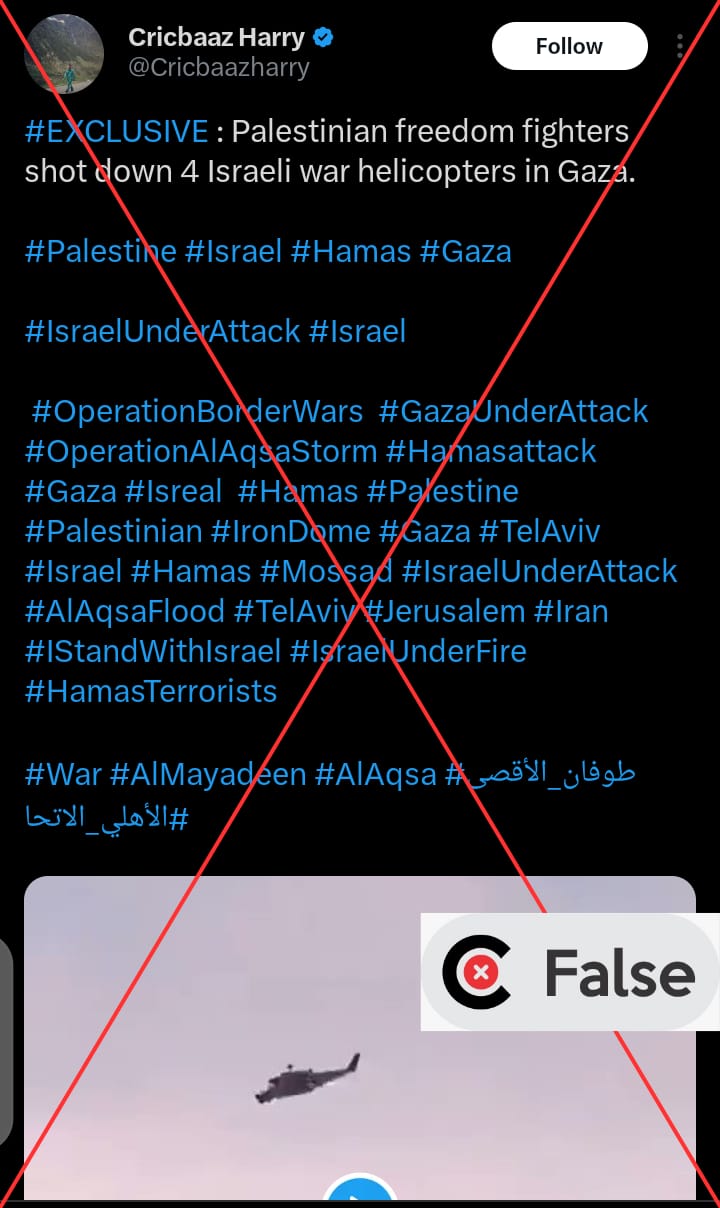
A video with the claim that Palestinian freedom fighters shot down four Israeli war helicopters in Gaza has been making rounds on the internet.

The video which was a 22-second footage was posted on the X app (formerly Twitter) by @Cricbaazharry.

The footage showed rockets bombing helicopters and there was a subscribe for more header floating on the clip with a caption that read:

#EXCLUSIVE : Palestinian freedom fighters shot down 4 Israeli war helicopters in Gaza. #Palestine #Israel #Hamas #Gaza #IsraelUnderAttack #Israel #OperationBorderWars #GazaUnderAttack #OperationAlAqsaStorm #Hamasattack #Gaza #Isreal #Hamas #Palestine #Palestinian #IronDome #Gaza #TelAviv #Israel #Hamas #Mossad #IsraelUnderAttack #AlAqsaFlood #TelAviv #Jerusalem #Iran #IStandWithIsrael #IsraelUnderFire #HamasTerrorists #War #AlMayadeen #AlAqsa #طوفان_الأقصى #الأهلي_الاتحا

The video has since garnered over 18,000 views since it was posted on Saturday, October 7, 2023.

Thousands of people have died and millions have been displaced as a result of the Israeli – Gaza conflict.

After a dare-devil attack on Israeli settlements by the militant Palestinian group, Hamas, on October 7, Israel declared war on the Gaza Strip, and now all eyes are more firmly fixed on the planned ground invasion of Gaza by the Israeli Defence Forces (IDF).

Screenshot of the Claim; Insert False verdict
Screenshot of the Claim. Insert: False verdict

CLAIM

Video shows Palestinian freedom fighters shot down four Israeli war helicopters.

THE FINDINGS

Findings by The FactCheckHub show that the claim is FALSE.

Using the InVid keyframes analysis tool to search for previous version of the video, it led us to the original version of the video on YouTube which is a 4 minutes 16 seconds footage posted by @SeveralSim, a realistic graphics gaming channel.

A look at the channel shows that they create realistic gaming content for game lovers.

The caption of the video on YouTube read:

Attack Helicopter shot down by Missile System – Ka 52 – Military Simulation – ARMA 3 Make sure to Subscribe and Like the Video for more Milsim Videos! 👍 I used ArmA 3 to create this Military Simulation. I really love to make this videos. I hope you like it too!!! Thanks you all for watching! Best ArmA 3 Mission.

Further checks by The FactCheckHub show that realistic graphic gaming content like this are usually used to amplify misinformation during war crisis.

VERDICT

The claim that video shows Palestinian freedom fighters shot down four Israeli war helicopters is false; the footage was extracted from a gaming YouTube channel.

Verified users post 74 per cent of misleading claims about Israel-Hamas war on X – Report

0

A new report  by NewsGuard has revealed that a significant portion of viral posts spreading misinformation about the Israel – Hamas war on the X platform are being shared by verified accounts. 

According to the misinformation monitor report published by the platform on October 19, 2023,  74 per cent of the most viral posts promoting false narratives about the conflict were traced back to “verified” X accounts (formerly Twitter).

In March 2023, X owner, Elon Musk, changed the verification policy, allowing users to pay $8 per month for a blue checkmark on their profile, granting their posts priority in users’ feeds. 

In April 2023, NewsGuard reported that the “blue check” which was previously an indication of an account’s authenticity, has now become a tool for propagators of false information to present themselves as credible.

NewsGuard analyzed the top 250 posts during the first week of the conflict and discovered that 74 per cent of these posts were attributed to verified X accounts. These posts perpetuated ten false or unsubstantiated claims, collectively garnering over 1.3 million engagements and more than 100 million views globally within just one week.

Elon Musk has emphasized X’s crowdsourced fact-checking feature, “Community Notes,” in response to criticisms. 

However, NewsGuard found that only 32% of the most prominent and harmful misinformation posts were flagged with Community Notes. Despite misinformation also spreading on other platforms like Facebook, Instagram, TikTok, and Telegram, NewsGuard chose to focus on X due to its public reduction in moderation efforts.

NewsGuard identified seven verified X accounts that spread at least two of the most widely shared myths about the war. 

In terms of fact-checking, X’s reliance on Community Notes appeared inconsistent, with 68% of debunked misinformation posts lacking these notes. While some posts did have fact-checks, it varied significantly by the specific false claim indicating that reliance on crowdsourced fact-checking might not be sufficient to combat misinformation effectively.

“In an example of how X’s Community Notes feature can function properly, fact-checks  appeared alongside 21 of the top 25 posts identified by NewsGuard as advancing the false claim that a video showed Hamas fighters with a kidnapped Israeli toddler.

“However, X attached a Community Note to only one of the top 25 posts advancing the unsubstantiated claim that Israel has killed 33,000 Palestinian children since 2008, and to just four of the top 25 posts promoting the false claim that a White House memo revealed the U.S. was sending $8 billion in military aid to Israel.”

Nov 11 polls : INEC warns against election-related misinformation

0

AHEAD of the November 11 governorship election in Bayelsa, Kogi, and Imo States, the Independent National Electoral Commission (INEC) has again expressed concern over the rising cases of fake news and misinformation.

The National Commissioner and Member, Information and Voter Education Committee (IVEC),  Kunle Ajayi made the remark on Monday in Nasarawa at a two-day capacity building and workshop for INEC Press Corps on ethical, safety practices and critical issues relating to the forthcoming polls.

READ : Pakistan Election: TikTok partners fact-checkers to combat misinformation

Ajayi stated that fake news was capable of having a negative impact on the management of elections in the country if not curtailed.

He noted that while reporting on election matters, the media must address issues with a deep sense of professionalism, journalistic ethics and high standards.

Ajayi stressed that the Commission’s distasteful experience with fake news in the 2023 general election has shown that, if not curbed, it can become the bane of election management in Nigeria.

“Disinformation is used to provoke religious, political, and tribal sentiments in an already polarized society such as ours, especially, during election season, which is often the leading cause of electoral violence and uprisings,” he said.

“Election-related disinformation has become a major strategy used by nefarious individuals and groups in the political space to manipulate the general public to their advantage, regardless of the consequential effect such propaganda may have on the peace and stability of the electoral process and the country at large.”

Ajayi appealed to the media to be objective and unbiased in their reportage, while avoiding fake news and inflammatory stories.

Meta vows to remove Hamas-related disinformation from its platforms

0

AFTER the European Union criticized social media companies for not doing more to combat disinformation online amid the ongoing Israel – Hamas conflict, Meta has announced that it was taking steps, including deleting praise and meaningful support for Hamas from its platforms.

Since the attack by the Palestinian militant group Hamas against Israel on Saturday, October 7, 2023, false information and altered photographs have gained popularity on Facebook and other social media platforms.

According to Meta on Friday, it removed or flagged more than 795,000 pieces of content in Hebrew or Arabic that is considered as upsetting in the three days following the incident.

Additionally, Meta is temporarily broadening its prohibition on violence and incitement and eliminating material that expressly names hostages abducted by Hamas, even when done to denounce or draw attention to their plight.

The tech platform claimed that while content with blurred photographs of victims is still permitted, if uncertain or unable to make a confident determination, it will prioritize the protection and privacy of abducted victims.

Numerous Israelis and foreigners have been taken hostage by Hamas in the Palestinian enclave of Gaza as a result of the conflict.

In response to Hamas’ threats to broadcast hostages’ footage, Meta announced it would immediately take down any such materials and prevent copies from being redistributed.

In order to prevent recommending content that would contravene policies across its Facebook, Instagram, and Threads platforms, it is also decreasing the threshold at which its technology takes action.

“Meta enables social and political dialogue, such as news reporting, human rights-related problems, or intellectual, neutral, and critical discussion, however Hamas is prohibited from the platforms,” it stated.

In order to comply with its Digital Services Act (DSA), a violation of which might result in significant fines, the European Commission has put pressure on social media platforms to remove dangerous and unlawful information from their platforms.

The response from Meta contrasts with that of X, (formerly Twitter), who requested further information from the Commission about infractions on its platform. The Commission says it has started looking into X.

EU warns Elon Musk over ‘disinformation’ on X about Israel – Hamas conflict

0

THE European Union (EU) has warned Elon Musk over alleged disinformation about the Hamas attacks on Israel, including fake news and “repurposed old images”, on X.

This was disclosed in a letter signed by the EU Commissioner, Thierry Breton, regarding the company’s handling of misinformation and its responsibilities under the Digital Services Act, especially amid the Israel-Hamas conflict.

This is coming weeks after the EU report which alleged that X (formerly Twitter) had the highest prevalence of misinformation and disinformation.

Breton told Musk that he needed to have “proportionate and effective mitigation measures to tackle the risks to public security and civic discourse stemming from disinformation”.

“Following the terrorist attacks carried out by Hamas against Israel, we have indications your platform is being used to disseminate illegal content and disinformation in the EU.

“Public media and civil society organisations widely report instances of fake and manipulated images and facts circulating on your platform in the EU, such as repurposed old images of unrelated armed conflicts or military footage that actually originated from video games. This appears to be manifestly false or misleading information,” he said.

The letter written to X by Breton.

Breton noted that the Digital Services Act sets very precise obligations regarding content moderation adding that changes in X’s public interest policies raised questions about his compliance with the new rules.

X opted out of a voluntary code of practice set up by the EU earlier this year to enable social media companies to put in place systems to comply with the new laws. Facebook, Google, TikTok and other companies are participating in the code of practice and are removing disinformation under the new rules.

Responding to Breton via the X app, Musk asked her to list the violations alluded to on X so that the public could see them.

“Our policy is that everything is open source and transparent, an approach that I know the EU supports. Please list the violations you allude to on 𝕏, so that the public can see them. Merci beaucoup,” Musk responded.