Home Blog Page 96

AFP, Dubawa, TheCable, others win 2023 African Fact-checking Awards

0

Fact-checkers from Agence France-Presse (AFP), Dubawa and TheCable Check, among others have emerged winners at the 2023 African Fact-checking Awards held on Friday, October 6, 2023, in Mauritius.

The award ceremony, now in its 10th edition and hosted by Africa Check, climaxed the two-day Africa Facts Summit held from October 5 – 6 at the University of Mauritius in Port Louis.

The award had participants from various African countries and winners were announced in three categories, namely: Fact-check of the year by a working journalist, Fact-check of the year by a student journalist, and Fact-check of the year by a professional fact-checker.

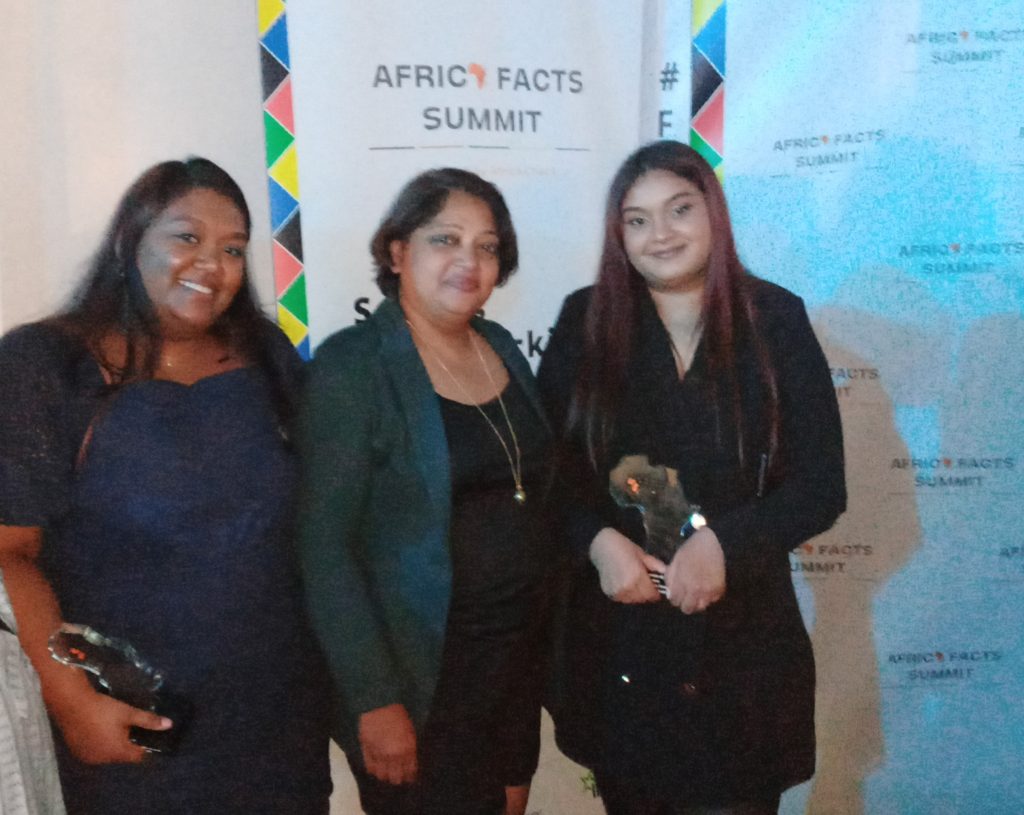
The Nigerian contingent at the African Fact-checking Award gala night in Port Louis, Mauritius, and Africa Check's Mmabatho Koena.
The Nigerian contingent at the African Fact-checking Award gala night in Port Louis, Mauritius, and Africa Check’s Mmabatho Koena.

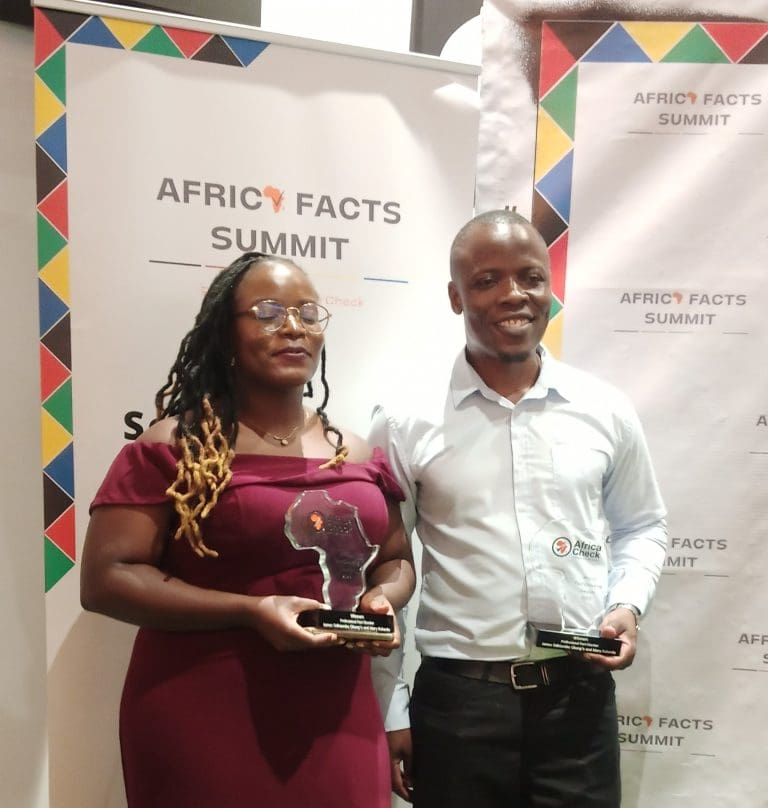
In the professional fact-checkers category, the duo of James Okong’o and Mary Kulundu from AFP Fact-Check were declared winners, with Kemi Busari from Dubawa as the runner-up. 

In the working journalist category, Moussa Ngom and Laureline Savoye from Les Reporter Sn and Le Monde Afrique emerged as the winners, while Claire Hiter Mom of TheCable was declared the runner-up. 

In the student journalist category, Papa Bocar Mbow from CESTI DAKAR clinched the first position, while the trio of Komagal Chocalingum, Georges Aurore, and Permalloo Suhaasinee from the University of Mauritius, were named the runners-up.

L-R: Komagal Chocalingum, a guest and Georges Aurore from the University of Mauritius.

Speaking with FactCheckHub at the gala award event held at Le Suffren Hotel & Marina in Port-Louis, one of the winners, James Okongo’o expressed joy over the award and thanked the organizers for providing a platform where works of African fact-checkers are recognized.

“I’m very excited today. I was a runner-up last year. I feel good because the award recognizes the work we do as fact-checkers. This is because most people don’t understand what we do. If we come to events like this where our works are recognised, it feels like the work we do is actually impacting people,” he said.

Claire Mom of TheCable thanked her editors and organizers of the African Fact-checking Award emphasizing that the award serves as a motivation for her to continue doing important stories. 

“I’m excited. It shows that we are on the right track and it shows that we are checking the right things and doing important stories,” she noted.

AI voice technology used to create misleading videos on TikTok – Report

0

A new report by NewsGuard has revealed that a network of 17 TikTok accounts is exploiting hyper-realistic AI voice technology to disseminate conspiracy content that appears convincingly human.

According to the report, these accounts employ AI text-to-speech software to instantly create narrations and voices for their videos on a large scale showing a novel way bad actors can leverage AI software to quickly and cheaply produce false content that reaches vast audiences.

The report revealed that these accounts, active since June 2023, have generated approximately 5,000 videos, many featuring AI-generated voiceovers. These videos have amassed 336 million views and 14.5 million likes as of September 25, 2023.

“Baseless narratives pushed by the AI narrators in these videos include the claim that former U.S. President Barack Obama was connected to the death of his personal chef Tafari Campbell; that TV show host Oprah Winfrey is a “sex trader”; that actor Jamie Foxx was left paralyzed and blind by the COVID-19 vaccine; and that comedian Joan Rivers was murdered for claiming that Obama was gay,” the report read.

“For example, a July 2023 video posted by an account that goes by @e.news.tv featured a female narrator with a polished tone delivering a three-minute “news” report that baselessly linked Obama to the death of his personal chef.  The video began with an AI narrator stating, “Obama has reacted to Sherise Campbell blaming him for the death of her husband Tafari Campbell. Here’s what he had to say about it.” 

“This introduction, seemingly read by an AI narrator, was followed by audio of a robotic, clearly AI-generated “Obama” reading a statement on Campbell’s death.

“While I cannot comprehend the basis of the allegations made against me, I urge everyone to remember the importance of unity, understanding, and not rushing to judgements,” the Obama voice stated. As of Sept. 27, 2023, the video had garnered more than 50,700 views on TikTok.”

NewsGuard reconstructed the video’s audio introduction using ElevenLabs’ AI text-to-speech software. An AI speech classifier by ElevenLabs confirmed a high likelihood that the audio was generated using their software.

Deceptively, 13 of the 17 accounts pretended to be mainstream news outlets, TV shows, or famous TikTok profiles to appear credible. Comments on these videos indicate that AI-generated content is influencing users and aids in spreading baseless accusations.

According to the report, TikTok introduced a disclosure label feature for AI-assisted content in September 2023, but none of the identified AI-narrated conspiracy videos had such labels as of September 26, 2023.

The report noted that TikTok took action by removing three accounts for impersonation and one video for manipulated media and restricted four videos from algorithmic promotion for spreading misinformation.

Hafiz Malik, a computer science professor at the University of Michigan-Dearborn, noted that AI text-to-speech technology has drastically lowered the barriers to producing fabricated audio, making it easier and faster to create deepfakes with a mere click of a mouse.

EU decries increased disinformation posts on X

0

THE European Union (EU) Commission has declared X (formerly Twitter), the social media platform with the largest ratio of misinformation and disinformation posts.

The Commission’s Vice-President for Values and Transparency, Vera Jourova, stated this on Tuesday while presenting new reports on how the signatories to the EU’s new Code of Practice on Disinformation of 2022 (Google, Meta, Microsoft, TikTok) have turned into practice their commitments to reduce the spread of disinformation.

According to her, X performed woefully during a pilot test of a new methodology developed by the Code signatories.

While other platforms like YouTube, TikTok, Microsoft, and Meta’s family apps were said to have taken some measures to address disinformation, X is said to be harbouring more disinformation actors.  

“X, former Twitter, who is not under the Code anymore is the platform with the largest ratio of mis/disinformation posts. The pilot also showed that disinformation actors were found to have significantly more followers than their non-disinformation counterparts and tend to have joined the platform more recently than non-disinformation users,” Jourova said.  

According to the EU Commission, all the social network platforms were asked to monitor specifically disinformation about the Russian war in Ukraine and the report shows that they have been taking significant steps in this regard.

“Disinformation is still one of the greatest risks to the European democratic information space, including that related to Russia’s war in Ukraine and elections. As Europeans will prepare to head to polling stations in 2024, all actors must do their part in fighting online disinformation and foreign interference to protect our online debate. The Code proves to be a useful exercise, but we all have to do more. I call for the platforms’ full engagement in applying the commitments they took under the Code to help ensure resilience of democracy,” the statement added.

According to her, Google reports that, between January and April 2023, YouTube terminated more than 400 channels involved in coordinated influence operations linked to the Russian state-sponsored Internet Research Agency (IRA).

“Meta reports expanding its fact-checking partnerships to 26 partners covering 22 languages in the EU, which now includes also Czech and Slovak.

“TikTok’s fact-checking efforts cover Russian, Ukrainian, Belarusian and 17 European languages, including through a new partnership with Reuters. In this context, 832 videos related to the war have been fact-checked, of which 211 have been removed.

“Microsoft highlights that Bing Search has either promoted information or downgraded questionable information in relation to almost 800 thousand search queries related to the crisis,” she added.

She expressed satisfaction that major platforms have started to address the risks of generative AI by starting to put in place safeguards to inform users about the synthetic origin of content posted online.

Jourova noted that these efforts need to continue and intensify considering the high potential of such realistic AI products for creating and disseminating disinformation. She said the risks are particularly high in the context of elections. 

Meanwhile, reacting to the report immediately after its release, X’s Global Affairs  Team denied the allegations insisting that X is committed to complying with the Digital Services Act.

“We disagree with the overall framing of this data and believe that the data does not fit the narrative being covered in the media. This important debate should take into account the full range of actions taken by platforms & recognize the importance of protecting free expression,” X’s statement read.

It added: “More than 700 unique Community Notes have appeared on posts related to the Ukraine conflict. Through Community Notes’ new “Notes on Media” feature, which automatically matches notes on an image or video to other posts that contain matching media, these notes appeared on over 1200 additional posts. These notes are in numerous languages and are written specifically for local audiences.”

Elon Musk’s policy change fuels engagement of unchecked propaganda on X – Report

0

ELON Musk’s policy change on X on state-affiliated labels has led to a significant increase in engagement for Russian, Chinese, and Iranian state-run media accounts, raising concerns about the spread of unchecked propaganda and disinformation on the platform.

This is contained in the NewsGuard’s misinformation monitor report for September 2023.

According to the report, prior to April 20, 2023, X users used to be notified when an account was linked to a state-affiliated source.

However, Musk removed these labels, allowing state-sponsored propaganda to spread unchecked content on the platform.

Based on an analysis conducted by NewsGuard, which utilized data from Meltwater, there was a 70 per cent increase in engagement, as indicated by the number of likes and shares, observed on posts from English language accounts of Russian, Chinese, and Iranian state-run media during the 90 days that followed the removal of state-sponsored labels on X, in contrast to the prior 90-day timeframe.

This surge in engagement raised concerns about foreign actors reaching a potentially more susceptible audience without users being aware of the propagandistic nature of these sources.

“Russia’s RT gained the most engagement after X users no longer had access to the information that the outlet — which changed its name from the more transparent Russia Today several years ago — is operated by the government of the country’s president, Vladimir Putin. It nearly doubled its engagement, to 2.5 million likes and reposts from 1.3 million, after the removal of the disclosure. Following the change in X policy, Russia’s TASS grew engagement by 63 per cent, Iran’s PressTV by 97 per cent, and China’s Global Times by 26 per cent,” the report noted.

According to the report, these state-run disinformation sources managed to increase their engagement despite posting a similar number of times as before. Three months after the policy change, these accounts collectively garnered 4.98 million likes and reposts on 63,108 posts, compared to 2.93 million interactions on 62,551 posts in the preceding 90-day period.

The report noted that the policy change, X, was used to alert users about an account’s government ties on the profile page and within posts.

Additionally, posts containing links to state-run media articles were labelled with an orange exclamation point, urging users to “Stay Informed.” However, this transparency was eliminated, making it difficult for users to discern whether an account was government-affiliated.

According to the report, none of the 12 state-run X accounts analyzed disclosed their government affiliation in their profiles. This lack of transparency raised concerns about the potential spread of disinformation.

The removal of labels was not the sole change benefiting state-affiliated accounts. X’s algorithm started promoting content from these sources to users, a practice that was restricted until early 2023. This algorithmic promotion, combined with the policy change, amplified the reach of state-sponsored propaganda.

Part of the report reads, “From August 2020 until early 2023, X (then Twitter) prevented state-affiliated accounts from being boosted, saying it would not “amplify state-affiliated media accounts or their Tweets through our recommendation systems including on the home timeline, notifications, and search.”

However, press reports have documented how state-run media accounts are now regularly algorithmically recommended on users’ “For You” feeds. These pages, according to the platform on March 31, 2023, feed users content based on a post’s engagement metrics and a user’s previous activity. 

Despite the controversy surrounding Musk’s decision, accounts that had previously carried state-affiliation labels celebrated the policy change, highlighting the reduced safeguards on the platform. 

Sarajevo, Rio de Janeiro selected to host GlobalFact 11, 12

0

THE International Fact-checking Network (IFCN) has announced that the GlobalFact 11 will take place in Sarajevo, Bosnia and Herzegovina in June 2024 while the GlobalFact 12 is slated to be held in Rio de Janeiro, Brazil in 2025.

IFCN director, Angie Holan, disclosed this in a statement on Monday, September 25, 2023.

“Fact-checkers in Bosnia and the rest of the Balkans were founding members of the International Fact-Checking Network and have been tireless in their efforts to bring accurate, high-quality information to their communities,” she said.

The GlobalFact is the world’s biggest and most influential fact-checking summit, hosted by the International Fact-Checking Network (IFCN) at the Poynter Institute. Fact-checkers can share best practices and form partnerships at this yearly conference, which includes several days of interactive learning sessions and networking opportunities.

Also, keynote talks by professionals in journalism, academia, disinformation, and technology are included on each day of the conference.

“Each day of the summit includes keynote presentations with experts in journalism, academia, misinformation and technology. Discussions are centered on the universal challenges fact-checkers face today, such as upholding information integrity with artificial intelligence, tracking online disinformation campaigns and protecting democracy in 2024 with more than 40 high-profile elections.

“The IFCN will host the conference in 2024 in collaboration with Zašto ne, a civil society group with headquarters in Sarajevo that works to create systems for government accountability, enhance civic engagement, and protect new media and technology,” the statement read in part.

Commenting on the announcement, Tijana Cvjetićanin , the head of fact-checking at Zašto ne, said her organisation was thrilled to collaborate with the IFCN to organize the GlobalFact summit in 2024.

“Our region has been at the forefront of fighting disinformation for years, and we are thrilled that our global community will meet here, at its very heart. We are especially grateful for the opportunity to share the spirit of solidarity and cooperation that we have nurtured through our regional network,” she said.

The 2025 conference will be organized in collaboration with Brazilian fact-checking organizations including Aos Fatos, known for producing technology-driven tools and award-winning investigations for battling disinformation; Estadão Verifica, whose team debunks suspicious content that goes viral on social media and WhatsApp; Agência Lupa, an award-winning site that led innovative fact-checking of the coronavirus pandemic and strategies for media literacy; and UOL Confere, the fact-checking and verification arm of Brazil’s biggest content, technology and digital services company.

Holan added that despite a contentious political climate and other difficulties, Brazil’s fact-checkers continue to do innovative, important work.

“Fact-checking in Latin America is growing rapidly, and we look forward to inviting fact-checkers worldwide to Rio de Janeiro, with its forested mountains and stunning beaches,” she noted.

“Brazilian fact-checkers excitedly anticipate the debut of GlobalFact on our soil in 2025 in a polarized society where disinformation abounds. We lead this fight against the tides of misinformation and disinformation in a nation that is frequently the victim of such attacks,” Natália Leal, CEO of Lupa, speaking on behalf of all fact-checkers in Brazil, remarked.

It will be recalled that several industry-leading projects and fact-checking advancements have originated through past GlobalFacts, including International Fact-Checking Day, the IFCN’s Code of Principles and partnerships with major tech companies.

Since 2014, more than 3,700 people have attended GlobalFact in cities around the world including London, Buenos Aires, Madrid, Rome, Cape Town, Oslo and Seoul. While the in-person experience went online during the pandemic in 2020 and 2021, the past two years have been full hybrid events. Those who cannot physically attend the 2024 conference in Sarajevo will be invited to sign up for online viewing, live and on-demand, of select main stage sessions. The format for 2025 will be determined next fall.

Holan further stated that the dates for GlobalFact 11 will be finalized in the coming weeks, as registration and speaker submissions will open in early 2024.

Video attributed to #justice4Mohbad protest in Abeokuta is MISLEADING

0

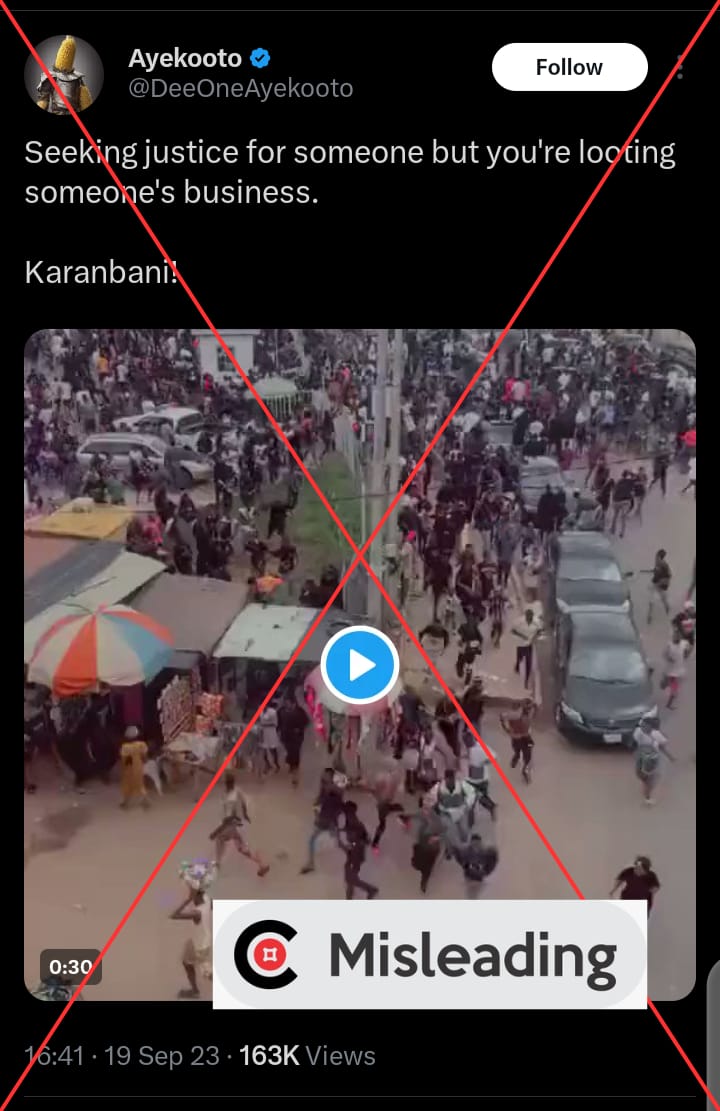
A claim that protesters are looting traders’ stalls at the venue of the #Justice4Mohbad protest in Abeokuta, Ogun State organised in honour of the late Nigerian artist, Ilerioluwa Aloba a.k.a. Mohbad is making rounds online.

The claim was made by Ayekooto with the username @DeeOneAyekooto in a post on the X app (formerly Twitter). He posted the video alongside a caption which read:

Seeking justice for someone but you’re looting someone’s business. Karanbani!

In the video, people could be seen running and scampering for safety while some were seen vandalising traders’ stalls without caution in a bid to seek cover.

The video, posted on Tuesday, September 19, 2023, has since garnered over 165,000 views, about 300 reposts and over 800 likes as of September 22, 2023.

Yabaleftonline, a blog also posted the same video on X with a caption thus:

What’s happening in Abeokuta?

The video which was posted on the same day had garnered almost 2 million views, more than 11,000 likes and over 1400 reposts.

Mohbad who died on Tuesday, September 12, 2023, at the age of 27 was a Nigerian artiste formerly signed to Marlian Music.

There have been various calls on the Nigerian authorities and police to carry out an investigation into the cause of the artiste’s death. The Nigerian police had responded saying it has begun investigation into Mohbad’s death. There have also been peaceful protests and walks in parts of the country to pay respect to the deceased artiste and to seek justice.


CLAIM

Video shows people looting stalls during a #justice4Mohbad protest in Abeokuta.


Screenshot of the claim alongside the viral video. Insert: MISLEADING verdict.


THE FINDINGS

Findings by The FactCheckHub show that the claim is MISLEADING.

Unlike what the claim stated that people were looting shops, people were actually fleeing for safety while vandalising properties.

Further checks show that the footage is not recent.

Using the InVID keyframes analysis tool to search the video for landmarks, some buildings were spotted in the video which was also spotted in a selfie video taken by some individuals at the peaceful protest which also took place in Abeokuta. The popular Panseke pedestrian bridge was also spotted in both videos.

Some X users had also tagged the video as ‘fake’ as it was not related to the protest which took place on Monday as the video was from a previous protest.

However, The FactCheckHub could not independently ascertain when the event from the viral video took place.

Similarly, several credible media platforms in the country including Channels TV, Punch, and Guardian, who reported the peaceful protest, did not cite any instance of violence from the protesters.


THE VERDICT

The claim that the video shows people looting stalls during a #justice4Mohbad protest in Abeokuta is MISLEADING; the footage is an old video being circulated as that of recent protest for Mohbad in Abeokuta. Also, the video does not show protesters looting traders but scampering for safety.

X ranks worst in climate change misinformation scorecard

0

THE Climate Action Against Disinformation has ranked Elon Musk’s X (formerly Twitter) as the least-performing among social media platforms due to its poor approach to curbing climate change misinformation.

The group disclosed this in its Climate of Misinformation report which examines the performance of Meta, Pinterest, YouTube, TikTok and X on their content moderation policies and efforts to mitigate inaccurate information such as climate denialism.

X was ranked last due to its unclear policies against the spread of misleading information about climate change, according to the scorecard. 

The Climate Action Against Disinformation is a coalition of more than 50 environmental groups, ad agencies, and other organizations. 

Social media researchers have long expressed concern over the proliferation of climate change denial. They contend that tech platforms exacerbate issues like rising sea levels when they fail to assume a more proactive stance in removing deceptive content from their platforms. 

X (formerly Twitter)
X (formerly Twitter).

“In the case of X/Twitter, Elon Musk’s acquisition of the company has created uncertainty about which policies are still standing and which are not,” the report said. 

The researchers said they reached out to X in preparing their report but did not get a response. 

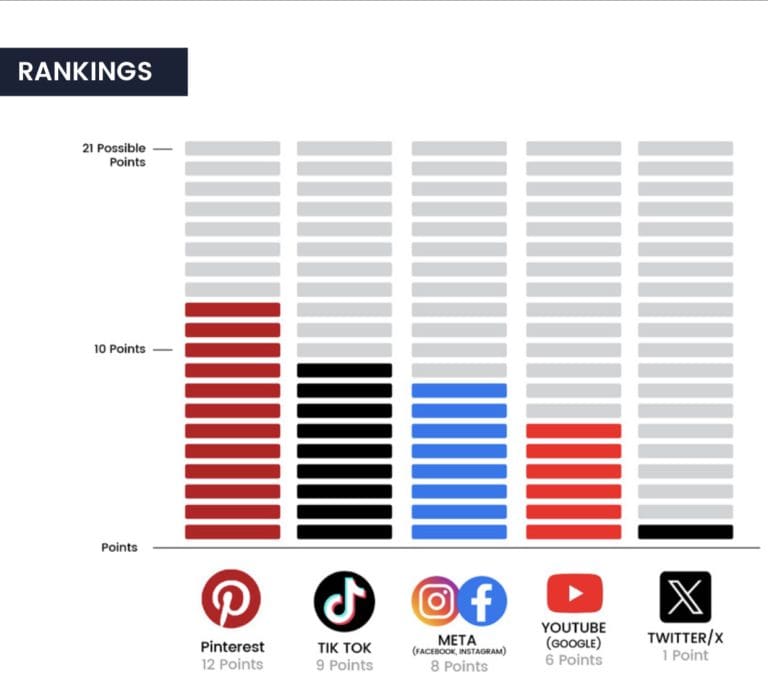
On the scorecard’s 21-point scale, X scored 1. The platform received its only point in the report for fulfilling one of the researchers’ requirements that platforms have an easily accessible and readable privacy policy. X was also the only platform that lacked a clear reporting process for flagging harmful or misleading content for higher review.

Pinterest scored the highest point on the scorecard (12 points). It was the only platform that had set out to define climate misinformation in detail in its community guidelines and the only one that releases an annual report on climate misinformation trends, the researchers said. Other platforms define misinformation in general, not specific to climate, they added.

It also got credit for banning the monetization of climate misinformation and for trying to protect the personal data of people who protest against fossil fuels. 

Pinterest was followed by TikTok at 9 points, Meta at 8 points and YouTube at 6 points respectively. The scorecard didn’t measure all apps that sometimes fall under the umbrella of social media, but the researchers said they’ve held meetings with other tech platforms not covered in the report, including LinkedIn and Wikipedia.

Claim that bank verification number expires after 10 years resurfaces online

0

A claim that the Bank Verification Number (BVN) issued to customers by banks in Nigeria expires after 10 years has resurfaced on social media.

The claim was contained in a video that was circulated in WhatsApp closed groups.

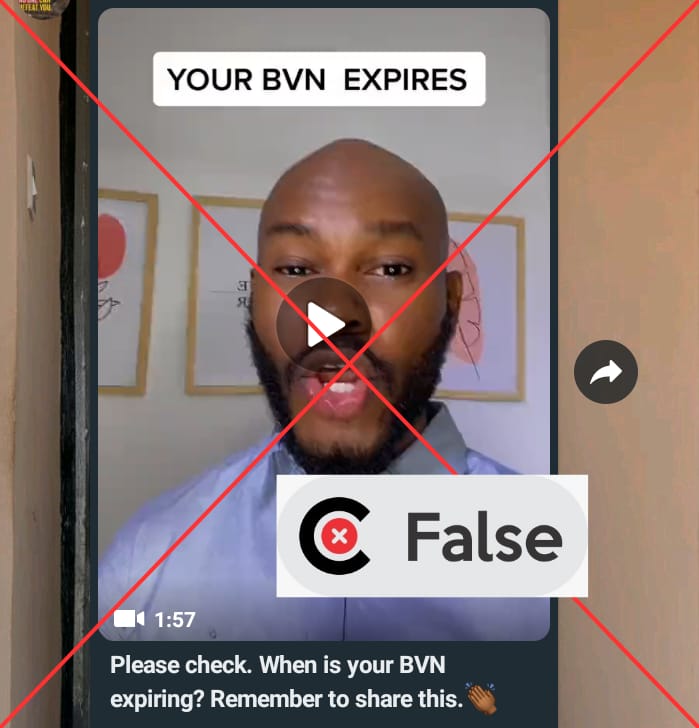
In the 1-minute, 57-second footage, an inscription with Your BVN Expires was shown at the beginning of the video alongside a man saying:

Today I am about sharing a secret in Nigerian Banking you do not know, and what is it? Drum rolls!!! Your BVN expires. Yes, are you aware that the BVN you have expires after 10 years? You can read it up on the CBN site, the BVN expires after 10 years and then you go back to re-enroll after 10 years…

He indicated in the footage that individuals should visit the website of the Central Bank of Nigeria (CBN).

He added that although individuals’ BVN does not change after re-enrolling, it was necessary as people’s details such as addresses, facial features etc. would have changed, noting that some people might have died which serves as Know Your Customer (KYC).

The bank verification number (BVN) is a biometric identification implemented by the CBN since 2015 to curb and reduce illegal banking activities in the country.

Screenshot of the video, Insert; false verdict
Screenshot of the video retrieved from a WhatsApp group. Insert: FALSE verdict.


CLAIM

The Bank Verification Number (BVN) issued by the Central Bank of Nigeria (CBN) expires after 10 years.


THE FINDINGS

Findings by the FactCheckHub show that the claim is FALSE.

A look at the green screen of the document posted at 00:18 seconds of the video showed that the document did not carry the logo or watermark of the apex bank. It only had ‘Bank Verification Number’ inscripted on it.

In May 2023, the apex bank issued a press release regarding the issue.

The statement signed by Isa Abdulmumin, the CBN spokesperson, read:

BVN Issued in Nigeria Has No Expiry Date – CBN
The attention of the Central Bank of Nigeria (CBN) has been drawn to reports suggesting
that the Bank Verification Number (BVN) issued by the Bank in collaboration with the Nigeria
Inter-Bank Settlement System (NIBSS) expires after a ten-year period.
Contrary to these claims, we wish to clarify that the BVN issued in Nigeria has no expiry date.
Once a customer’s biometrics have been captured and enrolled in the database of NIBSS,
the BVN remains for life. However, the Regulatory Framework for BVN issued by the CBN in
2021 stipulates that customers can only change their records due to certain conditions spelt
out in the document and after being cleared by relevant authorities.
Therefore, we urge bank customers, especially those whose biometrics have been captured
by the system, to continue using their unique identifiers as they last their entire lifetime.
Be guided accordingly.
Isa AbdulMumin PhD
Ag. Director, Corporate Communications

Further checks by the FactCheckHub show that this is not the first time the claim would be circulating online. Earlier this year, several credible media platforms including Channels TV and ThisDay had published news reports debunking the claim when it circulated then.


THE VERDICT

The claim that the  Bank Verification Number (BVN) issued by the Central Bank of Nigeria (CBN) expires after 10 years is FALSE; the CBN had earlier debunked the claim, saying the BVN issued in Nigeria is valid for lifetime.

Study exposes gaps in Meta’s policies against COVID-19 misinformation

0

A new research published on Science Advances has revealed that the COVID-19 vaccine misinformation policies of Facebook owned by Meta were not effective in reducing its spread on the platform.

The study titled the efficacy of Facebook’s vaccine misinformation policies and architecture during the COVID-19 pandemic” was published on September 15, 2023.

The study led by researchers at the George Washington University (GWU) in Washington, D.C. and Johns Hopkins University (JHU), Baltimore – both in the United States – revealed that Facebook’s efforts were undermined by the core design features of the platform itself. The research pointed out the need for the platform to focus on design and architecture.

The researchers include David A. Broniatowski (GWU), Joseph R. Simons (United States Department of Health and Human Services, Washington DC), Jiayan Gu (GWU), Amelia M. Jamison (JHU) and Lorien C. Abroms (GWU).

“Our results show that removing content or changing algorithms can be ineffective if it doesn’t change what the platform is designed to do – enabling community members to connect over common interests – in this case, vaccine hesitancy,” they said.

The research noted that misinformation on social media, particularly during a public health crisis like the COVID-19 pandemic, poses serious risks and fosters distrust in science. It added that it undermines public health efforts, and can even incite civil unrest. 

While attention is often placed on content and algorithms alone, the study argues that addressing misinformation requires a focus on design and architecture as well.

Despite Facebook’s efforts to remove anti-vaccine content during the pandemic, the study found that engagement with such content remained unchanged or even increased. 

In cases where content was not removed, the research shows that there was an uptick in links to off-platform, low-credibility sites and misinformation on alternative social media platforms, especially within anti-vaccine groups. This content became more misinformative, containing sensationalist false claims about vaccine side effects, it noted.

The study also highlighted “collateral damage” as pro-vaccine content may have been inadvertently removed, leading to increased political polarization around vaccine-related topics. Anti-vaccine content producers were found to be more effective at coordinating content delivery across Facebook.

The research compared Facebook’s architecture to a building, suggesting that the platform’s design inherently supports certain behaviours, making it challenging to balance public health and safety concerns. It emphasized the need to alter the platform’s architecture to address these issues effectively.

It proposed that social media platform designers collaborate to establish “building codes” informed by scientific evidence to reduce online harms. These codes would resemble the regulations governing building design, which prioritize public safety and well-being, and would involve partnerships between industry, government, and community organizations.

The study highlighted the importance of addressing platform design and architecture in combating misinformation on social media, particularly in critical public health contexts like the COVID-19 pandemic.

Did NBS say Kwara is the 3rd most expensive state to live in Nigeria?

0

ON Tuesday, September 19, a verified X user, MohdBashir Olanrewaju Abdulyekeen, with the handle: @Abdyekeen_Bash claimed that the National Bureau of Statistics (NBS) has ranked Kwara as the third most expensive state to live in Nigeria.

According to him, the NBS stated this in its latest Consumer Price Index report for the month of August 2023 which documents both food and all items inflation rates. 

His post read:

“Inflation rates serve as a vital economic barometer, offering insights into a nation’s economic health. However, these rates affect states differently within a country, reflecting varying economic conditions. Given their direct impact on the cost of living, it’s essential to identify which states in Nigeria are the most expensive to live in based on their current inflation rates.

“After providing a comprehensive overview, this ranking considers both August Food Inflation and All Items Inflation rates, as these indicators significantly influence daily life.

“Kwara State under the current administration of @RealAARahman. 

-Food Inflation: 35.3%

– All Items Inflation: 26.9%

“Kwara’s inflation rates position it as the third (3RD) most expensive state to reside in Nigeria, despite lacking the commercial status of Lagos.

“This high inflation rate has caused a serious economic meltdown where SMEs are unable to survive the harsh economic conditions as well as migration of the labor force from the State to other neighboring states which will further deplict or reduce the IGR drastically.

“Since the reelection of gov AA, he has left the business of governance to some very inexperienced few and then relocated to Abuja where he’s serving as the NGF chair.

“Everywhere in the world, we know that poor Economic decline resorts to insecurity and many societal vices, the reason innocent lives are being lost to cult clashes, kidnapping on the outskirts of the city and the state and banditry which are alien to our day-to-day activities in the state long before now. 

“If Gov @RealAARahman is unable to combine the role of a governor and that of NGF, I will advise he resign one for the other to improve our standard of living and economic lives as a people and a State.”

His claim is coming amidst hardship Nigerians are facing following the removal of petrol subsidy by the Nigerian president Bola Ahmed Tinubu, about four months ago. Tinubu later promised to ease the hardship in a national broadcast in July.


CLAIM

The National Bureau of Statistics ranked Kwara as the third most expensive state to live in Nigeria.


THE FINDINGS

Findings by The FactCheckHub show that the claim is MISLEADING. 

The Consumer Price Index (CPI) released by the National Bureau of Statistics shows that Nigeria’s headline inflation rate rose to 25.80 per cent in August 2023, an increase from 24.08 per cent recorded in July.

The report released on Friday, September 15, 2023, stated that the significant increase reflects the impact of the removal of petrol subsidies and the devaluation of the official exchange rate on consumer prices.

The food inflation rate rose to 29.34% in August 2023, representing a 2.35% point increase from 26.98% recorded in the previous month.

According to the report, in August, all items inflation rate on a year-on-year basis was highest in Kogi (31.50%), Lagos (29.17%), and Rivers (29.06%), while Sokoto (20.91%), Borno (21.77%) and Nasarawa (22.25%) recorded the slowest rise in headline inflation on a year-on-year basis. 

Food inflation on a year-on-year basis was highest in Kogi (38.84%), Lagos (36.04%), and Kwara (35.33%), while Sokoto (20.09%), Nasarawa (24.35%) and Jigawa (24.53%) recorded the slowest rise in food inflation on a year-on-year basis, according to the report. This means Kwara State is ranked among the top three in the food inflation rate.

However, a look at the report shows that the state is not among the top three states with the highest headline inflation rate.

For clarity, food inflation refers to the increase in the prices of food items over time. It is typically measured as a percentage change in the average prices of a basket of commonly consumed food products, such as grains, rice, fruits, and beans.

While headline/all items inflation is more encompassing. It measures the overall increase in prices for a basket of goods and services that an average consumer purchases.

It includes not only food items but also other goods and services like housing, transportation, healthcare, and more. Headline inflation is a key economic indicator that reflects the general trend in price changes in an economy.

The headline inflation rate provides a comprehensive view of the overall cost of living in a particular state or country. 

The report shows that while Kwara recorded food inflation of 35.33% food inflation rate, it recorded a 26.9% headline inflation rate making it the 10th state with the highest inflation rate across the country for the month of August 2023.  

A look at the report also shows that the NBS warned against using the report to make inter-state price comparison noting that the market baskets used to conduct the survey varies from state to state. 


THE VERDICT

The claim that the National Bureau of Statistics (NBS) ranked Kwara as the third most expensive state to live in Nigeria is MISLEADING; the report listed Kwara State as 10th among states with the highest headline inflation rate.