
Home Blog Page 97

How PEPT judgement, Niger and Gabon coups fuel misinformation on X

0

THE just concluded Nigeria’s presidential election petition tribunal (PEPT) alongside the coups in Niger and Gabon have attracted audiences from different parts of the world.

There have been a series of analyses on social media, especially on X (formerly Twitter), and a large number of these hot takes are often riddled with fake news and misinformation.

The FactCheckHub had earlier published a report on how ‘Blue Check’ verified accounts spread misinformation on the X app.

As the report stated, X had initially created its verification system to boost users’ confidence in the platform by placing a blue check-mark next to the names of public figures, companies, journalists, and organisations; but this changed after Elon Musk acquired the company.

Currently, the blue check-mark can be obtained by a Nigerian user by paying a monthly fee of $7.99. This move is part of Musk’s effort to increase the company’s revenue, which he acquired for $44 billion. However, the blue check-mark has become a tool for peddlers of misinformation to appear trustworthy and legitimate.

Most false information shared by the accounts bothered on the COVID-19 vaccine and the Russia-Ukraine war, among others. False information has now intensified and taken a new turn since Musk introduced ad revenue payment for subscribers of the ‘Blue Check’ mark.

The platform in August announced that users who subscribe to Twitter Blue can access new features and apply to enable subscriptions on their account and earn income directly on X by tapping on monetisation in settings to apply.

The recent feature helps creators get a share of Twitter’s revenue from the sponsored posts appearing under their tweets. It mainly allows verified creators to access a share of the revenue generated by advertisements displayed within the comments section of their posts.

The ICIR reported that while the exact methodology for calculating reimbursements and the portion retained by X remains unclear, it is a requirement for accounts to have accrued a minimum of 5 million impressions on their tweets within the preceding three months in order to qualify for participation. This criterion ensures that eligible creators have achieved a certain level of engagement and exposure before being able to participate in the revenue-sharing arrangement.

This has enabled creators to spread and amplify misinformation, disinformation and explicit content indiscriminately on the platform.

The coups in Niger and Gabon have been the focus of these fake news peddlers since July 2023. Some of them can be seen here, here and here (now archived here, here and here respectively). Several misleading posts were also spread about Nigeria’s presidential election petition court who delivered its final judgement on Wednesday, September 6, 2023, amongst others.

On August 21, 2023, an X user, @AjeboDanny, made a post on the app listing important things for users to know before they begin earning from X. In the post, he emphasized that quality engagements are what acquire users’ revenue payment. In his words:

‘If you’re looking to start earning from X, you should know a few things. A lot of things make up for your X Ad revenue, it’s not just by impressions as wildly misunderstood. Impressions are needed to be eligible but not for payouts So things like giveaways, rt4rt or follow trains might get you impressions but they won’t get you a revenue. Advertisers are not stupid lol Quality Engagements are what gets you revenue and by quality engagements i mean comments and replies to comments and also the quality of the commenters too.’

He added that spreading information disorder on the app won’t count as part of the revenue subscribers would get.

‘And You won’t get a revenue on a post by posting fake news, propaganda or nudity, gather all the impressions you want, that particular post is not going to count. So you can put on your clothes now dear because nothing for you.’

https://twitter.com/AjeboDanny/status/1693500455534424401?s=20

Silas Jonathan, a fact-checker and researcher at Dubawa stated that the Ads revenue payment for blue tick subscribers is an advantage for misinformation to thrive on the app.

“The advertisement payment for blue tick subscribers on the X platform can indeed contribute to information disorder on the platform. Firstly, the age-old tendency for falsehoods to garner more attention than the truth can influence these subscribers to share unverified information simply to acquire new followers or generate traction. With a price tag attached to gaining the most attention, almost anyone is willing to do whatever it takes,” he stated.

Jonathan added that information on X is now disseminated not based on the foundational concept of truth, but rather for monetary incentives and potential income.

“Given that visual content maintains consumer interest for extended periods, videos are given heightened importance in income generation. On X, these subscribers may share visuals that can harm individuals’ reputations. Recently, there has been an increase in the circulation of sexually explicit videos featuring well-known personalities. The motivation behind this remains consistent: sharing such content in pursuit of attention,” he added.

Ibrahim Alawode, another fact-checker with Twentyten Daily emphasized that since when payment for blue-tick ensued, the platform was no longer safe from misinformation.

“From the time the platform prioritized those who can pay for blue tick over the original verified tick it issued, it was obvious it’s no longer safe and will be an haven for misinformation. At the moment, people with large followership are interested in monetization of their account and will do anything to achieve that,” he told The FactCheckHub.


How misinformation post is determined by X

As part of its effort to address misinformation, X labels posts that are misleading to give readers a notice and/or share additional context with them. This is done and is subject to reduced visibility, and labels are visible in all X-supported languages.

Another effort is notifying readers when they try to share a post that was labelled for violating its policies, a prompt to help individuals find additional context and consider whether or not to amplify the post to followers.

There are also community notes where participants can write a note with additional information, to provide public context to the community on a post they feel is misleading; this is only available in limited testing to some people in the US.

Alawode stated that for the community notes to be effective, X would need to partner with fact-checkers and fact-checking organisations.

“Although X has an open algorithm called community notes which is meant to crawl the platform and gather potential fake news but the community notes have been heavily criticised by fact-checkers as a vehicle of fake news itself. For the community notes to work successfully, X (formerly Twitter) will need to work with independent media, fact-checkers and fact-checking organisations rather than ordinary registered users on the platform,” he added.

A check on the accounts that were mentioned earlier shows that their misinformation posts were not labelled for violating X policies and there was no prompt to stop readers from amplifying the post.

Also, contrary to what @AjeboDanny stated, Ads are posted in the comments section of these accounts that spread misinformation thereby making them eligible for Ads revenue payment.

Although the micro-blogging site has put a lot of checks in place, the revenue generating policy that rewards engagements is a major threat to the fight against fake news, misinformation and disinformation. It is also a major setback for all the work of several disinformation experts in the last half of the decade.

Did video show Naira Marley’s residence being set ablaze in Lagos?

0

A video showing a building engulfed in flames has surfaced online with a claim that it shows the residence of the Nigerian singer, Azeez Fashola, popularly called Naira Marley, being razed by irate youths in Ikorodu area of Lagos State.

The video is circulating following the death of singer Ilerioluwa Aloba, also known as Mohbad on Tuesday, September 12, 2023. 

Mohbad, who is a former Marlian records signee, died months after terminating his contract with the record label over constant attacks he allegedly received from Naira Marley and his gangs. 

Meanwhile, following his untimely death, some Nigerians have accused Naira Marley and his friend, Samson Erinfolami Balogun popularly known as Sam Larry, of playing a role in what led to his death. 

A verified  X user, Gowies (@Badgowies) posted the video with a caption that read: 

“Naira Marley house was set on fire.” 

The post has generated over 300 retweets and more than 1,000 likes as of September 17, 2023. 

Another X user, #DefendersFC (@IamWHYGeey) posted the video with another caption thus: 

“Naira Marley House In Lekki, Has Been Burnt, By Angry Ikorodu Boys, Over Mohbad Deaths.

Is it because, Naira Marley didnt attend, his funeral or what ? Haba.”

The post has garnered over 140,000 views as of September 17, 2023.


CLAIM

Video shows Naira Marley’s residence razed in Lagos.

Screenshot of one of the viral posts.


THE FINDINGS

Findings by The FactCheckHub show that the claim is MISLEADING.

Our researcher obtained the keyframes in the video using InVID, a video verification plug-in and subjected them to Google Reverse Image search. The result showed that the video does not depict an incident that occurred in Nigeria.

An earlier version of the video posted on YouTube by ABC 7 Chicago on March 7, 2023 shows that it depicts a fire incident in Chicago, United States. 

According to CBS News Chicago,  the incident shows a fire incident which led to the collapse of a two-and-a-half-story building in the 5100 block of South Union Avenue in Chicago.

A keyword online search via search engines revealed that the rumour that Naira Marley’s house was burnt was not reported by any credible media platform.


THE VERDICT

The claim that the video shows the residence of the Nigerian artist, Azeez Fashola, being razed by angry youths in Lagos is MISLEADING; as the video depicts an incident that happened earlier this year in Chicago, United States.

IFCN pauses acceptance of new signatories

0

THE International Fact-Checking Network (IFCN) has said it will pause its acceptance of new applications for fact-checking organisations seeking to become verified signatories to the network’s Code of Principles.

IFCN director, Angie Holan, disclosed this in a statement on Friday, September 15, 2023. The IFCN code of principles is a series of commitments to best practices that organisations abide by to promote excellence in fact-checking.

She said the decision was necessary due to influx of new applications from organisations seeking to become verified signatories and in order to ensure that applications already received would be tasked appropriately.

“In 2023, the IFCN received a record number of 61 new applications, 34 of which are still in process. To ensure that the IFCN maintains its standards, the IFCN announced today that it will pause its acceptance of new applications from Oct. 1, 2023, to Jan. 16, 2024. This will allow the IFCN to process in a timely manner the new applications it has already received. The IFCN will continue to process renewal applications from existing signatories during the pause,” she said.

The statement added that the applications are rigorously reviewed by independent assessors and approved by a board of advisors and signatories are to apply for renewal every year while adding that applicants go through a thorough screening process showing that they adhere to the IFCN’s Code of Principles’ five core goals which include:
a commitment to fairness and non-partisanship, a commitment to standards and transparency of sources, a commitment to transparency of funding and organization, a commitment to standards and transparency of methodology, and, a commitment to an open and honest corrections policy.

“The Code of Principles exemplifies what makes fact-checking distinctive. Fact-checkers have a heightened commitment to documenting sources and looking at all sides of issues. The code promotes fact-checking key practices, such as publishing source lists and offering hyperlinks to research and evidence. The mission of fact-checkers is not one of advocacy. The mission is to separate fact from fiction on the internet and in politics,” Holan stated.

How content creators use AI to misinform young children on YouTube – Report

0

YOUTUBE channels are using Artificial Intelligence to create misleading “scientific” videos that are recommended to children as educational content, an investigation by the BBC’s Global Disinformation Team has revealed.

The report uncovered more than 50 channels in over 20 languages spreading disinformation disguised as STEM (Science Technology Engineering Maths) content, including pseudo-science, false information, and conspiracy theories like electricity-producing pyramids, climate change denial, and alien existence.

According to the report, these channels manipulate legitimate content to create sensationalist videos with catchy titles and dramatic imagery to attract viewers and generate more Ad revenue while YouTube benefits from these high-performing videos by taking a portion of advertising revenue.

The report revealed that creators label their misleading videos as “educational content,” increasing the chances of them being recommended to children. 

The BBC’s Global Disinformation Team found these channels publishing content rapidly, suspected to be generated with AI programmes like Chat GPT, which can create new content instead of relying on existing examples. 

AI detection tools and expert analysis conducted by the researchers showed that most of these videos used AI to generate text and images, scrape information from websites, and manipulate real science videos, resulting in content that appears factual but is largely untrue.

Part of the report read, “To test this theory, they took videos from each channel and used AI detection tools and expert analysis to assess the probability or likelihood that the footage, narration and script were made using AI. 

“The BBC analysis showed that most of those videos had used AI to generate text and images, and to scrape – that is to extract information from a website, and manipulate material from real science videos. The result is content that looks factual, but is mostly untrue.

“To test whether the “bad science” videos would be recommended to children, the journalists created children’s accounts on the main YouTube site. (All the children they spoke to said they used children’s accounts rather than YouTube Kids.)

“After four days of watching legitimate science education videos, the BBC journalists were recommended the AI-made “bad science” videos too. If they clicked on them, more of the false-science channels were recommended.”

According to the report, when they shared this content with groups of 10-12-year-olds in the UK and Thailand, many children believed the false information until the journalists revealed that the videos were fake.

The report stated teachers have expressed concern that these videos take advantage of children’s curiosity and may confuse them about what is true while researchers express worry about children’s susceptibility to conspiratorial content, and YouTube’s role in profiting from misleading videos raises ethical questions.

The report questioned why YouTube recommends its YouTube Kids platform for those under 13, which claims to have higher-quality content while misleading videos continue to thrive on the main YouTube platform. 

The report warned that as AI tools continue to improve, identifying misleading content will become more challenging, urging teachers and parents to prepare for the growing impact of AI-generated content on children’s understanding.

How to protect yourself from online scams – Study

0

A study published by Social Catfish, an online dating investigation firm has provided tips on how people can protect themselves from online scams, especially those involving advanced technology like AI deepfake videos and voice cloning.

This follows the company’s revelation in its report titled State of Internet Scams 2023 which stated that America’s youths lost a record $210 million to online scams last year, up by 2,500% since 2017 – the largest increase of any age group.

The report outlines common online scam techniques, including phishing, botnets, VoIP, and malware. It also pointed out the growing threat of AI deepfake videos and voice cloning in scams.

These deceptive methods impersonate trusted individuals, like family members or CEOs, to solicit sensitive information, leading to financial loss or identity theft.


To avoid falling victim to such scams, the report provides the following tips:

1. Exercise caution with unsolicited requests, especially those requesting personal or financial information.

2. Be mindful of the personal information shared online, reducing the potential for scammers to exploit it.

3. Implement two-factor authentication (2FA) for added security on online accounts.

4. Stay informed about AI scam trends by following trustworthy cybersecurity sources.

5. Verify the authenticity of media content, cross-referencing with credible sources.

6. Report suspicious activities to relevant authorities to protect others from falling prey.

Furthermore, the report highlights five election-related scams, including phishing emails, fake fundraising campaigns, voter registration scams, disinformation campaigns, and robocalls. Each scam comes with avoidance strategies emphasizing verification and caution.

Five general tips to avoid online scams in 2023 are also provided:

1. Refrain from giving money to unfamiliar individuals.

2. Avoid sharing personal information with strangers.

3. Use reverse searches to verify the identities of online contacts.

4. Watch for red flags like poor grammar, reluctance to video chat, military or overseas claims, and requests for gift cards or cryptocurrency.

5. Enhance security by using a password manager to create unique passwords for online accounts.


The full report can be read here.

“We can’t do this alone”: Nigerian fact-checkers teamed up to debunk politicians’ false claims at this year’s election

0

Misinformation played a key role earlier this year during Nigeria’s 2023 general elections. The election cycle, held between February and March, ended with the victory of candidate Bola Ahmed Tinubu, who was inaugurated in May 2023.

In the run-up to the elections, activists and politicians used social media to disseminate misinformation to millions of followers. Photos, videos and text messages were doctored and shared massively on WhatsApp, and this became a conduit for false narratives and fake news.

Election cycles are always a tough period in Nigeria, and this one was made even tougher by the cacophony of the digital public sphere. But trolls and activists were not alone on the internet. Fact-checking teams across different newsrooms worked hard to debunk false claims and had a meaningful impact on public discourse.

These fact-checking teams worked with the Nigeria Fact-checkers’ Coalition (NFC), an alliance of 12 fact-checking news and research organisations, including CDD Fact-check, Dubawa, FactCheckHub, Cable Check, RoundCheck, Africa Check among others who verify statements from politicians and false narratives being shared online.

The coalition is not funded by any donor. However, three members (Africa Check, FactCheckHub and Dubawa) self-funded the activities and projects of the coalition.

I spoke to these five Nigerian fact-checking organisations to learn more about their strategy, their tactics and their work during the past election.


Fact-checking politicians

The Centre for Democracy and Development (CDD) Fact-check is an independent fact-checking operation run by the CDD West Africa, a nonprofit set up to provide democratic development in the region.

Mayowa Tijani, who led the fact-checking initiatives of the organisation, said they had between 12 to 20 journalists who worked round the clock during the election. He said the organisation had a partnership with media outlets who dedicated a number of journalists to assist in the fact-checking efforts.

The fact-checking project during the election was largely funded by the U.K’s Foreign, Commonwealth and Development Office.

Tijani said CDD had a “multi-pronged approach” to tackling misinformation. Before the election, the organisation set up a social media war room. “We prepared pre-bunks which we called ‘Fact Shields.’ They were basically explainers of issues that we thought could be soft spots for disinformation peddlers,” he says.

During the election, they published daily fact-checks on controversial claims by politicians and their handlers. “We were not only debunking claims,” Tijani says. “We were also flagging bad actors with social media platforms and providing context where necessary. Now that the election has passed, we are sharing what we’ve learnt with others so our processes get better ahead of future elections.”

Did CDD’s have a meaningful impact? Tijani thinks it did. “Candidates could not just get away with misinformation,” he says. “They became quite cautious about what to say and about the negative impact of being called out for a misleading statement.”

Over the election period, CDD’s posts got more than five million views on Twitter and created a community who looked to them for clarification on any controversial statement. “We were constantly being asked online and offline to check claims,” Tijani says. A more informed electorate was a big win for us.”

“Fighting misinformation is not a job for one organisation. We can’t do it alone,” Tijani says of the work of the coalition during the election.

He thinks fact-checkers have managed to “line politicians up in front of a mirror of truth, showing how false some of their claims have been.” Has this changed anything? Tijani thinks so. “Our work has helped improve the information ecosystem,” he says. “Politicians are now aware that journalists will always check what they say.”


Verifying information in real time

The FactCheckHub is an independent fact-checking initiative established by the International Centre for Investigative Reporting (ICIR) in 2020. Before the election, its team of fact-checkers embarked on a major social listening exercise for over a year. They wanted to know how accurate were the statements of all political players across the country, says Opeyemi Kehinde, editor of the hub.

As a member of the fact-checking coalition, Kehinde said that the Hub worked with other members of the coalition to produce live-checks on what was happening during the voting process. Live-checks, Kehinde explains, is fact-checking on the spot immediately a false claim was made, for example. This was mostly used during the election debates and town halls to debunk false claims made by politicians.

As part of the Nigerian coalition and as a member of the International Fact-Checking Network (IFCN), the FactCheckHub was able “to launch a much broader approach to tackling misinformation and disinformation,” Kehinde says. They independently fact-checked many of the people involved in Nigeria’s electoral process.

“Nigerians were faced with the threat of misinformation. Even presidential candidates shared false narratives and statements,” says Kehinde, who thinks their fact-check reports helped hold politicians to account during the campaign.

Kehinde gives a couple of examples. “In reaction to our multiple fact-checks on him, Peter Obi, one of the leading presidential candidates, had to recant some of the facts and figures he had shared,” he says. “We also fact-checked [winning candidate] Bola Tinubu, who had claimed that voter cards had expiration dates. He only rectified after we published a report debunking his claim.”

The hub debunked a false claim about a statement attributed to the European Union delegation and the election observation mission to Nigeria. This false statement called on the electoral chairman, Mahmood Yakubu ,to step down and initiate a review of the results. The claim also called for the disqualification of president-elect Tinubu after he was declared the winner.


Why local languages matter

The Cable Check is the fact-checking project of The Cable, one of the leading Nigerian newspapers. The initiative is led by editor Lanre Olagunju and is staffed by eight full-time journalists.

“Before the campaign, we monitored political conversations on television and town halls to identify any misleading claims,” Olagunju says. Then they produced fact-checks and translated them into Nigeria’s three main dominant local languages – Yoruba, Igbo, Hausa and pidgin English to reach audiences on their own terms. Fact-checks were also published in voice-over versions, so they could be listened to.

Olagunju and his team partnered with radio stations so that fact-check reports could be aired regularly. “These strategies are very important because fact-checks are always playing catch-up with fake news,” he says.

In a couple of cases, Olagunju says, fact-check reports from Cable Check were used to “present empirical factual evidence to politicians and their spokespersons.”

One of the most notable things of this year’s election, Olagunju says, was the sophistication of the digital tools used to mislead voters. He is concerned that the days ahead might reveal advanced weaponisation of digital tools to amplify disinformation, especially with the advent of artificial intelligence (AI).

“Fact-checkers should be better equipped with modern digital tools for investigations, to fight the scourge of fake news in the days to come,” he says.


Investigating misleading accounts

Dubawa is one of the leading fact-checking organisations in Nigeria. Its editor Kemi Busari explains he and his colleagues looked out for social media accounts which were persistently spreading misinformation around the election. Busari worked with 10 journalists during the election project.

They designed what they call a “Caution Card,” a social card with information about the accounts spreading falsehoods and alerting audiences they should beware of such accounts. “We also tried to put out some explainers and media literacy articles which helped to keep the public informed,” he says.

Busari said they received a lot of positive reviews from members of the public on the impact of their work during the election.

“We opened up our channels widely so people could send us tips and claims to debunk on WhatsApp, Twitter or Instagram. Some reached out to us to fact-check an issue they saw trending on social media and we did that,” he says.

Busari says politicians are now weaponising false information. “They craft falsehoods and then pay some of their supporters to spread them on social media and use them as a tool they use against their opponents.”

Adesola Ikulajo agrees with Busari. As the managing editor at RoundCheck, a fact-checking platform which focuses on reaching young audiences, he noticed politicians were the main source of misinformation during the election period.

“Thanks to the work of fact-checkers, audiences can decipher that most of what the politicians post is untrue,” Ikulajo says. “Some have been forced to recant false information they put out there. The problem is that they cherish all the engagement they get from social media more than the pressure from the information ecosystem.”

*This article was originally published by the Reuters Institute for the Study of Journalism here.

ICIR seeks applications for its Countering Misinformation, Promoting Media Literacy project

0

THE International Centre for Investigative Reporting (The ICIR) welcomes applications from journalists for its ‘Countering Misinformation and Promoting Media Literacy in Nigeria Project.’

The Countering Misinformation and Promoting Media Literacy project aims to reduce the dissemination and impact of misinformation in Nigeria by promoting media literacy and responsible information sharing among citizens, a statement by Bamas Victoria, The ICIR editor said.

The ICIR is an independent, non–profit media organisation committed to promoting good governance in Nigeria through robust investigative and data-driven reporting. It aims to build a culture of watchdog reporting for the media in Nigeria.

In the last five years, the Centre has worked to develop the capacity of journalists to undertake investigative and data-driven reporting, thus strengthening accountability and engendering effective service delivery for the welfare of the citizens, particularly at the sub-regional level, she stated.

Bamas noted that the project will be executed by The ICIR’s verification platform, the FactCheckHub, which was established in 2020.  “The FactCheckHub, which aims to enhance its capacity, visibility, operations and impact in Nigeria and Africa, has established itself as one of the country’s most reliable verification platforms.”

She added that the Countering Misinformation and Promoting Media Literacy project is supported by the Embassy of the Federal Republic of Germany, Abuja.

“For this training, The ICIR will select 30 journalists from different media organizations in Nigeria. The application opens on Tuesday, September 12 and ends on Friday, September 22, 2023.

“The training will build capacity and provide financial support for selected journalists to provide critical fact-check content, leading to responsible journalism and higher information quality in Nigeria.

“Candidates with at least two years of experience practising as print, electronic and online media journalists can apply. Freelancers with a track record of critical fact-checking skills are also welcome.

“Intending participants must provide proof of previous fact-checking content published in the last 12 months.

“Being a gender-inclusive organization, the Centre strongly encourages qualified female journalists to apply,” Bamas.

Interested candidates can apply for this project here.

No! Photos do not show Borno lawmaker sharing shoe kits to youths

0

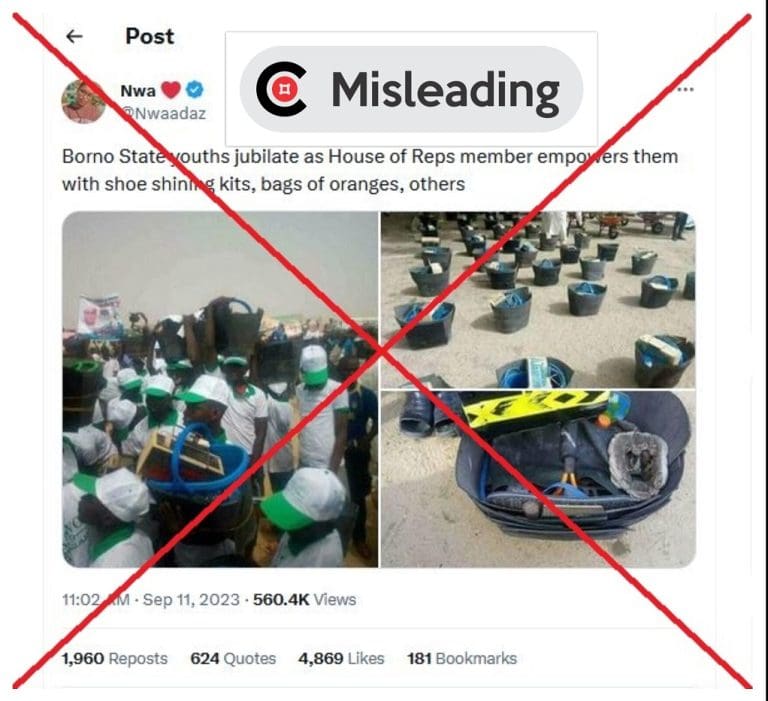
A photo collage showing some young men in similar polo shirts and shoe-shining kits have resurfaced online with a claim that a Nigerian lawmaker distributed the kits to the youths in Borno state recently.

The claim is being shared to emphasize the reported widespread poverty in the northern part of the country. 

A verified X (formerly Twitter) user, @Nwaadaz, posted the claim with a caption that read: 

“Borno State youths jubilate as House of Reps member empowers them with shoe shining kits, bags of oranges, others.” 

The post has garnered about 2,000 reposts and almost 5,000 likes as of September 12, 2023.

Another verified X user, @LawrenceOkoroPG, posted a similar claim with a caption thus:

“House of Reps member in Borno State just did entrepreneurship empowerment for the Borno Youths with Shoe Shining Kits. Borno Youths are really lucky.”

The post has garnered over 200 reposts and more than 500 likes as of September 12, 2023.

It will be recalled that Nigerians face more hardship in recent times following the removal of the petrol subsidy, even as the President Bola Ahmed Tinubu-led administration later promised to ease the hardship in a national broadcast in July.


CLAIM 

Photo collage shows Borno’s House of Representatives member sharing shoe-shining kits to youths in the state recently. 


THE FINDINGS

Findings by The FactCheckHub show that the claim is MISLEADING.

A Google Reverse Image search shows that the images in the photo collage have been online since 2018. An earlier version of the images can be found here. 

Premium Times had in 2018 reported that a former Commissioner for Education in Borno State (not a lawmaker), Usman Jaha, was criticised for distributing shoe-shining kits to youths in Gwoza as an empowerment programme.

The Commissioner, while responding to the criticism, explained that the programme represents his personal commitment tailored to address the specific requirements of Gwoza residents.


THE VERDICT 

The claim that the photo collage shows Borno’s House of Representatives member sharing shoe-shining kits to youths in the state recently is MISLEADING; the photos have been online since 2018 while the empowerment was facilitated by a commissioner in the state, not a lawmaker.

Claim that PEPC judges have been flown to Paris ‘to pick up bribe’ is UNPROVEN!

0

A verified X user, Jackson Ude (@jacksonpbn), has claimed that all the five judges of Nigeria’s Court of Appeal that participated at the Presidential Election Petition Court (PEPC) on Wednesday, September 6, 2023, have been flown to Paris, France allegedly ‘to pick up bribe.’

The claim was shared following the judgement delivered by the PEPC after several months of sitting of the Presidential Election Petition Tribunal (PEPT) in Abuja.

The two major contenders in the February 25, 2023 Presidential Election in the nation, Peter Obi of the Labour Party (LP) and Atiku Abubakar of the Peoples Democratic Party (PDP) had challenged the election results which saw Bola Ahmed Tinubu of the All Progressives Congress (APC) emerged winner of the election.

The PEPC had ruled that the petitions filed by Atiku and Obi and their parties have no merit and unanimously upheld Tinubu’s victory at the election.

However, Ude had on September 7, 2023 posted the claim with a caption that reads: 

“ALL PEPT JUDGES NOW IN PARIS TO PICK UP BRIBE MONEY 

All the five Justices of the Presidential Elections Petition Tribunal who affirmed the INEC selection of Bola Tinubu as President were immediately flown out of Nigeria via a Private Jet yesterday for Paris, France. The Judges, Haruna Tsammani, Stephen Adah, Misitura Bolaji-Yusuf, Boloukuoromo Ugoh, Abba Mohammed, are all in Paris to pick up their bribe money, a Judge who does not want to be named told me. 

The rogue Judges were promised $5million each while Haruna Tsammani who is the head of the panel gets $7million, according to the informant.” 

The post has garnered more than 160,000 views ,over 1,500 reposts and almost 2,000 likes as of Sunday, September 10, 2023. 


CLAIM 

Five judges of the PEPC that affirmed Tinubu’s victory at the presidential election have been flown to Paris ‘to pick up bribe’.

THE FINDINGS

Findings by The FactCheckHub show that the claim is UNPROVEN.

On Wednesday, the five-member panel took turns to dismiss the petitions filed by Atiku, Obi and the Allied Peoples Movement (APM) against the declaration of Bola Ahmed Tinubu as the winner of the presidential election, as announced by the Independent National Electoral Commission (INEC) on March 1, 2023.

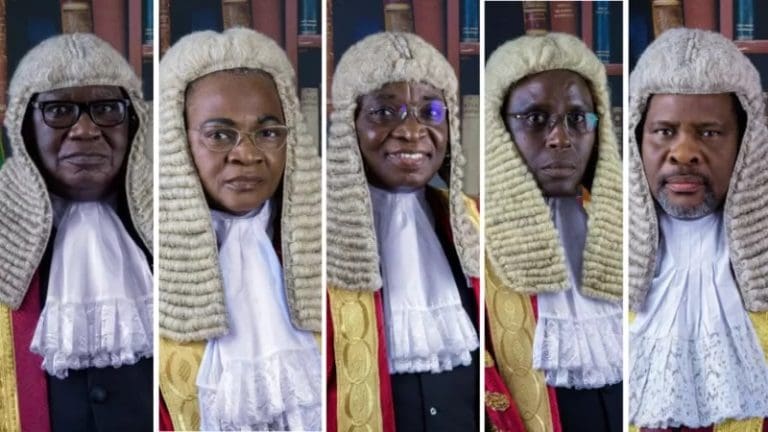
The judgement was delivered by the Chairman of the PEPC, Haruna Tsammani, assisted by other members of the panel, namely: Justices Stephen Adah, Monsurat Bolaji-Yusuf, Moses Ugo and Abba Mohammed.

Analysis of Jackson Ude’s X account shows that the user who is a Labour Party supporter has been posting unverified information to discredit the Nigerian judiciary and judges handling the presidential petition before and after the judgement.

Checks show that the X user did not attach any photograph or any other multimedia evidence to back up his claim, neither did he state the source of its information. 

The FactCheckHub found out that the news was not reported by any credible media platform in the country, as at the time of filing this report.

Although the Federal High Court had in June 2023 announced its annual judges’ vacation period which runs from from 24 July to 15 September 2023, there is no media report concerning vacation for Court of Appeal judges.

When contacted, the chief registrar of the Court of Appeal in Abuja, Umar M. Bangari Esq., debunked the viral claim, describing it as baseless and childish.

He questioned the assumption that judges would collect bribes during their vacation, pointing out that it’s in their normal schedule to embark on vacations just like the way senators also go on vacation without such accusations.

“You know we are in the era of social media. But all of us are educated. Let me deny this as I speak to you. But you know the court of appeal is on vacation now, what if any of the panel or all of them decides that they are going on vacation? Does it mean they are going to collect bribes? 

“All the senators and house of representatives members that have gone on vacation, where did they go and collect their own bribes? Why do we behave as if judges are in the moon unlike the rest of us? If after Wednesday, they decided to go on vacation, are they not going to go because someone will say they want to collect bribes? Even if they want to collect a bribe, must they go out (outside country) to collect it?” Bangari told The FactCheckHub.

He said the false allegations are being peddled by people who were heartbroken by the judgement of the court to discredit the Nigerian judiciary and judges.

It will be recalled that this is not the first time fake news merchants have targeted the Nigerian judiciary over the election petitions.

The BBC News Pidgin had also on September 6, 2023 reported about several misinformation targeted at the PEPC judges.

Also, The FactCheckHub cannot independently verify the allegation that they went ‘to pick up bribe’.


THE VERDICT

The claim that the five judges of the PEPC that affirmed Tinubu’s victory at the presidential election have been flown to Paris ‘to pick up bribe’ is UNPROVEN; As at the time of filing this report, neither the judges’ whereabouts after September 6 could be independently verified, nor the allegation that they went ‘to pick up bribe’.

Advanced search tips made easy

0

IN order to verify an article, image, video, document or a social media post, searching for proof on the internet might be long, tiring, frustrating, and difficult.

Using keyword searches might not be so effective in some situations, which is why there are advanced search tools to aid your research.

Knowing how to use advanced search might look difficult, but with the help of these tips, you are one click away from verifying an article or finding a document you need for your research.

You can easily access Google advanced search tools on the settings icon in the web page when you log into the Chrome app or browser. Other websites and social media apps also employ advanced search tools but the tips might slightly differ.

Tips on using advanced search tools

1. Advanced search tips for websites and files using Operators

A major tool for advanced search is Operators. A search operator (sometimes referred to as a search parameter), according to TechTarget.com, is a character or string of characters used in a search engine query to narrow the focus of the search. Thus, operators are special commands and characters that filter search results.

Operators are used when conducting Boolean searches. There are times when conducting searches that you tend to get too many results, and there are times you get few or no results. The aim of operators is to filter the results you would like to get. Some examples of operators are AND, NOT, OR, etc. and they must be written in capital letters when using the for search.

Narrowing Searches: To narrow your searches, it is essential to use the AND or NOT operator. ‘Nigeria AND Ghana’ would give you search results or articles that have to do with both countries. If you do not wish to see a certain item, you can use the NOT operator, e.g. ‘Nigeria AND Ghana NOT Accra’ would provide you with search results of Nigeria and Ghana without the city Accra.

Broadening Searches: To widen your search results, you should use the OR operator. ‘Nigeria OR Ghana’ would give you results that contain any or both of the countries.

Proximity Searches: This allows you to get specific results pertaining to your search. It uses closely related search terms. Proximity searches use the NEAR operator. It requires that a result has close terms in the text, making it more likely that there is a meaningful link between the terms in the record. To search for white dresses, you should use White NEAR dresses.

Truncation: This allows you to search for modifications of a word or text without having to specify them all in your search string. It is handy to take note of singular and plural forms of a noun. Typing  ‘dress*’ would give you results of dress and dresses.

Wildcard: Wildcards are synonymous with truncation but instead of the variation coming at the end of the word, it allows for variation of a character in the middle of a word. This comes handy when taking into account variations in spelling. For example, many words can be spelt with an s or a z, e.g. mobilise/mobilize. Mobili*e

In some cases, it tells the search engine that there is an unknown text. For instance, searching with these keywords e.g. ‘saint*churches’ Ilorin would provide you with results of churches with names that starts with saint in Ilorin.


2. Advanced search tips for websites and files using Symbols and  Keywords

Another advanced search tip is by using symbols such as two dots (..) and other keywords.

Two dots: This is used to search for a range of numbers. To search for victims of religious intolerance from 2020 to 2023, type ‘victims religious intolerance 2020..2023‘ into your device’s web browser.

To search a website for mentions of a particular word, typing site:factcheckhub.com palliatives would search for the mentions of palliatives on The FactCheckHub website.

To search for files or documents on the FactCheckHub website, typing site: factcheckhub.com filetype:pdf would crawl The FactCheckHub website for PDF files.

Similarly, typing related: factcheckhub.com covid-19 would provide you with search results of contents that are related to Covid-19 which have been published on The FactCheckHub website.


3. Advanced search tips for images using filters

While searching for images, most search engines populate the results with Ads in the first row, with rows and rows of images and then links back to their respective websites instead of giving you an image you can easily download at a first glance.

Search the web. Photo Credits: HackerNoon.com

Applying advanced search tips when searching for images online can provide you with more refined results if you use the right filters as explained below:

Size & Aspect Ratio: This will help you find images by their size or dimensions by giving you the options to choose from large, medium, small, or an icon. It also helps to quickly locate an image based on the specific size you want. The aspect ratio helps you find images that have a specific shape; for example, tall, square, wide, or panoramic.

Colour: This allows you to find coloured, black and white, sketches or transparent images. It also help you search for images with a specific color such as blue, red, yellow, etc.

In essence, this can help to easily narrow down an image search to pick up on any certain tones or colours you pefer. e.g. If you need a photo of room with yellow or red ambience, you can easily get it using the search filter.

Usage Rights: When you do a search, you can filter your results to find images that offer licenses for reuse.  They are mostly labelled with how they should be used such as labelled for reuse with modification, labelled for reuse, labelled for non-commercial reuse with modification, or labelled for non-commercial reuse.

This is helpful in order to easily identify which images are available for reuse and which ones are not.

Time:  This will help show you when the image was released or published online, for instance in the past 24 hours, past week, past month or year. It is useful to secure recent photos that may be applicable, depending on what you are searching for.

Other search filters include:

Region: This will help you find a particular region where a photo was taken.

Safesearch: This will help you remove explicit and/or block inappropriate contents.

Image type: This include if it is a line drawing, clip art, Giphy etc. It helps to easily locate images based on animation or illustration type.


4. Advanced search tips for videos using filters

Just like images, there are advance search tips for videos as well using the right search filters. Below are some of them:

Language: This gives you the option of searching for a specific video in a particular language.

Duration: This allows you to search for videos based on its length or duration, such as finding videos that are within the range of seconds, minutes or hours.

Date: This filter is similar to the time filter used in advanced image search. It comes handy in finding videos posted or updated within a certain period of time, like within the past hour, day, week, month, or year.

Quality: This allows you to limit your search results to the quality of videos you would like to get in order to maximise or save your data use. It helps you limit your search results to Higher Definition (HD) or Standard Definition videos.

Site or domain: This helps you search one site for your videos, e.g youtube.com or helps to limit your results to a particular domain such as .gov, .edu, or .com.

Subtitles: It helps you find videos with translation or closed captions.

Another search filter is also safesearch, as explained above.

When conducting an advanced search for videos, it is advisable to use Google or other search engines as this provides you with varieties of videos unlike YouTube that only provide you with its related contents only.

These advanced search tips can also be used on any web browser or social media apps. All you need to do is just read the help section to be familiar with the kind of operators, terms or symbols the sites use.