Please note that the FactCheckHub has not obtained any right from the authors or copyright owners of all third-party contents from embedded links and shall incur no liability in this regard.
Please note that the FactCheckHub has not obtained any right from the authors or copyright owners of all third-party contents from embedded links and shall incur no liability in this regard.
Please note that the FactCheckHub has not obtained any right from the authors or copyright owners of all third-party contents from embedded links and shall incur no liability in this regard.
Please note that the FactCheckHub has not obtained any right from the authors or copyright owners of all third-party contents from embedded links and shall incur no liability in this regard.
STAKEHOLDERS in Ghana’s media sector have deliberated on a comprehensive National Action Plan to tackle the rising challenge of misinformation and disinformation in the country.
The initiative follows a National Conference on Disinformation and Misinformation, where a seven-point communiqué was collectively agreed upon by political parties, Civil Society Organisations (CSOs), media representatives, and development partners.
The company conference was organized by Ministry of Information in Accra on Thursday, December 21, 2023.
The forum featured participation from media umbrella bodies such as Ghana Independent Broadcasters Association (GIBA), Ghana Journalists Association (GJA), Private Newspapers and Online News Publishers Association of Ghana (PRINPAG), and the National Media Commission (NMC).
The National Action Plan aims to safeguard the integrity of information, promote media literacy, and cultivate a culture of responsible digital citizenship.
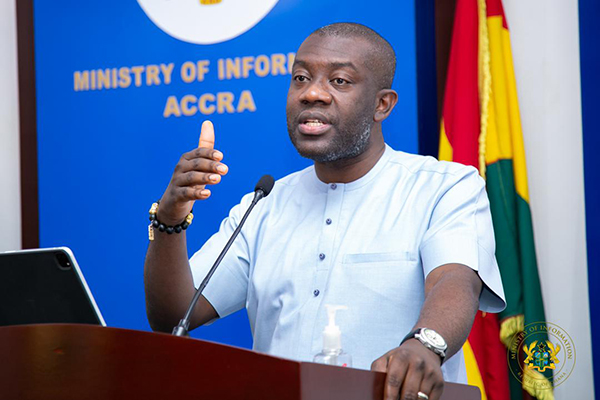
Ghanaian minister for Information, Kojo Oppong Nkrumah, who opened the ceremony emphasized the urgency of addressing the proliferation of false information in the media space.
He highlighted the exponential growth in media channels across the country and the need to put in measures to address the rising tide of mis/disinformation.
“With the advancement of media, now there’s a multiplicity of channels all over the country, and we’re very proud of that. About 700 radio stations have authorization to operate in the country, 100s of TV channels, last count was about over 200 of them and 1,000s of publications both online and print, and then new media platforms.
“So the question is where is the editor or editorial board? The risk, therefore, is that information that lacks integrity finds itself in the public domain, and that’s what gives rise to mis/disinformation,” Nkrumah said.
The minister called for a collective commitment to addressing the challenges posed by misinformation and disinformation, emphasizing the importance of the National Action Plan in safeguarding public trust and maintaining the integrity of information in Ghana’s evolving media environment.
The plan when finalized will help the country make a significant step forward against the adverse effects of misinformation in the West African nation.
A new study published by Nature has highlighted how search engines play a key role in the amplification and belief of misinformation while seeking to address the gap.
The authors note that while many media literacy interventions encourage people to use search engines to check news, there is little evidence to support the effectiveness of this approach in lowering belief in false information.
Since most internet users report using search engines instead of traditional news sources to learn about politics and form opinions about current affairs, it is imperative to determine whether and to what extent utilizing search engines lessens belief in misinformation and disinformation.
Across some experiments, the researchers find that for most users, online search to evaluate the truthfulness of false news articles actually increases the probability of believing them.
In the first experiment, participants were asked to rate the veracity of three news pieces in a randomized control trial to examine the impact of using search to assess news on belief in false information.
While participants in the control group were instructed not to use search engines, those in the treatment group were encouraged to do so in order to aid in their evaluations.
The results defy expectations by demonstrating that those who were encouraged to conduct online searches were more likely to consider a fake or misleading story to be accurate.
The researchers asked the same group of individuals to compare news stories found online and those found elsewhere. The results showed that, after being prompted to search online, 17.6 per cent changed their evaluation to true (for comparison, among those who initially incorrectly rated the article as true; only 5.8 per cent changed their evaluation to false/misleading).
This result contradicts the notion that consumers hold inflexible beliefs that are unalterable. Instead, it appears that assessing fake news with internet search engines can “falsely raise confidence in its veracity.”
The study added that it is also likely that search engines will eventually offer more reliable sources of information because false information spread quickly, even weeks after it was first published.
When asked to re-evaluate the article after treatment, even months after it was published, 18 per cent of respondents rated the same false/misleading story as true, according to the researchers who used a longer time-frame (3-6 months after initial publication) to test the robustness of these findings.
The authors attribute their findings to the concept of a data void, or informational spaces in which there is corroborating evidence from low-quality sources. Search engines frequently provide fewer reliable results when consumers use them to attempt and assess if a news piece is real or false, especially in the wake of breaking news events.
Data voids frequently occur as a result of search engine optimization (SEO) tactics used by low-quality news publishers, who push readers to use specific search queries when searching online by consistently using distinct phrases in their stories which might result in a loop of propaganda feedback.
Through all of these tests, the researchers present strong evidence that dispelling false information is not always possible with ‘doing your own research.’ Just as social media platforms may mislead consumers, so too can online search engines. This tendency may be exacerbated by data voids, which can obscure reliable information beneath a deluge of inaccurate information.
This increases the difficulty of determining the truth and necessitates regular quality checks from search engines, which put up barriers to keep bad news from rising to the top of the results page.
The researchers believe that Google’s strategy of displaying warning indicators when a search query returns no credible results is a positive first step. Search engines need to take extra steps to make sure they are not adding to the issue of people believing things that aren’t true.
ON November 16, 2023, the Spokesperson of Nigeria’s ministry of Foreign Affairs, Francisca K. Omayuli, signed a Press Release posted on X (formerly Twitter) by the Presidency with a claim that Nigeria has not signed the Samoa Agreement.
The release reads: “The attention of the Federal Government of Nigeria has been drawn to diverse pronouncements and publications on the implication of Nigeria signing the New Partnership Agreement, known as the Samoa Agreement, between the Member States of the Organisation of Africa, Caribbean and Pacific States (OACPS) and the European Union (EU).
“The general public is invited to note that Nigeria was not represented at the Signing Ceremony, which took place in Samoa on Wednesday, 15 November 2023 and hence has not signed the Agreement.”
The X post by the Nigerian Presidency has garnered over 50,000 views and over 200 reposts since it was published on the social media app over a month ago.
CLAIM
Nigeria has not signed the EU-ACP agreement.
THE FINDINGS
A release published on the European Union’s website stated that the EU and its member states have signed the new Partnership Agreement with some Member States of the Organisation of Africa, Caribbean and Pacific States (OACPS).
But before and after the reported ceremony, many Nigerians on the internet have raised eyebrow and questioned the rationale behind Nigeria allegedly endorsing the new Agreement.
An X user, @HbonesMedia, who tweeted about it stated: “It’s a no brainer! Nigeria can NOT sign this document on Nov 15 promoting LGBTQ as planned…”
However, the argument among the populace is that if the nation signs the Samoa agreement, it is going to contravene Nigeria’s domestic legislation that prohibits LGBTQ activities in the country.
To verify the claims and counter-claims, this reporter sent an email to Maria Ruiz-Nievas, the Press Officer of the EU Council, requesting the list of all the countries that have signed the agreement.
In an email response, Ruiz-Nievas shared a list of 43 countries tagged “the list of signatory countries” with this reporter. A look at the list shows that Nigeria is not included.
The listed signatories include: The Republic Of Angola, Barbados, Belize, Burkina Faso, The Republic Of Cabo Verde, The Republic Of Cameroon, The Republic Of Chad, The Union Of The Comoros, The Republic Of The Congo, The Cook Islands, The Republic Of Côte d’Ivoire, The Democratic Republic Of The Congo, The Republic Of Djibouti, The Dominican Republic, The Federal Democratic Republic Of Ethiopia, The Republic Of Fiji, The Gabonese Republic, The Republic Of The Gambia, The Republic Of Ghana, The Republic Of Guinea, The Republic Of Haiti, The Republic Of Kenya, The Republic Of Kiribati, The Kingdom Of Lesotho, The Republic Of The Marshall Islands, and The Republic Of Mauritius.
Others are: The Federated States Of Micronesia, The Republic Of Mozambique, Niue, The Independent State Of Papua New Guinea, Saint Vincent And The Grenadines, The Independent State Of Samoa, The Democratic Republic Of Sāo Tomé And Príncipe, The Republic Of Seychelles, The Republic Of Sierra Leone, Solomon Islands, The Republic Of The Sudan, The Republic Of Suriname, The Democratic Republic Of Timor-Leste, The Togolese Republic, The Republic Of Vanuatu, The Republic Of Zambia, The Republic Of Zimbabwe.
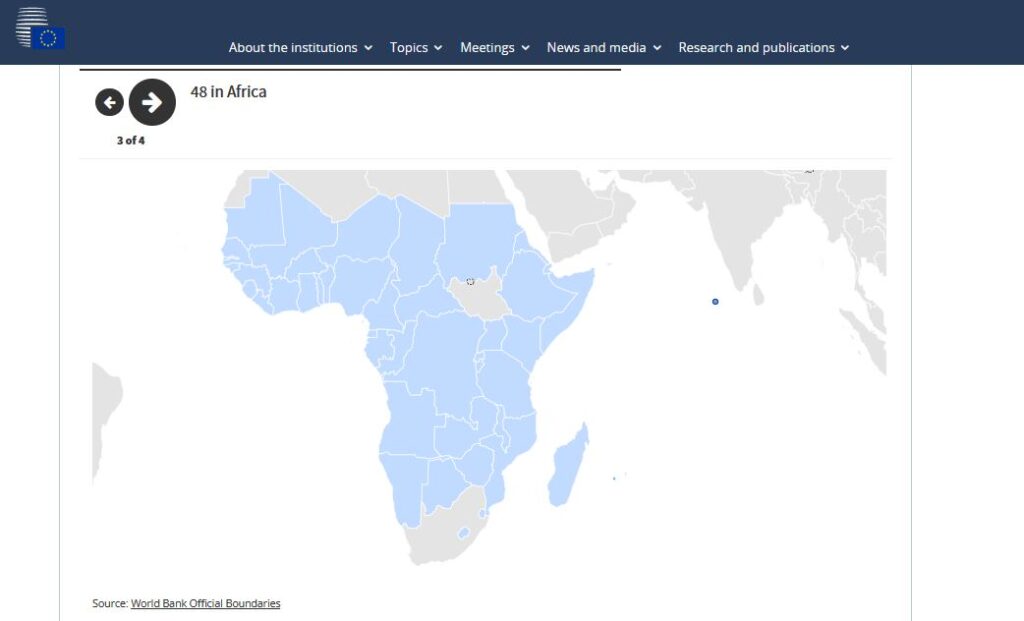
Meanwhile, on the EU Council’s website and the agreement document, Nigeria was found to be among the countries (OACPS member-states) expected to sign the Samoa Agreement, according to an infographic on the EU website.
An infographic showing 48 African countries who are expected to be part of the Samoa agreement.
EU-ACP: What got people talking?
Beyond Nigeria signing the EU-ACP Agreement, the major controversy was drawn from the four hundred and two paged document of the Partnership Agreement. On the document, there are different articles that highlight each focus of the agreement that will serve for the next twelve years. But on November 13, 2023, Civil Society Organizations (CSOs) however advised Nigeria against signing it, saying it is deceptive.
According to the EU Council, the EU-OACPS Partnership Agreement will serve as the new legal framework for EU relations with 79 countries – 48 African, 16 Caribbean and 15 Pacific countries. The agreement was designed to cover around 2 billion people with some of the key areas on democracy and human rights, sustainable economic growth and development, climate change, human and social development.
The EU release stated that the provisional application of the Agreement will start on 1 January 2024, noting that the Agreement will enter into force upon consent by the European Parliament and ratification by the Parties, i.e. all EU Member States and at least two thirds of the OACPS Members.
However, when a video, where CSOs and Human Rights Organizations openly criticized the agreement, appeared on the internet, the claim that it is going to support same sex union, marriage, or public display of same sex relationships in Nigeria – leading to information disorder among the general public, and thus raised questions about the credibility of information provided by the nation’s Foreign Affairs ministry.
What does it mean to sign an international treaty?
For context, Nigeria has an existing domestic law since 2014 that criminalizes same sex relationships with 14 years imprisonment and the bill was passed by the National Assembly under the former President Goodluck Jonathan. So, it is difficult to assume that the Nigerian government has signed an agreement that will repeal the Same Sex Prohibition Act without passing through the National Assembly.
Kanzullahi Hibatullahi, a legal practitioner at G. Elias, a Nigerian law firm in Lagos state, said that it is not enough for an international treaty to be signed and become a law in Nigeria.
“That is different from some other countries – where the moment it is signed, it becomes a law in the country that signs up to that agreement. Nigeria has to pass through the process of domestication.
“For example, if Nigeria signs or if Nigeria had signed that agreement, it will not contravene any domestic law because the domestic law would always reign supreme over and above an international treaty that is merely ratified but not domesticated,” he said.
Kanzullahi added: “An international treaty, like the Samoa Agreement, is a formal and legal agreement between two or more international countries. To domesticate an international treaty or agreement, is for such treaty or international agreement to become binding within the borders of member countries”.
On the other hand, he explained that when you go deep into the provisions of the agreement and you escalate and try to bring out the hidden and inner meaning of some of these agreements or some of the words that were used in the agreement, you can come to a conclusion that there is a bit of contradiction between the agreement and Nigeria’s domestic law.
However, Kanzullahi sees the Samoa Agreement as not a big deal “because it is not as if the agreement went in too deep in relation to its LGBTQ stance; it is not all that clear.”
THE VERDICT
The claim that Nigeria has not signed the EU-ACP agreement is TRUE; the EU Council confirmed via an email shared with the FactCheckHub.
NIGERIA’s minister of Information and National Orientation, Mohammed Idris Malagi, has said the nation will partner the United Nations Educational, Scientific and Cultural Organization (UNESCO) to establish community radio in order to fight fake news and disinformation in rural areas across the country.
Malagi stated this on Tuesday, December 19, 2023 when he received the country representative of UNESCO to Nigeria, Mr Abdulrahman Diallo, who paid him a courtesy visit in Abuja.
He disclosed that the partnership for the establishment of community radio was sequel to his meeting with UNESCO Assistant Director-General for Communication and Information, Tawfik Jelassi, on the sidelines of UNESCO’s 42nd General Conference in Paris recently.
“Let us break down this access of information to the local people so that local information becomes more readily available and when that happens, it also goes a long way to reduce fake news, reduce disinformation and it will also deny terrorists, bandits and miscreants the platforms that they always exploits to perpetrate their nefarious activities,” Malagi said.
He added: “Community radio will help a great deal in eliminating that. What you have seen is that there are some dark spots that they exploit. Criminals exploit those dark spots because they know that there is dearth of information especially for people in rural areas.
”They exploit those dark spots and provide them with the kind of information that they want so they can indoctrinate them to go the other way. We are going to collaborate in that direction with UNESCO.”
He noted that the community radio will also promote peaceful coexistence and access to free flow of information in rural areas.
“We feel that not just eliminating fake news and disinformation, it will promote healthy living, it will promote access and free flow of information from and to the people, and it will also take away or reduce that platform that is available for criminal and miscreants to perpetrate their activities. We want to work with you and UNESCO to see that we actualise that,” Malagi noted.
Expressing support for UNESCO’s inclusive society mandate, Malagi called for the promotion of community radio to bridge information gaps and provide citizens with platforms for expression and feedback.
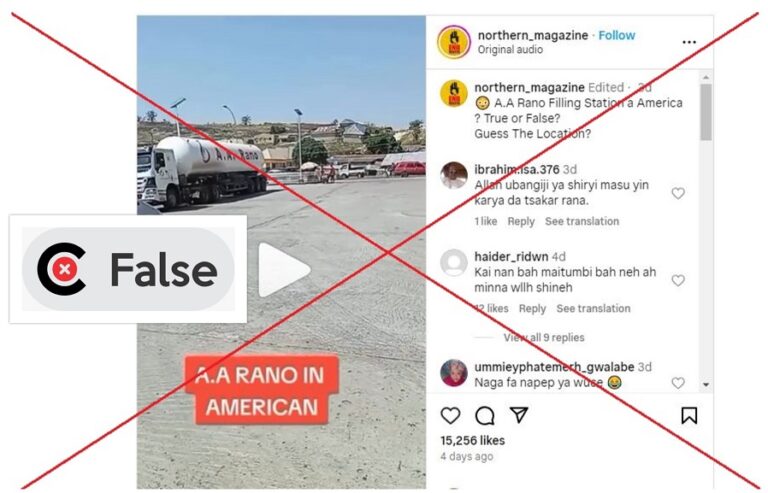
A video has circulated on social media showing visuals of A. A Rano filling station with a human voice narrating in Hausa Language that A A Rano Nigeria Limited has opened a filling station in the United States of America.
A.A. Rano Nigeria LTD is a Nigerian oil and gas company that markets and distributes petroleum products across the country. It has been in operation since 1994 with its headquarters located in Kano, Nigeria.
The 1 minute, 3 seconds video was shared by Northern Magazine on Instagram. It has been shared multiple times also on Facebook as seen here and here, as well as on X (formerly Twitter)here. It has gone viral because the narrator in the footage claimed that he is a prominent journalist named Usman Kabara, who lives in the United States. Kabara doubles as a Hausa content creator and shares content that explores the way of life in the country.
Giving that A. A Rano is an indigenous company owned by Alhaji Auwalu Abdullahi Rano from Kano state, and Usman Kabara is a well-respected journalist who worked with the Hausa service of Voice of America (VoA) and currently a U.S. resident, it is essential to shield more light on the claims in the video and debunk this viral misinformation spreading especially in Kano and other parts of northern Nigeria.
CLAIM 1: The man narrating the story in the footage is Usman Kabara
In his opening remark in the footage, the narrator claimed in Hausa Language that he is Usman Kabara.
“My people, I am Usman Kabara from America, today I’m here at A. A Rano branch filling station in the USA. This showed that A. A Rano is not some petty businessman because even in European countries he has station outlets,” he said.
Screenshot of the viral video posted on Facebook. INSERT: False verdict.
THE FINDINGS
Checks show that this claim is FALSE. When this reporter reached out to Usman Ahmad Kabara, the former VoA reporter through his email address, he debunked the claim.
Following the email conversation, he made a Facebook post in Hausa language disassociating himself from the video and warned members of the public to be wary of people who were imitating his voice to misinform the society.
“HATTARA! Jama’a ku yi hattara da masu damfara ko karya da suna na. Wannan bawan Allan karya ya shirga don kuwa ba muryata ba ce a wannan bidiyon. Sannan ina gargadin duk wanda yayi wannan aikin sojan gonar da ya gaggauta bari tum kafın shi ko makamancinsa su shiga hannun hukumar da na bawa bayanin wannan bidiyon. Masoyana ku yi hattara kafın wani ya damfare ku.”
His post, when translated into English by this reporter, reads:
“BE CAREFUL! People, beware of fraudsters or liars in my name. This man lied because it is not my voice in this video. And I am warning everyone who does this work to stop before he falls into the hands of the security agency that I reported him to. My dear, be careful before someone cheats you.”
THE VERDICT
The claim by the narrator in the footage that he is the Usman Kabara is FALSE, as the well-known Usman Ahmad Kabara disassociated himself from the video and its content.
Speaking in the footage, the narrator in Hausa language claimed that: “I’m here at A. A Rano branch filling station in the USA. This showed that A. A Rano is not some petty businessman because even in European countries he has station outlets.”
“Here is where they are selling gas if you want it, or you can have fuel here, no doubt A. A Rano owned different fuel stations in our countries like Nigeria and even European countries,” he added.
THE FINDINGS
The information available on the A. A Rano website stated that the company has over 200 filling stations across the 36 states in Nigeria, including the FCT with over 600 trucks and 115 retail outlets spread across the country.
A.A Rano together with all its subsidiaries is only incorporated in Nigeria with its headquarters in Kano, Nigeria, checks on its website show.
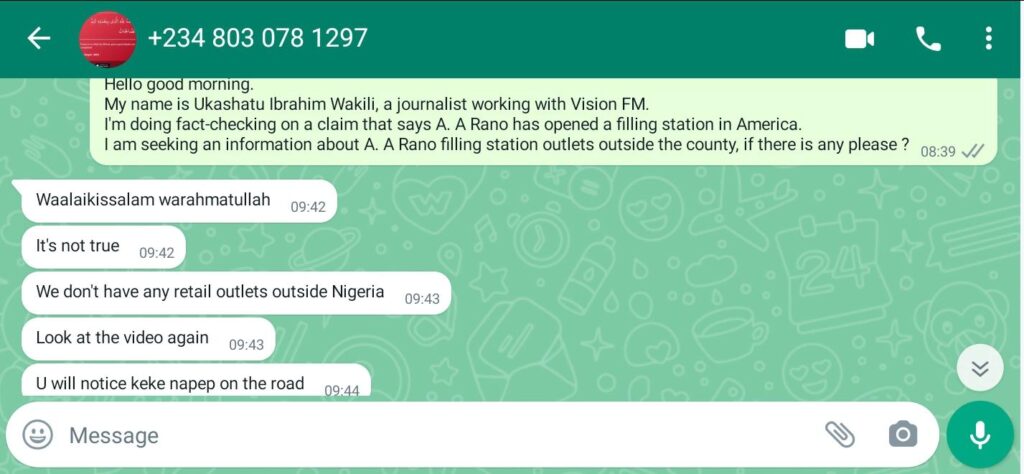
The WhatsApp chat between this reporter and A. A Rano official on December 20, 2023.
This writer contacted the company through a WhatsApp number listed on its website. One A. A. Rano official, in a response to this reporter’s inquiry, debunked the claim saying “It’s not true, we don’t have any retail outlets outside Nigeria.”
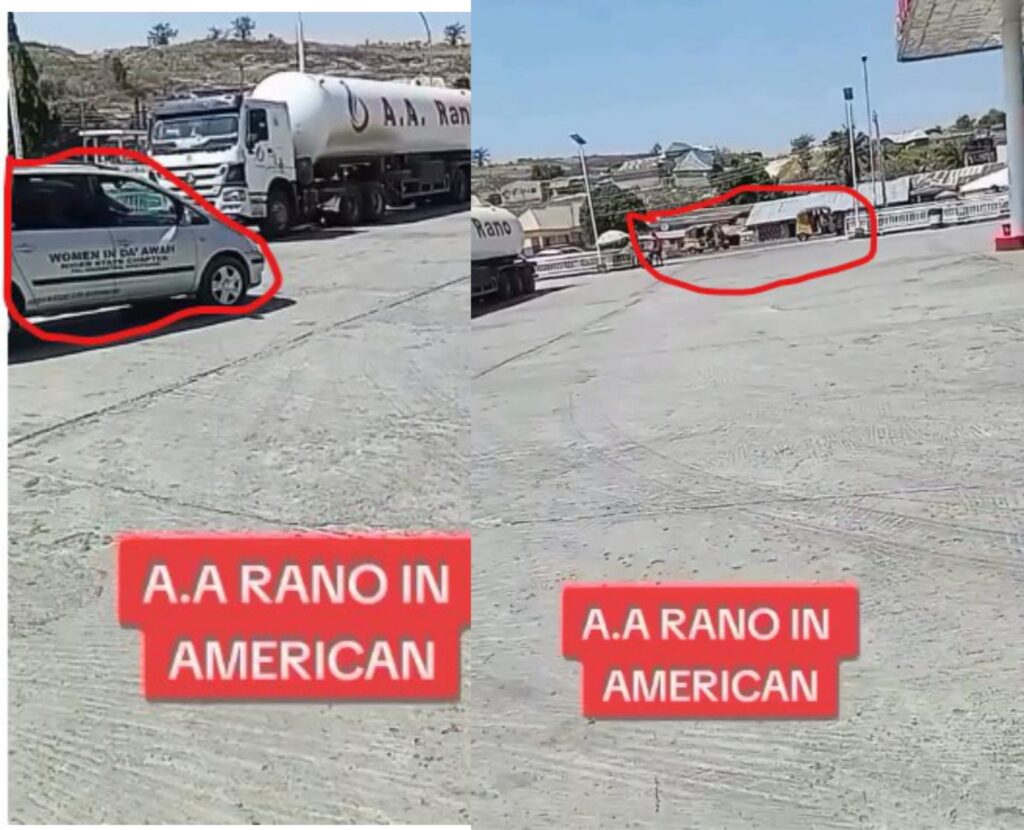
Also, a critical look at the video by this reporter shows that the video was recorded in Nigeria, as we can see in the picture below a parked vehicle with an inscription that reads: “Women In Da’awa, Niger state Chapter” while tricycles popularly called Keke Napep passed by the road.
A screenshot from the video showing tricycles and “Women in Da’awah” inscription on a vehicle.
THE VERDICT
The claim that A. A Rano has a filling station in the U.S. is FALSE; as findings revealed that it is an indigenous company which operates in Nigeria only.
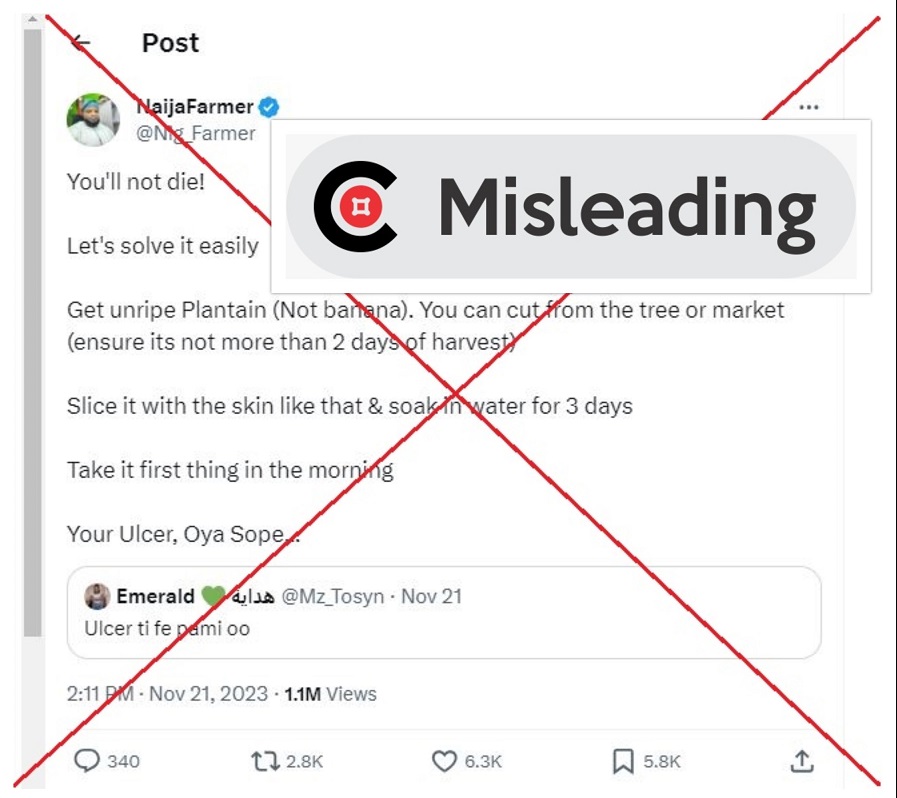
On November 21, 2023, an X user, @Nig_Farmer, posted a claim that drinking the water obtained from soaking unripe plantain for 3 days can cure ulcers.
The post reads: “Get unripe Plantain (Not banana). You can cut from the tree or market (ensure its not more than 2 days of harvest). Slice it with the skin like that & soak in water for 3 days. Take it first thing in the morning.”
The post has garnered over 1 million views, more than 6,000 likes and over 2,800 reposts since it was posted online.
So, can the water obtained from soaking unripe plantain for 3 days cure ulcers?
CLAIM
Water obtained from soaking unripe plantain for 3 days cure ulcers.
Screenshot of the viral X post by @Nig_Farmer. INSERT: Misleading verdict.
THE FINDINGS
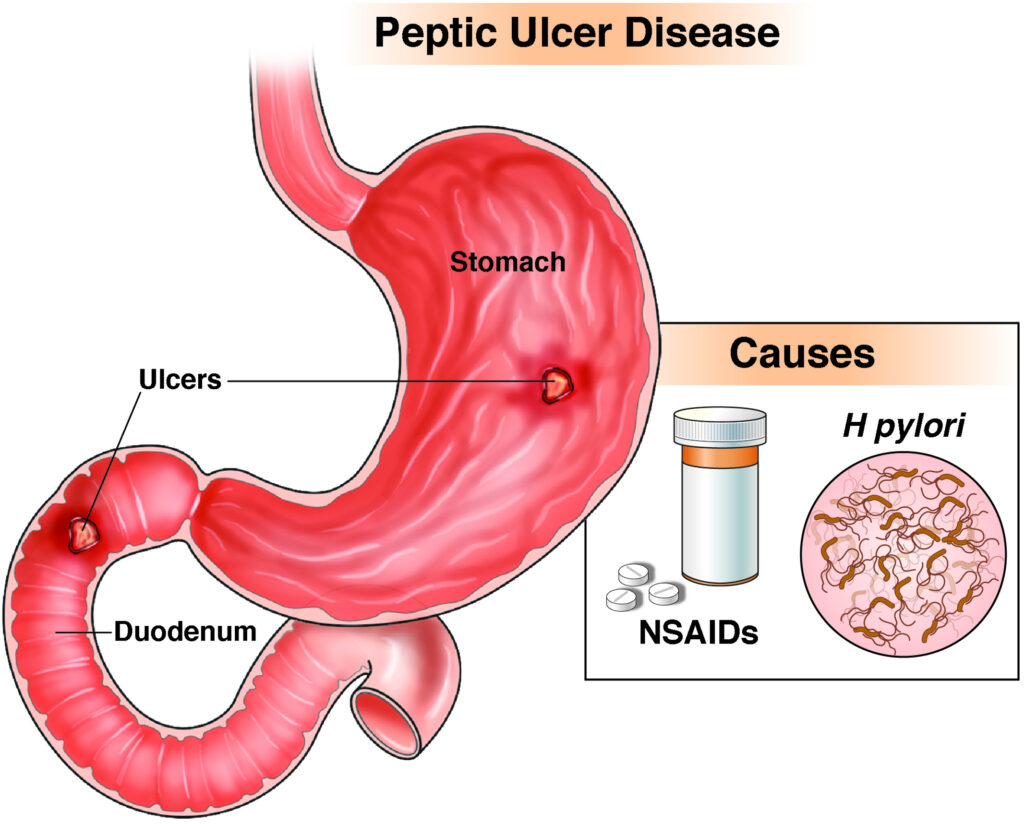
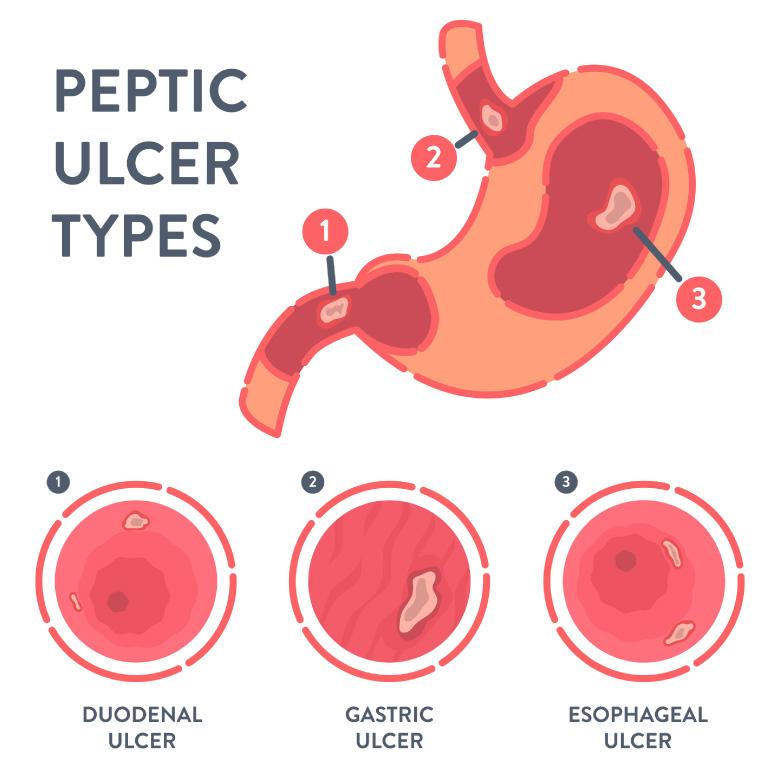
Stomach ulcers, also known as gastric ulcers, are painful sores in the stomach lining. Stomach ulcers are a type of peptic ulcer disease. Peptic ulcers are any ulcers that affect both the stomach and small intestines.
Stomach ulcers occur when the thick layer of mucus that protects your stomach from digestive juices is reduced. This allows the digestive acids to eat away at the tissues that line the stomach, thus causing an ulcer.
Stomach ulcers are caused by an infection with the bacterium Helicobacter pylori (H.pylori), long-term use of non-steroidal anti-inflammatory drugs (NSAIDs), and in rare cases a condition known as Zollinger-Ellison syndrome can cause stomach and intestinal ulcers by increasing the body’s production of acid.
A number of symptoms are associated with stomach ulcers. The most common symptom is a burning sensation or pain in the middle of the abdomen between the chest and belly button. Others are dull pain in the stomach, weight loss, nausea or vomiting, bloating, burping or acid reflux, heartburn, and anemia, among others.
Types of Ulcers
Properties of Unripe plantain
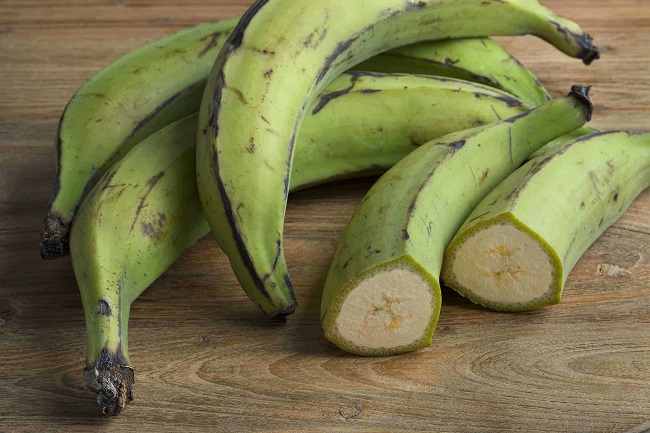
Plantain which is otherwise known as cooking banana, is a common food in West African countries like Nigeria, Cameroon, and Ghana. Unripe plantain is regarded as green plantain by some and serves as a source of vitamins, minerals, dietary fiber, and antioxidants.
In Nigeria, its wide consumption by various ethnic groups and socio–economic classes is due to the availability of affordable cheap technology in converting the fruit to other value-added products such as “Boli” (roasted plantain) which can be eaten with groundnut, stew or fried egg.
In addition, the unripe plantain can be processed into plantain flour and constituted to Amala which can be eaten with most kind of soups. Furthermore, its slices can be fried into chips which are consumed by everyone irrespective of class.
Besides potassium, fiber, vitamin C, vitamin B6, and magnesium, plantains contain vitamin K, vitamin A, copper, and iron etc.
What the science says…
The Nigerian Journal of Pharmaceutical and Applied Science Research 2021, revealed that plantain peel has high level of minerals, water, and different phytochemicals which could be responsible for the anti-ulcer properties exhibited and as such can be used to manage the treatment of ulcer.
While the study is said to have justified the claim made by traditional medicine healers that peels from plantain can be used for treating ulcer, it added that there is a need for further study on the peel of plantain to isolate and characterise the compounds responsible for the anti-ulcer activity and determine its mechanism of action.
According to the Journal of Science and Research 2020, plantain contains high quantities of vitamins A, C, and B groups and minerals such as calcium and iron. It is of high medicinal value and can be used in the treatment of bronchitis, dysentery and ulcer while the cooked flour is recommended for diabetic patients.
It added that blanched starter fermented samples of plantain with Lactobacillus plantarum have the best nutritional qualities.
Various preparations of dried unripe plantain banana were found to be anti‐ulcerogenic against aspirin‐induced ulceration in the rat and were effective both as a prophylactic treatment and in healing ulcers already induced by aspirin.
However, Dr Adenike Enikuomehin, a consultant endocrinologist at the University of Medical Sciences Teaching Hospital (UNIMEDTH), Akure in Ondo state, said knowing the cause of the ulcer determines the method of treating it.
She said, “If you know the pathophysiology of ulcer, you won’t say that someone should put plantain in one place and drink. It is just a psychology used by some like when people take water for a troubled stomach to feel relieved.”
She added that research is needed in this regard, as people embrace any solution that seems mystical without finding out its efficacy.
Similarly, a consultant gastroenterologist at UNIMEDTH, Akure, Dr Kenechukwu Okonkwo, said the claim is not true, adding that the claim is not backed by science.
“If anyone has ulcer, they should go to the hospital and see a doctor who will evaluate and give the necessary medications,” he said.
He disclosed that an untreated stomach ulcer can lead to some complications like upper GI bleeding, perforation, peritonitis, and obstruction, etc.
THE VERDICT
The claim that water obtained from soaking unripe plantain for 3 days can cure ulcers is MISLEADING. While researchers have shown that unripe plantain has anti-ulcer properties and can be used to manage the treatment of ulcer induced by aspirin, especially on rats, experts however opined that patients should instead follow the medical advice given to them by certified medical practitioners, as it has not been tested on humans; hence no scientific evidence to justify the efficacy of the treatment on humans.
A former Nigerian lawmaker, Shehu Sani, has claimed that a terrorist leader named Kachalla was announced to have been killed on three different occasions by Nigerian authorities.
Sani made the claim on X (formerly Twitter) on December 17, 2023 while reacting to the recent killing of four notorious terrorist commanders in air strikes by the Nigerian military last week with one of them bearing the name ‘Kachalla.’
“The terrorist leader called Kachalla was killed THREE TIMES;2020,2022 and 2023.”
Screenshot of the viral claim posted by Shehu Sani on December 17, 2023. INSERT: Misleading verdict.
The post, which shows a picture collage of at least 3 different websites’ screenshots, has garnered over 600,000 views, more than 2,700 reposts, over 1,700 comments and more than 4,000 likes as of December 19, 2023.
Similarly, the same post was republished on X by Professor Chidi Odinkalu, a lawyer and former Chairman of Nigeria’s National Human Rights Commission (NHRC) on December 18.
It has also garnered over 20,000 views as of December 19, 2023.
CLAIM
A terrorist named Kachalla was announced dead three times by Nigerian authorities.
Screenshot of the viral claim posted by Chidi Odinkalu on December 18, 2023. INSERT: Misleading verdict.
THE FINDINGS
Findings by The FactCheckHub show that the claim is MISLEADING.
When this researcher looked at the contents of the media reports shared by Shehu Sani, findings show that the terrorists were three different persons and not the same person.
While they shared same last names, their first names differ indicating that they are three different individuals.
The three terrorists were Nasiru Kachalla, Kachalla Gudau and Ali Alhaji Alheri, also known as Kachalla Ali Kawaje.
In 2020, Nasiru Kachalla, a notorious terrorist was killed during a rival war among bandits terrorizing Kajuru and Chikun Local Government Areas of Kaduna state.
The terrorist was said to be the mastermind of the January 9, 2020 kidnapping of seminarians of Good Shepherd Major Seminary, Kaduna and several other killings and kidnapping in the state.
In 2022, the state government announced the killing of bandit leader, Kachalla Gudau who was among those neutralized by the troops of Nigerian Army at Kankomi in Kaduna state.
Kachalla Gudau was also a bandits’ leader who commanded a large number of foot soldiers, kidnapped and killed several civilians in Chikun, Kachia and Kajuru local government areas of the state.
In a recent development, Defence Headquarters confirmed the killing of Ali Alhaji Alheri, popularly called Kachalla Ali Kawaje and three other notorious terrorist commanders in air strikes on December 12, 2023.
He was reportedly neutralized in Munya Local Government Area of Niger state along with many of his foot soldiers.
THE VERDICT
The claim that Nigerian authorities announce the killings of same terrorist named Kachalla three times is MISLEADING; findings show that they were three different persons who shared the same last name.
MAJOR events like the 2023 general elections had their fair share of misinformation and disinformation that contributed to the malaise in Nigeria’s media space.
Apart from the general elections, some false news was reported by media houses. Some of the false news stories were international but made their way into local media publications/broadcast, which many individuals unfortunately believed to be true.
But the fight against misinformation and disinformation would be stagnant if public figures and notable government officials keep spreading fake news and false information, which we saw played out in 2023.
Apart from government officials spreading false information, some international news stories, which were also false and misleading, made its way into the national news, courtesy of some media platforms.
Some of the major false information that went viral in 2023 include:
1. Aisha Binani’s acceptance speech
Nigeria’s gubernatorial elections, which were conducted on the 18th of March 2023, saw Kebbi and Adamawa states having supplementary elections on the 15th of April 2023 after both states were initially declared inconclusive due to the margin of the votes.
The APC candidate, Aisha Dahiru (Binani), had read her acceptance speech after she was illegally declared the governor-elect by the state’s resident electoral commissioner (REC).
She was still reading the speech when her victory was overturned by INEC. According to Nigeria’s electoral law, the REC, Hudu Ari, had no power to announce the winner of the election. The responsibility solely lies with the state collation officer appointed by the Independent National Electoral Commission (INEC).
The speech was televised by the Nigerian Television Authority (NTA) which misled many Nigerians.
On September 11 2023, the Special Adviser to the Nigerian president on Media and Publicity, Ajuri Ngelale, shared a statement(archived here) that the visa ban placed on Nigerian travellers by the United Arab Emirates have been lifted immediately. The statement added that Etihad Airways and Emirates Airlines were to resume flights in and out of Nigeria without further delay. A visa ban was placed on Nigeria in October 2022, as the UAE banned nationals of about 20 African countries including Nigeria from entering its borders.
The news was reported by credible media platforms, including ThisDay.
However, on 15th September, 2023, CNN, TheCable and BusinessDay reported that the UAE had contradicted claims of the Nigerian government that the visa ban had been lifted.
Furthermore, In November 2023, Channels TVreported that the FCT minister, Nyesom Wike, had received the UAE ambassador to Nigeria and that during the visit, the minister had sought for the visa restriction ban to be lifted.
On June 4, 2023, there were news reports that Sweden had become the first country to officially recognize sex as a sport and a tournament would take place on June 8 which would feature participants from different European countries which would span on for several weeks under the supervision of the Swedish Sex Federation. The news was reported by local and international media.
Few days after the news had made rounds on the internet, Anna Setzman, the spokesperson for the Swedish Sports Confederation debunked the claim in a written statement. She stated that an individual Dragan Bratic, who owned several strip clubs across the country and claimed to be a member of a sex federation applied for membership, but their application was rejected in May 2023.
Barely a week to Nigeria’s gubernatorial elections which took place on March 18, 2023, a photo of a lady smoking went viral on the internet with various version of a false claim that it was the Labour Party‘s Deputy Governorship candidate for Lagos state, Islamiyat Oyefusi.
The unnamed lady in the photo clearly wasn’t Oyefusi as they lack the same facial features while the lady in question looked younger than her. The deputy governorship candidate had also debunked the claim in a tweet in a response to the claim.
5. Kaduna tribunal judgement
The Kaduna tribunal sitting in its judgement on 28th September, 2023, had dismissed the suit filed by Isah Ashiru and his party, the Peoples Democratic Party (PDP), challenging the victory of Governor Uba Sani of the All Progressives Congress (APC) in the March 18 governorship election. In the suit, he stated that the pre-hearing notice was filed out of time and, therefore, deemed to lack merit.
But Isah Ashiru had shared a statement archived here on X (formerly Twitter) stating that the court had nullified the election and ordered that the Certificate of Return be retrieved and fresh elections be conducted in some polling units in four local government areas of the state.
This generated conflicting narratives in media reports as some media houses had reported Ashiru’s statement.
6. Moroccan football star divorce
On 14th of April, 2023, a French magazine reported that a Moroccan football star Achraf Hakimi’s wife, Hiba Abouk, who is an actress had asked for half of Hakimi’s assets and fortune after she filed for a divorce. The report allegedly said she was surprised when she learned that he has nothing in his name and the beneficiary of Hakimi‘s salary and wealth is none other than his mother. The news caused a stir everywhere as it was widely reported by both international and local media.
It was later discovered that the news was FALSE as the report was extracted and republished from a parody website. Abouk had responded to the allegations stating that such claims ‘no longer affect her’.
7. Otti arrests errant Abians
An X user, @DrChiemeziem, had on Sunday, December 10, 2023 claimed (archived here) that the Abia State governor, Alex Otti, had invited youths and elders who had barricaded a road undergoing construction for peace talks in Umuahia and locked them up.
The post had gone viral and garnered over 800,000 views, and over 6,000 likes within days, and thus prompted the governor to release an official statement via his spokesperson, Dodoh Okafor, who described the reports as ‘false and misleading’.
NIGERIA’s general election is arguably one of the biggest events of 2023. The election was characterized by various forms of inaccurate and misleading claims from politicians and their supporters.
In this analysis, we take a recap of some of the claims we fact-checked before, during and after the 2023 general election.
In the build-up to the 2023 general election, the current Nigerian president who was the flag-bearer of the All Progressives Congress (APC) referred to his counterpart, Atiku Abubakar of the Peoples Democratic Party (PDP) as a Senate President.
Tinubu said this in January 2023 at the campaign rally of the APC in Uyo, Akwa Ibom state, while calling on the electorate to sweep out the opposition parties at all levels of governance and promising a better living standard for all Nigerians. Our fact-check shows that Atiku Abubakar was never a lawmaker in the National Assembly throughout his political career till date.
Titi Abubakar, one of the wives of Atiku Abubakar, the presidential candidate of the Peoples Democratic Party (PDP) in the 2023 general election claimed that since the adoption of First Lady in Nigeria’s Presidency, no Yoruba woman has had the opportunity to occupy the seat of First Lady.
Titi, said this while canvassing votes for her husband during the party’s campaign rally in Abeokuta, the Ogun state capital on Wednesday, 18th of January, 2023. Our fact-check shows that Nigeria has had at least three First Ladies from the Yoruba ethnic group in the last 59 years.
A close monitoring of the social media accounts of Nigerian music artiste, Charles Chukwuemeka Oputa, by The FactCheckHub shows that he used his social media platform, especially X, to share manipulated videos and photos to promote the presidential bid of the Labour Party’s candidate, Peter Obi during the 2023 electioneering campaign. Our fact-check shows how he deliberately misinformed the public several times through false narratives and failed to heed when his attention was drawn to such.
In February 2023, the then majority leader of Nigeria’s House of Representatives, Alhassan Doguwa, claimed that the electoral law permits contestants for the House of Representatives seat to possess at least N70 million “in cash” to cover their expenses for the election.
Doguwa said this after a meeting with former President Muhammadu Buhari at the Aso Rock Villa in Abuja while expressing dissatisfaction over the scarcity of Naira notes. We checked the electoral law and contacted the Chief Press Secretary to INEC chairman, our findings show that Doguwa’s claim was FALSE.
An image showing Olumide Oworu, the Labour Party’s candidate for Lagos State House of Assembly in Surulere Constituency 1, with blood on his face and shirt surfaced online with a claim that it showed the moment after he was reportedly attacked by hoodlums in a part of the state. Our fact-check shows that the image has been online since October 2022 – more than five months before the reported incident.
Amidst the collation of results of the governorship supplementary election in Adamawa state, a video showing a lynched man inside a vehicle surfaced online with a claim that it shows the INEC Resident Electoral Commissioner (REC) in Adamawa State, Hudu Ari, who declared Aisha Dahiru, popularly called Binani, as the winner of the governorship election in the state. Our fact-check shows that the man in the video is not the INEC Resident Electoral Commissioner (REC) in Adamawa State but the INEC national commissioner and chairman, the board of the Electoral Institute, Abdullahi Abdul Zuru.
Following her emergence as the winner of the senatorial seat for the FCT in the National Assembly election held on February 25, 2023, a claim that Ireti Kingibe is the first female senator to be elected in the Federal Capital Territory (FCT) into Nigeria’s National Assembly (NASS) circulated online. Our fact-check shows that Khairat Abdulrazaq-Gwadabe had previously held the position of the Senator representing the Federal Capital Territory (FCT) from May 29, 1999 to May 29, 2003, over two decades before Kingibe’s election.
After the conclusion of the 2023 presidential election, a photo showing Peter Obi, the presidential candidate of Labour Party having a conversation with Seyi Tinubu surfaced online.
The photo was circulated alongside a claim that Obi had given up on his election-related court case and agreed to work with Bola Ahmed Tinubu. Our fact-check shows that the image was photoshopped.
Following the 2023 general election, another photo showing the 2023 Labour Party’s presidential candidate Peter Obi and President-elect Bola Tinubu with speaker of the House of Representatives, Femi Gbajabiamila, Nigerian businessman Aliko Dangote and the governor of Lagos state, Babajide Sanwo-olu, was circulated on social media. Our fact-check shows that the image has been manipulated and Peter Obi was not in the picture.
After Nigeria’s 2023 general election, a claim that Atiku Abubakar, the presidential candidate of the Peoples Democratic Party (PDP), was retiring from politics and promised to join hands with others to support the nation’s president-elect, Bola Ahmed Tinubu circulated online. Our fact-check shows that the claim was FALSE.
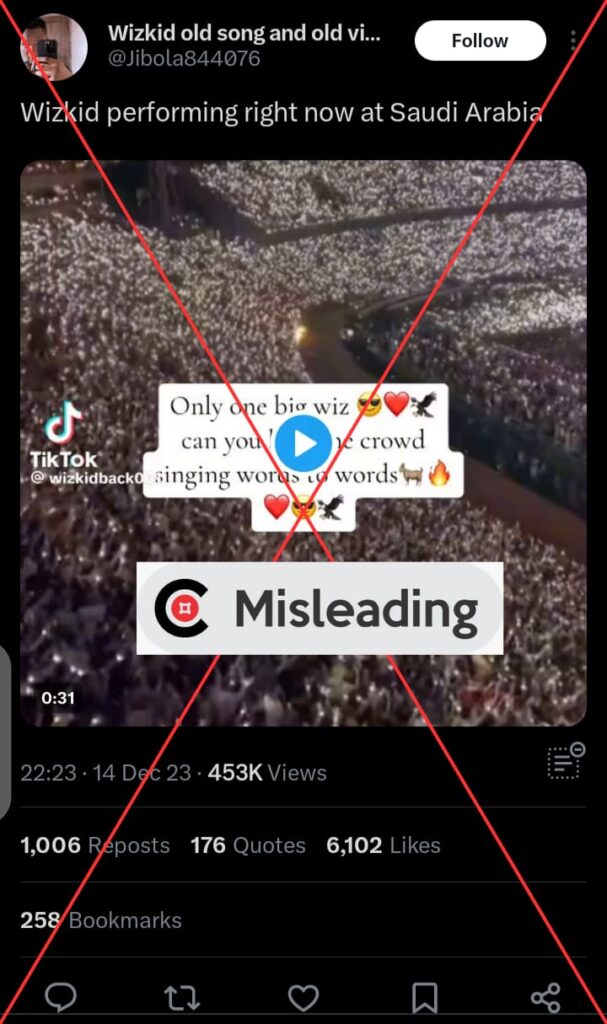
AN X user @jibola844076 posted a video on the social media app with the claim that it was an ‘ongoing Wizkid performance in Saudi Arabia.’
The 16 seconds footage captured the audience at a concert while Wizkid’s song ‘Pakurumo’ with an audience singing along was playing in the background. The video had an inscription: “only one big wiz can you hear the crowd singing word to word.”
The video also had a second caption: Wizkid performing right now at Saudi Arabia.
The video, posted on Thursday, December 14, 2023, has garnered over 460,000 views, over 6,200 likes and more than 1,100 reposts as of Sunday, December 17.
A close look at the video shows that it was culled from TikTok with the username @wizkidback001 watermark on the video.
A search of the username, @wizkidback001, on TikTok led us to the account where the same video was originally posted. It had gained over 73,000 plays and over 7,000 likes on the TikTok account.
Wizkid is a Nigerian Afrobeats singer who has many records and awards to his name.
CLAIM
Video shows Wizkid performing at a concert in Saudi Arabia.
Screenshot of the .; INSERT: Misleading verdict.
THE FINDINGS
Findings by The FactCheckHub revealed that the claim is MISLEADING, as the footage has been doctored.
Using Invid to verify the video via the TikTok web link, it was divided into key frames and thus led us to different versions of the same video on TikTok.
Checks show that the video was from a concert hosted by a Puerto Rican artiste, Bad Bunny, whose genre is Latin Trap. Several versions of the video showed that the video was uploaded on TikTok in August 2022. There were variations of the dates the video was posted as some were posted on the 24th and others on the 27th of the same August 2022.
Further checks revealed that the audio of the footage was manipulated with an audio of Wizkid singing along with his fans.
More findings showed that Bad Bunny was on a world tour in 2022, and he performed on the 23rd of August in Washington DC and on the 27th of August at New York.
Image of Bad Bunny 2022 world tour flyer. CREDITS: Pitchfork
The FactCheckHub could not independently verify the exact city the concert took place in the United States.
But a check on Wizkid’s profile on Instagram shows that the Nigerian singer was in Lagos, Nigeria over the weekend for the holidays while pictures on his page showed that the last concert he performed was in Sweden.
THE VERDICT
The claim that the video shows Wizkid performing at a concert in Saudi Arabia is MISLEADING; as findings revealed that the video is from one of Bad Bunny’s concert in 2022, though the audio is also manipulated.