Please note that the FactCheckHub has not obtained any right from the authors or copyright owners of all third-party contents from embedded links and shall incur no liability in this regard.
Please note that the FactCheckHub has not obtained any right from the authors or copyright owners of all third-party contents from embedded links and shall incur no liability in this regard.
Please note that the FactCheckHub has not obtained any right from the authors or copyright owners of all third-party contents from embedded links and shall incur no liability in this regard.
Please note that the FactCheckHub has not obtained any right from the authors or copyright owners of all third-party contents from embedded links and shall incur no liability in this regard.
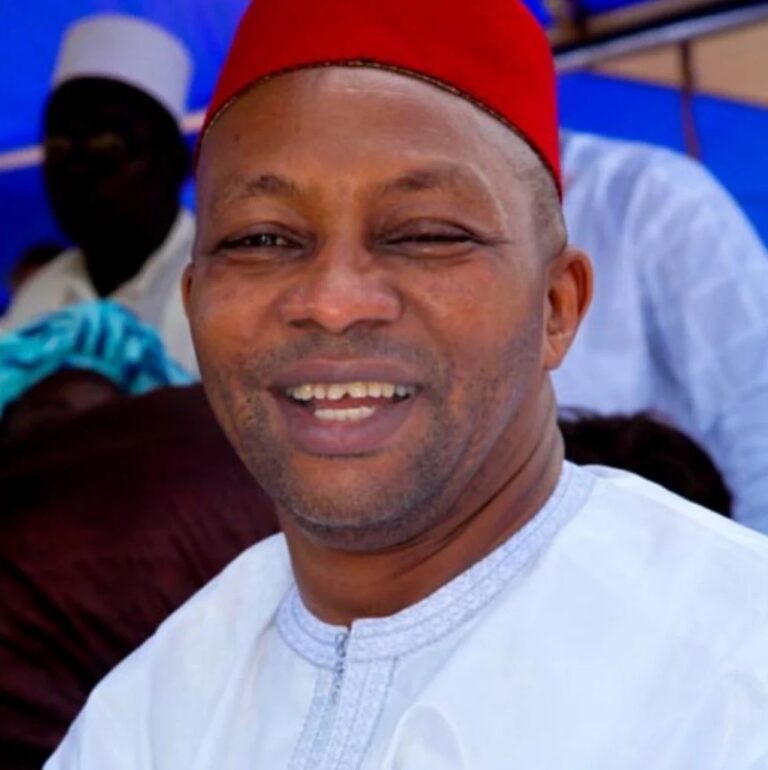
A claim that a former minister of Works in Sierra Leone, Alhaji Ibrahim Kemoh Sesay, had died has been circulating online.
The claim retrieved from a WhatsApp group on December 13, 2023, read: “Former Minister of Works Alhaji Ibrahim Kemoh Sesay Have Pass Away yesterday evening.”
The claim has triggered widespread misinformation about his alleged death on social media, especially among the people of Port Loko District (Sierra Leone) his birth place and the country at large.
Ibrahim Kemoh Sesay is a Sierra Leonean politician from the ruling All People’s Congress (APC) political party in the country. He was Sierra Leone’s former Minister of Transportation and Aviation and member of the Pan-African Parliament. Sesay was born in Port Loko, Port Loko District, a Muslim and a member of the Temne ethnic group.
In 2002, he served as a member of Parliament of Sierra Leone representing Port Loko District. He was appointed Minister of Transportation by former president Ernest Bai Koroma in October 2007. On August 4, 2008, President Koroma relieved Sesay of his appointment as Transport and Aviation Minister after a record haul of 700 kilogrammes of cocaine was discovered and confiscated at Freetown airport in July 2008.
Sesay was also nominated for the position of Minister of Political Affairs in 2013 and has been active in the nation’s politics since then.
CLAIM
Former Sierra Leonean minister of Works, Alhaji Ibrahim Kemoh Sesay, is dead.
THE FINDINGS
Findings by this researcher show that the claim is FALSE.
Kemoh Sesay personally debunked the claim via a telephone call put across to his mobile number on December 15, 2023 by this researcher.
Also, Sesay said he had released a video announcing that he is still alive days ago when he got the news about his alleged death.
In the video, which he sent to this researcher after the telephone conversation, he stated that he released the video to assure the public that he is safe, alive and strong.
Speaking in the local Creole language, which was translated by this researcher, he said:
“Greetings my Muslim and Christian brothers and sisters. I am compelled to make this video due to rumours going around that I, Alhaji Ibrahim Kemoh Sesay is dead. So, I am telling you now that I am not dead; I am well and kicking.
“As a matter of fact, the last time I see my doctor was in August 2021. Please, whosoever that is passing this heartbreaking news should stop; this is too much for my people as many people are already crying and suffering emotionally.
“I am well and kicking, nothing has happened to me insha Allah and I am alive. So, I am thankful to all concerned people and those who have suffered through this news, I say sorry about that.
“All my children, loved ones and family members, I am sorry that this news has troubled you all a lot; I am sorry about that”.
THE VERDICT
The claim that the former Sierra Leonean Minister of Works, Alhaji Kemoh Sesay, have passed away is FALSE; the former minister debunked the claim in a video days after his reported death.
* This report was written by Kadiatu Tholley, Presenter at Advocacy Radio 99.7FM in Sierra Leone under the mentorship of the Africa Facts Network Member, FactCheckHub. Africa Facts is a network of fact-checkers across the continent supported by Africa Check, Africa’s first independent fact-checking organisation.
Napoli striker and Nigerian international, Osimhenemerged 2023 African Footballer of the Year in the men’s category at the awards ceremony in Marrakesh on Monday, beating Egypt’s Mohamed Salah and Morocco’s Achraf Hakimi to become the first Nigerian to claim this accolade since Kanu Nwankwo in 1999.
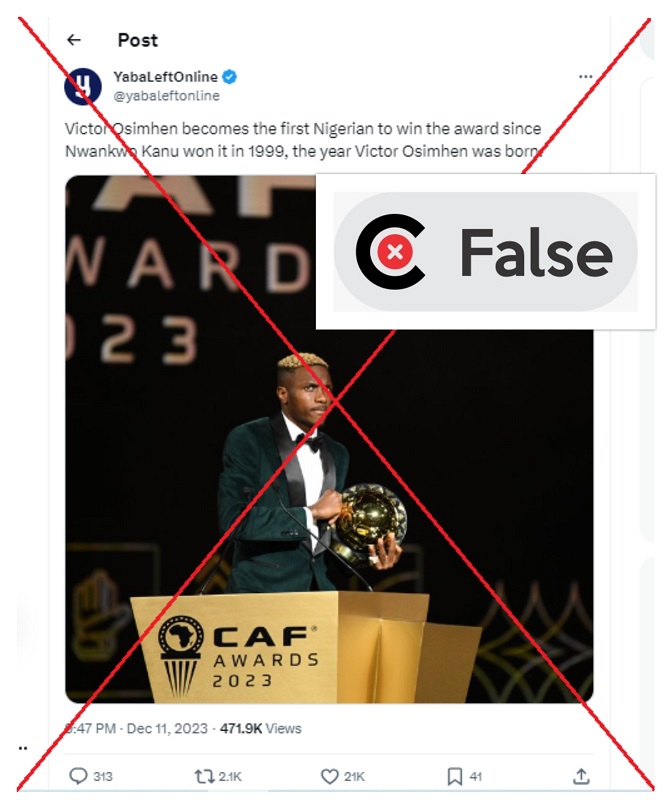
Following the event, Yabaleftonline posted on X (formerly Twitter), “Victor Osimhen becomes the first Nigerian to win the award since Nwankwo Kanu won it in 1999, the year Victor Osimhen was born.”
The claim has generated over 470,000 views, more than 2,000 reposts and over 21,000 likes as of December 15, 2023.
CLAIM
Victor Osimhen was born the year Kanu won the African Footballer of the Year.
Screenshot of the viral X post by @YabaLeftOnline. INSERT: False verdict.
THE FINDINGS
Findings by The FactCheckHub show that the claim is FALSE.
Osimhen became the first Nigerian to win the CAF men’s Player of the Year since Nwankwo Kanu in 1999.
Kanu is still the only Nigerian player to win the award twice and the last Nigerian to win it before Osimhen.
Several public records such as ones on Eurosport, and Soccerway show that Osimhen was born on December 12, 1998 – the year before Kanu won African Footballer of the Year (male category) in 1999. This indicates that Osimhen was born before Kanu clinched the award in 1999.
Further checks show that Moroccan midfielder Mustapha Hadji was named African Footballer of the Year by CAF in 1998. This coincides with the year Victor Osimhen was born.
THE VERDICT
The claim that Victor Osimhen was born the year Kanu won the African Footballer of the Year is FALSE; information available in public domains revealed that Osimhen was born before Kanu achieved the feat in 1999.
Mohammed Ali Ndume, a federal lawmaker representing Borno South Senatorial District at the National Assembly, has claimed in a recent interview on national television that the former Nigerian president, Muhammadu Buhari, recently admitted that some individuals in power hijacked his government.
Ndume, who doubles as the deputy chairman of the Senate Committee on Appropriations, stated this on December 1, 2023 when speaking about the details of the country’s proposed 2024 budget.
Bola Ahmed Tinubu, who was sworn in as Nigeria’s new president on May 29, 2023, presented the 2024 Appropriation Bill of N27.5 trillion to the joint session of the 10th National Assembly on Wednesday, November 29, 2023.
Ndume, when expressing the need for massive recruitment in the military, said: “I’m sure he (Tinubu) is going to do it because he has started well with this budget. I believe in him (Tinubu), he can change things. The president here is in charge, that’s one thing with him. Sometimes, people even think that Tinubu is too authoritative, he takes charge unlike our former president (Buhari).
“(The former president) will just give you an assignment, he will not look over you. That’s where the problem is and he knows that. That was the mistake president Buhari did, he ended up confessing these days that he had more kleptocrats in his government than people that they have interest at heart. I was here when I said there were too many kleptocrats in the (Buhari’s) government. And now he confessed recently that truly…he admitted that there were some kind of people that took over power themselves. But in Tinubu’s government, you can’t do that.”
Buhari served two consecutive four-year terms as Nigeria’s democratically-elected president from 2015 to 2023.
In November 2023, multiple media reports from Vanguard, Daily Trust, and The Cable, as archived here, here, and here, claimed that during an exclusive interview with the Nigeria Television Authority (NTA), Buhari said that his government might have been hijacked by a cabal.
According to the Oxford English Dictionary, a cabal is “a secret political clique or faction.”
CLAIM
Ex-Nigerian president Muhammadu Buhari admitted that cabals hijacked his government.
THE FINDINGS
Checks show that the claim is MOSTLY FALSE.
To confirm the authenticity of the claim, this researcher checked Buhari’s exclusive interview with NTA, which was posted on the broadcast service’s YouTube page on November 21, 2023.
In the interview, Buhari fielded questions bordering on his administration as president and as well addressed the speculations about his cabinet.
In the latter part of the interview, Buhari was asked to respond to the view by many Nigerians that he was surrounded by people who were corrupt. In response, he rather asked about what the citizens had done in their role to fight corruption.
“Well, what have they done in their own role to fight corruption as Nigerians? That is their own problem, it’s not my problem.”
He added: “You just can’t say such a person is corrupt. He has five cars when he should have only one. He has five houses when he should have only one and he has so many girlfriends or so many wives. But what have you done to stop it? Is it not part of your role or your duty as a citizen to make sure that if you see somebody who is corrupt, to blow the whistle? Why don’t you have the courage to blow the whistle? To say look, you are only treasurer for a local government, how do you manage to build house?
“He didn’t build the house in the air. He built it somewhere either in his village or he went to Abuja.”
When asked whether the impression that his administration was hijacked by certain cabals was a figment of imagination or not, Buhari responded that it must have been the former. He reiterated the question about what citizens had done in their role in the fight against corruption.
His words: “It must have been, otherwise, why didn’t they talk? Why didn’t they say it? What do the people think they form themselves into a cabal and they are so important that they are not being questioned. What did they do about it? Don’t they have a role as Nigerians if things are being done by government.”
He was further asked if he felt that his government was hijacked, and he responded, “No, because I don’t deliberately allow anybody to misuse public resources for himself or for me. I didn’t allow it. I can’t act on what I don’t know. I couldn’t have acted on what I didn’t know. But if people know and they decide to sit on their knowledge and refuse to…they are part of the problem.”
Again, Buhari was asked if he had seen anyone who would have been like a possible cabal during his time in government.
“No no no… Nobody was above the law and I don’t have any evidence of anybody doing anything wrong and being allowed to walk away, no,” Buhari said in response.
This researcher’s evaluation of Buhari’s responses in the interview showed that he did not admit that his government was hijacked by cabals.
The former president, while disregarding the impression of having cabals in his government, stated that there was no evidence to show that his government was hijacked by cabals. This was corroborated by media reports from The Punch and Daily Post, as seen here and here.
Meanwhile, Mrs Aisha Buhari had earlier in 2018 alleged that a cabal was running her husband’s (Buhari) government, though the then President Buhari denied the allegation, the Punch reported.
The President’s wife, Aisha, during an interview with British Broadcasting Service Hausa, had first alleged that her husband was being controlled by a cabal.
Premium Times had also reported in December 2019 that Buhari’s spokesman, Garba Shehu, said “it was improper to refer to the president’s advisers as a ‘cabal’ and it is not true that they influence critical decisions of the Muhammadu Buhari administration.”
Media reports show that those routinely fingered as members of the his cabal include President Buhari’s nephew, Mallam Mamman Daura; his associate, Isa Funtua; his then Chief of Staff, Abba Kyari and his wife, Aisha Buhari.
THE VERDICT
The claim that Buhari admitted that his government was hijacked by cabals is MOSTLY FALSE. During the recent interview he had with the Nigerian Television Authority (NTA), he described the impression that his government was hijacked as a figment of imagination, stating that he didn’t allow such to happen.
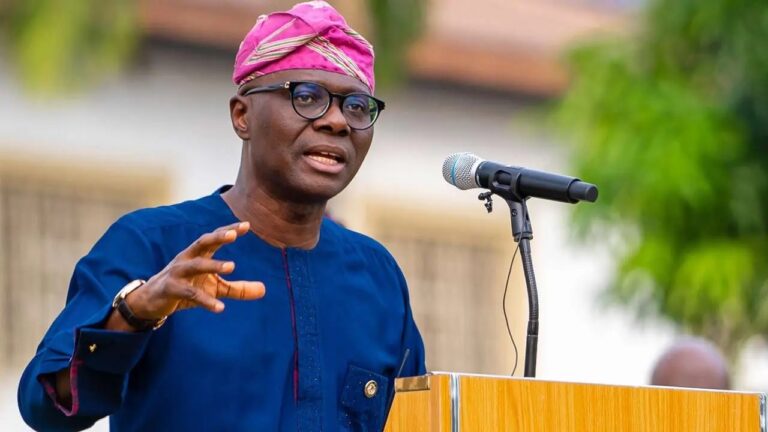
THE Lagos state governor, Babajide Sanwo-Olu, has claimed that the state did not record any incident of bank robbery in the last four years.
Sanwo-Olu made the claim on Tuesday, December 12, 2023 at the 17th Town Hall Meeting on security organised by the Lagos State Security Trust Fund held at the Eko Hotels & Suites, Victoria Island, Lagos.
Sanwo-Olu attributed the development to continuously reviewing the State’s security architecture and surveillance measures.
“Celebrating a milestone in security as Lagos achieves four consecutive years of zero bank robberies, marking a significant improvement in safety across the state.
“Our relentless efforts in enhancing security have yielded results. At the 17th Town Hall meeting on security, we discussed the progress made and strategies to further fortify safety in Lagos State,” the governor said.
CLAIM
Lagos state recorded zero bank robbery in four years.
THE FINDINGS
Findings by The FactCheckHub show that the claim is MOSTLY TRUE.
To verify this claim, our researcher analysed data by National Security Tracker (NST), a project of the Council on Foreign Relations (CFR) that documents data on violent incidents in Nigeria based on media reports. We filtered it to Lagos state and narrowed it to bank-related robberies.
According to the data, there was no reported bank-related armed robbery incident between December 2019 and June 2023 when the data was last updated.
However, only one case of attack on banks was recorded within the period. This occurred in February 2023 when hoodlums in the Epe area of Lagos State attacked some banks. The banks attacked include Zenith, Access and Keystone, the Punch reported. The development led to the temporary shutdown of these banks.
Further review of media reports shows that some men attempted to rob a bank at Oko Oba, Lagos in September 2023. But the attack was unsuccessful as it was foiled by the quick intervention of the Police.
The Punch reported that the suspects were breaking the security doors to gain entry when men of the state police command stormed the scene to prevent the attack.
Moreover, the FactCheckHub could not independently sourced data of bank robbery incident in Lagos state for July – December 2023, as there was no crime statistics available on the National Bureau of Statistics (NBS) website. The most recent crime statistics on NBS was that of 2017.
THE VERDICT
The claim by Governor Sanwo-Olu that Lagos state recorded zero armed robbery in four years is MOSTLY TRUE; a review of NST data has shown.
An image showing the analysis of over-voting in three local government areas of Kogi state has circulated on social media following the conclusion of the off-cycle governorship election held on November 11, 2023 in the state.
According to the viral image retrieved from a WhatsApp group, there was an over-voting of 174,183 votes in Adavi, Okehi, and Okene LGAs.
Part of the caption shared alongside the image read: “Don’t be panic, INEC has asked them to go and balance the result from the central as over voting was discovered.”
The WhatsApp broadcast message added, “See the analysis below from iREV: Total accredited voters 94,233. Over voting 174,183. The difference 79,950.”
Screenshot of the viral image retrieved from a WhatsApp group. INSERT: Mostly False verdict.
The image appears to have originated from members of the opposition parties, giving the impression that the data on INEC’s iReV indicates such an amount of over-voting in the three local government areas. The same image was shared on Facebook as can be seen here.
The INEC Result Viewing portal (IReV) is a platform created by the Independent National Electoral Commission (INEC) in Nigeria to provide real-time transmission of election results from polling units to the central collation centre. It was designed to enhance the transparency of the electoral process and reduce the incidence of vote rigging and election manipulation.
Adavi, Okehi, and Okene LGAs are under Kogi Central, one of the three senatorial districts in Kogi State, where the governorship election was held on Saturday, November 11, 2023.
Hours after polling units were opened for voting across the state, reports emerged online that the election result sheets brought to some of the polling units were found to have been pre-filled. That sparked controversies with the electorate calling for the election umpire’s immediate action.
At 8 pm on the Election Day, INEC released a press statement where it disclosed the suspension of election in the “nine wards in Ogori/Magongo LGA (Eni, Okibo, Okesi, Ileteju, Aiyeromi, Ugugu, Obinoyin, Obatgben and Oturu).”
The Commission added that the other local government areas where related incidents were reported were being “thoroughly investigated, and the outcome, including the way forward, will be announced in the next 24 hours.”
“The Commission has received reports from our officials in Kogi State on incidences of electoral malpractices, particularly the incident of result sheets completed before voting.
“Reports indicate that the incidents occurred in Adavi, Ajaokuta, Ogori/Magongo, Okehi and Okene Local Government Areas. The most serious incidents occurred in Ogori/Magongo, affecting nine of 10 Registration Areas,” parts of the statement read.
However, results from across the polling units where the election was not suspended, were collated at the Kogi State collation centre on Sunday, November 12.
The candidate of the All Progress Congress (APC), Usman Ododo, was declared winner and returned elected with 446,237 votes. His closest rival was the candidate of the Social Democratic Party (SDP), Murtala Ajaka, who polled 259,052 votes. Dino Melaye of the Peoples Democratic Party (PDP) came third with 46,362 votes.
CLAIM
iReV shows over-voting of 174,183 votes in Adavi, Okehi, and Okene LGAs of Kogi state.
THE FINDINGS
Checks by this researcher show that the claim is MOSTLY FALSE.
Over-voting in an election is a situation whereby the total number of valid votes declared for a polling unit is higher than the number of accredited voters for that polling unit. This is captured in Section 51 of the Electoral Act 2022. Sub-sections 1 and 2 of the section state accordingly, “No voter shall vote for more than one candidate or record more than one vote in favour of any candidate at any one election.
“Where the number of votes cast at an election in any polling unit exceeds the number of accredited voters in that polling unit, the Presiding officer shall cancel the result of the election in that polling unit.”
To confirm the veracity of the claim, this researcher checked the INEC’s result viewing portal, iReV, and assessed the uploaded results from the polling units across the three local government areas.
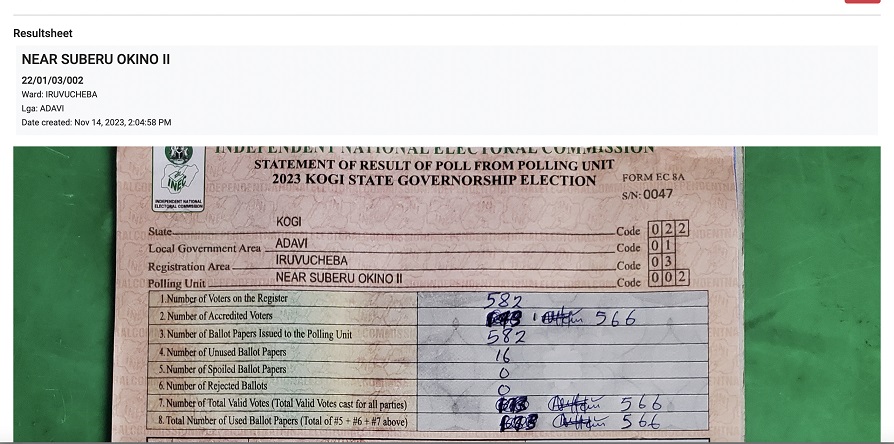
Form EC8A is the result sheet expected to be filled and uploaded to iReV by the Presiding Officer at the Polling Unit. While the form is already pre-filled with the details about the unit, ward, local government, and parties, the PO is required to manually fill in the figures of registered voters, accredited voters, ballot papers issued to the unit, unused ballot papers, spoiled ballot papers, total valid votes, and unused ballot papers. Also, there is a part of the sheet where the votes scored by each party are to be entered with the total of the valid votes.
On the iReV, the uploaded results are categorized by the polling units, wards, and local governments, with the number of accredited voters for each polling unit.
Voters’ Accreditation Data on iReV vs the figures on Form EC8As
The first observation made by this researcher was a notice below the voters’ accreditation figures on the iReV portal, which reads, “Please note that accreditation figures may not be final until synchronization is completed from the devices used in this location.”
This indicates that the number of accredited voters on iReV might not represent the actual figures for some polling units. Subsequent checks by this researcher proved that to be the case for numerous polling units in Adavi, Okehi, and Okene LGAs.
Adavi LGA comprises 11 wards/Registration Areas (RAs) with a total of 217 polling units (PUs). According to the portal, results for all the PUs have been uploaded. However, there were no accredited voters listed for five of the PUs on iReV. The number of accredited voters on iReV aligned with the figures on form EC8As for 22 PUs.
As for Okehi LGA, there are 11 wards and a total of 188 PUs. The portal shows that the results for 187 out of the 188 PUs have been uploaded. Nonetheless, there were no accredited voters for one PU on iReV. The number of accredited voters on iReV matched the figures on form EC8As for about 92 PUs.
Okene LGA has 11 wards with a total of 284 PUs. The portal indicates that the results for 274 out of the 284 PUs have been uploaded. However, there were no accredited voters listed for three PUs on iReV. The number of accredited voters on iReV corresponded with the figures on form EC8As for 6 PUs.
Accreditation Data on iReV Cleared
While assessing the uploaded results on iReV, this researcher observed changes in the accreditation figures on the portal.
Meanwhile, INEC had explained in a statement issued to address the alleged manipulation of accreditation data for Kogi election on iReV, that “the most accurate and up-to-date Voters’ Accreditation Data is available in the Bimodal Voter Accreditation System (BVAS), which is used for the authentication and accreditation of registered voters at various polling units on Election Day. It automatically retains the accreditation data of all voters.”
According to the Commission, the BVAS was designed to work offline without Internet connectivity to aid a seamless accreditation experience for voters. The BVAS is said to automatically export the accreditation data to the Accreditation Backend System (ABS) when its application is in use or active, depending on the strength of its connection to the Internet.
To further justify the changes in the accreditation figures, the Commission explained, “This exportation of data does not happen when the device’s application is inactive or when the internet connectivity is poor. The same experience applies to a situation where more than one BVAS gadget is used at a polling unit with 1,250 registered voters.
Screenshot of Form EC8A for PU 002, Ward 3, Adavi LGA on IReV before the Voters’ accreditation data were cleared.
“At the close of poll, Presiding Officers are expected to press the data exportation button on the BVAS to ensure that all the accreditation data are exported to the ABS. This process, referred to as synchronization and which is ongoing, could lead to changes in the accreditation figures as more data flow in to update the existing figures. This is the basis for the caveat provided on the iReV portal, regarding the accreditation figures. The accreditation data cannot be changed on the BVAS after the close of poll.”
However, at the time of filing this report, this researcher observed that the accreditation figures on iReV have been cleared.
Screenshot of Form EC8A for PU 002, Ward 3, Adavi LGA on IReV after the Voters’ accreditation data were cleared.
Discrepancies in Voting Figures, Blank and Blurry Result Sheets, Other Notable Issues
This researcher observed that the total valid votes for all parties were wrongly calculated on Form EC8As for some polling units. Similarly, while some of the Form EC8As uploaded to the iReV portal were marked with cancellation, some were wrongly captured making them blurry and not visible.
Screenshot of a blurry Form EC8A uploaded to the iReV.
Form EC60(E) was uploaded for three polling units. While an empty Form EC60(E) was uploaded for one of the PUs, the two others had filled sheets without voters’ accreditation figures even though the total valid votes on the sheets matched the accreditation figure on iReV.
Screenshot of Blank result sheet uploaded for PU 20, Ward 8, Okene LGA.
In Ward 2, Adavi LGA, the same Form EC8A was uploaded for PU 1 and PU 2. Also, for a polling unit in Ward 10, the number of accredited voters on the result sheet was higher than the number of registered voters for that unit.
Similarly, in PU 16, Ward 1, Okene LGA, the accreditation figure was higher than the number of registered voters on Form EC8A.
Cases of Over-Voting
This researcher analyzed the information provided on the uploaded result sheets and found that there were some cases of over-voting in some polling units across the three local government areas.
Adavi LGA:
In PU 7, Ward 10, Adavi LGA, the Form EC8A uploaded indicates that the number of total valid votes was higher than the number of accredited voters for the unit.
OKEHI LGA:
The Form EC8As for PU 10, Ward 7, Okehi LGA, indicate that the number of total valid votes was higher than the number of accredited voters for the unit.
The above table shows the breakdown of some over-voting recorded in 7 polling units across Adavi, Okehi and Okene local government areas, according to the available information on the INEC’s iReV portal.
THE VERDICT
The claim that iReV shows over-voting of 174,183 votes in Adavi, Okehi, and Okene LGAs in Kogi state is MOSTLY FALSE; the assessment of available data on the result viewing portal revealed that the cases of over-voting recorded across the three LGAs were significantly below 2,000 votes.
On November 11, 2023, off-cycle gubernatorial elections were held in Bayelsa, Imo, and Kogi states in Nigeria.
The electoral umpire, Independent National Electoral Commission (INEC), pledged to ensure a level-playing field for all political parties and candidates in the elections. The chairman of INEC, Prof. Mahmood Yakubu, noted that the commission is determined to ensure its officials are available at polling units without delay.
These states are part of the eight states that have off-cycle governorship elections held outside of the general election timetable in the country.
INEC cleared 18 candidates in Kogi State, 17 in Imo State, and 16 in Bayelsa State. 5.4m voters registered to exercise their franchise in these states combined.
However, in the buildup to the election, ROUNDCHECKobserved different political actors used disinformation to fuel violence and voter apathy especially in Imo state.
This action could seriously jeopardize democracy, says Silas Jonathan, a fact-checking expert at DUBAWA, a West African fact-checking organization.
“Information holds immense power, and its malicious use could further destabilize the already fragile electoral systems in Africa,” Silas explained.
Agitators push for ‘No Election’ in Imo state
2,419,922 voters were on the voters register for the November 11 Imo State governorship election, as there were 2,318,919 collected PVCs and 101,003 uncollected.
The election was tainted with fear and bodies like the Nigeria Labour Congress (NLC) had previously stated that the governorship election in Imo State is unnecessary because “widespread violence has already planted fear in the electorate and the results of the election may not change anything.”
ROUNDCHECK monitored different social media accounts pushing for no election in Imo state before the poll.
From our monitoring, many of the account handlers were supporters of the Indigenous People of Biafra (IPOB), a nationalist separatist group in Nigeria that aims to restore the Republic of Biafra, a country that seceded from Nigeria prior to the Nigerian Civil War (1967-1970), but later rejoined Nigeria after.
We were able to figure this out from their posts and several engagements on X (formerly Twitter).
IPOB was founded in 2012 in Southeast Nigeria by Nnamdi Kanu, a British-Nigerian political activist known for his advocacy for the contemporary Biafran independence movement, with the purpose of restoring the defunct Biafra. However, one Barrister Emeka Emekesiri allegedly lay claim to being the founder of the group, according to a Vanguard report.
These social media accounts call for no election in Imo state
An X user, Simon Ekpan Deberachi (@Daberec70231502) posted on November 2, that there will be a total lockdown and there will be no election in Imo state.
In his words, “PAY ATTENTION FROM. 9. 10. 11. 12. WILL BE TOTAL LOCKDOWN STAY AT HOME. DONT BLEME ANY BODY WHEN IT HAPPENS TO YOU. IF YOU SURVIVE IT. NO ELECTION IN IMO STATE KNOWS AS BIAFRA LAND”.
This post had 136 retweets and 174 likes and was viewed 3,951 times at the time of this report.
Also, another X user, Simon Ekpa Ekeidemmili Nnobi (@ekeidemmili), posted similar content, calling for no election in Imo state.
In his words “Biafrans in Imo stat, if you love yourself and value your life, respect the 4days Biafraland Lock Down 6 to 6. No Nigeria election in Imo state or elsewhere in Biafraland” [sic]
Also, on November 10, a day before the Imo governorship election, another X user, Promise Land (@chukws18), posted that there would be no election in Imo state, asking people to refrain from voting if they love their lives.
The user’s exact statement read: “We are fully prepared waiting for any Nigeria terorist in Army uniform tomorrow in Biafran land. No Election/ Selection in Imo sit at home if you love your life just leave the road for us Biafra Liberation Army to deal with the terorist who the have send to k!ll our people.”
Coordinated disinformation threatens Imo state election
We checked and saw different actors fueling violence on social media platforms and instilling fear in the minds of Imo electorate.
These activities are also accompanied by disinformation content. Several social media accounts monitored prior to and during the Imo governorship election posted content that threatened electorate to stay indoors and boycott the election.
For example, Alex Igwe (@AlexIgwe15), an X user claimed on November 8, that thugs disrupted INEC stakeholders’ meeting in Owerri. ROUNDCHECKchecked and our findings revealed it was MISLEADING.
A screenshot of the claim posted on X by Igwe. VERDICT: Misleading.
ROUNDCHECK findings revealed that truly INEC stakeholders met in Owerri, the capital of Imo state, but their meeting wasn’t disrupted by thugs as claimed by Alex Igwe.
The meeting which took place on Tuesday, November 7, in Owerri was a stakeholders meeting put together by INEC ahead of the off-cycle governorship elections in Imo, Kogi, and Bayelsa states on November 11, 2023. The meeting had representatives from different political parties.
However, rancor ensued when Kenneth Ukeagu, INEC’s national commissioner for the Southeast, asked the press to leave the meeting hall. This directive didn’t go down well with different political leaders in attendance who walked out of the meeting to express their displeasure. Thus, it was never a thug that disrupted the meeting.
Also, another X user, Simon Ekpa Akparawa (@Akparawasunny), claimed on November 9th that Saudi Arabian jihadists had been brought into Imo state.
A screenshot of the claim posted on X by Akparawa. VERDICT: False.
The post was accompanied by a picture of a military personnel, depicting it as a Saudi Arabian soldier.
The post had 79 comments, 616 retweets, 994 likes, and was viewed more than 14,000 times, as at the time of this report. We checked and found it to be FALSE.
We went forward to check the image and noticed that the image was from a US-trained brigade of special forces soldiers who fought ISIS on the frontline in Mosul, Iraq, according to a 2016 report by UK’s The Sun newspaper.
The elite fighters were part of Iraq’s 1st Commando Battalion which fought against ISIS in the Middle East.
It was also confirmed by another report published by Daily Star same year.
Who is pushing these narratives?
ROUNDCHECK observed that as these misinformation and disinformation narratives spread, fueling violence in Imo state, information was sourced from an actor, who influences the movement of the Biafran agitators. It was observed that people depended on him, shared his narratives, and acted upon his directives.
Simon Ekpa.
Our findings revealed that one person, known as Simon Ekpa was at the center of this disinformation chain. Simon Ekpa, through his various social media accounts, is observed to be the source of these narratives.
Simon Ekpa, a Nigerian-Finnish lawyer, political activist, and former athlete, was born on March 21, 1985, in Ohaukwu Local Government Area of Ebonyi State.
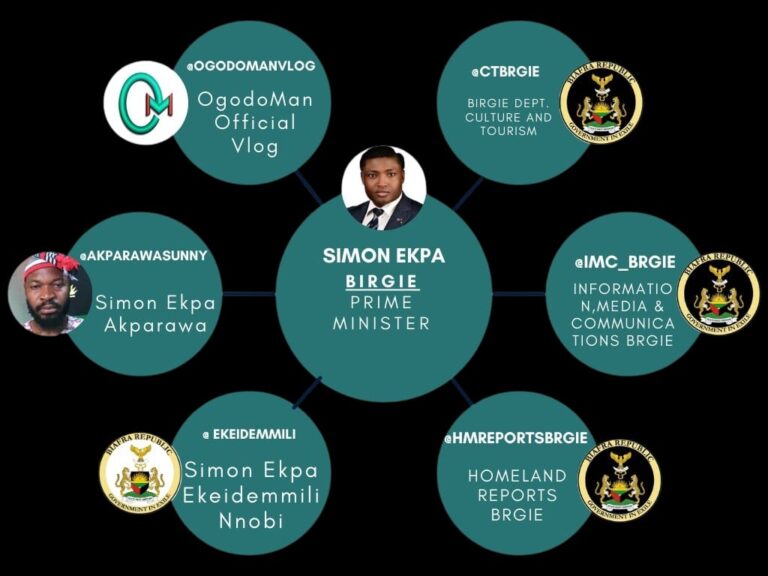
He is the self-acclaimed ‘Prime Minister of the Biafra Republic Government in Exile(BIRGIE)’, a body established to “undertake the political and administrative governance of the Biafran nation from outside the Biafra territory”, with over 60 administrative members.
An emblem of the reported BIRGIE with a collage showing its administrative members.
Simon Ekpa, who is at the center of the disinformation campaign, disseminates information to other Biafran sympathizers on social media who also share it further in a circle of influence operations.
A screenshot of Simon Ekpa’s post published on X on November 2, 2023.
On November 2, 2023, at exactly 8:15 pm, Simon Ekpa through his blue marked X account announced that “there will be no election in Okigwe, Orlu, and Oweri States on November 9, 10, 11, and 12”.
A part of his statement reads: “Biafrans should stay away from Hope Uzodinma’s election. The enemy is at rampage, and Biafra Forces is ready to engage the terrorists caliphate in an unusual manner. We are gravely provoked. Our freedom is costly, but we shall maintain the height of victory. Therefore, the Biafra military deployed and led by Prime Minister Simon has the muscles to quench every aggression of war and defend Bifrans”.
Few days later, this directive was disseminated by his supporters, fueling violence and voter apathy in the state.
Multiple X accounts amplified Simon Ekpa’s posts containing disinformation narratives.
Also, the claim about Saudi Arabia mercenaries in Imo state was first pushed by Simon Ekpa.
False information shared by Simon Ekpa on X on November 7, 2023 which was later amplified by his supporters.
Imo governorship election records low turnout
Hope Uzodinma, the Imo state governor, was re-elected in the November 11 poll. But the state’s governorship election was marred by low voter turnout as reported by media organizations which attributed it to security concerns.
These actors fueled violence and voter apathy through influence operations, thus instilling fear in the minds of Imo electorate.
ROUNDCHECK found all of the claims by these actors as False and Misleading, thus impacting the outcome of the election.
Way forward…
Silas Jonathan noted that unchecked disinformation campaigns have the potential to amplify societal issues, and can cause violence and political divisions.
He called for a comprehensive media and information literacy campaign and collaboration between major tech companies and disinformation experts as a way of exposing and eradicating disinformation trends in the country in general.
“Imposing clear punishments on those undermining democratic processes, particularly during elections, is necessary, and focusing on penalising disinformation rather than mere regulations.
“Journalists should undergo extensive research and skill development to effectively report on and expose these trends, remaining adaptable to technological advancements,” he added.
Murkthar Suleiman, a political expert, noted that for government officials to stop spreading disinformation, they need to start holding themselves accountable.
“To address this issue, I think the government needs to work overtime to promote a Nigerian dream, not just for Nigerians but also for those at the helm of affairs. We need to see them holding themselves accountable to it, too. Calling themselves out when any member of their ‘boys club’ falls below the standard,” he said.
An X account, @AkpraiseMedia, posted a photo showing a young man standing handcuffed amid two policemen with a claim that it shows the student undergoing Industrial Training (internship) at the telecommunication firm, MTN Nigeria Ltd, who purportedly cleared the debt of customers in November 2023.
Earlier in November, many Nigerian users of the network who borrowed airtime woke up to see their debts being cleared by the company. The debts were later reverted few days after.
The claim posted on Saturday, December 9, 2023, reads: “The IT student who allegedly cleared all MTN users debt has reportedly been arrested.”
The post has generated over 1500 reposts and more than 8,500 likes as of Sunday, December 10, 2023.
CLAIM
Photo shows MTN’s student intern who purportedly cleared customers’ debts.
Screenshot of the viral image alongside the claim.
THE FINDINGS
Findings by TheFactCheckHub show that the claim is FALSE.
The FactCheckHub subjected the image to Google Reverse Image search and the results show that the image has been online since 2014.
Findings show that an earlier version of the picture was posted by the Nigeria Police Force (NPF) on November 5, 2014 reportedly showing one Jeffery Ozuka Okafor, a fugitive that fled to Nigeria from the United Kingdom over murder allegations.
Okafor was arrested by Nigeria Police Force on 23rd September, 2014 in Asaba, Delta State, after fleeing the United Kingdom over the alleged murder of one Carl Beatson Asiedu on 1st August, 2009 in London.
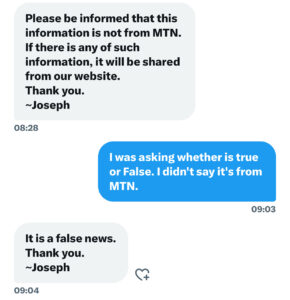
Screenshot of official response from the MTN support via X.
Meanwhile, MTN Nigeria had earlier clarified in a post on X that an unexpected glitch in its system caused the cancellation of debts owed by its network subscribers; meaning that it was not a deliberate action by the company.
The FactCheckHub further contacted the MTN Support on X to further verify the claim. An agent of the telecom company who identified himself as Joseph confirmed that the information is not true.
THE VERDICT
The claim that the image in circulation shows a student intern who purportedly cleared the debts of MTN subscribers is FALSE; findings show that the image shows a murder suspect arrested by the Nigerian police in 2014.
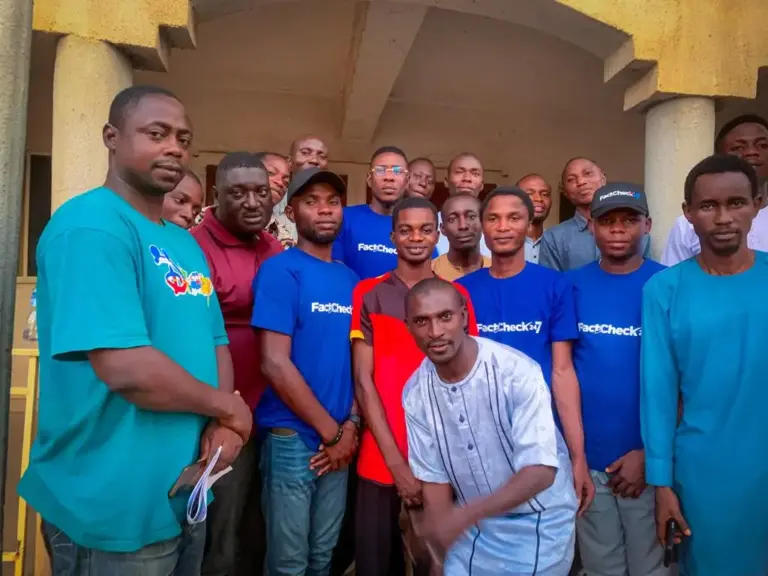
FACTCHECK247, a fact-checking platform in Nigeria, has sensitized members of a Kwara community on the danger of information disorder and the need for a healthy information ecosystem.
The media literacy campaign aims to reduce the dissemination and impact of misinformation at grassroots level by promoting media literacy and responsible information sharing and consumption among citizens in local communities.
According to a report published by the platform, the media literacy advocacy commenced on Monday, December 4, 2023 with a visit to six wards under the Balogun Fulani Constituency in Ilorin South Local Government Area of Kwara State.
In his opening remark, the Chief Executive Officer of The Informant247, the parent company, Salihu Shola Taofeek, stated that the advocacy is geared towards creating awareness about impacts of false information and ensuring a healthy information ecosystem.
He said the outreach aims to equip the community members with media literacy knowledge to minimize the spread of misinformation.
“The media space is awashed with different things and it’s becoming difficult to separate facts from fictions, so we believe that this enlightenment will help people to be aware of the positives and negatives that abound in the social media space,” he said.
Members of the platform took turns to enlighten the participants on the impacts of information disorder and basic verification tools. The grassroot enlightenment is one of the remarkable impacts from the Countering Misinformation and Promoting Media Literacy project (media cohort) organised by the International Centre for Investigative Reporting (ICIR) with the support of the Embassy of the Federal Republic of Germany in Nigeria.
Founded in 2022, FactCheck247 is an independent subsidiary of The Informant247 to combat the spread of fake news in the digital space.
Experts in the information ecosystem have criticized the Nigerian Government’s N24.5 million budget proposal to tackle fake news in 2024, despite its acknowledged threat to democracy and social cohesion.
A look at the breakdown of the budget shows that the ministry of Information and National Orientation have a budgetary allocation of N24.5 million to tackle fake news; this is slightly higher than the N22.6 million budgeted for the cause in 2023.
The funding will support the agencies in facilitating “special enlightenment campaign on government policies and programmes; testimonial series to gauge impact of government policies on the citizenry, advocacy against fake news, hate speech, farmers-herder clashes, banditry, rape etc.”
This was contained in the proposed 2024 budget retrieved from the website of the Budget Office of Nigeria.
Screenshot from Nigeria’s 2024 appropriation bill showing the budgetary allocation to tackle fake news and hate speech menace in the country.
Other budgetary allocations to the ministry shows that the government would spend N40 million to produce calendars; N30 million was voted for external publicity and engagement with foreign media; N20.7 million was voted for media interactions by ministers, influencers, and analysts on print and social media.
The government also said it would spend N21.7 million on the development of social media platforms and networking with other platforms.
The FactCheckHub recalls that the former minister of Information and Culture, Lai Mohammed, had in the 2023 budget defense earlier in November 2022, decried low budget allocated to the ministry to tackle fake news, disinformation, and hate speech across the country.
Mohammed said his ministry was incapacitated in the war against fake news, disinformation and hate speech currently ravaging the nation. But it seems Mohammed’s appeal fell to deaf ears.
The FactCheckHub reported how the menace of information disorder nearly marred the 2023 general and off-cycle elections as politicians and their supporters leveraged on false narratives to pursue their political ambitions.
Media experts working in the information ecosystem have said the budgetary allocation targeted at combating misinformation is insufficient and shows the lack of political will to stem its rise.
Lanre Olagunju, Fact-check Editor at TheCable, said the figure shows lack of readiness by the Nigerian government to sanitise the information ecosystem.
He said: “That figure sounds like a comic relief — a joke. It’s like going for a battle and when the people see the quality of the material you’ve as your arsenal, they can tell if you’re ready for the battle or not. If you are going for a battle and you’re coming with a catapult while your opposition are with something bigger, it’s clear that you’re there for a joke.”
He said the budget is too weak to make any significant impact and shows that the Federal Government is not ready to complement the efforts of fact-checking organizations working hard to minimize the impacts of misinformation and fake news in the country.
“The implications are numerous. The implication can also tell purveyors that they now have a free day; so it can even encourage them which may undermine the efforts of fact-checkers.”
On his part, Silas Jonathan, a fact-checker and researcher with Dubawa said the allocation is insufficient given the profound impacts of misinformation and disinformation in the country.
He said: “the adequacy of this budgetary allocation relies heavily on the strategies and initiatives it intends to support. Notably, while parts of the budget are earmarked for media appearances by ministers, engagement with social media influencers, and substantial funds allocated to various media-related activities, the absence of plans for collaboration with experts to address the fake news challenge raises concerns about the effectiveness of these initiatives.
“Sizable portions allocated for non-core activities, such as N40 million for calendar production, N30 million for external publicity, and N20.7 million for media interactions by ministers and influencers, appear to divert resources from the core issue. This indicates a potential misallocation of funds and raises questions about the government’s readiness to tackle misinformation effectively.
“Moreover, the allocation of N21.7 million towards the development of social media platforms seems somewhat disconnected from addressing the immediate challenge of misinformation. While enhancing online presence is crucial, this allocation may not directly confront the pressing issue of fake news.”
Silas urged the Nigerian Government to ensure strategic use of the limited resources towards initiatives which directly target misinformation in order to enhance government’s effectiveness in addressing this critical issue.
On his part, Ikulajolu Adesola, a fact-checker and Journalist with BBC told The FactCheckHub that the allocation to combat misinformation is not enough and shows that the federal government takes the issue of information disorder with levity.
“Information is a vital sector and the 2024 budget has not provided enough allocation to fight fake news, and this can also be traced to how the previous years were handled. There needs to be nationwide outreach on how to combat fake news and it should be catered for in the budget; but it didn’t receive enough attention in the 2024 budget. We can do better.”
Adesola argued that while the federal government focuses more on clamping down on freedom of speech and information, they fail to invest enough in sensitization and awareness creation.
Zobo, a popular Hausa name given to a drink made from Hibiscus sabdariffa, has been known to have many health benefits and has become part of cocktails at events and parties in Nigeria.
We verify a claim that says drinking Zobo cause miscarriage in pregnant women. WATCH as a medical doctor provides medical facts on this topic below:
Do leave your thoughts/questions in the comment section below.