Home Blog Page 86

No! Video does not show women being attacked in Sudan

0

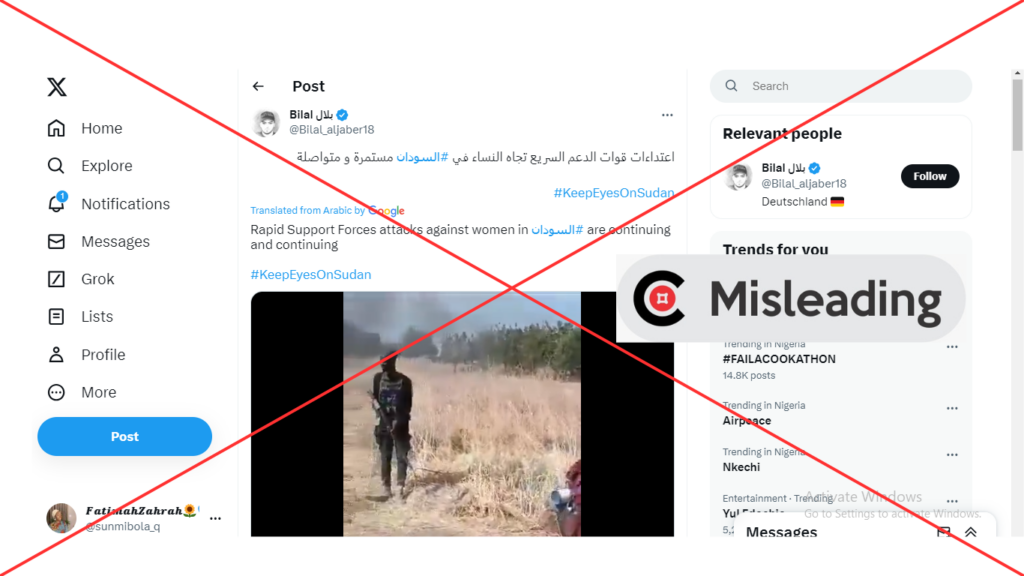
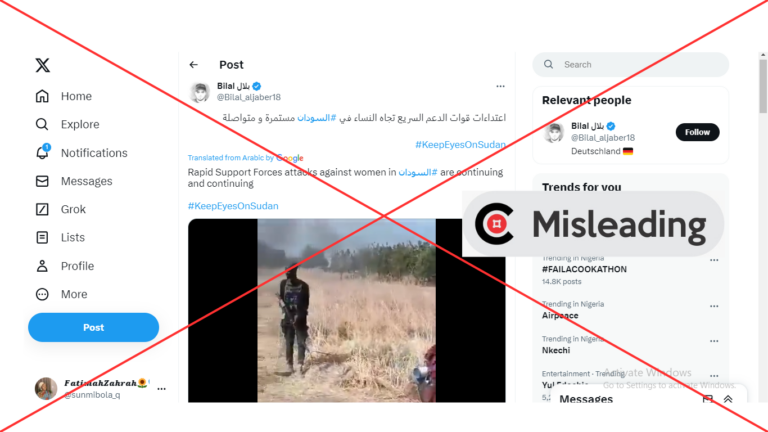
AN X user, @bilal_aljaber18, has posted a video alongside a claim that the Rapid Support Forces keep attacking women in Sudan.

The post was originally written in Arabic but was translated into English by Google Translate.

The seventeen seconds footage was a graphic one as a woman in hijab could be seen running in a bush while she was being kicked by a man in military uniform and surrounded by others and questioned in pidgin English and Hausa ‘’where dem dey’ (redacted) ‘’where dem dey’.

Another woman who had a baby strapped to her back was pushed by the forehead while falling on her back with her baby still strapped.

The video had its caption originally written in Arabic but was translated into English: Rapid Support Forces attacks continuing against women in #السودان (As- Sudan) are continuing and continuing. #KeepEyesOnSudan

The post was made on Friday, December 29, 2023 and has since garnered over 3 million views, over 5,000 reposts and more than 6,000 likes.

Other X users have also posted it as it can be seen here and here. The post has also appeared on YouTube as seen here.

The video was being circulated in respect to the current happenings in Sudan.

In April 2023, a war between the Sudanese Armed Forces under Abdel Fattah al-Burhan and the paramilitary Rapid Support Forces under Hemedti, rival factions of the military government of Sudan, had begun over security force reform during negotiations for a new transitional government.

In a recent investigation, Reuters had reported that young women from the ethnic-African Masalit tribe were sexually assaulted at gunpoint by RSF paramilitary and Arab militia forces during attacks on the city of El Geneina.


CLAIM

Video shows women being attacked in Sudan.

Screenshot of the claim; INSERT, Misleading verdict


THE FINDINGS

Findings by The FactCheckHub show that the claim is MISLEADING! 

The languages spoken in the video, Pidgin English and Hausa respectively,  are languages spoken in Nigeria. The official languages spoken in Sudan are Arabic, Nobiin and English.

A screenshot from the video showing the Nigerian Flag on a soldiers outfit.
A screenshot from the video showing the Nigerian Flag on a soldier’s outfit.

Further findings by The FactCheckHub show that the camouflage is a Nigerian military uniform as a close look at the video showed the Nigerian flag on the sleeves of the military men in the video as seen below. The men were not from the Rapid Support Forces (RSF)  an Arab-dominated paramilitary group in Sudan.

A Google Reverse Image search conducted on the video after being divided into key frame analysis by InVid led us to other versions of the video posted on the same day it was also posted on X. 

The FactCheckHub could not independently verify where the video originated from and where exactly in Nigeria the footage was taken.


THE VERDICT

The claim that a video shows women being attacked in Sudan is MISLEADING; the language spoken in the footage are Nigerian languages and the army uniforms won in the video is a Nigerian military uniform and not in anyway connected to the happenings in Sudan.

Some deep fakes, AI-generated contents to watch out for in 2024

0

ARTIFICIAL Intelligence (AI) can bring about favourable shifts in society, such as higher levels of access to education, better healthcare, and increased productivity.

Even if AI has its advantages, there are significant ethical and societal ramifications that need to be taken into account such as privacy, security, job displacement, and information disorder.

In 2023, a funky picture of Pope Francis wearing a puffy jacket appeared online, marveling a lot of people as people believed it to be real. What most who saw the photo didn’t know was that it was AI-generated.

When individuals are unable to distinguish between AI from reality, issues occur including likely misinformation. Alternatively, when deliberately created AI content is used to deceive people, that is disinformation.

Experts have expressed concerns about the prevalence of AI-generated content and new patterns in which it would be played out in 2024. Some of them include:


1. U.S. Elections

Just like we saw disinformation and misinformation played out in Nigeria’s 2023 general elections, disinformation and AI experts have projected that the use of  AI for misinformation and disinformation would pose a threat to the 2024 U.S. elections and democracy as malicious actors will increasingly use generative AI to spread disinformation which would not only affect the United States but other countries of the world who are looking forward to their elections.


2. Voice-cloning scams and impersonation

Apart from using AI-generative content to amplify misinformation, scammers are also devising new methods of using AI-generative content to defraud people of their monies. The old style of scammers calling and pretending to be a relative or friend has gone a step further as scammers now use AI to clone the voices of individuals in order to scam people.

This also plays out on social media as scammers now use AI-generated images of women and AI-generated texts to steal money from people on dating and social media apps. 

Apart from using AI-generated content to scam people, it is also being used to impersonate people.

Egemba Chinonso Fidelis, a popular Nigerian doctor and social media influencer, was impersonated with AI in September 2023. As a Facebook page (archived here) had posted deepfake videos of him advertising a cream that cures joint pain and arthritis.

Dr Fidelis disclosed this weeks after the video had gone viral stating that it was a video of him when he just had his surgery earlier in the year that was manipulated.

This also happened during the recent off-cycle governorship elections in Nigeria as a deepfake video of the People’s Democratic Party (PDP) gubernatorial candidate in Imo state, Samuel Anyanwu, claiming to have stepped down from the race and declaring his support for the All Progressives Congress (APC) candidate, Hope Uzodinma, went viral until the PDP candidate debunked the claim.


AI cyber-bullying and cyber harassment

Cyber-bullying and cyber harassment often manifest as a form of fake news.  It employs tactics such as rumours, post-truths, lies and sometimes mal-information. Politicians, government officials and public figures are most times victims of cyber-bullying, which we saw played out in the previous Nigerian elections. 

Cyber-bullying might take a different turn in 2024 as AI-powered tools are already being used by social media trolls to magnify their abusive messages and more readily target people who are easily sensitive. AI intensifies cyber-bullying by creating realistic fake content, posing a heightened threat to young individuals and their families.

While it is being used by malicious actors for cyber-bullying, AI tools can also be used to prevent cyber-bullying by detecting and correcting several forms of cyber-bullying to mitigate the harmful effects of cyber-bullying in online forums, social media apps and websites.


Way forward…

In October, media reports stated that the National Broadcasting Commission (NBC) sent a bill to the National Assembly seeking to repeal and re-enact the NBC Act, CAP L11 laws of the Federation of Nigeria (2004), to enable the NBC to regulate social media when passed.

The Nigerian government had earmarked a budget of N24.5 million to the ministry of Information and National Orientation to tackle fake news out of the  N27.5 trillion for the 2024 fiscal year.

The funding is expected to support the agencies in facilitating “special enlightenment campaign on government policies and programmes; testimonial series to gauge impact of government policies on the citizenry, advocacy against fake news, hate speech, farmers-herder clashes, banditry, rape etc.”

The FactCheckHub reports that experts had stated that the budget allocation targeted at combating misinformation was insufficient and shows the lack of political will to stem its rise.

The report added that the Federal Government was not ready to complement the efforts of fact-checking organizations working hard to minimize the impacts of misinformation and fake news in the country which could be deduced from the goal outline of the ministry as the fight against the increasing prevalence of misinformation and disinformation, including AI-generated content and deep fakes.

Kunle Adebajo, a fact-checker and Investigations Editor at Humangle noted that it is the responsibility of lawmakers, regulators, and tech corporations to ensure that the distinction between reality and fiction is not entirely blurred.

“The thing with artificial intelligence technology is that it is getting better at an exponential rate. And it is almost impossible to distinguish between content that is generated by AI and that which is made by humans,” Adebajo stated.

He added: “Some of the loopholes fact-checkers look out for in generative AI material are getting ironed out as updates are made to the applications. What this means is that the burden of ensuring the line between fact and fiction is not muddled completely now lies with the regulators, policymakers, and tech companies.”

He said that although it could be used in a lot of positive ways, it could also be used in nefarious activities if not regulated properly.

“If more and more people have easy access to advanced deepfake technology, yes it could be used in a lot of positive ways. But it will also be used for fraud, cyber crime/warfare, unethical propaganda, and to spread hate speech and misinformation. We’ve already seen some examples of this and it will only get worse unless drastic measures are taken,” he said.

Nikon, Sony and Canon to fight deepfakes with latest camera technology

0

THREE leading camera companies including Sony, Nikon, and Canon are collaborating to combat deepfakes by adding digital signatures to images captured with their equipment.

Nikkei Asia reports that these signatures will include information like the date, time, place, and photographer and that they are resistant to alteration.

A worldwide standard for these signatures has been agreed upon by the three companies. They will offer mirror-less cameras with authentication technology for photojournalists and other professionals.

The report noted that the technology development was necessary due to the increasing prevalence of deepfakes.

“Such efforts come as ever-more-realistic fakes appear, testing the judgement of content producers and users alike. Deepfakes of former U.S. President Donald Trump and Japanese Prime Minister Fumio Kishida went viral this year,” part of the report read.

The report added that a free online tool called Verify has been made available for picture verification by a coalition of major news outlets, tech firms, and camera manufacturers. The website shows the date, location, and other credentials if an image has a digital signature.

In addition, Sony will release in the spring of 2024 technology to incorporate digital signatures into three professional-grade mirror-less SLR cameras via a firmware update. The company is considering making the technology compatible with videos as well.
The report further stated that when a photographer sends images to a news organization, Sony’s authentication servers would detect the digital signatures and determine whether they are AI-generated.
Sony and Associated Press field-tested the tool in October. Sony will expand its lineup of compatible camera models and lobby other media outlets to adopt the technology.
A camera with similar features is scheduled for release by Canon. The business is also creating technology that enables digital signatures to be added to videos and an image management app to tell whether images are taken by humans.
In addition to marking images as real images, some other companies are looking at ways of identifying AI images as well. Last year, Intel developed a way to to determine whether an image was real by analyzing skin color changes. In August 2023, Google also released a tool to add invisible watermarks to AI-generated images.
Similarly, Google Search has built-in tools to help you find high-quality information and make sense of what you’re seeing online. In a blog post in October 2023, it also listed three new ways to check images and sources online.

New study reveals increasing sales of X gold badge on dark web platforms

0

A study by CloudSEK, a cybersecurity firm, has revealed that there is an increase in sales of compromised X accounts with the Gold verification badge on dark web marketplaces and forums.

The study titled: Gold Rush on the Dark Web – Twitter Gold noted that the ease of obtaining a Gold checkmark on X (formerly Twitter) has attracted malicious actors to purchase and compromise accounts to further their nefarious activities.

It further stated that threat actors can use Twitter Gold verified accounts to spread disinformation, conduct phishing attacks, and steal users’ sensitive data, which puts both individuals and organizations at serious risk.

“A hacked or compromised Twitter account can be exploited to mass spread phishing campaigns. This, in turn, damages the reputation and brand of the company whose account was compromised, clearly displaying a lack of stringent security policies and a weak incident response plan,” part of the report read.

X Gold is a premium feature that was introduced in 2023. It gives accounts a gold badge in addition to the blue and grey tick, which represents authority and brand awareness.

According to the research, these types of accounts are widely accessible for purchase on dark web platforms, with prices ranging from $35 for a basic account to $2,000 for accounts with substantial followings.

To get access to these accounts, threat actors are employing techniques like brute-forcing passwords and credential theft. After being obtained, the accounts are then used for a variety of nefarious activities, such as phishing, scam activities, and impersonating real accounts.

“When an unused and inactive account is replaced with threat actors’ data, the primary user is locked out from recovering the account. Once a complete account takeover occurs, the threat actor subscribes to the Twitter Gold package for 30 days.
“The service package offered by the threat actors ensures that the buyer has no hassles with the account for 30 days, and in the meanwhile, the scam campaign has achieved its goal through that account,” the study highlighted.
Citing an example of Vitalik Buterin, the co-founder of Ethereum, falling victim to a cyber attack that compromised his X account in September 2023, the report stated that the perpetrators seized control of Buterin’s profile and exploited his large following by posting a deceptive message offering free non-fungible tokens (NFTs) to unsuspecting users.
The malicious link embedded in the tweet directed users to a fake website designed to drain cryptocurrency from their wallets. Despite being active for about 20 minutes, the hackers managed to siphon off a staggering $691,000 digital assets before removing the fraudulent post.
The report also offered some recommendations for reducing hazards in organizations. It suggests educating and training staff members on workplace cybersecurity procedures while adding that password regulations should be updated, such as by routinely changing account passwords, and employees should be made aware of the risks associated with using cracked software.

Video does not show Shettima visiting terrorists

0

A video showing Nigeria’s Vice President, Kashim Shettima, exchanging pleasantries with some tribal Fulani men has resurfaced online with a claim that it shows the vice president during a visit to some terrorists. 

An X user, @Nwaadaz, posted the claim with a caption that read: 

“Watch the video of Kashim Shettima hanging out with Fulani terrorists. More reason why Terrorists are attacking Christian States in the North. RIP Nigeria.” 

A text inscription on the video itself read: Nigerian vice president elect caught visits bandits.

The post has generated over 26,000 views, more than 1,000 reposts and over 900 likes as of January 6, 2024. 

Another X user, @official_south, also posted the same video which is getting engagement too.


CLAIM

Video shows Nigeria’s Vice President, Kashim Shettima, visiting terrorists.

Screenshot of the post on X. INSERT:  Misleading verdict.
Screenshot of the post on X. INSERT: Misleading verdict.


THE FINDINGS

Findings by The FactCheckHub show that the claim is MISLEADING. 

FactCheckHub unraveled the source of the video using keywords search and the result shows that the video has been online since 2017 and largely taken out of context. 

The video was posted by Shettima on his Facebook account in June 27, 2017 when he was the governor of Borno State. 

Shettima said the video shows when he went to inspect Lamisula Primary School in Maiduguri, Borno state where they were facilitating the construction of classrooms. 

His post read, “Yesterday, I paid inspection visit to Lamisula Primary School where we are presently constructing new classrooms and fortunate enough, I met these well dressed Fulani men.

“Although I am impressed by their love for fashion but I’m not yet convinced that they are due for freedom until they abstain from carrying mirror in their pockets.

“The Fulanis should not forget that the Kanuris are still their masters and will continue to be their masters forever.” 

This is not the first time the vice-president has been falsely linked to terrorists. A viral photo falsely depicting him dining with bandits had earlier gone viral, but findings revealed that it captured a moment when he visited nomadic Fulani to encourage them to enrol their children in the state government’s free educational programme during his tenure as Governor of Borno State.


THE VERDICT

The claim that the video shows Nigeria’s Vice President, Kashim Shettima, visiting terrorists is MISLEADING; findings show that the video has been online since 2017 and depicted when Shettima visited a primary school in Maiduguri.

Partisan biases increase vulnerability to fake news – Study

0

A study published on Frontiers in Psychology has shown that while news media literacy helps individuals recognize and doubt news from unfamiliar sources, strong partisan biases can make people vulnerable to fake news. 

The study titled: True, justified, belief? Partisanship weakens the positive effect of news media literacy on fake news detection aimed to examine how people judge the accuracy of news content in the digital age.

“Understanding what improves detection of misinformation and disinformation is of global concern. A great deal of high-quality research has suggested that technological factors, such as a chaotic social media environment, can lead to quick, surface-level, consideration of new information,” said the author Daniel Sude, a visiting assistant professor at George Washington University.

“We believed, however, that the problem went deeper than that. Drawing on social-cognitive psychology and communication science, we argued that even people who want to process more deeply may do so in biased ways. Even people who are aware of their potential for bias may have difficulty truly correcting for that bias.”

“Further, we disputed the notion that mere detection of “fake news” should be society’s goal. Even a broken clock is right twice a day. We wanted to know what led people to be justifiably skeptical of content from unfamiliar news outlets, even if this content turned out to be true. Believing true information by accident, or rejecting false information by accident, is not, in our minds, sufficient. We want to know what leads people to take their time and patiently come to, hopefully correct, conclusions. Our two-study paper is just one of many tackling that question.”

The study involved two separate participant groups, with 1,008 individuals in the first study and 1,397 in the second. These participants were recruited through Qualtrics, a platform that facilitates online surveys. To be eligible, participants needed to be eligible voters in the United States and be aware of the potential exposure to misinformation on the web.

Participants viewed Facebook-like news posts with standard social media elements, including a logo, headline, image, and news organization URL. The method, according to the researchers, was to ensure experimental control and preserved ecological validity for real-world applicability.

The first part of the study focused on politically consonant fake news content. The participants were shown news posts that included content supporting their political leanings. For example, a politically consonant fake news headline for Democrats was: “Trump Say Republicans Are the ‘Dumbest Group of Voters.’”

The participants were also shown other types of content such as politically dissonant fake news and apolitical fake news. This mix was intended to obscure the primary purpose of the study and mimic the diverse content typically encountered on social media. The news posts were attributed to various news outlets, including both mainstream and alternative media sources.

The second study replicated and extended the approach of the first, but with a focus on real news headlines instead of fake news. The real news headlines were also attributed to a mix of mainstream and alternative news outlets, and the study aimed to differentiate impressions of the content from impressions of the outlets themselves.

The researchers controlled for a range of factors that might influence how participants interacted with the news content, such as information literacy, political interest, trust in news media and various institutions, reliance on intuition for assessing facts, the need for evidence in forming beliefs, perceptions that truth is influenced by politics, belief in conspiracy theories, and the extent of news exposure.

The study revealed that content from less recognized news sources was generally seen as less accurate than mainstream outlets, indicating natural skepticism towards unfamiliar sources.  However, for individuals with strong political biases, the study shows that the relationship is reversed, with political leanings influencing vulnerability to misinformation. 

According to the study, higher news media literacy generally enhanced discernment of source credibility, but this effect was not consistent for strong partisans. The findings emphasize the need for multi-faceted interventions addressing both news media literacy enhancement and partisan biases in combating fake news spread. 

The authors encouraged designing interventions that improve both accuracy and critical thinking about accuracy.

Viral images of bridge in circulation are that of Rivers’ Garrison flyover bridge, not Ebonyi

0

AN X user @africafactszone, has posted a photo collage containing four images including that of flyover bridge and road with a claim that suggests they are in Ebonyi state, Nigeria.

In the post made on December 30, 2023 but which is still going viral, the X user inferred that the bridge is situated in Ebonyi state in Nigeria.

AfricaFactsZone, according to its bio on X is a page that posts facts about Africa and the world. It also claims that it is the most up-to-date facts platform.


CLAIM

Images show flyover bridge in Ebonyi state.

Screenshot of the claim; INSERT misleading verdict
Screenshot of the claim, as posted on X. INSERT: Misleading verdict

THE FINDINGS

Checks by The FactCheckHub show that the claim is MISLEADING!

A Google Reverse Image search conducted on the image showed that the bridge is not situated in Ebonyi state; rather, it is the Rebisi flyover bridge also known as Garrison flyover bridge situated in Port-Harcourt, Rivers state.

According to media reports, the construction of flyover bridge commenced in 2019 by the then governor of Rivers state, Nyesom Wike, but it was unveiled in 2020 by Babatunde Fashola, the then minister of Works and Housing.

The Rebisi (Garrison) flyover bridge is a 969.4 meters-long dual carriage flyover bridge.

Further findings showed that the Ebonyi state government had commissioned a flyover bridge in February 2023 in Afikpo South local government area of the state linking Ebonyi State to Abia, Cross River and Akwa Ibom states.


THE VERDICT

The claim that the images show flyover bridge in Ebonyi state is MISLEADING; the bridge is situated in Port-Harcourt, Rivers state.

Five financial scams to be wary of in 2024

0

IN November 2023, an X user, @ElsaVanilla raised an alarm about the manipulative actions of Iriodalo Emmanuel Obhafuoso, a young man who fraudulently solicited money from multiple Nigerian women on the social media app under the guise of an alleged serious illness.

“This is Iriodalo Emmanuel Obhafuoso. He is a scammer. He enters girl’s dms, makes them comfortable talking to him and then proceeds to fall deathly ill. For me, he had a heart surgery. For Bolu, he had a spinal surgery,” she said in a post.

Following her post, several other Nigerian women began to come out to narrate their experiences of how they were seduced and unsuspectingly duped by the suspected fraudster who employs social engineering in manipulating individuals into giving out their fortunes.

Iriodalo’s primary targets are typically women in their twenties. He establishes a connection with them through charming messages, followed by falsely claiming to suffer from a serious illness, such as heart disease.

This kind of scam is called romance scam and it is one of the many ways Nigerians lost their hard-earned money in 2023.

Financial scams have been around for a long time, but in recent years, they have become increasingly sophisticated. This article highlights some financial scams you should be wary of as we navigate the new year.

1. Romance scam 

Despite being a good platform for finding companionship, online dating apps and social networking sites are increasingly used by scammers to perpetrate financial fraud. Romance or dating scam has been defined as creating a fake profile to attract someone online.

Fraudsters befriend victims over the internet in the hope that they can get them to send money. Many Nigerian fraudsters called “Yahoo Boys” use this method to defraud foreign citizens. They use fake names and fake images to seduce people and defraud them of their hard-earned money. The Idalo’s case shows that several Nigerians might have been falling victim to this trick.

West Africa, particularly Nigeria, emerges as a global epicentre for these online romance scams, according to a 2023 study by Social Catfish, an online dating investigation company. Titled ‘State of Internet Scams 2023,’ the report identified developed nations like the US as prime targets due to their strong economies, tech-savviness, and bustling financial activity.

Similarly, a study conducted by Techshielder in 2021 ranked Nigeria as the second most notorious country in the world for romance scams, next to the Philippines.

Every year, the Economic and Financial Crimes Commission (EFCC) record a large number of arrests and convictions for romance scams but many people are still falling for the scammers’ favourite lies.

2. Investment scam/Ponzi scheme

This is a type of scam where people will be asked to invest a certain amount in a business with the pledge that their investment will be multiplied within a certain time frame. In some cases, they create a website or app to deceive people that they are engaging in virtual trading, they reward a few people to lure several others to join and afterwards, the website will reportedly crash.

Examples of such schemes include MMM, GMG, Loom and eBay, where many Nigerians have become victims. These platforms promise substantial returns, enticing many Nigerians to invest their money. However, after gathering a significant number of participants, they vanish with their money.

Their method involves paying earlier investors with the funds contributed by new investors, rather than generating legitimate profits. Referrals play a crucial role in these schemes, as participants are often required to invite a specified number of people before accessing their returns. As more people join, the operators struggle to meet payment obligations, leading to the inevitable collapse of the scheme.

3. Giveaway/Lottery scam 

Phishing scams remain the top most dangerous scam to avoid in 2024. This is a social engineering technique used to deceptively obtain people’s sensitive information or data. People are directed to enter their information on a website that looks legitimate.

Over time, The FactCheckHub have debunked several of such claims hiding under the guise of recruitment, support funds, empowerment programmes, government activity or free internet data. They often target subjects and issues that are of interest to the public. For instance, in 2023, the election was one of the major events we debunked several claims about politicians sharing money. These are mostly perpetuated by scammers.

4. Accounts infringement/Hacking 

Internet fraudsters often commit fraud by hacking people’s social media accounts.  After gaining access to their accounts, they send messages to their contact list that they are in need of money. One of the best ways to avoid this is to create a strong password for your social media accounts and secure them with two-factor authentication. If you feel like your accounts have been hacked, find a way to notify your followers about it immediately you notice.

5. Impersonation/Identity theft

This can come in various forms. Sometimes, fraudsters create social media accounts using the profile and image of a highly respected public figures like celebrities, politicians and business tycoons to defraud innocent people.

They use the account to message you on social media, and you will be told that they are considering you for a specific opportunity or appointment or wish to do business with you. Then, you will be asked to pay a certain amount to claim the opportunity or appointment.

For example, earlier this year, the Economic and Financial Crimes Commission arrested Charles Osaigbovo and Evans Obayaedo, both Oyo State residents for defrauding an unnamed British woman of £38,000 (pounds) after impersonating Fredrick Leonard, a Nollywood actor and movie producer. The duo obtained the money for the production of a non-existent film.

According to the EFCC, investigations revealed that Osaigbovo and Obayaedo, who were arrested in Ibadan, had been impersonating Leonard to defraud unsuspecting social media users.

Fraudsters also impersonate bank workers. They call to tell you that they need details of your bank accounts in attempt steal your personal details like BVN, Passwords, and ATM PIN, among others. Nigerian banks have made this clear umpteenth time that they don’t ask for the personal information of customers via phone call or SMS.

CONCLUSION

Financial scams can be devastating for individuals especially with the current economic situation complicated by recent high inflation and removal of subsidy. Scams can cause people to lose their savings and enter debts. In some cases, victims feel embarrassed or ashamed to report the scam.

To protect yourself from financial scams, it is essential to be vigilant and take proactive steps to secure your finances. As we enter the new year, ensure that you secure your social media accounts by using strong passwords and two factor-authentication.

Never invest in any business without conducting thorough investigation into their modus operandi. Never send money to anybody without physical confirmation and ensure that you conduct routine searches of your name and images to ensure that you are not being impersonated.

Video does not show Osun governor, Adeleke dancing half-naked

0

A video showing a man wearing a traditional cap with a wrapper has circulated online with a claim that it shows the governor of Osun state, Ademola Adeleke, dancing to a music in a room. 

A verified X account, @JustKingss posted the video with a caption that read: “Is this not Davido ‘s uncle, Governor Adeleke ??” 

The post has generated over 340,000 views, more than 300 comments, over 300 reposts and more than 2,200 likes as of January 3, 2023. 

Another X account, @Tiwa_Memedia posted the same video with a similar caption thus:  “Osun state governor, y’all.” 

The FactCheckHub also observed that the video has circulated widely in multiple WhatsApp groups; thus, we found it worth debunking, due to its virality.


CLAIM 

Video shows Osun state governor, Ademola Adeleke, dancing half-naked in a room. 

Screenshot of the claim alongside the video posted on X. INSERT: False verdict.

THE FINDINGS 

Findings by The FactCheckHub show that the claim is FALSE. 

Ademola Adeleke, who is the current governor of Osun State, is known for his love of entertainment especially music and dancing. 

Adeleke used to be fondly called ‘the dancing senator’ when he was a lawmaker due to his energetic dance displays in public, many of which went viral on social media.

Critics have been using this to label him unfit for the serious task of governance, even though his supporters believed such a trait showed that he would be socially accessible by all.

Screenshot from the video posted on X.

During a recent interview on ARISE TV on Wednesday, December 27, 2023, the 63-year-old politician who is an uncle to the famous artiste David Adeleke also known as Davido said he would have been a musician and not a politician if he was not discouraged by his father.

“Actually, I was supposed to be a musician right away. But my father, when we were growing up in the sixties, didn’t allow it,” he said.

The FactCheckHub conducted a thorough examination of the extended version of the viral footage to identify the individual therein. It was observed that the person depicted is not Governor Adeleke, despite a few resemblance in terms of physique.

The viral footage circulating on social media is a short and back-view clip. However, the full video shows a totally different face which indicated that the person is not the governor. In addition, Adeleke is fairer in complexion and chubby than the man in the viral video. 


THE VERDICT

The claim that the viral video shows the governor of Osun State, Ademola Adeleke dancing half-naked is FALSE; it was observed that the man in the video has physical features unrelated to that of the governor.

Video does not show DR Congo election commissioner being beaten and stripped

1

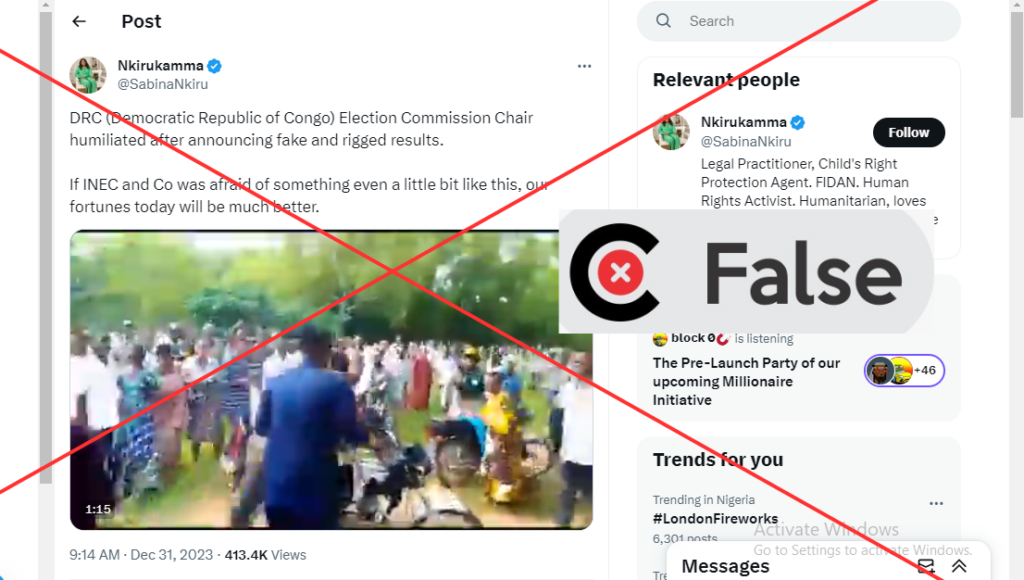
AN X user, Nkirukamma (@SabinaNkiru), has posted a video of a woman being lynched and beaten by a mob.

She claimed that the woman in the video is the Democratic Republic of Congo (DRC) election commission chair and that she was beaten up after allegedly announcing rigged results.

The video caption read thus: DRC (Democratic Republic of Congo) Election Commission Chair humiliated after announcing fake and rigged results. If INEC and Co was afraid of something even a little bit like this, our fortunes today will be much better.

In the 83 seconds footage, a woman could be seen being beaten and stripped by a mob. At some point, she tried to flee by walking away from the scene but was apprehended again and further stripped and beaten by the angry mob.

The video, posted on Sunday, December 31, 2023, has garnered over 700,000 views, more than 3,000 likes, over 1,000 comments and more than 2,500 reposts as of Wednesday, January 3, 2024.

Al-Jazeera reports that the preliminary results of the DR Congo presidential election conducted on December 20, 2023 was announced on December 31, 2023 which saw the nation’s current president, Felix Tshisekedi, re-elected into power.


CLAIM

Video shows DR Congo election commission chairperson being beaten and stripped.

Screenshot of the claim; INSERT, False verdict
Screenshot of the claim posted on X. INSERT: False verdict.

THE FINDINGS

Findings by The FactCheckHub show that the claim is FALSE!

A search conducted on Google search engine to identify the chairperson of the election commission in DR Congo showed that the person in charge is Denis Kadima Kazadi, a male.

Kazadi has been in charge of the DR Congo’s Independent National Electoral Commission otherwise known as Commission électorale nationale indépendante (CENI) since he was appointed by Felix Tshisekedi in October 2021.

Although, The FactCheckHub could not independently verify the identity of the woman been beaten in the footage, the video had appeared on X few days after the election as seen here and here alongside captions that say the woman was being beaten for voting for Moise Katumbi, candidate of the opposition party.

Reports stated that the election was characterized with electoral violence which resulted in the opposition party demanding for a re-run election.


THE VERDICT

The claim that the video shows DR Congo election commission chairperson being beaten and stripped is FALSE; the person in charge of the Commission électorale nationale indépendante (CENI) is Denis Kadima Kazadi, a male and not a woman as sighted in the footage.