Home Blog Page 79

AI may fuel dissemination of climate disinformation – Report

0

A new report has warned that the proliferation of large-scale Artificial Intelligence (AI) models may lead to a surge in falsified information concerning climate change online.

The report which was released on March 7, 2024 by members of a global coalition detailed “significant and immediate dangers” that artificial intelligence poses to the climate emergency.

According to the report, the AI models have enabled climate deniers to create and disseminate persuasive false content more easily and rapidly across various online platforms, including social media, targeted advertising, and search engines.

“Fossil fuel companies and their paid networks have spread climate denial for decades through politicians, paid influencers and radical extremists who amplify these messages online.

“In 2022, this climate disinformation tripled on platforms like X. In 2023, amidst a number of whale deaths on the east coast of the US, right wing media began spreading the false claim that offshore wind projects were impacting the endangered populations.

“It was included in 84% of all posts about wind energy over the relevant three-month period, and was advanced by right wing politicians on social media. In 2023, the Danish company, Orsted, while claiming the disinformation campaign was irrelevant, pulled out of a major project to build two wind farms off the coast of New Jersey.

“Generative AI will make such campaigns vastly easier, quicker and cheaper to produce, while also enabling it to spread further and faster. Adding to this threat, social media companies have shown declining interest in stopping disinformation, reducing trust and safety team staffing. There is little incentive for tech companies to stop disinformation, as reports show companies like Google/YouTube make an estimated $13.4 million per year from climate denier accounts.”

“Disinformation campaigns about climate change have a number of new AI tools to help them be more effective. Chair of the Federal Trade Commission, Lina Khan, warns that “generative AI risks turbocharging fraud” in its ability to churn out content. Instead of having to draft content one piece at a time, AI can churn out endless content for articles, photos and even websites with just brief prompts,” part of the report stated.

The report raised concerns over the advancements in generative AI technology, such as deepfake videos and persuasive text generation which has further enhanced the effectiveness of disinformation campaigns reflecting on how these tools have been used to create convincing fake content, including politically charged material and even pornography, thereby undermining trust in information and exacerbating political divides.

According to the report, even though some AI companies said they would address the situation in advance of the upcoming 2024 elections around the world by developing policies that might prevent bad actors from producing disinformation content, past efforts proved largely ineffective.

“Open AI claimed its ChatGPT-4 was “82 per cent less likely to respond to requests for disallowed content and 40 per cent more likely to produce factual responses,” but testers in a March 2023 NewsGuard report were still able to consistently bypass safeguards.

“They found the new chatbot was in fact “more susceptible to generating misinformation” and “more convincing in its ability to do so” than the previous version. They were able to get the bot to write an article claiming global temperatures are actually decreasing—just one of 100 false narratives they prompted ChatGPT to draft,” it noted.

The report urged the government to urgently study the problem and implement comprehensive AI regulations to fully understand the threats to climate change and protect against them, using a systems-wide approach to the health, integrity and resilience of the information ecosystem.

The coalition also called for collaboration between the government, companies, academia and civil society to work together to determine how to create “green AI” systems that reduce overall emissions and climate disinformation. 

“Tech companies implementing AI must commit to strong labour policies including: fair pay, clear contracts, sensible management, sustainable working conditions and union representation,” the report suggested.

Despite policies, AI-tools still generate misleading election-related images – Report

0

IMAGE creation tools powered by artificial intelligence from companies including OpenAI and Microsoft can be used to generate images that could promote election or voting-related disinformation, despite their policies against creating misleading content, a report by the Centre for Countering Digital Hate (CCDH) has shown. 

In the report published on March 6, 2024, the non-profit organization used generative AI tools to create images of U.S. President Joe Biden laying on a hospital bed and election workers smashing voting machines, raising worries about falsehoods ahead of the U.S. presidential election in November.

“The potential for such AI-generated images to serve as ‘photo evidence’ could exacerbate the spread of false claims, posing a significant challenge to preserving the integrity of elections,” CCDH researchers said in the report.

CCDH tested OpenAI’s ChatGPT Plus, Microsoft’s Image Creator, Midjourney and Stability AI’s DreamStudio, which can each generate images from text prompts.

The report follows an announcement last month that OpenAI, Microsoft and Stability AI were among a group of 20 tech companies that signed an agreement to work together to prevent deceptive AI content from interfering with elections taking place globally this year. Midjourney was not among the initial group of signatories.

CCDH said the AI tools generated images in 41% of the researchers’ tests and were most susceptible to prompts that asked for photos depicting election fraud, such as voting ballots in the trash, rather than images of Biden or former U.S. President Donald Trump.

CCDH researchers tested 160 prompts on ChatGPT Plus, Midjourney, DreamStudio, and Image Creator, and found that Midjourney was most likely to produce misleading election-related images, about 65 per cent of the time. Researchers were able to prompt ChatGPT Plus to do so only 28 per cent of the time.

“It shows that there can be significant differences between the safety measures these tools put in place,” says Hood. “If one so effectively seals these weaknesses, it means that the others haven’t really bothered.”

The report shows that Midjourney, Microsoft’s Image Creator, and ChatGPT Plus all have specific policies about election disinformation and yet, failed to prevent the creation of misleading images of voters and ballots.

The researchers recommended responsible safeguards by the tech companies to prevent users from generating images, audio, or video that are deceptive, false, or misleading about geopolitical events, candidates for office, elections, or public figures. 

They also urged them to invest and collaborate with researchers to test and prevent ‘jailbreaking’ before product launch and have response mechanisms in place to correct the jailbreaking of products. 

The report also called for clear and actionable pathways to report those who abuse AI tools to generate deceptive and fraudulent content.

To prevent election disinformation, the researchers recommended gatekeeping to prevent users from generating, posting, or sharing images that are deceptive, false, or misleading about geopolitical events and impact elections, candidates for public office, and public figures. 

They also recommended investment in trust and safety staff dedicated to safeguarding against the use of generative AI to produce disinformation and attacks on election integrity.

They finally urged policymakers to leverage existing laws to prevent voter intimidation and disenfranchisement and pursue legislation to make AI products safe by design, transparent, and accountable for the creation of deceptive images which may impact elections.

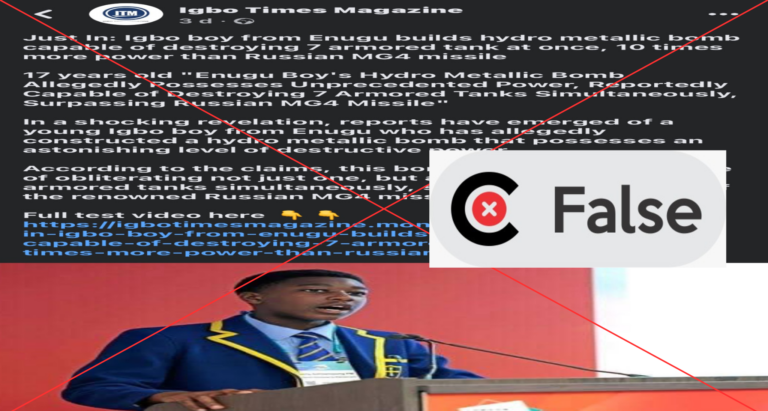
Did a boy from Enugu state build hydro-metallic bomb?

A photo showing a young boy standing behind a podium has surfaced online with a claim that a boy from Enugu State built a hydro-metallic bomb. 

An online blog, Igbo Times Magazine, posted the photo with a caption that read: 

“Just In: Igbo boy from Enugu builds hydro metallic bomb capable of destroying 7 armored tank at once, 10 times more power than Russian MG4 missile

17 years old “Enugu Boy’s Hydro Metallic Bomb Allegedly Possesses Unprecedented Power, Reportedly Capable of Destroying 7 Armored Tanks Simultaneously, Surpassing Russian MG4 Missile”

In a shocking revelation, reports have emerged of a young Igbo boy from Enugu who has allegedly constructed a hydro metallic bomb that possesses an astonishing level of destructive power.

According to the claims, this bomb is said to be capable of obliterating not just one, but a staggering seven armored tanks simultaneously, surpassing the power of the renowned Russian MG4 missile.”

The claim also surfaced online with the similar captions here, here, here and here.


CLAIM 

A boy from Enugu state built a hydro-metallic bomb.


THE FINDINGS

Findings by The FactCheckHub show the claim is FALSE.

Screenshot of the viral post retrieved from X.

The FactCheckHub subjected the viral image of the boy to a Google Reverse Image search and the result shows that the image was posted by Daily Express in June 2023. 

According to the news report, the boy is a British-Ghanaian, Harry Acheampong, who was a Children’s Parliament minister in the United Kingdom.  

Furthermore, The FactCheckHub also subjected the section of the photo showing the purported bomb to a Google Reverse Image search and the result shows that the photo depicts a home-made ‘time bomb’ discovered near a mosque in Hangu in Pakistan in 2018 as reported by The Express Tribune.


THE VERDICT 

The claim that a boy from Enugu State built a hydro-metallic bomb is FALSE; findings show that the viral photo shows a British-Ghanaian and not a boy from Enugu State. 

Did CEO of Erisco Foods Limited threaten to kill Chioma Okoli?

ON March 1, 2024, an X user, @FirstObidient posted a video showing Eric Umeofia, the CEO and President of Erisco Foods Limited with a claim that he threatened to kill the embattled Chioma Okoli who criticized one of its products last year.

It would be recalled that on September 17, 2023, Ms Okoli posted on her Facebook profile that she purchased a tin of Nagiko Tomato paste and discovered that the product contained “too much’’ sugar.

Replying to a comment on Facebook, she insinuated that the product was killing consumers due to its amount of sugar.

Erisco Foods released a statement describing her allegations as untrue, and she was subsequently arrested, a move condemned by Nigerians, who described it as intimidation.

The Federal Competition and Consumer Protection Commission (FCCPC) also waded into the case and summoned Erisco following the arrest.

Days later,  Okoli was arrested by men of the Nigeria Police Force in Lagos and transferred to Abuja following a petition by Umeofia. Both parties have been in court since then.

The issue attracted public attention recently when she had another interview with Arise TV on February 25, 2024.

The post by the X user, @FirstObidient, read:

“This is the CEO of ERISCO threatening to k!ll Chioma Okoli over a bad review! Is there any other thing she did that I’m not aware of?? What kind of country is this?????” 

The post has generated more than 400,000 views, over 2,800 reposts, over 500 comments and more than 3,000 likes as of March 3, 2024.


CLAIM 

The president of Erisco Food Limited threatens to kill Chioma Okoli.


THE FINDINGS

Findings by The FactCheckHub show that the claim is MISLEADING.

Screenshot of the viral post on X.

Checks by this researcher show that the X post by the claimant did not align with the context of the video. 

The full version of the video posted by Arise News TV on September 28, 2023, indicated that it was an interview the TV station had with Eric Umeofia, the CEO and President of Erisco Foods Limited.

In the 25-minute-long video, Umeofia said Erisco Foods Limited file a suit of N5 billion against Okoli if she failed to retract her statement and apologize via her Facebook profile publicly. However, there was no point in the video where he threatened to kill the Ms Okoli.

Rather, he was saying Okoli posted that Erisco products are killing people and they were taking her to court to defend themselves against her allegation.


THE VERDICT 

The claim that the president of Erisco Food Limited threatened to kill Chioma Okoli during an interview with Arise TV is MISLEADING; findings show the X post does not correlate with the context of the video, as he did not threaten Okoli during the interview held in September 2023.

No! Dangote is NOT selling fuel to Nigerian markets in dollars

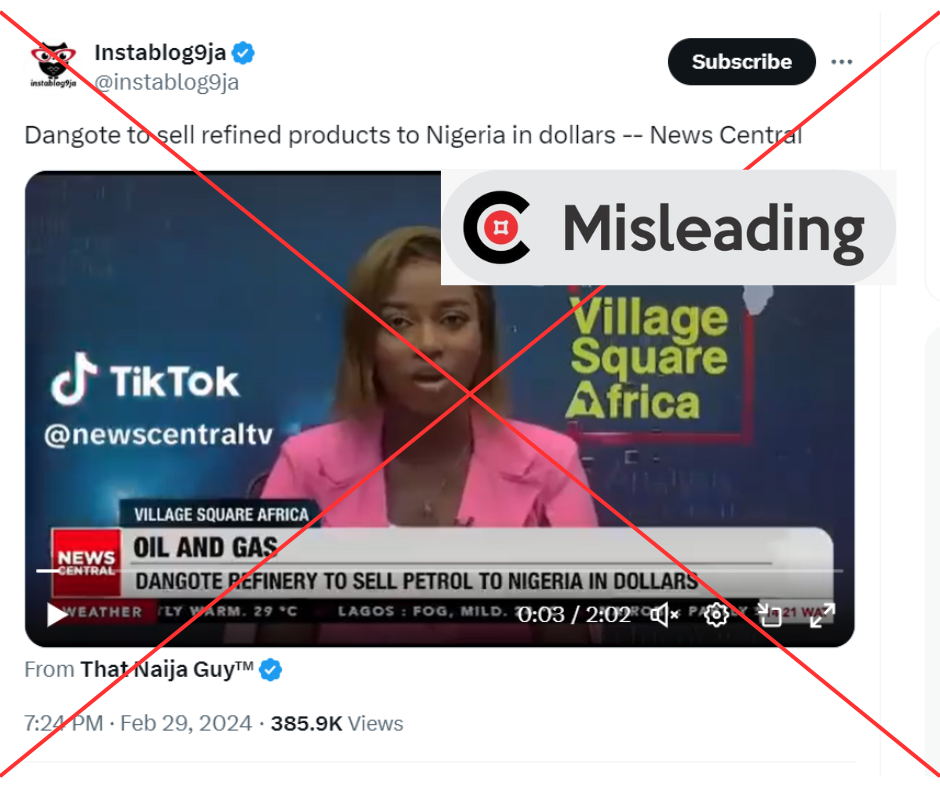
FOOTAGE of a broadcast programme by News Central TV has been circulated online with a claim that the Dangote Group said it will sell Premium Motor Spirit (PMS) popularly called ‘fuel’ locally to Nigerian markets in US dollars.

An X account, @instablog9ja posted the video with the caption thus:

“Dangote to sell refined products to Nigeria in dollars — News Central.” 

The post has garnered over 380,000 views, more than 800 reposts and over 2,700 likes as of March 2, 2024.

Another X user, @obiehieghuakhide, also posted the same footage with a caption that read:

“Dangote don run Nigeria Street.

Dangote to sell refined products to Nigeria in Dollars to service $2.7Billion loan debt after Emefiele claimed he had paid of 70% of his $3.4 billion loan from the CBN. This maths is not matheting O!” 

This post has also amassed more than 100,000 views, about 1,000 reposts and over 1,000 likes as of March 2, 2024.


CLAIM

Dangote announced plans to sell fuel to Nigerian markets in dollars.


THE FINDINGS

Findings by The FactCheckHub show that the claim is MISLEADING.

Screenshot of the viral post as retrieved on X.

A milestone was recorded in Nigeria’s oil and gas sector when the 650,000 barrels per day (bpd) Dangote refinery project began operations. 

The project is expected to be Africa’s biggest oil refinery and the world’s biggest single-train facility with 1,100 kilometres to handle 3 billion Standard Cubic feet of gas per day. The refinery has a 435MW Power Plant.

The refinery is expected to meet 100% of the Nigerian requirement of all refined products and also have a surplus of each of these products for export. It is designed to process Nigerian crude with the ability to also process other crude.

Checks by The FactCheckHub show that the video in circulation was uploaded by News Central TV on September 26, 2023. But the news had however been clarified by oil marketers in January 2024. 

Speaking on the speculation, National Public Relations Officer, Independent Petroleum Marketers Association of Nigeria (IPMAN), Ukadike Chinedu, in a report published by Punch newspaper in January 2024 clarified that even though the crude oil is an international commodity and it was sold to the plant in dollars, this would not make the plant to sell refined petroleum products to the Nigerian market in dollars.

 “The legal tender in Nigeria is the naira. The cement being sold by Dangote Cement is done in naira, not in dollar. The spaghetti and other essential commodities that he is involved in are all sold in naira.

“So why should one think that he will now sell fuel in dollars? Except for the offshore sales for those who want to move the refined products out of Nigeria using vessels to transport them to other countries. Such customers may get theirs in dollar equivalent,” Ukadike stated.

Furthermore, when The FactCheckHub contacted the Chief Branding and Communications Officer of Dangote Group, Anthony Chiejina, he described the footage alongside the claim in circulation as “fake news”.


THE VERDICT 

The claim that Dangote Group announced plans to sell fuel to Nigerian markets in dollars is MISLEADING; the video is an old footage from 2023 and it has been debunked multiple times since January 2024.

Four tips to identify, debunk false health claims shared on social media

The internet has become a breeding ground for health misinformation and thus poses a significant threat to public health.

False health-related claims make up a significant part of fake news and misinformation that is being spread via social media in today’s world, as users of these social media networks routinely tout questionable health claims unsupported by scientific research or medical evidence.

From claims of ‘miracle’ cures for ulcer as seen here and here, to bizarre anecdotes like ‘baby born holding mum’s failed IUD,’ these tips will guide you on how to identify and verify bogus health claims circulating online, thus enabling you to make informed decisions about your well-being.


1. VERIFY THE SOURCE

Once you come across any health claim either via texts, audio or video, it is essential to question the source; do not take anything at face value. 

How credible is the individual or website that shared the information? Is the website a verified health platform? Is the individual a licensed health practitioner in the field under discussion? Can the sources’ credentials be independently verified?”

Be aware, for instance, that titles can be deceiving. “Doctor” can refer to any number of things: a medical doctor (MD), a doctor of philosophy (Ph.D.), a doctor of science (Sc.D.) or an honorary doctorate.

To get to the bottom of this, do a quick search for the credentials and associations of the person or organization making the claim and ensure that their qualifications are relevant to their claims. 

Also, in this era of the internet age, a lot of people have digital footprint. So, to verify the authenticity of any health claim shared on social media, you could reach out to the author, if necessary, to seek more clarification.

Be wary if you cannot independently verify someone’s academic qualifications, just having a look to see who else is talking about the claim can help you discern between fact and fiction. 

Important breakthroughs in medicine will be covered by major news agencies, websites, radio stations, and television channels and published on reputable medical websites. If the treatment has not received recognition on these platforms, it is unlikely that there is sound evidence that it works.


2. ASK LICENCED HEALTH PRACTITIONERS

When in doubt, ask licensed medical or health practitioners around you. Also, speaking to friends, and relatives who are experts in the field can help provide better insights on the issue or topic.

For instance, The FactCheckHub regularly reach out to certified health professionals including members of the Nigeria Medical Association, Medical and Dental Council of Nigeria, Pharmaceutical Society of Nigeria, Nigerian Association of Resident Doctors and Nursing & Midwifery Council of Nigeria, among others to verify the accuracy or otherwise of health-related claims shared on social media platforms by users.

Some health claims already debunked by The FactCheckHub can be found here, here, and here. 

Also, note that if it looks too good to be true, it usually isn’t factual. The US Food and Drug Administration (FDA) warns that products sold as a panacea, capable of treating a range of ailments, are usually hoaxes.


3. USE ADVANCED INTERNET SEARCH

If you were unable to find any medical or health practitioner to debunk or verify a claim, you can use advanced internet search to access health-related published works, including from scientific and medical journals such as Nature Medicine, The New England Journal of Medicine, The Lancet, and the Journal of the American Medical Association (JAMA) etc.

The abstracts of most published studies are available online and they should give you a good overview of their findings.

Currently, there is growing support for health information to be made universally accessible, courtesy of global and national bodies like the World Health Organization (WHO); Nigeria Centre for Disease Control and Prevention; National Health Service; National Institutes of Health (NIH) etc.

When it comes to health advice, always turn to trusted websites like Google Scholar which will bring up results from the most reputable academic journals. Be wary of the common misconception that because something is labelled “herbal,” it cannot be harmful.

In addition, health-focused platforms like the National Library of Medicine, WebMD,  National Health Service, or Healthline can be used to check if a health claim has medical backing or not.


4. FOLLOW VERIFIED FACT-CHECKING WEBSITES

Whilst proven treatments are usually marketed directly to the medical community, quacks often go straight to the media or social media platforms and rely on the press and the public to advertise their products or fake claims to the public. 

But it cannot only be left to the press to snuff out misinformation, especially those myths that are widespread through instant messaging apps such as WhatsApp, Telegram, WeChat and Facebook Messenger, among others.

To help tackle health misinformation, follow fact-checking platforms like the FactCheckHub, Africa Check, Dubawa and PolitiFact etc which debunk viral health claims from time to time. You can also learn more by reading about FDA’s Health Fraud Scams.

Similarly, you can also submit any health claim that you want to verify on any of these websites. This can help you hone your ability to sift through fake and fraudulent health claims regularly and most importantly, guide you to making informed decision about your health.

IFCN awards $2 million to 20 groups to fight misinformation globally

THE International Fact-Checking Network (IFCN) at the Poynter Institute has awarded $2 million to 20 groups to enhance their capacities to fight misinformation globally.

Announcing the award on March 1, 2024 via a blog post, IFCN director, Angie Drobnic Holan said the proposals selected for funding will all strengthen the global network of fact-checkers that is essential for the fight against dangerous misinformation.

“The winning proposals put forward innovative, impactful fact-checking projects that will make a difference around the world. With upcoming elections and the arrival of generative artificial intelligence, fact-checkers need resources to engage and innovate,” Holan said.

The grant tagged ENGAGE is the third phase of the Global Fact-Check Fund, a $12 million initiative established by a grant from Google and YouTube. It is being administered by the IFCN.

A statement from the IFCN said the grant will enable the beneficiaries to cross-pollinate features across technology channels, explore new target markets, capture audience research metrics and analytics, employ digital media, enhance community engagement, or apply innovation and experimentation to develop tools for fact-checking.

Some of the funded proposals include “Newschecker” in India which was developed to equip senior citizens with the tools to combat misinformation through digital literacy training.

“Fake News Tragač” in Serbia which will leverage eye-tracking technology to understand how audiences consume fact-checks and tailor communication strategies for maximum impact and “The HKBU Fact-Check” in Hong Kong aims to promote media literacy through interactive public exhibitions and student-led workshops.

Others are “The ColombiaCheck” in Colombia, which will be launching an engaging chatbot and media literacy programme targeting young people, and “Brain Builders Youth Development Initiative, Nigeria” among others. 

The grant follows the fund’s first phase, BUILD, which awarded grants to verified signatories of the IFCN’s Code of Principles, and GROW, which allowed non-signatory organizations to apply with the endorsement of a verified signatory as long as the projects advance fact-checking.

It will be recalled that The FactCheckHub and Dubawa were among the 35 organisations named in June 2023 as recipient of the fund’s Build phase.

The release of the ENGAGE phase winners concludes the three-tier round for 2023. Two more rounds, in 2024 and 2025, are upcoming.

The next stage of the project, BUILD for 2024, will open grant applications in March. The $25,000 awards will fund material and logistical support for continuing activities as well as capacity growth for fact-checking organisations globally.

Below is the full list of ENGAGE recipients, according to their name and country: 

Agence France-Presse (AFP), France

Brain Builders Youth Development Initiative, Nigeria

Chequeado, Argentina

Colombiacheck, Colombia

Demagog, Poland

Doğruluk Payı, Turkey

Fact Crescendo, India

Faktograf, Croatia

Maldita, Spain

HKBU Fact Check, Hong Kong

Ideosync Media Combine, India

Liputan6.com, Indonesia

Mongolian Fact-checking Center, Mongolia

Newschecker, India

FakeNews Tragač, Serbia

Redes Cordiais and Lupa, Brazil

Science Feedback, France

Facta and Pagella Politica, Italy

Factcheck.org, North America

Wisconsin Watch, North America.

Google to partner news publishers, fact-checkers to tackle election misinformation in India

0

GOOGLE has announced plans to work with a consortium of news publishers and fact-checkers in India to tackle the menace of misinformation ahead of the country’s 2024 general elections billed for April and May.

The tech firm revealed this development in a blog post on March 1, 2024.

Google said it will work with Shakti, the India Election Fact-Checking Collective to create a common repository that news publishers can use to tackle the challenges of misinformation at scale.

Shakti, a pan-Indian network, will be driven by DataLEADS, in collaboration with the Misinformation Combat Alliance, The Quint, VishvasNews, Boom, Factly, and Newschecker, with support from the Google News Initiative.

READ: Google announces initiatives to help curb misinformation, improve media literacy in Africa

“Starting today until the conclusion of the General Elections in India, the project will focus on connecting independent fact checkers and Indian language publishers, giving them a collaborative platform to share fact-checks, research resources and alerts on elections-related viral misinformation and deepfakes, saving crucial time,” Google said.

“Fact-checks in multiple Indian languages and formats, including videos, will be shared and amplified via partnering news publishers, ensuring they reach a wider set of language users and diverse audiences across the country,” the statement added.

Google noted that the project will provide news organizations and fact-checkers essential training in advanced fact-checking methodologies, deepfake detection, and the latest Google tools like the Fact Check Explorer, to streamline verification processes.

“With this launch, the India Fact-Checking Collective will continue to onboard new partners and scale the effort to reach most parts of the country,” it further stated.

Chatbots pose threat to voters with AI-generated misinformation – Report

0

AS many countries hold national elections this year, a new study has revealed the risks posed by the rise of artificial intelligence chatbots in disseminating false, misleading or harmful information to voters.

The study which was published by The AI Democracy Projects on February 27, 2024, brought together more than 40 experts, including US state and local election officials, journalists and AI experts.

The experts built a software portal to query the five major AI large language models: Open AI’s GPT-4, Alphabet Inc.’s Gemini, Anthropic’s Claude, Meta Platforms Inc.’s Llama 2 and Mistral AI’s Mixtral.

They developed questions that voters might ask around election-related topics and rated 130 responses for bias, inaccuracy, incompleteness and harm.

The report reveals that chatbots such as GPT-4 and Google’s Gemini, trained on vast amounts of text from the internet, are prone to providing inaccurate and harmful responses when it comes to election-related information. These chatbots may suggest non-existent polling places or invent illogical answers based on outdated information.

The report highlights several key findings from the workshop where the chatbots were tested. More than half of the chatbots’ responses were rated as inaccurate, and 40% were categorized as harmful.

The chatbots perpetuated outdated and inaccurate information that could limit voting rights, such as incorrectly stating that there is no voting precinct in a particular ZIP code.

In some instances, the chatbots appeared to draw from outdated or inaccurate sources, raising concerns about their ability to amplify longstanding threats to democracy.

For example, four out of the five chatbots tested wrongly asserted that voters in Nevada would be blocked from registering to vote weeks before Election Day, despite same-day voter registration being allowed in the state since 2019.

The report also draws attention to the lack of regulation surrounding AI in politics in the United States. While major technology companies have signed a voluntary pact to adopt precautions against AI-generated misinformation, the report raises questions about their compliance with these pledges.

The findings suggest that chatbots are not yet equipped to provide reliable and accurate information about elections, emphasizing the need for further scrutiny and regulation.

Meta launches safety campaign to tackle online misinformation

0

META has unveiled a safety campaign awareness tagged ‘Know What’s Real’ to shed light on in-built product features and safety measures present on its apps.

The social media firm disclosed this in a statement on Tuesday, February 27, 2024.

It stated that the awareness campaign aims to enlighten users on spotting and addressing misinformation on WhatsApp and Instagram by promoting digital best practices and highlighting available safety tools.

On WhatsApp, there is the block and report feature as well as forward labels that help users to identify misinformation and prevent its further spread, it said. It noted that it encourages people to verify inaccurate information via fact-checking organisations on WhatsApp Channels.

Meta’s Director & Head of India Public Policy, Shivnath Thukral, noted that the campaign, which would span for eight weeks, is part of Meta’s effort to curb the spread of falsehood online.

“The campaign is an extension of our ongoing efforts to prevent the spread of misinformation and serves as a simple safety guide to educate people on the role they can play to combat it,” Thukral said.

He added that Meta has invested in programmes which included the setting up of independent fact-checkers that would work to debunk false claims and help citizens access accurate information.

READ ALSO: Meta, MCA launch WhatsApp helpline to combat AI misinformation

On Instagram, Meta said it teams up with a robust network of fact-checkers to verify the accuracy of information shared on the platform.

“If something false, like deepfakes, is found, they put warning labels in the app on the post to tell people that it’s not accurate.

“We also limit the reach of content that is labeled “False” by our fact-checkers, so less people can see it.

“Through the campaign, Meta is encouraging people to not forward or share any inauthentic content and instead report the same to the Grievance Officer or any of the independent fact-checking partners to verify the information,” the statement added.