Home Blog Page 70

Okonjo-Iweala debunks claim of bringing investors to Nigeria

0

THE Director-General of the World Trade Organisation (WTO), Dr Ngozi Okonjo-Iweala, has debunked a viral message stating that she is bringing investors into Nigeria.

She disclosed this via her personal X handle on Friday, May 17, 2024, saying that the message was fake and was intended to disinform people.

READ: How foreign-linked accounts amplify disinformation about gunmen attack in Nigeria’s Plateau state

“It’s been brought to my attention that another fake message has been manufactured and is being forwarded in my name. I want to make it clear that this fake message is not from me. I am pleased that those who know me instantly recognized this as fake,” part of the post read.

She attached a screenshot of the viral message which was crossed with a black line.

The texts on the screenshot read:

I am bringing investors to Nigeria using the president’s commendable policies as a bait. Is that too difficult to understand? President Tinubu’s reforms might be harsh now but they would birth a new and prosperous nation, i have lost counts of presidents, respected institutions and investors that have congratulated me on Nigeria eventually having a focused leader since the reforms were rolled out. At least six multi national manufacturing giants are coming with me by December later this year to see how their firms can have factories here. It’s all part of my contributions to the progress of Nigeria. I am not a politician. I only desire the best for my dear country. It informed my visit to President Tinubu. The world has accepted him as our president, like it or not. May God heal us.

She emphasized that she doesn’t utilize WhatsApp broadcast for messaging and urged individuals to disregard any subsequent messages, highlighting the incident as a prime example of social media exploitation.

ALSO READ: How to fact-check viral post shared via WhatsApp

“Please be aware that I do not use WhatsApp broadcasts; thus anything forwarded to you purporting to be a message from me is Fake. This is a bad example of the use of social media. I want to warn those in the business of manufacturing FAKE messages, that they will not succeed,” she said.

You can learn how to identify such viral messages as explained in one of our previous reports here and also learn how to debunk them as highlighted in our tutorial here.

Viral video showing Yahaya Bello inside car is NOT recent

A video showing Yahaya Bello, a former governor of Kogi State, listening to music inside a luxury car has resurfaced online.

In the footage, Bello was seen in the driver’s seat smiling and posing for the camera while examining the car’s steering.

The video is circulating alongside a claim that the ex-governor is moving freely despite being declared wanted by the Economic and Financial Crimes Commission (EFCC) recently over corruption allegation.

READ: Yahaya Bello makes FALSE claim about strike in Kogi state-owned tertiary institutions

An X user, @X_Dailly posted the video with a caption that read:

“N85 Billion Fra*ud: Ex Kogi State Governor, Yahaya Bello Captured Chilling In His Multi Million Naira Mercedes Benz.”

The video has garnered over 1.1 million views with over 4,000 likes, more than 2,000 reposts and over 1,000 comments as of May 19, 2024.

Also, another X user, @LawrenceOkoroPG posted the same footage with another caption thus:

“Only in Nigeria that you see politicians steal aggressively and taunt the masses with the proceeds of their long standing theft.

Yahaya Bello can afford to flaunt the wealth acquired from his series of “Kogi money heist” because he’s sure Nigerians will never rise against them.”

The footage has also gone viral on the social media space in Nigeria.


CLAIM

Video shows the former Kogi State governor, Yahaya Bello, inside a car recently.


THE FINDINGS

Findings by The FactCheckHub show that the claim is MISLEADING.

Screenshot of the viral footage retrieved from an X account.

On April 18, 2024, the EFCC declared Yahaya Bello wanted for offences relating to corruption.

The anti-graft agency had stormed Bello’s Abuja home a day earlier (April 17) but could not arrest him as the incumbent governor of Kogi State, Ahmed Usman Ododo, arrived at the scene, forcing the security officials to leave the premises. Bello has been on the run since then.

The FactCheckHub subjected the keyframes in the viral footage to a Google reverse image search and the result shows that it has been online since 2020 when he was still the governor of Kogi State.

An earlier version of the video had been shared by Society Now and First Weekly Magazine in their new reports published in the year 2020.

The reports indicated that the governor was criticized by social media users for flaunting a luxury car at a time when civil servants in the state were being poorly paid.


THE VERDICT

The claim that the video shows the former Kogi State governor, Yahaya Bello, inside a car after he was declared wanted by the EFCC is MISLEADING; findings show that the video has been online since 2020.

Video of crowd fleeing their homes is from Burkina Faso not Zamfara

AN X user, Serah Ibrahim (@TheSerahIbrahim), has posted a video showing a huge crowd of mostly women with a claim that the footage shows residents of Zamfara state fleeing their homes due to incessant abduction by bandits.

Video of mining site collapse NOT from Zamfara but Niger Republic

She posted the video with a sensational caption thus:

“BREAKING:

“Not 1. Not 2. Not 50. But 500. 500 people have been kidnapped in Zurmi LGA, Zamfara State. And not a single word from the Governor or the Presidency. Families around that region can be seen migrating to unknown destinations, in an attempt to run away from the attackers(sic).”

The post has garnered more than half a million views with over 5,000 reposts, more than 5,000 likes and over 1,000 comments as of May 19, 2024.


CLAIM

Video shows residents fleeing their homes in Zamfara state recently.


THE FINDINGS

Findings by The FactCheckHub show that the claim is MISLEADING.

Screenshot of the viral video showing a crowd fleeing the scene as retrieved on X. INSERT: Misleading verdict.

Zamfara, a North-West Nigerian state is facing persistent attacks by terrorists and bandits. The development has led to the death, abduction and displacement of thousands of residents in recent years.

When The FactCheckHub subjected the keyframes of the video to multiple Reverse Image Searches, the results show that the video has been online since June 2021.

Checks revealed that a longer version of the video was published on the Facebook page of SAIDA International e.V, a German-based international organization on the 8th of June, 2021 with a caption in German language indicating that the video emanated from Burkina Faso.

“Fleeing their own country: As if the people of #BurkinaFaso, one of the poorest countries in the world didn’t have enough to worry about, they now have to leave their possessions and goods behind and flee murderous gangs,” a Google translation of the Facebook post read.

The 92-second longer video was also posted the same day on the YouTube channel of Lobs Paalga TV, a Burkina Faso-based Television station with the title: “Vidéo d’un exode attribué aux habitants de Solhan.”

Using Google Translation, it reads: “video of an exodus attributed to the inhabitants of Solhan.”

Further findings show that the incident was also reported by Al-Jazeera on the same date.

The media reported that over 7,000 families fled their homes in Solhan village in Burkina Faso’s northern region following the massacre that claimed the lives of several people.


THE VERDICT

The claim that the video shows residents fleeing their homes in Zamfara state recently is MISLEADING; the video emanated from the crisis that occurred in Solhan village in Yagha province, Burkina Faso in June 2021.

No! Opay is not exiting Nigeria

A viral claim that Opay has reportedly announced its decision to exit Nigeria has been circulating on WhatsApp.

The claim was contained in a WhatsApp broadcast message alongside a link to a website where the claim was likely lifted from. 

The WhatsApp message read:

Breaking News: Opay Reportedly Announces Leaving Nigeria Market Space, Urges Customers to Withdraw All Funds Within One Month of Notice

In a surprising turn of events, popular mobile payment platform Opay has allegedly announced its decision to exit the Nigerian market space.

Opay has urged its customers to withdraw all funds from their accounts within a one-month period.

Full Details Here 👇👇

https://igbotimesmagazine.monster/2024/05/01/breaking-news-opay-reportedly-announces-leaving-nigeria-market-space-urges-customers-to-withdraw-all-funds-within-one-month-of-notice/

This WhatsApp broadcast has been shared in multiple WhatsApp groups as of May 19, 2024.

Established in 2018, Opay is a mobile money platform and financial technology company in Nigeria licensed by the Central Bank of Nigeria (CBN). It offers a one-stop financial service platform for payments, transfers, savings, loans and other essential services for users in the country.


CLAIM

Opay announced plans to exit Nigeria.


THE FINDINGS

Checks by The FactCheckHub show that the claim is FALSE!

Screenshot of the claim that Opay is exiting Nigeria retrieved from a WhatsApp group.

When our fact-checker contacted the company via its official X handle, the company debunked the claim, saying it is false. 

“Please be informed that we wish to address recent misinformation and unfounded claims from unreliable sources circulating on WhatsApp and some microblogging platforms regarding OPay discontinuing operations it Nigeria. We wish to state that these claims are entirely false and lack merit,” Pamela, a social media handler with the company responded to our inquiry.

Further checks by The FactCheckHub show that the claim has been previously debunked on Opay’s social media handle including X and Instagram.

Also, no reputable media reported the news.


THE VERDICT

The claim that Opay announced plans to exit Nigeria is FALSE; the claim has been debunked by the company.

How ICIR-led fact-checking clubs in Nigerian universities are taking media literacy campaigns to grassroots

0

In an era where misinformation spreads like wildfire, the Countering Misinformation and Promoting Media Literacy (CMPML) project of the International Centre for Investigative Reporting (ICIR) has empowered students in Nigerian universities to take media literacy campaigns to the grassroots.

The innovative fact-checking initiative, launched in 2023 and supported by the Embassy of the Federal Republic of Germany in Abuja, targeted twelve Nigerian tertiary institutions.

It will be recalled that the students were earlier empowered with fact-checking skills via in-persons training to critically evaluate information and combat false narratives, thus fostering a more informed and discerning generation of thinkers among Nigerians.

AUDIO PODCAST: Impact of ICIR‘s Countering Misinformation and Promoting Media Literacy project

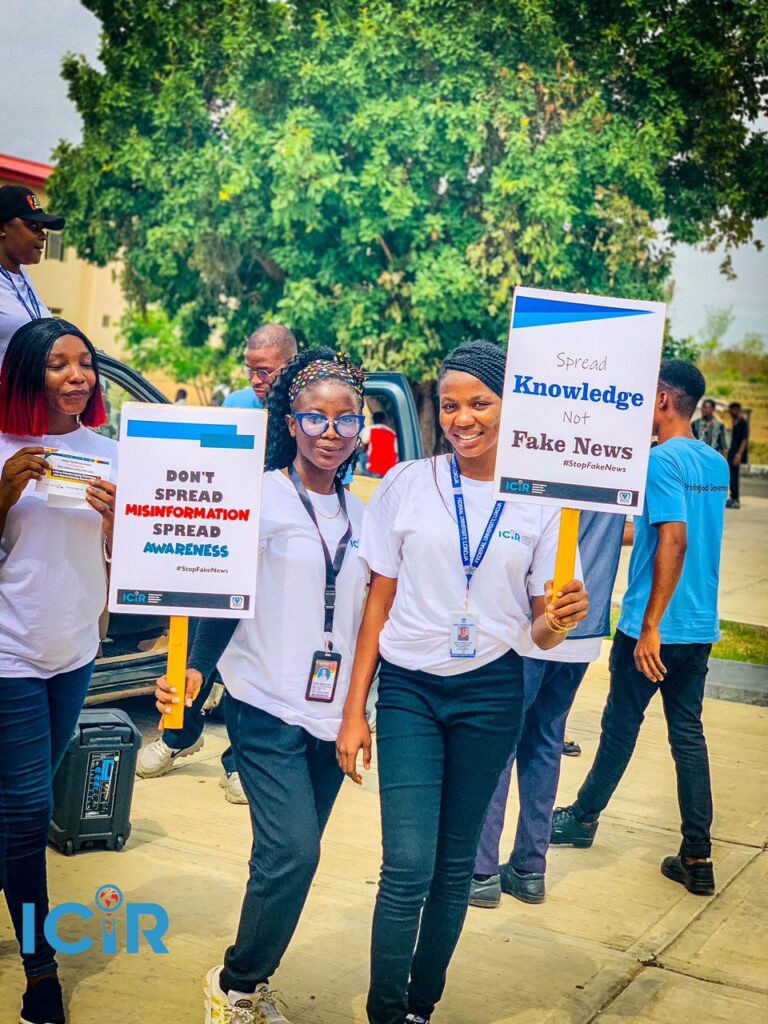
"No gree for fake news" - a member of the Fact-Check Club holding a signpost at the Usmanu Danfodiyo University Sokoto (UDUS).
“No gree for fake news” – a member of the Fact-Check Club holding a signpost at the Usmanu Danfodiyo University Sokoto (UDUS).

This led to the launch of fact-checking clubs in at least two of schools so far – the Federal University, Lokoja in Kogi State and Usmanu Danfodiyo University, Sokoto (UDUS).

The fact-check club in UDUS focused their sensitization programme and campus media literacy campaign on the significance of fact-checking, with intriguing titles like “No gree for fake news; if it’s fake, it’s not news; verify before sharing; put an end to misinformation,” among others.

Meanwhile, their Federal University of Lokoja counterpart focused their one-day programme on verifying the authenticity of information.

Some members of the Fact-Check Club in Federal University Lokoja holding their sign posts during the grassroot campaign.

The ICIR’s fact-checking initiative is a crucial step towards combating misinformation and promoting media literacy among Nigerian students.

Speaking with The FactCheckHub, the coordinators of the clubs in both universities charged other schools in The ICIR countering misinformation project and other nigerian universities at large to inaugurate their fact-checking club. They also urged fellow students to imbibe the practice of fact-checking in their daily living.

Miss Samuel Shade, the fact-check club coordinator and a 300 level Mass Communication student at the Federal University of Lokoja said that in response to the campaign, more students wants to be part of the fact-check club in the university. She noted that it has made fellow students in her department and the school community aware of the need for verification of information.

“We organized a campaign and there was a massive turnout. The club has brought the consciousness of information verification to the students of Mass Communication and the campus community,” Samuel said.

Some members of the Fact-check club in Federal University Lokoja, engaging and sensitizing their peers on campus during the programme.

Also speaking, Abdulrasheed Akere, a 400 level student of the department of Science and Vocational Education and the coordinator of the fact-check club in Usmanu Danfodiyo University, Sokoto (UDUS) said the prevalence of misinformation have reduced on campus as most students now reach out to the club before reposting or sharing any information seen on social media.

Cross-section of participants at the Fact-check club sensitization in UDUS
Cross-section of participants at the Fact-check club sensitization organised in UDUS recently.

“The rampancy of false claims has reduced on our campus because students used to call us at the rumor level before they put it on their status or Facebook handle and we will verify it for them,” he said.

“We have network with the management which makes the task easy for us. Students often call me to verify news even if it is about their department. We created a campus where misinformation purveyors now fear to operate because we will debunk their claims with just a phone call to the authority,” Akere noted

ALSO READ: Nigerian government tasks editors on media literacy, fact-checking

He added that the main challenge they are burdened with is hearing the side of the person that shares false information, noting that some of them would not respond to messages sent to them seeking clarification on why they spread misinformation.

Akere, however, stated that his team usually reach out individuals and authorities concern to debunk such information or verify its accuracy and by also using digital tools learnt during the ICIR-led fact-checking training held in the university last year.

They both noted that the success of the CMPML project is a testament to the power of collaborative efforts in promoting fact-based communication and combating the spread of misinformation.

Maria Ressa, Levitsky, others headline GlobalFact 11 as keynote speakers

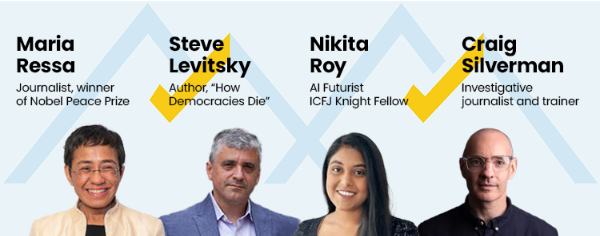
Maria Ressa, a Filipino-American journalist and Nobel Peace Prize winner, has been announced as the keynote speaker for this year’s Global Fact-Checking Summit tagged GlobalFact 11.

This was announced in a statement by the International Fact-Checking Network (IFCN) on May 16, 2024.

In October 2021, Ressa received the Nobel Peace Prize in appreciation of her work “to safeguard freedom of expression, which is a precondition for democracy and lasting peace.”

She is a co-founder of Rappler, a Philippine-based digital news site with a comprehensive fact-checking division. Rappler has signed the IFCN’s Code of Principles since 2017.

Ressa formerly served as a CNN bureau head in both Manila (Philippine) and Jakarta (Indonesia). She has written many books, including her most recent biography, “How to Stand Up to a Dictator.”

She will appear at the GlobalFact 11 in conversation with Phil Chetwynd, Global News Director of Agence France-Presse (AFP).

They will also be joined by the following distinguished speakers: Steve Levitsky, an American political scientist and co-author of “How Democracies Die” and “Tyranny of the Majority”; AI futurist, Nikita Roy, a practitioner and promoter of responsible use of artificial intelligence in media and Craig Silverman, a longtime presenter and trainer at the GlobalFact.

The GlobalFact is the world’s biggest and annual fact-checking summit, hosted by the IFCN at the Poynter Institute. Fact-checkers can share best practices and form partnerships at this conference, which includes several days of interactive learning sessions and networking opportunities.

Also, keynote talks by professionals in journalism, academia, disinformation, and technology are included on each day of the conference. This year’s edition will be held from June 26 to 28, 2024 in Sarajevo, Bosnia and Herzegovina.

You may join this year’s edition online via www.globalfact11.com.

Fact-checking claims about companies that have exited Nigeria under Tinubu presidency

AN X user, @Irunnia_ has listed eight companies that have allegedly left Nigeria since Bola Ahmed Tinubu became Nigeria’s president in May 2023.

Nigeria has been facing the woes of multinational operations in Nigeria, where foreign companies especially manufacturers and energy firms have been exiting in droves since President Tinubu became the president on May 29.

Most of them cited the current foreign exchange crunch and devaluation of the naira, which means lower earnings for foreign companies in dollar terms, insecurity and lower revenue as their reasons for leaving.

READ: How true are claims on mining companies in Osun State?

The X user posted, “Since Tinubu became president, these companies have all left Nigeria due to “bad business conditions” in 1 year! PZ Cussons, GSK, Proctor&Gamble, Sanofi, Equinor, Binance, and Microsoft just left, Bolt is packing If you voted in this govt, you will die young & you will not die well.(sic)”

The post has generated over 3000 reposts and more than 8000 likes as of May 18, 2024.


CLAIM

PZ Cussons, GSK, Procter&Gamble, Sanofi, Equinor, Binance, Microsoft and Bolt have left Nigeria.


THE FINDINGS

Findings by The FactCheckHub show the claim is HALF-TRUE. We reviewed the information online and below are our findings:

1. PZ Cussons 

Media reports indicated that PZ Cussons Nigeria PLC, a consumer goods company in the business of personal care, home care and electrical products, which has been in Nigeria since 1899, is planning to leave the country. 

Premium Times reported that the local unit of British healthcare products and consumer goods giant, PZ Cussons Plc, slipped into a negative net asset position after a free fall in the value of the naira eroded earnings and wiped out its shareholders’ fund in its entirety.

Negative net asset is a financial condition whereby a company’s total liabilities exceed its total assets.

PZ Cussons Nigeria is the maker of notable brands including Devon King’s Vegetable Oil, Mamador, Morning Fresh, Premier Cool, Joy soap and Robb, among others.

Apart from media reports indicating that the company is considering its exit due to business operation-related difficulties in Nigeria and poor sales performance, there has not been an official statement or credible media report regarding the purported exit of the company. 

THE VERDICT 

The claim that PZ Cussons has left Nigeria is FALSE; the company has not announced its exit despite indications.


2. GSK 

GlaxoSmithKline (GSK) announced plans to discontinue direct operations in Nigeria in August 2023, The Cable reported.

This ended its 51-year presence in the country, known for household brands like Panadol and Sensodyne. While the company didn’t explicitly state reasons, experts have attributed their exit to foreign exchange scarcity and increased competition.

GSK opted for a distributor-led model instead of complete withdrawal, meaning their products might still be available in Nigeria, but supplied through a third party.

THE VERDICT 

The claim that GSK has left Nigeria is TRUE; the company exited the country in August 2023.


3. Procter & Gamble

In December 2023, Procter & Gamble (P&G), a US consumer goods company, announced that it would discontinue manufacturing in Nigeria and pivot to import-only activity.

This was disclosed at the Morgan Stanley Global Consumer & Retail Conference in New York by Chief Financial Officer, Andre Schulten.

“We’ve announced that we will turn Nigeria into an import-only market, effectively dissolving our footprint on the ground in Nigeria and reverting to an import-only model,” Schulten said.

He noted that another reality that arises in some of these markets is that it gets increasingly difficult to operate and create U.S. dollar value. “So, when you think about places like Nigeria and Argentina, it is difficult for us to operate because of the macroeconomic environment.”

THE VERDICT 

The claim that Procter and Gamble has left the country is TRUE; the company announced its exit in 2023.


4. Sanofi 

Sanofi, a French multinational pharmaceutical company, announced its exit from Nigeria in November 2023, the Business Day reported.

The company said it had appointed a third-party distributor to handle its commercial portfolio of medicines from February 2024.

“This strategic move is driven by our commitment to improve access to our medicines continually and better to serve our patients and the Nigerian health system,” Folake Odediran, Sanofi’s general manager (general medicines) and country lead, said.

THE VERDICT 

The claim that Sanofi has left Nigeria is TRUE; findings revealed that the company announced its exit in 2023. 


5. Equinor 

Findings showed that Norwegian oil firm, Equinor announced the sale of its Nigerian business, including its share in the Agbami oil field, to Nigerian-owned Chappal Energies. 

The transaction ended its three-decade presence in Nigeria.

THE VERDICT 

The claim that Equinor has left the country is TRUE; the company exited Nigeria in November 2023.


6. Binance 

Premium Times reported in March 2024 that the crypto exchange platform, Binance, disclosed plans to discontinue all Nigerian Naira (NGN) services on its platform.

This is after the Nigerian government accused the platform of engaging in foreign exchange rate manipulation through currency speculation and rate fixing.

ALSO READ: Did Tinubu build independent power plant as Lagos governor?

It later detained two executives of the platform after they flew into the country as part of moves to negotiate with the Nigerian authorities amid a crackdown on the crypto platform.

In a notice sent to its customers, Binance noted that this discontinuation affects NGN services exclusively and users can continue to utilise services and products for other available cryptocurrencies on the platform.

However, a check on its website revealed that users in Nigeria could no longer access its platform or app, except through a Virtual Private Network (VPN).

THE VERDICT

The claim that Binance has left Nigeria is MOSTLY TRUE; the platform had earlier announced the discontinuation of all Nigerian Naira (NGN) services on its platform. Also, its platform is no longer freely accessible to users in Nigeria.


7. Microsoft

The global tech company, Microsoft, recently announced plans to shut down its Africa Development Centre, in Lagos, Nigeria. The firm explained that it was part of its normal organizational workforce adjustments.

A report by Vanguard and clarification by the Nigerian Presidency indicated that the shutdown of the centre does not mean the company is leaving the country. 

Reuters also reported that the “company said it would, however, continue to operate in Nigeria, continuing to prioritize and invest in strategic growth areas.”

THE VERDICT 

The claim that Microsoft has left Nigeria is FALSE; the company only shut down a centre in Lagos.

8. Bolt

In October 2021, Bolt, a ride-hailing company launched Bolt Food to simplify access to food in Lagos, Nigeria.

Bolt Food extended its reach to other places in Lagos, including Ajah, Sangotedo, Festac, Satellite Town, Egbeda, and Ogba, in April 2023. 

In November 2023, the company announced its decision to cease the food delivery services starting from December 7, 2023.

But other services being rendered by the tech-driven ride-hailing platform such as transportation are still operative and there is no indication that the platform has a plan to shut down operations in the country.

THE VERDICT

The claim that Bolt is leaving Nigeria is FALSE; the company discontinued its food delivery service but there is no official announcement that it is exiting Nigeria.

Deceptive crypto platforms use celebrities’ images to defraud people on X – Report

A new report by Maldita.es has exposed a widespread scam on X (formerly Twitter) targeting users with fake cryptocurrency investments. 

The report revealed that the scam uses attention-grabbing ads featuring images of celebrities and fabricated interviews with reputable news outlets to lure victims.

“Accounts that published the promoted tweets were a few months old and all had the blue tick of the X Premium payment service, formerly Twitter Blue. These accounts managed to increase the visibility of the publications by investing in advertising through X Ads,” Maldita revealed.

READ: Elon Musk’s policy change fuels engagement of unchecked propaganda on X – Report

“Ads reached 368,000 users on average and were viewed a minimum of 76 million times overall. The most viewed post reached almost four million impressions. Most ads were programmed to be shown to users over 25 years of age located in Spain,” part of the report published recently read.

The report further revealed that 96 of the publications circulated for a total of 354 days and image of singer Lola Índigo was the most repeated in the ads while the most spoofed media outlet was El País.

“The X ads repository shows that the online platform stopped the promotion of 35.15% of the ads we analyzed. For the rest, there isn’t information of any kind,” Maldita said.

“X acts inconsistently as it alleges different reasons for moderation on posts that follow exactly the same pattern. 32.76% of the publications for which data is available contained illegal content, according to X. Most of the remaining ads were classified by the company as violations of its internal policies.”

The report detailed a three-step scheme: phoney ads with stolen celebrity images, fake news websites with fabricated interviews, and bogus investment opportunities in cryptocurrency. 

Clicking on the ad redirects users to websites impersonating legitimate news outlets, lending a false air of legitimacy to the scam, the report revealed adding that these websites promote fraudulent investment opportunities in cryptocurrencies, designed to steal personal data or defraud people.

The report showed that over 165 fraudulent posts were identified in a short period. These ads targeted users over 25 years old in Spain, reaching millions and garnering over 76 million impressions.

While X removed some of the identified ads, the report raises concerns about the platform’s overall response. X offered no explanation for the remaining ads and classified a significant portion as violating internal policies rather than illegal content.

It argued that these advertisements likely violate Spanish laws concerning misleading advertising, unauthorized investment services, and image rights violation.

The report highlighted X’s obligations under the European Union’s Digital Services Act (DSA) to remove demonstrably illegal content. The report contends that X’s failure to address this widespread scam effectively may necessitate more decisive action under the DSA.

It recommended that X invest in content moderation with regional language expertise, improve detection processes to prevent fraudulent ads, and enhance transparency in its advertisement repository.

The report emphasized the need for authorities to enforce existing laws and collaboration with experts to ensure online platforms remain safe spaces for users.

Online tools to identify and counter misinformation on the internet

IN an era where misinformation proliferates online, the need for effective tools to identify and counter false information has become increasingly urgent.

From fact-checking platforms to browser extensions, a myriad of innovative solutions has emerged to empower users in discerning truth from fiction in the digital realm.

These tools not only serve to safeguard individuals against the pitfalls of misinformation but also play a crucial role in upholding the integrity of information ecosystems.

READ: Advanced search tips made easy

One of such tools is the Get It Right co-developed by the FactCheckHub, ICIR and the Digital Public Square. The FactCheckHub has compiled a list of other tools that can detect and combat misinformation online.


Adblock Plus

Adblock Plus functions as a browser extension and application designed to block advertisements and websites by utilising filtering lists.

Initially developed as an adblocker, the tool has expanded its scope to enable users to shield themselves from intrusive ads and potentially harmful sites, including those disseminating misinformation.

It automatically permits ads that comply with the “acceptable ads” criteria, allowing them to evade blocking. Users have the option to opt out of these ads by customising their settings.

To use Adblockplus to block adverts on websites, you have to install or add it to your browser extension as it automatically blocks ads from pops up on any website you visit.

To disable online tracking to stop companies or trackers from collecting your browsing history data across multiple websites, you can do this by installing and enabling the “EasyPrivacy” filterlist subscription; thereafter, click on “Add”.


Bot Sentinel

Bot Sentinel is a free platform designed to identify and monitor trollbots and dubious X profiles. Utilizing machine learning and artificial intelligence, Bot Sentinel assesses X accounts to categorize them as reliable or suspicious, with a specific focus on detecting bots.

These identified accounts are then cataloged in a database and monitored daily. The gathered data is utilized by developers to analyze the impact of bots and their propaganda on online discussions and to devise strategies to combat their dissemination of information.

Accounts with a substantial follower count and a significant proportion of misleading or factually inaccurate posts may be categorized as untrustworthy. This tool is essential for fact-checkers in analysing coordinated disinformation campaign and influence operations.

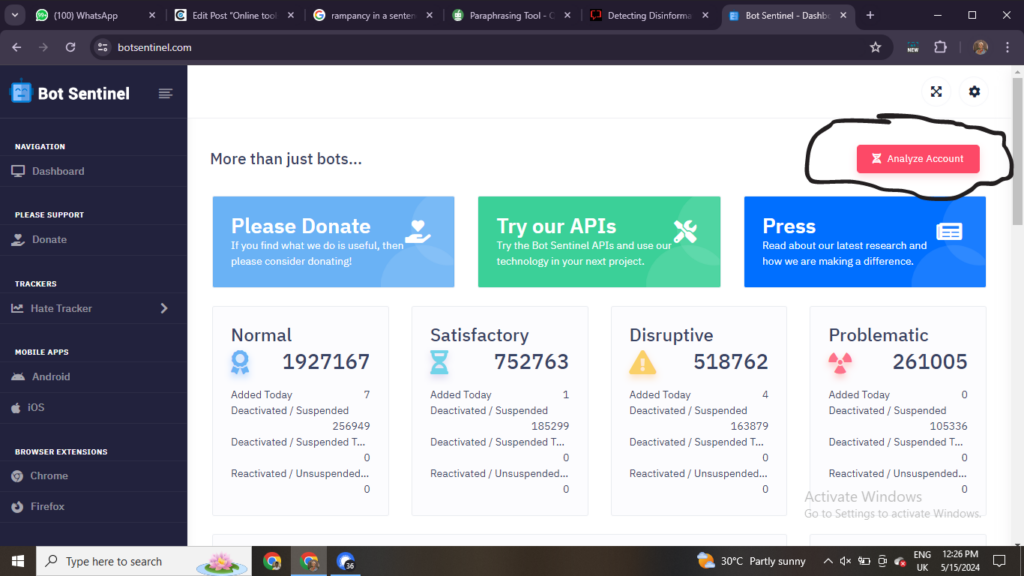
To use Bot Sentinel,

  1. You have to analyze the account or post, by clicking click on the red “Analyze Account” button.
creenshot of the steps to take on the webpage.
Screenshot of the steps to take on the webpage.

2. Bot Sentinel will evaluate the account or post and assign it a rating as either “Normal,” “Satisfactory,” “Disruptive,” or “Problematic” once you enter the account handle or the whole post URL and then click “Submit.”

3. For further information, click “View Profile.” This will provide you with the account’s score history on Bot Sentinel, as well as a list of frequently used terms, hashtags, and URLs.

4. To search accounts that Bot Sentinel has already examined by category, scroll to “Analyzed Accounts” on the left menu bar.

Screenshot of the action extracted from the website.
Screenshot of the step taken on the website.

Botometer X

Botometer X (formerly Botometer), is an online tool that employs machine learning to categorize X accounts as either bot or human based on various profile features such as connections, social network layout, activity over time, language usage, and sentiment. It generates a comprehensive bot score ranging from 0 to 5, along with additional scores that offer insights into the probability of an account being a bot.

This tool is mostly used by fact-checkers and investigative journalists for investigating cyber attacks and any other digital investigation.

To use Botometer X,

  1. You need to have an X account to use this tool. After clicking on the website, it requires you to log into your X account.
  2. After logging in, then type the name of the user you want to check and click on check user.
  3. It would analyze the data from the account and produce a score between 0-5 to indicate if the account is a Bot or operated by a human.

Note that Botometer X  is currently in archival mode, and the results were pre-calculated based on historical data collected before May 31, 2023.


Misinformation Detector

Misinformation Detector is a blockchain-based web tool for credibility scoring and verification developed by BitPress which is known as a “decentralized trust protocol,” aiming to transparently monitor the credibility of news. It evaluates trust by scrutinizing content and its connections, forming a network illustrating how information circulates among media outlets.

This tool endeavours to counter disinformation directly by offering users evaluations of information accuracy and credibility. It identifies and rectifies false or misleading content, aiding readers in discerning between trustworthy and untrustworthy sources of information.

The tool integrates fact-checking services, utilizing a blend of human fact-checkers and blockchain technology. Journalists and publishers have the option to register as partners to access this tool.


Who Targets Me

Who Targets Me is a disinformation tracking tool where users can establish an anonymous profile with this tool to gather data on political and other advertisements they encounter, including insights into the reasons behind their targeting which helps in investigating influence operation and state-sponsored disinformation.

It also offers users statistics on the entities targeting them, contributing to the construction of a comprehensive database on political advertising and targeting.

Who Targets Me aims to enhance users’ understanding of online targeting, fostering awareness of targeted advertisements and disinformation to bolster resilience against them.

Similarly, it constructs a repository of political advertisements and targeting, with the intention of exerting pressure on major tech firms to amend practices concerning transparency and the management of political ads.

To use Who Targets Me,

  1. You need to install the browser extension on your Chrome or FireFox or Safari or Microsoft Edge web browser.
  2. Click the Who Targets Me icon in the toolbar of your browser after installing the extension.
  3. You can see the findings displayed by surfing results.whotargets.me or by clicking the Who Targets Me extension icon in your browser’s toolbar whenever you start seeing political advertisements. Alternatively, you can visit the website directly or bookmark it.
  4. It would break down the results into a summary of why you are being targeted, who is targeting you, other Who Targets Me users and so on.


Schema.org’s Claim Review

Schema.org’s claim review is a credibility scoring tool. The “ClaimReview” label is affixed to any website content to furnish search engines with insights into the content’s nature.

This label may include a fact-check designation for content that undergoes fact-checking by reputable sources and organizations, with the goal of furnishing users with more precise information. Consequently, such content will display with a “Fact-Check” tag when appearing in search engine results.

ALSO READ: How to use Wayback machine to view deleted web pages

The tool employs evaluations and scoring of source credibility, considering factors like accuracy and objectivity, to direct readers towards higher-quality information and away from lower-quality sources online.


Fakey

Fakey is an online interactive educational platform created to enhance media literacy skills. It showcases news articles featuring elements of clickbait, fake news, conspiracy theories, and more. Users are prompted to decide whether to share, conceal, or fact-check the presented information. The objective is to offer users practical experience in distinguishing between true and false information.

The goal of this tool is to combat disinformation by cultivating a community of information consumers who possess improved abilities to recognize and steer clear of false information on the internet.

TikTok begins auto-labelling of AI-generated content

TIKTOK has commenced automatically labelling of videos and images made with artificial intelligence (AI).

The Chinese-owned short-form video-sharing platform disclosed this in a statement recently.

The platform said it has teamed up with the Adobe-founded Content Authenticity Initiative (CAI) and the Washington-based Coalition for Content Provenance and Authenticity (C2PA) to implement the initiative.

The collaboration will allow TikTok the use of the C2PA’s content credentials technology to show the source of a video and whether it was made using AI or not.

“AI enables incredible creative opportunities but can confuse or mislead viewers if they don’t know content was AI-generated. Labeling helps make that context clear—which is why we label AIGC made with TikTok AI effects, and have required creators to label realistic AIGC for over a year,” part of the statement read.

The platform revealed that AI-generated content on the app will now be tagged with “Content Credentials,” a digital watermarking technology from the Coalition for Content Provenance and Authenticity.

“Content Credentials attach metadata to content, which we can use to instantly recognize and label [AI-generated content],” TikTok said. “This capability started rolling out today on images and videos, and will be coming to audio-only content soon.”

“Using Content Credentials as a way to identify and convey synthetic media to audiences directly is a meaningful step towards AI transparency, even more so than typical watermarking techniques,” Claire Leibowicz, head of the AI and Media Integrity Programme at the Partnership on AI, said in a prepared statement.

“At the same time we need to better understand how users react to these labels and hope that TikTok reports on the response so that we may better understand how the public navigates an increasingly AI-augmented world.”

TikTok already labels content created with its in-app AI effects and mandates that creators label any content containing realistic AI. This new initiative will extend automatic labelling to AI-generated content uploaded from other platforms.

The update is amid the growing concerns from lawmakers and experts about the potential threat AI poses in the upcoming 2024 election globally, particularly in light of the risk of deepfakes and misinformation.

Additionally, TikTok announced it will join the Content Authenticity Initiative, an Adobe-led group dedicated to setting standards for making the digital production of images, videos, or audio clips transparent and traceable across the industry.

TikTok said it is the first video-sharing platform to put the credentials into practice and will join the Adobe-led Content Authenticity Initiative to help push the adoption of the credentials within the industry.

In February 2024, TikTok was one of 20 leading tech companies committed to combat AI misinformation in this year’s election cycle.