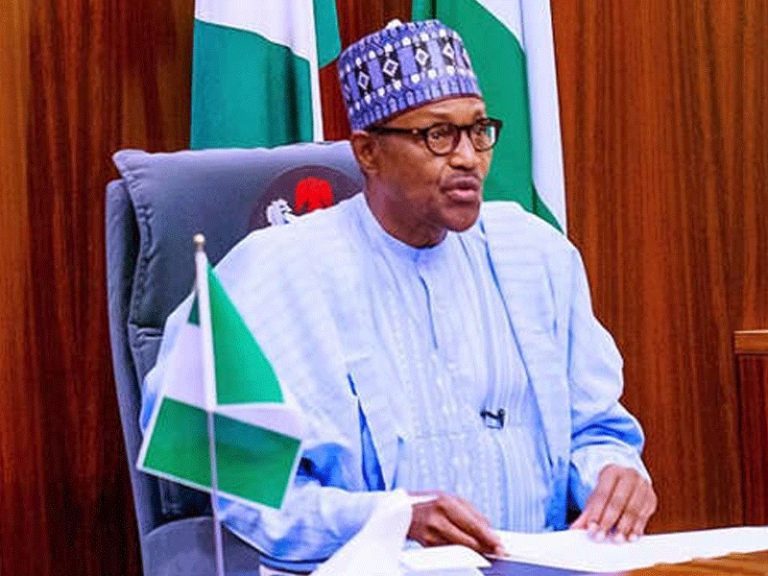
THE former President Muhammadu Buhari died on Sunday after an illness in London. However, this is not the first time he has been rumoured to have died.
One of the most bizarre and persistent conspiracy theories in Nigeria’s modern political history centres around Buhari’s identity itself — a rumour that once spread like wildfire across the country and even drew a response from the former President himself.
According to the now-infamous rumour, Buhari had died during a prolonged medical trip to London in 2017 and had been replaced by a body double, allegedly a Sudanese man named “Jibril,” the gave rise to the name “Jibril of Sudan” or different viarations of it.
Buhari served two terms as president of Nigeria. The first period was from 2015 to 2019, and the second period was from 2019 to 2023, this is excluding his time as military head of state in the 80’s.
Origins of the conspiracy
The conspiracy gained traction in 2017 during one of Buhari’s longest absences from public view. In January of that year, Buhari left Nigeria for medical treatment in the United Kingdom, handing over power temporarily to Vice President Yemi Osinbajo.
He remained in London for over 100 days, fueling anxiety about his health and a possible power vacuum at home.
While his aides insisted he was alive and recuperating, the length of his stay and the government’s tight control over updates stirred suspicion.
The absence of photos, videos, or substantial updates created a vacuum, and conspiracy theories began to fill the void.
Some Nigerians speculated about his death, while others took it further: claiming he had died and been replaced by a clone or lookalike.
By late 2017, a name had emerged, “Jibril from Sudan”, allegedly the man impersonating Buhari.
The theory postulated that a cabal in Aso Rock, desperate to retain control of the presidency, had smuggled in a double to replace the ailing or deceased president.
The story spread on WhatsApp, Facebook, YouTube, and Twitter, bolstered by dubious “evidence,” including supposed differences in Buhari’s handwriting, changes in his earlobe shape, and inconsistencies in his spoken Hausa.
The earliest mention of the claim of an imposter was in a Twitter post by user @sam_ezeh on September 3, 2017, which showed Nnamdi Kanu, the leader of the Indigenous People of Biafra (IPOB), telling his followers that Buhari had died.
“The man you are looking at on the television is not Buhari… His name is Jubril, he’s from Sudan. After extensive surgery, they brought him back,” he said. Kanu has separately referred to the supposed lookalike as “Jubril Al-Sudani”. Others have called him “Jibrin”. Neither Kanu nor the others making the claim provided any credible evidence.
The rumour was fueled by the real-life death of a Nigerian diplomat in the Sudanese capital, Khartoum in May 2018. There were allegations that the diplomat was deliberately killed due to his involvement in the supposed cover-up about Buhari.
Prominent public figures, including former ministers and aides, repeated the rumour. Reno Omokri, a former aide to President Goodluck Jonathan, and Femi Fani-Kayode, a former minister under President Olusegun Obasanjo, both amplified the claims.
Eric Joyce who claims to be from Scotland and claimed to have campaigned for President Buhari, tweeted a condolence message to the President’s wife, Aisha Buhari, and further remarked that a new president would be confirmed in a day or two to replace the departed Buhari. “The Acting President, I guess. He’ll be confirmed in a day or two,” he wrote.
The claim gained so much traction that it prompted an official response from the President during a town hall event in Poland in December 2018. Standing before a crowd of Nigerians living abroad, Buhari addressed the rumour head-on:
“It’s the real me, I assure you. I will soon celebrate my 76th birthday and I will still go strong,” he said, brushing off the claims with a chuckle. “A lot of people hoped I died during my ill-health. Some even reached out to the Vice President.”
That public denial did little to stem the tide of misinformation. For many Nigerians, especially those disillusioned with the state of governance, the rumour was both a metaphor and a coping mechanism – a way to make sense of an increasingly dysfunctional system where transparency was scarce, and the leadership seemed distant, opaque, and unaccountable.
Buhari’s questionable health status
Fueling these persistent rumours about Buhari’s death at the time was a genuine, yet largely unaddressed concern: his fragile health.
Throughout his presidency, Buhari’s tenure was marked by repeated medical trips to the United Kingdom, many of which were shrouded in secrecy and never fully explained. Between 2015 and 2021 alone, he spent over 200 days abroad receiving medical treatment.
The President’s first official medical trip came on February 5, 2016, just eight months after assuming office. He spent five days in London. Four months later, on June 6, 2016, he returned to the UK for another 10 days to treat an undisclosed ear infection, extending his stay by three more days before finally returning to Abuja on June 19.
Then came one of his most controversial absences. On January 19, 2017, Buhari informed the Senate, led by Bukola Saraki, that he would be embarking on a 10-day medical vacation in London and would hand over power to Vice President Yemi Osinbajo. Though the leave was scheduled to begin on January 23, he departed the same day he sent the letter. He didn’t return until after 49 days away.
Just two months later, in May 2017, Buhari once again flew to London—this time for what would become his longest medical absence, lasting 104 days. Nigerians were not told the nature of his illness. Instead, they were simply urged to “pray for the President.” The lack of transparency sparked intense speculation, misinformation, and wild rumours including claims that Buhari had died and been replaced by a body double from Sudan.
Whatever treatment he received appeared to yield some relief, as he didn’t return to London for another medical check-up until May 2018, when he spent four days on what was described as a “medical review.”
But the trips resumed. In March 2021, amid a national health sector crisis and a strike by resident doctors protesting unpaid allowances, Buhari again departed for London. This time, the trip was described as a “routine medical check-up” and lasted 15 days.
On March 6, 2022, Buhari was once again airborne, leaving for a 12-day medical trip to London, shortly after attending the United Nations Environmental Programme in Nairobi, Kenya. Later that year, on October 31, he flew from Owerri, Imo State, to London for yet another medical check-up that lasted about two weeks. He returned to Nigeria on November 13, 2022.
Throughout these trips, Buhari’s media aides consistently defended the President’s decision to seek medical care abroad.
Presidential spokesman Femi Adesina often cited Buhari’s long-standing relationship of over 40 years with his UK-based medical team as justification. According to him, sticking with the team familiar with Buhari’s medical history was not just logical, but necessary.
Each time Buhari left the country, public anxiety surged, and the rumours followed. The silence surrounding his condition only widened the gap between the presidency and the people. In a nation grappling with a broken healthcare system, the image of its leader repeatedly flying abroad for treatment was not just frustrating—it was deeply symbolic.
Moreover, the presidency’s habit of shielding Buhari from the public during his absences, instead of offering clear, transparent updates, left fertile ground for conspiracy theories to grow. In the absence of facts, misinformation continues to thrive.
A man who ‘died’ many times
Until his passing, misinformation surfaced multiple times about his death. Social media platforms, particularly WhatsApp, enabled the claims to evolve and gain traction.
Pseudo-documentaries, doctored images, and deepfakes surfaced to support the claim. Even after multiple fact-checks by reputable organisations debunked the theory, it remained remarkably resilient.
In October 2022, for instance, a video posted on Facebook accused Nigerian vice president Yemi Osinbajo of betraying Christians by failing to announce president Muhammadu Buhari’s “death” and expose “the person in Aso Rock”.
“Buhari is dead. We are just being duped, #endfakebuhari,” the video’s caption read. It was shared multiple times.
The video’s narrator claimed that Buhari died long ago but was replaced by a lookalike named “Maj-Gen Jubril El-Sudani El-Okene”. It showed a screenshot of a Twitter profile with the same name.
The disinformation didn’t disappear even after he left the office. Claims surfaced on Facebook in 2024 that his wife Aisha, said he died in 2017 while on a medical trip to the UK.
One of the posts reads, in part: “My real husband Buhari, died in 2017 in the UK before a Sudanese man who mimics people’s characters was paid and clown to act like my late husband – Aisha Buhari Former First Lady of Nigeria opened up.”
How the claim is found to be false.
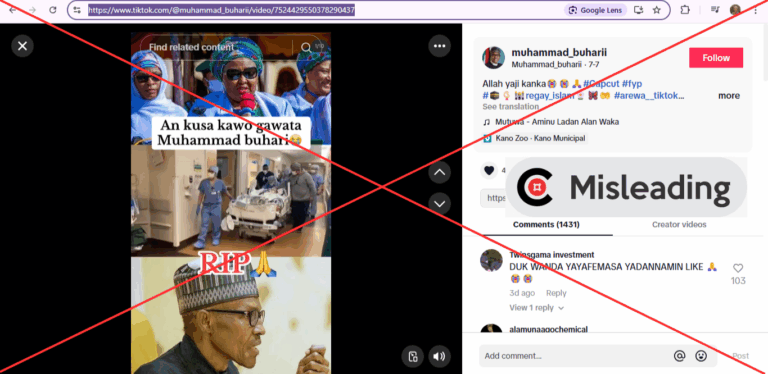
Just a few weeks before his death, FactCheckHub reported how many social media users posted a misleading video claiming it depicts the burial rites of the former president.
This followed earlier reports that emerged, which indicated that he was critically ill and had been admitted to the Intensive Care Unit. However, Bashir Ahmad, who was a digital media aide to the former President, refuted the claim.
The FactCheckHub analysed keyframes from the video using Google Reverse Image Search, the result shows that the video depicts the funeral of Safara’u Umar Radda, mother of Katsina State Governor, Dikko Umaru Radda, who was buried on Sunday, March 23, 2025.
Prolonged absences, frequent medical trips abroad, and the government’s lack of transparency created an information vacuum. In that vacuum, speculation thrived. With little official clarity, even the most implausible claims began to seem plausible to some.