Please note that the FactCheckHub has not obtained any right from the authors or copyright owners of all third-party contents from embedded links and shall incur no liability in this regard.
Please note that the FactCheckHub has not obtained any right from the authors or copyright owners of all third-party contents from embedded links and shall incur no liability in this regard.
Please note that the FactCheckHub has not obtained any right from the authors or copyright owners of all third-party contents from embedded links and shall incur no liability in this regard.
Please note that the FactCheckHub has not obtained any right from the authors or copyright owners of all third-party contents from embedded links and shall incur no liability in this regard.
ROTIMI Chibuike Amaechi, minister of transportation and the director-general of the APC presidential campaignorganisation was said to have been arrested by the police in his home on Wednesday, January 23 on allegations of corruption.
CrossCheck Nigeria, a collaboration of newsrooms in Nigeria which includes The ICIR, confirms that Amaechi was not arrested and that he was at the presidential rally of President Buhari in both Sokoto and Kebbi states yesterday, January 23.
The post, published on January 23, at 06:52 am by AIT News Nigeria, a Facebook page, has garnered 488 likes, 571 comments, and 1,029 shares as at 6:02 pm, January 24.
Also, Happenings in Nigeria, another Facebook page, shared yesterday at 11:55 am. It has the traction of 101 likes and 157 shares as at 6:03 pm, January 24.
The Facebook page cannot be said to be owned by the African Independent Television (AIT) because there appears to be another page named, Africa Independent Television (A TV Channel) that is well updated with programmes aired on its television station and also with larger followership. While the TV channel has about 454,720 followers, AIT News Nigeria has 55,000 followers.
To verify this, CrossCheck Nigeria tracked the minister’s public appearance on said date. The presidential rally of the APC was in Sokoto and Kebbi on January 23. A NANreport confirmed the APC campaign DG was in attendance. Live coverage of the event by the NTA also showed Amaechi addressing the crowd at the rally.
The police, through the Rivers state commissioner, debunkedthe claimed and urged the general public to disregard it.
THE negotiating committees of the Federal Government and the Academic Staff Union of Universities (ASUU) have been in a fight, an online video alleges.
Shared on the 17th of January by Hope For Nigeria, a Facebook page, the 20secs video had been viewed 52, 297 times five days later.
A verification check by CrossCheck Nigeria, a collaboration of newsrooms in Nigeria which includes The ICIR, however, reveals that the mentioned parties were not involved in the video being circulated.
“Free for all Fight as ASUU AND FG’s negotiators engages in boxing Match,” the caption read. The post had garnered 2,022 shares and 158 comments as at 19:45 pm on January 22.
Using an online video verification software designed by Amnesty International, Youtube DataViewer, CCN found the date and time of upload and thumbnails.
A reverse image search on the thumbnails then revealed the brawl as one between supporters of Abdul’aziz Yari, governor of Zamfara state, and Kabir Marafa, a senator from the state, disrupting an APC election committee sitting.
This was reported by The Cable newspaper, who is also a member of the CrossCheck Nigeria coalition.
The oldest version of the video was posted by journalist, Kadaria Ahmed on her twitter handle on October 7, 2018.
She said in her post: “Just a few hours before @OfficialAPCNg has to submit the names of its candidates to @inecnigeria for #NigeriaDecides2019 the situation in Zamfara has deteriorated. Clashes between Gov Yari’s supporters & that of Senator Marafa, disrupt sitting of the election committee”
The video has since been published on several Youtube channels and most of them dating three months ago.
A VIDEO showing that the Vice President, Prof. Yemi Osinbajo was booed and chased away by angry people in a market in Ilorin, Kwara State capital has surfaced online. The post was shared on the website of SpyNigeria.ng News.
CrossCheck Nigeria a collaboration of newsrooms in Nigeria which includes The ICIR confirms that neither the Vice President nor his convoy was seen or traced to the scene of the video, based on verification checks.
Spy Nigeria, on January 10 posted on their website that the Vice President was chased away on Friday, January 4 from two markets in Ilorin where he was alleged to have gone to solicit for votes through the TraderMoni initiative of the Federal Government. The post garnered 505 shares on Facebook as at 11:25 am on January 14.
To verify this, CrossCheck Nigeria tracked the public appearances of the Vice President across the country from January 4 to date. Through his official Twitter account and that of his media aide, Laolu Akande, it can be confirmed that the Vice President has not been to Kwara State this year; and the last time he was in the State was on December 7, 2018, when he went to launch the state chapter of the Tradermoni scheme.
A geo-satellite search on the video reveals that it was actually shot at the UTC Shopping Complex, Area 10, Abuja.
FIVE political parties, represented either by their presidential candidates or other top members, shared their strategies on the subject of ‘corruption and accountability’ at a debate organised by the Centre for Democracy and Development.
The event took place at Sheraton Hotel, Abuja, and is a continuation of the Nigerian Political Parties Discussion Series. The first of the series, which centred on issues of national security, was held in December and had three parties in attendance.
In the latest edition, six political parties were invited and all but the All Progressives Congress were represented. For two hours, Omoyele Sowore, presidential candidate of the Africa Action Congress (AAC); Tope Fasua, presidential candidate of the Abundant Nigeria Renewal Party (ANRP) responded to questions bordering on their plans to tackle corruption.
Others were Kazeem Afegbua, presidential campaign council spokesman of the People’s Democratic Party (PDP); Paul Isamade, National Publicity Secretary of the Allied Congress Party of Nigeria; and Egbeola Olawale Martins, National Publicity Secretary of the Young Progressives Party (YPP).
In this fact-check, The ICIR examines seven claims made by Tope Fasua of the ANRP and YPP’s Olawale Martins.
Tope Fasua,Abundant Nigeria Renewal Party
Tope Fasua. File credit: CDD West Africa
Claim: Nigeria has the highest level of maternal, child mortality in the world
“… and according to the World Bank and UN and all that, we are also the country with the highest number of poor people, the highest number of out-of-school children, the highest number of maternal mortality and child mortality. And I think this is very very important.”
According to the latest statistics about maternal mortality from the World Bank, Nigeria has the fourth worst maternal mortality ratio per 100,000 live births in the world (814), bested only by Chad (856), Central African Republic (882), and Sierra Leone (1360). This statistic was cited, in 2018, by Bill Gates, Co-chairman of the Bill and Melinda Gates Foundation.
Also, when it comes to child mortality levels, though one of the lowest ranked, Nigeria is not the worst performing country across the indices: neonatal, infant, under-five mortality rates. This is according to Levels and Trends in Child Mortality, a report compiled by the World Health Organisation (WHO), World Bank Group, United Nations, United Nations International Children’s Emergency Fund (UNICEF).
In the latest report, the infant mortality rates of Mali (66), Lesotho (67), Democratic Republic of Congo (70) and others are higher than Nigeria’s 65. The neonatal mortality rates of Mauritania (34), Mali (35), Lesotho (38) and others are higher than Nigeria’s 33. Finally, the probability of children aged 5-14 dying in Niger (39), Somalia (24), Cameroon (28), Cote d’Ivoire (27) among others is higher than Nigeria rated as 20.
Verdict: The claim is false.
Claim: 25% of our budget as at 2010 is spent by 18,000 top people, civil servants
“According to Adamu Fika report, 25 per cent of our budget as at 2010 and going forward is spent by 18,000 top people, who are top politicians, and top civil servants … this is unacceptable.”
In 2013, the Presidential Committee on the Review of the Reform Processes in the Nigerian Public Service, headed by former head of service Adamu Fika, submitted its findings to the government. Among Fika’s revelations was that Nigeria annually spends huge resources (N1.126 trillion) annually on the salaries and allowances of certain public office holders, constituting only 0.013 percent of the population (estimated then to be 167 million).
He said: “Of this, salaries took a mere N94.56 billion, while allowances gulped the whole of N1.03 billion, which represented 91.56%. There is, therefore, a need to take a hard look at this glaring anomaly, where allowances are more than ten times greater than salaries.
“Such a re-examination is very necessary in the light of the fact that the total number of beneficiaries of the RMFAC largesse is only about 18,000 officers.”
Verdict: The claim is true. The percentage of 25 is also fairly accurate. Using the 2013 budget of N4.987 trillion, this will give us 22.6 percent; and using the 2010 budget of N4.6 trillion, we will arrive at 24.5 percent.
Claim: If you Google the budget of Lagos or any state, you won’t see anything
“We are going to be looking at transparency in general. If you went to South Africa right now, you can Google the budget of Johannesburg and you will see it in pdf. You can Google the budget of Capetown. But if you Google the budget of Lagos State or any of our states, you won’t see anything.”
Actually, if you Googled these keywords, you would find something. BudgIt, a civic startup that documents, visualises and engages budgets and public data has done a remarkable job bringing all available budgetary resources into a single database, both at the national and sub-national level.
For 2018 alone, its database contains the summaries of Lagos and Kwara States’ approved budgets, as well as the approved budgets of Anambra, Jigawa, Ebonyi, Kebbi, Abia, and fourteen other states.
Verdict: The claim is false.
Claim: 50 percent of the police are bag carriers for people
“There are 400,000 people in the Nigerian police. 200,000 of them are carrying bags for people, according to the police themselves. According to the former chairman of the PSC, MIke Okiro, 50 per cent of the Nigeria Police are bag carriers for people. That is not good enough.”
Indeed, Mike Okiro, Chairman of the Police Service Commission, has made such a statement — but not exactly. In February 2018, Okiro said during an interview with the News Agency of Nigeria (NAN) that more than 150,000 policemen are attached to VIPs and unauthorised persons in the country.
“We cannot afford to have more than half of the population of the Police in private hands,” he said.
Okiro did not, however, give the population of the Nigeria Police as 400,000. In an earlier fact-check of a claim by Osita Chidoka, former Aviation Minister, The ICIR established that this is not the population of the law enforcement body.
According to the International Criminal Police Organisation (INTERPOL), the Nigeria Police Force has a strength of over 350,000 men and women; and a recent statement by the Inspector General of Police Ibrahim Idris suggests the population is within the range of 320,000.
Claim: Nigeria is ranked 152nd presently on the Human Development Index
“Let me start by saying the direct consequence of corruption is our placement in the Human Development Index, where presently Nigeria is being ranked 152nd among 157 nations in the world.”
No. According to the Human Development Indices and Indicators 2018 Statistical Update of the United Nations Development Programme (UNDP), Nigeria is ranked 157th out of 189 countries. Though the country’s performance has continued to rise steadily, especially since 2010, the overall rank compared with other nations of the world worsened. In the UNDP reports of 2015 and 2016, Nigeria was ranked 152nd.
Verdict: The claim is false and outdated.
Claim: Nigeria is the worst place to give birth to children
“As it is today in Nigeria, we currently have over 13.5 million children [who are] out of school. Nigeria is the worst place to give birth to children, [and] as it stands today our life expectancy is being put at 55 years.”
A similar claim was made at the debate by Omoyele Sowore who said Nigeria “has become the capital where a child is likely to die before the age of five”.
However, these claims do not agree with the figures provided by ‘Levels and Trends in Child Mortality’, a report compiled by the World Health Organisation (WHO), World Bank Group, United Nations, United Nations International Children’s Emergency Fund (UNICEF).
According to the 2017 report, half of all neonatal deaths (death during the first 28 days of life, constituting 46 percent of under-five deaths) are concentrated in five countries. India (with 24 percent) and Pakistan (with 10 percent) surpassed Nigeria’s 9 percent of the global figure.
More specifically, the latest report of 2018 states the country’s under-five mortality rate as 100 (per 1000 live births) and puts the figure of under-five deaths at 714,000. A comparative study of the figures shows that Central African Republic (122), Chad (123), Mali (106), Sierra Leone (111), and Somalia (127) have higher under-five mortality rates. Also when it comes to a total number of under-five deaths, India (with a figure of 989,000) is worse off.
If maternal mortality figures are used to evidence this claim, it still will not hold water, as latest statistics from the World Bank — as earlier noted — place Nigeria as the fourth worst country, not the absolute worst.
Verdict: The claim is false.
Claim: Nigeria’s GDP to per capita income is less than $2800
“As we are speaking, our per capita income is put around … GDP to per capita income is put at less than $2800.”
The ICIR, in an earlier fact-check of Peter Obi, PDP vice presidential candidate, already established that information on the IMF website states that Nigeria’s Gross Domestic Product (GDP) per capita dropped to $1,994 in 2017. In 2018, the World Bank states that the country’s GDP per capita rose to $2,050. Therefore, though it is lesser than $2800 as claimed by the YPP publicity secretary, it is actually much less.
FIVE political parties, represented either by their presidential candidates or top party officials, shared their strategies on the subject of ‘corruption and accountability’ at a debate organised by the Centre for Democracy and Development.
The event took place at Sheraton Hotel, Abuja, and is a continuation of the Nigerian Political Parties Discussion Series. The first of the series, which centred on issues of national security, was held in December and had three parties in attendance.
In the latest edition, six political parties were invited and all but the All Progressives Congress were represented. For two hours, Omoyele Sowore, presidential candidate of the Africa Action Congress (AAC); Tope Fasua, presidential candidate of the Abundant Nigeria Renewal Party (ANRP) responded to questions bordering on their plans to tackle corruption.
Others were Kazeem Afegbua, presidential campaign council spokesman of the People’s Democratic Party (PDP); Paul Isamade, National Publicity Secretary of the Allied Congress Party of Nigeria; and Egbeola Olawale Martins, National Publicity Secretary of the Young Progressives Party (YPP).
In this fact-check, The ICIR examines five of the claims made by the representatives of AAC and PDP.
Omoyele Sowore, Africa Action Congress
Omoyele Sowore, AAC Presidential Candidate
Claim: Nigeria is the capital of where a child is likely to die before five years
“It is a crime that a country like Nigeria making so much money has become the capital of where a child is likely to die before the age of five. It is not only bad but our leaders who are supervising the death of these five-year-olds ought to be tried for a crime against humanity.”
This claim is not in agreement with figures provided by Levels and Trends in Child Mortality, a report compiled by the World Health Organisation (WHO), World Bank Group, United Nations, United Nations International Children’s Emergency Fund (UNICEF). According to the 2017 report, half of all neonatal deaths (death during the first 28 days of life, constituting 46 per cent of under-five deaths) are concentrated in five countries. India (with 24 per cent) and Pakistan (with 10 per cent) surpassed Nigeria’s 9 per cent of the global figure.
More specifically, the latest report of 2018 states the country’s under-five mortality rate as 100 (per 1000 live births) and puts the figure of under-five deaths at 714,000. A comparative study of the figures shows that Central African Republic (122), Chad (123), Mali (106), Sierra Leone (111), and Somalia (127) have higher under-five mortality rates. Also when it comes to total number of under-five deaths, India (with a figure of 989,000) is worse off.
Verdict: The claim is false according to latest statistics.
Claim: There are over 13 million kids who are not in school
“We have to invest in these kids… We also have to take over 13 million kids who are not in school back to school by investing N1.3 trillion in their education, take them out of the streets.”
A similar claim was made during the debate by YPP’s National Publicity Secretary who said Nigeria has about 13.5 million out-of-school children. The source of the figure is Ahmed Bobboyi, Executive Secretary of the Universal Basic Education Commission (UBEC), who said in October that the population of out-of-school children has risen from 10.5 to 13.2 million.
Bobboyi cited as his proof the Demographic Health Survey (DHS) “conducted by UNICEF published in 2015”. An earlier fact-check conducted by The ICIR however revealed that there is no such report. Geoffrey Njoke, a Communication Specialist with UNICEF Nigeria said “the last report on NDHS was that of 2013 and the next edition of the report should be published this year”.
Using the Multiple Indicator Cluster Survey (MICS) conducted by the National Bureau of Statistics and UNICEF and published in early 2018, as advised by the Statistician General of the Federation, Yemi Kale, there are 9.1 million out-of-school children in the country.
Verdict: There is no documentary evidence for this claim.
Kazeem Afegbua, People’s Democratic Party
File Photo: Kazeem Afegbua
Claim: Sowore emerged presidential candidate without due process
“The last time I understand, Sowore from the party emerged the presidential candidate without due process, but that is just aside.”
After this claim was made, Sowore responded the next time he was given the floor by saying the party’s convention was broadcast live to everybody, they “didn’t pay anybody $5000 to vote” for the presidential candidate, and they “didn’t take the BDCs (Bureaus de Change) from everywhere to Port Harcourt”.
According to Section 85(6) of the 2010 Electoral Act, where there is only one aspirant in a political party standing for any elective positions, including the presidency, “the party shall convene a special convention or congress at a designated centre on a specified date for the confirmation of such aspirant and the name of the aspirant shall be forwarded to the Commission as the candidate of the party”.
The next sub-section states that a “political party that adopts the system of indirect primaries for the choice of its candidate shall clearly outline in its constitution and rules the procedure for the democratic election of delegates to vote at the convention, congress or meeting”.
According to the constitution the Africa Action Congress (AAC), schedule three on nominations for elections, all aspirants seeking nomination shall submit themselves to the National Convention. It adds that “the candidate that wins more than fifty per cent of the votes of the total delegates of the Special Convention shall be considered duly nominated”.
The AAC National Convention was held in October at Duplex Plaza, CMD, Shangisha, Lagos and, according to media reports, party delegates unanimously decided in favour of the presidential candidacy of Omoyele Sowore, who contested unopposed.
Verdict: The claim is false, as Sowore’s candidacy did not break the relevant laws.
Claim: 150 million Nigerians live in dirty environments
“57 million children don’t have access to basic health needs, and about 150 million or 130 million (thereabouts) according to statistics also live in dirty environments.”
The only study that claims to have measured how many Nigerians live in dirty environments was conducted by a Non-Governmental Organisation called Clean-Up Nigeria (CUN) and was widely reported in November, 2018. Reports say the study has 768 pages, was conducted from October 2017 to October 2018, and is titled: “Clean-Up Nigeria National Technical Working Committee Report on the state of the nation’s cleanliness performance ratings for states of the federation, state capitals/cities in Nigeria.”
Among other claims stated, Ene Baba Owoh Jr, who said he is the CUN’s National Coordinator and Secretary of its National Technical Working Committee (NTWC), said that 175 million Nigerians are living in unclean environments.
The ICIR could however not find this extensive study. The NGO does not appear to have an online presence or a website, and there are very little reports about past activities of the organisation asides the 2018 press briefing.
When an official of Clean-Up Nigeria, the only project by that name with a website, was called, he explained that the website belongs to a project of the African Clean Up Initiative, which has no connections with the other CUN.
Verdict: While the claim is inaccurate according to the only available evidence on the extent of Nigeria’s dirty environment, the source of this proof is unverifiable.
The claim would however be grossly exaggerated if Afegbua was referring only to children. This is because, according to the World Bank, Nigerians under the age of fifteen constitute 43.9 per cent (87.4 million) of the population — nowhere near the PDP campaign spokesman’s figures.
Claim: I’m not sure anybody can tell you the budget of EFCC for 2018 or 2019
“I am not sure, if you throw the question here, anybody will tell you this is the budget of the EFCC for 2019 or 2018. Everything is shrouded in secrecy.”
The Economic and Financial Crimes Commission (EFCC) was established in 2003 under the administration of former president Olusegun Obasanjo; and checks by The ICIR showed that its budget has been included in the federal budget annually submitted to the National Assembly since 2004.
In the approved 2018 budget, the commission received a total budgeted amount of N26.4 billion, out of which N16.3 billion was for recurrent while N10 billion was for capital expenditures. For the 2019 fiscal year, the commission is proposed to receive N22 billion, N18 billion for recurrent expenses and N4 billion for capital projects.
Verdict: It is false that the budget of the EFCC is not available to the public for perusal.
Immediately after making this claim, Afegbua also claimed that EFCC has not published audited reports for the last 15, 16 years. The senate in March, 2018, levelled a similar allegation when Matthew Urhoghide, chairman of the Public Accounts Committee, reported that certain MDAs including the EFCC have not submitted audit reports since their establishment. The EFCC spokesperson, Wilson Uwujaren, however almost immediately described this as “incorrect”.
“It is incorrect to say that the EFCC never submitted audit report to the office of the auditor-general. A check with that office would have forestalled this error of fact,” he told the press.
THE Presidency may not entirely be right about President Muhammadu Buhari’s support for the Anti-Open Grazing Law enacted by the Benue State Government to check killings between the herdsmen and farmers in the state.
Senior Special Adviser on Media and Publicity to the President, Garba Shehu, on Sunday had issued a statement reacting to alleged hate campaign from Governor Ortom against the President, claiming that Buhari supported the anti-open grazing law.
“The allegations coming from Ortom were particularly unfair, when one considers how much support the governor received from the Federal Government, which supported his grazing laws as a means to end the farmer-herder crises that have plagued the state.
“If not for President Buhari’s insistence that the governor be given a chance to effect the law, he would have faced resistance from different sources and found it difficult to implement,” the presidency claimed.
But contrary to claims by the presidency, state and federal lawmakers including other prominent Nigerians publicly appealed for President Buhari’s support the law, without success.
The law, initiated by the Benue State Assembly and implemented by the State government and led by Governor Samuel Ortom in 2017, was part of measures to restore peace in Benue.
But findings revealed that there was no time where the President categorically supported the anti-open grazing law which was outrightly kicked against by the Miyetti Allah Cattle Breeders Association of Nigeria (MACBAN)), Miyetti Allah Kautal Hore Fulani Socio-Cultural Association among other pastoral groups.
Member of Buhari’s minister of defence, Mansur Dan Ali in January 2018 asked states implementing the anti-open grazing law – Ekiti, Benue and Taraba to stop the law and repeal it.
The National Executive Council (NEC) chaired by the Vice President, Prof. Yemi Osinbajo also insisted on ranching.
“Whatever crisis that happened at any time, there has to be remote and immediate causes. What are the remote causes of this farmers/herders crisis? Since Independence, we know there used to be a route whereby these cattle rearers use.
“Cattle rearers are all over the nation, you go to Bayelsa, you see them, you go to Ogun, you see them. If those routes are blocked, what happens? These people are Nigerians, it’s just like you going to block river or shoreline, does that make sense to you?
“These are the remote causes. But what are the immediate causes? It is the grazing law. These people are Nigerians, we must learn to live together with each other, that is basic. Communities and other people must learn how to accept foreigners within their enclave, finish!”, Mansur Dan Ali had stated.
In February 2018 the Inspector General of Police, Ibrahim Idris during his appearance before the Senate had reportedly canvassed for the suspension of the anti-open grazing law attributing it as the root cause of killings, especially in Benue State.
The summon was after a 14-day ultimatum issued by the Senate for the Police to arrest and prosecute killers of 73 Benue State residents.
“He asked for stoppage of implementation of the law until ranches are provided, then the law can be gradually implemented again. He also asked for further equipping and funding for police to assist their work in the area and across the country,” he allegedly stated.
In March 2018, the House of Representatives chaired by Hon. Yakubu Dogara asked the President to direct security operatives to begin implementation of the anti-open grazing law.
Mr. Hassan Saleh, a federal lawmaker from Benue State had reported the killings to the House and accused the Police and other security operatives of their refusal to implement the law in his state.
Beyond that, Dr. Paul Unongo, Chairman, Governing Board of the Nigeria Educational Research and Development Institute further appealed to the President to support the implementation of the law.
“Governor Ortom’s campaign is clearly designed to stir division and hatred, and to divert the people’s attention from his inability to pay staff salaries and pensions for several months.
“It has been noted that the governor has been visiting churches in the state where he falsely tells congregations about President Buhari’s so-called plans to Islamise Benue State.
“This nonsense has formed the basis of his campaign because he has nothing to offer Benue people,” the presidency stated.
It reads further that, “While advising Ortom to immediately stop his dubious attacks on President Buhari, the Federal Government calls on the people of Benue State to not fall for Ortom’s deception and allow themselves to be hoodwinked by such a negative campaign”.
“They should instead, ask him why he has refused to pay staff salaries and pensions for months, and what he did with the funding from the excess crude account which should ideally have gone towards addressing such payments”.
“The Presidency calls on Governor Samuel Ortom of Benue State to desist from basing his campaign for re-election on falsehoods concerning President Muhammadu Buhari and instead focus on the dire issues confronting the State”.
This position shows that the presidency, rather than support Ortom’s anti-grazing law, wants the law fizzle away unenforced.
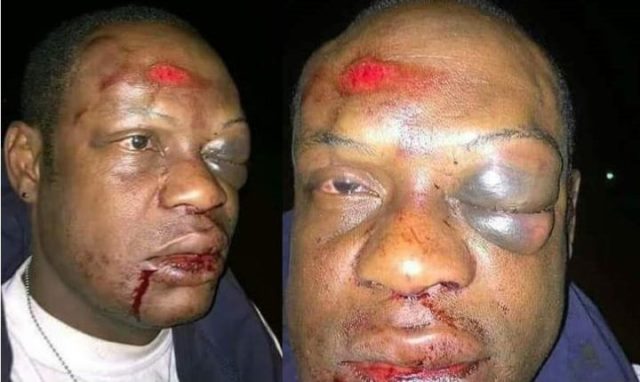
A photo, supposedly of the door-to-door campaign leader of the All Progressives Congress (APC), surfaced on Facebook saying he was brutalised while campaigning for the re-election of President Muhammadu Buhari.
It didn’t say where in Nigeria the assault happened.
CrosscheckNigeria, a collaboration of newsrooms in Nigeria which includes The ICIR has confirmed the claim to be false and pretentious and that the man in the photo may not even be Nigerian.
The picture posted by one Facebook user, Abaelu Ike-Anthony on January 7, has garnered about 153 shares and 119 comments. Abaelu claimed to have received it on Whatsapp.
In the post, he wrote: “1ST VICTIM OF APC DOOR TO DOOR CAMPAIGN.
“Mr Dapo, one of the APC door to door campaign leader and a next level preacher was badly brutalized yesterday when he mistakenly visited the house of 3 hungry Nigerian graduates who lost their Jobs immedietly president Buhari took over in 2015.
“The 3 friends Imoh, Ikenna and Steven started panel beating the face of Mr Dapo with lots of anger until neighbors came to his rescue. When asked why they had to beat Dapo that way, one of the unemployed graduate Mr Imoh said ” a hungry Man is an angry Man.
“The injury on Mr Dapo’s face has disorganized his face totally and it’s even hard for his wife and family to recognize him.”
Using the reverse image search tool TinEye, we found that the earliest version of one of the photos surfaced online on January 29, 2018 when a website called Timeofgist reported how a Facebook user posted how a man was beaten for sleeping with another man’s wife in Lagos.
A day after, January 30, 2018, the photo surfaced online again on a Ugandan blog to depict another version of the same story, but this time naming the subject, Ntinda – the name of a suburb in Kampala, the capital city of Uganda.
VICE Presidential candidate of the People’s Democratic Party (PDP), Peter Obi, evidently gave out the greatest number of facts and figures at the recently organised vice presidential debate, but The ICIR has found that a good number of them were false, grossly exaggerated or only partly true.
The debate, which featured five running mates for the 2019 general elections was put together by the Nigeria Elections Debate Group (NEDG) and the Broadcasting Organisations of Nigeria (BON).
Others who participated include Yemi Osinbajo of the All Progressives Congress (APC), Ganiyu Galadima of the Allied Congress Party of Nigeria (ACPN), Khadijah Abdullahi-Iya of the Alliance for New Nigeria (ANN) and Umma Abdullahi-Getso of the Young Progressives Party (YPP).
In this fact-check, The ICIR shares its findings on thirteen sets of claims given by the PDP candidate.
Claim: Nigeria’s poverty rate grows at 6% per minute
“We now live in a country where we have the highest number of poor people in any nations, 87 million, and growing 6 per cent every minute,” he said.
Not only is this claim outrageous on the face value, but it is also not true. According to the Brookings Institution, “each April and October, the World Poverty Clock data are updated to take into account new household surveys and new projections on country economic growth from the International Monetary Funds’s World Economic Outlook” and these data form the foundation for poverty trajectories computed for 188 countries across the world.
Today, the clock says we have 90.7 million Nigerians who are extremely poor — that is, 46.4 per cent of a population of 195.5 million. Data highlights from the clock, Brookings noted in June, show that “extreme poverty in Nigeria is growing by six people every minute”. It is possible this is how the PDP vice presidential candidate had intended to phrase his statement.
Verdict: The claim is false. If we follow the premise of Nigeria’s poverty rate growing by 6 per cent every minute, it means by the fourteenth minute, the entire population (assuming even that it grows to 205.8 million) will be extremely poor.
Claim: Nigeria dropped on HDI from 152 to 157 …
He said: “Our HDI has dropped from 152 to 157, our global competitive index has dropped from 124 to 127. In terrorism, we have moved from seven to number three behind Iran and Afghanistan.”
Nigeria ranked 152 out of 173 countries according to 2015 Human Development Report developed by the United Nations Development Programme (UNDP). And in the latest report of 2018, the country has dropped to 157 out of 189 countries. It should be noted however that the human development index value improved from 0.514 in 2015 to 0.532 in 2018.
According to World Economic Forum’s 2015-16 Global Competitiveness Report, Nigeria ranked 124 out of 140 countries, an improvement from the 127th position of the previous year. In the 2017-2018 report, which is the latest, the country now ranks 125th out of 137 countries. Nigeria’s score also dropped from 3.46 to 3.30. Nigeria had ranked 127 in the 2016-2017 report.
For the Global Terrorism Index, prepared annually by the Institute for Economics and Peace, Nigeria’s position has not shifted since 2015. In the 2015 report, Nigeria was ranked 3rd out of 129 countries and, in the 2018 report, Nigeria again ranks 3rd out of 138 countries, just behind Afghanistan and Iraq (— not Iran as Obi said). The country’s performance has, however, improved from 9.213 in 2015 to 8.660 in the latest report.
Verdict: The claim is partly true. While Obi is right about Nigeria’s worsening performance — in relation to the rest of the world — on the first two indices, he is wrong with respect to terrorism.
Claim: Nigeria uses over 50 per cent of revenue for debt management and owes N22.7 trillion
He said: “Today we are virtually at a level where our debt is not sustainable because we are using over 50 per cent of our revenues to service debt, which means we don’t even have enough to be able to do infrastructural projects that are highly needed in this country.”
The latest figure on Nigeria’s public debt stock as at June 30, 2018, is available on the website of the Debt Management Office (DMO), which centrally coordinates the management of the country’s debt. According to the report, the total domestic and external debts owed by the federal government, state governments and the Federal Capital Territory stand at N22.38 trillion.
When it comes to debt servicing, the International Monetary Fund (IMF) has said the country spends more than 50 per cent of its revenue on servicing. This was according to Amine Mati, the Senior Resident Representative and Mission Chief for Nigeria, when he presented the “Regional Economic Outlook for Sub-Saharan Africa – Capital Flows and the Future of Work” in Abuja in November.
The ICIR has, however, gone through the said IMF report and could not find any part which supports this claim by Mati. While he was correct to say Nigeria’s growth rate for 2018 is 1.9 per cent, the report does not specifically mention Nigeria’s rate of debt servicing to revenue. But it has two indices on government debt as a per cent of GDP (24.8) and external, official debt as a per cent of GDP (8.2).
The DMO had said in January that Nigeria’s spending on debt servicing stands at 34.02 per cent of revenue — as likewise noted in its 2017 Report of the Annual National Debt Sustainability Analysis (DSA), the latest of such reports.
A look at the approved budget for 2018 confirms this claim by the DMO. The total of expected oil and non-revenue is N7.17 trillion and the total debt service is N2 trillion, thus making the percentage 28.1 per cent. But we will arrive at 30.5 per cent if we use the proposed oil revenue of N2.4 trillion.
Verdict: The claim is partly true. While the figure on Nigeria’s debt stock is true, the statement about the country’s debt servicing as a per cent of revenue is inconsistent with figures from the DMO and budgetary instrument.
Claim: Bank loans are about 15 per cent of GDP… China is 250 per cent of GDP
“Your banks today, all the loans they have given are about 15 per cent of your GDP, when other countries are doing 50, 100 percent. China alone is doing 250 per cent on their GDP as credits to businesses, to private sector,” Obi said, while answering a question on driving investments to the economy.
According to data sourced from the IMF and made available on TradingEconomics, which provides more than 20 million economic indicators for 196 countries, in Nigeria, domestic credit provided by the bank sector as a per cent of the GDP for 2017 is 26.56 per cent. For China, the figure stands at 215 per cent.
Verdict: The claim is exaggerated.
Claim: In 2015, we attracted $21 billion in FDI, and only 12 last year …
“In 2015, we were attracting $21 billion in foreign direct investment. We attracted only 12 last year. Our GDP was 520 in 2015 and per capita was 2,500. Today, it is under 1,900,” the PDP candidate said in justifying his point that fighting corruption is not an economic policy.
In 2014, we generated $21bn in FDI, in 2017, Nigeria attracted only $12bn. Unemployment & underemployment was 24% in 2014. In 2017 it is now 40%. Even our stock market has lost over N2Trillion in one year. You can’t shut down your shop and be chasing criminals. #2019Debate
On Foreign Direct Investment, according to records of the World Bank, Nigeria’s FDI started going downhill from $8.8 billion in 2011 to $3.1 billion in 2015. In 2016, it rose to $4.4 billion and was $3.5 billion in 2017. We have similar data from the Central Bank of Nigeria, broken down into various quarters.
Information on the IMF website states that Nigeria’s Gross Domestic Product (GDP) per capita in 2015 was $2,763, in 2016 it dropped to $2,207, and it dropped even further to $1,994 in 2017. The GDP per capita, in 2018, has however risen to $2,050, and the IMF projects that it will continue to rise till it gets to $3,317 in 2023. IMFreports also that Nigeria’s GDP in 2015 was $494 billion, and not $520 billion.
Verdict: The claims are false. The FDI figures were grossly exaggerated. Also, while the GDP per capita in 2015 and 2018 were understated, the GDP of 2015 was exaggerated.
Claim: Nigeria has only 2 million vehicles, 10 per 1000
He said: “It [subsidy] is a waste… what are you actually subsidising? Look at it. Nigeria has one of the low car ownership in the world. It is 10 per thousand. So we have only two million vehicles, and you are paying almost a trillion when we have 87 million people that are poor.”
According to data from the National Bureau of Statistics (NBS), Nigeria’s estimated vehicle population as at the second quarter of 2018 is 11,760,871, and the vehicle per population ration was put at 0.06 (as against Obi’s 0.01).
In 2017, commercial vehicles accounted for 53.8 per cent of the total vehicle population, private vehicles accounted for 44.5 per cent, government vehicles accounted for 1.65 per cent and diplomat vehicles made up to for 0.1 per cent.
Verdict: The claim is false and grossly exaggerated.
Claim: 40 per cent of the GDPs of China, Indonesia and Malaysia from manufacturing
“No country that is doing well… If you look at the GDP of China, 40 per cent is from manufacturing, Indonesia 40 percent, Malaysia 40 percent. Even in the western world… yours is under eight, and your factories are closing down,” he said.
According to 2017 data from the World Bank, while the manufacturing sector contributes 29.3 per cent to China’s GDP, it contributes 20.12 per cent to Indonesia’s GDP and 22.3 per cent to Malaysia’s GDP — none of the figures as high as that cited by the PDP candidate.
Obi also said the contribution of Nigeria’s manufacturing sector to the GDP is “under eight per cent”, but the World Bank records put it at 8.74 per cent.
Verdict: The claims are false.
Claim: Total bank loans today is N19tn and only 0.5% goes to SMEs
He said: “You can look at your loan portfolios. Today, the total loan from the banks is N19 trillion, and only … 0.5 per cent of that goes to your SMEs, where in the countries it is about 20 percent.”
It is the Central Bank of Nigeria’s Statistical Bulletin on Financial Statistics that provides official figures on bank loans and what percentage goes to small-scale enterprises. According to the latest bulletin of 2017, in the year’s fourth quarter, the amount of commercial bank loans that went to the private sector was N16.2 trillion.
Out of this, N10.7 billion went to small-scale enterprises, which amounts to 0.1 per cent. The only periods when the percentage increased between 2014 and 2017 was in the second quarter of 2014 and the first quarter of 2017 when it was 0.2 and 1.7 per cent respectively.
Verdict: The claim is exaggerated.
Source: CBN Statistical Bulletin, 2017
Claim: The power generation in Indonesia is 50,000 for 250 million people…
“…If you can support the SMEs properly and be able to work on your manufacturing, which then leads to the issues of power, because what we are generating today is too low. Look at your competitors, the lowest that you can see in the MIND countries is Indonesia that is generating 50,000 for 250 million people and you are generating about 4,000 for 200 million,” Obi said.
To begin with, the current population of Indonesia, based on the latest United Nations estimate, is 268 million.
Then according to data from the U.S. Department of Commerce’s International Trade Administration, by the end of 2016, Indonesia’s “installed generation capacity was 58,541 MW, with 40,461 MW (75%) generated by state-owned National Electric Company (PLN) and the remainders, 13,254 MW and 2,434 MW are produced by independent power producers (IPPs) and private power utility (PPUs) respectively”.
It is not clear what Obi meant by “MIND countries” or what exactly he said — perhaps it was an acronym for emerging economies such as “BRICs” is used to refer to Brazil, Russia, India, China and South Africa.
Verdict: The claims are inaccurate and outdated.
Claim: African trade today is less than 9% … Oil gives 80% of our forex
“African trade today is less than nice percent, and ff we get it right it can go as high as 30 per cent or 40 percent. The foreign exchange you are saying today you’re now earning from oil, oil now gives you 80 per cent of your foreign exchange, when in effect if you do the right things, you can have twice than coming from manufacturing,” he said, while commenting on the African Continental Free Trade Agreement.
The 2018 African Trade Report developed by the African Export-Import Bank notes that intra-Afican trade is at 15 per cent (nearly double Obi’s claim), compared to Europe’s 67 per cent, Asia’s 58 per cent, North America’s 48 per cent, and Latin America’s 20 per cent. According to Brookings, in 2016, intra-African exports made up 18 per cent of total exports.
Source: NBS
On the other hand, the contribution of oil products to Nigeria’s foreign exchange is closer to 90 per cent than 80. According to the NBS, crude oil and other petroleum products constituted up to 87.7 per cent of Nigeria’s foreign exchange earnings in the first quarter of 2018.
Verdict: The claims are false and understated, respectively.
Claim: I have invested aggressively in education as governor, taking my state from being 28th to number one…
“The more you invest in education, the better your economy. So we will aggressively invest in education. I have done this even as a governor of a state, where I took a state from being number 28 to number one, because we know the value of education. I was the first to equip all our schools with ICT… Go to HP, I bought the highest [number of] computer[s] ever bought by a government in Africa: 30,000. So I know the value,” he said.
Truly, Anambra State was declared first among states in Nigeria in the 2013 West African Senior School Certificate Examination (WASSCE) followed by Abia, Rivers and Lagos states; and the Anambra State Commissioner for Education, Uju Okeke, attributed the feat to Obi’s policies in the education sector. The same feat was achieved the following year when his tenure came to an end.
It is also true that the former governor’s acquisition of computers for secondary schools has been acknowledged. In 2014, at the 25th Annual Conference of the Nigeria Computer Society, Obi was awarded for his contributions along the line.
“On the assumption of office, the former Governor embarked on the computerization of schools and offices in Anambra State. Today, all public offices in the State have computers unlike before him, when manual typewriters were still in use,” David O. Adewunmi, the society’s president said.
“He purchased more than 30,000 desktop and laptop computers for secondary schools in the State. The last purchase was 22,500 units of laptop computers from HP at the ratio of one computer to 10 students, the largest for computer purchase for school in the entire African continent.”
It is not clear if this last claim applied generally or was restricted to sub-national governments only. Records, however, show that countries such as Rwanda, Kenya, and South Africa have implemented much more ambitious educational computer projects before 2015.
The ICIR could not confirm whether Anambra State’s secondary schools were ranked 28th by WAEC before Obi’s administration.
Verdict: The claims are true, to the extent which they can be verified.
Claim: NPA has an office and guesthouse in London…
Obi said: “Nigerian Ports Authority, for years, looked at the expansion that is coming and everything and decided not to invest. Instead, we are using money wrongly. Nigerian Ports Authority is the only ports in the world that has an office, even a guesthouse, outside its country of operation. They have a guesthouse in London; and that is the problem.”
NPA’s contact page
Checks on the website of the Nigerian Ports Authorities show that the agency has an “overseas liaison office” with the physical address stated as: 2nd Floor, Allenby House, 1a Temple Rd Cricklewood, London. The ICIR could however not confirm if the agency has a guesthouse in the same city, or if it is the only ports authority in the world to have an office outside national borders.
Verdict: The claimabout the overseas office is true, while others could not be ascertained.
Claim: Buhari on March 26, 2015… said he should be removed if he doesn’t deliver
“We are in a situation where, four years ago, on March 26 2015, our president said to us, ‘if I fail to deliver, choose your leader.’ The question is: Have they delivered?” Obi said in his closing statement, as the audience cheered.
There is no record of Buhari delivering a reported speech on this day. What he did though was sign a second peace accord alongside then President Goodluck Jonathan, which was initiated by the National Peace Committee. Bola Tinubu delivered a speech the previous day at the 7th Annual Bola Tinubu Colloquium, and he said nothing close.
The ICIR has also studied the president’s acceptance speech of April 1, 2015, inaugural speech of May 29, 2015, independence day speech of October 1, 2015, and speech at the swearing-in of ministers on November 11, 2015, and could not find the statement credited to him by the PDP vice presidential candidate.
It should be noted also that March 26 was nearly one week before Buhari was declared president-elect by the Independent National Electoral Commission, which would have made the utterance of the attributed statement premature.
Verdict: The claim is false and could not be substantiated.
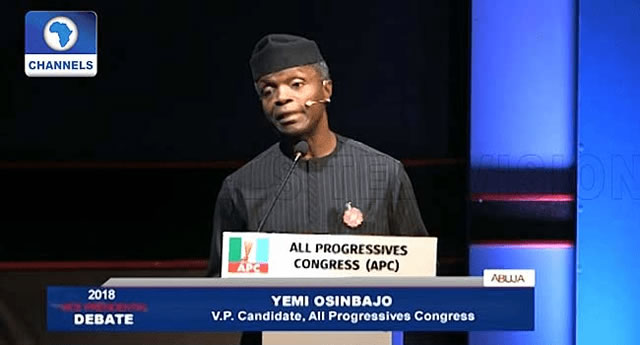
VICE President Yemi Osinbajo was not entirely truthful about the African Continental Free Trade Area during his presentation at Friday’s Vice Presidential debate, The ICIR has discovered.
The debate, which featured five running mates for the 2019 general elections was put together by the Nigeria Elections Debate Group (NEDG) and the Broadcasting Organisations of Nigeria (BON).
Others who participated include Peter Obi of the People’s Democratic Party (PDP), Ganiyu Galadima of the Allied Congress Party of Nigeria (ACPN), Khadijah Abdullahi-Iya of the Alliance for New Nigeria (ANN) and Umma Abdullahi-Getso of the Young Progressives Party (YPP).
In this fact-check, The ICIR shares its findings on Osinbajo’s statement about the free trade area as well as six other claims.
Claim: The continental free trade area has been negotiated for years and these negotiations started under the previous government
“I think my rebuttal is simple. The question really is that the Continental Free Trade Area has been negotiated for years. The negotiation started under the previous government. So the question of consultation or non-consultation and when it ought to have taken place really could have taken place many years ago when they started these negotiations,” he said in rebutting an argument presented by the PDP vice presidential candidate.
The Vice President was correct to say that the continental free trade agreement has been negotiated for years, but he was mistaken to have stated that the negotiations started under the previous administration.
While preliminary planning for the agreement started in 2013 with the inaugural meeting of the Continental Task Force on the Continental free Trade area in Addis Ababa, negotiations did not start until June 2015, when the African Union launched negotiations at the 25th Ordinary Summit of Head of States and Governments in South Africa.
Contrary to Osinbajo’s claims, President Muhammadu Buhari represented Nigeria at this summit in Johannesburg, as he had been sworn into office the previous month.
Verdict: The claim is false.
Claim: Nigeria imported $5 million of rice daily five years ago, and today we are down to 90 percent less
He said: “Barely five years ago, this country was importing $5 million of rice every single day. Today, we are down to 90 percent less. We are producing 90 percent of the rice that we consume and we are importing only two percent of what we used to import.”
It is key to first note that the figures given by the Vice President are self-contradictory. On the one hand, he said imports have reduced by 90 per cent; and then seconds later he added that Nigeria now imports only 2 per cent of what it used to import.
Moreover, the worth of rice Nigeria imported on a daily basis before 2016 depends on who is talking. In July 2015, Governor of Central Bank of Nigeria, Godwin Emefiele, said figures available with the CBN show that “from the period January 2012 to May 2015, the country had spent over 2.41bn dollars on the importation of this commodity [rice].” This, in other words, means the country spent $2.2 million on rice importation every day in those three years.
However, Akinwumi Adesina, then Minister of Agriculture and Rural Development, said in 2013 that Nigeria spent N356 billion annually and nearly N1 billion daily on rice importation. Using the exchange rate of 160 Naira to a dollar applicable then, it would mean the country spent $6.3 million on importing the commodity every day.
As a matter of fact, statistics about rice importation and production have generally been conflicting and lack transparency. While it is true that imports from Thailand have dropped by 96.7 per cent, statistics from the same source suggest that smuggling from Benin Republic and Cameroon may have increased as imports by them increased by an almost equal measure. Besides, the federal government’s figure does not account for rice imports from other countries.
Information Minister Lai Mohammed said in November that Nigeria’s rice consumption is 6 million metric tonnes, while local production capacity is 4.9 million. This means the country produces 81.6 per cent of what it consumes — as against the VP’s 90 per cent.
In May, Agriculture Minister Audu Ogbeh had said the country produces between 5.8 million to 6 million tones of rice. To make matters even more confusing, Sadiq Daware, National Treasurer of the Rice Farmers Association of Nigeria (RIFAN), said in October 2017 that the country’s consumption rate has increased to 7.9 million tonnes and production has increased to 5.8 million tonnes.
But, two months after, RIFAN’s National Vice President, Segun Atho said the association’s rice production for the year was 15 million metric tons whereas “Nigerians can only consume six to seven million metric tons”. He added that Nigeria can now start exporting excesses to other African countries.
Meanwhile, the 2018 World Agricultural Supply and Demand Estimates, which is approved by the World Agricultural Outlook Board, say that Nigeria’s rice production is at 3.78 million metric tonnes, while 3.0 million metric tonnes are imported. An e-mail sent to the United States Department of Agriculture by The ICIR asking for how it arrived at its figures has not been replied yet.
Verdict: The claim is partly self-contradictory, and the figures available for substantiation are not uniform.
Claim: At least 400,000 people so far brought out of poverty with conditional cash transfer scheme
“Under the NSIP, we have the Conditional Cash Transfer Scheme, taking at least 400,000 people so far out of poverty,” he said just before the moderator interjected.
The Vice President also made this claim in September, but The ICIR has been unable to match it with other sources from the government. It was pointed out in a previous report that Maryam Uwais, Special Adviser to the President on Social Investment Programmes, gave a much lesser figure of 297,973 while addressing newsmen in November.
Again, the APC 2019 campaign manual, also released in November, states on page 12 that “almost 300,000 Nigerians now receive N5,000 monthly, across 20 states [with] N12.8 billion so far disbursed to beneficiaries.”
At the time of the report, The ICIR has been unable to get the National Social Investment Office to clarify the apparent contradictions in the provided figures, as calls placed to Iquo Ayi, the office’s Programme Officer, were not answered, and texts sent to her are still without reply.
Verdict: The claim cannot be corroborated, and it conflicts with other figures provided by the Federal Government.
Claim: We have spent 2.7 trillion in two budget cycles on capital
He said: “In the past three years, the government of President Muhammadu Buhari has spent N2.7 trillion on capital in two budget cycles. That is the highest ever in the history of Nigeria, despite earning 60 percent less than the previous government.”
In 2016, according to documents released by the Office of the Accountant-General of the Federation, the total cash release for capital projects was N1,219,471,747,443 (N1.2 trillion) and, in 2017, the figure rose to N1.6 trillion — making a total sum of N2.8 trillion spent in the two fiscal years.
Verdict: The claim is true.
Only two months ago, however, while addressing participants at the 9th Presidential Quarterly Business Forum in Abuja, the Vice President had goofed by understating the achievement. “We have spent so far in two budgets, N1.7 trillion in capital investment,” he had said.
Claim: We have set up six tech hubs in all six geopolitical zones
In one of his rebuttals, the VP said: “With respect to technology … at the moment, we have set up six technology hubs in the six geopolitical zones. Those technology hubs are being funded mainly by the federal government. Some of them are part-funded.”
The Buhari Media Centre has made a similar claim in its list of “Ongoing/Completed Projects By The Buhari Administration Across 36 States”, which mentions ICT innovation hubs in the FCT and Lagos as part of the government’s achievements.
But going by the details provided to The ICIR on Saturday by Laolu Akande, Senior Special Assistant to the VP on Media and Publicity, Osinbajo is not entirely correct. Akande explained that the administration did not set up hubs in all of the regions but “worked with existing players in the ecosystem” for places where there is already observed innovation activity.
Giving examples, he said the federal government ran the Start-Up Nigeria project to support start-ups in collaboration with Ventures Platform Hub in Abuja (for the North Central) and Genesys Hub, Enugu (for the South East).
However, the spokesperson said in the North East, the North East Humanitarian Innovation Hub was set up in partnership with the International Committee of the Red Cross, and Premier Hub was set up in Akure in partnership with the State Government and other private sector actors.
“In the South-South we set up the Marydel Hub, in partnership with the Edo Innovates program of the State Government, and also ran programs and projects in the Tinapa Knowledge City,” he added.
“In Lagos, we set up the Nigeria Climate Innovation Center, in partnership with the Enterprise Development Center in the Lagos Business School, and the World Bank. In the North West, we are working with Colab, who have been listed to benefit from world bank GEM funds, and the Kaduna ICT Hub set up in 2016 by the state government in partnership with Zenith.”
Verdict: The claim is partly true.
Claim: Under PDP, Nigeria fell 64 places in the World Bank index of ease of doing business
“I thought the candidate of the PDP would at least acknowledge that while under the PDP, we fell 64 places down on the World Bank index. Under us, in eighteen months, we have moved 24 places up in the ease of doing business,” he said, in reaction to Peter Obi.
Though the Doing Business Report, a co-publication of the World Bank and the International Finance Corporation, has its origin in a paper published in 2002, the ranking of world economies was not introduced until 2006. That year, Nigeria ranked 94 out of 155 countries.
Under the previous administrations led by the People’s Democratic Party, the country’s rank only slightly improved in 2012 and 2013. In 2014, Nigeria dropped further to 147 and this worsened further to 170 in the 2015 report. Since the 2016 report gathered data from June 2014 to June 2015, and it ranked Nigeria 169 out of 189 countries, it means the country fell 75 places under the previous government.
Today, in the latest report for 2019, Nigeria is ranked 146, which means the country has moved up 23 places since the All Progressives Congress took over control of the executive arm of government at the federal level.
Verdict: While the Vice President’s claims are not exactly accurate, they are close to the true figures as may be deduced from the Doing Business Reports released between 2006 and 2019. The number of places Nigeria has improved since APC took over would, however, be 24 if the 2018 ranking were used.
Claim: Poverty was 80 million in 2004 and increased to 112 million in 2014
“Poverty in 2004 in Nigeria was 80 million. As of 2o14, it went to 112 million in Nigeria. What we set out to do from 2015 was to reduce that poverty and contain it,” Osinbajo said in his closing remark.
According to the National Bureau of Statistics, 54.7 percent of Nigerians lived in “absolute poverty” in 2004. At this time, the country’s population was estimated at over 138 million, meaning the number of extremely poor Nigerians then would be at least 75.5 million.
In 2014, the bureau’s findings revealed that the number had increased to 112 million, which represented 67 per cent of the country’s 167 million population — though the World Bank’s Nigeria Economic Report of the same year concluded that poverty rates may be significantly lower (33.1 per cent) “using newly-available data on growth, poverty, and living standards”.
Verdict: The claim is true — using statistics provided by the National Bureau of Statistics.
PETER Obi, vice-presidential candidate of the Peoples Democratic Party (PDP has claimed that the unemployment and underemployment rate in Nigeria rose from 24 per cent in 2015 to 40 per cent in 2018.
Obi made the claim at the just concluded vice presidential candidate debate organised by the Nigeria Elections Debate Group (NEDG) and the Broadcasting Organisations of Nigeria (BON).
His goal is to make the economic policy of Buhari look worse than bad.
“In 2015, unemployment and underemployment rate used to be 24 per cent, but now, it is about 40 per cent” Obi claimed
VERIFICATION OF CLAIM
To verify the claim, The ICIR looked through data and reports published by the National Bureau of Statistics (NBS) on unemployment and labour.
UNEMPLOYMENT/UNDEREMPLOYMENT DEFINED
The labour force population covers all persons aged 15 to 64 years who are willing and able to work
regardless of whether they have a job or not. The definition of unemployment, therefore, covers persons (aged 15–64) who during the reference period were currently available for work, actively seeking for work but were without work. Underemployment, however, occurs if one work less than full-time hours, which is 40 hours, but work at least 20 hours on average a week and /or if you work full time but are engaged in an activity that underutilizes your skills, time and educational qualifications.
UNEMPLOYMENT AND UNDEREMPLOYMENT RATE FIGURES FROM 2015 TO 2017
Data obtained from a report titled “Unemployment/underemployment report Q3 2016″ from the website of the NBS shows that Nigeria’s unemployment and underemployment rate in Q1 2015 was 29.1 per cent, it increased to 35.2 per cent at the last quarter of 2016.
The latest report by the NBS shows that unemployment and underemployment rate for Q1 2017 was 37.2 per cent and rose to 40.0 per cent in Q3 2017
CONCLUSION
Obi’s claim is correct on one side and not correct on the other side. He said that “Unemployment rate used to be 24 per cent in 2015, but now, it is about 40 per cent”. Available official records support his claim for 2017 figure. However, the rate was slightly higher than he claimed it to be in 2015; the rate was 29.1 per cent. Therefore, Buhari should not be held accountable for 5.1 per cent loss of job
The unemployment and underemployment rate in Nigeria kept increasing since 2015, it has RISEN to 40 per cent as claimed by Obi.