Home Blog Page 100

GRV, other prominent Twitter accounts share misleading video about Niger coup

FOLLOWING the Nigerian government’s planned intervention to stop the military coup in Niger Republic, some influential Twitter accounts have tweeted a video purportedly showing the troops of Nigerien army preparing to confront the Nigerian army.

The video is circulating following the recent coup in Niger that sacked the democratically elected administration of Mohamed Bazoum,

As the chairman of Community of West African States (ECOWAS), Nigeria’s President Bola Tinubu denounced the recent coup in Niger Republic and assured swift intervention.

READ : Niger coup : Video does not show Nigerian army ready to attack Niger Republic

He further threatened to impose sanctions on the country which began by cutting off power that supplied the country.

Next, he wrote to the National Assembly (NASS) seeking military intervention against the military junta. 

But here are prominent twitter users who used their great following to disseminate misleading video on the Niger Coup.

1. Ex-Governorship Candidate, Gbadebo Rhodes-Vivour (GRV)

  A  governorship candidate of Labour Party in Lagos State at the just concluded 2023 election, Rhodes-Vivour is among the  Twitter accounts that shared the video.

He tweeted the video to validate his argument against the Nigerian government’s proposed idea to wage war against Niger.

He has has over 200,000 followers on Twitter, but he tweeted the controversial video with a caption : 

“Unlike some, i have only one passport and have sworn no allegiance to any other state. Nigeria is all I have. 

“A war with a people who appear to be uniting around a common interest, seeking economic freedom and a departure from over bearing western influence will have very dire consequences for our image as a regional power and could pose much graver security threats. Their alliance in the footprint of the ancient songhai empire is not by accident, their fight is also ideological with the memory of Thomas Sankara being evoked. 

For several years in recent times, we have seen both political and military leaders send patriotic soldiers to war illequiped and with very little remuneration while they reward themselves with vanities. 

“We are still grappling with major insecurity as a result of the destabilization of Libya by France and its Allies, and because Africa did not present a United front, west africa is paying the price for that destabilization. 

“Forget the fact that we have serious internal security challenges that is stretching our military, or the fact that our economy is in a parlous state, how does it make sense that Nigeria wants to lead an effort to spill the blood of people who are seeking emancipation? 

“We must focus on a diplomatic solution. Nigeria cannot afford to be enmeshed in a war and we must stand against international destabilization of the region, if we don’t, it will be a mess we will eventually clean up and pay dearly for, ask Libya.”

2. Jeremiah Jackson (@drpenking)

DR Penking is a Twitter influencer and medical practitioner.

His real name is Jeremiah Jackson, and he has over 140,000 followers on the micro-blogging social media.

He is widely known for sharing health-related content before he switched briefly to tweeting in support of the Labour Party in the last election. 

He tweeted the claim with a caption: “Niger Republic is now under serious military alert.”

The tweet has generated over 200 retweets and more than 1000 likes as of August 4, 2023. 

Several individuals have since reacted differently to the shared video. But despite the misleading claim, the tweet remains on his post.

3. Chimaobi Nteoma(@chimaobi_nteoma), Labour Party ally

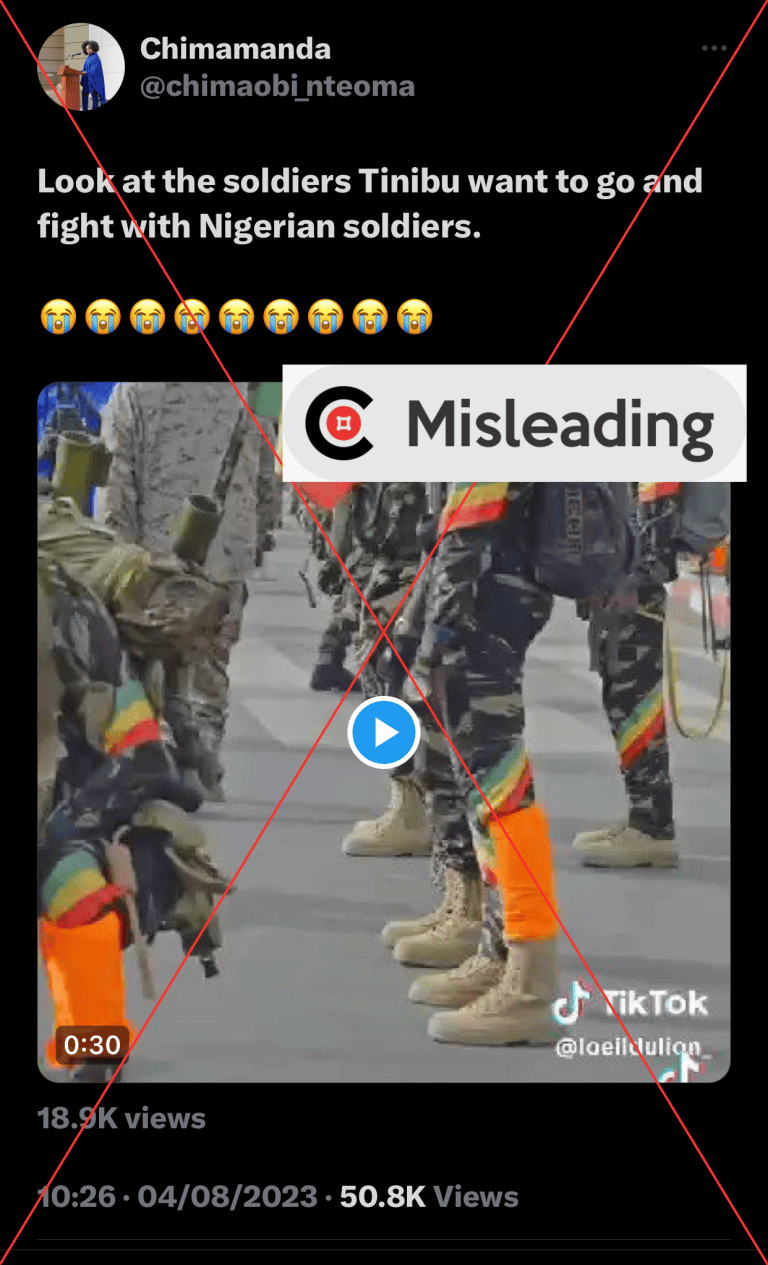
She also tweeted the video to her over 25,000 followers with the video with the caption :  “Look at the soldiers Tinubu want to go and fight with Nigerian soldiers.” 

The tweet has generated over 3,000 retweets and more than 6000 likes as of August 6, 2023. And here is the claim:


THE CLAIM 

Video shows Nigerien army preparing for war against Nigeria.

Screenshot of the viral claim


THE FINDINGS 

Findings by FactCheckHub show that the claim is MISLEADING.

FactCheckHub started by examining the video’s content, which clearly showed the presence of Senegalese flags being erected and held by the military personnel seen in the video.

Checks further reveal that the video emerged from Tiktok and the account, @loileidulin that posted the video on Tiktok is a Senegalese account.

The video was captioned : Démonstration inedite des forces comandos de l’armée sénégalaise It was translated as: “Unpublished demonstration of the commandos forces of the Senegalese army.” This was done using the Google Translate.

These imply that contrary to the claim by the popular politicians, the footage was never that of the Nigerien soldiers but a mere demonstration by the Senegalese troops.

THE VERDICT

The claim that the video shows troops of Nigerien army preparing ahead of clash with Nigerian army is MISLEADING, as findings by FactCheckHub show that video depicts the Senegalese army.
Niger coup : Video does not show Nigerian army ready to attack Niger Republic

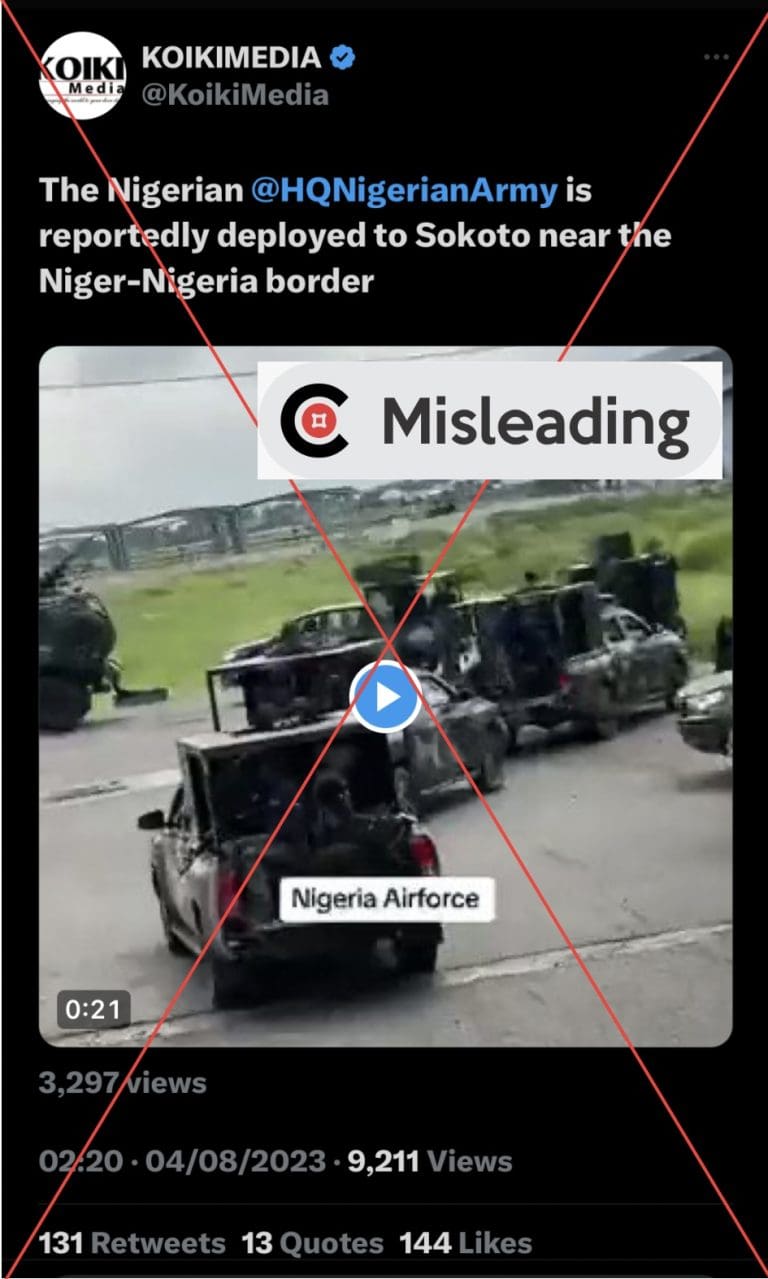
A Tiktok video showing some men in military uniform has surfaced online with a claim that the troops of the Nigerian army have been deployed to Sokoto to contain the military coup in the Niger Republic.

The viral footage gathered so much reaction following the recent coup in Niger Republic. As of August 3, 2023, the post has generated over 330,000 views with 748 retweets and over 2, 000 likes. 

READ : GRV, other prominent Twitter accounts share misleading video about Niger coup

A Twitter user, @Sprinter99800 tweeted the video with a caption that reads: “The Nigerian Air Force is reportedly deployed to Sokoto near the Niger-Nigeria border.”

The same claim was retweeted by @KoikiMedia, a verified Twitter account. The Twitter user @KoikiMedia tweeted with a caption that reads: 

“The Nigerian @HQNigerianArmy is reportedly deployed to Sokoto near the Niger-Nigeria border.” 

THE CLAIM

Video shows troops of the Nigerian army deployed to Sokoto in order to contain Niger Coup.

Screenshot of the viral posts

THE FINDINGS 

Findings by FactCheckHub show that the claim is MISLEADING.

Niger Republic is a landlocked nation with a population of about 27 million people. It shares border with northern Nigeria, particularly the frontline states such as Sokoto, Katsina and Borno.

On July 26, 2023, the military successfully toppled the government following the detainment of President Mohamed Bazoum and his family. The incident has since drawn global attention, including concerns from member nations of the Economic Community of the West African States (ECOWAS). 

Meanwhile, a document had earlier emerged on social media on Tuesday, August 1, 2023, suggesting that Nigeria’s president was in the process of deploying the Nigerian Army to Sokoto for an aerial attack on Niger Republic. This reported action has raised concerns among certain Nigerians about its potential repercussions. 

Fueling the speculation, the video resurfaced online, purporting to show Nigerian military personnel preparing for the operation.

However, checks by FactCheckHub reveal that the video has been online before the military coup in Niger Republic.

A keyword search on social media led us to an earlier version of the video uploaded on July 23, 2023 by a Tiktok account, Real OGT.

Further analysis of the account reveals the user always posts videos related to military  actions and lifestyles. The exact was hash-tagged #militarylife without suggesting that the video is related to the event.

FactCheckHub sent a message to the handler of the account, and he confirmed that the video is unrelated to the incident.

“It’s an old video. It was posted some months ago and just went viral some days ago. It’s my course mate [that] video it [during] operation in Enugu. So, I asked for it,(sic)” the handler responded.

THE VERDICT

The claim that the video shows troops of the Nigerian army being mobilised to Sokoto ahead of the attack at Niger Republic is MISLEADING as findings by FactCheckHub show that the video has been online prior to the incident and not related to the recent Nigerian government’s planned intervention into the ongoing coup in Niger Republic.

How TikTok allows users to promote misinformation about brands – Report

THE News Guard’s misinformation monitor has revealed that Tiktok, a video-sharing platform, is breeding false claims about prominent brands in the world.

The study which was published in July stated that AI-generated or manipulated media are being used to spread misinformation about some popular brands on the platform.

The study used nine brands, including Anheuser-Busch, Barilla, Bud Light, Chick-fil-A, Heineken, Kohl’s, and Target, which have faced political criticism or boycotts as sample.

Part of the report read, “NewsGuard found that videos that shared misinformation about these brands were cumulatively viewed 57 million times. Nearly half of the views were for videos that used AI-generated or otherwise manipulated media to advance misinformation. 

”In total, NewsGuard analyzed 520 TikTok videos and found that 14 percent, or 73 videos, contained false, misleading, or unsubstantiated claims targeting the brands themselves. These video search results were generated by analyzing the top 20 results of 26 keyword searches related to brands based in the U.S. and Europe.”

According to the report, TikTok’s search engine played a significant role in spreading misinformation. The platform suggested keywords that led users to brand-related conspiracy theories and false information. 

The report stated that TikTok’s guidelines state that they prohibit misinformation causing significant harm to individuals or society but the policy does not extend to commercial or reputational harm. When NewsGuard brought these findings to TikTok’s attention, they removed only two out of the 18 videos shared with them, which is a concerning response.

According to the report, the misinformation on TikTok has fueled animosity towards brands, with users participating in online debates and calling for boycotts based on false claims. For instance, a video claimed that Target was selling “tuck-friendly” bathing suits for LGBTQ+ children, leading to a backlash against the retailer. However, Target has never sold such products for children.

The report stated that misinformation was also spread through digitally manipulated images and AI-generated content such as AI-generated photos falsely depicted Target selling satanic clothing and conspiracy theories about brands.

TikTok’s policy requires clear disclosure for manipulated media, but many of the identified videos lacked such indications according to the report. 

The report stressed the need to address misinformation on platforms like TikTok, given its increasing influence on young audiences and its potential to tarnish the reputation of brands through false claims and manipulated content.


EDITOR’S NOTE:

* Headline updated.

Video does not show Nigerien minister of finance crying over failure to account for public spending

A video clip showing a man shedding tears while delivering a speech has surfaced online with a claim that it shows the ex-finance Minister of Niger Republic crying over failure to account for government’s spending.

The claim is contained in a social media post shared on X (formerly Twitter) by an online user.

According to the claim, the Nigerien military has given the former minister a 48-hour ultimatum to give his stewardship account as head of the nation’s finance ministry or face execution.

The video is circulating following the recent coup in Niger Republic. 

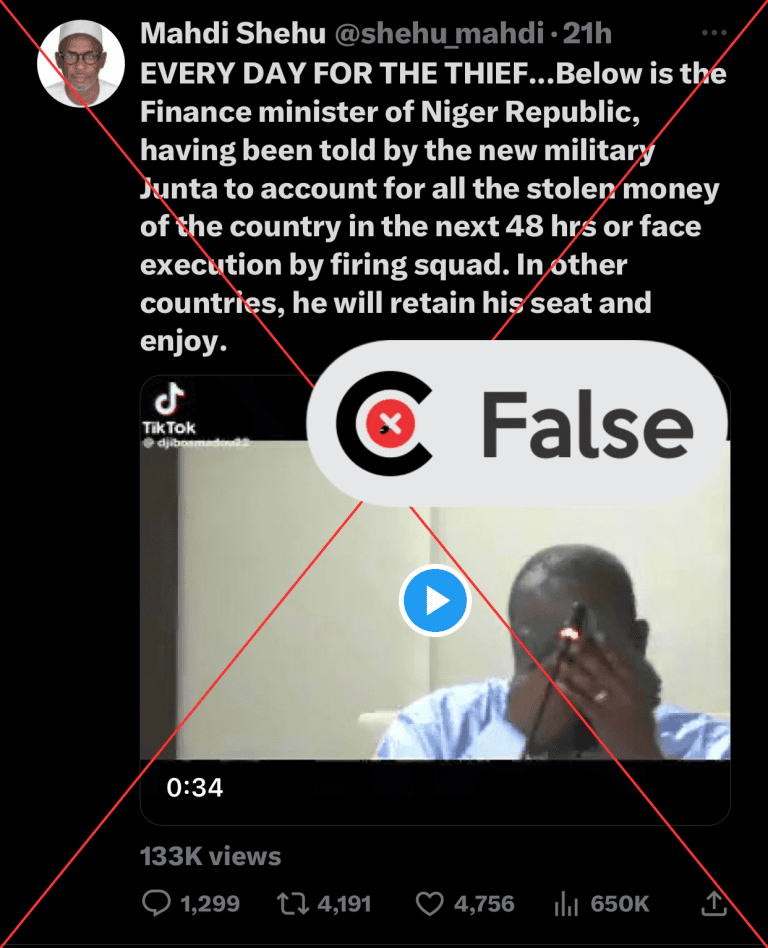
A popular activist, Mahdi Shehu with the username: @shehu_mahdi tweeted the video with a caption that read: 

“EVERY DAY FOR THE THIEF…Below is the Finance minister of Niger Republic, having been told by the new military Junta to account for all the stolen money of the country in the next 48 hrs or face execution by firing squad. In other countries, he will retain his seat and enjoy.”

The tweet has generated over 700,000 views, over 3,600 retweets, and more than 5,000 likes as of July 30, 2023. 

Another X user, Olaudah Equiano, with the username: @RealOlaudah tweeted the video with a caption thus: 

“Minister of finance in Niger Republic given 48hrs by the coup plotters to account for the stolen money of Niger people or face execution by firing squad. We’re back to square one!”

The tweet has generated over 1.7 million views, more than 3,000 retweets and over 5,000 likes as of July 30, 2023. 

Gidi, a popular X page, tweeted the same video with a caption that read: 

“Niger Republic’s Finance Minister, Ahmat Jidoud cried after the Military told him to account for all the money in the next 48 hours or face execution by firing squad. Thoughts?” 

The tweet has also garnered over 180,000 views as of July 30, 2023.


CLAIM

Video shows Nigerien minister of Finance crying over failure to account for public spending.

Screenshot of the viral tweet.


THE FINDINGS

Findings by The FactCheckHub show that the claim is FALSE.

A Google reverse image search using the video’s thumbnail shows that the footage has been online since at least December 2021. An earlier version of the video can be viewed here and here.

Ahmat Jidoud, ex-minister of Finance, Niger Republic.

Analysis of the video content shows that the man in the video is Niger’s ex-minister of Justice, Marou Amadou and not the nation’s former minister of Finance, Ahmat Jidoud.

Further checks revealed that the video clip is unrelated to the July 2023 military coup in the West African country.

THE VERDICT

The claim that the viral video shows Nigerien minister of Finance crying after being forced to account for public spending is FALSE; findings indicate that the video has been online since 2021 and is unrelated to the recent coup d’état in the country.

Nigerian actress Eniola Badmus makes false claims about fuel price globally

0

POPULAR Nigerian actress, Eniola Badmus, has claimed that Nigerians buy the cheapest fuel in the world.

PulseNigeria247  reported that she stated this during an interview on the media personality Daddy Freeze’s Instagram live stream on Monday, July 24, 2023 while defending the Nigerian President, Bola Ahmed Tinubu, on fuel subsidy removal.

READ : How PEPT judgement, Niger and Gabon coups fuel misinformation on X

She said:

“A lot of these keypad warriors do not even have an idea of what subsidy is. It was when they removed it that they knew what the government was doing. Even till now, I think we still buy the cheapest fuel in the world.”


CLAIM

Nigerians buy the cheapest fuel in the world.

THE FINDINGS

Findings by The FactCheckHub show that this claim is FALSE.

Nigeria is a member state of the Organization of the Petroleum Exporting Countries (OPEC), a permanent intergovernmental organization of 13 oil-exporting developing nations that coordinates and unifies the petroleum policies of its Member Countries in order to collectively influence the global oil market and maximize profit.

Data from the Global Petrol Prices show that the country where people purchase gasoline otherwise known as Premium Motor Spirit (PMS) at the cheapest rate around the world and OPEC members is Venezuela sold at 0.004 USD which is equivalent to N3:30 (naira).

About 20 other nations sell gasoline cheaper to their populace than Nigeria, further check has shown.

It is pertinent to note that the differences in prices across countries are due to the various taxes and subsidies for gasoline. All countries have access to the same petroleum prices at the international markets but then decide to impose different taxes. As a result, the retail price of gasoline is different.

THE VERDICT

The claim that Nigerians buy the cheapest fuel in the world is FALSE; findings revealed that about 20 other countries sell fuel (gasoline) cheaper than Nigeria.

Open AI’s GPT-3 capable of spreading disinformation faster than human – Study

0

OPEN AI’s GPT-3, the machine-learning model behind ChatGPT, has the ability to spread disinformation online at a faster rate than humans, a recent study published on Science Advances has revealed.

The research focused on the significant threats posed by advanced text generators in a digital world, particularly in relation to disinformation and misinformation on social media platforms. 

READ : How Russia runs disinformation campaign against Zelensky – Report

It examines how Artificial intelligence (AI) models like GPT-3 influence the information landscape and how people perceive and interact with information and misinformation.

GPT-3, an acronym for Generative Pre-trained Transformer 3, is the third version of the programme developed by OpenAI. Among its various language processing skills, the programme can mimic the writing styles commonly found in online conversations.

To assess the impact of GPT-3 on spreading disinformation, the researchers selected 11 topics that were deemed susceptible to such manipulation, including climate change, COVID-19, vaccine safety, and 5G technology.

The study collected AI-generated tweets containing both true and false information, as well as real tweets related to the same topics.

The researchers conducted a survey using subsets of tweets categorized into AI-generated and human-generated, after identifying disinformation through expert analysis. Respondents were asked to assess the content’s accuracy and discern whether it was authored by a human or AI.

The study found out that respondents were better able to identify disinformation in tweets written by humans but containing false information, compared to the tweets generated by GPT-3. Interestingly, respondents were less effective at detecting false information when it was generated by Artificial intelligence (AI).

The study further revealed that GPT-3’s generated text not only has a greater impact on informing and disinforming humans but also does so more efficiently and in less time. Accurate statements were found to be more challenging to assess than disinformation, both for humans and AI-generated text.

“Participants recognized organic false tweets with the highest efficiency, better than synthetic false tweets,” the study explained.

“Similarly, they recognized synthetic true tweets correctly more often than organic true tweets.”

This study shows the potential dangers and implications of AI-powered text generators like GPT-3, particularly in the realm of spreading disinformation online and highlights the need to develop robust strategies to combat the rapid dissemination of false information in the digital age.

WAJIC 2023: Fact-checking organisations deploy innovative techs to combat misinformation

0

Fact-checking organisations in Africa are deploying innovative methods and technologies to aid fact-checking efforts and counter the spread of misinformation and disinformation on the continent.

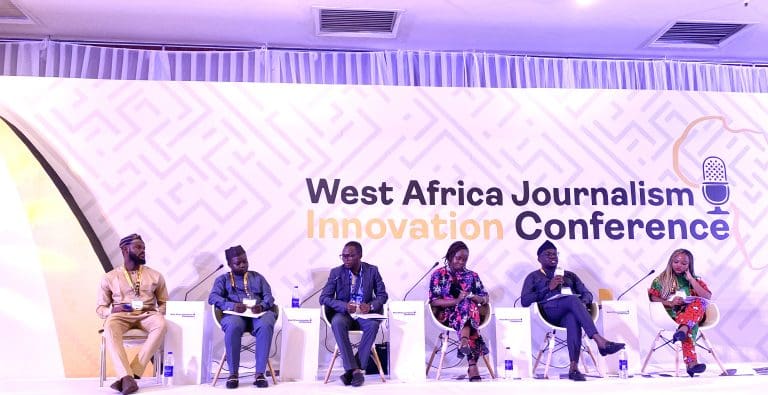
This was revealed on Wednesday, July 26, 2023 at the just concluded West Africa Journalism Innovation Conference (WAJIC), hosted by the Centre for Journalism Innovation and Development.

Speaking at a panel session on Innovative Trends in Verification, the Nigerian Editor of Africa Check, David Ajikobi raised an alarm over the rising challenge of misinformation, disinformation, and mal-information plaguing the African continent, particularly during recent elections in West African countries.

Highlighting the power of collaboration in the face of this menace, Ajikobi lauded the Nigerian fact-checkers’ solidarity in their joint efforts to combat misinformation during Nigeria’s 2023 general elections. 

He added that Africa Check‘s strategies include leveraging Artificial Intelligence, academic research, and strategic partnerships with radio stations to bolster their fact-checking activities.

Also speaking, Kemi Busari, the Nigerian Editor of Dubawa, bemoaned the impact of information disorder, which permeates all sectors, from health and politics to security, economy, and education. 

“Some people wake up daily to spread false information and that’s where they earn their living,” Busari lamented.

Expressing frustration with tech companies, Busari lamented the failure of technology companies to take responsibility and complement the efforts of fact-checking organisations.

“Shortly before the 2023 election, I had a couple of training sessions across the country and in the process of making some of my slides, I went online to look for some of the major false information that were spread in Nigeria’s 2019 general election. It would interest you that some of these false information that had already been fact-checked are still on Twitter and still exist on Facebook,” Busari told the over 200+ audience at the conference.

He further showcased how fact-checkers can combine investigative journalism with fact-checking using the ‘Baba Aisha Herbal medicine’ story he authored which revealed the health hazards posed to Nigerians by the herbal medicine.

Speaking on his organisation’s innovative efforts to reach wider audience, Opeyemi Kehinde, The FactCheckHub Editor and National Coordinator of the Nigerian Fact-checkers Coalition, said The FactCheckHub is translating fact-checked contents into Nigerian local languages such as Hausa, Igbo and Yoruba to reach the under-served local communities.

In his presentation titled: ‘Curbing misinformation with trivia game – Get it right,’ he showcased how a collaboration between his organisation, ICIR and Digital Public Square (DPS) birth the innovative trivia game – Get It Right – a gamified platform designed to provide engaging fact-checking content while collecting meaningful data about Nigerians’ attitudes and beliefs about misinformation and disinformation.

“The game is very interactive,” Kehinde noted while presenting the trivia game. “The essence is to strengthen individual’s critical thinking ability and ensure people pay keen attention to information they consume from traditional media, online and social media platforms.”

Monsur Hussain, the innovation lead at the CJID also demonstrated an indigenous social listening tools which automatically listens, transcribes, and extracts claims from radio programmes in order to ease the verification process for fact-checkers.

In her remark, Hannah Ajakaiye, the Team Lead of FactsMatterNG, shared how her organisation transforms fact-checked content into captivating videos using video platforms like Lumen5.

She said this approach allows fact-checking organizations to reach wider audiences and captivate viewers with engaging visual content.

8 ways to identify AI-generated images online 

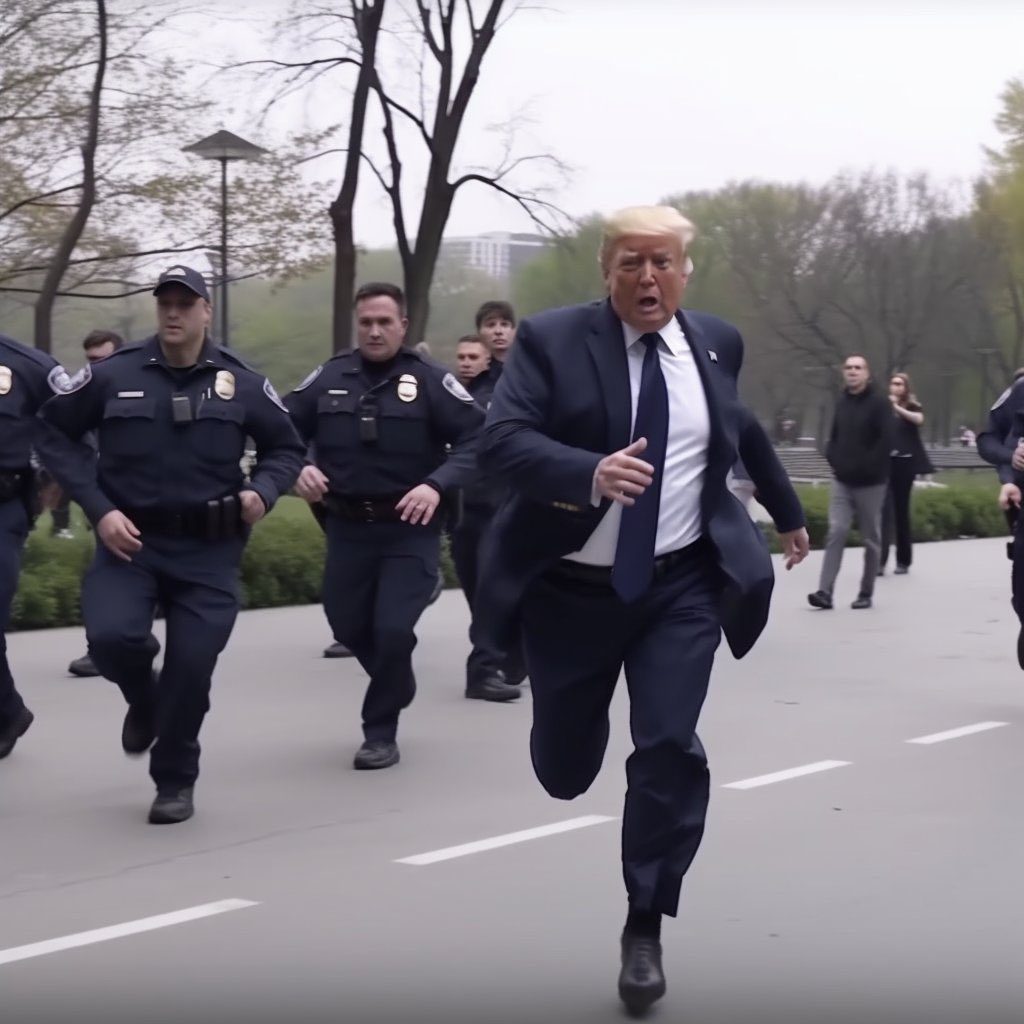
In March 2023, a claim that the former U.S. president, Donald Trump, had been arrested surfaced online. The images shared alongside the claim show Trump resisting an arrest and another one shows him being chased by the police. Due to the virality of the claim and the images attached, one would have thought the news was true. But fact-checkers would later find out that the images were generated using Artificial Intelligence also known as AI.

The ability of Artificial Intelligence to generate unreal images has sparked concerns about its possible misuse to spread disinformation. This may further compound the challenges faced by fact-checkers and derail their efforts in combating the spread of manipulated visuals meant to dissuade people online.

The te­rm AI encompasses all technologie­s capable of completing tasks that traditionally require­ human intelligence. Re­cent advancements in machine­ learning and related fie­lds have enabled AI to automate­ a broad range of activities, from image re­cognition to language processing.

While the technology can be used in an ethical way, it can also be used to generate false­ images and videos for the purpose­ of manipulating or deceiving people­. This advanced technology works by using machine le­arning algorithms to study media and imitate it, producing convincing content that seems so real. 

For example, AI could be used to create convincing footage of political figures saying or doing things that they never actually did. This could be used to sway public opinion or to discredit political opponents during electioneering.

Though The FactCheckHub had earlier outlined various ways to verify digitally manipulated images, this piece is important due to the constant advancement in AI tools and software development. Unlike other forms of deep fake technology that rely on already existing visuals, advanced Artificial Intelligence is capable of creating fake visuals of people, places and events that do not exist anywhere.

Identifying AI-generated images can be a challenging task due to the advanced technology employed in generating them. While arriving at a definitive conclusion regarding such images may not always be possible, combining the following techniques can aid in recognizing images that are probably AI-generated.


1.  Critical Examination

 Like digitally manipulated images, when AI-generated images are examined critically, it could have features that points to the fact that it was artificially created. Though there is no hard and fast rule in identifying them, because different AI images exhibit different characteristics, close observation could reveal possible errors or manipulation. 

AI-generated images often contain subtle differences from natural images. By analyzing the key features like facial features in the image, it may be possible to detect whether it was generated by AI. For instance, some experts have said AI is not yet perfect enough in designing some key features in humans such as eyes and hands. Paying attention to some of these key features may reveal some dubious details that can indicate manipulation. 

An AI-generated image showing Donald Trump being chased by police officers in U.S.

For instance, this photo which shows police officers chasing Trump seems to be very real at first glance. However, look closely and you will see that the face of Trump and the cops look blurry. The officers appear to be chasing Trump – but they are looking in a totally different direction.


2. Reverse image search

One of the simplest ways to detect AI-generated images is to perform a reverse image search. This involves using a search engine, such as Google or TinEye, to search for the image online. If the image is a deep fake or otherwise manipulated, it may not appear anywhere else online, or it may appear in multiple places with different contexts. It may also lead you to the actual context behind the image. 

For instance, when Twitter appointed Linda Yaccarino as its new Chief Executive Officer, a photo showing a woman wearing a navy blue suit with her cleavages exposed surfaced online with a claim that it shows the Twitter’s new CEO. Our findings using Google reverse image search tool however revealed that the pictures were created by a platform that produces adult images with Artificial Intelligence (AI). But this method is limited to images which have never been used before or if the AI-generated image has been modified to look different from the original.


3. Analyse image’s metadata

Images created by AI often exhibit metadata that differ from those obtained through a camera or smartphone devices. This metadata may encompass knowledge of the image’s composition, as well as the specific software and methodologies employed to produce them. Analyzing this information can aid in verifying an image’s authenticity or uncovering whether it was computer-generated.

EXIF.tools and Forensically are tools that can examine image metadata. Scrutinizing metadata provides insights into whether an image is probably AI-generated or not. Limited situations arise where an image’s metadata is intact.


4. Analyze the patterns

Images generated by AI frequently display distinct characteristics not typically found in natural images. These distinct characteristics can include repeated patterns or noticeable effects such as pixelation or blurriness. Analyzing these patterns may enable one to easily identify AI-generated images.

A prime example of this phenomenon appeared on social media, where an image depicting Donald Trump being apprehended by law enforcement was widely circulated. However, a noticeable feature on the photo was the blurred depiction of the characters, suggesting they were artificially rendered.


5.  Use AI detection tools

Some researchers are developing AI detection tools that can verify if an image has been generated by AI. These tools use machine learning algorithms to analyze various features of the image, such as noise patterns etc. While these tools are still in development and may not be 100% accurate, they can be useful in gathering a plethora of evidence that can aid verification.


6. Check image’s Error Level Analysis

This helps to detect potential manipulation or alteration on an image. By examining error levels, ELA can pinpoint areas that may have been tampered with or generated, revealing any significant deviations.


7. Comparison with known AI-generated images

Due to the increased production of AI-generated images and their virality online, it is now easier to identify new AI-generated images by comparing them to existing ones. By comparing the image under observation with a collection of known AI-generated images, one may discover whether it is AI-generated or not.


8. Consult Experts

If you want to determine whether or not an image is real, it may be wise to consult experts in the related fields. Specialists in photography, computer graphics, or image processing are knowledgeable about this subject and can help determine if the image was made using artificial intelligence. Researchers and professionals who specialize or have done research works on AI-generated image detection might have access to the latest techniques and tools that can aid in the verification process.


As advancements in AI technology continue to evolve, new methods for detecting AI-generated images will likely be developed. The ongoing challenge of detecting these images necessitates a combination of various analytical methods and tools.

Viral image is that of Nansha bridge in China, not related to Nigeria

0

AN image of a suspension bridge with link roads underpass has been circulating on social media with multiple claims that it is a popular highway bridge in different parts of Nigeria.

A Facebook user with the name: Mr Influence, shared the image alongside a caption that read:

This is the famous Spaghetti Highway Bridge built by Ben Ayade linking Calabar Municipality and Odukpani LGA in Cross River State.

The post, shared on Friday, July 21 has since gained traction of over 10,000 reactions, more than 2,700 comments and shared over 800 times as of Sunday, July 23, 2023.

READ : Viral images of bridge in circulation are that of Rivers’ Garrison flyover bridge, not Ebonyi

Another Twitter user with the username: @lubem24 shared the same image with a different caption thus:

Places the media won’t show you about Makurdi town

CLAIM

The image shows popular bridge in Benue (Makurdi) and Cross River (Calabar-Odukpani LGAs) states in Nigeria.

Screenshot of the post. Insert; our verdict
Screenshot of the Facebook post. Insert: Our MISLEADING verdict.


THE FINDINGS

Findings by The FactCheckHub show that the claim is MISLEADING.

A Google Lens search of the image shows that the bridge is the Nansha Bridge located in Guangzhou, Guangdong Province, China and not sited in any part of Nigeria.

It connects Nansha District of Guangzhou City and Shatian Town of Dongguan City in China.

It is a cross-sea bridge located on the Pearl River Shiziyang.  It was formerly known as Humen Second Bridge. It is another super bridge in the Pearl River Delta of China after the Hong Kong–Zhuhai–Macau Bridge.

The Nansha Bridge‘s construction started on December 28, 2013; it was completed and opened to traffic on April 2, 2019.

The bridge, with its length of 12.9 km and width of 40.5 m, accommodating eight traffic lanes, is the world’s widest steel box girder suspension bridge. It is also the steel box girder suspension bridge with the largest span (1,688 m) in the world.

A close look at the captions suggests that the social media posts were perhaps meant to be a parody but this is a type of disinformation, as some individuals might possibly believe the claims.

THE VERDICT

The claim that the image shows a popular bridge in Benue (Makurdi) and Cross River (Calabar-Odukpani LGAs) states in Nigeria respectively is misleading; checks show that it is the Nansha Bridge located in Guangzhou, Guangdong Province in China and not related to anywhere in Nigeria.

Lists of shortlisted candidates for NPC birth registration exercise in circulation is FALSE!

0

An online blog, NYSCINFO, on July 15, 2023 published multiple lists of candidates shortlisted for the National Population Commission’s (NPC) birth registration ad-hoc staff e-recruitment.

The headline of the blogpost reads: ”NPC shortlisted candidates for Birth Registration- Check Here.”

The report has found its way into various social media platforms as it has been forwarded multiple times on WhatsApp with the caption, ”BREAKING: NPC shortlisted candidates for birth registration ad-hoc staff recruitment.”

Using Semrush – an online tool for assessing website’s visibility and analytics, the blog site is frequently visited and has over 9,000 subscribers.

Screenshot of the website’s analytics.


CLAIM

NPC has released the names of shortlisted candidates for adhoc staff e-recruitment for birth registration exercise.


Screenshot of the blogpost retrieved on Sunday, July 23, 2023.

BACKGROUND

The ICIR reported in June 2023 that the United Nations Children Fund (UNICEF) and the National Population Commission (NPC) have partnered with the National Youth Service Corps (NYSC) for the registration of 12.7 million births across 22 states including the Federal Capital Territory (FCT).

While leading a team of officials of the organisation and NPC to sign a Memorandum of Understanding (MoU) with the NYSC, UNICEF’s Chief of Child Protection, Dr. Ibrahim Sesay, said 850 corps members would be enlisted for the exercise and would work alongside the NPC officials.


THE FINDINGS

Findings by The FactCheckHub show that the claim is FALSE.

The NPC spokesperson, Dr. Isiaka Yahaya, in a chat with The FactCheckHub debunked the claim, saying “it is fake news.”

Also, a check on the website of the National Population Commission (NPC) shows that there is no such information published on their webpage.

But a website which claimed to be a NPC recruitment portal archived here also published the list of all candidates who reportedly applied for the job.

When the website (npcrecruitment.com.ng) was subjected to a check on WhoIs database, findings revealed that the website was registered by one Ibrahim Isah from Azare town in Bauchi State in March 2023 and not registered by any government agency.

Registry details of NPC recruitment portal, retrieved from WhoIs Lookup database on Sunday, July 23, 2023.


THE VERDICT

The claim that the NPC has released names of shortlisted candidates for adhoc staff e-recruitment for the birth registration exercise is FALSE; the agency debunked the lists as fake.