Please note that the FactCheckHub has not obtained any right from the authors or copyright owners of all third-party contents from embedded links and shall incur no liability in this regard.
Please note that the FactCheckHub has not obtained any right from the authors or copyright owners of all third-party contents from embedded links and shall incur no liability in this regard.
Please note that the FactCheckHub has not obtained any right from the authors or copyright owners of all third-party contents from embedded links and shall incur no liability in this regard.
Please note that the FactCheckHub has not obtained any right from the authors or copyright owners of all third-party contents from embedded links and shall incur no liability in this regard.
Paracetamol (Panadol, Calpol, Alvedon) is a popular analgesic and antipyretic drug used to relieve mild-to-moderate pain and fever temporarily. It is commonly included as an ingredient in cold and flu medications and is also used on its own.
Screenshot of the claim by Rufai Oseni retrieved from X. INSERT: False verdict.
It is one of the most widely used painkillers by Nigerians and can be bought over the counter in pharmacies and supermarkets.
A Google search using the key phrase ‘Paracetamols sold in Nigeria are underdosed’ reveals that Rufai’s claim was based on a study (now retracted) titled “Comparative Analysis of Five Different Brands of Paracetamol Sold in Nigeria with British Pharmacopoeia Standards” which was published in the journal: Communication in Physical Sciences.
According to the study, samples from five different paracetamol brands, each claiming to contain 500mg, were tested and analyzed using the spectrophotometric method.
The concentrations, according to the study, ranged from 185mg to 358mg, which was much lower than the suggested 500mg limit.
The study’s researchers raised concerns about the possibility of treatment failure in the country due to underdosed paracetamol tablets.
However, findings show that the NAFDAC had in January 2024 debunked the study and confirmed that Paracetamol tablets in Nigeria meet both national and international pharmaceutical standards.
The agency conducted a laboratory test on the Paracetamol tablets sampled from 13 different manufacturers in Lagos and Abuja. The tablets were tested according to the British Pharmacopoeia 2023 edition volume, with all 20 tablets per manufacturer passing the assay with a 100% compliance rate.
“The result of our test clearly showed that all the twenty tablets from each manufacturer met the stipulated dosage standards and specifications. This includes adherence to both national and international regulatory requirements,” part of the report reads.
“This is a 100% pass rate for the full compendia tests result for the 20 samples of paracetamol tablets tested. The assay was validated using British Pharmacopoeia testing methodologies for precise and reliable assessments of the dosage levels in the sampled paracetamol tablets,” NAFDAC stated.
NAFDAC further refuted claims made in the study suggesting substandard tablets. They highlighted several discrepancies in the study such as incorrect use of UV spectrophotometric absorbance (usage of 700 nm instead of the recommended 257 nm), inadequate sample size (only two tablets used by the study), and lack of transparency in methodology, including missing details on solvent use, equipment calibration, and sample preparation.
These errors led to the retraction of the study from the journal “Communication in Physical Sciences”, according to NAFDAC.
NAFDAC emphasized that their rigorous testing procedures, which included additional parameters like uniformity of mass and disintegration time, confirmed that the paracetamol tablets meet both national and international standards.
This is not the first time Rufai will be sharing false information on social media, particularly on X (formerly Twitter).
Recall that Rufai had previously on January 30, 2022 claimed that there are over 136 refineries in the United States of America (USA), adding that there are 47 refineries in Texas alone.
The FactCheckHub debunked the claims here, as data from the U.S. Energy Information Administration (EIA) contradicted his claims.
THE VERDICT
The claim by Rufai that nearly all the paracetamol tablets in Nigeria are underdosed is FALSE; the study has been debunked by the NAFDAC.
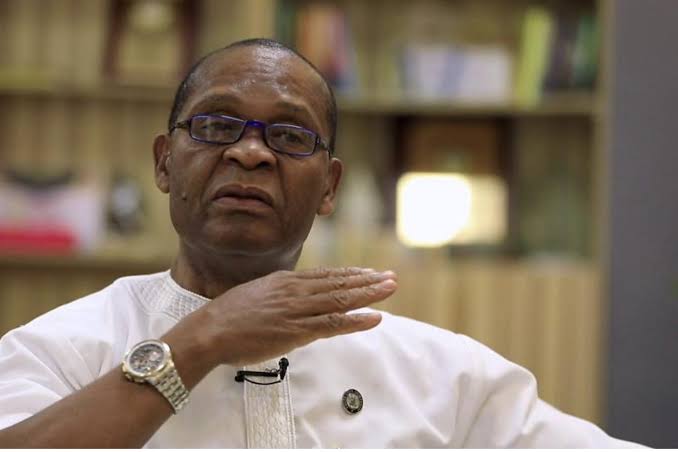
A chieftain of the All Progressives Congress (APC) in Lagos State, Joe Igbokwe, has posted a footage showing flooded residential areas alongside aclaim that the flood happened in Italy.
Igbokwe, who is also the Special Adviser on Environment and Water Resources to the Lagos State governor, Babajide Sanwo-Olu, made the post on his Facebook page on July 17, 2024.
In the 64-second footage, properties could be seen being damaged by the purported flood that overwhelmed different parts of a city, as screams rented the air in the video.
The footage also has an inscription that read: Italy was flooded today.
The caption accompanying the Facebook post stated thus: Flood in Italy.
Recall that heavy rainfall in Nigeria has been characterised with flooding particularly in Lagos State which have sparked criticisms from netizens while some supporters of the state government argued that the situation is a natural disaster which occurs everywhere in the world regardless of the government’s efforts.
The video post has since gone viral and is drawing criticisms, hence the need to verify its accuracy.
CLAIM
Video shows flooding in Italy.
THE FINDINGS
Findings by The FactCheckHub show that the claim is MISLEADING!
Screenshot of the claim retrieved from Joe Igbokwe’s Facebook page. INSERT: Misleading verdict.
When screenshots of the video was subjected to a Google Lens search on mobile device, it showed search results relating to a mudslide that happened in Japan.
A video compilation posted on YouTube on July 3, 2021 by a Japanese newspaper, Sankei News, have similar visuals as the one posted by Igbokwe.
Further findings showed that the footage was from a mudslide that happened in Japan in 2021. A keyword search on the words “mudslide in Japan” led our fact-checker to another version of the video posted on YouTube by multiple credible news organisations including CBS Evening News, Guardian News and The Sun as seen here, here, and here etc.
The New York Times also reported on Saturday, July 3, 2021, that there was a mudslide triggered by heavy rainfall as 19 people went missing in Atami, a resort town approximately 60 miles southwest of Tokyo, according to Japanese officials.
The mudslide washed away homes and left roads covered in debris. In response, police, fire, and military personnel initiated search-and-rescue operations in Atami, the coastal town affected.
Also, the video has been used out of context multiple times to depict flooding in some countries around the world such as Libya, India and an earthquake that happened in Japan earlier this year.
Moreover, The FactCheckhubrecently debunked a flood related claim that had reportedly taken place in Austria.
It will be recalled that this is not the first time Igbokwe would be seen spreading false information online as The FactCheckHub and other fact-checking and media platforms in the country have debunked his claims multiple times as seen here, here ,here and here.
THE VERDICT
The claim by Joe Igbokwe that the video shows flooding in Italy is MISLEADING; the footage is from a mudslide event in Japan that happened in 2021.
A former Nigerian presidential aide, Reno Omokri, has claimed that Peter Obi, the 2023 presidential candidate of Nigeria’s opposition Labour Party, was among the Nigerian state governors who refused to hold Local Government elections during his tenure as the governor of Anambra State.
Omokri made the claim following the recent judgement by the nation’s Supreme Court which affirmed the financial autonomy of Nigeria’s 774 local government areas (LGAs).
The Court delivered the judgement following a suit filed by the Attorney-General of the Federation and Minister of Justice, Lateef Fagbemi (SAN) against the 36 state governors.
The AGF had sued the state governors through their respective state attorneys-general.
The court declared that a state government had no power to appoint a caretaker committee and a local government council was only recognisable with a democratically-elected government.
The apex court put an end to the practice of appointing caretaker committees to run the councils by the state governors and declared that “a democratically-elected local government is sacrosanct and non-negotiable.”
While many public figures commended the development, Obi did not make a public statement on the issue, according to Omokri.
Reacting to Obi’s silence, Omokri said in his X post on July 12, 2024:
“Those, like Peter Obi, who refused to hold Local Government elections, and have been stiffing the growths of Local Governments are not happy with the freedom acquired for Local Governments by the Tinubu administration.
“That is why the usually talkative Peter Obi, who posts on social media more than a teenage girl, has not said anything more than twenty-four hours after the Supreme Court verdict.
Obi and his supporters are still in shock! Obi is not happy that Local Governments are free. The Gbajue family is in mourning. There is no bad news for them to celebrate. And since they only talk when evil occurs, Obi is silent!”
The claim has garnered over 60,000 views, more than 200 comments and reposts each plus over 800 likes as of July 19, 2024.
CLAIM
Obi failed to conduct Local Government elections during his tenure as Anambra governor.
THE FINDINGS
Findings by The FactCheckHub show that the claim is FALSE as Obi conducted local government elections in January 2014 towards the end of his governorship tenure in the state.
The local government is Nigeria’s third tier of government. i.e the level of government closest to the grassroots.
Before he contested for the presidential seat under the Labour Party in 2023, Peter Obi served for eight years as the governor of Anambra State from March 17, 2006, to March 17, 2014.
A review of media reports indicated that Obi inaugurated the 20 (out of the 21) elected chairmen of local government councils in the state, who won the seats under the banner of his political party, the All Progressives Grand Alliance (APGA), at the time.
In his address then, Obi said his administration respected the Nigerian Constitution and that the local government system should be democratised every two years, noting that many obstacles delayed the LG elections.
THE VERDICT
The claim that Obi refused to conduct Local Government elections during his tenure as Anambra governor is FALSE; findings show that Obi conducted local government elections in January 2014 towards the end of his governorship tenure in the state.
Dutch researchers have revealed that coordinated networks of accounts spreading disinformation flooded social media in France, Germany and Italy before the elections to the European Parliament.
Elections to the European Parliament are a series of national elections held by European Union (EU) member states to elect members to the European Parliament (MEPs). These elections occur every five years where EU citizens vote for their representatives in the European Parliament, which is the legislative body of the EU. The last edition was held between June 6 – 9, 2024.
The researchers analysed disinformation on the social media platform X (formerly Twitter) in the four countries and concluded many of the accounts were “cranked up” in the build-up to the election, The Guardian reported.
Trollrensics, a specialist consultancy commissioned by the Dutch Socialist and Democratic parties in the European parliament, noted that the impact of these accounts is increasing at an alarming rate showing a certainty that a large coordinated network of accounts was influencing the EU elections in Germany, France and Italy.
Trollrensics specialises in analysing disinformation networks that typically include troll accounts attempting to interfere in a concerted manner to influence public discourse.
The report, titled EU Elections Investigation, said: “The scale of the operation suggests that it [the disinformation network] necessitates significant human resources and time.”
The consultancy firm used specialist software tostudy 2.3m posts from 468,000 accounts in Germany, France, Italy and the Netherlands. From that dataset, it identified 50,000 accounts that spread disinformation.
In France, they found that out of more than 127,000 posts mentioning Éric Zemmour, founder of the far-right political party Reconquête, 20 per cent originated from disinformation accounts.
In Germany, 10 per cent of posts about Alternative für Deutschland came from these accounts. Trollrensics suggested the actual percentages might be higher in both countries.
It found no organised disinformation networks in the Netherlands and the accounts it studied in Italy were less concerned with the EU elections and more with controversies over migration or vaccination.
The researchers said the scale of disinformation networks meant they could and did “take over an entire debate by just flooding X with posts, reposts, comments and likes”.
Accounts were shown to be “densely connected” and probably run by humans rather than AI, said the Trollrensics co-founder, Richard Odekerken.
One X account used in Germany named @888_leila and belonging to a Leila Ruth 888 also posted in Russian.
The report showed that 13 different accounts belonging to a Leila Ruth 888 from user-stated locations around the world including Brazil, Ohio, Finland and Uganda.
Many were created after January 1, 2024 and amassed a large number of followers very quickly. Nearly all the accounts followed by the researchers followed back – another red flag for coordinated activity.
“The technique is primarily used to give the account credibility as it appears more legitimate if it has a large number of followers,” the report said.
Dutch S&D MEP Thijs Reuten, who commissioned the report, noted that while it was challenging to establish a direct link between these accounts and the EU election results, the research showed that the primary objective was to sow doubt and discredit Western authorities, a narrative known to be pushed by Russia.
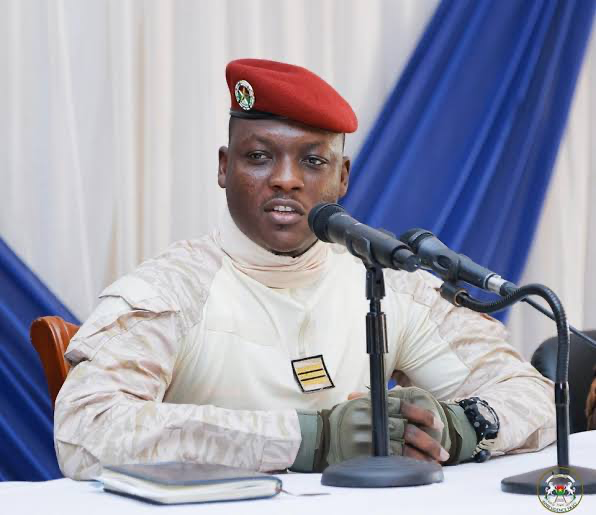
A video purportedly showing Burkina Faso’s military president, Ibrahim Traore, announcing that the country will no longer be importing uniforms for its police and army has surfaced online.
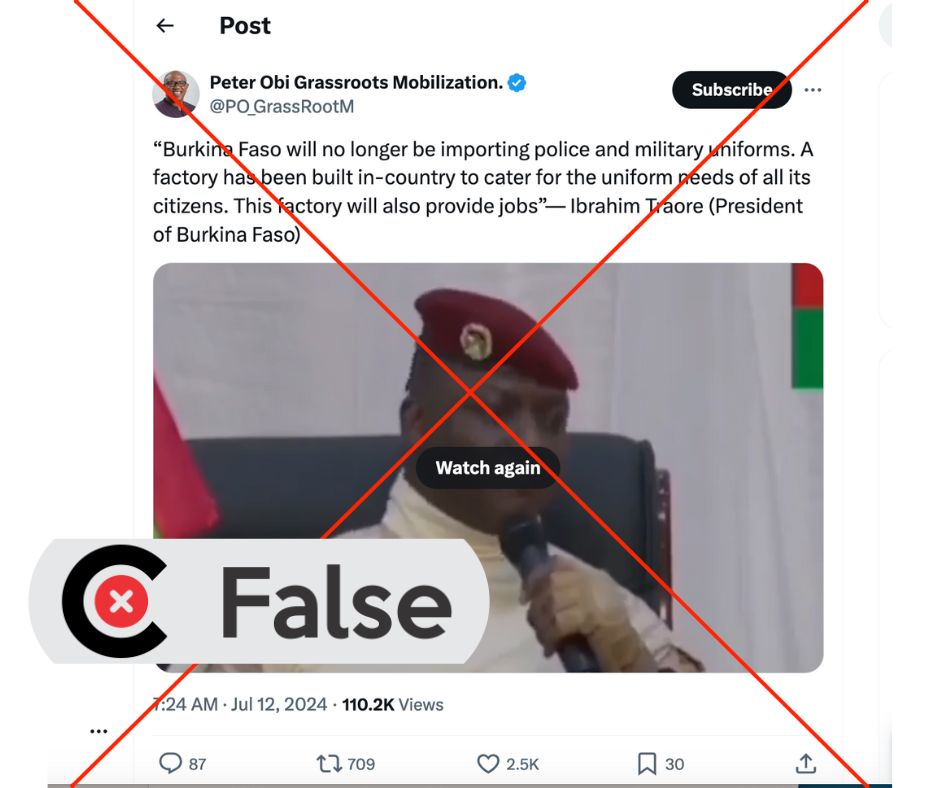
An X user, @PO_GrassRootM posted the video with a caption that read:
“’Burkina Faso will no longer be importing police and military uniforms. A factory has been built in-country to cater for the uniform needs of all its citizens. This factory will also provide jobs’— Ibrahim Traore (President of Burkina Faso).”
The post has generated over 100,000 views, more than 700 reposts and over 2,500 likes as of July 17, 2024.
It was also shared here and here by other X users and here on Facebook too..
CLAIM
Video shows Traore announcing that Burkina Faso will no longer be importing military uniforms.
THE FINDINGS
Findings by The FactCheckHub show that the video is FALSE.
Screenshot of the viral post/video on X purportedly showing Ibrahim Traore making the announcement. INSERT: False verdict.
Burkina Faso, a landlocked country is one of the West African countries taken over by military junta. Others are Mali, Guinea, and Niger. In January 2022, Burkinabé President, Roch Marc Christian Kaboré, was deposed by the junta led by Lt Col. Paul-Henri Sandaogo Damiba. Later in September 2022, Damiba was ousted by another coup, bringing Ibrahim Traore to power. He was officially appointed as president in October 2022.
Firstly, a look at the video reveals that Traore spoke English while delivering the speech. The official language in Burkina Faso is French, which is the language Traore uses often in most of his public speeches.
Secondly, our fact-checker subjected some keyframes obtained from the video to Google Reverse Image searches and we found out that the video has been online since May 2024. In the original video, Traore addressed the audience in French while talking about military cooperatives, a topic entirely different from the thematic focus of the viral video.
“Coopérative militaire et paramilitaire d’épargne et de crédit: Ibrahim Traoré échange avec les FDS” translated as “Military and Paramilitary Savings and Credit Cooperative: Ibrahim Traore interacts with the FDS.”
A further search using some keywords from the above caption led us to a statement published on the Burkina Faso military government’s website about the event.
The search shows that the video depicted when Traore presided over a meeting of the Military and Paramilitary Savings and Credit Cooperative (COMIPEC) of Burkina Faso on Friday, May 17, 2024.
The cooperative, scheduled to be operational in 2025, is an initiative of the nation’s Head of State, which aims to offer innovative financial and non-financial services to the Defense and Security Forces (FDS) for their full development.
In his original speech, Traore emphasized the importance of improving the living conditions of military personnel and their families.
He noted that the cooperative would help FDS members overcome financial challenges and encourage investment in agriculture and livestock sectors to support national food self-sufficiency.
However, there was no part of the statement suggesting that the country will be producing military and police uniforms locally.
Our fact-checker also searched online but couldn’t find any credible platform that reported the purported development.
THE VERDICT
The claim that the video showed Traore announcing that Burkina Faso will no longer be importing military uniforms is FALSE; there was no mention of such topic in the original video.
ON July 2, 2024, the Secretary to the Government of the Federation (SGF) in Nigeria, George Akume warned communication managers across all Ministries, Departments and Agencies (MDAs) against leaking official secrets.
Akume who was represented by the Director of Information in his office, Segun Imohiosen, issued the warning in Abuja at a one-day workshop on the Role of the Official Secrets Acts (OSA) in Maintaining Confidentiality and National Security, organised by the Bureau of Public Service Reforms, in collaboration with the Office of the SGF.
Reacting, Media Rights Agenda (MRA), an organisation with a focus on press freedom in Nigeria condemned the claim credited to the SGF (Akume), which threatened that government officials who disclose information without authorisation would be jailed.
The Deputy Executive Director of the organization, Ayode Longe, described the SGF’s allegation against civil society organizations (CSOs) as “false and illogical.”
Longe stated that Akume’s accusation that CSOs use the FOI Act to “harass, intimidate and siphon resources from public officers through the dissemination of fake and unfounded information” is baseless.
He called on Akume to substantiate his allegations, noting that the SGF apparent aversion to transparency and accountability should not lead him to mischaracterize the FOI Act or falsely accuse CSOs that have merely exercised the right granted to them and all others by the Act.
He added that the SGF would face a significant challenge in attempting to prosecute any government official for unauthorized disclosure of information in light of Section 27(2) of the FOI Act which provides circumstances in which they can do so.
In its editorial published on July 8, 2024, Blueprint, a Nigerian news medium chaired by the nation’s Minister of Information and National Orientation, Mohammed Idris Malagi, described MRA’s position that the government would find it difficult to prosecute its officials for unauthorised disclosure of information due to the FOI Act as misleading and mischievous.
“Unfortunately, the MRA’s claims are as misleading as they are mischievous, thus, falling on all fours. It is trite to state that the FOI Act is neither inconsistent nor incongruous to the Official Secrets Act. The FOI, therefore, does not invalidate, vitiate, void or repeal the Official Secrets Act. The extant legal instruments are, in fact, complementary and analogous as they are geared towards the overall objective of ensuring the nation’s security and accelerating its socio-economic and political development,” part of the editorial reads.
In its reaction to Blueprint’s editorial, the MRA noted that while the FOI did not repeal the Official Secrets Act, it was not consistent or complementary with the Act, as claimed in the editorial.
The MRA noted that there was a difference between the Official Secrets Act (OSA) which criminalises disclosure of information without authorisation and the FOI Act which protects workers that disclose information without authorisation.
“The two laws are not complementary, they are not analogous and there is absolutely no meeting point between them. The difference between the two pieces of legislation is as stark as the difference between night and day. Besides, there is nothing contained in the Official Secrets Act that can be interpreted to be aimed at enhancing transparency or accelerating the socio-economic and political development of Nigeria,” the MRA noted in its latest statement.
But this is not the first time that the Nigerian government will issue a similar threat. In February 2024, the head of the civil service of the federation issued a warning to civil servants in ministries, departments, and agencies (MDAs) against leaking sensitive documents to the public describing it as “embarrassing”.
The FactCheckHub observed that some sensitive government documents have found their way to the public space in recent times. Some of them revealed mismanagement of funds, abuse of office, outrageous spending, corruption, etc.
Another leaked document revealed how Betta Edu, the suspended minister of Humanitarian Affairs and Poverty Alleviation, received N3 billion of COVID-19 funds for the verification of the national social register.
Another one also revealed that Edu, in December 2023, asked Oluwatoyin Madein, Nigeria’s Accountant General of the Federation, to transfer a total sum of N585.2 million from the National Social Investment office account to the UBA account of Bridget Oniyelu, the accountant of a federal government poverty intervention project called Grants for Vulnerable Groups.
But, is FOIA complementary to the Official Secrets Act?
To support his stance, Akume relied on the Official Secrets Act (OSA), a law enacted in 1962 to protect state secrets and sensitive government information from unauthorized disclosure. Its main purpose is to prevent espionage, sabotage, and other activities that could threaten national security.
Apart from this law, various Nigerian laws such as the Evidence Act, the Public Complaints Commission Act, the Statistics Act and the Criminal Code prevent civil servants from divulging official facts and figures.
Prior to the introduction of the FOI Act in 2011, virtually all government information in Nigeria was classified as top secret. This secrecy makes it difficult to get information from government agencies. The implication of this is that the public especially the media was denied access to information that is critical for accurate reporting, and unravelling the web of corruption in government agencies.
The FactCheckHub reviewed various research papers on this controversy. The result shows that Blueprint’s stance is not entirely true (HALF-TRUE). While the essence of FOI Act is to ensure access to information, the official secrets act was aimed at restricting the disclosure of information.
The FOI Act aims to promote transparency and accountability in governance, while the Official Secrets Act prioritizes national security and confidentiality. In fact, the law serves as the justification used by government officials over the years to deny public access to basic information.
The research argued that since the FOI Act came after the Official Secrets Act, it means the latter came to correct some “mischief” and “anomalies” of the former and this makes the FOI Act superior.
It concludes by stating that the Freedom of Information (FOI) Act effectively renders the Official Secrets Act obsolete, and the press should freely use the FOI Act without worrying about the constraints of the ‘outdated’ Official Secrets Act.
Even though the two laws have to do with managing information, they fundamentally serve different purposes. The Official Secrets Act imposes strict secrecy obligations on government officials, making it illegal to disclose classified information. This directly conflicts with the FOI Act’s intent to make information accessible.
Can a public official disclose ‘classified’ information?
But while the official secrets act is still relevant, the Freedom of Information Act (FOI Act) which is the latest acknowledges the already existing laws such as the official secrets act and goes on to provide some circumstances in which a public official can leak an official secret or classified information.
The FOI Act is a law that allows individuals to request access to government-held information and records. The primary objective of the FOI Act is to promote transparency and accountability within government institutions by providing the public with the right to know how decisions are made and how taxpayer money is spent.
Section 27(2) of the FOI Act which protects whistleblowers states that “Nothing contained in the Criminal Code or Official Secrets Act shall prejudicially affect any public officer who, without authorisation, discloses to any person, an information, which he reasonably believes to show mismanagement, gross waste of funds, fraud, and abuse of authority or a substantial and specific danger to public health or safety notwithstanding that such information was not disclosed pursuant to the provision of this Act”.
Even though the two laws appear conflicting and have led to arguments between the government, media and CSOs over the years, this section explicitly provided a ground in which classified information can be disclosed by a government official without authorization.
It means public officers and anyone acting on behalf of a public institution are protected from civil or criminal charges if they disclose information in good faith under the FOI Act. This means they can’t be sued or prosecuted for sharing information as long as the information falls under any of the classes covered.
Lawyers, CSOs react
A lawyer and Principal Partner at Clay & Amicus Solicitors, Chukwubuikem J.S. Azoro, explained that the interpretation of “leaking” depends on its definition.
He noted that the FOI Act mandates public officers to disclose information on official matters to any interested member of the public who applies for such information and if there is a refusal to comply, the applicant can sue to compel disclosure.
However, Azoro highlighted that exceptions exist to this rule such as information which can undermine national security.
Azoro also emphasized that if “leaking” is defined as disclosure made without due process, it is considered unlawful under the Official Secrets Act. He, however, pointed out that some specific classes of information are exempted by FOIA, and anything outside that class is not included, with general rules continuing to apply.
“The FOI is currently the main law. It authorizes disclosure. However, there are limited situations involving specific classes of information that the FOIA does not cover. In such cases, the OSA applies,” he said.
“FOIA is the main law on official disclosure of information. It states the procedure for official disclosures. If disclosure is made without compliance with the FOIA, it may amount to “leakage of official information” which is prohibited by both the OSA and Criminal Code.
“However, if the “leakage of information” is done with respect to some specific classes of information as listed in section 27(2) of FOIA, the person may escape liability and punishment which he should have suffered under the OSA and Criminal Code. Where the leaked information falls outside the class listed in section 27(2) of FOIA, the protection is lost and the OSA and Criminal Code will apply to make the person liable.”
Edo State Lead of Hope Behind Bars Africa, Emmanuel Okorie, noted that leaking official secrets generally is an offence which attracts punishment.
He explained that it may not attract punishment if the official unintentionally or accidentally leaks the document.
“You have to check the intention. You have to check the motive behind the person’s action. If the person didn’t intend to release it. Like a situation where some documents are in possession of an individual and may be in the process of transferring or sharing to another end, it gets intercepted along the way, it can be a defence for the person in court.
“If the action is there but the intention is not there, there’s no offence. If the intention is there and there is no action, there’s no case. This can serve as a defence or justification for which an official document is leaked,” he added.
He also agreed that if the official secret involves corruption, mismanagement of funds or abuse of authority, such can serve as a defence in a court of law.
On his part, the Chairman of the Board of Governors, Freedom of Information Coalition Nigeria (FOICN), Dr. Walter Duru, said, “I don’t know why there should be an issue for the people to be involved or aware of what the government is doing. Governments all over the world are not secret cults.”
He pointed out that the FOI Act is a recent law and its introductory part clearly states that any law conflicting with the FOI Act is null and void.
Duru expressed disappointment that the current administration, led by President Tinubu, who was previously an advocate for good governance, has not met expectations regarding transparency. He argued that good governance is impossible without operational access to information laws.
“The SGF didn’t tell Nigerians under which law or legislation that he gave that directive or pronouncement if it’s under the Official Secrets Act or not; when it comes to FOIA, they will tell you, especially the states that it is yet to be domesticated. But can you tell me one state that has domesticated an official secrets act in Nigeria?” he queried.
While not supporting irresponsible behaviour by public servants, Duru said any attempt or effort to keep Nigerians uninformed about government activities, policies, and spending will not be accepted.
He argued that some of the information being “leaked” by public officials is information that is supposed to be made available to the public by public institutions in line with the proactive disclosure rule of FOI Act.
“Therefore, if they are not proactively disclosed and any good citizen acting in good faith decides to release such information. I don’t see any crime that the person has committed. We expect this administration to be deliberate about implementing the FOI Act,” he told The FactCheckHub.
AMID controversies over the signing of the Samoa Agreement by the Nigerian government, a letter allegedly written by Ex-President Muhammadu Buhari to a former US President, Barack Obama, has surfaced online.
According to the purported letter, Buhari said he fully supported the anti-gay law signed by his predecessor (Goodluck Jonathan) and asked Obama to grant US visa to Nigerians who are queer to enable them relocate to America.
Let me start by saying that I have admiration for you and great respect for your country, and its constitution. United States is the epitome of democracy, and good leadership for the entire world.
As you know, I assumed the presidency of Nigeria a little over a month ago, and after proper review of the law enacted by my predecessor, making it illegal for homosexuals to marry in Nigeria, I must say that I agree fully with this law.
Nigeria is a sovereign country, and very different from the United States in many ways. We are a Nation that respects our religions, and rich cultural heritage. Our constitution does not separate the entity of God from its rule of law, unlike the United States.
If I may borrow your motto “In God we trust”, and in God we always will, therefore I implore you to understand my position on this issue, and to respect our brand of democracy, in as much as we respect
May I also advise you, that you are welcome to give visas to all the homosexuals to depart Nigeria for the United States, thank you very much
Yours Sincerely
President Muhammadu Buhari”
A verified X user, Abdul-aziz Nai’bi Abubakar (@jrnaib2), posted the letter with a caption that read: “I commend Buhari on this.”
The post has garnered over 400 reposts and more than 1,000 likes as of July 14, 2024.
Another X user, @AbbaM_Abiyos, posted the letter with another caption thus: “Ex President Buhari deserved respect for this letter.”
The post has generated over 100 reposts and more than 500 likes as of July 14, 2024.
CLAIM
Buhari writes Obama, asks him to grant US visa to queer Nigerians.
THE FINDINGS
Findings by The FactCheckHub show that the claim is FALSE.
The Samoa Agreement was signed on June 28, 2024 at the Organisation of Africa, Caribbean and Pacific States (OACPS) Secretariat in Brussels, Belgium.
Screenshot of the purported letter. INSERT: False verdict.
Daily Trust had earlier in July 2024 reported that the Nigerian government signed the Samoa Agreement with clauses requiring Nigeria to endorse the rights of Lesbians, Gay, Bisexual, Transgender, Queer and Intersex (LGBTQ+) people. However, the report was later found to be incorrect.
Upon review, various discrepancies were identified suggesting the viral letter was forged and inauthentic.
First, the letter does not have the signature of Ex-President Buhari, which is unrealistic for official correspondence between presidents. Buhari has since May 2023 handed over power to the current Nigerian president, Bola Ahmed Tinubu, after the latter won the 2023 Presidential Election early last year.
Additionally, it was neither stamped nor placed on the letterhead of the Nigerian Presidency, which is standard for such official letters. Examples of official letters, like those addressed to the Senate and former Vice President Yemi Osinbajo, always include the Presidential insignia.
In addition, the letter contains some grammatical errors. To mention but a few, “Dear President, Obama” should be “Dear President Obama” without a comma.
The letter was not properly dated while its tone appears awkward and informal, our fact-checker observed.
For instance, the paragraph “May I also advise you, that you are welcome to give visas to all the homosexuals to depart Nigeria for the United States” is highly unusual for diplomatic correspondence, which typically maintains a formal and respectful tone.
The FactCheckHub contacted Garba Shehu, the then Senior Special Adviser to President Buhari and he confirmed that the former president did not write the letter.
“Can a president anywhere write that kind of letter? No sir,” Shehu responded via a text message sent to our fact-checker.
Similarly, Adeniran Bamisaye, a public communication expert told The FactCheckHub, that the letter appears shady, as it lacks critical features of an official memo.
“The letter has no signature, the design is questionable. Also no subject or headline or date. In addition, the letter is not well punctuated and addressed,” he said.
THE VERDICT
The claim that Ex-President Buhari wrote the viral letter to former US President, Barack Obama, asking him to grant US visa to LGBTQ+ Nigerians is FALSE; multiple checks show that the letter is fake.
AN X user, @uptownoflagos, has made multiple claims about development indices in Anambra State.
The claim was made in a post thread in response to another X user’s comment to the initial post @uptownoflagos made.
The X user @adabanpegede stated that Peter Obi was always looking for cheap popularity hence his failure as a governor in response to the main post that Obi fulfilled a stranger’s desire to attend her wedding.
In response to @adabanpegede’s comment, the claimant (@uptownoflagos) posted thus on the X platform:
Today his state has: Lowest Out of school children One of the lowest unemployment One of highest industries 6th largest GDP in Nigeria Best Education performance in Nigeria(mostly true/misleading) Highest Child school enrollment nationwide(misleading) One of the best Health system in Nigeria (true) The Joke is on you.
He highlighted the increasing development indices in Anambra State especially when compared to other Nigerian states.
Our fact-checker examines some of the claims in the X post as shown below:
CLAIM 1
Anambra has the lowest out of school children in Nigeria.
THE FINDINGS
Findings by The FactCheckHub show that the claim is TRUE!
According to a data released by The Cable Index on the states with the highest number of out-of-school children aged 6-15 in Nigeria citing NMPI 2022 as its source, it highlighted Kebbi state as the highest with 66.7 per cent and closely followed by Sokoto at 66.4 per cent.
The state that had the lowest number of out-of-school children was Anambra at 2.9 per cent followed closely by Ekiti and Imo at 5.1 per cent respectively.
Using the same data, Nigerian Tribune and other media platforms also reported that Anambra is the state with the lowest number of out-of-school children in Nigeria.
THE VERDICT
The claim that Anambra has the lowest out of school children in Nigeria is TRUE; a 2022 data shows that Anambra State has 2.9 per cent out-of-school children in the country.
CLAIM 2
Anambra is one of the states with the lowest unemployment rate in Nigeria.
THE FINDINGS
Findings by The FactCheckHub show that the claim is FALSE!
A 2020 report by Nairametrics stated that as at the second quarter of 2020, Anambra State has the lowest unemployment rate in Nigeria.
According to the National Bureau of Statistics (NBS), Anambra recorded an unemployment rate of 13.1 per cent, which is the lowest in the countryas at then. This is in stark contrast to states like Imo, which has the highest unemployment rate at 48.7 per cent.
However, another report published by Premium Times in March 2021 noted that the Nigerian states with the lowest rates as at the fourth quarter of 2020 were Osun, Benue and Zamfara. They recorded 11.66 per cent, 11.98 per cent and 12.99 per cent respectively; thus, eliminating Anambra from states with the lowest unemployment rate in the country.
THE VERDICT
The claim that Anambra is one of the states with the lowest unemployment rate is FALSE; the most recent statistics show that Osun, Benue and Zamfara states had the lowest unemployment rates in Nigeria in the fourth quarter of 2020.
CLAIM 3
Anambra state has the 6th largest Gross Domestic Product (GDP) in Nigeria.
THE FINDINGS
Findings by TheFactCheckHub show that the claim is TRUE!
A 2024 report by BusinessDay citing BudgIt as its source highlighted the top ten richest states in Nigeria ranked by GDP in 2022. Lagos state ranked first with ₦41.17 trillion GDP followed closely by Rivers state with ₦7.96 trillion GDP.
Anambra state ranked 6th on the list with ₦5.14 trillion by GDP due to growth in trade, manufacturing, and agriculture with notable contributions from sectors like banking, real estate, and education.
THE VERDICT
The claim that Anambra state has the 6th largest GDP in Nigeria is TRUE, according to a 2022 BudgIt data.
CLAIM 4
Best education performance in Nigeria.
THE FINDINGS
Findings by The FactCheckHub show that the claim is FALSE!
A ranking done and published in November 2023 by THEABUSITE, an online blog owned by The Abusites Media Service with CAC registration number RC: 3508811, ranked Lagos state as the highest in terms of education performance.
Anambra state was ranked number seven on the list of the top ten states with Kaduna state at the tenth position.
The blog claimed it uses the methodology of academic performance, infrastructure, teacher quality, access to education, innovation and technology innovation and government investments to rank the states. TheFactCheckHub cannot independently verify the methodologies used.
Also, another 2020 ranking of pupils aged 4-15 done by Kingmakers ranked Anambra State as sixth out of the 36 Nigerian states including the FCT while using adult literacy, educational attainment, education quality and school attendance as its selection criteria.
A similar ranking by another blog, SchoolNews.com.ng, ranked Anambra State as the fifth most educated state in Nigeria. Those leading the ranking include Rivers, Edo, Abia and Imo states.
In addition, a report by Legit.ng in May 2024 shows that a student (Zainab Asake) from Kaduna emerged the overall best student in the 2024 Unified Tertiary Matriculation Examination (UTME) held between April 19 and 29.
THE VERDICT
The claim that Anambra has the best education performance in Nigeria is FALSE; the state, though one of the top states in educational performance, is not ranked the best nationally.
CLAIM 5
Highest child school enrollment in Nigeria.
THE FINDINGS
Findings by The FactCheckHub show that the claim is FALSE!
A 2022 data by Statista show that in the 2018/2019 school year, 22.7 million children in Nigeria were enrolled in public elementary schools with Kano state having the largest number of pupils enrolled in public elementary schools, with over three million, while Katsina state had the second largest number of children attending elementary schools with over one million.
Anambra state had 359,023 number of pupils enrolled in public elementary schools. While 7.4 million students aged 12-14 were enrolled in both private and public junior secondary schools. The data was not grouped according to states.
THE VERDICT
The claim that Anambra state has the highest child school enrollment in Nigeria is FALSE; a 2020 Statista report shows that Kano state has the largest number of pupils enrolled in public elementary schools, with over three million pupils.
CLAIM 6
Anambra state has one of the best health systems in Nigeria.
THE FINDINGS
Findings by The FactCheckHub show that the claim is TRUE!
In 2020, Punch, BusinessDay and other media platforms reported that Anambra state has the most efficient healthcare services in Nigeria, closely followed by Osun, Ogun, Lagos, and Rivers states respectively.
The ranking was done by WellNewMe, a health technology company in Nigeria which used 27 indicators that measured performance in four domains important to policymakers, providers, patients, and the public: care process, access, equity, and healthcare outcomes.
Another report by Premium Times in July 2022 shows that in terms of primary healthcare services delivery, Anambra is one of the top performing states with FCT and Enugu setting the pace.
THE VERDICT
The claim that Anambra state has one of the best health systems in Nigeria is TRUE, according to studies by both the WellNewMe and ONE campaign which were widely reported by multiple media platforms in the country.
Syvaniah Ezekiel had no idea what her life would turn into when she woke up on December 24, 2023. She was completely unaware that her spouse, the community pastor, would not be spending Christmas with her.
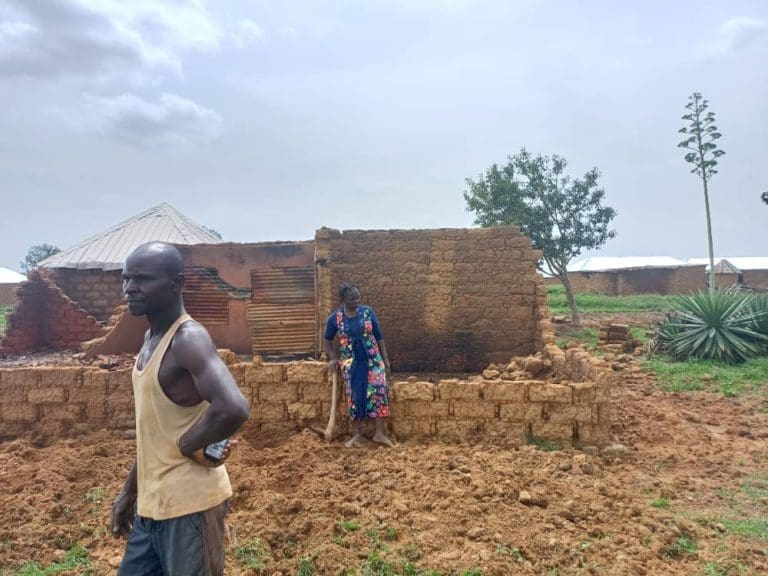
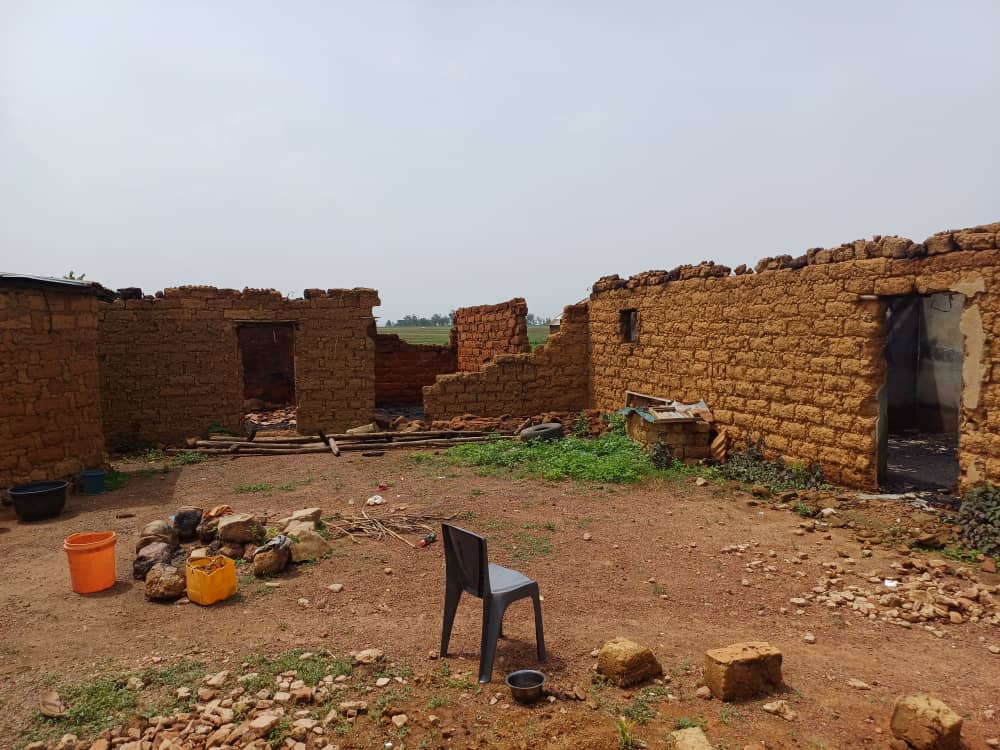
Her worries for the day were what to cook for her husband, Ezekiel Rigat, her visiting kids, and their family’s Christmas celebration the next day. Syvaniah said that while cooking, she heard gunfire growing louder every second. She then saw her fellow villagers running. At that point, she ran into the bush with them. She and the other villagers managed to flee the attack, but her husband wasn’t lucky; he was killed and set ablaze by the armed insurgents who stormed Lunghai community, under Bokkos local government area in Plateau State and damaged several properties.
Syvaniah was unaware of her husband’s death until the following day, December 25, 2023, when the villagers started going back to their homes. She drew nearer after seeing the grieving congregation, realising her husband’s body was among the burned rubber seats of the church.
When asked if she could talk about what had happened, she replied, “They killed my husband,” she said in her dialect, to a villager who translated to this reporter.
Burnt houses in Lunghai community, Plateau state.
Mikal Dauda, a community leader and a farmer in Lunghai, the same village as Syvaniah, said their village was attacked by their herders’ neighbours. He claimed that the Lunghai community had no problems with their herder’s neighbour, which would have justified the killing of their pastor and the extent of the damage that was seen on December 24.
“We always had disagreements with them, but it was always during the planting and harvesting season, as their cows usually damage our farms,” he stated.
“They burned houses to the ground”, Dauda further said.” I still don’t know why they attacked us to this day. It is not religion or ethnicity, as is being said. To this day, I still don’t know why we were attacked and our pastor killed”.
Explaining the origin of the Bokkos conflict while touching on the Christmas Eve attack, Kefas Mallai, a community leader and chairman of the Youth Peace Network and Community Peace Observer in Bokkos Local Government Area, said a disagreement between a farmer and a herder in the Murish community during the Muslim fasting period led to the killing on December 24, 2023.
He said a herder had killed a farmer in the course of a disagreement during the Ramadan fast in 2023. “The farmer community killed him and fifty-five of his cows, and also attacked his settlement and killed four other people.” This incident, he said, spurred retaliatory attacks from Fulani herders to natives of Mangu, leading to a cycle of violence in surrounding villages, including Kambar Pelli.
Kambar Pelli is a community in the Bokkos local government area, but it is inhabited mostly by Mangu Mwaghavul-speaking people. The community, according to Kefas, had been attacked on the night of December 23rd and the early hours of December 24, 2023, where sixteen people were killed. “This was what led to the December 24, 2023 attack.”
He continued, “When they came, they didn’t say we were here for Mwaghavul-speaking people, but just started killing people, and this led natives in Bokkos and Mangu to come together and begin ransacking the Fulani settlements in Bokkos as they believed they were the perpetrators.”
He further said that while the Fulani herders were being chased from their settlements, they began calling other herders in other areas in Bokkos and beyond to inform them of what was happening. While those in Bokkos were coming to their rescue, they also began attacking native villages in Bokkos on their way.
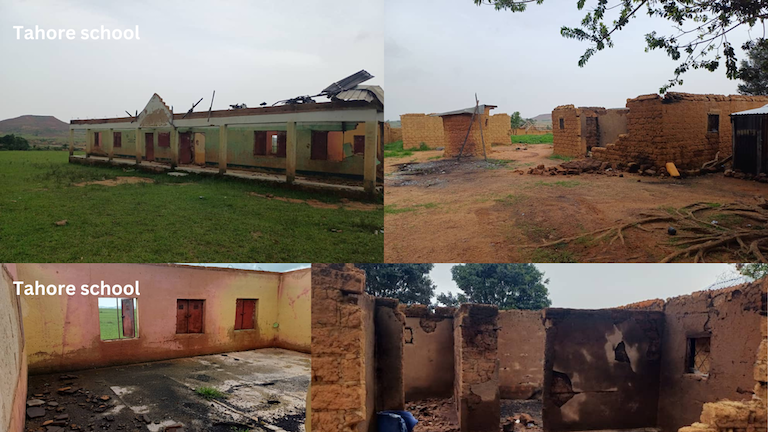
The Tahore community was one of the communities attacked with 31 people killed.
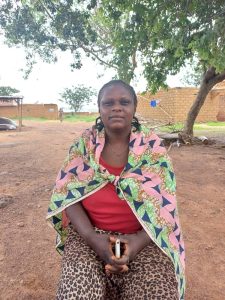
Christiana Danjuma recounts her experience of loss.
Christiana Danjuma lost her husband and one of her children who was 25 years old when the Tahore attack happened. She and other community members only managed to escape by running through incoming attackers. In the process, they killed six people, while 25 others were killed in the community, raising the total death toll in the community to 31.
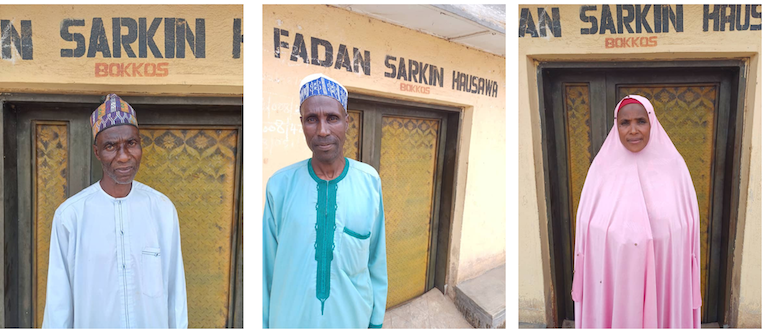
In an interview, the Sarkin Hausawa, Audu Idi Balarebe, whose community houses some displaced Fulani herders, clarified that the killing on December 24 that sparked international outcry was not the result of religious or ethnic differences, but a dispute between a herder and farmer that ultimately resulted in the farmer’s death.
According to him, the farmer’s death sparked reprisals from the farming community, which in turn sparked back-and-forth fighting between the indigenes and Fulani herders, resulting in the deaths of hundreds of their cows and the demise of 22 people in Fulani settlements across the Bokkos local government area.
Tahore school and other houses damaged by the attackers.
Abubakar Hassan and Zainab Yakubu, who are from the same Fulani settlement under Tangur district in Bokkos that was affected by the conflict, disclosed in an interview that nine people in their settlement had been killed. Hassan and other Fulanis now residing as IDPs in Bokkos express displeasure with the situation, as they have been chased away from their homes and their livelihoods destroyed.
From Left to Right: Sarkin Hausawa of Bokkos, Audu Idi Balarebe, Abubakar Hassan and Zainab Yakubu.
The experiences of Syvaniah, Hassan, and Zainab Yakubu is a reflection of how the farmer-herder conflict in Nigeria is affecting communities across the country.
Fulani herders settlement in Tangur district under Bokkos LGA of Plateau state.
Gunmen suspected to be herders had on Sunday, December 24, 2023, invaded the villages of Ndun, Ngyong, Murfet, Makundary, Tamiso, Chiang, Tahore, Gawarba, Dares, Meyenga, Darwat, and Butura Kampani in the Barkin Ladi, Mangu, and Bokkos regions of Plateau State. They set fire to homes, opened fire on locals, and killed over 150 people.
One of Nigeria’s biggest security concerns in recent years has been the conflict between farmers and herders. Disagreements between farmers and herders across the country over the use of land and water, obstruction of historic migration routes, cattle theft, and crop damage have all been linked to the conflict, explaining it as essentially a problem of resource management.
Heat map of attacks in Plateau State on December 25, 2023: Source: NASA FIRMS.
Narratives woven on various social media platforms tend to paint either Muslims or Christians as the greatest victims of the conflict and even accuse security forces of aiding aggressors. This is especially done with the help of pictures and videos showing totally different events, a trend that may make it harder to restore calm.
According to him, Nigeria is currently polarised due to many factors, including religious, political, and multi-ethnic.
“These factors are what misinformation purveyors often take advantage of to promote hate speech and spread fake news, thus aggravating tension, breeding enmity, and threatening national unity and the peaceful coexistence of the whole nation.
“In the past, both state and non-state actors have deployed misinformation towards achieving their selfish agendas during conflict times in Northern Nigeria, including Plateau State, which has witnessed multiple conflicts ranging from ethno-religious to farmers-herders crises, among others,” Kehinde said.
He added: “This has contributed in no small measure to the perennial crisis in the North Central State, which has defied nearly all solutions to mitigate the conflict as misinformation stokes continuous violence and multiple counter-attacks.”
The British Broadcasting Corporation (BBC), in a report published in 2018, said its research showed that fake news on social media platforms fuels the farmers-herders crisis in Nigeria. The report claimed at the time that false reports of violence between communities in Nigeria are being exacerbated by fake images that are making the rounds on social media.
Nigeria’s north-central region has been the most hit by conflict between farmers and herders, which is being fueled by a problem of resource management.
Plateau State, which lies in North-central Nigeria has seen frequent clashes between farmers and herders. Mangu, Bokkos, and Barkin Ladi LGAs have been the scene of various clashes between herders and farmers in recent years.
We reviewed social media platforms using advanced search as well as various hashtags (#PlateauMassacre, #PlateauChristianKilling, and #PlateauMuslimKilling) on X and Facebook and found multiple accounts with hundreds of thousands of followers on various social media platforms from within Nigeria and outside with vested interests amplifying false claims that aggravated the conflict. Also, we found countless examples of problematic online posts that could potentially be considered misinformation or disinformation. Some of these users made false claims online, which may heighten tensions.
Notwithstanding legislation like the amended Cybercrimes Act (2024), and a rule prohibiting the dissemination of false information with the intention of inciting fear, the Nigerian government and social media firms have not taken legal action against those who posted false information about the conflict on their platforms.
Despite being marked as read, Hadiza Umar, the head of corporate affairs at NITDA, did not reply to two messages that were sent to her WhatsApp number about what the agency is doing about inaccurate information posted online regarding the conflict between farmers and herders.
Also, as at the time of this publication, Meta, the owner of Facebook, and X did not respond to detailed questions sent on June 27, 2024, about why they don’t take any action whenever there is inaccurate post relating to the conflict between farmers and herders in Nigeria.
A 2017 International Crisis Group assessment revealed that “many natural water sources throughout Nigeria’s far-northern Sahelian belt have dried up due to drought and desertification. Degrading pastures and the migration of a large number of herders to the south in search of grassland and water for their herds are other factors mentioned in the assessment.”
The conflict is becoming more polarised along ethnic, regional, and religious lines as a result of false information spreading on social media. Most of the herders can be classified as Muslim-Fulani, who are primarily nomadic. Nevertheless, the farmers are generally found in numerous ethnic groups that practise Christianity.
Infographic showing list of victims of the 2023 Christmas Eve attack in Bokko LGA of Plateau state.
Amnesty International said that there have been incessant attacks on communities in the Barkin Ladi, Bokkos, and Mangu local government areas of Plateau State. From December 2023 to February 2024, 1,336 people were killed: 533 women, 263 children, and 540 men. The total number of people displaced is 29,554, out of which 13,093 are children and 16,461 are women.
Many posts use online reference language, claiming religion and ethnicity as the drivers of the conflicts in Plateau State.
For Emeka Okoro, a security analyst with SBM Intelligence, social media platforms need to establish clear policies and enforcement as the spread of false information online relating to the farmer-herders conflict will significantly impact the conflict by fueling mistrust, escalating tensions, provoking violence, and obstructing constructive dialogue and resolution.
Social media users behind information disorder complicating farmers/ herders conflict
As news of the Christmas Eve massacre and January 2024 religious and ethnic conflict began appearing online, numerous accounts based on a variety of stories about the killings and the perpetrators began to circulate on social media. Some claimed that Christian natives were killing Fulani herders alleged to be Muslims in Plateau State, while others claimed Islamist militants were responsible for the deaths of Christians in north-central Nigeria.
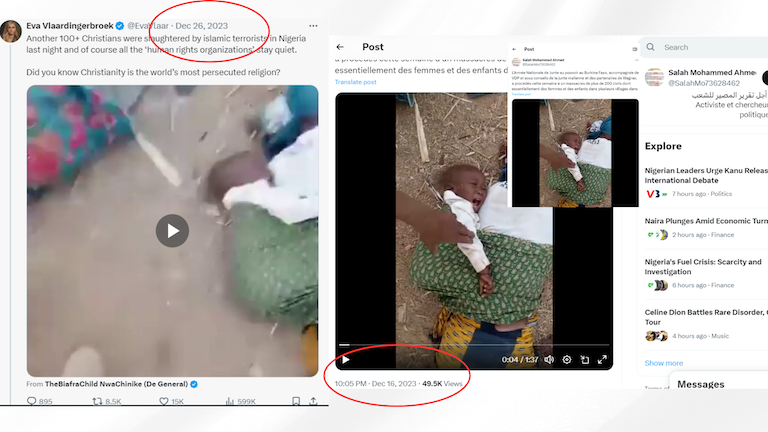
On December 26, 2023, a Dutch conservative activist, Eva Vlaardingerbroek, shared a controversial post on X (previously known as Twitter); this time not about her usual posts relating to politics in Europe and the United States, but about the killing that occurred 5,126 km away from her country.
She had uploaded a video gotten from a pro-Biafra account on X, TheBiafra_Child NwaChineke (De General) (@TheBiafraChild) showing the bodies of multiple people, saying it was a scene of Muslim extremist killing of Christians in Nigeria’s north central state of Plateau. Eva made the post two days after news of herdsmen attacks in some Plateau communities began spreading online.
Screenshot of the Vlaardingerbroek social media post and Salah confirming the time the video first appeared online.
However, a reverse image on a screenshot captured from the video showed that the video was uploaded online on December 16, 2023, by Salah Mohammed Ahmed (@SalahMo73628462), an X account. It featured a French description, which was translated into English using Google Translate, indicating that the video originated from Djibo in Burkina Faso rather than Nigeria.
Also, two other well-known accounts on X that made a similar claim were Yasir Arafat Jubril (@oi_shaekh) and Kangyang Pwajok (@pwajok_jane). Pwajok claimed that Muslims were responsible for the murders in a reaction to a Channels TV post on X on December 25, 2023. The post has garnered over 28,000 views.
Screenshots of social media posts by Yasir Arafat Jubril and Kangyang Pwajok.
36 minutes after Pwajok’s post, Yasir posted that a Fulani village in Jos was allegedly attacked. Yasir’s post appears to be referencing the Burkina Faso video that Eva and @TheBiafraChild shared. The attack on December 24, 2023, was also not in Jos, as alleged by Yasir, but in the Bokkos local government area which is 76.5 km from the Jos local government area.
Pwajok also celebrated a December 30, 2023 Fox News report on the killing titled: “The world looks the other way as Christians are killed for sport by jihadists in Nigeria.”
Another account that described the conflict as Muslim terrorism issues against the Christian community is Visegrad. Visegrad is a Polish-owned online news site that publishes information relating to current events. With more than a million followers on X, the platform had made more than 20 posts since December 2023 in which it prominently labelled herders as Islamist Fulani militias.
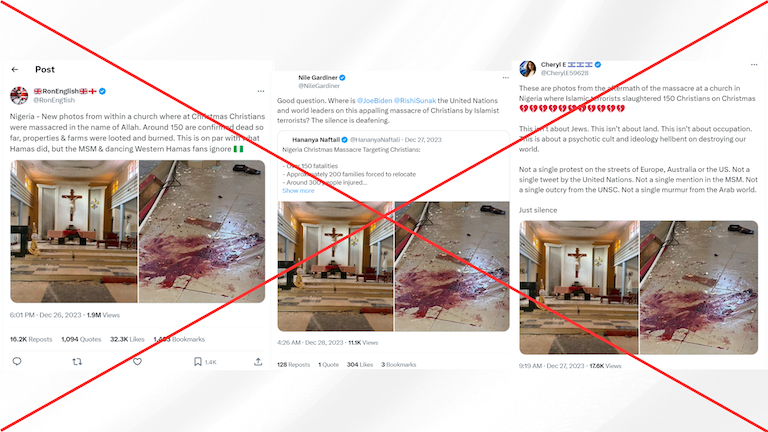
Many other posts focus on the use of images and videos in spreading false information. For example, a post found on X showing a photo collage of the interior of a church, and a floor stained with blood is purported to be from Plateau State. This was used to depict the attacks as being driven by religion. The photo garnered thousands of reposts on X, but when it was subjected to Google Reverse Image searches, the results showed that the photos were from the Owo church terrorists’ attack in Ondo State which happened on June 5, 2022.
An examination of social media accounts that spread the image, using advanced search on X, indicated that many of them are not from Nigeria. The collage photos were shared online by X accounts namely @RonEnglish and Nile Gardiner. Their online profiles show that while the former is a British conservative commentator, the latter is a foreign policy analyst based in Washington, DC. Other foreign accounts who also posted the collage of photos include Israelis Cherryl E and Hananya Naftali.
Screenshots of social media posts by Ron English, Nile Gardiner, and Cheryl E.
Naftali is an Israeli influencer and an aide to the Israeli prime minister, Benjamin Netanyahu.
Six months later, Naftali’s post has been viewed more than 1.6 million times, with 15,000 reposts, 2,600 comments and 25,000 likes.
Gardiner had reposted Naftali post alleging that the president of the United States, Joe Biden and UK Prime Minister, Rishi Sunak were mum on the issue.
In another post, a video of men suspected to be Islamists was alleged to be from Plateau State. On a closer inspection using the InVid video verifier, it was confirmed that the video was first uploaded on X by a security analyst and counter-insurgency specialist in the Lake Chad region, Zagazola Makama on December 26, 2023. It clarified that the video showed members of the terrorist organisation, Boko Haram, storming the Islamic State of West Africa province (ISWAP) position at Gaizuwa, Sambisa Forest, after ISWAP had taken off.
Screenshots of social media posts by Remix News Views and Zagazola confirming the time the video first appeared online.
The video was found on a Russian based Telegram channel and Remix News & Views on X, a platform that purports to provide news and commentary from Central Europe. Both claimed that the video was shot in Plateau State.
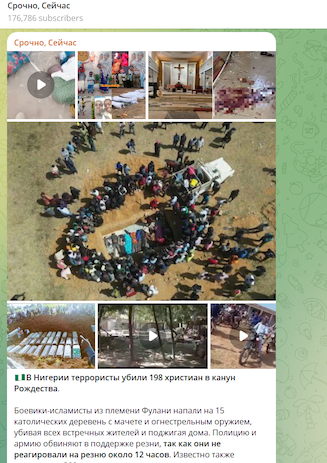
The Russian based Telegram channel “Срочно, Сейчас” (Urgent,Now) with more than 176,786 subscribers had on December 28, 2023 posted a series of images and videos entitled, “In Nigeria, terrorists killed 198 Christians on Christmas Eve.”
A screenshot of the post published by the Russian based Telegram channel.
The post shared by the channel had three videos and four photos. The channel also alleged men from the Nigerian Police and Army were supporting attacks against villagers, stating that “the police and army are accused of supporting the massacre as they did not respond to the massacre for about 12 hours.”
One of the videos in reference to the claim that Nigerian soldiers escorted gunmen to the murder of several people on Christmas eve in Plateau State shows people in military uniforms amidst several gun-wielding bandits on motorbikes.
Using the InVid video verifier, it was discovered that the video was not connected to the fatal occurrence in Plateau State and had been available online since September 2023.
A security expert and Journalist, Mohammed Idris (@Eedris4Peace), with some knowledge of bandits’ operations in the Northern part of Nigeria, had earlier uploaded pictures from a gathering on X on September 16, 2023, alleging it to be a truce meeting between community members in Katsina and bandits. He had identified the meeting to have taken place at Fankama village in Faskari Local Government Area in Katsina State.
Another image that appeared on the Russian Telegram channel is a collage of six different pictures of a woman and children and another photo showing five people wrapped in white clothes being prepared for burial. However, a Google reverse image search showed that the collage of photos was from a blog named The Famous Naija, which reported the killing of a 32-year-old Adamawa woman named Harira Jubril and her four children in 2022 by gunmen in southeastern Nigeria.
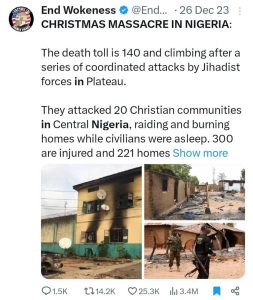
Another X account, End Wokeness (@EndWokeness), with more than 2 million followers, posted three images of charred buildings and another of two security personnel standing guard at a burned building to accompany the claim that the attack had been carried out by Jihadists. Since it was uploaded on December 26, 2023, the post has had over 3.4 million views.
Screenshot of @EndWokeness post on X.
A Google image reverse search shows the building in the first image as the correctional centre that was attacked by gunmen on April 5, 2021 in Imo State, freeing over 1,500 prisoners in the process. The images in the second and third places are from a previous attack that took place in April 2022 in Kanam LGA of Plateau State.
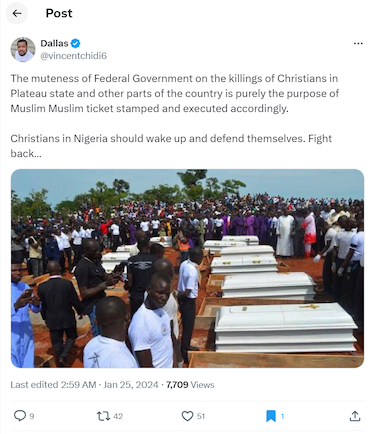
The January 2024 crisis in the Mangu local government area further sparked the spread of false claims online about the inter-communal violence on social media. For example, on January 25, 2024, another image of a mass burial surfaced on X. The poster said the Nigerian government was keeping quiet about the murders of Christians in the Plateau and other regions of the country. He said this was because the president and vice president are Muslims, and he urged Christians to fight back.
Screenshot of a social media post by Dallas.
However, a Google reverse image search on the image showed that it was taken in May 2018 in Benue State at the burial of two priests and seventeen worshippers killed by suspected Fulani herders.
Also, a Facebook user, Ghali Usman, claimed on January 24, 2024, that 96 Muslim deaths had been verified in Mangu, along with the destruction of two schools and the burning of ten mosques.
The image, according to a reverse image search, is of a mosque in Billiri, Gombe. It was set on fire in February 2021 due to a dispute over a traditional title and the death toll is also at odds with a statement released by Jama’atu Nasril Islam’s First Aid Group, which claimed to have buried 16 victims due to the violence.
A Facebook user named Victor Bazy used a March 2018 image of a house burned by suspected herders during a violent attack in Kogi State to reference the attacks on Mangu in January 2024.
Okoro of SBM Intelligence acknowledged the issue of false information online relating to the farmers conflict, but added that to stem it, there is a need for social media platforms to change algorithms for moderating and fact-checking content to reduce harmful content spreading online.
“The spread of false information online during herder-farmer clashes is harmful, escalating tensions, obscuring the truth, perpetuating stereotypes, and undermining trust. It can also amplify simplistic narratives, mobilise militant groups, and perpetuate violence. However, verifying sources, fact-checking, and promoting credible news can help combat misinformation and foster a more informed and peaceful resolution,” Okoro said.
A new study by the Global Public Policy Institute (GPPi) has identified four important steps in mitigating digital threats to elections while engaging with over 100 experts and practitioners in Africa.
The report stated that digital threats to elections are evolving worldwide, posing risks to democratic institutions and potentially inciting violence.
Despite efforts by various organizations to mitigate these threats, it’s difficult to determine which strategies are effective, and limited resources hinder learning from past elections.
The study noted that its findings offer valuable lessons for safeguarding elections from digital threats globally.
“To address this, our team spent the past year engaging with over 100 experts and practitioners from civil society organizations (CSOs), governments, international bodies, and election assistance funders across Africa, through interviews, workshops and scenario exercises.
“Our research identified four key “building blocks for success” present in programming that managed to mitigate digital threats to elections. We also explored how different levels of investment (high, medium and low) can contribute to each of these building blocks,” the study stated.
The study affirmed that the innovative strategies demonstrated by the organizations that was consulted not only provide valuable lessons for addressing digital threats in Africa, but also offer insights for implementers and funders worldwide who aim to develop effective programmes to protect elections from digital threats.
It further noted that the four foundational elements include: understanding the digital threat landscape; varied actors for varied digital threats; taking an institutional approach to digital threats; and hybrid fixes for hybrid problems.
The research stated that funders make decisions based on flawed assumptions gleaned from headlines, leading to ineffective or counterproductive interventions in electoral issues.
“In many cases, we found that funders rely on faulty or uninformed assumptions – often drawn from headlines – about the most pressing electoral issues or the most useful contributions they could make, which resulted in ineffective or even counterproductive interventions. More successful efforts have used baseline surveys, iterative learning and post-programming reviews to target real needs and follow effective theories of change.
When working alone, organizations will always struggle to respond to the multiple issues entailed by digital threats at the scale required. More successful efforts have brought together a variety of stakeholders (through coalitions, strategic coordination and facilitated networking) and developed multi-pronged solutions, which tackled a diverse range of threats by sharing information and coordinating action,” it added.
The study also noted that training programmes that exclusively enhance individual-level skills for specific groups like journalists, activists, or electoral management representatives may have limited impact if their respective organizations cannot effectively integrate these improvements.
Successful initiatives, on the other hand, focus on strengthening entire organizations through collaborative project design, comprehensive training across all levels, and addressing fundamental institutional capacity gaps—not solely increasing project funding which are more sustainable in the long run.
Additionally, the study said that solely concentrating on digital solutions overlooks the fact that digital threats often transcend into offline realms, risking the implementation of strategies that are ill-suited to their context.
“More effective efforts prioritize understanding the genuine digital needs and the technological capabilities of Civil Society Organizations (CSOs) and their intended audiences. This approach often results in more suitable solutions, which may not always be high-tech, to address urgent threats effectively,” it concluded.