Please note that the FactCheckHub has not obtained any right from the authors or copyright owners of all third-party contents from embedded links and shall incur no liability in this regard.
Please note that the FactCheckHub has not obtained any right from the authors or copyright owners of all third-party contents from embedded links and shall incur no liability in this regard.
Please note that the FactCheckHub has not obtained any right from the authors or copyright owners of all third-party contents from embedded links and shall incur no liability in this regard.
Please note that the FactCheckHub has not obtained any right from the authors or copyright owners of all third-party contents from embedded links and shall incur no liability in this regard.
A video clip of Ben Ayade, an ex-governor of Cross River State addressing youths, has surfaced on social media with a claim that Ayade was on the streets to caution youths to shelve the planned nationwide protests starting on August 1, 2024.
A verified X user @Gen_buhar posted the two minutes, twenty three seconds footage on July 27, 2024 with a caption that read:
“The immediate past Governor, Professor Ben Ayade was on the Streets of Calabar talking to people. Our Governors, NASS members and Ministers should return home now and engage their constituencies. Help Mr President. Don’t wait until it happens”.
In the footage, Ayade, who served as Senator for Cross River North from 2011 to 2015 and also a current member of ruling All Progressives Congress (APC), could be seen behind security officials addressing hundreds of youth.
The former governor urged the youth not to destroy Calabar and the nation, adding that he understands their pain, agony and hunger in the state in particular.
CLAIM
Ayade addresses youths, urges them to shelve planned nationwide August protest.
THE FINDINGS
Findings by The FactCheckHub indicate that the claim is MISLEADING, as the video has been online since 2020.
This fact-checker subjected screenshots from the clip to a Google Reverse Image search. The result shows that the video has been online as far back as 2020.
A Facebook page, Instablog9ja, posted the same clip on October 28, 2020.
Furthermore, an online medium, Tori.ng, reported how the ex-governor hid behind his security personnel to address residents in the state after looters broke into warehouses in search of “Covid-19 palliatives” in 2020.
“Governor Ben Ayade of Cross River stood behind his security personnel to address residents of the state.
“For days, looters have been breaking into warehouses in search of “Covid-19 palliatives” to loot. Hoodlums have also been destroying private and public properties in the name of looting.
“Following days of destruction, Governor Ben Ayade came out to address his people. He appealed to them to desist from destroying private and public properties. He added that he empathizes with them, understands the poverty in the land, and wishes he could make them all “billionaires”,” part of the report stated.
Further checks revealed that the same clip was posted by another Facebook page, IK Osamede Backup on October 28, 2020 with a caption that Ben Ayade hid behind layers of security as he addressed his people following days of vandalism during the COVID period.
THE VERDICT
The claim that Ayade addressed youths and urged them to shelve planned nationwide August protest is MISLEADING; it is an old footage from an event that happened in October 2020.
A recent judgement by Nigeria’s Supreme Court ordered that the 774 local government councils in the country should manage their funds themselves, while adding that it is unconstitutional for state governors to hold funds allocated to the local government which was the norm. Against this backdrop, The ICIR looked at how much had been disbursed to local governments in the last three years.
Between January 2022 and June 2024, the federal government, through its Federation Account Allocation Committee (FAAC), released a total of N6.92 trillion for the 774 local governments in Nigeria.
The ICIR compiled this disbursement from data released by the National Bureau of Statistics (NBS) monthly report on FAAC allocation.
The ICIR gathered that in 2022, the total allocation disbursed to the local government was N2.62 trillion, while in 2023, the total disbursement to the local governments was N2.60 trillion. Meanwhile, between January and June 2024, a total of N1.69 trillion has been disbursed to the 774 local governments in the country.
The data showed that more allocations have been made to the LGAs within the last year after the fuel subsidy was removed in May 2023 when Bola Ahmed Tinubu assumed office as the Nigerian president.
The ICIR checks showed that between June 2023 and June 2024, one year under Tinubu’s administration, FAAC distributed a total of N3.34 trillion to the local government.
Month
2024
2023
2022
January
N288.93 billion
N221.81 billion
N163.88 billion
February
N278.04 billion
N183.23 billion
N131.88 billion
March
N267.15 billion
N173.94 billion
N722.38 billion
April
N288.69 billion
N171.26 billion
N167.91 billion
May
N293.82 billion
N213.67 billion
N149.25 billion
June
N282.48 billion
N221.79 billion
N175.94 billion
July
–
N218.06 billion
N182.33 billion
August
–
N236.23 billion
N210.62 billion
September
–
N266.54 billion
N164.25 billion
October
–
N210.90 billion
N172.78 billion
November
–
N225.21 billion
N177.09 billion
December
–
N258.81 billion
N202.49 billion
Total
N1.69 trillion
N2.61 trillion
N2.62 trillion
Table showing the disbursement to the 774 LGAs in three years. Source: NBS.
A senior research & policy analyst for BudgIT, Vahyala Kwaga, told The ICIR that the issue with the data on the distribution of local government funds is the uncertainty in precisely how much the local governments actually got at the end of the day.
He said, “It is an open secret that governors “hijack” funds in the Joint Account of the states and the local governments. More worrisome is despite the minimal amount of money received by the local governments, publication of the spending efficiency is nonexistent. This speaks to the lack of transparency even with the little received by the LGAs.”
Supreme Court judgment
A recent judgement by the Supreme Court has ordered that the 774 local government councils in the country should manage their funds themselves, adding that it is unconstitutional for state governors to hold funds allocated to the local governments.
Every month, allocations are disbursed from the revenues generated into the federation accounts. The bulk of the revenue shared at FAAC meetings by the federal, state, and local governments are earnings from oil exports, taxes, and other statutory allocations.
In the current revenue-sharing formula, the Federal Government gets 52.68 per cent of the revenue, states 26.72 per cent, and local governments 20.60 per cent.
The fund, which serves as the primary revenue stream for most states, is designed to facilitate development across various tiers of government, enabling states and local governments to fulfil their financial obligations and deliver essential services to their citizens.
However, up until the recent judgement, allocation to the local governments has always been managed or controlled by the state governors.
LG autonomy
The Attorney General of the Federation, Lateef Fagbemi, had filed a lawsuit on behalf of the Federal Government, seeking to grant full autonomy and direct funding to all the 774 local government councils in the country.
But this suit was counterclaimed by the 36 state governments, arguing that the Supreme Court lacked the jurisdiction to hear the case.
In the lead judgement read by the judge, Emmanuel Agim, the apex court said the AGF has the right to institute the suit and protect the constitution. It also added that Local Government allocations from the FAAC should be paid directly to them henceforth, and not to state government coffers as this is a breach of Nigeria’s 1999 constitution.
Recall that The ICIRreported that former President Muhammadu Buhari, in May 2020, signed an Executive Order to grant financial autonomy to the judiciary, legislature, and local government councils but analysts said the misappropriation of LGA funds would not end until a proper constitutional amendment is done.
EDITOR’S NOTE:
* This report was republished from The ICIR. You can read the original article here.
A Facebook post that is advertising an investment networking scheme has been circulating online.
The post, allegedly shared by a Facebook page with the name ‘NTA News Nigeria’, read:
Breaking News
NORLAND INTERNATIONAL INVESTMENT
This company has been registered under the Corporate Affairs Commission of Nigeria and certified fraud free to do business in Nigeria by the Economic Financial Crimes Commission (EFCC).
NO SCAM
NO LIES
This is a Nigerian network marketing company that has collaboration with the CBN and also the government to help the Disables,employees or unemployed citizens of the country achieve their goal.
INVEST NOW AND CELEBRATE WITH US” The company takes pride in the fact that it stands out amongst other network marketing companies. It has the best compensation plan, affordable and effective services, systems that keeps her customers coming back for more..
Click on the WhatsApp button to message for more information and get started thank You🙏
The post indicated that the company is registered with the Corporate Affairs Commission (CAC), adding that the scheme is in collaboration with Nigeria’s central bank.
The post also had a collage of footages showing testimonies from individuals who claimed to have benefited from the investment scheme.
The post has garnered over 16,000 play views, with more than 100 likes and over 70 comments.
CLAIM
NTA advertises Norland investment scheme.
THE FINDINGS
Findings by The FactCheckHub show that the claim is FALSE, as the Facebook page is fake!
Screenshot of the official page of the NTA.
A keyword search of the phrase ‘NTA Facebook handle‘ on Google search engine led us to the original Facebook page of the Nigerian Television Authority (NTA) which is NTA Network News as shown in the image here.
It has over 950,000 followers and also verified with the ‘Blue tick’.
This is in contrast with the fake Facebook account which had ‘NTA News Nigeria’ as its profile name with 15 followers only.
Further search indicated that the company, Norland International Investment, is not registered in Nigeria, as it was not found on the website of the Corporate Affairs Commission (CAC) – the Nigerian government agency in charge of registration of businesses and companies in the country.
Screenshot of the company search on the CAC website.
A keyword search of the words ‘Norland Investment‘ on Google search engine provided lists of some companies and social media pages with the name. It also showed that one Norland Investments Limited is actually registered in the United Kingdom, and not in Nigeria as claimed in the Facebook post above.
Norland Industrial Group (NIG) is another name that featured in the search results with characteristics matching the alleged company’s description.
But the company is a health consultancy company that provides supplements and consumables. Pictures of the building and reviews were also contained in the detailed results shown in the Google search.
However, the NIG also issued a statement as far back as 2022 distancing itself from the ponzi scheme while shedding light on the services and products it offer.
Further checks show that other fact-checking organisations in Nigeria, including Africa Check and Dubawa, had debunked claims associated with the Norland investment scheme as seen here, here and here multiple times.
THE VERDICT
The claim that NTA is advertising Norland investment scheme on Facebook is FALSE; the post is targeted at defrauding unsuspecting individuals in what’s likely a phishing scam.
An X user, @thatverydarkmnn has posted a video of protesting on the streets has surfaced online with a claim that the planned nationwide protest has commenced in some Nigerian states.
The protesters wielded placards with inscriptions like: “End Nigerian Hardship”, “Tinubu Go ooo”, “Tinubu. It is not by force. Come and be going”.
“BREAKING NEWS: END HARDSHIP PROTEST OFFICIALLY STARTED IN SOME STATES.”
The video has generated over 140,000 views, with over 1,000 reposts and more than 2,300 likes as of Monday, July 29, 2024.
CLAIM
Video shows #EndBadGovernance protest in some Nigerian states.
THE FINDINGS
Findings by The FactCheckHub show that the claim is MISLEADING.
Screenshot of the viral post retrieved on X. INSERT: Misleading verdict.
Nigerians are planning to stage a nationwide protest from August 1 to 10, dubbed “10 days of rage,” or “End Bad Governance in Nigeria” to express their displeasure over the country’s soaring cost of living and economic hardship. This is why the hashtags: #EndBadGovernance, #EndBGIN, #EndBadGovernance2024 and #EndBadGovernanceinNigeria have been trending on multiple social media platforms, especially on X for days. There were reports that the protest has allegedly commenced in some states.
Despite pleadings by some political leaders in the country, many Nigerians still insist on embarking on the protest.
The Nigerian President, Bola Ahmed Tinubu, had scrapped a popular fuel subsidy and devalued the local currency, the naira, thus causing a spiral hike in food and commodity prices.
Analysis of the footage shows that it was shared by a TikTok account, “mc_bokujaka01”, on February 19, 2024, without a caption.
Some clues in the footage also revealed that it was taken in February 2024. For instance, two banners seen at exactly 12 and 21 seconds into the video had “19TH February 2024” written on them.
A keyword search online showed that the video showed a protest over the economic hardship by residents of Ibadan, the Oyo state capital. The protest was reported here by TheCable. Some banners seen in the video are also seen in the images posted by an X user on the same day.
Findings also showed that the video had earlier been falsely used to depict a protest in May 2024, which was debunked by AFP. An AFP journalist who was at the scene of the protest confirmed in the reportthat the video shows a protest in the southwestern city of Ibadan.
Recall that The FactCheckHub had earlier debunked a video showing some youths holding placards and burning tyres which was shared with a claim that the protest had commenced in Kano.
THE VERDICT
The claim that the video showed the ‘end bad governance’ protest in some Nigerian states is MISLEADING; the video depicts a protest that occurred in Ibadan in February 2024.
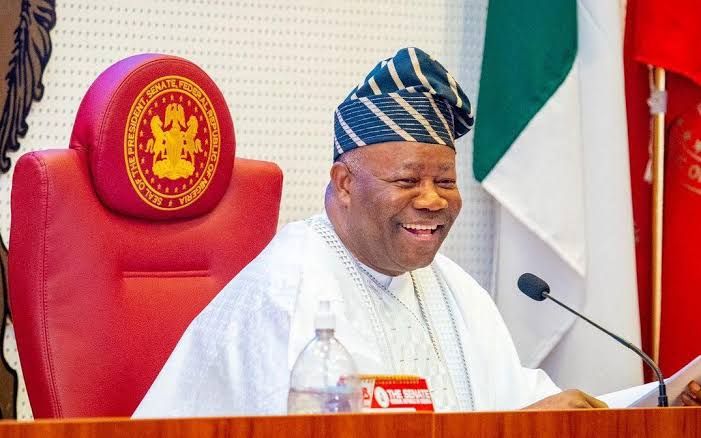
NIGERIA’s Senate President, Godswill Akpabio, recently claimed that every employer in the country must pay their workers the new national minimum wage.
He made the claim on July 23, 2024 during the passing of the new national minimum wage bill at the National Assembly in Abuja.
The new legislation amends the National Minimum Wage Act of 2019 by addressing two key issues: raising the minimum wage from N30,000 to N70,000 and reducing the review period from five years to three years.
This comes after months of back and forth from the Nigerian Labour Congress (NLC) and the Nigerian government.
During the plenary session following the bill’s passage, Senate President Godswill Akpabio stated that Nigerians can no longer pay any domestic worker less than N70,000.
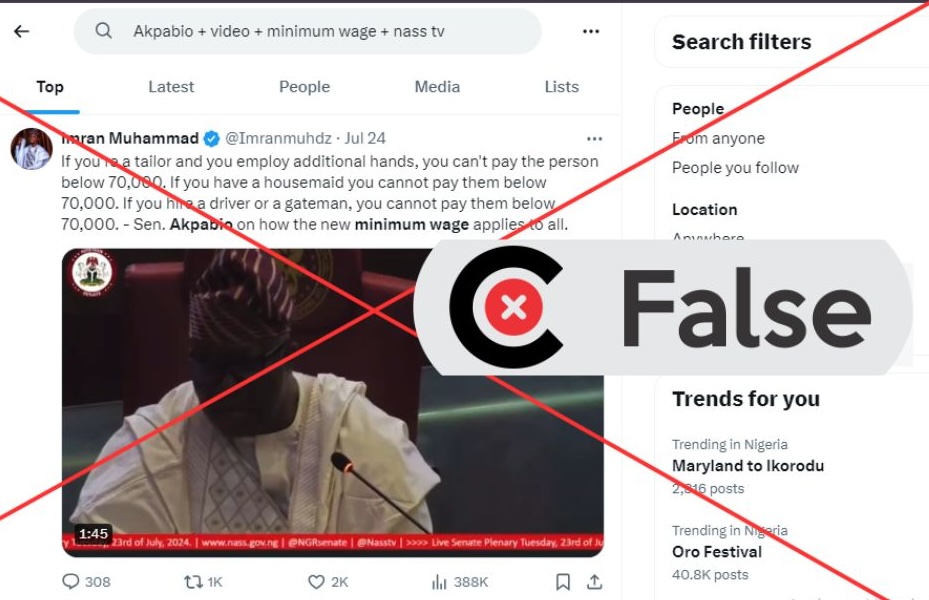
He made this known in about two-minute video which has now gone viral on social media, particularly on X and has been reposted multiple times by online users.
Part of the transcribed audio of the footage read:
“…It (the bill) only says that if you are a tailor and you employ an additional hand, you cannot pay the person below N70,000. If you are a mother and you have a newborn child and you want to bring in a housemaid to look after your child, you cannot pay that housemaid below N70,000. It is not maximum wage. It applies to all and sundry. If you bring in a driver, if you bring in a gateman — you cannot pay that gateman below N70,000. So, I am very delighted that this has been passed and we now look forward to employers of labour going ahead to improve on what has been set as a benchmark for all and sundry to follow…”
The video has gone viral and generated multiple reactions online.
CLAIM
All employers must pay their workers the new national minimum wage.
THE FINDINGS
Findings by The FactCheckHub show that the claim is FALSE!
Section 3 of the National Minimum Wage Act 2019 mandates that all employers must pay their workers at least the national minimum wage.
A screenshot showing an X user shared the video of Akpabio’s statement on the newly signed National Minimum Wage Act on July 24, 2024.
The law declares any agreement to pay wages below the national minimum wage as void, although there are exceptions.
According to Section 4 of the Act, the minimum wage requirement does not apply to employers with fewer than 25 employees.
The Act also states that certain establishments are exempted from paying the minimum wage, such as part-time employees, employees paid on commission or piece-rate, fewer than 25 employees, workers in seasonal employment, such as agriculture, and any person employed on a vessel or aircraft governed by merchant shipping or civil aviation laws. Here’s the amended 2024 Act.
The Punch newspaper also found Akpabio’s statement to be FALSE as seen here.
THE VERDICT
The claim that all employers must pay their workers the new national minimum wage is FALSE; the National Minimum Wage Act exempts some employers with fewer than 25 employees, freelancers, and part-time employees, among few others.
AHEAD of the planned nationwide protest scheduled for August 1, a video showing some youths holding placards and burning tyres has surfaced online with a claim that the protest has commenced in Kano.
A verified X user, @CrownprinceCom2, posted the video with a caption that read:
“This is Northern Nigeria Kano State to be precise.. Can you repost this video and let’s them see it… Tinubu without you doing the needful you can’t stop an hungry man 1st of August is here.”
The post has generated more than 290,000 views, with over 3,000 reposts and more than 4,000 likes as of July 27, 2024.
Another X user, @EmmaMillelJnr, posted the video with a similar caption thus:
“Kano has started their protest. As i always said, the revolution that will change the trajectory of the country will start from Kano.”
The video has generated over 32,000 views as of July 27, 2024.
CLAIM
Video shows #EndBadGovernance protest in Kano.
THE FINDINGS
Findings by The FactCheckHub show that the claim is MISLEADING.
Reports have indicated that various Nigerian groups are planning a nationwide protest from August 1 to 10, dubbed “10 days of rage,” or “End Bad Governance in Nigeria” to address the country’s soaring cost of living and economic hardship. This is why the hashtag: #EndBadGovernance, #EndBGIN, #EndBadGovernance2024 and #EndBadGovernanceinNigeria has been trending on multiple social media platforms, especially on X for days.
The plans for protests follow weeks of demonstrations in Kenya that were sparked by proposed tax hikes and outrage over high-level corruption in the East African nation. The demonstrations resulted in a tax hike bill being withdrawn and Kenyan President, William Ruto, dissolving his cabinet.
In Nigeria, the main concerns revolve around the soaring cost of living, which many Nigerians blame on government’s economic policies.
The Nigerian President, Bola Ahmed Tinubu, had scrapped a popular fuel subsidy and devalued the local currency, naira, thus causing spiral hike in food and commodity prices.
Nigeria’s overall inflation was in June 2024 at its highest level in 28 years – more than 34 percent with food inflation much higher, according to the Nigerian Economic Summit Group (NESG). This is in addition to widespread insecurity and climate change affecting farmers’ ability to grow crops.
The FactCheckHub subjected some keyframes in the video to a Google reverse image search and the result showed that the video has been online since May 2024 amid the emirship tussle in Kano State.
An earlier version of the video was posted here by Daily Trust on May 26, 2024.
Recall that earlier this year, Emir Muhammadu Sanusi II and Aminu Ado Bayero, dethroned Emir of Kano, were locked in a battle for the royal stool of the Kano emirate.
Sanusi was the Emir before he was dethroned in 2020 by the then governor of Kano State, Abdullahi Ganduje, over allegations of insubordination.
Following the emergence of a new Kano governor, Abba Kabir Yusuf, after Nigeria’s 2023 general election, the Kano State House of Assembly repealed the law which was used to unseat Sanusi.
Consequently, the Kano governor, Abba Kabir Yusuf, announced Sanusi’s reinstatement as Emir after signing the new Kano Emirate Council Law. The development led to long tussle for weeks in the state.
The video showed some of the youths in the state who marched to the streets to demand reinstatement of Emir Ado Bayero, the dethroned monarch. Some of them lit bonfires on the major road as they marched chanting anti-government songs, Daily Trust reported in May 2024.
THE VERDICT
The claim that the video shows the #EndBadGovernance protest in Kano State is MISLEADING; the video showed protest over the emirship tussle in Kano State and unrelated to the planned protest billed for August 1.
A new report from the blockchain analytics firm, Chainalysis, has shown that cryptocurrency is being used to finance and facilitate disinformation campaigns globally.
The study titled: “Malign Interference and Crypto: How Crypto Transaction Tracing Can Expose and Disrupt Malign Influence Efforts” revealed an intricate web of state and non-state actors leveraging digital currencies to spread false information and sow discord, especially in the lead-up to crucial elections.
According to the report, Crypto is playing an increasingly significant role in funding online disinformation campaigns aimed at influencing elections.
“We’re seeing a sophisticated nexus between cryptocurrency and disinformation that poses a significant threat to democratic processes globally,” said Sarah Johnson, lead researcher at Chainalysis. “This isn’t just about tracking money anymore—it’s about safeguarding the integrity of information ecosystems.”
The report revealed that foreign actors have been conducting systemic influence campaigns to disrupt democratic processes, particularly during election cycles. Notably, these campaigns have adopted novel tactics involving cryptocurrency to purchase the necessary technology and infrastructure.
It also highlights the role of technology services in enabling these campaigns. Ubar Store, a marketplace for stolen social media accounts, and Shinjiru, a Web hosting service known for its anonymity features, both accept cryptocurrency payments. These services provide the infrastructure needed to create and amplify fake news at scale.
The report also revealed mutual donation patterns among disinformation groups. One donor, for instance, allegedly sent over US$43,000 in Bitcoin to multiple pro-Russian organisations, including a paramilitary group called MOO Veche.
For policymakers and law enforcement agencies, the report offers a way to track and shut down the disinformation perpetrators.
It detailed how blockchain analysis techniques can be used to trace these financial flows and potentially disrupt malign influence networks. A case study on the takedown of the 911 S5 botnet demonstrates the effectiveness of these methods.
As nations worldwide prepare for national elections, the findings underscore the urgent need for enhanced regulatory frameworks. International cooperation is crucial to combat these evolving cross-border threats.
THE World Bank has denied a recent allegation by the Nigerian minister of Women Affairs, Uju Kennedy-Ohanenye, that the Bank’s staff in Nigeria pocket 40 per cent of all loans Nigeria receives from the financial institution.
The Bank refuted the claim in an exclusive mail sent to The ICIR, noting its staff did not receive 40 per cent of project funds in “consultation fees,” as alleged by the minister.
It also disputed the claim by the minister that Nigerian officials were entitled to five per cent of project funds after signing loan agreements.
The ICIRreported how Kennedy-Ohanenyeaccused the World Bank staff in Nigeria of pocketing 40 per cent of the loans given to Nigeria as consultation fees, while government officials who sign those loans get five per cent of the funds.
“All the loans they collect, including World Bank loans, are you aware that the same World Bank staff in Nigeria take back 40 per cent and call it consultation fees?
“These are things you people should look into. You people should focus on where the problem is and let them leave me alone,” the minister said during a phone interview with THISDAY newspaper.
She also alleged that she was being victimised by the National Assembly and some cabals for refusing to sign a $500 million World Bank loan request.
“There is a $500 million loan that was meant to be signed by me, but I refused to sign. There was also a case of $100 million earlier as well. Find out what it was meant for,” the minister added.
World Bank reacts
Meanwhile, the World Bank, while responding to The ICIR’s queries on the issue, emphasised that projects funded by the Bank were implemented by recipient governments and were governed by strict policies designed to prevent the misuse of funds.
The Bank also noted that it worked closely with borrowers to manage procurement processes, ensuring that funds are used transparently and efficiently. Key contract award information, including details about the recipients and the purposes of the funds, is required to be published as a condition of Bank financing, the Bank said.
“In response to your query, please note that World Bank staff do not receive 40 per cent of project funds as “consultation fees”. Nor are ministers entitled to five per cent of project funds for signing loan agreements. Both assertions are unequivocally false.
“World Bank-funded projects are implemented by recipient governments and are governed by rigorous policies meant to prevent the misuse of funds and ensure they are used for the purposes intended.
“Under our Procurement Framework, the Bank works with borrowers to carefully manage the integrity of procurement processes in line with core principles that emphasise fair competition, transparency, and efficiency.
“Borrowers are required to publish key contract award information – who the contracts were awarded to, where the money goes, and for what purposes – as a condition for bank financing,” the organisation wrote.
It further claimed that project staff involved in World Bank-supported initiatives are employees of the government ministry that hired them, not of the World Bank.
“Furthermore, it is worth noting that the World Bank does not recruit project staff. Such is purely the responsibility of the government ministry in charge of the project. Project staff in World Bank-supported projects are not employees of the Bank, but employees of the government ministry that hired them.
“The World Bank has zero tolerance for fraud and corruption and takes very seriously our obligation to ensure that our funds are used for clearly defined activities for the benefit of the poorest and most vulnerable,” the statement added.
Loan distribution based on claim by women’s affairs minister
Meanwhile, through media reports, The ICIR gathered that Nigeria has secured $4.95 billion in loans from the World Bank since the beginning of President Bola Ahmed Tinubu’s administration in May 2023.
Infographic on loans Nigeria took from the World Bank under President Bola Ahmed Tinubu and amount that allegedly went to World Bank staff as claimed by the Nigerian minister of Women Affair, Uju Kennedy-Ohanenye.
The amount was secured from six different loan requests: $750 million for the power sector, $500 million for women empowerment, $700 million for educating adolescent girls, another $750 million for renewable energy, $1.5 billion for economic stabilization reforms, and $750 million for resource mobilization reforms.
With the claim by Kennedy-Ohanenye, of the $4.95 billion secured by the country, $1.98 billion went for consultancy fees to the World Bank staff, meaning that only $2.97 billion was for the federal government to execute projects.
Nigeria’s current loan status
According to the Country’s Debt Management Office (DMO), Nigeria’s total public debt portfolio rose by 24.99 per cent in three months to N121.67 trillion as of March 31, 2024.
The DMO in its latest report released on Thursday, June 20, declared that the federal government and the 36 states, including the Federal Capital Territory (FCT), owe $91.46 billion.
“Central Bank of Nigeria’s (CBN) official exchange rate of $1 to N1,330.26 as of March 31, 2024, was used in converting external debt to naira,” the DMO noted.
Also, domestic debt rose to N65.65 trillion or $49.35 billion, representing 11.05 per cent increase relative to N59.12 trillion or $65.73 billion as of December 31, 2023.
External debt rose to N56.02 trillion or $42.12 billion, representing a 46.57 per cent increase compared to N38.22 trillion or $42.495 billion the debt office declared as of December 31, 2023.
Of the external debt, The ICIR reports that Nigeria’s current World Bank loan, as of March 31, is $15.59bn, according to data from the DMO.
EDITOR’S NOTE:
*This report was republished from The ICIR. You can read the original EXCLUSIVE article here.
AMID the panic surrounding the planned nationwide protest by Nigerians next week, a video purportedly showing the Nigerian president, Bola Ahmed Tinubu, promising to reduce the purchasing power of citizens, slow down the economy and widen the tax net has resurfaced online.
As a result of the economic hardship facing the country due to the recent policies by the current Tinubu-led government especially the removal of fuel subsidies, many Nigerians have expressed interest to protest their grievances starting from August 1, 2024.
In the 30-second video, Tinubu can be heard saying:
“We reduce the purchasing power of the people, we can further slow down the economy. Let’s widen the tax net. Those who are not paying now, if it is inclusive of Oyebola Tinubu, let the net get bigger and we take in more taxes. And that’s what we must do in the country.”
An X user, @realqueenbee__ posted the video with a caption thus:
“You must listen to this again and again.
His campaign promises:
1. Further slow down the economy: Done from No 1 to No 4
2. Has your purchasing power been reduced?”
The video post has been circulating widely online and shared by multiple X users as seen here and here.
CLAIM
Tinubu promises to reduce the purchasing power of Nigerians and slow down the nation’s economy.
THE FINDINGS
Findings by The FactCheckHub show that the claim is MISLEADING as Tinubu was quoted out-of-context. The video was also edited to suit the goal of the disinformation campaigners – to mislead the public.
Checks revealed that the doctored video first made its way to social media in the build-up to Nigeria’s 2023 general election.
Screenshot of the viral video retrieved from the X user’s page. INSERT: Misleading verdict.
Findings showed that the speech was made at the 11th Bola Tinubu Colloquium held in Abuja on March 28, 2019.
“The global economy faces a stiff headwind. Factors, not our making. It casts doubt now and its projection is slow growth. Consumer spending is slipping. And this is where I will stop and appeal to Professor Yemi Osinbajo, the Vice President, and his team. Put a huge question mark on any increase on VAT, please. If we reduce the purchasing power of the people, we can further slow down the economy. Let’s widen the tax net. Those who are not paying now, if it is inclusive of Oyebola Tinubu, let the net get bigger and we take in more taxes, and that is what we must do in the country, instead of additional layer of taxes. For now, I’ll stop there.”
The above quotes was extracted from 11:33 – 12:57 (timestamp) of the ‘Live broadcast’ of the event by Channels TV.
Contrary to the viral video, Tinubu didn’t promise to reduce the purchasing power of Nigerians. What he called for was a stop to the proposal by former President Buhari’s economic team to increase VAT in the country.
Tinubu argued that increasing the VAT would result in a reduction of the purchasing power of Nigerians with the unintended consequences of further economic slowdown, according to the Channels TV report. Thisday also reported same here.
As an alternative, he proposed a broadening of the tax base which will get more people to pay their taxes and lead to increased tax revenue instead of placing additional tax burdens on Nigerians.
Many Nigerians, including a popular Nigerian columnist – Farooq A. Kperogi, had misrepresented Tinubu’s speech at the event and quoted him out-of-context, as seen here.
Recall that the video had previously been fact-checked by FIJ and another online blog, AfricanPlume as seen here and here.
THE VERDICT
The claim that Tinubu promised to reduce the purchasing power of Nigerians and slow down the economy is MISLEADING; Tinubu was quoted out-of-context in the doctored video.
A verified X account, @Straightshuters, has posted a claim online that Nigeria’s food inflation rate has dropped to 2 per cent from 34 per cent.
The X user said the food inflation rate dropped following a reported move by the Nigerian government to share bags of rice to the poor and vulnerable households across the country.
Food Inflation Drops To 2% After Tinubu’s Genius Idea of Sending Trucks of Rice To States
There has been a miracle in Nigeria after the genius move of President Bola Tinubu @officialABAT: Food inflation has now dropped to 2%. Straight Shooters can authoritatively report that President Tinubu’s brilliant idea of using rice giveaway to end the high food inflation has worked. In an NBS @NBS_Nigeria report on Monday, the statistics body said food inflation is now at 2%, down from over 34% in a miraculous development. “We told Nigerians, especially these Obidients, that Asiwaju knows what he is doing, they said our mouth was smelling. Now, see, our brilliant president has delivered a miracle,” an excited APC member told Straight Shooters. At publishing time, global economists are still in disbelief over how the genius idea worked. Tinubu spokesperson, Bayo Onanuga@aonanuga1956 even disclosed that many world leaders are now seeking appointment with Tinubu to tap from his wealth of brilliant economic ideas.
It will be recalled that on the same day the inflation rate for June 2024 was publicly released, the Nigerian government donated about 20 trucks of rice to each of the nation’s 36 states and the FCT as part of measures to cushion food insecurity in the country.
CLAIM
Food inflation rate drops to 2 per cent from 34 per cent.
THE FINDINGS
Findings by The FactCheckHub show that the claim is FALSE!
Screenshot of the claim retrieved on X. INSERT: False verdict.
On July 15, 2024, The ICIRreports that Nigeria’s headline inflation rose to 34.19 per cent in June from 33.95 per cent in May this year.
Earlier in June 2024, the food inflation rate also rose to 40.87 per cent on a year-on-year basis, compared to the 25.25 per cent rate recorded in June 2023.
“The rise in food inflation on a year-on-year basis was caused by increases in prices of the following items: Millet whole grain, Garri, Guinea corn, etc. (Bread and Cereals Class); Yam, Water Yam, Coco Yam (Potatoes, Yam & Other Tubers Class); Groundnut Oil, Palm Oil, etc. (Oil & Fats Class); and Catfish Dried, Dried Fish-Sardine, Mudfish (Fish Class), etc,” the National Bureau of Statistics (NBS) stated in the report.
The report further stated that the rise in food inflation on a Month-on-Month basis was caused by the rise in average prices of Groundnut Oil, Palm Oil, etc (Oil & Fats Class); Water Yam, Coco Yam, Cassava, etc (Potatoes, Yam & Other Tubers Class); and Tobacco, Catfish Fresh, Croaker, Mudfish Fresh, Snail, etc, (Fish Class).
Following the removal of petrol subsidies, Nigerians have been facing more hardship with persistent hike in cost of living since President Bola Ahmed Tinubu was sworn-in on May 29, 2023 as inflation rate rose to a 28-year high in June 2024, according to the Nigerian Economic Summit Group (NESG) report.
A further check on the X account by our fact-checker shows that the user acknowledges that the account was created to misinform people as seen on its bio.
A careful read of the post might indicate that it is a political satire but it can also mislead individuals who have no idea it is satirical and may amplify the claim.
Screenshot of the X account’s bio.
THE VERDICT
The claim that the food inflation rate drops to 2 per cent from 34 per cent is FALSE; Nigeria’s food inflation rate as at June 2024 is 40.87 per cent.