Please note that the FactCheckHub has not obtained any right from the authors or copyright owners of all third-party contents from embedded links and shall incur no liability in this regard.
Please note that the FactCheckHub has not obtained any right from the authors or copyright owners of all third-party contents from embedded links and shall incur no liability in this regard.
Please note that the FactCheckHub has not obtained any right from the authors or copyright owners of all third-party contents from embedded links and shall incur no liability in this regard.
Please note that the FactCheckHub has not obtained any right from the authors or copyright owners of all third-party contents from embedded links and shall incur no liability in this regard.
A claim that Bayo Onanuga, the Special Adviser on Information and Strategy to the Nigerian President Bola Ahmed Tinubu, has deleted all the posts he made about the Labour Party’s presidential candidate in Nigeria’s 2023 election, Peter Obi, has surfaced online.
Many followers of Obi have circulated the claim on X.
For instance, an X user, @novieverest posted the claim thus:
Wait, Bayo Onanuga deleted all the posts he made about Peter Obi? Why now? A 70-year-old man spent hours deleting his history. Shocking.
The claim has garnered more than 200,000 views with over 1,500 reposts and more than 5,000 likes as of August 17, 2024.
Also, another X user, @TosinOlugbenga posted the claim with a caption that read:
“Bayo Onanuga has finally folded. Deleted all tweets that mentioned Peter Obi. Bayo Folden.”
The claim has garnered over 240,000 views plus over 1,400 reposts and more than 3,400 likes as of August 17, 2024.
CLAIM
Bayo Onanuga deleted all his posts about Peter Obi on X.
THE FINDINGS
Findings by The FactCheckHub show that the claim is FALSE.
Onanuga had alleged that Peter Obi supporters are behind the just concluded 10-day nationwide protest tagged “End Bad Governance protest”.
In a lengthy post on his X handle (formerly Twitter) on July 20, 2024, Onanuga claimed that the organisers of the anti-government protests were the same people who infiltrated the #EndSARS Movement in 2020 to cause mayhem across the country acting on the instigation of the now detained leader of the proscribed Indigenous People of Biafra (IPOB), Mazi Nnamdi Kanu.
“Obi should be held responsible for anarchy. Don’t be fooled: the malcontents planning to stage nationwide protests are supporters of Peter Obi, the failed presidential candidate of the Labour Party. And he should be held responsible for whatever crisis emanates from the action.
“The protest planners are also the same people who were instigated by IPOB leader Nnamdi Kanu to launch the destructive ENDSARS protest in Nigeria in October 2020.”
Following the accusation, Obi through his counsel demanded an apology from Onanuga or he faced a defamation libel lawsuit.
Obi’s counsel described the allegation as a “calculated plot” to demean and embarrass their client, causing significant harm to his reputation and emotional well-being.
The imbroglio has now birthed the claim that Onanuga has deleted all the posts he made about Peter Obi on X but checks by The FactCheckHub indicate the contrary.
The FactCheckHub ran a search on Onanuga’s X account and the result shows that the posts he made criticising Obi and his followers are still on his X account.
For instance, the post where he alleged that Obi supporters were the ones behind the protest can be found here. The one about the allegation that Obi endorsed the protest can be found here, among several others are still on his X account as of August 17, 2024.
THE VERDICT
The claim that Onanuga deleted the posts he made on X about Peter Obi is FALSE; the posts are still available on his X timeline as of August 17, 2024.
Holan noted that the initiative, in collaboration with Meta, will allow recipients to experiment and innovate with WhatsApp features, expanding the reach of their current projects and improving the user experience for their audience.
“We are excited to see how these projects will push the boundaries of what’s possible in tackling misinformation on WhatsApp and using AI-driven techniques to do it,” Holan said.
Also speaking, Clair Deevy, director of external affairs at WhatsApp stated that it was elating to deepen its partnership with IFCN and other fact-checking partners across the globe.
“These projects will help fact-checkers adapt to the latest trends in the fact-checking ecosystem and connect users to accurate, reliable information,” Deevy said.
The statement noted that each of the 10 selected projects will run for six months under the programme, which aims to create findings and best practices that benefit the broader fact-checking community.
WhatsApp Business awardees will receive a grant of $20,000 each, while WhatsApp Business Platform + Business Solution Providers (BSP) awardees receive $40,000 each.
FactSpace West Africa, a fact-checking organisation in Ghana with its Project: WhatsApp Initiative for Strengthening Expertise & Guarding Against Disinformation (WISEGUARD) which would target political, health, and social issues, aiming to reach the public, media, and civil society in the Sub-Saharan Africa. It will develop a chatbot that allows users to submit content for rapid, automatic verification.
While The Stage Media, a fact-checking organisation in Liberia with its Project: Pidgin – You geh it teh eye? / Did you verify? will focus on developing its WhatsApp Business App tip line service and expanding it to make it available for the Pidgin-speaking audience in Liberia.
The IFCN announced this new opportunity earlier this year, building on the $450,000 it awarded to 11 projects in 2022.
Below are the list of grant winners and their projects:
1. Digital Forensics, Research and Analytics Center (DFRAC) – India
Project: AI Against AI: Fighting Misinformation with Technology on WhatsApp
2. FactSpace West Africa – Ghana
Project: WhatsApp Initiative for Strengthening Expertise & Guarding Against Disinformation (WISEGUARD)
3. Lupa – Brazil
Project: AI Match
4. The Stage – Liberia
Project: Pidgin – You geh it teh eye? / Did you verify?
5. Verify Media Platform – Turkey
Project: Verify+ ًAI bot
6. Aos Fatos – Brazil
Project: Fátima 3.0
7. Facta – Italy
Project: AI-powered chatbot to optimize response to climate-related misinformation.
On July 1, 2024, during a reception organised by the European Union (EU) in Abuja, Nigeria’s capital city, Abubakar Bagudu, minister of budget and economic planning, announced that the country had signed the Samoa Agreement, a legal framework overseeing cooperations between EU member states and African, Pacific, and Caribbean countries.
Bagudu’s statement set off a string of chain reactions that would fan embers of deep-seated anger among citizens, and question the public’s trust in the government.
Some 48 hours later, an opinion article claimed that Nigeria’s signatory to the pact would usher in LGBTQ rights and escalate teenage sexual abuse. Sonnie Ekwowusi, the author, said Western countries aimed to reduce Nigeria’s human capital and undermine democratic pillars through the agreement.
“Nigeria must undo the damage; Nigeria should immediately proceed to withdraw from the LGBT Agreement. The National Assembly must invite the Nigerian officials who signed the agreement to explain why they did so,” Ekwowusi, chairman, human and constitutional rights committee, African Bar Association, wrote.
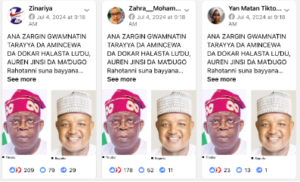
On July 4, Kaybat News, a media company that seems to be run from Kano syndicated the story and posted a link to the Ekwowusi’s opinion piece on its website via its Facebook page. The page boasts 31,000 followers. Multiple copy pasting of the story was also made on Facebook in Hausa language by 15 different pages generating 1,943 interactions in total.
Public figures were also involved in the dissemination of these narratives. All posts reference Abdulhadi Isa Ibrahim as the author.
The posts were made at a similar time with reference to Abdulhadi Isa Ibrahim as author, indicating patterns of a coordinated effort.
Citing reactions from clerics, rights activists, and civil society organisations (CSOs), a news report headlined: “LGBT: Knocks As Nigeria Signs $150 Billion Samoa Deal” said Nigerians were furious about the government’s decision to sign the controversial Samoa agreement. The report referenced Ekwowusi’s article as an example of opposition to the pact.
According to the report, the agreement was gaining traction despite opposition by “many countries that cherish Islamic and Christianity values, in addition to the sensitivity of their cultures”.
The report was shared on X and Facebook, amassing nearly 3,000 reactions on both social media platforms. It triggered a wave of disinformation as other blogs, particularly in northern Nigeria, ran with the story.
THE BREAKOUT SCALE
One common tactic to manipulate public opinion is through influence operations. This involves using powerful tools, an organised network, and systemic weaknesses — in this case, the hostility towards the LGBTQ community in Nigeria especially in the northern parts where religion and culture are key factors.
In influence operations, a breakout scale describes where an influence strategy transitions from a niche or limited impact to achieving significant, widespread effects. Measuring the impact of these campaigns is done across six stages.
PHASE ONE: The opinion piece, when first shared to Facebook, signified the first stage. This confined the campaign to one online community on a single platform.
PHASE TWO AND THREE: Both stages happened concurrently, after multiple copy-pasting was done around the same time on one platform which was the second phase. The sharing of the article to X, another platform, almost immediately shot the campaign to the third phase. All posts referenced a single author – the engineer of the dissemination.
PHASE FOUR: Hours after the posts made the round on social media, the reports began to seep into mainstream media. TV stations began to grant Ekwowusi interviews and other forms of traditional media soon followed, elevating the campaign to the fourth stage.
PHASE FIVE: On social media, discussions began to get heated with popular accounts with large following discussing the subject, bringing the disinformation campaign to phase 5.
PHASE SIX: When influence operations enter the sixth stage, it marks a significant shift that risks harm. Calls for violence and policy change begin to echo. On July 8, multiple northern influencer accounts (Sample 1, Sample 2) began posting information on the board of directors of NGOs focused on LGBTQ+ rights and opened them to hate speech.
MORE DISINFORMATION TACTICS SPOTTED IN THE CAMPAIGN
Another way of describing and analysing disinformation behaviours is through DISARM frameworks. The DISARM frameworks are organised ways of describing and analysing disinformation behaviours.
Multiple tactics used to spread disinformation in this campaign were noticed. One tactic, “Distort facts”, was done by distorting the SAMOA agreement’s coverage of human rights to centre on LGBTQ rights.
While human rights are inherent to all human beings, regardless of race, sex, nationality, ethnicity, language, religion, or any other status, disinformation campaigners only narrowed the clause to centre on a particular group.
Another tactic — “Inauthentic sites amplify news and narratives” – was employed. Inauthentic sites circulated and cross-published reports to amplify the narratives. Often, these sites have no masthead, bylines, or attribution. For example, a look at Kaybat News site’s source code showed there was no masthead and often no bylines.
“Threaten to Dox”, a tactic where private information about individuals was put out by multiple accounts was also used, exposing these individuals to attacks.
NIGERIAN GOVERNMENT DEBUNKS LGBTQ CLAIMS
In response, the federal government of Nigeria said the Samoa agreement was signed in the interest of the country without contravening any of the existing laws.
Muhammed Idris, minister of information and national orientation, said the federal government signed the agreement on June 28, 2024 after extensive reviews and consultations.
The information minister said the review of the agreement was done by an inter-ministerial committee convened by the ministry of budget in collaboration with the ministries of foreign affairs and justice.
In addition, Bagudu said nowhere in the document mentioned same-sex marriage.
The minister clarified that what was signed hinged on a $150 billion trade component, adding that it would be wrong for anyone to imply that Nigeria had gone against the provisions.
But the explanations did little to soothe millions of citizens who had already run with prior false narratives that were spun.
NIGERIAN GOVERNMENT COMES UNDER ATTACK
Nigeria’s Same-Sex Marriage Prohibition Act (SSMPA), passed in 2014, prohibits LGBTQ rights and criminalises marriage between people of the same sex.
The country’s legal position on same-sex marriage was what fuelled the uproar that followed its signing of the Samoa agreement.
Nigeria’s President Bola Tinubu and Vice-President Kashim Shettima, who are both Muslims, were accused of betraying their religion.
The claims inundated social media, sat atop X trend tables, and became the leading subject of debate for influencers and political commentators.
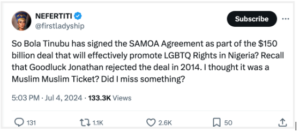
“As a Nigerian, I’m saddened by President Tinubu’s signing of the Samoa deal with LGBT. This is a big slap in our faces, especially to those who voted him into power in the name of a Muslim-Muslim ticket,” an aggrieved X user tweeted.
“May the Almighty Allah save Nigeria from the hands of capitalists.”
In another reaction, an X user knocked the Nigerian Senate for allowing a deal that introduced LGBTQ rights.
“I think we will imitate Kenya in some aspects,” one A A Hassan replied, referencing the recent anti-government demonstrations in Kenya, where citizens protested against the proposed Finance Bill 2024.
At a press conference in July, the information minister said the reports were beginning to compromise national security and stability.
Idris said while the government tolerates ethical media and free speech, it would not take fake news and disinformation lightly and that every lawful means would be used to seek redress in court.
In a separate address to the National Media Complaints Commission (NMCC), media ombudsman, the federal government said its officials were subjected to hate speech, threats, intimidation, and cyberbullying across social media as a result of the false reports.
WHAT DOES THE SAMOA AGREEMENT TRULY ENTAIL?
In simple terms, the agreement lays down principles for the EU and 79 countries from Africa, the Caribbean and the Pacific to address global challenges together.
Respect for human rights, democratic principles, and the rule of law constitute an essential element of the agreement, but it also encompasses areas like sustainable economic growth, climate change and migration.
The €150bn deal which Bagudu said informed Nigeria’s decision to become a signatory to the agreement is part of finances that is not exclusively available to the country but to Africa.
The scheme, known as Global Gateway, is aimed at boosting “smart, clean and secure links in the digital, transport, energy and climate-relevant sectors” and strengthening education.
EKWOWUSI’S PRECEDENCE OF STIRRING HEATED DEBATES
Ekwowusi is not new in the business of putting out narratives to drive certain interests.
The lawyer is one of the country’s most vocal anti-rights advocates and is at the nexus of many of the country’s major organisations that specifically oppose sexual and reproductive health and rights, including access to contraception and safe abortion.
Ekwowusi also sits on the editorial board of national dailies which he freely uses as his pulpit to stir sentiments among citizens.
In 2006, Ekwowusi’s editorials perpetuated a series of disinformation and misrepresentations about the proposed reproductive health institute bill.
These editorials contributed to an anti-bill climate that helped kill it before it reached the Senate floor. Reflecting on the process for blocking the proposal in a 2008 editorial, Ekwowusi acknowledged as much when he wrote: “The lawyers who contested the Bill at the National Assembly had a hard time trying to convince the National Assembly that even though the word abortion was never mentioned anywhere in the Bill, it was nevertheless an Abortion Bill from head to toe”.
In May, the legal practitioner claimed surrogacy in Nigeria is a criminal offence punishable by the law, describing the act as “womb renting” and the greatest violation of a woman’s dignity and identity. The claim is false.
In 2023, Ekwowusi also claimed Nigeria secretly signed the pact despite calls for a pause. After his statement, videos began to surface on Facebook claiming LGBTQ had been secretly introduced. The foreign ministry refuted the allegations.
Following the heated debates over the LGBTQ accusations on social media, the National Assembly reportedly bowed to pressure and asked the federal government to suspend the implementation of the Samoa agreement. This was despite the government’s establishment of the claims to be false.
On July 10, Akin Rotimi, spokesperson for the House of Representatives, said lawmakers resolved to thoroughly scrutinise the Samoa agreement for “all contentious clauses”.
Amid the backlash, Ekwowusi’s untrue narratives continue to thrive.
This article was produced through a collaboration between The Cable and Code for Africa’s AAOSI programme and republished by The FactCheckHub. The AAOSI initiative is a collaborative effort to empower media and NGOs in African countries to combat disinformation and propaganda through training and resources, aiming to strengthen information integrity and foster collaboration among investigators in the region.
Stakeholders from various Civil Society Organizations and media have emphasized the urgent need to expand broadband access in Nigeria and digitise public services to drive economic growth and ensure that digital opportunities reach all segments of society, especially low-income and underserved populations.
The forum featured various members of civil society organizations in Nigeria, the media and the Nigerian Fact-checkers Coalition, where they deliberated and made contributions on the revised provisions of the Global Digital Compact ahead of the Summit of the FutureUN Summit of the Future billed for September 22 – 23, 2024 in New York, USA.
The purpose of the Global Digital Compact is to establish an inclusive global framework, essential for multi-stakeholder action required to overcome digital, data, and innovation divides.
The compact is expected to outline principles, objectives, and actions for advancing an open, free, secure, and human-centered digital future for all, one that is anchored in universal human rights and that enables the attainment of the Sustainable Development Goals.
In his opening address, Programme Specialist for Culture at the UNESCO Nigeria, Philippe Delanghe, noted that the forum aimed to provide a vital opportunity to explore how digital transformation efforts can be realized within the framework of the global digital economy.
He emphasized UNESCO’s strong support for the initiative, which seeks to ensure that the Global Digital Compact fosters a safe and inclusive digital environment.
“UNESCO commends the Global Digital Compact for its role in fostering a safe and inclusive digital environment. We believe the government should prioritize pressing key issues such as digital skills, data privacy, cybersecurity, and the ethical use of technology,” he said.
He also noted that the discussion would play a crucial role in identifying how Nigerian civil societies can contribute to and benefit from the Global Digital Compact.
The representative of the Nigerian ministry of Communications, Salisu Kaka, noted that the document is a global guide on how the United Nations wants the world to move toward digital transformation.
“Largely, what is inside the document is about what we want to achieve; how to do that is left to the jurisdiction and the mandate of the member organizations to come up with their own approach and to manage the goal by implementing the initiatives,” he said.
He said, “It is one thing for the government to pass laws on behalf of citizens; it is another thing for citizens themselves to get involved in how these policies are formulated.”
Kehinde, who represented The ICIR‘s Executive Director, Dayo Aiyetan, at the event, thanked the UN in Nigeria for the opportunity given to Civil Society Organizations and media to contribute to the Global Digital Compact for the UN summit and emphasized the value of such participation in having a lasting impact on the people’s digital future.
“In today’s world, we are not only dealing with artificial intelligence (AI) but also other emerging technologies that are constantly evolving. It is important to recognize that as these technologies emerge, they also pose threat to our collective peace and mutual engagement if not managed properly,” he noted.
Kehinde emphasized the need for multinational governments to incorporate citizens’ concerns into their policies, as exemplify by the Nigerian Civil Society Consultative Forum on the GDC hosted by UNIC.
In his closing remarks, the Director of the United Nations Information Centre (UNIC) in Nigeria, Ronald Kayanja, said the interaction at the event has enriched the document that will be presented to the UN Secretary-General at the Summit of the Future holding in New York next month.
“Once this document is adopted at the summit, we should come back to see how it will be domesticated in Nigeria; what are the steps that Nigeria should take to ensure the digital future for all. We’ll do that after September and see how Nigeria will take this forward,” he told participants.
Other suggestions raised by the participants at the forum include the importance of cohesive data governance across government agencies and the establishment of digital governance infrastructures throughout Nigeria’s 774 LGAs to ensure effective and secure data management at all levels of government, thus enhancing the efficiency of public services.
Youth empowerment also featured prominently in the discussions, with a strong call for greater support for youth-led initiatives aimed at promoting digital inclusion, particularly in low-income and rural communities.
Participants also recognized the potential of Nigeria’s young population to drive innovation and growth in the digital economy if given the necessary resources and support.
Moreover, the stakeholders advocated for strengthening Nigeria’s position in the global digital economy by promoting digital skills and products within the African Continental Free Trade Area (AfCFTA) and on the international stage.
On Artificial Intelligence, they called for the development of robust national frameworks to mitigate potential harms and protect data privacy on online users in the country, in line with the National Mental Health Act of 2021.
Concerns were also raised about the suppression of press freedom by the Nigerian authorities and how the Nigerian Cybercrime Act is being used to victimize journalists and other vocal citizens in Nigeria.
A video showing the Nigerian presidential spokesman, Ajuri Ngelale, announcing the reduction of number of people on entourages for federal government’s official travels has resurfaced online.
Ngelale is the Special Adviser to the Nigerian President, Bola Ahmed Tinubu, on Media and Publicity.
The video is being circulated with a claim that Tinubu has reduced the nation’s cost of governance due to the nationwide protest.
A verified X user, @SabinaNkiru posted the video with a caption thus:
“Tinubu allegedly cuts cost of governance in response to the demands of the #EndBadGovernaceInNigerian protest.
Long police entourage from Abuja to Lagos and Item 7 for international travels removed.
It’s like FG not Tinubu doesn’t know the demands of the protesters.”
The video has garnered over 270,000 views, with more than 800 likes and over 500 reposts as of August 10, 2024.
Multiple X users shared the video with a similar narrative.
CLAIM
Nigerian presidency cuts cost of governance due to ‘hunger’ protest.
THE FINDINGS
Findings by The FactCheckHub show that the claim is MISLEADING, as the video has been online since January 2024.
Screenshot of the viral video retrieved from X. INSERT: Misleading verdict.
When our fact-checker subjected keyframes obtained from the video to a Google reverse image search, the result shows that the video has been online since January 9, 2024.
The video showed the moment Ngelale announced a reduction of travel delegations for all Federal Government official trips within and outside the country during a press briefing at the State House in Abuja.
An earlier version of the video can be seen here and here.
Ngelale said the directive means a 60 per cent slash across board, noting that it affects all MDAs, including the president’s office, vice president, and first lady.
This came a month after the controversy that trailed the federal government’s spending of at least N2.7 billion to sponsor delegates that attended the United Nations’ annual climate summit, COP28 in Dubai where Nigeria’s delegation at the conference was 1,411.
Ngelale said the directive is part of cost-cutting measures of the Nigerian presidency, adding that the measure will affect the office of the president, vice-president, first lady, ministers and heads of agencies.
“President Tinubu has directed that all state entourages be drastically reduced. This is not a request. It is a directive. The office of the president and staff will be affected. Vice-president, appointees are affected,” part of the statement read.
Recall that hundreds of Nigerians took to the streets to demand economic and political reforms in a nationwide protest that started on August 1. The protests which began peacefully, later turned violent in many states leading to the deaths of some Nigerians and the destruction of properties.
Dubbed #EndBadGovernanceinNigeria, the protest movement has won widespread support with an online campaign that called for the government to reduce fuel prices and tackle the cost-of-living crisis, among other demands.
THE VERDICT
The claim that the video shows Nigerian presidency announcing a cut in the cost of governance due to the nationwide protest is MISLEADING; the video has been online since January 2024.
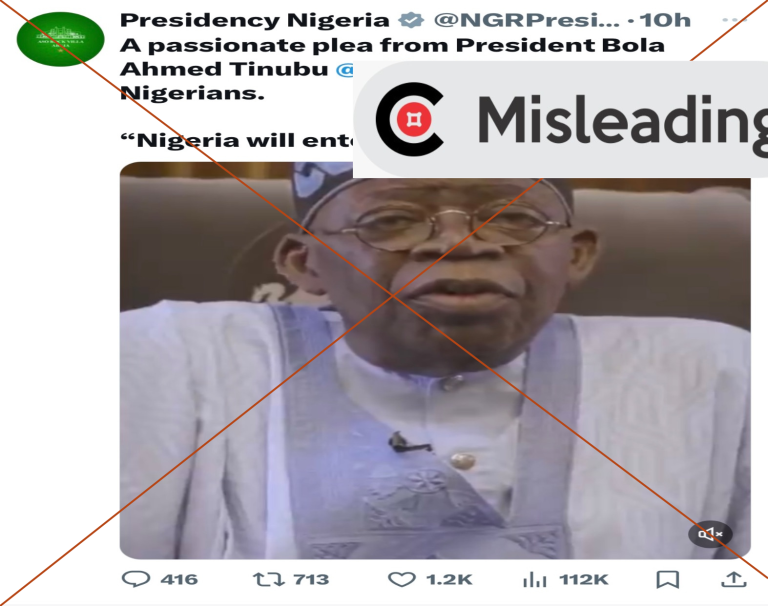
FOLLOWING the criticism that trailed the nationwide broadcast delivered by President Bola Ahmed Tinubu on August 4, the official X accounts of the president and Nigerian Presidency have posted an old video showing the president urging the citizens to be calm and patient.
The video was posted on the presidency’s X handle, @NGRPresident, on August 7 with a caption that read:
“A passionate plea from President Bola Ahmed Tinubu @officialABAT to all Nigerians. “Nigeria will enter a new dawn”
The video has garnered over 1,000 likes, more than 600 reposts and over 150,000 views as of August 9, 2024.
However, the same video was also posted without any caption on the official account of the president same day. It has generated over 4,000 reposts and more than 13,000 likes and over 1 million views as of August 9, 2024.
The video which showed the president addressing the citizens was reported as a follow-up speech to the one delivered earlier on August 4 in some sections of the media.
For instance, The Nation newspaper ran with the headline: Tinubu urges Nigerians to remain calm, patient in another broadcast.
CLAIM
Video shows Tinubu addressing Nigerians in another broadcast on August 7.
THE FINDINGS
Findings by The FactCheckHub show that the claim is MISLEADING.
Since August 1, hundreds of Nigerians have taken to the streets to demand economic and political reforms including reversal of some government policies. The protests which began peacefully, later turned violent in many states leading to deaths of some Nigerians and destruction of properties.
Dubbed #EndbadGovernanceinNigeria, the protest movement has won widespread support with an online campaign that called for the government to reduce fuel prices and tackle the increasing cost of living, among other demands.
To douse the escalating tension across the country, the President addressed citizens in the early hours of Sunday, August 4, 2024.
However, the address sparked significant criticism from various quarters as it failed to directly address the primary demands of the protesters across the country.
Analysts say the speech shows a clear disconnect between the President and the people showing that the government is oblivious of the daily struggles of the average citizen.
The FactCheckHub also verified some claims made by the president in his August 4th speech. You can read it here.
In what appeared like an attempt to fix this communication gap, the Presidency released another video on August 7 but findings by The FactCheckHub show that the video is an extract from an old broadcast by Tinubu.
A Google reverse image search conducted on some keyframes obtained from the video showed that the longer version was posted by the Nigerian Presidency on July 31, 2023. The text version was also posted on the Presidency’s website same day.
However, a part of the speech where the president acknowledged hardships caused by subsidy removal and reassured Nigerians of his plans to make Education more affordable has been extracted and recirculated.
The part reads: “Fellow Nigerians, this period may be hard on us and there’s no doubt that it is tough on us but I urge you all to look beyond the present temporary pains and aim at the larger picture. All our good and helpful plans are in the works. More importantly, I know that they will work. Sadly, there was an avoidable lag between subsidy removal and these plans coming fully online.
“I plead with you, please, have faith in our ability to deliver and in our concern for your well-being. We will get out of this turbulence and due to the measures we have taken, Nigeria will be better equipped and able to take advantage of the future that awaits her.
“For example, we shall fulfill our promise to make education more affordable to all and provide loans to higher education students who may need them. No Nigerian students will have to abandon the higher education system because of a lack of money.
“Our commitment is to promote the greatest good for the greatest number of our people. On principle, we shall never falter, I assure you, my fellow countrymen and women, that we are exiting the darkness to enter a new and glorious dawn. Now, I must get back to work in order to make this vision come true.”
THE VERDICT
The claim that the video shows a recent broadcast by Tinubu is MISLEADING; the video was taken from a part of his speech he delivered in July 2023 – about two months after his inauguration as Nigeria’s president.
NIGERIAN musician, Charles Oputa, has posted a video allegedly showing the recent looting of a warehouse amid the ongoing nationwide #EndBadGovernance protests in Nigeria.
Popularly called Charly Boy or Area Father, Oputa posted the video with a caption that read:
“Palliative when poor people suppose get for Abuja, na em one oga go hide for one warehouse hoping to sell it later. Una no go die better. Dia fathers.”
The post has garnered half a million views with over 4,000 reposts and more than 8,000 likes as of August 7, 2024.
CLAIM
Video shows recent looting of a warehouse in Abuja.
THE FINDINGS
Findings by The FactCheckHub show that the claim is MISLEADING, as the video has been online since March 2024.
A Google Reverse image search on keyframes extracted from the video revealed that the video had been online long before the “End Bad Governance” protests began. An earlier version of the video was posted on YouTube in March 2024.
Screenshot of the viral post
The video was uploaded by Alert Hub Studios on March 6, 2024 with the caption “Hunger in the Land. Another food warehouse looted in Abuja.”
A keyword search on Google indicates that the video shows mobs who broke into a government storage facility in Gwagwa area of the Federal Capital Territory (FCT) on March 3, 2024 and looted stored food items, Daily Trust reported.
Since August 1, hundreds of Nigerians have taken to the streets to demand economic and political reforms including reversal of some government policies. The protests which began peacefully, later turned violent in many states leading to deaths of some Nigerians and destruction of properties.
Tagged “10 days of rage,” or “End Bad Governance in Nigeria”, the protests have led to the trending of hashtags like #EndBadGovernance, #EndBGIN, #EndBadGovernance2024 and #EndBadGovernanceinNigeria on multiple social media platforms, especially on X for days. The protest is expected to end by August 10.
THE VERDICT
The claim that the video shows the recent looting of a warehouse in Abuja is MISLEADING; the video showed an incident that happened in March 2024 when some residents looted a government warehouse in the FCT.
A video has been spreading across multiple social media platforms with a claim that it shows protesters of #EndBadGovernancelnNigeria chasing ‘soldiers’ away with stones in Kaduna State, northwestern Nigeria.
In the 57 seconds footage, some security operatives could be seen hopping into their truck as a large mob of protesters pursued them. Though, a shield that fell on the ground had an inscription of “Police” written on it.
An X user, @EmmaMillelJnr, posted the video on August 6, 2024 with a caption thus:
“Soldiers on the run as protesters pursue them with stones in Kaduna. Truth be told, Nigeria has the most civil soldiers globally. The way some people are behaving as if they have two lives is scary”.
“#EndBadGovernancelnNigeria”
The post has garnered over 250,000 views alongside over 1,100 comments, more than 1,300 likes and over 800 reposts as of August 7, 2024.
Another X user, @ElitesAfrica, also posted the same video with another caption that read:
“Police on the run as protesters chase the with stones in Kaduna…” (sic)
It has also gone viral with over 360,000 views, more than 1,500 reposts and over 2,300 likes as of August 7, 2024.
CLAIM
Video shows protesters stoning ‘soldiers’ in Kaduna, Nigeria.
THE FINDINGS
Findings by TheFactCheckHub show that the claim is MISLEADING, as the video is from the anti-finance bill protests held in Kenya earlier on July 16 – about 2 weeks before the Nigerian protests kicked off.
This fact-checker subjected screenshots taken from the video to a Google Reverse Image search; the results show earlier versions of the video which has been online since July 16, 2024.
An X user, @Gideon_Kitheka, posted the video on July 16, 2024, noting that the incident happened in Emali Town, in Kenya.
A day after, another X user, @CaptainDominicO posted the same video with a caption that read: ”Police officers were chased like dogs yesterday, Kenyans are tired 😫”.
The video trended around July 16-17 especially on X (formerly Twitter) as multiple X users posted the video amidst the finance bill protests widely known by the hashtag #RejectFinanceBill2024 in Kenya.
Further checks show that a YouTube channel posted the same video on July 17, 2024, noting that the incident happened in Kenya.
It was captioned: “Kenya: Polisi Yawakimbia Waandamanaji”. Using Google Translate, it revealed that the texts is in Swahili language, meaning: “KENYA: Police are fleeing protesters” when translated into English.
When our fact-checker carefully examined the video, he observed that the Nigerian security operatives do not dress like the ones seen in the video.
THE VERDICT
The claim that the video shows protesters stoning ‘soldiers’ in Kaduna, Nigeria is MISLEADING; the video emanated from Kenya during the finance bill protests that engulfed the East African country around July 2024 and not related to the Nigerian protests.
The global fact-checking body issued the statement on August 6.
The IFCN noted that such action can affect independent accountability journalism, including the work of fact-checkers across the world.
“Ellinika Hoaxes is a respected member of the international fact-checking community and should be able to continue its work without threats,” IFCN noted.
Recently, Kyriakos Velopoulos who is also the president of the Greek Solution political party, repeatedly made a series of threats to abolish Ellinika Hoaxes through legislative interventions he said he intends to introduce.
The attacks include a statement from the parliamentary floor in which he declared, “We will abolish the anti-Hellenic Hoaxes because they fight against the true informing of Greeks.”
Ellinika Hoaxes has stated that the threat directly contradicts Greece’s constitution, which guarantees freedom of speech and the press.
IFCN director, Angie Drobnic Holan said that it is preposterous to claim that the organization which is a verified IFCN member and a reputable fact-checking organization is fighting against accurate information.
“Such statements have no other purpose than to attack fact-checking and lay the foundation for stifling of the free press. We condemn them in the strongest terms,” she said.
Ellinika Hoaxes has been a longstanding signatory to the Code of Principles, receiving its first independent assessment and successful approval in 2019, the IFCN stated.
It noted that fact-checkers voluntarily sign on to the Code of Principles and go through a verification process to prove they meet universal standards of transparency, independence and methodology.
The Code of Principles is administered by the IFCN, a global community of fact-checking organizations based at the Poynter Institute, a U.S.-based nonprofit organization established in 1975 that advocates for independent journalism.
The Code of Principles process involves an assessment of the fact-checking organization by an independent academic or media expert familiar with the local context. The assessment is then verified by the IFCN advisory board. The advisory board is made up of leaders of independent fact-checking organizations from around the world who have been selected by their peers.
“The IFCN, which was established in 2015, is dedicated to supporting press freedom and fact-checkers globally, including our signatories.
“Ellinika Hoaxes deserves to continue publishing its explanatory journalism and fact-checks that hold the government, political parties and candidates accountable without threat of reprisal,” the statement noted.
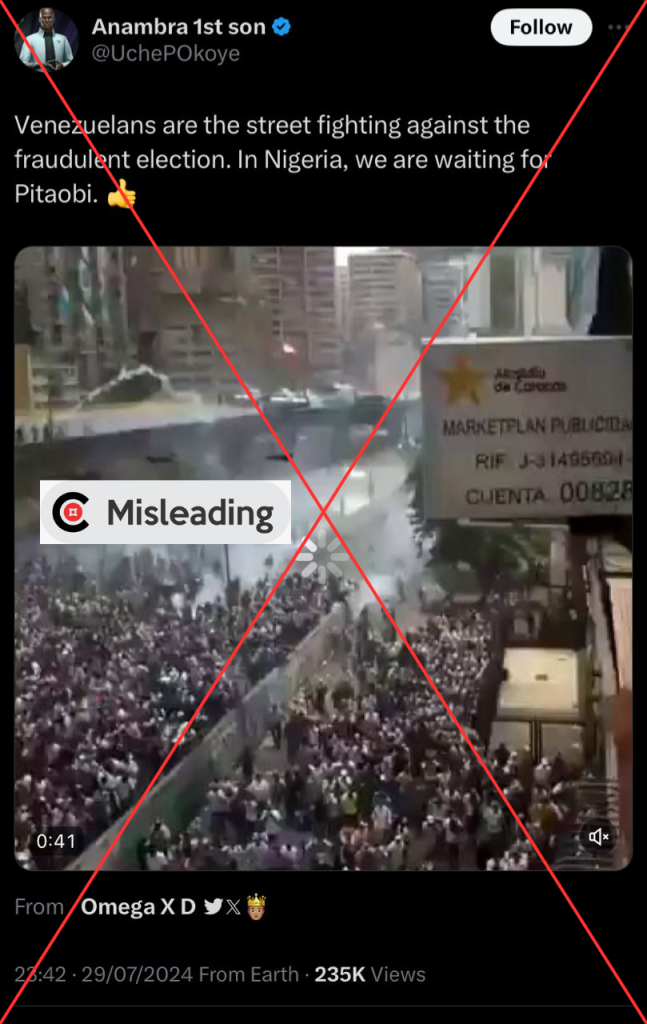
AN X user, @UchePOkoye, has shared a video of people protesting on the streets alongside a claim that it is the protest against an alleged fraudulent election in Venezuela.
In the 40-second video which was taken from an aerial view, people could be seen marching on the streets in protest.
Venezuelans are the street fighting against the fraudulent election. In Nigeria, we are waiting for Pitaobi.
The post has garnered over 200,000 views, with more than 7,000 likes and over 3,000 reposts as of August 6, 2024.
Similarly, another X user, @Urchilla01, shared the same video with a different caption that read:
This is Venezuela. They’ve poured out and filled up the streets because their sitting president dared to tamper with their mandate. They did not wait for anyone to spur them on. They took the initiative & took to the streets. Power belongs to the people. Again, if your government isn’t afraid of you, you’ve failed in your duties as a citizen. If your government thinks of taking an anti-people action and isn’t terrified of what your reaction to such action could possibly be, you haven’t started being an active citizen. Fellow Nigerians, go out and strike fear & terror into the hearts of the very few people who have sworn to make your life a living hell. The Nigerian armed forces, which comprise the army, navy, and airforce, have a population of less than 300,000. The Nigerian police force has a population of less than 400,000. The civil defence has a population of less than 20,000 operatives. The DSS has a population of less than 200,000. The public office holders are less than 300,000 in number. That’s a combined total of less than 1.5 million people (being very gracious with the numbers here) holding down a population of over 200 million! Is Nigeria an animal farm??!! Your slavery and subjugation are only in your minds and your heads! Go out and remind them who pays their salaries. Go out and remind them at whose pleasure they serve. Go out and remind them that their tenures end the day you say so. Go out and remind them that the office of the citizen supercedes every other office in the land. Go out and reclaim the land that was promised to you and your offspring! A land flowing with milk and honey; milk and honey that have been cornered & plundered by a select few while your children go to sleep hungry at night! Remind them that their wives, husband’s, and children will not feel safe in their homes and their beds unless they do right by the people they’re sworn to serve. Enforce judicial reforms! Enforce electoral reforms! Enforce legislative reforms! Fucking take back your country!
The post has also gained a significant traction with over 89,000 views plus over 1,300 likes and more than 1,000 reposts.
Multiple X users have also posted the same video with varying captions as seen here.
The BBC on July 30, 2024 reports that protests broke out in Caracas, the capital of Venezuela, a day after President Nicolás Maduro claimed victory in the recent election held in the South American country.
The opposition has refuted Maduro’s victory, claiming that the vote count was rigged and that 73.2% of the total votes cast showed that its candidate, Edmundo González, had won handily.
The video is trending on social media, especially on X amidst the ongoing ‘End Bad Governance’ protests that engulfed Nigeria since August 1.
Media reports on Thursday (August 1) indicated that the #EndBadGovernance protest kicked off in Lagos, Abuja, Kano and Borno, among other Nigerian states.
The ICIR is providing LIVE UPDATES from the scene of the protests across Nigeria here.
CLAIM
Video shows Venezuelans protesting over election recently.
THE FINDINGS
Findings by The FactCheckHub show that the claim is MISLEADING, as the video is from a 2017 Venezuelan protest and unrelated to recent event.
A Google Lens search conducted on some screenshots retrieved from the video displayed multiple thumbnails of the same video previously posted on various social media platforms.
But an earlier version of the video was uploaded on X (formerly Twitter) by Mariana Atencio, an America-based Venezuelan Journalist on April 20, 2017.
“This is what the protests in #Venezuela look like. Imagine this 40 sec. happening for hours. #19A,” the caption on her X post read.
Screenshot of the claim retrieved from X. INSERT: Misleading verdict.
The search led our fact-checker to another version of the video posted on YouTube by an Argentina-based newspaper, Diario La Capital de Mar del Plata, on April 20, 2017.
Recall that a series of protests engulfed Venezuela for over 3 months in 2017, Aljazeera reported.
An explainer published by Aljazeera in March 2018 explained the genesis of the Venezuelan crisis which has repeatedly led to multiple protests as Maduro-backed supporters and government forces clashed with the oppositions in the country intermittently in the last 7 years.
THE VERDICT
The claim that the video shows Venezuelans protesting over a recent election is MISLEADING; the video is over 7 years old and not related to recent event in the country.