Please note that the FactCheckHub has not obtained any right from the authors or copyright owners of all third-party contents from embedded links and shall incur no liability in this regard.
Please note that the FactCheckHub has not obtained any right from the authors or copyright owners of all third-party contents from embedded links and shall incur no liability in this regard.
Please note that the FactCheckHub has not obtained any right from the authors or copyright owners of all third-party contents from embedded links and shall incur no liability in this regard.
Please note that the FactCheckHub has not obtained any right from the authors or copyright owners of all third-party contents from embedded links and shall incur no liability in this regard.
A claim that both the newly appointed Director Generals of the National Intelligence Agency (NIA) and the State Security Service (SSS) are from Yoruba ethnic group has surfaced online.
An X user, @arewatwiter, posted the claim with a caption thus:
“NIA Yoruba
DSS Yoruba
In just one day”
The post has garnered over 480,000 views with more than 500 reposts, over 1,600 likes and over 1,000 comments as of August 31, 2024.
Another X user, @xagreat posted the claim with a caption that read:
“Mohammed Mohammed the new NIA DG is a Yoruba man from Kwara while Mr. Oluwatosin Ajayi the new DSS DG is also a Yoruba from south west. Yoruba Lokan”
The post has generated over 200,000 views alongside more than 300 reposts and over 900 likes as of August 31, 2024.
CLAIM
The newly appointed Directors-General of the National Intelligence Agency (NIA) and the State Security Service (SSS) are from the Yoruba extraction.
THE FINDINGS
Findings by The FactCheckHub reveal that the claim is HALF-TRUE.
President Tinubu recently appointed Ambassador Mohammed Mohammed as the Director-General of the National Intelligence Agency (NIA) and Adeola Ajayi as the Director-General of the State Security Service (SSS). Note that the SSS is sometimes referred to as the Department of State Service (DSS).
According to a statement released by Ajuri Ngelale, the Special Adviser to the President on Media and Publicity, these appointments followed the resignation of the previous heads of the two agencies.
Adeola Ajayi is an indigene of Ogun State, which is in Southwestern Nigeria, and he is from the Yoruba ethnic group. He has risen through the ranks within the SSS, serving as State Director in various states, including Bauchi, Enugu, Bayelsa, Rivers, and Kogi.
However, Ambassador Mohammed Mohammed is an indigene of Lafiagi in Kwara State. Lafiagi is the headquarters of Edun Local Government Area, predominantly inhabited by people from the Nupe ethnic group.
Mohammed, a seasoned diplomat and intelligence officer, hails from Kwara State and has held various positions within the NIA, including Director of Operations and Director of Intelligence. Before his recent appointment, he was the head of the Nigerian mission to Sudan.
Thus, while Ajayi is Yoruba by tribe, Mohammed is from the Nupe extraction.
THE VERDICT
The claim that both the newly appointed Director Generals of the National Intelligence Agency (NIA) and the State Security Service (SSS) are from the Yoruba ethnic group is HALF-TRUE; while Ajayi is Yoruba by tribe, Mohammed is from the Nupe extraction.
A recent survey has revealed that 58 per cent of adults in the United States have been deceived by misinformation generated by Artificial Intelligence (AI).
The study done by HostingAdvice, which surveyed over 1,000 people aged between 18 – 43, highlights the pervasive influence of sophisticated misinformation technologies on public perception and human behaviour.
The survey found that AI-generated content, which often includes realistic images, videos, and articles, can be incredibly convincing.
“A staggering 58% of people we surveyed have been fooled by AI-generated fake news, or at least, know they’ve been fooled,” part of the report reads.
Gender differences in susceptibility were evident in the survey results. Approximately 60 per cent of women reported being tricked by fake news, compared to 56 per cent of men, according to the survey.
However, men were more likely to engage in arguments over fake news, with 44 per cent of men versus 35 per cent of women reporting conflicts. Nearly 40 per cent of respondents admitted that fake news has led to arguments or conflicts, which has affected their relationships.
Generational disparities are also significant. About 69 per cent of Gen Z respondents have fallen for AI-generated fake news, compared to 56 per cent of millennials. This higher susceptibility among younger individuals may be due to their extensive use of social media, where emotionally charged content often proliferates.
The survey also revealed widespread concern about the impact of fake news on politics.
Approximately 70 per cent of respondents expressed anxiety about how AI-generated misinformation might influence the upcoming 2024 election. This concern was particularly pronounced in the Western U.S., where 79 per cent of respondents voiced worry about fake news affecting political outcomes.
Furthermore, 17 per cent of respondents said their political views have shifted due to fake news. The survey indicated that 35 per cent of people have experienced anxiety or stress because of misinformation, while 30 per cent made poor decisions based on false information.
Approximately 22 per cent of respondents experienced financial loss as a direct result of misleading content.
Warnimont highlighted the broader implications of the survey’s findings thus: “Mental health, financial stability, political views — these are all affected by AI-generated fake news. We may think we’re better at identifying it than others, but the stats often show otherwise.”
The experts recommended a stronger focus on education to tackle this growing issue as the survey highlights the urgent need to teach children and adults how to critically evaluate online information and identify fake news.
According to the survey, current digital literacy programs in schools and colleges are a step in the right direction, but this education must extend beyond the classroom.
“Spreading awareness and improving digital literacy across all age groups will help individuals better discern credible information from falsehoods,” the survey noted.
The experts also stated that social media platforms such as Facebook, X, and Instagram need to develop more sophisticated algorithms to detect and flag fake news.
The survey further reveals that the appeal of conspiracy theories and sensational stories underscores a broader tendency to seek out engaging narratives, even when they are not based on fact.
By combining educational efforts with advanced technological solutions, the survey emphasizes that significant progress can be made in reducing the impact of AI-generated fake news and fostering a more informed society.
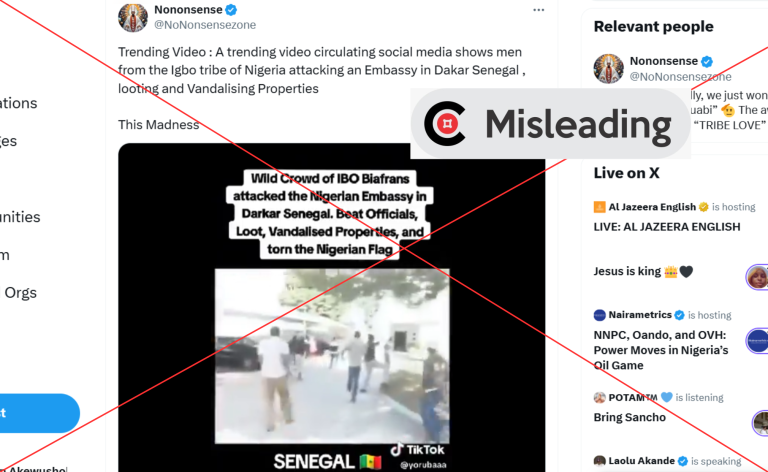
A video showing angry youths reportedly vandalizing the Nigerian embassy in Dakar, Senegal has surfaced online with a claim it shows a recent riot by Nigerians of Igbo extraction in that country.
The video shows dozens of stick-wielding persons vandalizing cars, office equipment & fittings and desecrating the Nigerian flag reportedly within the premises of the Nigerian embassy in the Senegalese capital.
The video has a watermark that reads:
“Wild crowd of Ibo Biafrans attacked Nigerian embassy in Dakar Senegal, beat officials, loot, vandalized properties and torn the Nigerian flag.”
Ridwan Ajetunmobi (@Riddwane), a media aide to Lagos State Governor, Babajide Sanwo-Olu posted the video with a caption thus: “It’s a “regular trademark.””
His post has garnered over 100 reposts, more than 22,000 views and over 200 likes as of August 28, 2024.
Another X user, @NoNonsensezone posted the same video with another caption that read:
“Trending Video: A trending video circulating social media shows men from the Igbo tribe of Nigeria attacking an Embassy in Dakar Senegal, looting and Vandalising Properties.This Madness.”
The video has generated over 40,000 views alongside over 200 reposts with over 300 likes as of August 28, 2024.
CLAIM
Video shows Igbos attacking the Nigerian embassy in Dakar, Senegal recently.
THE FINDINGS
Findings by The FactCheckHub show that the claim is MISLEADING as the video in question is not recent, nor does it exclusively depict people from the Igbo extraction.
Screenshot of the viral video on X purportedly showing Igbos vandalizing properties in Dakar, Senegal. INSERT: Misleading verdict.
The Igbo people are one of the major ethnic groups in Nigeria, concentrated in the Southeastern Nigeria. They can also be found in the South-South part of the country.
Our fact-checker observed that there’s a growing divide between members of the Igbo extraction and their Yoruba counterparts (majorly from Southwestern Nigeria) on X. This has fueled ethnic-motivated misinformation on the social media platform.
When our fact-checker subjected the keyframes from the video to a Google reverse image search, the result shows an earliest version of the video from March 2013 and not in 2024 as suggested by the recent X posts.
The video shows an attack on the Nigerian embassy in Dakar, Senegal. It was reported by Channels TV on March 9, 2013 as the issue was discussed at Nigeria’s House of Representatives chamber in Abuja by lawmakers then.
According to media reports, the attack on the Nigerian embassy was done amid the protest by Nigerians over the disappearance of a Nigerian citizen’s body from a hospital morgue.
Some aggrieved Nigerians had sought to retrieve the body of the deceased from the Senegalese authorities, only to find out that the body had been disposed of without informing the Nigerian community in that country.
There is no evidence to support the claim that the attack was carried out by Igbos alone. The video is being recirculated to mislead the public and inflame ethnic tension in Nigeria.
Similarly, there is no credible media report about any recent unrest or riot in Dakar, Senegal.
This is not the first time a video targeted at spawning ethnic tension in Nigeria would go viral on the X platform.
The FactCheckHub had earlier debunked a graphic video that surfaced online with a claim that it showed Igbos from Nigeria being killed for using people for money rituals in Mozambique. Our findings showed the incident occurred in Haiti and was unrelated to money rituals or people from Igbo extraction.
THE VERDICT
The claim that the video shows Igbos attacking the Nigerian embassy in Dakar, Senegal recently is MISLEADING; the video is from an unrelated event that occurred over 11 years ago.
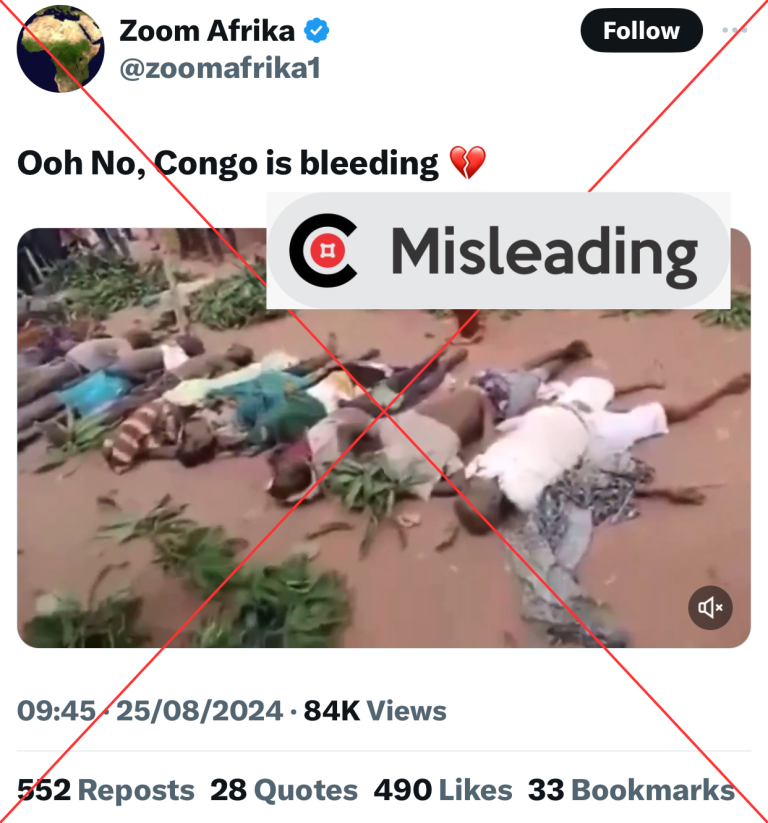
An X account, @zoomafrika1, has posted a video showing some corpses lying on ground in a remote community with a claim that the video shows the recent security situation in Democratic Republic of Congo.
The X account shared the now deleted video with a caption thus: “Ooh No, Congo is bleeding💔”
The post has generated over 500 reposts and more than 80,000 views as of August 26, 2024.
CLAIM
Video shows recent insecurity situation in DR Congo.
THE FINDINGS
Findings by The FactCheckHub show that the claim is MISLEADING, as the video shows gunmen attack in Benue State, Nigeria.
Viral video of corpses used to depict an attack in DR Congo by the X user. INSERT: Misleading verdict.
The Democratic Republic of the Congo is a country in Central Africa and the largest nation in Sub-Sahara Africa.
The FactCheckHub subjected keyframes in the video to a Google Reverse Image search and the result shows that the video has been online since March 8, 2024.
Earlier version of the video, as seen here and here by our fact-checker, show that the video depicts an attack by gunmen on a Benue community, in North Central Nigeria and unrelated to DR Congo.
The video shows a moment after suspected gunmen killed 17 people, during an attack on Mbaikyor Mbalom community, in Gwer LGA of Benue State.
The gunmen also razed many houses, huts, farmlands and food barns in 11 settlements during the attack.
THE VERDICT
The claim that the video shows recent insecurity situation in DR Congo is MISLEADING; the video shows an attack on Nigeria’s Benue Community in March 2024.
AN X user, @ChiemekaEb9240, shared a photo of a man holding a human head while claiming the man in the photo was the winner of a skull mining competition.
The caption alongside the photo read:
Behold Adekunle, the winner of the 2023/2024 skull mining competition. It was keenly contested competition. Congratulations , more heads Adekunle.
The post has amassed a traction of over 440,000 views with 1,700 likes, and 700 reposts.
Photo shows a man holding a human head as his “prize” from a skull-mining competition.
THE FINDINGS
Findings by The FactCheckHub show that the claim is MISLEADING!
Screenshot of the claim retrieved on X. INSERT: Misleading verdict.
When our fact-checker used Google Lens to verify the image, it revealed earlier versions of the photo circulating online, primarily from news outlets. These sources identified the image as that of a farmer who had beheaded another man in Benue State.
One of the news websites, Idoma Voice that used the image in its report stated that the suspect, named Raphael Agazi, and the victim, Ajah Asim, had been in a long-standing dispute over a piece of land. The conflict escalated on Monday, July 13, 2015 at the farm, where Agazi allegedly decapitated Asim, buried half of his body in a grave on the disputed land and fled the scene.
The story was further confirmed by reputable media organizations like Vanguard and The Nation who omitted the pictures in their reports.
“Both men and their respective families have been quarreling over a piece of land that is located around the boundaries of both Ado and Oju local government areas.
“We heard that both men met in the farm this morning (yesterday) and a fight ensued between them in the bush without anybody knowing.
“The suspect eventually overpowered the deceased and killed him with a machete after which he cut off his head and buried his body in a shallow grave inside the farm,” the Vanguard reported.
THE VERDICT
The claim that the photo shows a man holding a human head as his “prize” from a skull-mining competition is MISLEADING and taken out of context; the image was actually taken in 2015 in Benue State, where the man depicted had beheaded the victim.
A claim that the United Nations (UN) would take over the country from the Nigerian president, Bola Ahmed Tinubu, if protests continued longer than 15 days has circulated online.
The #EndBadGovernance protest held from August 1 – 10 this year was aimed at calling the Nigerian government’s attention to the increasing economic hardship faced by millions of Nigerians across the West African nation.
An X user, @TheML007, on August 2, 2024, posted the claim thus:
BREAKING NEWS ; UN will take power from TINUBU if protesters continue the protest for 15 days, it used to be 30days but they’re doing Promo at the UN.
Way to go guys.
The post had garnered over 470,000 views, with more than 3,000 likes and over 1,000 comments as of August 22, 2024.
Due to the sensitive nature of the claim, The FactCheckHub decided to verify its veracity.
Recall that The FactCheckHub verified a number of claims during the recent Nigeria protest as seen here, here, here, here, here, and here.
CLAIM
United Nations will take over any country after 15 days of continuous protests.
THE FINDINGS
Checks by The FactCheckHub show that the claim is FALSE as the UN does not exercise such power over a sovereign State, according to its charter.
Screenshot of the claim retrieved from X. INSERT: False verdict.
The United Nations, established in 1945, is an international organization consisting of 193 member states. Its activities and mission are directed by the goals and principles outlined in its founding Charter.
The UN Charter is the constitutive instrument of the United Nations, signed on June 26, 1945. It sets out the rights and obligations of Member States and establishes the principal organs and procedures of the United Nations.
Nigeria became a member state of the United Nations on October 7, 1960 after gaining its independence the same year.
“Nothing contained in the present Charter shall authorize the United Nations to intervene in matters which are essentially within the domestic jurisdiction of any state or shall require the Members to submit such matters to settlement under the present Charter; but this principle shall not prejudice the application of enforcement measures under Chapter VII.
“The Security Council shall determine the existence of any threat to the peace, breach of the peace, or act of aggression and shall make recommendations, or decide what measures shall be taken in accordance with Articles 41 and 42, to maintain or restore international peace and security.”
“In order to prevent an aggravation of the situation, the Security Council may, before making the recommendations or deciding upon the measures provided for in Article 39, call upon the parties concerned to comply with such provisional measures as it deems necessary or desirable. Such provisional measures shall be without prejudice to the rights, claims, or position of the parties concerned. The Security Council shall duly take account of failure to comply with such provisional measures.”
From the above articles, it is evident that the United Nations addresses issues concerning the preservation of international peace and security, which are handled by its Security Council.
Speaking with The FactCheckHub, Tope Temokun, a Nigerian lawyer ad human rights activist stated that the UN lacks the legal power or mandate to intervene in such a manner, as sovereignty is a core principle of international law that cannot be overridden, even by international organizations like the UN.
“…that is not true; UN does not have the powers to take over the government of any sovereignty under any circumstance,” Temokun stated.
Similarly, Yunus Adelodun, a UK-based Nigerian lawyer who specializes in Arbitration, Litigation, Data Protection and Privacy, noted that despite the claim trending for a while, there has been no proof of when such power was exercised by the United Nations.
“The claim has been trending a bit. But no one has really provided any proof to back it up with any legal provision or even a precedent where such power was exercised by the UN.
“The UN charter doesn’t provide for such. There are also countless protests in UN member states that lasted more than 15 days without such ‘take over’,” Adelodun said.
However, he highlighted that there is the possibility of the UN imposing sanctions on the government as a result of human rights violation citing the occurrence in Libya 1973.
“There is the possibility of the UN issuing statements, reaching out to governments involved, imposing sanctions maybe due to human rights violations in some cases.
“Although UN Security Council have passed resolutions that led to military operations in some countries in the past like resolution 1973 that led to the invasion of Libya.
“It wasn’t primarily due to demonstrations lasting more than 15 days. Other issues were considered from human rights and international peace angle,” Adelodun further emphasized.
Further checks showed that the claim has previously been debunked by The Cable.
THE VERDICT
The claim that the United Nations will take over any country after 15 days of continuous protests is FALSE; the UN charter does not contains such power as reconfirmed by lawyers.
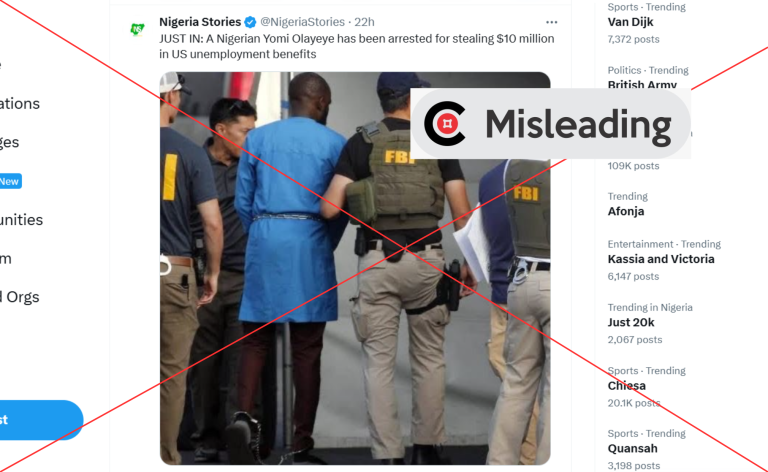
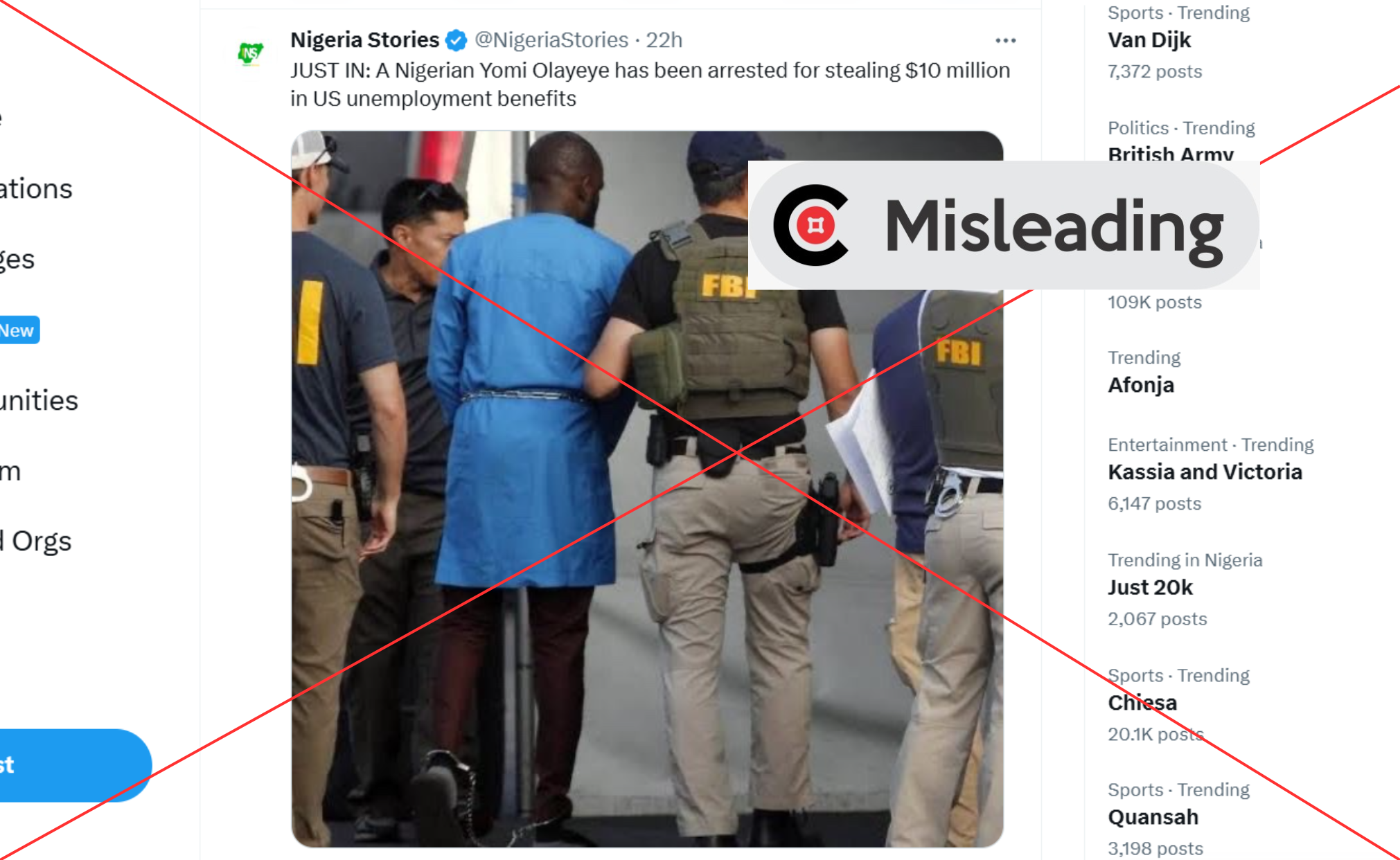
An image showing a group of security operatives escorting a suspect in a blue native outfit has been used by many Nigerian news platforms to depict the recent arrest of a Nigerian man, Yomi Jones Olayeye, in the United States over $10 million pandemic unemployment assistance fraud scheme.
The image showed the handcuffed suspect, walking in between security agents who wore uniforms labelled FBI (Federal Bureau of Investigation) on their back.
A statement by the United States Attorney’s Office for the District of Massachusetts said Olayeye a.k.a. “Sabbie,” from Lagos was arrested upon arriving at John F. Kennedy International Airport in New York on August 13, 2024.
An X account, @TrendingEx posted the image with a caption that read:
Nigeria-based Punch newspaper also captioned the image as “Nigerian Arrested For Stealing $10 Million in US Unemployment Benefits.”
CLAIM
Image shows a Nigerian man recently arrested over fraud in the United States.
THE FINDINGS
Findings by The FactCheckHub show that the claim is MISLEADING, as the image has been online since 2019.
Screenshot of the viral post showing Nigerian man arrested over fraud in 2019.
Our fact-checker subjected the viral image to a Google reverse image search and the result shows that the image has been online since 2019.
An earlier version of the image found in reports by the Los Angeles Times and Daily Mail revealed that it shows the moment a suspect was arrested in a downtown Los Angeles parking lot after pre-dawn raids that saw dozens of people arrested on August 22, 2019.
The unidentified suspect was among the 80 suspects (mostly Nigerians) of an international crime ring accused of ‘stealing at least $46 million through email scams and fake online romances’ in a sophisticated operation spanning from Los Angeles to Nigeria.
They were accused of using various online fraud schemes – including business email compromise (BEC) frauds, romance scams, and schemes targeting the elderly – to defraud victims of millions of dollars.
The full list of 77 members of the crime ring was published by Nigeria-based Premium Times same August 2019.
The FactCheckHub reviewed the list but we couldn’t find the name of Olayeye on it – a possible indication that the two incidents are unconnected.
THE VERDICT
The claim that the image shows the recent arrest of a Nigerian man, Yomi Olayeye, in the United States over fraud is MISLEADING; the image depicts an incident that occurred in 2019.
As concerns mount over speculations that the Nigerian government is secretly paying fuel subsidy, a video showing the Group Chief Executive Officer of the Nigerian National Petroleum Company (NNPC) Limited, Mele Kyari, saying there’s no subsidy on fuel imports has resurfaced online.
The video is being circulated following a recent report that the government accepted the NNPCL request to use the 2023 dividends due to the federation to pay for petrol subsidy.
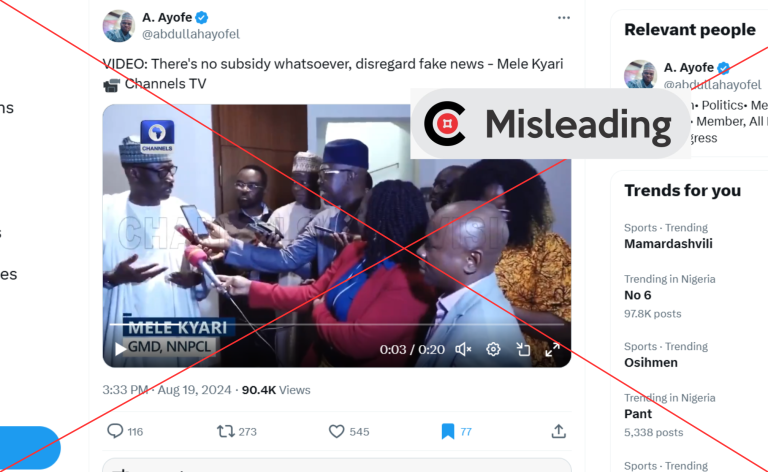
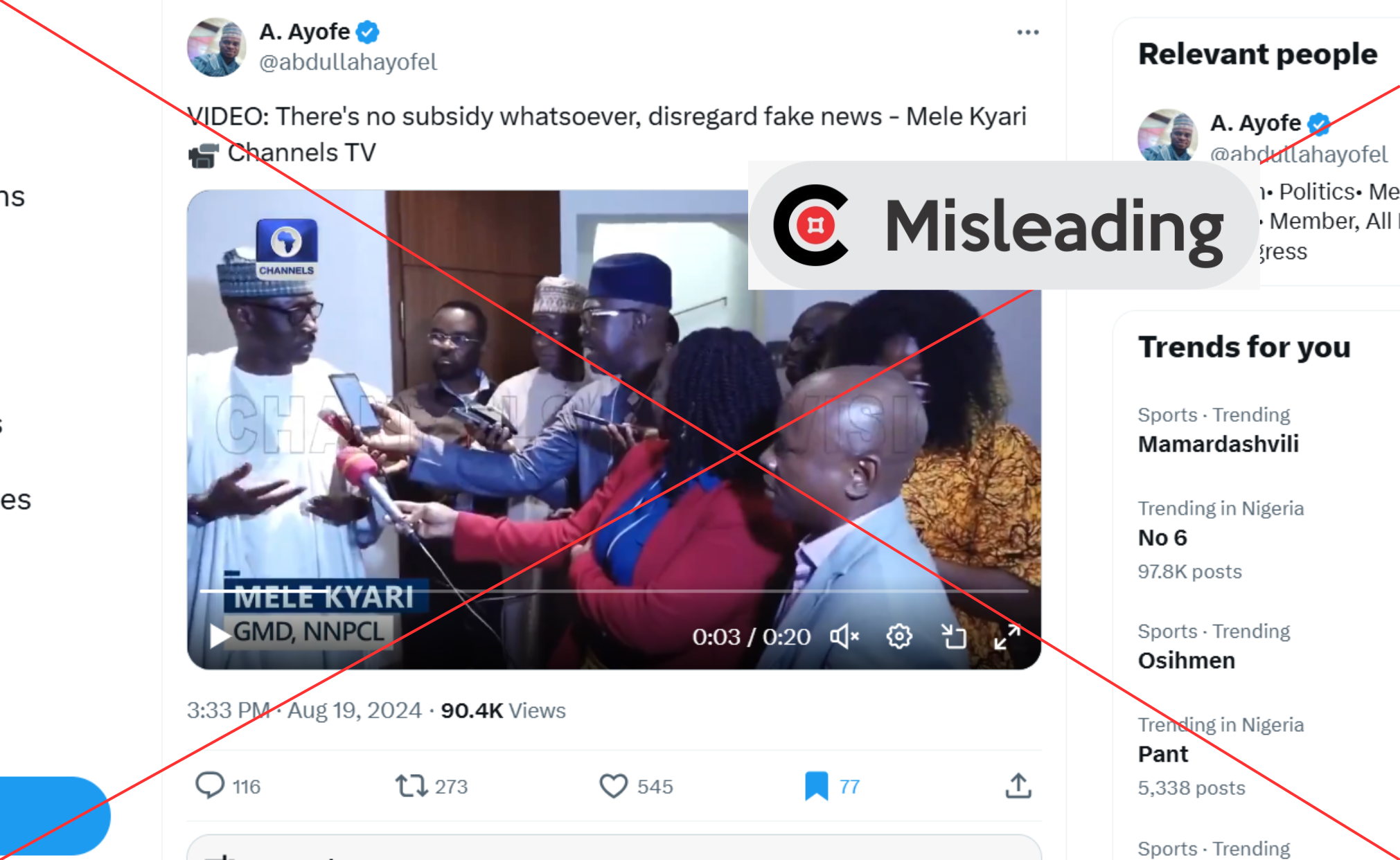
An X user, @abdullahayofel, posted the video with a caption thus:
“VIDEO: There’s no subsidy whatsoever, disregard fake news – Mele Kyari”
The video has garnered over 100,000 views on X, alongside over 500 likes and about 300 reposts as of August 21, 2024.
Another X user, @abj_online posted the video with another caption that read:
“VIDEO: There’s no subsidy whatsoever, disregard fake news – Mele Kyari @MKKyari, GMD NNPCL @nnpclimited clarifies.”
The video has generated more than 33,000 views and over 170 likes plus more than 100 reposts as of August 21, 2024.
CLAIM
Recent video shows the NNPCL boss, Mele Kyari, denying payment of fuel subsidy.
THE FINDINGS
Findings by The FactCheckHub show that the claim is MISLEADING, as the video has been online since 10 months ago.
Screenshot of the viral video showing Mele Kyari denying payment of fuel subsidy.
In his inaugural speech on May 29, 2023, the Nigerian President, Bola Ahmed Tinubu, announced the removal of fuel subsidy. The fuel subsidy is a financial support meant to subsidize the price of petrol locally for Nigerians. However, there have been strong indications that the government still spends billions on its payments.
Though the Nigerian government has consistently denied paying fuel subsidy, a recent report by The Cable said the government has agreed to help the NNPCL pay outstanding fuel subsidy contrary to the government’s claim.
This indicates that President Tinubu has allowed the company to use money that was supposed to be shared among the federal, state, and local governments (known as dividends) to cover the cost of the subsidy instead.
Though the NNPCL has denied paying fuel subsidy in a recent statement, the viral video of Mele Kyari has been online since October 9, 2023, according to this Channels TV report.
The video shows when Kyari was addressing State House Correspondents at the Presidential Villa in Abuja in October 2023 where he vehemently denied the return of the fuel subsidy regime.
“There is no subsidy whatsoever. We’re recovering our full cost from the products that we import. We sell to the market; we understand why the marketers are unable to import.
“We hope that they do this very quickly and these are some of the interventions the government is doing. There is no subsidy,” Kyari said.
Kyari’s denial then was to douse speculations over a rise in landing cost of petrol beyond N700 after oil marketers raised the alarm that pump prices could rise to record numbers.
THE VERDICT
The claim that recent video shows the NNPCL boss, Mele Kyari, denying payment of fuel subsidy is MISLEADING; the video has been online since October 2023.
It is essential to instill critical thinking skills in children in order to help them navigate internet safely and avoid the negative impacts of false information.
Online guides which need to be imbibed by parents/guardians can be used to empower children and aid them in making informed decisions, complementing their ability to recognize misinformation.
By teaching these skills, you can prevent them from falling prey to misinformation in the first place. Here are some strategies to support children and young people in this area.
1. Building connections online
As children build relationships and friendships online, it’s crucial to help them develop critical thinking skills to make safe choices about the people they interact with. This is especially important in the context of misinformation, where online interactions can sometimes lead to misleading or harmful content.
If someone they’re connected with shares or says something that makes them feel uneasy, worried, or scared, they should be empowered to take control—whether that means speaking to someone they trust, blocking, or reporting the individual. It’s important that children feel they can turn to you or other trusted sources without the fear of being told to stop using a certain platform. Keeping an open mind and working together to resolve issues encourage them to share their concerns.
As online interactions evolve, especially with the increasing popularity of gaming where children may interact with strangers, it’s vital to encourage them to trust their instincts. If something feels off, it probably is misleading. Creating an environment where children feel confident to discuss their concerns without fearing a ban from a particular platform can help them navigate the online world safely and critically, thus reducing their exposure to misinformation.
2. Handling online privacy
With the rise in phishing attempts and fraudulent scams, it’s essential to equip children with the tools they need to protect their personal information to avoid them being victims
Start by discussing the importance of strong passwords with your child and how they can help prevent phishing attacks. Consider using a password manager to create and store secure passwords for the whole family. It’s common for children to share passwords with friends as a sign of trust, often knowing each other’s phone and account passcodes. However, it’s crucial to explain the risks this behavior pose, particularly when it comes to phishing scams.
To help your child create strong, unique passwords that are less vulnerable to fraudulent schemes, you can use resources like the Bee Secure site to test out password ideas together. Additionally, the Cyber Security Activity Pack from ThinkuKnow and KnowBe4 offers valuable tools to help your family learn more about staying cyber-aware and recognizing the signs of phishing attempts.
3. Problem-solving methods
When it comes to dealing with misinformation and harmful content online, it’s crucial to provide children with ways to seek help before issues arise, especially if they feel they can’t talk to you directly.
Encourage them to explore other reporting options. There may be another trusted adult they can turn to for support—it doesn’t always have to be you as their parent. Discuss who these trusted adults might be, and explain that they can also report any problems directly to the platform where the issue occurred, whether it’s a game, social network, or website.
Remind them that doing nothing isn’t the best option, as misinformation or harmful content could negatively impact others as well. Even if they aren’t particularly worried about what they’ve encountered, reporting it can help protect others, which may encourage them to take action and support their peers.
Take some time to go through the reporting features on the services, games, and apps your child uses.
4. Safely setting up
When your child is online, whether playing games or chatting with others, the devices they use come with built-in tools and settings that can help you manage their online experience. These controls are essential for protecting them from harmful content, misinformation, and unwanted contact, while also helping to limit screen time.
Just as there are rules in place for their safety in the offline world, it’s important to have similar guidelines for their online activities. By setting up privacy controls together, you can help your child understand why these boundaries are necessary and how they help keep them safe. As they grow older and become more independent online, they can take on more responsibility for managing these settings themselves, learning to self-regulate their device use and recognize the importance of privacy and security.
Many popular platforms now offer features that allow parents to link their accounts with their child’s, providing valuable oversight. Collaborating on these setups ensures that your child feels involved and understands the importance of these measures. Just as they accept rules for their offline activities, they should also see the value in having rules for their online interactions.
5. Dealing with harmful content & Cyber-bullying
As your child begins to interact with others online, it’s crucial to teach them good online manners early in life, especially when it comes to expressing their feelings and emotions. While cyber-bullying is more commonly experienced by older teens and tweens, fostering a respectful online presence from a young age is essential.
Unfortunately, many people believe that they can say unkind things online without facing any consequences, thinking anonymity will protect them. To combat this, it’s important to ensure your child’s privacy settings on social media platforms are properly configured, giving them control over who can comment on their posts. Our social media how-to guide provides tips on setting these up. Show your child how to use tools to block or report a post, or report another user for cyber-bullying, misinformation, or other harmful behavior.
While social networking sites and gaming platforms do moderate content, these measures are not foolproof. It’s important to familiarize yourself with the tools available on the platforms, games, and apps your child uses to report or block harmful content. Ensure your child knows what to do if they encounter unpleasant or misleading content. Depending on their age, it might be best for them to come to you rather than trying to handle it on their own.
OpenAI has identified and shut down an influence campaign linked to the Iranian government.
This operation, aimed at disseminating false information about the US elections, utilized artificial intelligence technology to generate and spread misinformation through ChatGPT.
In a blog post on August 16, 2024, the AI company said it had banned several accounts linked to the campaign from its online services. The Iranian effort, OpenAI added, did not seem to reach a sizable audience.
“This week we identified and took down a cluster of ChatGPT accounts that were generating content for a covert Iranian influence operation identified as Storm-2035,” OpenAI said.
“The operation used ChatGPT to generate content focused on a number of topics — including commentary on candidates on both sides in the U.S. presidential election – which it then shared via social media accounts and websites.”
The popularity of generative A.I. like OpenAI’s online chatbot, ChatGPT, has raised questions about how such technologies might contribute to online disinformation, especially in a year when there are major elections across the globe.
Earlier in August, a Microsoft threats-intelligence report said Iranian network Storm-2035, comprising four websites masquerading as news outlets, is actively engaging U.S. voter groups on opposing ends of the political spectrum.
The engagement was being built with “polarizing messaging on issues such as the U.S. presidential candidates, LGBTQ rights, and the Israel – Hamas conflict,” the report stated.
Recall that in May 2024, OpenAI released a first-of-its-kind report showing that it had identified and disrupted five other online campaigns that used its technologies to deceptively manipulate public opinion and influence geopolitics. Those efforts were run by state actors and private companies in Russia, China and Israel as well as Iran.
These covert operations used OpenAI’s technology to generate social media posts, translate and edit articles, write headlines and debug computer programs, typically to win support for political campaigns or to swing public opinion in geopolitical conflicts.
In some cases, the commentary seemed progressive. In other cases, it seemed conservative. It also dealt with hot-button topics ranging from the war in Gaza to Scottish independence.
According to OpenAI, the campaign used its technologies to generate articles and shorter comments posted on websites and on social media. In some cases, the campaign used ChatGPT to rewrite comments posted by other social media users.
OpenAI added that a majority of the campaign’s social media posts had received few or no likes, shares or comments, and that it had found little evidence that web articles produced by the campaigns were shared across social media.