Home Blog Page 60

Viral photos do not show recent arrest of ritual suspects in Ondo State

0

AN X user, Harry (@chiditweets042), has posted two photos: one showing two people in front of a plastic bowl, and another showing bowls containing human body parts with a claim that the photos show a Yoruba couple recently apprehended for ritual killings in Ondo State.

Harry claimed that a search was conducted at the suspects’ house recently in Akoko area of Ondo State where human hands, three kidneys, three hearts, a spine, and a tongue were found in their possession.

READ: Old image falsely used to depict recent arrest of Nigerian fraud suspect in the US

He posted on X thus:

“Yorubanivorous Skuller Alfa Oluwafemi Idris has been arrested by the police in Ondo State. 

“A search was conducted in his house at Akoko and human hands, three kidneys, three hearts, spine and tongue were found in his possession.

The suspect claimed he is an Islamic cleric and some of the human parts were supplied by his friend, an Alhaji who is also a cleric and one Samuel Kutelu, while he supplied one Babatunde Kayode ( an Oluawo) 3 human heads.

The said Oluawo and Babatunde Kayode have been arrested.” 

The post has garnered over 600,000 views with more than 4,000 likes and over 2,400 reposts as of September 9, 2024.


CLAIM

Photos show a Yoruba couple caught with human parts recently.


THE FINDINGS

Findings by The FactCheckHub show that the claim is MISLEADING, as the photos were old images being reposted as recent.

Screenshot of the viral post retrieved from X. INSERT: Misleading verdict.

Our researcher conducted a Google Reverse Image search on the images, and the result showed that they were old pictures being reposted as recent. 

Image 1 

When the first image was subjected to a Google Reverse Image search, the result revealed that the image had been online since February 2022. The image showed a couple – Kehinde Oladimeji, 43 and Adejumoke Raji, 35, – who were caught in possession of human parts in Ogun State, The Nation reported.

The couple were arrested at their residence situated at No.72, MKO Abiola Way, Leme, Abeokuta, the state capital.

The suspects were reported after community members perceived a stench coming out from the residence. This prompted the police to search the house and arrest them.

The image was also used in the same report as published by other media platforms as seen here, here, here and here.


Image 2 

A Google Reverse Image search conducted on the second image revealed that it shows human hands recovered from a self-proclaimed Islamic cleric, Oluwafemi Idris, who was arrested by the Ondo State Police Command in March 2024. The image was also shared here and here with same narrative. 

The suspect was apprehended after a search was conducted in his house at Akoko. Other human parts such as three kidneys, three hearts, spine and tongue were also found in his possession.

Our researcher however noticed that a textual part of the X post was reported by some media platforms earlier in the year 2024, though the focus of this fact-check is on the images used to mislead the public as though recent.

Our researcher had earlier observed a growing divide between Nigerians of Igbo extraction and their Yoruba counterparts (majorly from Southwestern Nigeria) on X, thus fuelling ethnic-motivated misinformation on the social media platform. 

This is not the first time a visual targeted at spawning ethnic hatred in Nigeria would go viral on the X platform.

ALSO READ: Video does not show bandits arrested by Nigerian Army recently

The FactCheckHub had earlier debunked a graphic video that surfaced online with a claim that it showed Igbos from Nigeria being killed for using people for money rituals in Mozambique. Our findings showed the incident occurred in Haiti and was unrelated to money rituals or people of Igbo extraction.

Similarly, a video showing angry youths reportedly vandalizing the Nigerian embassy in Dakar, Senegal surfaced online with a claim it shows a recent riot by Nigerians of Igbo extraction in that country. However, our findings showed that the claim is misleading.


THE VERDICT

The claim that the photos show a Yoruba couple caught with human parts is MISLEADING; they are old photos from separate incidents that occurred in different Nigerian states.

Did Zamfara Government allocate over N1 billion to bandits, media houses?

1

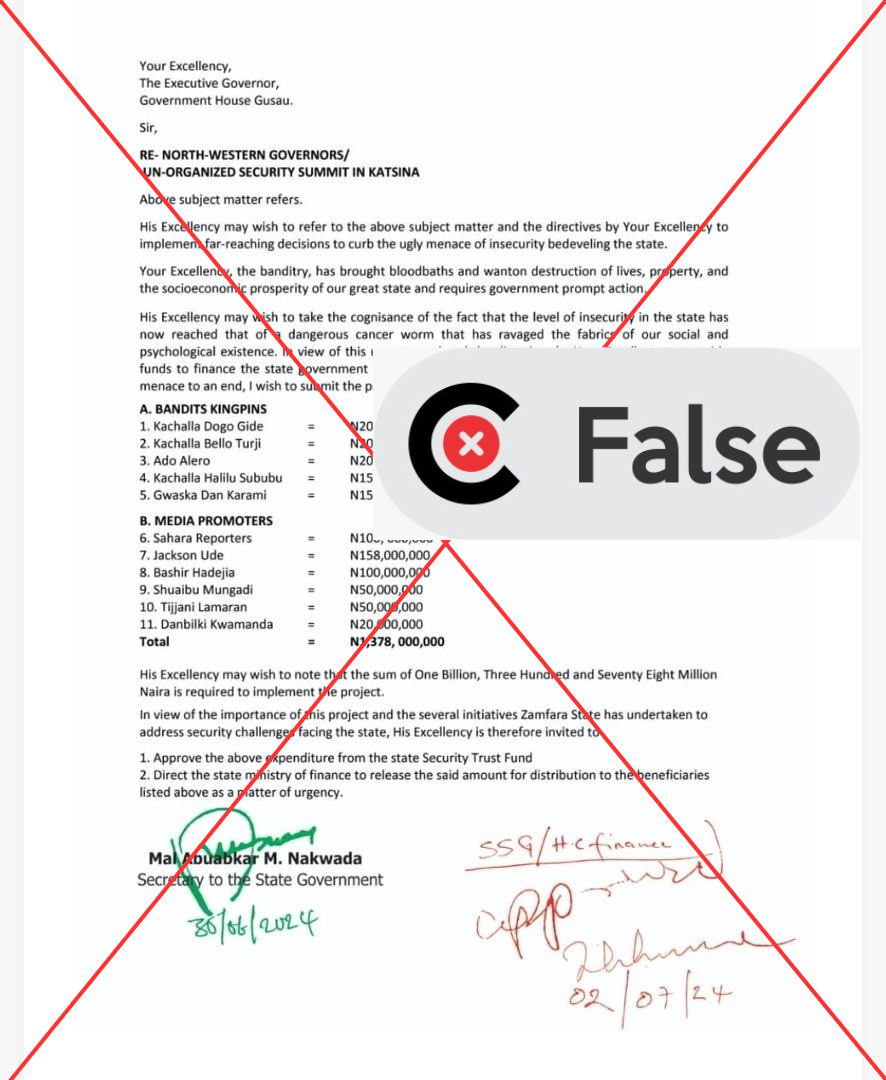
A memo insinuating that the Zamfara State Sovernment had released a sum of N1.3 billion to some bandits’ kingpins for dialogue in the state has been going viral online.

The letter purportedly signed by the Secretary to the Zamfara State Government also claimed that money was paid to some media promoters including Sahara Reporters under the guise of “reconciliation efforts” from the state’s Security Trust Fund.

READ: LGBTQ+: Did Buhari ask Obama to grant US visa to queer Nigerians?

The letter reads:

“Your Excellency,
The Executive Governor,
Government House Gusau.

Sir,

RE- NORTH-WESTERN GOVERNORS/
UN-ORGANIZED SECURITY SUMMIT IN KATSINA

Above subject matter refers.

His Excellency may wish to refer to the above subject matter and the directives by Your Excellency to implement far-reaching decisions to curb the ugly menace of insecurity bedeviling the state.

Your Excellency, the banditry, has brought bloodbaths and wanton destruction of lives, property, and the socioeconomic prosperity of our great state and requires government prompt action.

His Excellency may wish to take the cognisance of the fact that the level of insecurity in the state has now reached that of a dangerous cancer worm that has ravaged the fabrics of our social and psychological existence. In view of this urgent need and the directives by Your Excellency to provide funds to finance the state government reconciliation programme with bandits in order to bring the menace to an end, I wish to submit the proposal as follows for Your Excellency’s kind approval:

A. BANDITS KINGPINS
1. Kachalla Dogo Gide = N200,000,000
2. Kachalla Bello Turji = N200,000,000
3. Ado Alero = N200,000,000
4. Kachalla Halilu Sububu = N150,000,000
5. Gwaska Dan Karami = N150,000,000

B. MEDIA PROMOTERS
6. Sahara Reporters = N100,000,000
7. Jackson Ude = N158,000,000
8. Bashir Hadejia = N100,000,000
9. Shuaibu Mungadi = N50,000,000
10. Tijjani Lamaran = N50,000,000
11. Danbilki Kwamanda = N20,000,000

Total
= N1,378,000,000

His Excellency may wish to note that the sum of One Billion, Three Hundred and Seventy Eight Million Naira is required to implement the project.

In view of the importance of this project and the several initiatives Zamfara State has undertaken to address security challenges facing the state, His Excellency is therefore invited to:

1. Approve the above expenditure from the state Security Trust Fund.
2. Direct the state ministry of finance to release the said amount for distribution to the beneficiaries listed above as a matter of urgency.

Signed,
Mallam Abubakar M. Nakwada
Secretary to the State Government.

The claim has gone viral on multiple social media platforms, including on WhatsApp.


CLAIM

Viral letter shows Zamfara State Government allocated money to bandits and media houses for dialogue over insecurity in the state.


THE FINDINGS

Findings by The FactCheckHub show that the claim is FALSE, as the letter is fake and filled with multiple grammatical errors.

Screenshot of the viral post

First, The FactCheckHub observed that the letter is not written on any letterhead and doesn’t come in the usual formats of an official letter. Official letters from high-level government officials, such as state governors or secretaries, typically include a coat of arms, seal, or emblem that reflects the office of the sender.

ALSO READ: NTA page advertising Ponzi scheme is fake!

Upon review, some grammatical and stylistic errors could be seen which undermine the authenticity of the letter.

For instance, the salutation “Your Excellency” is followed by a full stop, whereas formal letters typically use a comma in such cases.

Moreover, the phrase “Above subject matter refers” is awkward and grammatically incorrect. The correct phrasing should be “The above subject matter refers” or “Reference is made to the above subject.”

The use of “the banditry” in “Your Excellency, the banditry, has brought bloodbaths…” is erroneous. The correct expression should omit “the,” making it “Your Excellency, banditry has brought bloodbaths…”

Finally, typographical errors include an inconsistent spacing before commas in figures like “N200,000,000” and “N1,378,000,000,” reflecting poor formatting.

Some of the items listed, such as large financial allocations to individuals and media outlets, raise questions about the legitimacy of the request. Official documents rarely allocate funds in such a straightforward manner, and the request for such large sums of money would typically involve much more rigorous justification and documentation. These cannot be found in the letter.

Meanwhile, The Secretary to the State Government (SSG), Abubakar Nakwada, who addressed newsmen in Gusau on September 5, 2024 said the documents “were not only fake but also mischievous, misleading, malicious and false.”

Nakwada said that the information was completely false and the documents with his signature and other top government officials being circulated by some social media outlets were forged.


THE VERDICT

The viral letter is FALSE, as the content was not on any official letterhead and filled with grammatical errors. Also, the Secretary to the Zamfara State Government, Abubakar Nakwada, has debunked the claim, saying the document is fake, forged, and malicious.

Video does not show recent army mobilization against Turji-led bandits in Sokoto

0

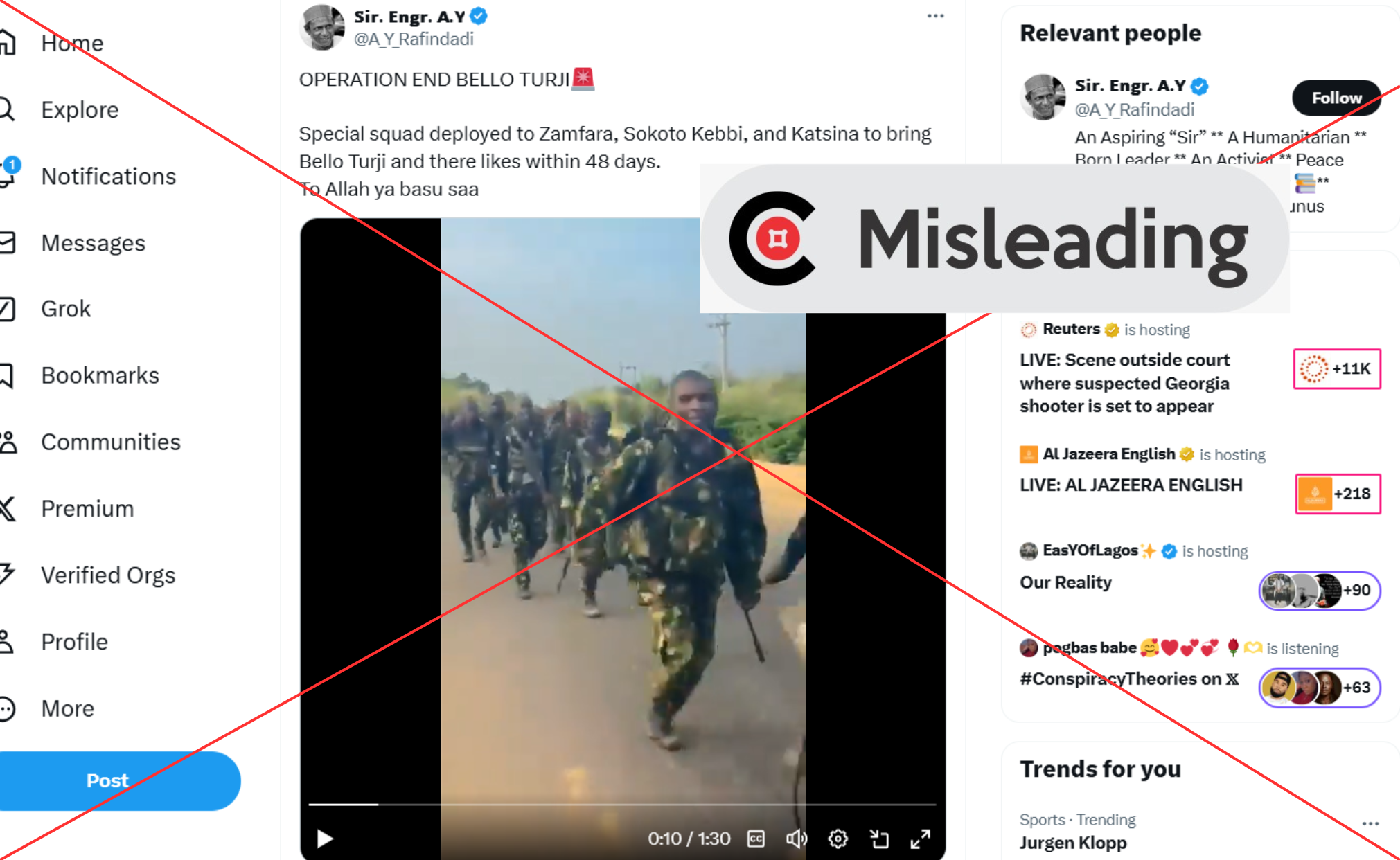
A video showing soldiers on parade has resurfaced online with a claim that it shows the soldiers recently mobilized to bring Bello Turji-led notorious bandits to justice within 48 hours.

Bello Turji is a notorious bandit leader in northern Nigeria, primarily operating in Zamfara, Sokoto, and Niger states.

READ: Drone footage of ‘bandits’ posted by Joe Igbokwe is from Kenya not Nigeria

He has been involved in numerous attacks, kidnappings, and killings, often targeting villages, travellers, and security personnel. Turji’s group is one of the many armed gangs, commonly referred to as bandits, who have wreaked havoc in the region, leading to widespread insecurity.

The video surfaced following the recent directive of the federal government for the service chiefs to relocate to Sokoto to flush out the terrorists.

An X user, @A_Y_Rafindadi, posted the video with a caption thus:

“OPERATION END BELLO TURJI

Special squad deployed to Zamfara, Sokoto Kebbi, and Katsina to bring Bello Turji and there likes within 48 days.

To Allah ya basu saa.”

The video has garnered over 490,000 views, with over 1,900 comments, more than 6,000 likes and over 1,900 reposts as of September 6, 2024.


CLAIM

Video shows soldiers recently mobilised to fight Turji-led bandits in Sokoto State.


THE FINDINGS

Findings by The FactCheckHub show that the claim is MISLEADING, as the video has been online since June 2024.

Screenshot of the viral video retrieved from the X post.

Checks show that the video of soldiers on parade has been online before the recent directive by the Nigerian government.

Earlier versions of the video were posted here on June 15, 2024 and here on June 19, 2024. In the 2-minutes video, the soldiers were seen singing and chanting during a parade.

Earlier this September, the Nigerian President, Bola Ahmed Tinubu, directed the Minister of State for Defence, Bello Matawalle, and other military chiefs to relocate to Sokoto State to intensify efforts to end the menace of banditry, kidnapping, and terrorism in the North-West region.

The government emphasised that the move was part of its strategy to combat the ongoing security challenges in the Northwestern part of Nigeria.

ALSO READ: No! Bandits did not order Nigerian churches to close down

Following this directive, Matawalle, along with the Chief of Defence Staff (CDS) Christopher Musa, and other top military officials, stormed Sokoto State while declaring their readiness to lead a military onslaught against Turji and other bandits and criminals in the region.

In response to this development, the notorious bandit leader, Bello Turji released a video claiming he and his associates are not afraid of death.


THE VERDICT

The claim that the video shows soldiers recently mobilised to fight Turji-led bandits in Sokoto State is MISLEADING; the video has been online since June 2024.

Lauretta Onochie shares false image of Nigerian woman arrested for hate speech on TikTok

0

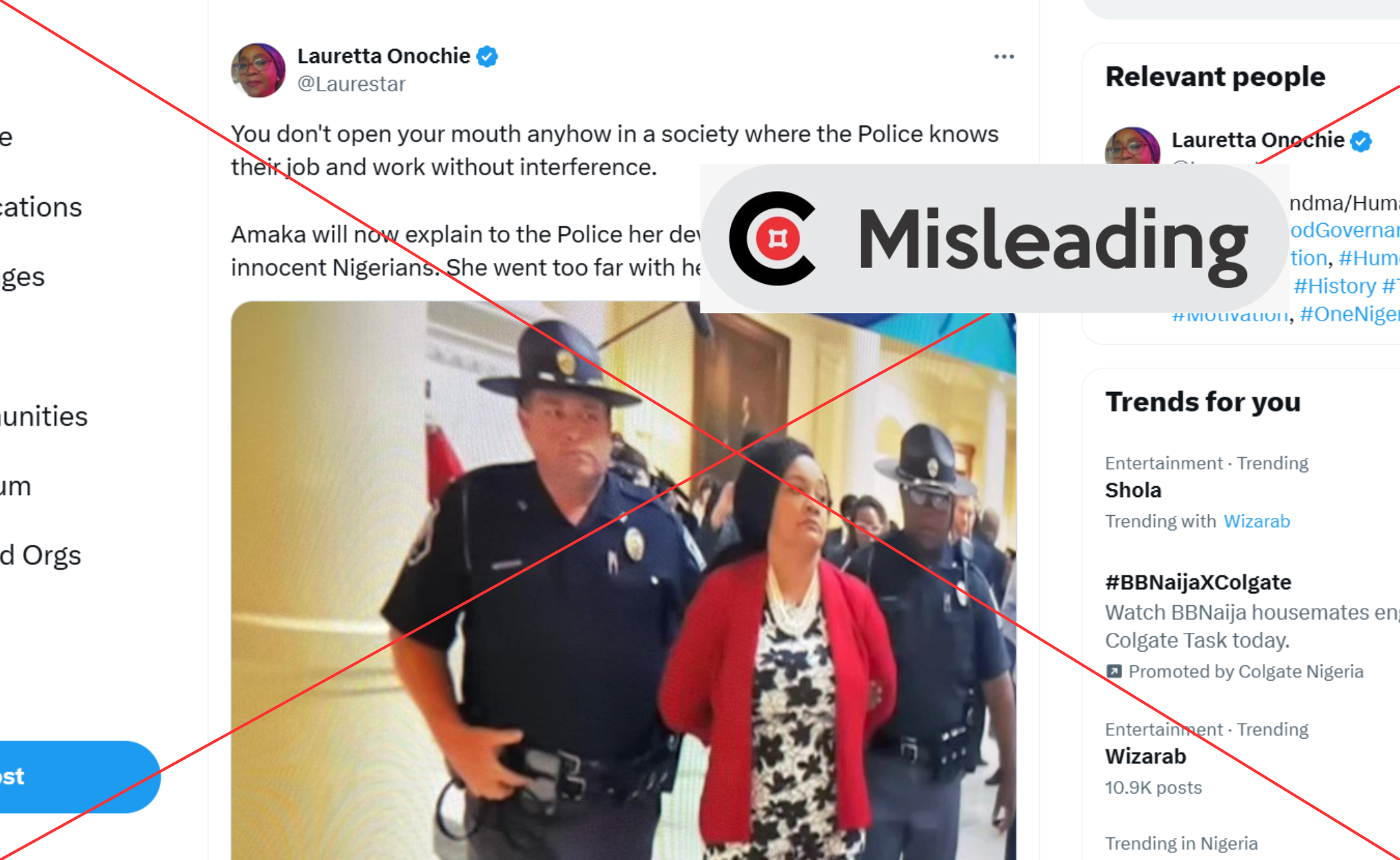
A former Presidential aide, Lauretta Onochie, has posted a photo showing a woman arrested by Police with a claim that it shows Canada-based Nigerian woman, Amaka Sonnberger, who threatened to poison Yoruba and Benin people living in the North American country.

Amaka reportedly issued the threat while speaking on TikTok live.

DON’T MISS THIS: Stakeholders urge media organisations to uphold ethical reporting to combat misinformation, hate speech

Onochie, who was an aide to ex-President Muhammadu Buhari, posted the photo with a caption thus:

“You don’t open your mouth anyhow in a society where the Police knows their job and work without interference.

“Amaka will now explain to the Police her devious plans to poison innocent Nigerians. She went too far with her #Obidiocy.”

The post has garnered over 800,000 views, with over 3,600 comments, more than 1,400 reposts and over 2,800 likes as of September 6, 2024.


CLAIM

Photo shows Canada-based Nigerian woman arrested for threatening Yorubas, Binis.


THE FINDINGS 

Findings by The FactCheckHub show that the claim is MISLEADING, as the woman in the photo is Georgia State lawmaker, Nikema Williams, when she was arrested during a protest in 2018.

Screenshot of the viral post retrieved from X. INSERT: Misleading verdict.

When our fact-checker subjected the photo shared by Onochie to a Google Reverse Image search, the result shows that the photo has been online since 2018 and is unconnected to the Sonnberger’s saga.

The image shows Georgia State lawmaker, Senator Nikema Williams (D-Atlanta), who was arrested by Capitol police during a protest over election ballot counts in the rotunda of the state capitol building in November 13, 2018, in Atlanta, USA.

PM News reported that a Canada-based Nigerian woman, Sonnberger had in a live video on TikTok vowed that she would take poisonous substances to her workplace and poison any Yoruba or Benin person she came across.

“Record me very well; it’s time to start poisoning the Yoruba and the Benin. Put poison for all una food for work. Put poison for una water, make una dey kpai one by one,” Mrs Sonnberger said in what appears to be a virtual meeting on TikTok.

She claimed that her comment was in response to the “hate” against the Igbo. Some other voices could be heard, interjecting and prodding her on.

Her comment sparked public outrage after the video made its way to X, and later caught the attention of Abike Dabiri, the chairperson of a federal agency, the Nigerians in Diaspora Commission (NiDCOM).

ALSO READ: The many social media lies of Lauretta Onochie, President Buhari’s aide

She has however been arrested on September 1, 2024 by the Toronto Police Service, Canada and charged for uttering threats.

The FactCheckHub has reported how ethnic-motivated hate speech continues to spread like wildfire on X due to the divide between Igbos and other major Nigerian ethnic groups such as the Yorubas and Hausa-Fulanis on major socio-political discourse on the social media platform.


THE VERDICT 

The claim that the photo shows Canada-based Nigerian woman arrested for threatening Yorubas, Binis on TikTok is MISLEADING; it shows a Georgia State lawmaker, Nikema Williams, arrested during a protest in the US in 2018.

Indian-aligned network using AI, fake accounts to target nation’s ‘foes’ uncovered

0

A new report by NewsGuard has uncovered massive India-aligned influence operation using AI-generated content and fake social media accounts to promote pro-India propaganda and undermine Pakistan. 

The investigation revealed a network of nearly 1,500 fake accounts on Facebook and X (formerly Twitter), which had been operating undetected for three years.

The network’s coordinated efforts involved boosting the image of Indian Prime Minister Narendra Modi’s administration while criticizing Pakistan and its allies.

READ THIS: Five quick tips to identify fake news shared on social media

NewsGuard could not precisely identify the individuals responsible for the network, but the accounts exhibited behaviour pointing to a link with the Indian military, including consistent promotion of pro-government and pro-army narratives.

The network, which first became active in September 2021, managed to avoid detection despite its size and prolonged activity, making it one of the most enduring influence operations attributed to India.

The 500 Facebook and 904 X accounts identified by NewsGuard often posted up to 10 identical messages per day, promoting pro-Indian government and military content. The accounts, which used fake names and AI-generated profile pictures, frequently shared material from pro-India outlets such as ANI News and Hindustan Times, as well as other platforms with ties to the Indian military.

Using artificial intelligence detection tools, NewsGuard found that many of the posts published by these accounts were likely generated by AI, allowing the network to rapidly produce and distribute vast amounts of content.

“NewsGuard found that the posts published by the network of fake accounts were, according to the tool, ‘highly likely’ generated by AI, which allows networks such as this one to rapidly produce and disseminate large amounts of content.

“NewsGuard’s finding follows several reports raising concerns about the increasing use of AI to supercharge state-sponsored ‘influence campaigns’ including ‘Spamouflage,’ a pro-China network that regularly posts divisive content about the U.S.

“The posts typically promote propaganda rather than provably false claims. However, the network exhibits all the hallmarks of “inauthentic behaviour,” a type of activity prohibited under the rules set by social media platforms X and Facebook for attempting to deceive users and manipulate public opinion,” part of the report published on September 4, 2024 read.

NewsGuard’s investigation revealed that many of the fake accounts were used to praise the Indian military, especially the Indian Army, through coordinated posts designed to glorify its activities and enhance its image.

One page in the network, JK News Network, which presents itself as a legitimate news outlet, repeatedly posted content that promoted the Indian Army in a highly favoruable light. Its posts, amplified by hundreds of fake accounts, showcased positive stories about the Indian army’s community engagement efforts, such as promoting women’s cricket and inaugurating a community radio station in Leh. These posts attracted significant interaction from fake accounts that praised the army’s efforts, thus enhancing their visibility.

DON’T MISS THIS PODCAST: Unveiling recent actors of disinformation in Nigeria

While NewsGuard could not definitely prove the Indian military’s involvement in the campaign, the close alignment of the network’s messaging with military interests, as well as the type of content it promoted, suggests a possible connection. Notably, the network used multiple accounts to boost pro-military narratives, with posts lauding the army’s work in fostering unity and social development.

The accounts also targeted Pakistan’s relationship with China, including criticisms of the China-Pakistan Economic Corridor (CPEC), a $62 billion infrastructure project that has been a key component of Pakistan’s economic strategy.

In addition to its anti-Pakistan stance, the network also portrayed India’s governance of Kashmir in a positive light.

Besides its focus on Pakistan, the network also directed criticism at other countries seen as geopolitical adversaries of India, such as China, the Maldives, and Bangladesh. They frequently criticized China over its handling of the COVID-19 pandemic, its alleged human rights abuses in Xinjiang, and its support for Pakistan’s treatment of minorities in Balochistan.

Musk launches offensive with paid Starlink ads after suspension of X in Brazil

0

By Cristina Tardáguila


A flood of paid ads about Starlink, a satellite internet company owned by Elon Musk, appeared on Google and Meta platforms in Brazil after Supreme Court (STF) minister Alexandre de Moraes threatened the X with suspension for not complying with court orders and ending his legal representation in the country.

Lupa survey shows that 41 ads offering Musk’s internet with tempting discounts were active in the last four days of August in national territory – a number far above that practiced by the company in this market.

Active ads paid by Space X to promote Starlink per month on Google: January to August 2024
Active ads paid by Space X to promote Starlink per month on Google: January to August 2024.
Active ads paid by Space X to promote Starlink per day on Google: August 2024
Active ads paid by Space X to promote Starlink per day on Google: August 2024.
Data from Google and Meta’s ad libraries show that Space X’s peak investment in Starlink ads in Brazil coincides with a confrontation between X and the Supreme Court. Between January 1 and August 27, an average of one online ad about Starlink every eight days circulated in Brazil.
After the threat of suspension of X, published on Wednesday, August 28, and until Saturday, 31, the investment had a strong rise, reaching 37 active ads at the same time on August 30. Many of them offered discounts of up to 58% for those who joined the company’s internet service in national territory.

READ: Legal battle shuts down X in Brazil: Key points behind the controversy

Therefore, if your computer and mobile phone are flooded with announcements of attractive Starlink plans, know that it is not by chance. These advertising campaigns indicate a strategy by Musk to expand the customer base of his internet company in Brazil and, at the same time, guarantee revenue in the national territory, shaken by the suspension of X.
Last Thursday (29), Moraes decreed the freezing of Starlink’s assets in national territory for understanding that the organization could bear the fines of about R$ 18 million applied to X until then. The minister’s polemical decision says that Musk’s companies form a “de facto economic group”, and, therefore, Starlink values can be used to honor X fines.
On the same day, Musk assured that the company will provide free internet service to its Brazilian customers while their accounts are blocked and received praise on social networks. On Friday (30), the Supreme Court ordered the overthrow of X, blocking access to the application throughout the national territory. But on Sunday, UOL reported that Starlink customers still had regular access to the social network. Starlink informed the National Telecommunications Agency (Anatel) that it will not comply with the Supreme Court’s order and will not block X in Brazil. 
Founded in 2019, Starlink has at least 215,000 customers in the country, according to Anatel.
Space X ad libraries on Google (above) with ads for satellite internet plans targeted to Brazil, between August 28 and 31, 2024.
Space X ad libraries on Google with ads for satellite internet plans targeted to Brazil, between August 28 and 31, 2024.
Starlink ad libraries on Meta, with ads for satellite internet plans targeted to Brazil, between August 28 and 31, 2024.


Advertising was also paid for by Space X

On Google, the company Space Exploration Technologies Corp., Space X, the parent company of Starlink and founded by Musk to build spacecraft, paid to activate 39 ads about satellite internet plans between August 28 and 31, 2024. Before that, from January 1st of this year until August 27, the day before the STF summons with the threat of closing X, a total of 31 ads of the same type had been targeted to Brazil.
Announcements made by Space X about Starlink in Brazil, via Google, between August 28 and 31.
Announcement made by Space X about Starlink in Brazil, via Google, between August 28 and 31.
“Speed up to 200+ Mbps, R$1,000 (58% discount on equipment)”, said one of the 39 ads active on Google in the last week of August.
“⁦Starlink – R$1,200 for the Starlink Kit⁩. The most advanced satellites in the world with high-speed internet and low latency. It’s fast to place the order,” said another active ad on the platform on the 31st, raising the previously set price.

In Meta, highlight for loyalty exemption

On Meta’s platforms, it was Starlink itself – and not Space X – who paid for the ads. Before 2024, the company had never advertised on Facebook, Instagram or Threads, and this year, there were seven advertising pieces directed to Brazil since January. Of this total, two were created in the last four days of August and were still active at the closing of this report. These two ads are also the only ones made in Portuguese – the five previous pieces, already inactive, circulated through the Brazilian market in English, according to data from the Meta library.
The advertising pieces that circulated on Mark Zuckerberg’s social networks followed the style of Google’s. They also brought the 58% discount for membership and the new values of the satellite internet package. But they went a little further and highlighted that Starlink will not require long-term contracts or loyalty plans from its new Brazilian customers.
Announcements made by Starlink in Brazil, via Meta, between August 28 and 31.
 

Effort above the curve

There is no information in the Google and Meta ad libraries about the cost of each ad, nor which states or cities in Brazil were reached by these advertisements. On both platforms, however, it is possible to see that the advertising operation made last week means a large investment compared to what the company has historically made.

ALSO READ: Disinformation in Brazil election: Lessons for Nigeria ahead of 2023 polls

If in the last week of August there were 39 advertisements about Starlink on Google, in the same period of the previous month (from July 28 to 31), there were only 14 – less than half. In the previous year – between August 28 and 31, 2023 – only four, that is, 10% of last week’s total.
Lupa also searched for data on Starlink advertisements on Tiktok, but the ad library of this platform still does not show information about paid advertising in Brazil.
*This article was republished by The FactCheckHub. You can read the original report here on Lupa website.

No, Labbadia did not reject Super Eagle’s job because politicians demand bribe from him

0

A claim that German coach, Bruno Labbadia, said he rejected the offer to become the new head coach of the Nigeria’s Senior Men football team – Super Eagles – after some Senators and politicians asked him to pay them bribes from his salary has surfaced online.

The claim which was purportedly reported by The Nation newspaper and accompanied by the snapshot of the front page of the newspaper is circulating on Facebook, X and other social media platforms.

“I quit Nigeria job just four days after my appointment. Some senators and politicians threatened to make life miserable for me if I don’t give them 10% of my monthly salary. Corruption in Nigeria system is unbelievable,” the viral quote reads.

READ THIS: Photos do not show Nwabali and his wife

An X user, @SabinaNkiru posted the claim with a caption thus: “I am ashamed”

The post has generated more than 700,000 views, over 5,000 reposts and more than 9,000 likes as of September 3, 2024.

It has also appeared on Facebook page as can be seen here.


CLAIM

German coach, Bruno Labbadia, rejects offer to become Nigeria’s Super Eagles’ head coach after some politicians demanded bribe from him.


THE FINDINGS 

Findings by The FactCheckHub show that the claim is FALSE as the quote was not reported by The Nation or any other credible publication.

Screenshot of the viral post on X. INSERT: False verdict.

The Nigeria Football Federation (NFF) had announced Bruno Labbadia as the new head coach of the Super Eagles, stating that he would take up the role immediately. However, the deal collapsed due to “tax dispute”.

Labbadia requested that the NFF cover his tax liabilities in Germany but the federation deemed this request unreasonable and declined to pay the taxes, leading to the collapse of the deal.

“The tax details were never part of our discussions, and he had personally agreed to all terms before the tax issue came up,” said NFF president, Ibrahim Musa Gusau in a statement on social media.

“We were doing our best to be flexible in the discussions but he was adamant that the NFF had to pay the full tax amount as well. We simply cannot do that.”

Checks by The FactCheckHub revealed that The Nation did not report or hint that the coach turned down the national team coaching job because of threats or demands from senators and politicians.

The FactCheckHub reviewed the publication of the platform on August 31 and confirmed that the statement was not quoted anywhere in the report.

The Nation’s report titled “Super Eagles coach: Labbadia turns Nigeria down” stated that there was no commitment or even a signature from the coach, as reported by the NFF before the announcement.

ALSO READ: 8 ways to identify AI-generated images online 

The FactCheckHub also observed that the website embedded in the viral snapshots is not the nation’s website. The nation’s website address is www.thenationonlineng.net but the link attached to viral snapshots instead has this web address: www.nigerianewspapers.net, a website that republished stories by other various news publications.

A look at the website also led us to a news report republished from Daily Trust. The report is based on the NFF’s X update, stating that Labbadia rejected the job due to the federation’s inability to agree on tax payments.

The FactCheckHub also discovered that the Nation newspaper has distanced itself from the claim.

“READERS BEWARE!

“The quote attributed to the German coach is not part of our cover. It was clearly photoshopped to give the impression it is from us. Readers are advised to be wary of such inventions,” The Nation posted on X.


THE VERDICT

The claim that German coach, Bruno Labbadia, rejected the offer to become Nigeria’s Super Eagles’ head coach after some politicians demanded bribe from him is FALSE; the quote was not reported by The Nation newspaper or any other credible media platform.

Legal battle shuts down X in Brazil: Key points behind the controversy

0
By Gabriela Soares and Maiquel Rosauro, Rio de Janeiro.
On Friday, August 30th, Brazil’s Supreme Court Justice Alexandre de Moraes ordered the nationwide suspension of X (formerly Twitter), adding the country to a list of nations where this social media platform is no longer available.
By Saturday (31st) morning, the app was already showing instability, and the content was not loading as usual — an indication that the order is being enforced by the country’s internet providers.
The decision followed CEO Elon Musk’s refusal to appoint a legal representative in Brazil and his non-compliance with Moraes’ content moderation orders. On Wednesday, August 28, Moraes summoned Musk (via a controversial post on X) to comply with Brazilian legislation in 24 hours. The businessman responded with sarcasm, posting memes generated by artificial intelligence, and calling the justice a censor and a dictator.
Here’s what you need to know about this case:

Why did the Brazilian Supreme Court summon Elon Musk?

Musk has been under investigation in Brazil since the first week of April. In Inquiry #4957, he is investigated for obstruction of justice, involvement in a criminal organization, and incitement to crime. In the so-called Digital Militias Inquiry, connected to the attacks seen in Brasília on January 8, 2022, he is investigated as part of groups suspected of spreading fake news on social media to influence political processes. Brazil is currently in an election year, with more than 5,000 cities across the country set to choose their new mayors in October. The campaign period officially began on August 16th.

How did the investigation against Musk begin?

On April 3rd, Brazil was hit by the leak of internal emails sent from and within X. In those documents, the company criticized decisions made by the Superior Electoral Court (TSE, in Portuguese) in 2022. X appeared to disagree with judicial requests to remove content from the platform and to provide user data to the Superior Electoral Court. At that time, Moraes was the president of that entity and responsible for overseeing the general elections (including the presidential).
Four days after the leak, on April 7th, Moraes included Musk in the Digital Militias Inquiry and ordered X to refrain from “disobeying any judicial order already issued” by the Brazilian Judiciary, including reactivating profiles whose blocking had been ordered by the Supreme Court (STF, in Portuguese) or the TSE. It was also determined that, in case of non-compliance, a daily fine of R$ 100,000 (about USD 20,000) per profile would be imposed on the company, and the legal representatives of X in Brazil would be charged with disobedience to a judicial order.
Less than 24 hours later, on April 8th, Musk posted on social media that X had lifted all restrictions it had applied based on legal requests, and complained that Moraes had not only imposed heavy fines to the company but also threatened to imprison its staff. Musk mentioned that he might close X’s office in Brazil in response to what he considered Moraes’ excesses and “censorship.” That same day, the judge included Musk in Inquiry #4957.
On August 17th, X announced the closure of its office in Brazil, which violates the country’s legislation. To operate in national territory, all social media platforms must have at least a legal representative.
On August 28th, Moraes summoned Musk via X, demanding that, within 24 hours, he appoint a new representative for the company in Brazil. The CEO flooded his own social media with memes and jokes about the judge—some of them generated by artificial intelligence.
On August 30th, almost 48 hours after Musk was summoned, Moraes ordered X’s suspension in the country. The social media platform still did not have a person in Brazil.
On August 31st, the platform was no longer available in the country.

Is it valid to summon someone via X in Brazil?

There is no final answer to this question, as it has become a legal controversy in the country. However, most experts consulted by Lupa believe that summoning someone via X is an invalid move.
In a statement, lawyer and professor Andréa Rocha, specialized in public law and coordinator of the International Law Department at the Brazilian Institute of Resources and Processes in Higher Courts (IRTS), stated that there is no legal regulation supporting summons made through social media, especially in criminal proceedings.
She emphasizes that the Brazilian legal system has methods to notify defendants abroad through diplomatic channels. Therefore, in her opinion, methods not provided for by law should only be used after all legal options have been exhausted, which did not seem the case here.
Lawyer Paulo Peixoto, a professor of constitutional law and human rights at Damásio Educacional, also classified the summons via X as atypical and pointed out the possibility that this could lead to the annulment of the entire inquiry.
“Since it involves a foreign company, a letter rogatory should have been issued according to the Code of Criminal Procedure and international treaties. In this sense, there is a possibility of declaring the act null and void,” Peixoto explains.
André Marsiglia, a constitutional lawyer and specialist in freedom of expression, states that the summons “is not valid.” He explains that, legally speaking, the summons must be delivered in person and also points out a problem with the document itself.
“Musk is not the CEO of the company; the recipient of the summons needs to respond legally on its behalf,” he argues. The current CEO of X is Linda Yaccarino.
In an article for the UOL news portal, Wilton Gomes, a master’s and doctoral candidate in State Law at the University of São Paulo, explains that despite the absence of specific federal legislation for summonses via social media, the principle of the instrumentalization of forms can validate the act if it fulfills its purpose without harming the parties.
“The summons of Elon Musk via X, through his personal profile, and moreover, the responses he made, giving a deadline for it to be acknowledged that he indeed ‘received’ the summons, and that it is of his undeniable knowledge, would be sufficient for the validation of the procedural summons, despite not being provided for in federal law and seeming atypical,” Gomes wrote.

DON’T MISS THIS: Musk explains how X corrects inaccurate posts with community notes

According to the Brazilian Supreme Court itself, the summons via X is unprecedented in the country. In a statement, the court highlighted that the platform has no legal representative in Brazil and that the lawyer appointed in the case was also summoned.

Will users still be able to access X by any other means?

No. On Friday (30th), Moraes ordered the suspension of X for failing to comply with the summons sent on Wednesday (August 28th) and for not appointing a legal representative in Brazil. The decision mandates that the National Telecommunications Agency (Anatel) and companies such as Apple, Google, internet providers, and phone operators like Claro, Tim, and Oi take measures to block access to the ‘X’ app in Brazil. As a result, users will be unable to access the platform from devices with an IP address in Brazil (Internet Protocol)—a unique address assigned to each device on a network to identify and locate its communication on the internet.

What about VPN (Virtual Private Network)?

In his order, Moraes also prohibited users from adopting alternative technological means, such as using a VPN to disguise the device’s location (as being in another country) and access X. If a user attempts to access the platform via VPN, they will be fined R$ 50,000 (USD 10,000) per day, according to the decision.
For some specialists, like lawyer André Marsiglia, the decision to punish users for using VPN is irregular. “You cannot punish people who are not part of a legal process; you can punish the parties, but not third parties. And in this case, the users are third parties. The VPN tool is not illegal, so there should be no issue,” he explained.
*This article was republished by The FactCheckHub. You can read the original article on the Lupa website here in English or Spanish.

Claim by Simon Ekpa that Nigerian govt sponsored attack against Christians in Zamfara is MISLEADING!

0

Simon Ekpa, a Finland-based Nigerian and self-proclaimed separatist leader, has posted a video purportedly showing dead bodies of some Christians in Zamfara State with a claim that their attackers were sponsored by the Nigerian government.

In the 57-second footage posted by Ekpa, two persons dressed in army camouflage were observed riding a motorcycle in an area with tens of lifeless bodies littering the environs. Two gun-wielding persons also spoke to the two on the motorcycle.

Ekpa, who has over 168,000 followers on his X handle, posted the video on August 27, 2024 with a caption that read:

“Breaking; The Nigeria government sponsored and supervised terror attack against Christians in Zamfara state. This is what we prevented in Biafraland”.

The video has garnered over 35,000 views with more than 2,000 reposts and over 2,000 likes as of September 1, 2024.


CLAIM

Nigerian government sponsored terror-attack against Christians in Zamfara State.


THE FINDINGS

Checks show that the claim is MISLEADING as the attack happened in Barsalogho community in Burkina Faso and not related to Christians in Nigeria’s Zamfara State.

When this fact-checker conducted a Google Reverse Image search on some screenshots from the video, the result revealed multiple online publications which reported the killings in the Burkina Faso town.

A report published on August 25, 2024 by BSC Happy Portal, a Serbian news platform, stated that the incident happened in Barsalogho community in Burkina Faso.

Screenshot of the X post by Simon Ekpa. INSERT: Misleading verdict.

“Between 100 and 200 people died in the terrorist attack that took place in the town of Barsalogo in Burkina Faso, and among the victims there are civilians and soldiers, security sources said today.

“Armed terrorist groups attacked the place, 45 kilometers north of the town of Kaya, yesterday, while the population was helping security forces dig trenches to protect army security posts”, the report, when translated into English language with the aid of Google Translate, read.

Further checks show that another news outlet, ETtoday, on August 28, also published a similar report which had some images from the Barsalogho incident in Burkina Faso in its traditional Chinese language.

“A terrorist incident occurred in central Burkina Faso, West Africa. On the 24th, while residents of the Barsalogho region were digging trenches around the town, they were opened fire by militants suspected of being jihadists from the Islamic extremist organization, resulting in at least 400 deaths.

“Reuters” reported that jihadist groups related to al Qaeda and the Islamic State entered Burkina Faso from neighboring Mali nearly 10 years ago, causing the country to fall into a security crisis, even in 2022. Triggered two coups, and the attack in Barsalogho on the 24th was the deadliest incident after the coup,” parts of the report, when translated from Chinese to English using Google Translate, read.

An X user, @War_Noir, posted the same video on August 28, 2024 with a caption that read: #BurkinaFaso (#Sahel) 🇧🇫: #JNIM (part of #AlQaeda) killed 200 villagers digging trenches in #Barsalogho, #Sanmatenga.

“Militants used #Chinese 🇨🇳 Type 67-2 machine gun, Type 56 rifles, #Serbia-made 🇷🇸 Zastava M05E1 rifle, #Bulgaria-made 🇧🇬 MG-1M machine gun, AKM pattern rifles”.

This fact-checker further observed that multiple credible media platforms including Le Monde, Reuters and Al Jazeera, among others reported the attack on the Burkinabe town.

UN Secretary-General, António Guterres, also condemned the killing of around 200 people in the Burkinabe town of Barsalogho at the weekend, which left a further 140 injured.

However, Premium Times reported that many bandits were killed why attempting to raid Matuzgi, a community in Talatar Mafara Local Government Area of Zamfara State, on Tuesday, August 27, 2024.

“Residents said 35 bandits were killed by the local vigilante and the state’s Community Protection Guard (CPG) stationed in the community.

“Residents said soldiers later arrived in the area and joined the fight, forcing the bandits to retreat from Matusgi,” part of the report added.


THE VERDICT

The claim by Simon Ekpa that the Nigerian government sponsored terror-attack against Christians in Zamfara State is MISLEADING; the video showed an incident which occurred in Barsalogho town in Burkina Faso and unrelated to Zamfara State.

Viral video did NOT show Davido fighting at Seyi Vibez’s London concert

0

A video showing a man being dragged away from stage has surfaced online with a claim that it shows Nigerian Afrobeat artiste, David Adeleke popularly called Davido fighting at the recent Seyi Vibez‘s concert in London, United Kingdom.

An X user, @_judaxx posted the 14-second video on August 24, 2024 with a caption that read:

“Davido seen fighting at Seyi vibez concert.

OBO just Dey disgrace the culture.”

The video post has garnered over 1 million views with more than 6,000 likes and over 700 reposts as of August 31, 2024.

Another X user, @thedamiforeign posted the same video with another caption thus:

“Davido was seen fighting at Seyi Vibez concert because he wasn’t allowed to see Wizkid.”

The post has garnered over 500,000 views plus over 5,500 likes and more than 700 reposts as of August 31, 2024.


CLAIM

Video shows Davido fighting at Seyi Vibez’s concert in London.


THE FINDINGS 

Findings by The FactCheckHub show that the claim is MISLEADING, as the video has been online since 2022 and unrelated to a recent Seyi Vibez’s London concert.

Seyi Vibez, a Nigerian Afrobeat artist kicked off his SOA world tour on August 23, 2024, at the O2 Indigo in London, UK.

Screenshot of the viral X post. INSERT: Misleading verdict.

After gaining more prominence with so many hit songs including a feature with Burna Boy on his album, Seyi Vibez alongside his full live band and artists signed to his label hit London with a live performance recently.

The concert became internet sensation due to the unexpected appearance of the popular Nigerian artist, Ayodeji Balogun also called Wizkid. However, his appearance birthed misinformation that his rival, Davido, was denied access to perform at the concert.

When The FactCheckHub subjected keyframes obtained from the viral video to a Google Reverse Image search, the result shows that the video has been online since July 2022.

An earlier version of the video posted on X indicated that the video showed the Afrobeat singer during the Afrobeats Festival 2022 which took place in Berlin, Germany on July 9, 2022.

“The crowd wanted more performance from Davido at Afrobeats festival but his time was over and his guys wanted to go home. If Davido perform all his hit songs nobody will go home that day,” the X user posted on July 11, 2022.


THE VERDICT 

The claim the video shows Davido fighting at Seyi Vibez’s London concert is MISLEADING; the video has been online since 2022.