Home Blog Page 149

Does drinking onion juice prevent, treat prostate diseases?

0

A message shared with the FactCheckHub via WhatsApp on April 20, 2021 claimed that onion juice can prevent and treat prostate diseases.

The message which has a call to action “share it to our men” is titled, ‘Onion remedy for prostate’.

It directed men of all ages to drink a 33cl – equivalent to a generic soda can – of onion juice,  three times in six weeks, and it should be repeated after 10 years.

THE CLAIM

Drinking a glass of onion juice three times in six weeks prevents, treat prostate diseases.

A claim shared on social media that drinking onion juice will treat and prevent prostate diseases.

THE FINDINGS

This claim is FALSE; there is no evidence that onion juice taken in such dosage is effective against the prevention and treatment of prostate related ailments.

An online search gives a potpourri of different self-help remedy using onion, while it has some benefits to the human health, according to a 2002  study published in Phytotherapy Research, there is still insufficient evidence on it effect in the prevention and treatment of prostate diseases.

In addition, Martin Igbokwe, a Urologist and Kidney Transplant Surgeon, noted that, onion being a natural vegetable has some health benefit, but he was not aware of such of benefit in relation to the prescription in the claim.

“As doctors, we only do evidenced based medicine. Using onion juice [to prevent and treat prostate disease]  is not scientifically proven. So, it is not true from the urological perspective”, Uyobong Brown, a Senior Registrar at the Division of Urology, National Hospital, Abuja  (NHA) in Nigeria told The FactCheckHub.

Medical doctors working in the Urology field spoken to by The FactCheckHub concurred with Uyobong.

Does prostate accumulate toxins due to urine and semen which passes through the urethra?

Furthermore, the circulated post also claimed that “from 25 years, the prostate accumulate toxins due to urine and semen which passes through the urethra”.

Medical experts dismissed this claim.

“It is not true.  The prostate does not do that. The prostate is an organ that helps in reproduction. It aids the reproductive process. It doesn’t accumulate toxins”, Orbih Osilama a medical doctor with the Urology Division of the NHA told The FactCheckhub.

Osilama advised against consuming unregulated medication. It can lead to other ailments.

Embed from Getty Images

Prostate diseases

A prostate is a gland in the male reproductive system which produces fluid that carries sperm. The diseases are in a spectrum, It can be benign or malignant, Uyobong Brown explained.

Benign prostate diseases range from normal infections to prostate enlargement (Benign prostatic hyperplasia, BPH), while the malignant is the prostate cancer, he noted.

The medical doctor explained that a benign enlargement (BPH) which can occur as men get older does not mean a patient has cancer or raises the risk as “studies have shown size increment does not correlate with symptoms”.

He advised men who are 50 years and above to go for regular screening, while noting that there is an increased likelihood  for men who have a family history of it.

In 2020, The FactCheckHub debunked social media posts claiming that consuming onion and garlic cures COVID-19.

Studies on onion and effect on prostate diseases

A 2004 study published in peer-reviewed British Journal of Cancer suggests that regular consumption of garlic and onion show promising signs of possessing chemopreventive activity in patients with prostate cancer.

Another study published in 2007 also found out that men with prostate enlargement (BPH) typically ate less garlic and fewer servings of onions per week than those without it. The study however pointed out some weakness which include not taking into account changes in diet over time.

In a population based study in Shanghai, researchers found out that men who had a higher intake of total Allium vegetables had a reduced risk of prostate cancer than those who took less. Allium vegetables are garlic, scallions, onions, chives, and leeks.

However, the research also found out that “Men in the highest intake categories of chives and onions experienced nonsignificant risk reductions”.   This and like the previous studies cited implies that onion showed promise when combined with other vegetables unlike as claimed in the WhatsApp message.

Onion did, however, show promise when studies were done on rats here and here.

In conclusion, there is no sufficient evidence yet that onion is effective against the prevention and treatment of prostate related ailments.

Furthermore, studies carried out in relation to onion and prostate diseases generally used regular intake of the vegetable than the thrice in 10 years prescribed in the circulated claim.

THE VERDICT

The claim that drinking a glass of onion juice three times in six weeks and repeating it after 10 years prevent and treat prostate diseases is FALSE.

Notes: The report was updated on April 24, 2021 to reflect studies done around onion and prostate diseases. 


How to trace images online using Yandex

0

THERE  are several ways to verify images online. The FactCheckHub had earlier explained how TinEye and Google Reverse image tools can help to achieve this.

Using Yandex is another method.

It can be a useful tool in tracing images online.

It can help to know, if a photo has been altered, the location, and so on.

For instance, if a photo used to represent an event that happened in 2020 comes out in the search results as published in 2018, it means the event couldn’t have happened in 2020.

Reverse image search was used to trace a video of students running which was from a different event and not due to the fear of COVID-19 vaccination as alleged.

You can also know if an image from a particular country is passed to be for a different country; like when a photo of cattle in India eating tomatoes was falsely used to represent an event in Nigeria.

To use Yandex:

Save the picture

Save the picture you want to verify either on your mobile device or laptop.

You can also use the link/URL of the photo to search.

Go to Yandex website

Go to www.yandex.com on your browser.

Once the page opens, click the image icon titled “images”.

Click the camera icon

After opening the image icon on your device, navigate to the camera icon and click on it.

The next page gives an option to upload the photo or to paste the URL in the search box.

Next, click on search, it will bring out the image [if it has been uploaded online before] or other similar images.

You can now sort and filter the results according to different metrics.

You can search for an image published by right-clicking, if you are using a Yandex Browser; then select ‘Search for this image’ on Yandex.


Claims of COVID-19 vaccine turning people into vampire is FALSE

0

CHRISTOPHER OGHENEBRORIE Okotie, a Nigerian televangelist and the pastor of the Household of God Church International Ministries in a viral video claimed that taking the COVID-19 vaccine will turn people into vampire.

Pastor Okotie made this claim in a video published here and also reported by some major Nigerian blogs like, Thisnigeria.com, blogtrent.com, tori.ng as well as SaharaReporters.

An excerpt from the video read:

… and you take the vaccine, you have entered into communion with Lucifer and that communion involves blood.

Since the blood of Jesus is not what it needs, it will require you to seek blood somewhere else.

And the only place you can find blood is another human being. So one of the things that the vaccine will make you do is to become a vampire who needs to drink blood for sustenance.

Chris is not the first clergy to make spurious comments about COVID-19 and its vaccine.

THE CLAIM

COVID-19 vaccine will turn human recipients’ to vampire.

THE FINDINGS

The FactCheckHub findings show that the claim is FALSE.

According to the World Health Organisation (WHO), Vaccines work in training and preparing the body’s natural defense, otherwise known as the immune system to recognise in order to fight and battle any targeted virus or bacteria.

The WHO also stated that “vaccines are a critical new tool in the battle against COVID-19 and it is hugely encouraging to see so many vaccines proving successful and going into development.”

Although, some minor side effects of the vaccine have been reported thereby forcing some countries to stop its administration but there has never been a record of the vaccine turning anyone into a vampire.

The WHO stated that the side effects of COVID-19 vaccines have been mild and moderate so far.

The reported effects of the vaccines so far according to WHO are: fever, fatigue, headache, muscle pain, chills, diarrhoea, and pain at the injection site, becoming a vampire is not one of them.

Similarly, a WHO Infection, Prevention and Control Expert, Prof Adebola Olayinka told The FactCheckHub that vaccine generally does not change the genetic makeup of the body and it is untrue that vaccine can turn people into vampire.

She added that the various COVID-19 vaccines that are in circulation are meant to generate an immune response against COVID-19 infection.

Basically, the various COVID-19 vaccines that are available are products that are meant to generate an immune response against the potential COVID-19 infection and that has been the basis for any form of vaccination and it is not different for the COVID vaccine.

A fact-check has earlier debunked, here, a claim that the vaccine will change the recipients’ genetic make up.

THE VERDICT

The claim that that the COVID-19 vaccine recipients’ will turn people into vampires is FALSE.


Fact-checking Atiku’s claims on Nigeria’s poverty rate, others

0

A former vice president of Nigeria, Atiku Abubakar, on March 28, 2021  made several claims that the country is the world headquarters for extreme poverty, the world capital for out-of-school children, and the nation with the highest unemployment rate on earth.

Abubakar made the claims on a Twitter thread he titled “World’s Highest Unemployment Rate: Time To Help This Government Help Nigeria”.

His thread was prompted by a Bloomberg report which stated that Nigeria is heading towards taking the position of the country with the highest unemployment rate.

Abubakar rounded up his thread with;

In a situation where we are simultaneously the world headquarters for extreme poverty, the world capital for out of school children, and the nation with the highest unemployment rate on Earth, there is a very real and present danger that we might slip into the failed states index – God forbid!

The thread has gotten over 14,000 engagements and has been the subject of several news reports.

Part of a Twitter thread by Atiku Abubakar.

CLAIM 1

Is Nigeria the world headquarters for extreme poverty?

The United Nations defines extreme poverty, also known as absolute or abject poverty as, “a condition characterised by severe deprivation of basic human needs, including food, safe drinking water, sanitation facilities, health, shelter, education and information. It depends not only on income but also access to services.”

The World Bank Commission on Global Poverty tags individuals living below the international poverty line of $1.90 per day as the benchmark for extreme poverty.

In 2018, Nigeria overtook  India to become the poverty headquarters of the world. This was based on the number of people in poverty.

By June of 2018, Nigeria had over 86 million people  – making nearly 50 per cent of the population – living below the $1.90 poverty line compared to India’s 71.5 million.

A Washington-based research organisation, Brookings, gave a rounded figure of 87 million for Nigeria compared to  73 million for  India, noting that “extreme poverty in Nigeria is growing by six people every minute, while poverty in India continues to fall”.

Fast-forward to April 2021, data from the World Poverty Clock, a web tool produced by the World Data Lab and statistical projections from the International Monetary Fund’s World Economic Outlook puts Nigeria’s figure at over 89.8 million which makes it 43 per cent of an estimated 209 million population.

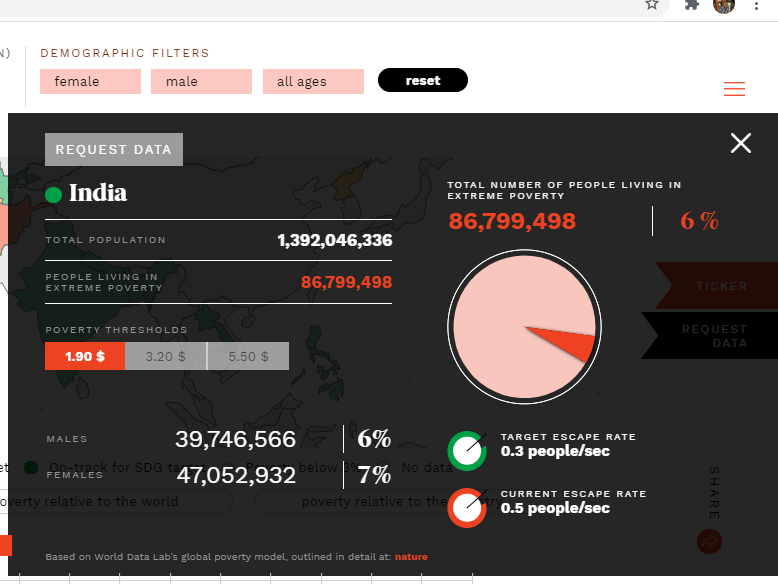
Whereas, India has 86.7 million which makes it 6 per cent of its nearly 1.4 billion estimated population.

This figure still pegged Nigeria as the country with the most people in extreme poverty. As such, the claim by   Abubakar is TRUE.

The World Poverty Clock data is updated in April and October.


Source: Wworld Data Lab
The world poverty clock showing Nigeria’s extreme poverty data.
The world poverty clock showing India’s extreme poverty data.

CLAIM 2

Is Nigeria the world capital for out-of-school children?

Earlier in 2021, the Minister of Education for Nigeria, Adamu Adamu, said the number of out-of-school children which was 10.1 million in 2019 had reduced to 6.946 million in 2020.

However, by March 2021, the country’s Minister of State for Education Emeka Nwajiuba said the figure has increased by 3.054 million bringing the total to 10 million out-of-school children.

Nwajiuba, while speaking at the official flagging off of the World Bank-sponsored Better Education Service for All (BEDSA) in Dutse, Jigawa State, said: “With an estimated 10,193,918 children out-of-school, Nigeria has the highest number of out-of-school children in Sub-Saharan Africa.”

The United Nations Children Fund (UNICEF) spokesperson in Nigeria, Geoffrey Njoku, in response to the FactCheckHub enquiry, if Nigeria is the world capital for out-of-school children, said: “I don’t think so. It should be India or Pakistan.”

He directed the FactCheckHub to the UNICEF’s website.

A report on the website places Nigeria out-of-school children at 10.5 million, another report places India’s number at about 6 million and another report places Pakistan’s number at 22.8 million. This report went on to state that “Pakistan has the world’s second-highest number of out-of-school children (OOSC) with an estimated 22.8 million children aged 5-16 not attending school”, it, however, did not state the first.

These reports were all not dated as such it cannot be determined at what point did these countries have these figures.

UNESCO Institute for Statistics database (UIS) records no entry for Nigeria’s out-of-school children.

Missing data

Data released in November 2019 by UNICEF has the figure for Nigeria missing. The data from The World Bank has no entry for Nigeria, Pakistan and some other countries. The same applies to data from UNESCO Institute for  Statistics (UIS) database which uses dots to signify “Data not available”.

A UIS Fact Sheet, no 56, released in September 2019 puts the countries with the highest out-of-school rates to include South Sudan (62%), Equatorial Guinea (55%), Eritrea (47%), and Mali (41%).

This shows that Nigeria does not have the highest out-of-school rate, it however does not answer the question if Nigeria has the highest number (population) of out-of-school children. As such, the available information cannot debunk or substantiate the claim.

CLAIM 3

Is Nigeria the nation with the highest unemployment rate on earth?

The International Labour Organisation (ILO) has certain criteria to determine unemployment, some countries apply only a part of these criteria. This inevitably distorts cross-country comparisons.

As a result of this disparity, the claim by Abubakar that Nigeria is the nation with the highest unemployment rate on earth would be tested against various rankings and also the harmonised ranking by ILO.

Key terms

The labour force consists of all employed and unemployed people within an economy. While Unemployment refers to the part of the labour force that is without a job and has been seeking employment and the Unemployment rate is the proportion of the labour force that is without a job but is available and actively looking for work.

Source: NBS

The Nigerian National Bureau of Statistics (NBS), considers an individual, between ages 15 to 64, unemployed, if he or she has no work or worked for less than 20 hours within the reference period which is a week.

The most recent data from the NBS as at when this claim was made is for the fourth quarter of 2020. This data has the country’s unemployment rate at 33.3 per cent for a labour force population of 69.8 million and a total unemployed population of 23. 2 million.

However, the NBS stated that using the international standard to compute  Nigeria’s unemployment rate will be 17.5 per cent.  This puts Bosnia & Herzegovina and Namibia at the top of the list with 33.7 per cent and 33.4 per cent respectively.

The ranking done by  Trading Economics also lists Bosnia & Herzegovina and Namibia at the top with  33.89 per and  33.4 per cent respectively.

Source: Trading Economics

The World Population Review also ranked Burkina Faso top with 77 per cent.

However, the Index Mundi, citing the CIA World Factbook which was updated on January 21, 2021, placed Bosnia and Herzegovina at number 10 while Burkina Faso tops the list at 77 per cent.

Source: World population Review
Source: World Population Review

ILO harmonised unemployment rate for countries

As a result of the disparity in the selection of criteria by different countries, ILO harmonises the data to ensure comparability across countries and over time by accounting for differences in the data source, the scope of coverage, methodology, and other country-specific factors.

From the data presented by The World Bank and dated January 2021, Nigeria’s unemployment rate which stood at 9 per cent does not top the table list whereas South Africa has 28.5 Botswana 17.2, Libya 18, Gabon 20.5, Namibia 20.4.

This and the different sources presented above negates the claim that Nigeria is the unemployment rate capital on earth.

THE VERDICT 

The claim that Nigeria is the world headquarters for extreme poverty is TRUE.

Secondly, there is no enough data to substantiate or debunk the claim that Nigeria is the world capital for out-of-school children.

However, the claim that Nigeria is the nation with the highest unemployment rate on earth is FALSE. 

Did Pantami say Nigerians risk imprisonment for not having NIN?

ON FRIDAY, April 2, 2021, many Nigerian dailies and blogs reported that enjoying specified government services without a National Identification Number (NIN) risks 14 years jail term.

This was attributed to the Minister of Communications and Digital Economy, Isa Pantami.

He was said to have made the claim at the sixth edition of the ministerial briefing organised by the Presidential Media Team, at the Presidential Villa, Abuja on April 1.

The  Channels Televison, Livetimesng and National mirror online had similar variations of this headline “Nigerians without NINs risk 14-yr jail term, says FG” used by the Guardian.

Headlines from different media platforms.

THE CLAIM

The Minister of Communications and Digital Economy, Isa Pantami said Nigerians without National Identification Number (NIN) risk 14 years jail term.

THE FINDINGS

The FactCheckHub findings show that the claim is FALSE.

The minister as seen in a video from the event  here,  stated that the law to sanction people using certain services without NIN has been in existence for 14 years now. He started by listing the services. He said:

National Identity is a law and it’s mandatory and for you to conduct certain activities without the number is an offence. For you to get a voter’s card in Nigeria based on Section 27 of the NIMC Act, it is an offence.

For you to open a bank account without a National Identity Number is an offence. For you to pay tax is an offence. For you to collect pension it is an offence.

For you to enjoy any government service without having a National Identity Number is an offence.

Section 29 says if you do any of these in Section 27 without obtaining National Identity, you have committed a crime that will lead to fine or imprisonment or both of them and this is 14 years, not today.

The phrasing of Pantami’s sentence “this is 14 years” is what led to the confusion. However his addition of “not today” puts the phrase in context. It is referring to something that has happened in the past.  In this case when the law came into existence.

Section 27 of the NIMC Act lists where use of NIN is mandatory.

In addition, Pantami has clarified on his twitter page that he was not referring to “14 years imprisonment” rather “NIMC has been 14 years in existence, since 2007”.

A screenshot of Panatami’s tweet.

The NIMC Act which penalises using of certain social infrastructures without a NIN came into existence in 2007. This makes it 14 years old in 2021.

What is the penalty for accessing services without NIN? 

Section 29 of the NIMC Act enumerates the offences and penalties for carrying out or permitting use of services listed in section 27 without the NIN.

It states that a person who carries out or permits the carrying out of any transaction specified in section 27  without a NIN commits an offence and shall be liable to a fine of not less than N50,000 or imprisonment for a term of not less than  6 months or both.  Whereas  cooperate body gets not less than  N1 million fine among others.

Section 29 of the NIMC Act on Transaction without a NIN.

THE VERDICT

The claim that the Minister of Communications and Digital Economy, Isa Pantami said Nigerians without National Identification Number (NIN) risk 14 years jail term is FALSE.


Ezekwesili, others mull new approach against fake news

NIGERIA’s former Minister of Education, Dr Oby Ezekwesili, on Wednesday, disclosed the need to consider motivating purveyors of factual information, through incentives as a way of discouraging the spread of fake news.

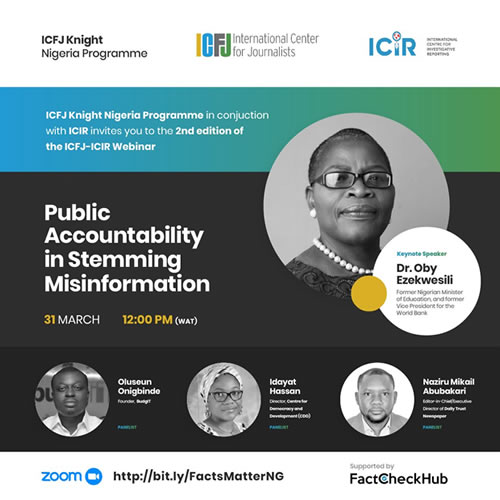
Ezekwesili made the call during a webinar jointly organised by the International Centre for Investigative Reporting (ICIR) with the International Center for Journalists (ICFJ) Knight Fellowship in Nigeria.

The maiden edition held last year had the Minister of Youths and Sports Development, Sunday Dare, as the keynote speaker.

In her keynote address at the conference themed, ‘Public Accountability in Stemming Misinformation,’ Ezekwesili said aside from the incentives, such a system would also reduce the credibility of those notorious for sharing misinformation.

The initiative is to be developed through collaborations with the public and media, and the group would determine the trust points as well as indicators on how the trust should be measured, she noted.

For every solution, we must consider for reducing or ensuring people are accountable for fake news, we need to think incentive and disincentive based approach. That is an approach that rewards a record of consistent dissemination of facts, truth.

That system that makes a person a purveyor of accurate information, especially those with strong followers and are sufficient to influence what others may think or do.

“The system would also deduct trust points in case unverified news are disseminated by the newsmakers or social media influencers.”

According to her, “the erosion of trust points overtime will signify a red flag anytime news comes from such individual or individuals.”

Besides, the former World Bank vice president, Africa region, identified the need to overwhelm ‘the market of news’ with accurate, evidence-based reporting. The continuous publication of factual information, she said, would overshadow false information.

While she spoke on being mindful of the inalienable right of the freedom of information of the people, in the guise of fighting fake news, the media is expected to perform its education function, thus teach the public in the simplest, plain language.

In the area of legislation, Ezekwesili kicked against the proposed social media bill, saying it would only repress the people. She tasked the relevant government institutions to remain alive to their responsibilities as there is an existing law that addresses issues of defamation, libel and the likes.

Earlier, the Executive Director of The ICIR, Dayo Aiyetan, said while holding people who deliberately post fake news to account, there is the need to look at the responsibility of the ordinary man who tends to look at misinformation warfare.

Citing Femi Fani-Kayode, a former Aviation Minister, as an instance, he said the politician had discouraged people from taking the COVID-19 vaccine through unverifiable assertions that it was meant to depopulate Africa. Still, the same minister recently took the COVID-19 vaccine.

The FactCheckHub, he said, has been deliberate in creating explainer videos, and training people to make everyone a fact-checker.

He also called for collective responsibilities from the government, Civil Society Organisations, stakeholders and the important role of the general public to check the spread of misinformation.

“We need to increasingly look at the responsibility of the ordinary man who becomes the weapon to use in the misinformation warfare. At the end of today, we hope we will have sensitized the public to combat misinformation.

“It is not the job of the government, civil society and the media alone. Everyone must be involved.”


The executive director/ editor-in-chief of Daily Trust newspapers, Naziru Mikail Abubakar, shared similar positions with Aiyetan and the former minister.

But, in his remarks, he encouraged both the legacy media and digital media to take active participation in combating misinformation.

The digital media organisations, he said, have bigger responsibilities to play.

Abubakar advised on the need for journalists’ training, media collaborations, investigative journalism, fact-checking, and self-examination.

Beyond media training initiated by local and international Non-Governmental Organisations (NGOs), he tasked local media with best practices, stressing the need to set up a dedicated fund for the capacity building of journalists.

He also advised journalists to get the right modern tools.

Abubakar, who called for more investigative reporting encouraged local fact-checking organisations to increase fact-checking efforts, rather than republishing verified claims published by international fact-checking organisations.

“Government officials are making false statements. Some of these are false claims that should be fact-checked. If it is difficult to do individually, media organizations should collaborate with each other to make this possible.”

The Executive Director, Centre for Democracy and Development (CDD), Idayat Hassan, expressed worry on how fake news could impact the nation’s democracy.

She observed the benefits of social media as a tool that enabled the people to influence government policies, gave voices to the marginalised, but it is something that requires more attention.

Examining the difference between misinformation and disinformation, she highlighted the deliberate intent of the purveyor.

“The automation in disinformation in Nigeria is huge with 19.5 per cent. And the tools used include Nairaland, Facebook, Twitter, WhatsApp and the recent one is Opera News.” She said.

However, in providing a lasting solution against the menace, Hassan advised the use of audio, picture, video to spread factual information. Beyond these, she also identified the adoption of local languages.

“There is a need to construct an informal structure that would resonate with the people.”

The founder of BudgIT, Seun Onigbinde, was the last panellist. In his topic titled, Digital Advocacy and Public Enlightenment on Social Media, he also described fake news as an extension of malicious reporting.

In the process, he explained the dynamism and how people react to information on each of the social media platforms, such as Twitter, Facebook, LinkedIn, WhatsApp.

Describing the distinctiveness as ‘spirit of the medium’, he advised media firms to shut down trolls.

In addition, Onigbinde urged the tech giants to design special algorithms that could discourage fake news, as well as spotting and delegitimising its purveyors.

He said there is a need for more advocacy for the tech giants to play an important role in addressing fake news.

Ezekwesili, other panellists at ICIR, ICFJ webinar mull new approach against fake news

0

Nigeria’s former Minister of Education Dr Oby Ezekwesili says there’s a need to consider motivating purveyors of factual information through incentives to discourage the spread of fake news.

Ezekwesili made the call during a webinar jointly organised by the International Centre for Investigative Reporting (ICIR) and the International Center for Journalists (ICFJ) Knight Fellowship in Nigeria.

How to archive posts for future reference

There are several reasons why you may want to keep a post or content you saw online for future reference.

One of such reasons is if you are fact-checking claims made by people.

It has been argued that sharing a direct link to a false claim made on social media in your report is giving publicity and traction to the user who shared the misinformation or disinformation.

To solve this conundrum, it’s better you archive the post.

There are different platforms that offer archiving services.

One of such is the  Wayback Machine. This is a digital archive of the World Wide Web, founded by the Internet Archive, a nonprofit library based in San Francisco, United States. It is a web archiving tool, which is a repository of stored information. It does this by taking snapshots of web pages.

Archive Today is also another time capsule for web pages. It takes a ‘snapshot’ of a webpage so that it can still be online even if the original page disappears or is deleted.

“It saves a text and a graphical copy of the page for better accuracy and provides a short and reliable link to an unalterable record of any web page,” it noted on its homepage.

To use Archive Today, here are the steps:

    1. Visit archive.is through the address bar of your internet browser.
    2. Copy the URL (website link) of the post you want to archive and paste in the red bar provided for it.
    3. Then, click Save.
The homepage for Archive Today.

4. Hold on while it saves the page. This will take a few minutes.

5. Once the archiving is completed, it will display a notification page.

An archived tweet for tutorial purpose only.

How to retrieve an archived post

To retrieve a saved post on the Wayback Machine:

  1. Visit archive.org through your web browser (Mozilla, Internet Explorer, Google Chrome, etc)
  2. Enter the URL or internet web link of the post to the address bar of the Wayback machine (e.g https://twitter.com/NNPCgroup/)
  3. Click on browse.
  4. A calendar will be displayed and the date(s) the post was archived highlighted.
  5. Click on the highlighted date. It will display the archive post.
  6. Alternatively, if you do not have the URL you can use keywords to search.
The highlighted date on a calendar showing when a post was archived.

Ezekwesili, others headline ICIR, ICFJ Knight Fellowship webinar on misinformation

0

The International Centre for Investigative Reporting (ICIR) in conjunction with the ICFJ Knight Fellowship in Nigeria will on Wednesday, March 31st, 2021, hold a webinar on stemming misinformation.

This is in keeping with the The ICIR interest in dispelling misinformation which led to setting up its fact-checking operation The FactCheckHub.

Dr. Oby Ezekwesili, former Minister of Education, and former Vice President for the World Bank, Africa region, would deliver the keynote address of the conference themed, “Public Accountability in Stemming Misinformation.”

The panelists scheduled to speak at the conference include Naziru Mikail Abubakar, the Executive Director/Editor-in-Chief of Daily Trust newspapers, Idayat Hassan, Executive Director of the Centre for Democracy and Development (CDD) and Oluseun Onigbinde, Founder of BudgIT.

Intending participants are expected to register for the webinar, which will commence  12 noon via this link.

Hannah Ajakaiye, the ICFJ Knight fellow for Nigeria who will moderate the event, said the webinar will curate discussions around combating the misinformation pandemic and galvanize citizens to advocate for good governance.

She added that, the event will arm the citizens with ideas on how they can promote public accountability through fight against misinformation and disinformation.

“The virtual event promises to be a well-rounded discussion intellectual guaranteed to provide possible solutions and ideas on how citizens can promote public accountability by owning the fight against misinformation and disinformation in the Nigerian society”, she noted

In 2020 the ICIR and the ICFJ hosted a similar webinar where the Minister of Youth and Sports, Sunday Dare delivered the keynote speech.


FG is NOT giving out COVID-19 ‘survival fund grant

0

A VIRAL post circulating on WhatsApp claims the Federal Government of Nigeria is giving out COVID-19 survival fund grant.

According to the broadcast message retrieved on March 25, 2021, the Federal Government of Nigeria will give N30,000 to successful applicants.

It reads:

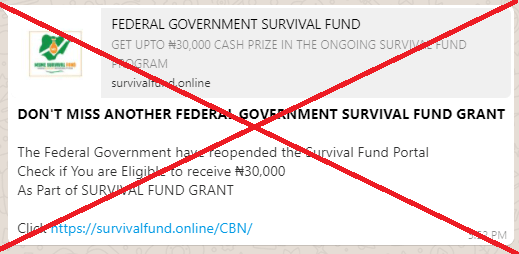
[sic] DON’T MISS ANOTHER FEDERAL GOVERNMENT SURVIVAL FUND GRANT

The Federal Government have reopended the Survival Fund Portal

Check if You are Eligible to receive ₦30,000

As Part of SURVIVAL FUND GRANT

THE CLAIM

The Federal Government is giving out N30,000 COVID-19  survival fund grant.

A screenshot of the claim as shared on WhatsApp.

THE FINDINGS

Findings by the FactCheckHub show that the claim is FALSE.

SEE ALSO: Again, False claim circulates that Nigerian Government is giving out N10,500 weekly COVID-19 support

The FactCheckHub observed that the website in the broadcast post is different from the website specified for survival fund set up by the Federal Government of Nigeria for the Micro, Small and Medium Enterprises (MSME).

The official survival fund website is https://survivalfund.gov.ng/

The FactCheckHub also observed that the website is a phishing website that seeks to gain traffic by prompting people to share on WhatsApp groups.

The FactCheckHub has in the past written on how people can spot such phishing ploys and websites.

You can also watch the tutorial video below.

Read also: Nigerian govt is not giving out N10,500 weekly COVID-19 support

THE VERDICT

The claim that the Federal Government is giving out N30,000 COVID-19 second wave survival fund is FALSE. The url (link) attached to the claim directs to a phishing website.