Please note that the FactCheckHub has not obtained any right from the authors or copyright owners of all third-party contents from embedded links and shall incur no liability in this regard.
Please note that the FactCheckHub has not obtained any right from the authors or copyright owners of all third-party contents from embedded links and shall incur no liability in this regard.
Please note that the FactCheckHub has not obtained any right from the authors or copyright owners of all third-party contents from embedded links and shall incur no liability in this regard.
Please note that the FactCheckHub has not obtained any right from the authors or copyright owners of all third-party contents from embedded links and shall incur no liability in this regard.
NIGERIA’s Minister of Information and Culture, Lai Mohammed, has said the 2022 Global Media and Information Literacy (GMIL) Week of UNESCO, will give a boost to the federal government’s war against hate speech, fake news and misinformation.
The Minister stated this in Abuja on Friday while inaugurating the 25-member Local Organizing Committee (LOC) for the event, which will take place in Abuja from October 24th to 31st.
Mohammed said that Nigeria was considered to host the confab because the country is known as a strong advocate of Media and Information Literacy (MIL).
He said, “Hosting the 2022 GMIL will go a long way to address the growing trend of fake news, misinformation, and hate speech, thus enhancing the campaign we launched in 2018 against these practices.
“In 2013, Nigeria successfully hosted the First Global Forum for Partnership on MIL, tagged Abuja 2013. This Forum gave birth to the UNESCO MIL Alliance as well as other initiatives, as part of our collective desire to achieve Media and Information Literacy for all and by all.
“Nigeria’s contributions towards the birth and the growth of MIL, especially in the West African Sub-Region, played a large role in UNESCO’s decision to offer our country the right to host this event.”
The minister also urged the LOC members to use their wealth of experience to organise a successful event, adding that nothing less is expected from such a high-caliber committee.
“Since we agreed to host the 11th edition of the Global Media and Information Literacy Week, we have been working with the UNESCO Secretariat, UNESCO Regional Office, Abuja and other stakeholders to host the world for a befitting and memorable event. A critical aspect of this preparation is the choice of the theme and the development of the Concept Note. Permit me to inform you that both have successfully been concluded.
“Accordingly, the theme of this year’s Global Media and Information Literacy, which has been duly approved by UNESCO, is: ‘Nurturing Trust: A Media and Information Literacy Imperative.’ The theme highlights how Media and Information Literacy (MIL) helps with nurturing trust and countering mistrust.”
He also used the occasion to unveil the MIL Week Logo, saying the conference would witness participants from over 193 UNESCO member countries.
THE Nigerian Government says it is collaborating with Google to curb the spread of hate speech and disinformation on YouTube channels.
The Minister of Information and Culture, Lai Mohammed, stated this when a team from Google Inc. visited him in Abuja on Thursday.
The minister expressed delight that both the Federal Government and Google shared the same concern on the responsible use of social media.
“We want Google to look into how to tackle the use of private and unlisted YouTube channels and YouTube live streams by proscribed groups and terrorist organizations. Channels and emails containing names of proscribed groups and their affiliates should not be allowed on Google platforms,” he said.
Mohammed further implored Google to deny IPOB the use of its platform for its acts of violence and destabilization.
He said that Nigerians are among the most vibrant social media users in the world, with over 100 million Internet users in the country, and that internet platforms such as Google, Facebook, TikTok, Twitter and WhatsApp enable Nigerians to interact, share ideas, earn a living and participate in social and political affairs.
The minister however observed that those platforms are also used by unscrupulous persons or groups for subversive and nefarious activities.
Mohammed noted that the Nigerian Government recently proposed a “Code of Practice for Interactive Computer Service Platforms/ Internet Intermediaries” in an attempt to provide a framework for collaboratively protecting Nigerian users of internet platforms.
“This code couldn’t have come at a better time, as the country prepares for general elections next year. We are committed to working with platforms like yours as well as the civil society, lawyers, media practitioners and other relevant stakeholders to ensure responsible use of the internet and to protect our people from the harmful effects of social media,” he said.
In his remarks, Google’s Regional Director, Sub-Saharan Africa, Government Affairs and Public Policy, Charles Murito, said the platform has introduced a programme called “Trusted Flaggers” for citizens trained to track and engage with online content to flag the contents of serious concern.
“As I mentioned earlier, we share the same sentiments, we share the same goals and objectives and we do not want our platform to be used for ill purposes,” he said.
On his part, Google’s Government Affairs and Public Policy Manager, Adewolu Adene, said “Equiano”, a subsea cable that recently berthed in Nigeria from Portugal, is aimed at enhancing connectivity and access to the internet as well as driving down the cost of data, in order to create jobs and facilitate the transfer of knowledge.
He said through the Google News Initiative Challenge, 30 media platforms, with 5 from Nigeria, including the Dubawa fact-checking platform, would be awarded a $3.2 million grant in recognition of their innovative work in information dissemination.
Adene also pledged the readiness of Google to work with the Federal Ministry of Information and Culture to digitize the recently repatriated artifacts to preserve and market them to a global audience through Google Arts and Culture.
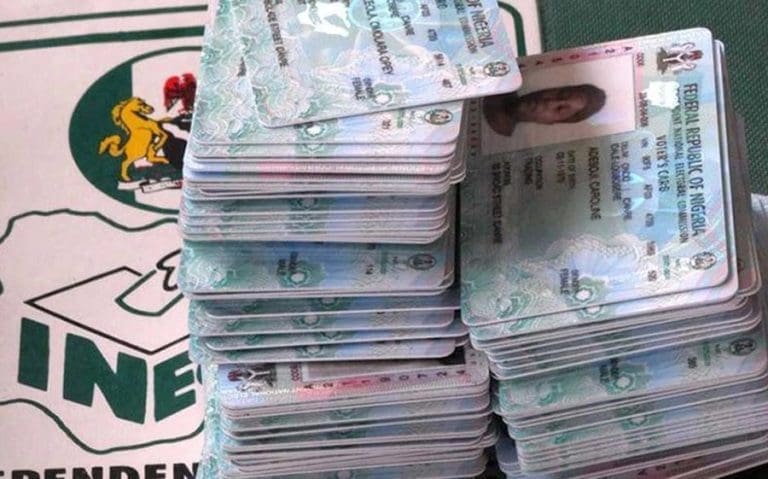
JUST as the Continuous Voters’ Registration (CVR) exercise embarked upon by the Independent National Electoral Commission (INEC) was winding down in July 2022, fake websites advertising voter’s card registration circulated online.
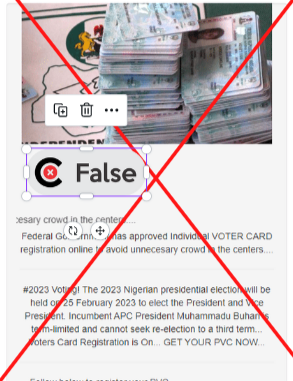
The web links were shared alongside some texts on social media. One of such posts circulating on WhatsApp read: “Federal Government has approved Individual VOTER CARD (PVC) registration online to avoid unnecessary crowd in the NIMC centers. Enroll Now”.
It also directs users to a website for registration, alongside a claim that the Nigerian government has approved individual voter card registration online.
The INEC is the umpire that statutory oversees elections in Nigeria.
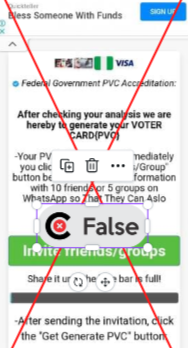
The screenshot of the phishing website.
Checks by The FactCheckHub show that the claim is FALSE.
Apart from the fact that the phishing website attached to the claim is different from the INEC’s CVR portal, it is also riddled with grammatical and spelling errors.
The second page of the website requests biodata, while the third page, like every other phishing websites, prompts users to share the web link to several individuals or groups on WhatsApp.
This is one of the characteristics of scam and phishing websites observed by The FactCheckHub in the report about scam sites in Nigeria.
Screenshot of the third page of the phishing website
Further findings revealed that the just-concluded exercise by the INEC on its portal is known as Continuous Voters Registration (CVR).
It is strictly done on the INEC portal and allows users to update their voter registration information, pre-register as a new voter or transfer voter registration to another polling unit.
Similarly, the INEC on Monday, August 1, 2022 disowned the fake websites and warned Nigerians not to fall victims.
In a statement signed by National Commissioner Festus Okoye and reported by Channels TV, INEC said it has concluded its Continuous Voter Registration exercise for the 2023 general elections.
“The Commission states unequivocally that the site is not linked to the Commission and the link/portal is spurious and from a dubious source.
“Members of the public are strongly advised not to succumb to the antics of online scammers and should avoid such fake sites.
“The Commission has concluded the Continuous Voter Registration exercise nationwide and does not need to open an additional site or portal for the purposes of registration of voters,” the statement partly read.
In June 2021, when the INEC commenced the CVR exercise to enroll those who have attained the legal age of 18, The FactCheckHub reported similar fake websites which went viral on WhatsApp at the time.
The FactCheckHub has observed, over time, a trend that scammers usually ride on to carry out their phishing activities and has highlighted how to spot such in order not to fall victim to their scams.
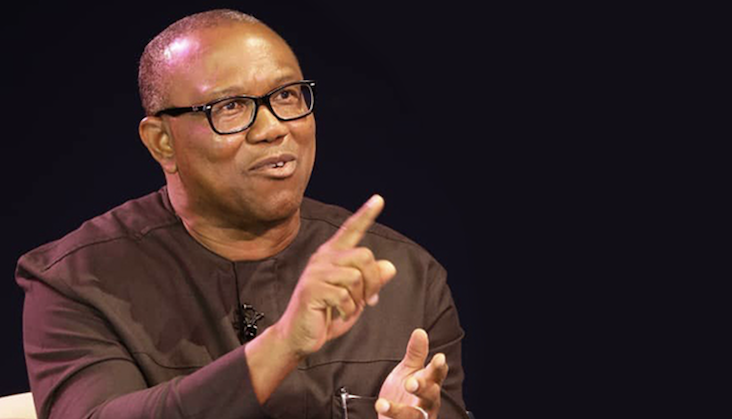
THE presidential candidate of the Labour Party, Peter Obi, has claimed that Nigeria’s total export was less than 30 billion US dollars in 2021.
According to a report by The Punch, Obi made this claim while speaking in Umuahia, Abia State capital, on Saturday, 23rd of July, 2022 during a non-denominational prayer organized by the Catholic Diocese of Umuahia.
A report by Vanguard also quoted Obi making the claim.
“All I’m saying is that you should go and verify and ask those who want to become your president what they did and what they want to do.
“Nigeria is a country with 923000 square kilometres of land, and a population of 200 million people. God blessed us with oil and other resources. We have over 100 million people living in poverty.
“But to show that we are not a producing country, last year, our total export including oil was less than 30 billion dollars, that is why we can’t find dollars today,” Obi said.
Obi is contesting for the office of President in Nigeria’s 2023 general election.
CLAIM
Peter Obi claimed that Nigeria’s total export was less than 30 billion dollars in 2021.
But is Nigeria’s total export less than 30 billion dollars in 2021?
Findings by The FactCheckHub show that Obi’s claim that Nigeria’s total export including oil was less than 30 billion dollars in 2021 is FALSE.
Nigeria’s exports are goods grown, extracted or manufactured in Nigeria and are transported to another country for sale or trade. It is a crucial element of a country’s economy.
An infographic showing Nigeria’s total exports from 2018-2021.
In Nigeria, it is divided into oil and non-oil exports. However, oil exports are the dominant portion of Nigeria’s export revenues.
India remains the top export destination for Nigeria with 16.4% (US$7.8 billion) of total Nigeria exports in 2021. Others were Spain, France, The Netherlands, Canada, USA, Italy and Indonesia.
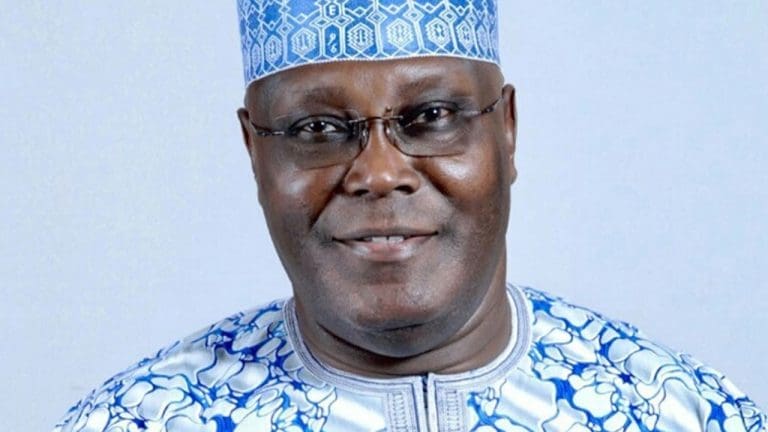
THE presidential candidate of the Peoples Democratic Party (PDP) Atiku Abubakar has claimed that 90 per cent of Nigerians from the Northern part of the country are not on social media.
The former vice president made the claim in an exclusive interview with Arise TV, aired on Friday, July 22, 2022.
This is coming as Peter Obi, the candidate of the Labour Party (LP) is reportedly known for having many supporters on social media especially on Twitter even though his party, allegedly, does not have strong grassroot structures across the states of the Federation.
Atiku argued that this development would limit the chances of Obi winning the 2023 presidential election.
“So, it is very difficult to expect a miracle to happen, simply because Peter Obi is in the Labour Party. After all, they were saying through social media, that they had more than one million votes in Osun state.
“But how many votes did Labour Party get in Osun? And then again, mark you, you’re talking about social media. In the north, 90 per cent of our people are not tuned to social media,” he said.
Both Atiku and Obi are among the candidates from various political parties contesting Nigeria’s 2023 presidential election.
But how accurate is Atiku’s claim?
According to the Nigeria Digital Data 2022 report by datareportal, there were 32.90 million active social media users in Nigeria as of January 2022 – equivalent to 15.4 per cent of the country’s total population put at 214.1 million in the report.
According to the data, Facebook and Facebook messenger had 26.10 million and 4.05 million users respectively; Instagram had 9.05 million users; YouTube had 32.90 million users; LinkedIn had 6.30 million members; Snapchat had 9.50 million users and Twitter had 325.4 thousand users.
Northern Nigeria comprises three geo-political zones, namely the North-West, North-East and North Central.
Though the national population census has not been carried out since 2006; but the current population of Nigeria is 216,687,552 as of Thursday, July 28, 2022, based on Worldometer elaboration of the latest United Nations data, which was also published on the National Population Commission (NPC) website.
However, the Nigeria Population Projection and Demographic Indicators-State and National, published by the NPC in 2020 stated that the country’s total population is expected to be 216,783,381 by 2022. This year, the male population is projected to be 108,350,410 while the female population is 108,432,971.
The nineteen Northern states plus FCT account for 122,305,437 of the entire projected population for the year 2022.
Based on the projection analysed by The FactCheckHub, North Central has a population of 31,613,217; North-West has 60,150,348 and North-East has a population of 30,541,872 people.
Though there is no publicly available data which provides the estimate of social media users based on region or according to states of the Nigerian federation, a report by the Nigerian Bureau of Statistics (NBS) titled “Telecoms Data: Active Voice and Internet per State” shows that a total of 145,851,496 Nigerians were active on the internet in the first quarter of 2022.
According to the data, Northern states account for 68,531,602 of the population of internet subscribers in the country. North Central records 27,476,820 internet subscribers while North West records 26,912,492 internet subscribers. North East, which had the lowest subscribers in the region, records 14,142,290 internet subscribers.
Infographic showing the number of active internet subscribers in Northern Nigeria
Comparing it with the 2022 population projection, about 86.9 per cent of the population subscribe to the internet in North Central, 44.7 per cent in North-West and 46.3 per cent of the population subscribe to the internet in the North-East.
In total, 56 per cent of the entire Northern region’s population in the country subscribes to the internet.
The above analysis casts a doubt on the accuracy of Atiku’s claim because a large majority of internet users make use of social media in one way or the other, according to a social media poll result by the NOIPolls.
Doctors, scientists, among other health professionals, have banded together to amplify health-related information on the microblogging platform, Twitter.
The team, which comprises health professionals from various institutions, was formed to combat health misinformation on Twitter, following the widespread false information that trailed the emergence of the COVID-19 pandemic across the world.
Called the health professional amplifier, the team tweet accurate health and safety information about the coronavirus.
Dr. Regina Royan, the first author of a new Northwestern Medicine paper, while explaining the genesis of the group said they amplify one another “to combat misinformation and drown out some of the noise.”
Royan is a member of the Illinois-based health professional amplifier, known as the Illinois Medical Professional Action Collaborative Team (IMPACT), which uses the verified Twitter handle @IMPACT4HC.
Royan, alongside her fellow medical professionals, explained in the paper published on July 22 in the Journal of Medical Internet Research, how successful the group has been.
The study is titled, “Use of Twitter Amplifiers by Medical Professionals to Tackle Misinformation During the COVID-19 Pandemic.”
Other Northwestern authors include Dr Seth Trueger and Tricia Pendergrast.
They noted that it has been an effective tool to disseminate accurate medical information and combat disinformation while minimizing the harm related to personal and professional harassment that can come with social media advocacy.
Royan (@reginaroyan), who is the emergency medicine research fellow and clinical instructor of emergency medicine at Northwestern University Feinberg School of Medicine, said, “The pandemic has been really taxing for health professionals.”
“In addition to the emotional toll caring for these very sick patients, particularly in the early waves of the pandemic, the politicization around COVID-19 added another layer of stress for many of us. One thing we highlight in this paper is that this kind of groups can be a safe space for health professionals to talk about issues like harassment on social media to keep the fight against misinformation going.”
The issues include the effectiveness of masking and social distancing, and how mRNA was used to create the Pfizer-BioNTech and Moderna COVID-19 vaccines.
IMPACT and other health professional amplifiers are comprised of nurses, health economists, scientists, public health professionals, and physicians.
They’ve endured public harassment and attacks after posting scientifically proven medical information about the COVID-19 virus and vaccines.
“We know that COVID-19 has disproportionately affected the Latino population, and it’s been important to us to partner with community organizations like Illinois Unidos to ensure that we are also addressing misinformation with Spanish-language resources,” Royan said.
The group has recently begun to combat false information about reproductive health issues following the U.S. Supreme Court’s overturning of Roe vs. Wade.
Also, they have started disseminating information about firearm injury, such as a recent tweet that stated, “Fact: Mental illness is not an effective predictor of gun violence against others.”
Meta Platforms Inc., the parent company of Facebook, says it is considering reviewing its policies on COVID-19 misinformation.
In addition, it said that it is proposing a shift from removing false claims to simply labeling or demoting them on its social media platform.
Nick Clegg, Meta’s president of global affairs disclosed this in a blog post.
“We’re asking the Oversight Board whether our current COVID-19 misinformation policy is still appropriate. Under this policy, we began removing false claims about masks, social distancing, vaccines and more.
“Meta remains committed to combating COVID-19 misinformation and providing people with reliable information,” part of the statement read.
“As the pandemic has evolved, the time is right for us to seek input from the Oversight Board about our measures to address COVID-19 misinformation, including whether those introduced in the early days of an extraordinary global crisis remain the right approach for the months and years ahead,” Clegg said.
Meta’s current policies explicitly ban a wide array of false contents about Covid-19, such as that the illness can be transmitted by 5G wireless technology or that Covid-19 tests can infect you with the virus.
Clegg said the company has listed as many as 80 distinct types of false claims that are subject to removal from its platforms and has removed more than 25 million pieces of violative content.
He explained that Meta’s original decision to begin removing those claims was an unprecedented step brought on by the global health emergency.
“The change meant that, for the first time, the policy would provide for the removal of entire categories of false claims on a worldwide scale,” he wrote.
Clegg described the company’s decision, and its request for an Oversight Board opinion, as an effort to resolve “inherent tensions between free expression and safety.”
A WEB portal allegedly from the National Population Commission (NPC) is circulating on social media with a claim that the Commission is receiving applications from eligible Nigerians for the NPC ad-hoc recruitment exercise.
The post, which was retrieved from WhatsApp groups, includes a web link purported to be the official recruitment portal launched by the Commission. The portal listed the requirements for the recruitment exercise.
The post read:
“NATIONAL POPULATION COMMISSION E-RECRUITMENT EMPOWEREMENT 2022/2023
The National Population Commission has Launched its recruitement Empowerements portal ahead of 2022/2023 and the about to start trial census.
How to apply for NPC Adhoc Recruitment:
Interested and Eligible NIGERIANS who are willling to apply for the recruitment are to visit the official site.
REQUIREMENTs:
1. APPLICANTS MUST BE NIGERIAN BY BIRTH
2. VALIDATORY I.D CARD
3. APPLICANT MUST POCESS ATLEAST
OND
HND
BS.c
NCE
SSCE
NOTE: APPLICANTS MUST NOT BE MINOR i.e Under 18”
Screenshot of the viral post retrieved from a WhatsApp group.
The National Population Commission (NPC) is the principal demographic government agency in Nigeria responsible for generating data about the country’s population.
The Commission had revealed plans to conduct a fresh national population census in 2023.
The NPC Chairman, Nasir Isa-Kwarra, had earlier disclosed that there would be a trial census that would run from June 27 to July 30, 2022, with coverage of about 7,718 enumerated areas.
Similarly, Deji Ajayi, who is the NPC Commissioner representing Ekiti State had said that the Commission would recruit not less than one million personnel for the conduct of the 2023 national census.
Ajayi said the recruitment for the 2023 census will be done electronically because “census is a massive operation that will engage one million personnel and managing such a huge workforce manually will raise huge logistical and documentation challenges.”
“This is the first time we will be doing a paperless census, everything will be digital to check corruption and bring about accurate data that can help national development,” he added.
CLAIM
The National Population Commission (NPC) is receiving applications from Nigerians for the NPC ad-hoc recruitment exercise.
A screenshot shows the webpage view of the viral link.
THE FINDINGS
Findings by The FactCheckHub show that the viral post in circulation is FALSE.
A click on the link, archived here, redirects intending applicants to web pages requesting their details such as name, email address, phone number, and password to apply.
Further checks show that the web link is fake as it was found to be a phishing website and not the official recruitment portal of the NPC as claimed in the viral post.
A phishing website, according to TechTarget, is a domain similar in name and appearance to an official website; they’re made in order to fool someone into believing it is legitimate.
The NPC had, on May 30, 2022, announced the opening of an e-recruitment portal for the recruitment of ad-hoc staff for the Trial Census exercise nationwide.
In a press statement signed by the Commission’s Director of Public Affairs, Isiaka Yahaya, the recruitment of the 14,461 field functionaries has been concluded and the Trial Census has since commenced.
“The attention of the National Population Commission has been drawn to the circulation on social media platforms of a fake ‘NPC Recruitment 2022/2023’ portal, inviting Nigerians to apply for employment for the Trial Census and the 2023 Census.
“The Commission wishes to state that this information is totally false, misleading, and should therefore be treated as a scam by fraudsters to swindle unsuspecting members of the public, particularly job applicants.
“The Commission disassociates itself from the portal and reiterates the fact that its recruitment portal for the ongoing Trial Census is no longer active and was shut down the moment the Commission concluded its recruitment process for the exercise.
“Furthermore, National Population Commission is taking every measure to uncover those behind the fraudulent recruitment site. Similarly, scammers are warned to desist from this inglorious act as the Commission will not hesitate to bring the full weight of the law to bear on perpetrators in its quest to conduct the first fully digital Population and Housing Census in Nigeria next year that will be credible and acceptable,” the statement read.
These claims usually follow a similar modus operandi by targeting areas that would be of interest to a lot of people.
They are often shared via the WhatsApp platform. Oftentimes, they impersonate a group, person, or organisation and they all have a web link they ask people to click.
The claim that the NPC is receiving applications from Nigerians for the ad-hoc recruitment exercise is FALSE; as findings show it is a phishing website.
FOLLOWING the collapse of Nigeria’s national electricity grid last week, a viral claim has circulated online.
The report, which was published by several blogs in Nigeria, claimed that last Wednesday’s collapse made it the 18th time the grid would collapse in the year 2022 alone.
“The National Grid on Wednesday suffered another system collapse resulting in blackout in many parts of the country.
“It was the 18th time a nationwide blackout would be recorded this year.
“While some collapses were not made public because they lasted for a short period, many others were made public and lasted days in some cases.
“Eko Electricity Distribution Company (EKEDC) confirmed the latest development in a statement on Wednesday,” the report published by The Paradise read in part.
THE CLAIM
The national grid has collapsed 18 times in 2022.
Screenshot of the claim as seen on The Nigerian Voice blog.
THE FINDINGS
Findings by The FactCheckHub show that the claim is FALSE.
According to the major newspapers in Nigeria, last Wednesday’s grid collapse was the sixth one this year (2022).
“Major Nigerian cities including the Federal Capital Territory were thrown into darkness on Wednesday when the country’s electricity grid collapsed.
“Electricity distribution companies announced Wednesday that the collapse occurred at about 11:00 a.m.
“Wednesday’s incident is the sixth reported collapse in 2022,” Premium Times report read in part.
Similarly, the EKEDC the blogs quoted in their reports did not in any part of the statement mention that the grid had collapsed eighteen times.
There is no evidence to support the claim made by the blogs that the grid had witnessed 18 collapses this year.
Also, prior to Wednesday’s collapse, a report by Ripples Nigeria, when the grid collapsed for the fifth time in June 2022, chronicled the timeline of the grid collapses as twice in March and twice again in April.
THE VERDICT
The claim that the national grid has collapsed 18 times this year is FALSE; as findings revealed that the grid had collapsed six times only this year.
Russia’s communications regulator, Roskomnadzor said the content includes “fake news” about the conflict in Ukraine.
The regulator said the Tagansky District Court fined Google 21.1 billion rubles for repeatedly failing to restrict access promptly to banned materials.
Tekedia reports that Alphabet Inc.’s YouTube has been a particular target of the state’s ire but was yet to be blocked unlike Twitter and Meta Platforms’ Facebook and Instagram.
The fine placed on Google was calculated as a share of Google’s annual turnover in Russia.
It had been handed a similar 7.2-billion-ruble penalty late last year.
Google’s Russian unit’s bank account has been seized, which has prompted the subsidiary to file for bankruptcy, making it impossible to pay staff and vendors.
Google, however, did not respond to a request for comment.
The Deputy Head of the Parliamentary Committee on Information Policy, Anton Gorelkin, said Google was showing a demonstrative disregard for Russian law.
He said, “It is not hard to predict what this attitude will lead to: Google risks losing the Russian market altogether.”