
Home Blog Page 84

TikTok announces measures to combat misinformation, hate speech ahead of Pakistan elections

0

TikTok has announced measures to combat misinformation, violence and hate speech to uphold election integrity in Pakistan as the South Asian country heads to the polls on February 8.

The video sharing platform widely embraced by millions of Pakistanis has faced backlash within the conservative part of the South Asian society. In recent years, Pakistani courts have prohibited the platform, citing its perceived negative effects on the younger generation.

In a press statement released on Tuesday, the platform says it has put robust measures in place to combat misinformation, violence, and hate speech in line with its community guidelines. It says it’s available in English and Urdu.

“The platform is dedicated to removing misleading information about civic processes, including voter registration, candidate eligibility, ballot counting, and election results,” it stated.

TikTok said its policies prohibit content that intimidates voters, suppresses voting, or incites violence, adding that it has deployed over 40,000 personnel globally to ensure user safety on the platform.

The platform said it works with local and regional fact-checkers that help it to remove election misinformation accurately. 

“Content under review or identified as unsubstantiated is restricted from the ‘For You Feed’ recommendation, and both viewers and creators are alerted about the potential misleading nature of such content,” TikTok said.

TikTok added its “Pakistan Election Center” hub will direct users to information on the national polls, including voting procedures and locations. 

It explained that it has designated policies for accounts that belong to a government, politician, or political party, removing their ability to give or receive money through advertising, fundraising, or TikTok monetization tools.

“Recognizing that global events often influence creative expression, TikTok remains dedicated to supporting its community in Pakistan and worldwide,” it stated.

According to a World Economic Forum (WEF) survey, information disorder is the second biggest risk to global economy and could undermine democracy and polarize society.

“Societies could become further polarized as people find it harder to verify facts, Fake information also could be used to fuel questions about the legitimacy of elected governments, which means that democratic processes could be eroded, and it would also drive societal polarization even further,” Carolina Klint, a risk management leader at Marsh, whose parent company Marsh McLennan co-authored the report with Zurich Insurance Group, said.

As many countries hold elections this year, misinformation and disinformation enhanced by Artificial Intelligence (AI) generated content could disrupt and alter voting results and mar election integrity.

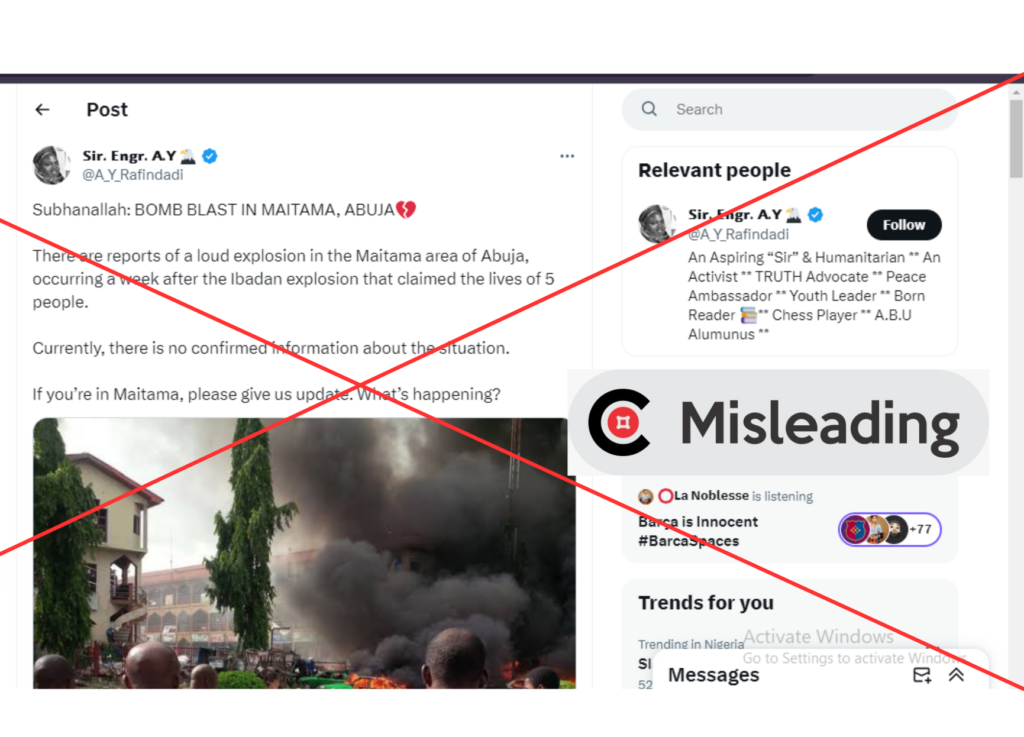
Image used to depict Maitama explosion on X has been online since 2014

0

A claim that a bomb blast had occurred in Maitama, a highbrow district in Nigeria’s capital city, Abuja has been circulating online, particularly on X.

The claim was posted by an X user: @A_Y_Rafindadi on the app.

The post was shared alongside a picture showing a fire incident involving vehicles with passersby watching.

The post read thus:

Subhanallah: BOMB BLAST IN MAITAMA, ABUJA There are reports of a loud explosion in the Maitama area of Abuja, occurring a week after the Ibadan explosion that claimed the lives of 5 people. Currently, there is no confirmed information about the situation. If you’re in Maitama, please give us update. What’s happening?

The post has gone viral and also appeared on different posts on X which can be seen here, here and here, before it was later deleted.


CLAIM

Image shows bomb explosion in Maitama.

Screenshot of the claim; INSERT, misleading verdict
Screenshot of the claim on X. INSERT: Misleading verdict.


THE FINDINGS

Findings by The FactCheckHub show that the claim is MISLEADING!

A Google Reverse Image search conducted on the image revealed that the photo has been online since about ten years ago.

The image was from the bomb blast that occurred at Emab Plaza in Wuse District of Abuja on the 25th of June, 2014 which was reportedly carried out by the Boko Haram terrorists and which left over 20 people dead as reported by local and international media platforms.

Josephine Adeh, the Spokesperson of the FCT Police command, on Wednesday stated in a post on X (formerly Twitter) that the Maitama explosion was not bomb related but rather caused by a heated waste bin.

“The FCT Police Command urges members of the public to exercise caution and refrain from using metal refuse bins. Instead, we recommend the use of plastic or rubber containers for waste disposal. They pose a reduced risk of incidents related to over heated metal refuse container,” her post read.


THE VERDICT

The claim that the image shows bomb explosion in Maitama is MISLEADING; findings show that the image has been online since about 10 years ago, while there was no bomb blast incident in the locality in January 2024.

Nigerian police rated ‘worst’ globally 7 years ago, not recent

0

AN online publication, Parallel Facts, has claimed that the Nigeria Police Force (NPF) is the worst and most corrupt police agency in the world.

According to the platform, the report was based on the ranking conducted by the World Internal Security and Police Index (WISPI), now known as the Global Police and Security Index (GPSI).

The post has generated over 3,000 reposts and more than 4000 likes on her X handle (@ParallelFacts).

Part of the publication (archived here) reads: “The World Internal Security and Police Index (WISPI) has declared the Nigerian Police Force (NPF) the number-one worst police department globally. The ranking comes as no surprise, considering the NPF’s consistent failure to uphold law and order.
“The force’s dismal record is reflected in its blatant disregard for court orders and the constitution, earning it a zero in respect for legal norms.”


CLAIM 

Nigeria Police Force (NPF) is recently ranked the worst and most corrupt Police force in the world.


THE FINDINGS

Findings by The FactCheckHub show that the claim is MISLEADING.

The Nigeria Police Force (NPF) has often been criticized for bribery, widespread corruption and human rights abuses by its officers. The need for police reform led to a nationwide protest in October 2020.

Checks by The FactCheckHub show that the publication based its report on a blog post by Nigerian Queries with the headline that read:  “10 Most Corrupt Police Forces in the world (2024).”

However, The FactCheckHub found out that the ranking was based on a 2016 report which rated the Nigeria Police Force as the “worst” globally in terms of its ability to handle internal security challenges.

The report was released in 2017 by the International Police Science Association (IPSA) and the Institute for Economics and Peace, a nonprofit organisation that brings together experts, researchers and scholars concerned with security work from all over the world.

The WISPI ranking examines the four domains of internal security: capacity, process, legitimacy and outcomes.

According to the report, the Nigerian police performed worst on the index on all four domains, with a score of 0.255 ranked 127 below the Democratic Republic of Congo, Kenya, Uganda and Pakistan.

The report was released about seven years ago during the tenure of Inspector General of Police (IGP), Ibrahim Kpotun Idris (2016-2019) and reported by local media including The Cable newspaper, Premium Times and Vanguard, among others.

The NPF, at the time, rejected the ranking as published by Channels TV and Punch newspaper in November 2017.

The then Force Public Relations Officer, Jimoh Moshood, in a statement rejected the ranking saying Nigeria Police is the best in Africa and one of the best in the world.

“Nigeria Police Force is the best in UN Peace Keeping Operations, the best in Africa, one of the best in the world. The Force rejects the report as unempirical and absolute falsehood, should be disregarded and discountenanced,” Moshood said in the statement.

The Nigerian police said after a careful study of the report and the news items emanating from it, it discovers that the report is misleading, adding that the report did not consider various training and re-training that the force has been empowered with by both local and foreign organisations.

In addition, there has been three IGPs in Nigeria since then, namely: IGP Mohammed Abubakar Adamu (2019-2021), IGP Usman Alkali Baba (2021-2023) and the current IGP, Kayode Egbetokun.

The report did not consider the impact of recent police reforms such as the disbandment of the tactical (SARS) squad and the current performance of the police force.

The FactCheckHub dug further and found a more recent ranking by the International Police Association which measures the perceived levels of police departments in 211 countries and territories.

According to the report published in 2019, over 40 countries were ranked poor for performing below average. The country in the worst category included Azerbaijan, Somalia, Venezuela, Djibouti, Uganda, Liberia, Vietnam, Niger, Iraq, Turkmenistan Republic, Burundi, Egypt, Syria, Chad, Congo, Cameroon, Sudan, North Korea, Libya, Congo Republic among others.

Meanwhile, the report ranked Nigeria among average-performing police forces under a satisfactory category. Others in the category are Argentina, Bahamas, Bahrain, Cuba, Kenya, Morocco Qatar, Rwanda, Saudi Arabia, Singapore, and the United Arab Emirates among others.

On corruption, The FactCheckHub could not find a recent credible research or survey with verifiable methodology indicating that the Nigeria Police Force is ranked the most corrupt in the world.


THE VERDICT

The claim by Parallel Facts that the Nigeria Police Force is the worst and most corrupt globally is MISLEADING; findings show that the publication relied on data published about seven years ago.

Fake list of assets recovered from Betta Edu circulates online

0

A claim that the Economic and Financial Crimes Commission has released a list of some valuable properties recovered from the suspended Nigerian minister of Humanitarian Affairs and Poverty Alleviation, Betta Edu, has surfaced online.

The list which is now viral on social media contains valuable items such as a filling station, an estate and millions of naira among other assets purportedly owned by the suspended minister.

President Bola Ahmed Tinubu suspended Edu on January 8, 2024, following a leaked memo alleging that she approved the transfer of over N585 million into the personal account of one Oniyelu Bridget Mojisola.

Following her suspension, the EFCC invited her for questioning and investigation but she was subsequently released after hours of grilling and expected to report daily to the anti-graft commission.

A Facebook user, Prince Toyin Akingbade posted the list on the app with a caption thus: 

“EFCC exposes Betta Edu, lists atrocities. 

“The Economic Financial Crime Commission (EFCC) has allegedly revealed various assets belonging to the suspended Humanitarian Affairs Minister, Betta Edu, since becoming minister.

The reports quoted sources within the EFCC to have disclosed the information.

According to the reports, Edu is discovered to have owned the following:

Ownership of an estate at Linda Chaulker Road, Asokoro Extension worth N750 million.

Plaza at El-Rufai Crescent Guzape Asokoro Extension worth N1.4 billion.

One filling station along Abuja-Kubwa Express way, worth N1.2 billion.

Ownership of four (4) estates at Metropolitan Estate Abuja worth N350 million.

Six (6) plots of land in airport road Abuja worth N300 million.

Four (4) estates at airport road worth N530 million.

Two (2) estates in Federal Housing Estate Calabar Cross River State worth N190 million.

One (1) Dillion station in Calabar metropolis worth N430 million.

Cash said to have been dscovered by the EFCC are allegedly said to have included the following:

N2.7 billion in Zenith bank, N725 million in First bank, N388 million in Polaris bank, $2.1 million in Zenith bank, £57,000 in zenith bank, €13,000 in zenith bank, $6500 in Polaris bank. The report quoted the anti-corruption agency to have said: “We are checking for more including jewellery.”

The post was also seen here and here on Facebook, among other social media platforms.


CLAIM 

EFCC releases list of items recovered from suspended minister, Betta Edu.


THE FINDINGS

Findings by The FactCheckHub show that the claim is FALSE. 

First, The FactCheckHub reviewed the media handles of EFCC including Facebook, X and its website but we could not find the viral list on the handles of the anti-graft agency or any information suggesting such. 

In addition, The FactCheckHub searched the internet but found no credible media report regarding the purported items recovered from the suspended minister.

For further clarification, when The FactCheckHub contacted the Spokesperson of the EFCC, Dele Oyewale, he debunked the viral list adding that investigation is still ongoing and the outcome has not been made public yet.


THE VERDICT

The claim that EFCC releases list of items recovered from suspended minister, Betta Edu, is FALSE; findings show the list did not emanate from the anti-graft agency.

TB Joshua: Video of Tinubu criticizing BBC documentary is doctored!

0

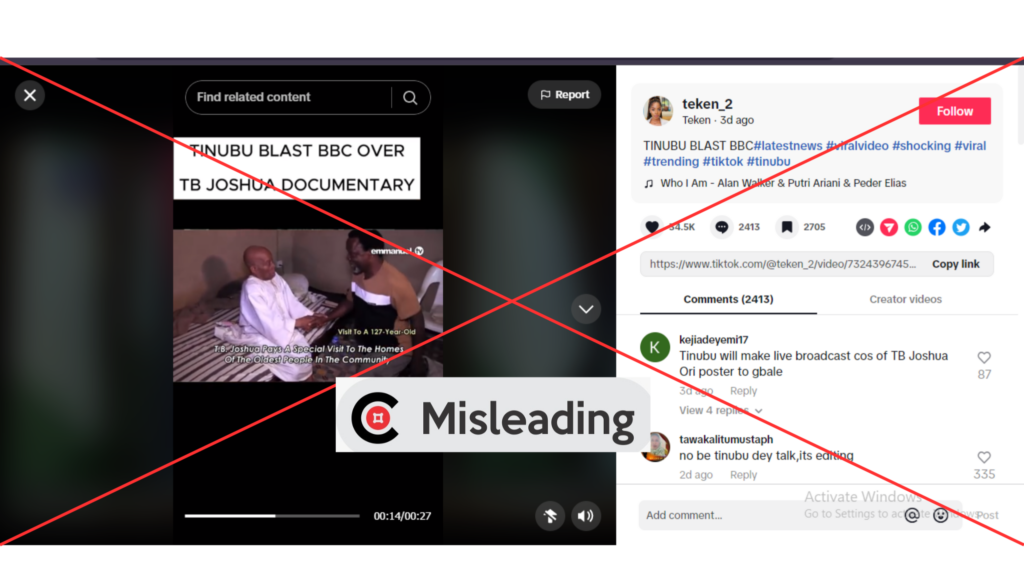
A video of Nigeria’s president, Bola Ahmed Tinubu, condemning BBC’s recent investigation on the late Prophet T.B. Joshua has been circulating on the internet.

The video which was posted by a TikTok user @teken_2 on the app has been circulating online and has made its way to WhatsApp groups.

In the footage, the president was seated on an official seat in the usual manner whenever he wants to make a national broadcast. The video also contained visuals of TB Joshua on his different outings.

The 28-second footage had an inscription on it that read: “Tinubu blasts BBC over TB Joshua documentary.”

The transcript of what President Tinubu said in the footage read thus:

I the president of Nigeria reject every documentary and evidence made by BBC against our noble prophet, Prophet TB Joshua . He was a good man and he brought so many foreigners while I was governor, they hate him because he is from a black country.

It will be recalled that the British Broadcasting Corporation (BBC) had  released a documentary earlier this month on the sins of the late Prophet T.B. Joshua which had generated controversial conversations amongst Nigerians.

The footage, posted on January 16, 2023, has since garnered over 40,500 likes, more than 2,700 comments and over 6,000 reshares as of January 20.

The video can also be seen here, here and here.


CLAIM

President Tinubu criticizes BBC over T.B. Joshua documentary.

Screenshot of the claim; INSERT misleading verdict
Screenshot of the footage as seen on TikTok. INSERT: Misleading verdict.

THE FINDINGS

Findings by The FactCheckHub show that the claim is MISLEADING!

A close look at the footage shows that it was doctored.  The audio is not in sync with the visual-motion. Another careful look at the video also shows that the lips and hands are only moving in a particular manner throughout the video – a common feature of AI-generated video and deep fakes.

Listening to the audio, it also revealed that some of the words like ‘Lagos’ was not pronounced correctly. It was pronounced ‘La + Gos’ and not ‘Lay+ Gos’ the way most Nigerians pronounces it locally. The sentences were also muddled up together, there were no pause or intervals at some point of the video.

Further checks revealed that the video doctored from the original video of President Tinubu’s national broadcast to Nigerians on New Year’s day on the 1st of January, 2024.


THE VERDICT

The claim that President Tinubu criticized BBC’s documentary on the late Prophet T.B. Joshua is MISLEADING; the video in circulation is doctored.

Meta oversight board member urges actions against fake news on WhatsApp

0

Helle Thorning-Schmidt, a Meta oversight board member, has urged the tech giant to take further steps to stop the spread of false information on WhatsApp.

Thorning-Schmidt, a former prime minister of Denmark and member of Meta’s oversight board, made the call during an H/Advisors session in Davos, Switzerland while speaking on the dangers of social media and AI for democracy on January 17, 2024.

H/Advisors is a global strategic advisory group for cross-border communications and based in England.

“Of course, Meta has a responsibility to keep check on [WhatsApp] groups. They have a responsibility to make sure there’s not loads of misinformation and disinformation on those groups. If we’re not responsible, regulation will act,” she stated.

William Lewis, CEO of The Washington Post, expressed similar worries about social media and artificial intelligence as threats to democracy, highlighting the need for immediate action in light of state-sponsored misinformation.

“The threat is very significant, the longer we delay doing something about it, the worse it gets. It’s not coming, it’s here. It’s going to take a multi-level effort from all elements of society to fight back. If we don’t, there’s a significant threat to the health, well-being, and presence of democracy, discourse, debate, and the ability to have freedom of thought in societies around the world,” Lewis said.

Although social media and artificial intelligence (AI) have the potential to be beneficial as well as harmful, Thorning-Schmidt recognized that these platforms have a significant workload.

“If we say everything that’s not true is not permissible on the platform – then we are going down the wrong path. Is this content misinformation or disinformation, and is it causing real, live harm? It’s very difficult to find out. Sometimes, they get a little bit guided by governments about what content should be removed — we need transparency from the companies,” she noted.

Thorning-Schmidt underlined the need for greater examination while discussing the roles played by governments and public actors, adding that public actors are subject to a higher degree of scrutiny than others.

She did, however, emphasize that total government control over social media companies might not be the solution.

Moderated by H/Advisors co-CEO, Neil Bennett, the session also highlighted the changing landscape of information consumption.

Five AI tools used in generating disinformation visuals

0

IN a recent report, the World Economic Forum (WEF) listed Artificial Intelligence-generated misinformation as one of the top immediate risk to the global economy in 2024.

The FactCheckHub had earlier published an analysis on some deepfake AI-generated content to watch out for in 2024. Here are some AI tools that are used to generate disinformation.

1. Fodey

Fodey is a newspaper generating website and application that is designed initially for creating newspaper clippings to make learning activities fun for students in the classroom as they can summarize passages being read, write notes etc. It could also be used to write birthday greetings for family and friends.

But currently, it is being used to spread disinformation, this is done by users filling out a box with the name, date, and headline of the newspaper.  While direct links to the newspaper clippings are broken, anyone can download the newspaper’s blueprint and distribute it on their blogs or websites with ease.

An example of a generated newspaper can be seen here; the cited author in the manipulated content debunked it.

2. ManyCam

ManyCam can be used to edit and manipulate video calls. By utilizing an intuitive camera and live-streaming software, it can generate live videos for usage on streaming services, video chat programmes, and distance learning resources.

A pre-recorded video can be uploaded and edited by the user with the application to fit the screen. The computer camera is replaced with the virtual camera of the ManyCam, which lets the pre-recorded footage to be presented on the receiver’s screen.

By using additional software tools, the user can remove the audio from the pre-recorded video and converse with the receiver in real time.

As stated on its website, the software is used to enhance the quality of live-stream videos to deliver professional live videos on streaming platforms, video conferencing apps, and remote learning tools.

However, this is currently being manipulated by malicious actors to perpetrate phishing scams.

3. Prank me not

With Prank Me Not, users can imitate others’ Facebook, Messenger, and Twitter status updates, including images and chats. With the aid of AI technologies, users can create a social setting and dialogue that has never been before.

Users can change social networking information, likes, comments, events, and more, with its customization screen function. The edited content can then be saved by users by clicking the “save” button prior to posting.

It is clearly stated on its website that it is meant create funny or amusing chats to send to friends to make them believe it was an actual post.

But, it is now a tool employed by scammers in creating phishing websites to defraud individuals and organisations.

4. Deepfakes Web

Users are able to digitally alter videos using Deepfakes Web. For the video to be edited and keep its image qualities, it must be of a high resolution.

To prevent inconsistencies, users of AI tools must meticulously mimic the actions of the characters in the video they wish to replicate.

Deepfakes Web has features like celebrity deepfake and AI image generator. Thus, in few steps, a deepfake video can be easily created.

5. Tweetgen and Break your own news

Fake tweets are created using Tweetgen. Dark, muted, and light themes are supported on the Tweetgen application. Every element on a tweet, including the time and date, the quantity of likes, the retweets, the identities, and X (formerly Twitter) applications like the Twitter Web app, Twitter for iPhone, Android, etc., can be replicated by users.

Breaking News headline intended for humor Photo Credit: Zikoko memes
Breaking News headline intended for humor. Photo Credit: Zikoko memes

Apart from manipulating headlines and taking screenshots from the web, Break your own news is used to produce fictitious breaking news for widely watched news networks. Users can upload an image, compose a title for the story, and publish.

Just like other tools aforementioned, the software’s developers claim that amusement, humor, and parody are its intended uses. However, the application is now frequently being used to create fake news stories or content and amplified on social media platforms.

An example of a breaking news used for humorous content can be seen above.

Cholera misinformation killed 23 in Mozambique – Police

0

THE Mozambican Police have confirmed the death of at least 23 people due to a wave of misinformation about cholera disease in the country.

According to media reports, the commander-general of the Mozambique police (PRM), Bernardino Rafael, revealed this during a press conference in Ressano Garcia, in Maputo province on Wednesday.

He said 91 infrastructures were vandalised, mainly those of the government and community authorities while 27 violent cases related to cholera were recorded.

The majority of community leaders and health technicians were killed or wounded by people on allegations that they were bringing the disease to the communities.

According to the commander-general, some Mozambican police officers were also victims during the violence when they were trying to guarantee public order and security.

“We remain steadfast in guaranteeing order and security so that the country can enjoy peace, harmony, tranquillity, well-being and, above all, harmony among Mozambicans themselves,” he said.

Between May and November 2023, at least 16 people were arrested in Sofala province, in the centre of Mozambique, for passing on misinformation about cholera, the authorities said.

It would be recalled that earlier in May 2023, the World Health Organization (WHO) warned against the spread of misinformation following the violence that trailed the spread of false claims about the spread of Cholera in Northern Mozambique.

False claim circulates that minimum wage application portal is now open

A claim that the Nigerian government has opened an application portal for the payment of minimum wage has been circulating on WhatsApp.

During Nigeria’s 63rd independence celebration on the 1st of October 2023, President Bola Ahmed Tinubu had announced an additional increment of N25,000 to the minimum wage of government workers in the country during his Independence Day address.

The ICIR reported that the increment was going to be effected for the next six months after the announcement was made. The president also approved an additional N10,000 for employees making it N35,000 to avert the planned strike by labour unions pending when the new minimum wage would be implemented.

The claim was contained in a broadcast message sent to various contacts in a WhatsApp group. The message noted that the minimum wage was only for individuals and asked Nigerians to check if they are eligible by clicking on a web link.

The WhatsApp post read thus:

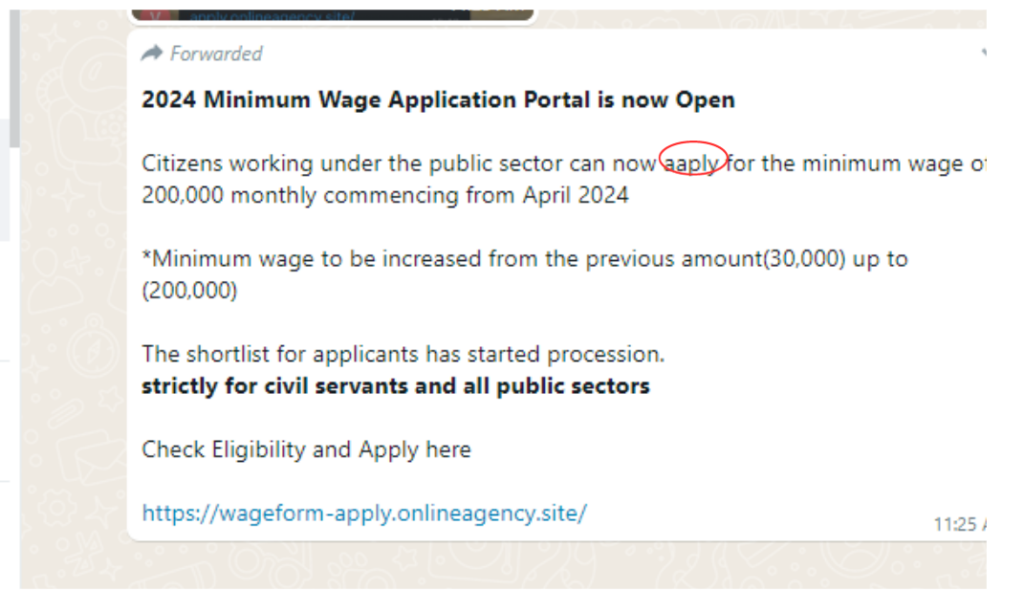
2024 Minimum Wage Application Portal is now Open

Citizens working under the public sector can now aaply for the minimum wage of 200,000 monthly commencing from April 2024

*Minimum wage to be increased from the previous amount(30,000) up to (200,000)

The shortlist for applicants has started procession.
strictly for civil servants and all public sectors

Check Eligibility and Apply here

https://wageform-apply.onlineagency.site/

CLAIM

Nigeria’s minimum wage application portal is now open.

Screenshot of the claim; INSERT False verdict
Screenshot of the claim, as retrieved from a WhatsApp group. INSERT: False verdict.


THE FINDINGS

Findings by The FactCheckHub show that the claim is FALSE!

A careful look at the website link shows that the domain name has features synonymous with most phishing websites which The FactCheckHub had reported in the past.

Whenever users click the web link, it neither direct them to the official web page of the State House or the Federal Civil Service.

Rather, it asks you to fill in personal details like your name and bank details as seen below. Thereafter, you will be asked to share to groups and your phone contacts till a ‘green bar is full.’ This is a typical modus operandi of phishing websites and online scams, which The FactCheckHub had earlier reported here.

Screenshot of the claim showing a typographical error synonymous with phishing websites.
Screenshot of the claim showing a typographical error synonymous with most phishing websites.

A careful look at the message on the post shows that there were typographical errors which is often found in phishing scams and websites as the messages are often constructed in a hurry.

Screenshot from the Phishing website asking users to share
Screenshot from the Phishing website asking users to share.

Further checks revealed that the Nigerian government had paid the N35,000 additional wage award directly to public civil servants’ accounts for the month of September 2023 via the government’s integrated payroll system (IPPIS). Thus, civil servants were not requested to register on any website to benefit from the additional wage award.

Also, media reports in December 2023 indicated that the government had paused the payment, as the nation’s trade union called on the federal government to resume the payment of N35,000 wage award.

To avoid falling victim to click baits by scammers or phishing websites, learn how to identify phishing scams and websites here.

You may also wish to learn how to verify viral WhatsApp messages too here.


THE VERDICT

The claim that Nigeria’s minimum wage application portal is now open is FALSE; findings revealed that the web link is a phishing scam.

YouTube profits from Ads on channels promoting climate misinformation – Report

0

YOUTUBE makes $13 million a year from advertising on channels propagating false claims about climate change, says the Center for Countering Digital Hate (CCDH) in its recent report.

The Centre stated that it used artificial intelligence (AI) to analyze the text transcripts of 12,058 climate-related YouTube videos from the last six years containing what researchers labelled as “new denial” arguments.

The study concluded that the Google Inc.-owned online video-sharing platform (YouTube) is making huge profits from videos containing climate falsehoods, and thus breaching its policy on climate misinformation.

The findings showed that the channels promote content that undermines the scientific consensus on climate change that human behaviour is contributing to long-term shifts in temperature and weather patterns.

According to the report, the challenge persists because content creators are using new tactics that evade the social media platform’s policies to combat misinformation.

“A new front has opened up in this battle,” Imran Ahmed, chief executive of CCDH, said on a call with reporters. “The people that we’ve been looking at, they’ve gone from saying climate change isn’t happening to now saying, ‘Hey, climate change is happening but there is no hope. There are no solutions.'”

The report alleged that YouTube is making up to $13.4 million a year from ads on the channels that the report analyzed and the AI model was crafted to be able to distinguish between reasonable scepticism and false information.

CCDH called on YouTube to update its policy on climate denial content adding that the analysis could assist the environmental movement to combat false claims about global warming more broadly.