Home Blog Page 72

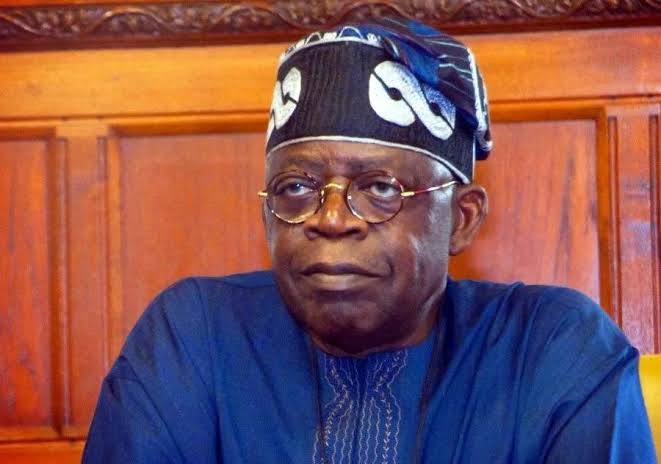
Did Tinubu build independent power plant as Lagos governor?

An X user, @Riddwane, has claimed that the Nigerian president, Bola Ahmed Tinubu, built an independent power plant during his tenure as the governor of Lagos State.

He made the claim while responding to a post by Peter Obi, the presidential candidate of the Labour Party in the 2023 general election, who was lamenting the inadequate power supply in Nigeria.

The claim by the X user read:

“Bukola Saraki served as Kwara governor in the same dispensation you served; Saraki revived Ganmo Power Station. Tinubu, as Governor, built the Independent Power Project in Lagos. As a two-term Governor, can you tell us about any power project your administration achieved in Anambra?”

READ: Tinubu makes false claim about Nigeria’s total population

The claim has generated over 430,000 views alongside more than 1,300 likes and over 500 reposts on X as of May 4, 2024.

Due to the virality, our fact-checker deemed it fit to look at the records to assess the veracity of the claim.


CLAIM

Tinubu’s administration built an independent power plant when he was Lagos State governor.


THE FINDINGS

Findings by The FactCheckhub show that the claim is TRUE.

Lagos State has several independent power projects which include AES barge Independent Power Plant, Lagos Island Power Project, Chevron Agura Power Plant in Ikorodu, Oando’s Power Plant in Akute and the Manufacturers Association of Nigeria (MAN) Power Plant in Ikeja.  The projects were aimed at augmenting  Nigeria’s power generation capacity and providing power supply to Nigerians.

Checks by The FactCheckhub show that the AES barge Independent Power Plant (formerly Enron Nigeria Barge Power Plant) was initiated by Tinubu when he was the Lagos state governor between 1999 and 2007.

Tinubu-led Lagos State Government initiated a partnership with Enron Nigeria Power Holdings Ltd in 1999 to build an Independent Power Plant to initially generate 90MW of electricity for Lagos state. The AES, a global energy company, after acquiring a majority share in Enron Nigeria Power Holdings Ltd, later took over the contract between 2000 and 2001 to build an Independent Power Plant to generate 270MW for Lagos residents in an attempt to break the monopoly of the then National Electric Power Authority (NEPA). It will be recalled that NEPA later became Power Holding Company of Nigeria (PHCN).

The AES barge located adjacent to the Egbin power station owned by the then NEPA consisted of nine barge-mounted combustion turbines with a combined generating capacity of 270MW. 

Despite its ambitious goals and significant investment, a review of multiple media reports backed up by archivi.ng, a website that digitises old Nigerian newspapers, showed that the project encountered various challenges and controversies from its inception.

However, the power project ultimately saw some successes, with the AES Corporation acquiring a majority share in the project and overseeing its construction and operation.

The project commenced commercial operations in 2001, supplying close to 230 megawatts to the Egbin Thermal Station and contributing to the national electricity grid. 


THE VERDICT

The claim that Tinubu’s administration built an independent power plant when he was Lagos State governor is TRUE; records showed that during his governorship tenure, Lagos State Government partnered with private investors to execute the AES power plant in Lagos.

Computer games may aid students to spot disinformation – Study

0

INDIVIDUALS who play video games are more likely than non-players to watch online content intently, which allows them to notice even the smallest details more frequently, a new study has shown.

A brand-new game called Bad News was developed by researchers from Uppsala University in Sweden, the University of Cambridge, and video game firms to test their theory on players.

516 Swedish upper secondary school students from four different schools participated in the experiment. In Bad News, players take on the role of a fake news propagandist, giving them the opportunity to learn about common manipulation strategies used to trick viewers.

READ: How to help children spot fake news

The game focuses on six common misinformation-spreading techniques: trolling, emotion, polarization, conspiracy, impersonation and discredit.

According to Thomas Nygren, an education professor at Uppsala University in Sweden and one of the study’s authors, this is a critical step in giving young people the tools they need to navigate a world full with misinformation.

Fake news tactics. CREDITS: E. Meszaros and M. Goodsett, "Debunking & Prebunking: Strategies for Librarians to Eradicate Misinformation" (2022). Michael Schwartz Library Publications, 183.
Fake news tactics. CREDITS: E. Meszaros and M. Goodsett, “Debunking & Prebunking: Strategies for Librarians to Eradicate Misinformation” (2022). Michael Schwartz Library Publications, 183.

“This is an important step towards equipping young people with the tools they need to navigate in a world full of disinformation.

“We all need to become better at identifying manipulative strategies since it is virtually impossible to discern deep fakes, for example, and other AI-generated disinformation with the naked eye,” Nygren added.

In the study, which was published in the Journal of Research on Technology in Education, students used a shared scorecard to play the game as a class, in pairs, or individually.
Students’ abilities to recognize deceptive content in social media posts and distinguish between trustworthy and false information significantly increased as a consequence of all three strategies.
The researchers discovered that adding competitive aspects to the game raised player interest.

“Some people believe that gamification can enhance learning in school. However, our results show that more gamification in the form of competitive elements does not necessarily mean that students learn more – though it can be perceived as more fun and interesting,” Nygren added.

ALSO READ: How content creators use AI to misinform young children on YouTube – Report

The game, according to the authors, not only safeguards players against false information but also fosters positive perceptions of reliable news sources.

Serious games, which are fully realized games created with a particular training or instructional goal in mind, are becoming more and more common in public awareness campaigns.

Two further serious games were created by the Cambridge Social Decision-Making Lab: Go Viral, which focuses on COVID-19 misinformation, and Harmony Square, which was created in collaboration with the US Department of Homeland Security and is specifically about election disinformation.

EU probes Meta over election disinformation concerns

THE European Union (EU) has launched an investigation into Meta-owned Facebook and Instagram over the failure of the platforms to counter disinformation ahead of EU elections in June 2024. 

According to France24, the probe launched on Tuesday, April 30 falls under the EU’s new Digital Services Act, a law that cracks down on illegal content online and forces world’s biggest tech companies to do more to protect users online. 

The commission said the suspected Meta’s moderation of adverts was “insufficient” and an increase in paid spots in those conditions could harm “electoral processes and fundamental rights, including consumer protection rights”.

READ: EU warns Elon Musk over ‘disinformation’ on X about Israel – Hamas conflict

EU leaders expressed concerns about Russian attempts to manipulate public opinion and undermine European democracy.

The EU internal market commissioner, Thierry Breton, explained that the probe seeks “to make sure that effective actions are taken in particular to prevent that Instagram’s and Facebook’s vulnerabilities are exploited by foreign interference.”

“We suspect that Meta’s moderation is insufficient, that it lacks transparency of advertisements and content moderation procedures,” the commission’s Executive Vice President, Margrethe Vestager, said in a statement.

Meta failed to respond on the investigation’s focus but insisted that it had “a well-established process for identifying and mitigating risks on our platforms”.

“We look forward to continuing our cooperation with the European Commission and providing them with further details of this work,” a Meta spokesperson said.

How true is the claim that no university has mosque in Nigeria’s South-east?

AN X user, Sarki (@waspapping_), has claimed that there’s no single university in Southeastern Nigeria with mosque on its premises.

He made the claim while responding to an X user who challenged him to name a southern university with a single mosque. 

READ: NOA makes false claim about first female First Class Physics graduate in Sokoto university

The post by @waspapping_ read:

“There isn’t a single university in the entire South East that has a mosque on its premises.  If you can find one university in the Southeast with a mosque, I’ll give you N200k.”

The claim has generated more than half a million views, with over 1,400 likes and more than 200 reposts as of April 30, 2024.

This follows the allegation made by the Bishop of the Catholic Diocese of Sokoto, Reverend Father Matthew Kukah, who claimed that public universities in Northern Nigeria are not open to the idea of having churches built on their campuses.


CLAIM 

No single university with mosque on its premises in Southeastern Nigeria.


THE FINDINGS 

Findings by The FactCheckHub show that the claim is FALSE.

Contrary to Sarki’s claim, The FactCheckHub found some Nigerian universities located in the Southeast region that have mosques on their premises.

The southeast geopolitical zone of Nigeria is made up of five states, namely, Abia, Anambra, Ebonyi, Enugu and Imo States with eighty-five Local Government Areas (LGAs) and a population of over twenty million people dwelling in over ten commercial cities and large towns, according to a 2016 report. (See the region’s map here).

For instance, the University of Nigeria, Nsukka in Enugu State has a central mosque. The mosque serves as an avenue for Muslims, especially students in the university to perform their obligatory and voluntary prayers.

The completed UNN Central Mosque. Source: @Odogwu_Rico on X.

It will be recalled that the Daily Trust had in 2016 reported that the UNN Central Mosque remain uncompleted 55 years after the building’s foundation was laid.

Photos of the uncompleted UNN mosque were also seen here as published in October 2018.

A report by The Record in 2021 also indicated that mosque was in use as of May that year as prayers were held there.

Similarly, Michael Okpara University located in Abia state has a mosque built by the Muslim community in the university. Even though the mosque has not been completely furnished, the Muslim students have started using the mosque to observe five daily prayers.

Michael Okpara University Mosque, Abia state/ Credit : @Xchange1 on X.

These instances contradict the claim by Sarki that there is no single university with a mosque on its premises in the Southeast region.


THE VERDICT

The claim that there is no single university with mosque on its premises in Southeastern Nigeria is FALSE; checks show that both UNN and Michael Okpara University in Enugu and Abia States respectively have mosques on campus.

AI fuelling misinformation on public health, climate change – UN spox

0

ARTIFICIAL intelligence (AI) has been facilitating easy distribution of misinformation and disinformation regarding climate change and vaccines including other global public health issues, said Melissa Fleming, the United Nations (UN) Under-Secretary-General for Global Communications.

Flemming stated this when she presented a lecture at Boston University recently where she discussed the United Nations‘ viewpoint on utilising AI to enhance resilience in global communication.

In her lecture, Fleming addressed the challenges and opportunities associated with AI in effectively distributing accurate global public health communication, focusing specifically on vaccines, climate change, and the well-being of women and girls.

She noted that one of the major concerns revolves around the capability of new technologies to facilitate the spread of misinformation more effortlessly and inexpensively.

READ: From rejection to advocacy: How religious clerics helped to drive high COVID-19 vaccination in Kano

“With the advent of AI, those who might have been screaming in a park with an audience of three now have the ability to reach thousands, if not millions of people. One of our biggest worries is the ease with which new technologies can help spread misinformation easier and cheaper, and that this content can be produced at scale and far more easily personalized and targeted,” Fleming stated.

Fleming emphasized that misinformation, particularly concerning vaccines, has notably flourished, especially since the onset of the COVID-19 pandemic. The utilization of AI has further exacerbated this issue, making it both more accessible and cost-effective.

She also noted that due to the polarization of vaccine-related information, numerous celebrities and influencers are hesitating to advocate for vaccination benefits out of fear of facing backlash. Consequently, there has been an increase in outbreaks of previously controlled diseases, such as the measles outbreak in Florida (USA) in February 2024.

Climate change is another domain heavily influenced by misinformation. Fleming described the concept of “merchants of outrage” as individuals who adeptly manipulate algorithms by disseminating content engineered to provoke outrage and polarization among viewers. They profit from the interactions with their posts, creating a financial motivation for spreading misinformation online.

“Since Elon Musk took over X (formerly known as Twitter), all of the climate deniers are back, and [the platform] has become a space for all kinds of climate disinformation. There is a connection that people in the anti-vaccine sphere are now shifting to the climate change denial sphere,” said Fleming.

Fleming referenced a 2022 UNESCO survey involving female journalists worldwide that revealed that 73% had encountered online violence, with 20% experiencing offline attacks, which they believed were connected. She highlighted the ease of creating AI-generated images and the incentivization of online misogyny monetization.

READ: Nearly 4,000 celebrities are victims of deepfake pornography – Report

While recognizing the enduring presence of AI and exploring potential solutions for its use in addressing the situation, she mentioned her team’s efforts to form coalitions and launch initiatives leveraging AI to advance engaging and factual global public health communications.

Additional initiatives entail establishing an official UN code of conduct regarding information integrity in the digital realm and engaging with UN member states during a general assembly to advocate for safe, secure, and reliable AI systems.

Sanwo-Olu did not announce minimum wage increment in viral video

A video purportedly showing Lagos State governor, Babajide Sanwo-Olu, announcing that the state government has increased minimum wage from N35,000 to N70,000 has gone viral.

The video has gone viral on social media especially X. 

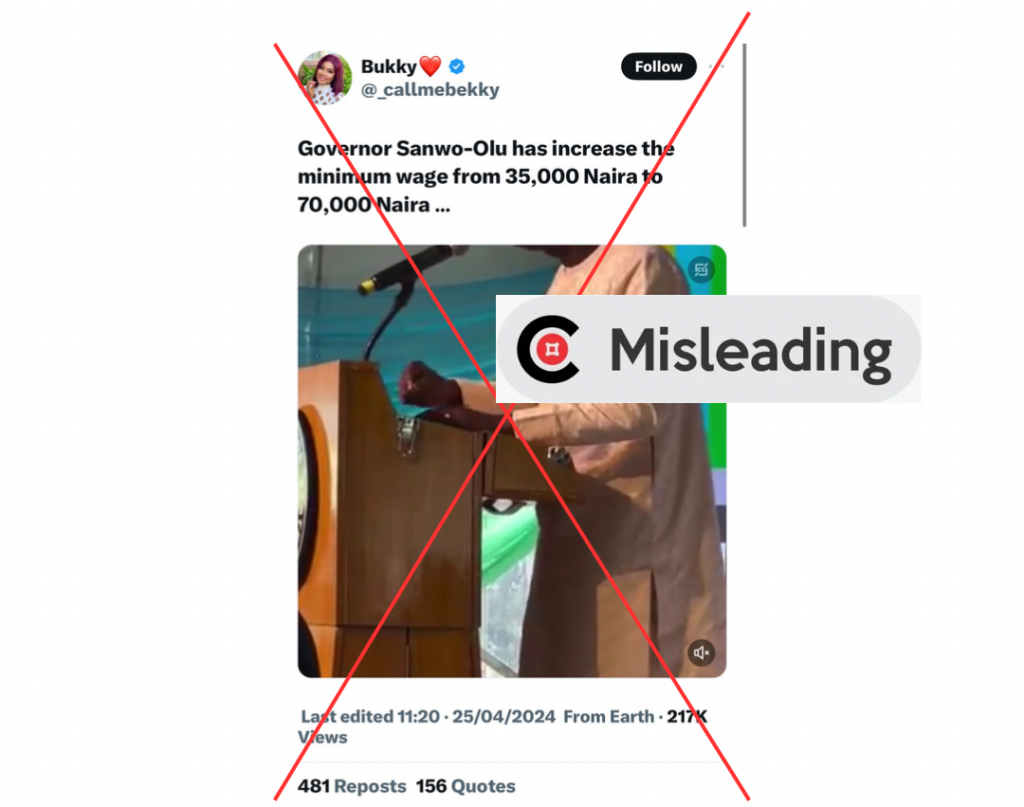
An X user, @_callmebekky, posted the video with a caption thus:

“Governor Sanwo-Olu has increase the minimum wage from 35,000 Naira to 70,000 Naira”

The post has generated over 200,000 views, with more than 400 reposts and over 1,500 likes as of April 27, 2024. 

READ: Video of naked women protesting is NOT from Lagos

Similarly, another X account, @NigeriaStories, amplified the post alongside the same video with another caption that read: 

“JUST IN: Lagos state Governor Sanwo-Olu confirms he has increase the minimum wage from 35,000 Naira to 70,000 Naira for Lagos state workers”

The post has generated over 545,000 views, with more than 10,000 likes and over 2,200 reposts as of April 27, 2024. 


CLAIM

Governor Babajide Sanwo-Olu announced minimum wage increment to N70,000 for Lagos workers in viral video.


THE FINDINGS

Findings by The FactCheckHub show that the claim is MISLEADING, as Babajide Sanwo-Olu was quoted out of context.

Checks showed that Sanwo-Olu’s speech which was made at the launching of Lagos State Social Intervention Programme tagged: “Eko Cares” has been taken out of context.

Screenshot of the viral X post showing the footage.

A review of the full video uploaded by TVC News on Thursday, April 25, 2024 shows that Sanwo-Olu did not increase minimum wage for the state workers; rather, it said the state had implemented the N35,000 minimum wage as directed by the federal government. 

This means civil servants earning N35,000 before the implementation now earns around N70,000 and above.

His words: “I know that by the grace of God very very soon we’ll see a new minimum wage that will be approved by the Federal Government and by the state government. The civil servants and all public officers, they know that since January we have continued to pay the wage allowance of minimum of N35,000 over and above what they were earning before.

“People that were earning a minimum of N35,000 to N40,000 before, they are now earning over N70,000. So, it’s important for people to know and for us to lay this thing very clearly. This government has doubled up and has not left its citizens on their own…”.

In addition, the Lagos State Government in  a statement by the state’s Commissioner for Information, Gbenga Omotoso, clarified that the governor did not imply that the minimum wage for the state workers has increased to N70,000 in the viral video.


THE VERDICT 

The claim that Governor Babajide Sanwo-Olu announced minimum wage increment to N70,000 for Lagos workers in the viral video is MISLEADING; he was quoted out of context.

Did Israel propose a bill to criminalize Christian gospel recently?

A WhatsApp post which claimed that Israel recently proposed a bill to criminalize Christianity in the Middle-East country has been circulating widely.

The post was shared alongside a Newsmax news footage which reported that the alleged bill by Israeli lawmakers aims ‘to ban Christian proselytisation.’

The caption on the post read:

“Israel has proposed a bill to criminalize Christianity in the country.

These are the people Christians are supporting their genocidal activities in Palestine”.

Similarly, an X user, @KawuGarba, also posted the same footage on April 21, 2024, with the same caption.

The post has garnered over 180,000 views, with more than 1,700 likes and over 1,300 reposts as of April 26, 2024.


CLAIM

Israel proposed a bill to ban Christianity recently.


THE FINDINGS

Findings by The FactCheckHub show that the claim is MISLEADING, as the video is over a year old.

A thorough search on the YouTube channel of the media platform (Newsmax) showed that the video was posted on March 20, 2023.

Old news footage of the proposed Israel bill to criminalize Christian gospel.

Further checks showed that two Israeli lawmakers had proposed a bill outlawing Christian proselytisation in January 2023, but it neither scale through the Israeli parliament nor was it signed into law by the nation’s Executive arm of government.

Notable news media including Punch and Associated Press (AP) reported the story in 2023 as seen here, here, and here.

Also, Israeli Prime Minister Benjamin Netanyahu shared a post on X on March 22, 2023, saying: “We will not advance any law against the Christian community.”


THE VERDICT

The claim that Israel proposed a bill to ban Christianity recently is MISLEADING; the news footage is an old video and is likely being shared for propaganda purposes.

Was Onitsha’s College of Nursing Sciences executed by Obi-led administration in Anambra State?

A claim that the College of Nursing Sciences, St Charles Borromeo Specialist Hospital, Onitsha, was executed by Peter Obi, the 2023 presidential candidate of the Labour Party, during his tenure as Anambra state governor has surfaced online.

This follows a claim by Reno Omokri, a former Nigerian presidential aide, who said Obi did not build any school during his time as a governor and challenged Obi’s supporters popularly called ‘Obidients’ to mention one school built by Obi-led administration from 2007 to 2014.

He offered to give a $10,000 reward to whoever could come up with a response.

He threw the challenge in an interview on the ‘Mic On’ podcast hosted by Seun Okinbaloye, on April 20, 2024.

In response, an X user, @Nnanyelogu13 posted:

“This school of nursing was started and finished by Peter Obi, I sent it to @renoomokri and he blocked me. @seunokin it’s time you stop bringing clowns to your shows. Tell your friend that he doesn’t have 10k USD to give.”

The claim has generated almost 300,000 views with over 1,700 reposts and more than 3,600 likes as of April 26, 2024.


CLAIM  

St Charles Borromeo Specialist Hospital, Onitsha was executed by Peter Obi-led administration in Anambra state.


THE FINDINGS 

Checks by The FactCheckHub show that the claim is FALSE, as Peter Obi admitted in a recent interview that he didn’t build any school when he was Anambra state governor.

When asked at a press conference in Abuja on Wednesday, April 24, 2024, Obi admitted to focusing on improving the quality of the infrastructure that were on ground then rather than building new ones.

He said that when he came to Anambra State, education was in shambles as schools were closed.

“I improved the quality, physical and mental well-being of the people, schools, had the basic things they needed and the people shone like stars and that was my manifesto.

“Building new schools when the old ones are moribund is just like building coastal lines when internal roads are impassable,” Obi said at the media event.

In addition, The FactCheckHub reviewed information on the college’s website among others, to verify the accuracy of the claim. 

According to the information obtained from the college’s website, the idea to establish the College of Nursing Sciences, St. Charles Borromeo Specialist Hospital, Onitsha was conceived by Archbishop Valerian Maduka Okeke.

The Archbishop envisioned the college as part of the hospital’s expansion programme to address the nationwide shortage of nursing professionals, particularly due to emigration.

The college also mentioned the ‘kind support’ it received from the Anambra State government during the college’s planning stages, though it didn’t indicated any direct funding by the state government under Obi.

The college’s website stated that the project site was blessed in 2012 and the foundation stone laid by Governor Peter Obi. This showed Obi’s involvement in the initial stages.

However, the college building itself was blessed and commissioned in 2015 – a year after Obi left office.  This falls outside the governorship period of Peter Obi, who left office in March 2014.

However, Obi has made personal donation to the college after he left the office. For instance, he donated N10 million to the school in April 2024.

The FactCheckHub contacted the college for official comment via its telephone line but an official who received our phone call asked that we sent a message instead.

The college is yet to respond, days after receiving the message sent to the mobile line by this fact-checker, as of the time of filing this report.


THE VERDICT 

The claim that St Charles Borromeo Specialist Hospital, Onitsha was executed by Peter Obi-led administration in Anambra state is FALSE; the college is owned by Catholic missionaries while Obi also admitted that the state didn’t build any school during his governorship tenure.


EDITOR’S NOTE:

* A reference to ‘Channels TV’ has been removed from the fourth paragraph.

Sydney universities launch database to tackle information disorder

0

Researchers from three Sydney universities in Australia have developed an online database to track policies and regulations from 50 countries dealing with misinformation, AI regulation, online harms, cybersecurity and digital identity.

The project led by Terry Flew, Professor of Digital Communication and Culture, Media and Communications at The University of Sydney, aims to combat misinformation, fake news and online disinformation.

The database named the ‘International Digital Policy Observatory’ (IDPO) is a comprehensive, open-source and freely accessible database to track developments in digital/internet regulation internationally.

READ: How information disorder heightens tension, confuses public during crisis

Academics and digital specialists from The University of Sydney, University of New South Wales (UNSW) and University of Technology Sydney (UTS) teamed up to produce the IDPO, a report stated.

It noted that the database, which was funded by the Australian Research Council through its Linkage Infrastructure Equipment and Facilities (ARC LIEF) programme, will assist academics, policymakers, regulators, the ICT industry and advocacy groups in staying ahead of global issues in the digital economy.

“With the internet increasingly monopolised by a small number of tech giants, governments and community organisations need information and resources that provide countervailing power. The IDPO is enabling infrastructure that policymakers and regulators can use to be aware of what is happening globally around key issues in the digital economy,” said Professor Flew.

The site will first provide comprehensive resources on misinformation, to coincide with the Draft Combatting Misinformation and Disinformation Bill before the Australian Federal parliament. Resources will subsequently be made available on AI regulation, online harms, cybersecurity and digital identity.

“Being able to show different understandings of these policies can give really interesting insights into policy making for different kinds of practitioners and could potentially enable people from very different fields to collaborate more effectively,” said Heather Ford, an Associate Professor of Digital and Social Media at the UTS.

Despite deepfake concerns, Olympics 2024 to embrace AI

0

As part of an initiative spearheaded by the International Olympic Committee (IOC) to use artificial intelligence (AI) technology, the games’ broadcaster is using these developments extensively amidst rising deep fake concerns.

AI was first implemented at the PyeongChang Winter Games in 2018 by Olympic Broadcasting Services (OBS), the organisation responsible for coordinating the live television, radio, and digital broadcasts of the Olympic and Paralympic Games.

The CEO of OBS, Yiannis Exarchos provided insight into the role artificial intelligence (AI) will play at the 2024 Paris Olympics in an interview with Reuters.

READ: Five financial scams to be wary of in 2024

“In Paris, we will take this to a completely different level, numerous applications are envisaged, primarily geared towards enhancing the viewer experience, whilst also fostering significant operational efficiencies,” he said.

Exarchos added that OBS and Alibaba, a huge Chinese retailer, are working together to use AI to provide 360-degree aided replays. Partnerships with the official timekeeper of the Paris Games, Omega, a Swiss wristwatch-maker, also seek to provide enhanced data that would entail additional explanations generated by AI or tracking athletes.

Additionally, OBS and chip maker – Intel – are collaborating to produce quick, AI-generated highlights.

With the abundance of footage available from the Olympics, Exarchos stated that broadcasters would be able to quickly showcase various events according to a country, athlete, sport, or mood and tailor the viewing experience for viewers on social media or traditional television.

The usage of deepfake technology to produce digital fabrications has followed the global expansion of AI use. This has led to the dissemination of misinformation and propaganda, fraud, extortion, and impersonation, among others.

Exarchos expressed significant worry regarding the potential manipulation of reality and emphasized his efforts towards preventing deepfakes when questioned about his apprehensions regarding advancements in video technology leading to the creation of false content.

He noted that ensuring the integrity of competition is paramount while emphasizing the importance of safeguarding sports against such risks. He noted that OBS’s clients acknowledge the presence of this threat and are implementing various measures to shield Olympic content from any potential harm.

“The concerns that fans have is very legitimate. I am a huge believer in the possibilities of technology but precisely because I understand how technology can be wrong, I think we all need to be vigilant. We need to go to trusted sources to get our information.

“In the Olympics, we fully protect the authenticity of the video, so we do not tamper with it,” Exarchos said.

He noted that the protection and management of the IOC-owned content is “of utmost importance.”