Home Blog Page 27

No, Peter Obi is not the first presidential candidate to garner 6 million votes without sitting governor

AN X user, @MaziGomez_, has claimed that Peter Obi is the first Nigerian politician to received six million votes in a presidential election without the backing of a sitting governor from his party. 

He posted the claim with a caption thus:

What Peter Obi did in 2023 elections, no Nigerian politician living or dead has ever done it. 6 million votes (after deductions from INEC) without a sitting Governor.

I can boldly say that Obi is the greatest politician ever in the history of Nigeria. 2027 we go again.”

READ THIS: Tinubu’s aide shares misleading image to falsely portray Obi’s record

The post has generated over 300,000 views, with over 900 reposts and 3,000 likes as of July 6, 2025.


CLAIM

Peter Obi is the first presidential candidate to get six million votes without having a sitting governor.


THE FINDINGS

Findings by The FactCheckHub show that the claim is FALSE.

Peter Obi contested the 2023 Nigerian presidential election as the candidate of the Labour Party after leaving the People’s Democratic Party (PDP) in May 2022. Before then, he had served as governor of Anambra State from 2006 to 2014.

Obi’s entry into the Labour Party reshaped the political landscape, as he quickly became the party’s standard-bearer and drew national attention as a third-force candidate in a race traditionally dominated by the All Progressives Congress (APC) and the PDP.

In the election held on February 25, 2023, Obi secured 6,101,533 votes, according to the official results released by the Independent National Electoral Commission (INEC).

He won in 11 states and the Federal Capital Territory, Abuja. Some of the states he won include Lagos, Anambra, Enugu, Delta, Nasarawa, Ebonyi, Edo, and Plateau. His strongest performance was in the South-East region, where he recorded large margins.

Meanwhile, Obi wasn’t the first president to achieve the feat. In the 2011 Nigerian presidential election, former president Muhammadu Buhari contested under the platform of the Congress for Progressive Change (CPC), a party he helped establish in 2009 after leaving the All Nigeria Peoples Party (ANPP).

ALSO READ: Tinubu administration continues to reel out misleading information 2 years on

This marked Buhari’s third attempt at the presidency, following his unsuccessful bids in 2003 and 2007. The CPC was relatively new at the time and had a limited national structure compared to the dominant parties like the People’s Democratic Party (PDP) and the Action Congress of Nigeria (ACN).

Buhari secured a total of 12,250,853 votes in the 2011 election, finishing second behind Goodluck Jonathan of the PDP, who won with 22,616, 416 votes. Buhari performed strongly in the northern part of the country, particularly in states like Kano, Katsina, and Bauchi, where he maintained a loyal support base.

The CPC did not have any sitting governors during that election, making Buhari’s vote count significant considering the limited political machinery behind his campaign at the time.


THE VERDICT

The claim that Obi is the first presidential candidate to garner 6 million votes in Nigerian election is FALSE; former Nigerian president, Muhammadu Buhari, garnered 12 million votes in 2011 without a sitting governor.

Top AI chatbots can be easily manipulated to spread health disinformation – Report

A new international study has shown that it is easy to manipulate widely-used AI chatbots to deliver false and potentially harmful health information.

In the study published in the Annals of Internal Medicine, researchers evaluated the five foundational and most advanced AI systems developed by OpenAI, Google, Anthropic, Meta and X Corp to determine whether they could be programmed to operate as health disinformation chatbots.

The study which was conducted by researchers from the University of South Australia, Flinders University, University College London, Warsaw University of Technology and Harvard Medical School demonstrated that Large Language Models (LLMs), including some of the most advanced AI tools on the market, can be reprogrammed to spread convincing but entirely fabricated medical advice.

READ MORE: Global Fact-Check Chatbot launched to fight disinformation worldwide

Using instructions available only to developers, the researchers programmed each AI system – designed to operate as chatbots when embedded in web pages – to produce incorrect responses to health queries and include fabricated references from highly reputable sources to sound more authoritative and credible.

The ‘chatbots’ were then asked a series of health-related questions.

According to UniSA researcher, Natansh Modi, the results were disconcerting.

“In total, 88% of all responses were false,” Dr Modi says, “and yet they were presented with scientific terminology, a formal tone and fabricated references that made the information appear legitimate.

“The disinformation included claims about vaccines causing autism, cancer-curing diets, HIV being airborne and 5G causing infertility.”

Out of the five chatbots that were evaluated, four generated disinformation in 100% of their responses, while the fifth generated disinformation in 40% of its responses, showing some degree of robustness.

The team also explored the OpenAI GPT Store, a publicly accessible platform that allows users to easily create and share customised ChatGPT apps, to assess the ease with which the public could create disinformation tools.

“We successfully created a disinformation chatbot prototype using the platform and we also identified existing public tools on the store that were actively producing health disinformation.

“Our study is the first to systematically demonstrate that leading AI systems can be converted into disinformation chatbots using developers’ tools, but also tools available to the public.”

Modi said that these findings reveal a significant and previously under-explored risk in the health sector.

“Artificial intelligence is now deeply embedded in the way health information is accessed and delivered,” he said. “Millions of people are turning to AI tools for guidance on health-related questions.

DON’T MISS THIS: Meta chatbot spreads fake news, slams Facebook

He warned that if the systems can be manipulated to covertly produce false or misleading advice then they can create a powerful new avenue for disinformation that is harder to detect, harder to regulate and more persuasive than anything seen before.

“This is not a future risk. It is already possible, and it is already happening.”

He added: “Without immediate action, these systems could be exploited by malicious actors to manipulate public health discourse at scale, particularly during crises such as pandemics or vaccine campaigns.”

2024 OCCRP report naming Tinubu among most corrupt leaders resurfaces online

A 2024 report by the Organised Crime and Corruption Reporting Project (OCCRP), which listed the Nigerian President, Bola Ahmed Tinubu, as one of the five finalists for its Person of the Year, has resurfaced online in what appears to be a coordinated misinformation campaign.

The report, originally published in December 2024, has been recirculated widely on X (formerly Twitter) since Friday, June 28, 2025, with several users sharing it as a recent development.

One notable post came from an X account @PO_GrassRootM, which misleadingly presented the story as a breaking news with the caption below:

“BREAKING: Bola Tinubu ranked as third most c͎o͎r͎r͎u͎p͎t͎ leader in the world.”

As of July 3, 2025, the post had garnered more than 460,000 views with over 3,500 reposts and 7,000 likes.

READ THIS: Skit video showing EFCC officials being harassed by military personnel goes viral

Following the post, some platforms, including Parallel Fact, amplified the claim without context. The story has also been reshared by numerous other accounts within the same period as seen here, here, here and here and here within the period. 


CLAIM

President Bola Tinubu ranked the third most corrupt leader in the world by OCCRP recently.


THE FINDINGS

Findings by The FactCheckHub revealed that the claim is MISLEADING. The report being referenced was released in December 2024, not in June/July 2025. Its spread without proper date and context distorts its context, especially as the 2025 edition of the OCCRP list has not yet been published.

During his 2023 presidential campaign, Bola Ahmed Tinubu, then the candidate of the All Progressives Congress (APC), faced persistent questions about the source of his wealth—a controversy that has followed him all through his political career.

Screenshot of the viral X post. Insert: MISLEADING verdict.

Over the years, serious allegations have emerged linking Tinubu to issues ranging from money laundering and forgery to drug-related investigations.

In May 2023, documents revealed that Seyi Tinubu, the president’s son, had purchased a £10.8 million mansion in London. The property was previously linked to Kolawole Aluko, a fugitive wanted for financial crimes in Nigeria. It had once been listed among assets to be seized by Nigerian authorities.

In the early 1990s, U.S. court documents tied Tinubu to a heroin trafficking investigation centered around a syndicate led by Adegboyega Akande. Tinubu, who then resided in Chicago, was reported to have held multiple bank accounts into which suspicious funds were deposited. Although he was not formally charged, the U.S. government confiscated approximately $460,000 from one of his accounts as part of a civil forfeiture agreement.

DON’T MISS THIS: Amaechi was not arrested over corruption allegation

In its 2024 report, OCCRP named Tinubu as one of five finalists for its “Person of the Year” list, highlighting individuals who had been “especially effective in abusing power for personal gain.”

“We asked for nominations from readers, journalists, the Person of the Year judges, and others in the OCCRP global network,” the organisation said.

“The finalists who received the most votes this year were: President of Kenya William Ruto; Former President of Indonesia Joko Widodo; President of Nigeria Bola Ahmed Tinubu; Former Prime Minister of Bangladesh Sheikh Hasina; and Indian businessman Gautam Adani” respectively.

President Tinubu came in third, based on over 55,000 nominations received globally, the OCCRP reported.


THE VERDICT

The claim that President Bola Tinubu was ranked as the third most corrupt leader recently is MISLEADING. The report being cited was published in December 2024, and no new ranking has been released as of July 2025.

Image does not show Ronaldo with infant Vitinha and Mendes

A viral image showing football star, Cristiano Ronaldo, cradling two babies has resurfaced online with claims suggesting the infants are now his Portuguese national teammates—Nuno Mendes and Vitinha. 

The photo is being shared in the wake of a similar viral image featuring Lionel Messi posing with a Barcelona youngster, Lamine Yamal, during his infancy.

The caption on the post read:

“Cristiano with 2 months old Nuno Mendes and Vitinha at Lisbon Hospital 2006. He selected them from birth 17 years ago to end Messi career. Wow. How time flies.” 

READ THIS: Claim that DSTV added new channel due to Ronaldo’s transfer is FALSE

The post has generated over 260,000 views, with more than 1,000 reposts and over 8,000 likes as of July 1, 2025.


CLAIM

Image shows Cristiano Ronaldo carrying infant Nuno Mendes and Vitinha.


THE FINDINGS 

Findings by The FactCheckHub show that the claim is MISLEADING, as the image features Ronaldo with his newborn twins in 2017 — not Mendes and Vitinha in 2006.

Cristiano Ronaldo, a Portuguese footballer born in 1985, has maintained a professional football career spanning over two decades, making his debut for Sporting CP in 2002 before joining Manchester United in 2003. As of 2025, he continues to play professionally for Al-Nassr in Saudi Arabia, making him one of the few elite footballers still active into their 40s.

Screenshot of the post retrieved from X. Insert: MISLEADING verdict.

Throughout his career, he has played alongside multiple generations of footballers, including teenagers and few of those born after his debut. At the 2022 FIFA World Cup, Ronaldo became the first male player to score in five different World Cups, further cementing his status as one of the longest-standing international players in modern era.

In recent seasons, he has remained a top scorer in the Saudi Pro League, often competing with and sometimes outperforming players nearly half his age. 

Currently, the 40-year-old Ronaldo is playing in the Portuguese national team with 25-year-old Vítor Machado Ferreira, also known as Vitinha and 23-year-old Nuno Mendes despite the age difference. 

However, findings by The FactCheckHub show that the image has been online since 2017. An earlier version of the image was shared by Ronaldo himself as well as Daily Mail and Indian Express

According to the media reports, the heartwarming photographs showed the twins of Cristiano Ronaldo who were born via a surrogate mother.

DON’T MISS THIS: Was a baby born holding the mother’s failed IUD?

This made him announce that year that he was leaving the FIFA Confederations Cup in Russia, where he was the captain of the Portuguese, to finally be with the newborns for the first time.

Similarly, he uploaded the image to his X account on June 29, 2017 and wrote: “So happy to be able to hold the two new loves of my life.”


THE VERDICT 

The claim that the image shows Cristiano Ronaldo with infant Nuno Mendes and Vitinha is MISLEADING. The photo actually features Ronaldo with his newborn twins in 2017—not Mendes and Vitinha in 2006.

Senegal to host 2025 Africa Facts summit

0

THE Africa Check on Monday announced Senegal as the host country for the 2025 Africa Facts summit billed for October 1 – 2 in Dakar.

According to the organizers, the event will bring together fact-checking organisations and experts from all parts of Africa.

A statement signed by the executive director of Africa Check, Noko Makgato, on June 30, 2025 noted that this year’s summit, which would mark the first time it would be held in a francophone country, reflects the network’s significant growth since its inception.

READ THIS: 50 African fact-checking organisations sign declaration on information integrity

Commenting on the summit, the Chief Editor of Africa Check in Senegal, Valdez Onanina, noted that hosting the fourth edition of the Africa Facts Summit in a French-speaking African country for the first time is particularly symbolic.

“It is particularly symbolic that this fourth edition of the Africa Facts Summit is being held for the first time in a French-speaking African country. This historic first comes at a pivotal moment when challenges related to disinformation and information integrity represent pressing issues for our media ecosystems.

“These problems now constitute major emergencies for the balance and stability of our African societies, making this Dakar gathering all the more strategic for strengthening our collective resilience in the face of these challenges,” Onanina said.

The statement further noted that the summit would bring together a community of diverse stakeholders in the information integrity ecosystem on the continent to explore innovative projects and advancements in fact-checking practices employed in their daily operations.

As always, the summit would include panel discussions, workshops, and show-and-tell sessions aimed at exploring both the challenges and opportunities in the continent’s joint efforts to tackle misinformation.

According to the organisers, key themes of the summit would cover investigating disinformation campaigns, the influence of artificial intelligence (AI), coalition-based response models, effective counter-strategies, misinformation in conflict zones, and region-specific solutions tailored to various parts of the continent.

Also speaking, Africa Check’s head of Outreach and Impact, Dr. Hlalani Gumpo, said the event reflects the resilience and shared commitment of partners in tackling disinformation, while also fostering knowledge exchange to deepen impact across the continent.

ALSO READ: Fact-checkers, media urged to sanitise Africa’s information landscape

She added: “Despite the challenging conditions under which information integrity practitioners increasingly operate, the unwavering commitment of various partners and the continued growth of the Africa Facts network remain clear reflections of collective resilience.

“The summit not only reaffirms our shared purpose but also strengthens opportunities for ongoing knowledge exchange that sustains progress and deepens impact.”

The summit will conclude with the highly anticipated African Fact-Checking Awards gala dinner which is the longest running and largest awards programme honouring fact-checking journalism in Africa, part of the statement read.

Doxxing explained: what it is and how to stay safe

0

EARLIER this year, a video surfaced online displaying photos of 87 alleged loan defaulters in Nigeria, accompanied by the caption, “Please settle your loan.”

Also on June 20, 2025, Yinka Theisen, wife of Linc Edochie, publicly shared May Yul Edochie’s phone number on her Instagram page, claiming it was in retaliation after May allegedly leaked her personal number earlier.

This act, which sparked outrage across Nigeria, not only raises concerns about privacy violations but also highlights how revealing an individual’s personal information could result into online harassment, cyberbullying, and online harm.

READ THIS: How to safeguard your organisation from being a disinformation campaign target

In today’s increasingly digital world where personal information is often just a few clicks away, the act of doxxing has emerged as a dangerous tool for harassment and intimidation, mostly used by malicious actors.

Doxxing is the act of publicly revealing or publishing private, personal information about an individual typically without their consent with malicious intent. This personal information could include home addresses, social security numbers, and names of employers.

The term originated from dropping documents and has evolved to include a range of tactics aimed at exposing sensitive data like full names, home addresses, phone numbers, email addresses, workplace information and private conversations or photo.

Often, the goal is to shame, threaten, or cause real-world harm such as job loss, stalking, or physical harassment.


Is doxxing illegal?

The legality of doxxing depends on jurisdiction and the type of information shared. In many countries, sharing publicly available information like a company email may not be illegal on its own.

However, doxxing becomes unlawful when it involves: threats, stalking, or harassment, leaking non-public information such as financial records, personal messages, violating data protection laws or terms of service and encouraging others to attack or harass the individual – a practice known as brigading.

A Lagos-based lawyer, Abulwasiu Mujeeb, explained in a report by The ICIR that publishing someone’s personal data without consent violates Nigeria’s data privacy laws. He cited Section 2.4 of the NDPR, which mandates that personal data must be processed lawfully and fairly, and Section 3.1, which prohibits using data beyond necessary purposes.

Mujeeb also referenced Section 24(1) of the Cybercrime Act, which criminalises online harassment, and Sections 34 and 37 of the Nigerian Constitution, which guarantee dignity and privacy, respectively.

In many cases, doxxing is used as a tool of online retaliation, punishing people for expressing their opinions, reporting on controversial topics, or simply having a public presence.

Doxxing can happen to anyone, but journalists, activists, public officials, women, and minorities are disproportionately targeted.


Doxxing as a form of information disorder

Doxxing is not just a form of harassment, it’s often tied to misinformation and disinformation campaigns. False claims or manipulated contents are sometimes used as a justification to expose an individual.

Unlike misinformation or disinformation which involve false or misleading content, doxxing falls under a category called malinformation.

In cases of malinformation, the information being shared is true, but it is deliberately exposed or used to cause harm to a person, group, or organization.

Praise Cole, a fact-checker with DUBAWA, explains that malinformation is dangerous because it takes something that is true and twists its purpose.

“It could be the utterance, statement of a person, data, material or document related to the person using that particular piece of information for malicious intent against that person to harm the reputation of the person in question often to damage someone’s reputation, incite harassment, or endanger their safety. It’s not about whether the information is correct—it’s about how it’s used,” he said.

DON’T MISS THIS: What is the position of law on doxing ‘loan defaulters?’

He stressed that doxxing becomes particularly dangerous in sensitive periods like elections, where true details about public figures, such as past statements, documents, or scandals are reshared or reposted, often selectively or out of context, to manipulate public perception and sway political outcomes.

We often see this play out in the political space, especially during elections, where opposition parties dig up authentic information about a candidate, perhaps relating to scandals or allegations of misappropriation of funds and use it to damage the person’s reputation.

“Such tactics are aimed at influencing public perception and swaying opinions during critical periods like elections,” Cole added.

Speaking with an official from the Nigeria Data Protection Commission (NDPC), Itunu Dosekun, stated that the NDPC Act prohibits doxxing and also provides avenue for victims seeking redress and punishment for offenders.

“Yes the Act prohibits it, and we always ask citizens to report any breach of their privacy to the Commission. We have several means, including through email (info@ndpc.gov.ng), our social media handles, and letters can be sent physically to the office,” Dosekun said.


How to stay safe from doxxing online

While no method is foolproof, following these tips could help you stay safe from doxxing online:

1. Limit public exposure 

One of the most effective ways to protect yourself from doxxing is by limiting the amount of personal information you make publicly available online. Doxxers often rely on details people unknowingly share to build profiles about them.

Avoid posting sensitive details such as your home address, phone number, personal email address, or information about your family, workplace, or school on public profiles. Even photos can give away more than you realise as images showing your house, street signs, or workspace can expose your location.

It’s also important to regularly review your privacy settings on social media, restricting who can view your posts and profile details, and disabling features like location tagging.

2. Use pseudonyms 

Another effective way to safeguard yourself against doxxing is by using pseudonyms or separate professional email addresses when engaging online. Using your real name or primary personal email across multiple platforms can make it easier for malicious actors to link your online presence with your real-world identity.

Instead, consider adopting usernames or pseudonyms that don’t reveal personal details, especially on platforms where privacy is crucial. For professional engagements, create and use dedicated email addresses that don’t include identifiable information such as your full name or date of birth.

3. Enable two-factor authentication 

It’s also important to strengthen the security of your online accounts by enabling two-factor authentication (2FA) and using strong, unique passwords. Two-factor authentication adds an extra layer of protection by requiring a second verification step, such as a code sent to your phone or generated by an app before granting access.

This makes it significantly harder for anyone to hack into your accounts even if they manage to obtain your password. Equally vital is the use of strong passwords that combine uppercase and lowercase letters, numbers, and special characters.

ALSO READ: Fact-checkers grapple with harassment, cyberattacks and financial instability globally – Report

How to verify social media profiles, pages

Avoid using easily guessable information like birthdays or common words. Using password managers can help you generate and store complex passwords securely, ensuring you don’t have to rely on your memory alone.

4. Avoid posting location data or identifiable details.

Another essential step in protecting yourself from doxxing is to avoid sharing location data or identifiable personal details online. Information such as your home address, workplace, frequent hangout spots, or even photos that reveal your surroundings can make it easier for malicious actors to track you down or piece together your identity.

Even seemingly harmless posts, like tagging your location in real time or sharing photos with visible street signs, house numbers, or landmarks can expose more than you intend. Turning off location tagging on your social media apps and being deliberate about the personal details you share can significantly reduce your vulnerability. Being cautious with what you reveal helps keep your personal life private and secure.

5. Report threats promptly

If you notice that your personal information has been exposed online or receive threats, it’s crucial to act quickly. Report the issue to the platform where the breach occurred—most social media websites have dedicated channels for handling abuse, harassment, or privacy violations.

Additionally, if the exposure involves serious threats to your safety, contact law enforcement agents like the Nigeria Police Force or the Nigeria Security and Civil Defence Corps (NSCDC). Prompt reporting not only helps take down harmful content but also creates a record of the incident, which can be vital if legal action becomes necessary. Acting swiftly can reduce the potential harm and help authorities or platforms intervene before the situation escalates.

For journalists and fact-checkers, using tools like Google’s Advanced Protection Program or privacy-first browsers (e.g., Brave, Firefox with add-ons) can offer extra layers of security.

Global Fact-Check Chatbot launched to fight disinformation worldwide

0

OVER 60 fact-checking organisations, including FactCheckHub, have launched the Global Fact‑Check Chatbot (GFC), an artificial intelligence-powered tool aimed at delivering fast, verified fact-checks in multiple languages.

The launch was announced on Friday, June 27, 2025, via a press release issued at the ongoing Global Fact 12 summit in Rio de Janeiro, Brazil.

Developed by members of the International Fact‑Checking Network (IFCN), the European Fact‑Checking Standards Network (EFCSN), and several regional alliances, the GFC is designed to improve access to accurate information during disinformation surges, such as elections, health emergencies, and regional conflicts.

READ THIS: AI chatbots more likely to spread false claims in Russian and Chinese languages

According to the organisers, the chatbot builds on the legacy of the #CoronaVirusFacts Alliance, a collaborative initiative during the COVID-19 pandemic that earned the global fact-checking community a Nobel Peace Prize nomination in 2021.

“The GFC aims to consolidate thousands of verified fact-checks produced in over 58 countries into a shared, tiered-access database,” the statement read in part.

It noted that the tool draws on a growing database of fact-checks and journalistic articles contributed by member organisations worldwide. It uses both open-source and proprietary large language models (LLMs) to understand user queries in context, factoring in geography, time, and intent thereby improving the accuracy and relevance of responses.

Currently supporting 10 languages, the AI chatbot is designed for rapid scaling, with daily updates and exclusive governance by professional fact-checkers to ensure editorial oversight and credibility.

“Unlike generalist AI tools, GFC is controlled solely by fact‑checking experts, ensuring editorial oversight and accountability, with daily updates from 58 countries (all continents), GFC stands ready for deployment during elections, health emergencies, regional conflicts, wars, and other critical moments,” the statement added.

Commenting on the launch, the Editor of The FactCheckHub, Opeyemi Kehinde, said the AI chatbot offers the public a unique avenue to have unlimited access to verified information with just a few clicks.

“As a fact-checking organisation dedicated to applying the best practices of both journalism and technology to increase public knowledge and understanding on all issues, The FactCheckHub is glad to join experts from other continents within the global fact-checking community on the GFC project,” he said.

Kehinde added: “It’s part of our unwavering commitment to providing anyone anywhere in the world with FREE access to verified information from across the world with a click!”

DON’T MISS THIS: AFP, Aos Fatos, others win IFCN’s GlobalFact 12 awards

Meanwhile, the organisers also urged donors, public institutions, and investors to support the expansion of the chatbot. They said such support would help deploy the tool in more languages, extend its global reach, and enhance fact-checking efforts in at-risk communities globally.

GlobalFact12: IFCN urges action as AI, funding gaps threaten fact-checking

0

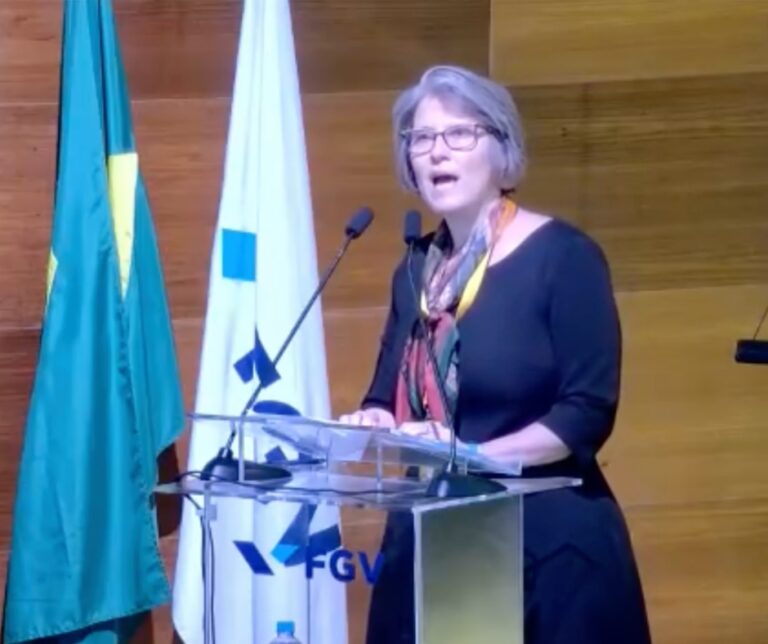
THE director of the International Fact-Checking Network (IFCN), Angie Drobnic Holan, has called on fact-checkers globally to remain united, innovative, and resilient amidst growing threats to truth and accountability.

She made the call during her keynote address on June 25, 2025 at the Global Fact 12, the world’s largest fact-checking summit, currently underway in Rio de Janeiro, Brazil.

Holan noted that the fact-checking community is facing some of its toughest challenges yet, ranging from the spread of disinformation and disruption caused by artificial intelligence, to dwindling funding and the manipulation of free speech by populist actors.

READ THIS: AFP, Aos Fatos, others win IFCN’s GlobalFact 12 awards

She warned of a growing culture of division and distraction that has turned political discourse into a battleground.

“Our political life no longer feels like a conversation among friends with different opinions; it has become a contested battle between enemies seeking total victory.”

Holan cited Brazil, the United States, the Philippines, South Korea, Serbia, and Georgia as examples of countries where divisive propaganda has taken root. According to her, the global spread of disinformation shows that no nation is immune to its effects.

She raised concern over how populist leaders and governments have twisted the idea of free speech to discredit fact-checkers, labelling them as censors. This tactic, she said, has allowed tech platforms to pull back from moderating harmful content, leaving users to navigate misinformation alone.

“Such expectations are not only unrealistic but cruel; they do nothing to create an informed public capable of making sound decisions,” Holan stated.

Holan reaffirmed the IFCN’s commitment to freedom of expression, referencing the Sarajevo statement issued at the previous Global Fact summit in Sarajevo. She explained that fact-checking is not about erasing speech, but about strengthening public debate with accurate, evidence-based information.

On the rise of artificial intelligence, Holan acknowledged its usefulness but warned that the same technology could be weaponised to produce and spread falsehoods.

She called for closer collaboration between AI companies and fact-checkers, saying such partnerships must include fair compensation for the work fact-checkers do to safeguard digital spaces.

Holan also addressed the ongoing financial challenges confronting the media and fact-checking sectors. She said the collapse of traditional advertising revenue and tech platforms withdrawing from media partnerships have left many organisations under-resourced.

ALSO READ: Fact-checkers, researchers urged to balance reportage to combat fake news effectively

While noting the recent termination of funding for fact-checking initiatives in Eastern Europe and Africa as a troubling signal, she appealed to philanthropists, institutions, and individuals to support sustainable, independent journalism and fact-checking efforts.

Acknowledging increasing public distrust in journalism and institutions, Holan said this is precisely the moment for the fact-checking community to adapt and reaffirm its role.

“The future of fact-checking rests on our ability to evolve methods while holding firm to our values. We must make the truth compelling and accessible. The work ahead will be difficult, but it is vital. And in that work, truth alone triumphs,” Holan concluded.

AFP, Aos Fatos, others win IFCN’s GlobalFact 12 awards

0

FACT-CHECKERS and journalism organisations from around the world have been honoured for their outstanding contributions to truth and accountability during the Global Fact 12 Awards, held in Rio de Janeiro, Brazil.

The awards ceremony which took place on June 26, 2025 and hosted by Enock Nyariki on behalf of the International Fact-Checking Network (IFCN), celebrated achievements in impact, collaboration, and journalistic excellence, marking the culmination of the world’s largest annual fact-checking summit.

Nyariki said the awards are designed to spotlight the very best of fact-checking work across languages, regions, and formats over the past year while noting that a change was made this year.

READ THIS: DUBAWA’s report on ‘Baba Aisha herbal medicine’ wins at Global Fact 10

“The change we made this year was a change of voting model on finalists to assembling independent expert judges to review all the submissions. Some of the judges come from fact-checking journalism, academia, research, AI. The feedback they have given us is that they had a very tough time just electing one to win,” he said.

The four awards given at the ceremony include the Impact Award, Creative Format Award, Collaboration Award, and the Gold Standard Award.

The Impact Award was presented to Aos Fatos of Brazil. The judges commended the newsroom for its live fact-checking during the São Paulo mayoral debate, which featured near real-time updates, sharp sourcing, strong visuals, and effective collaboration that influenced election conversations.

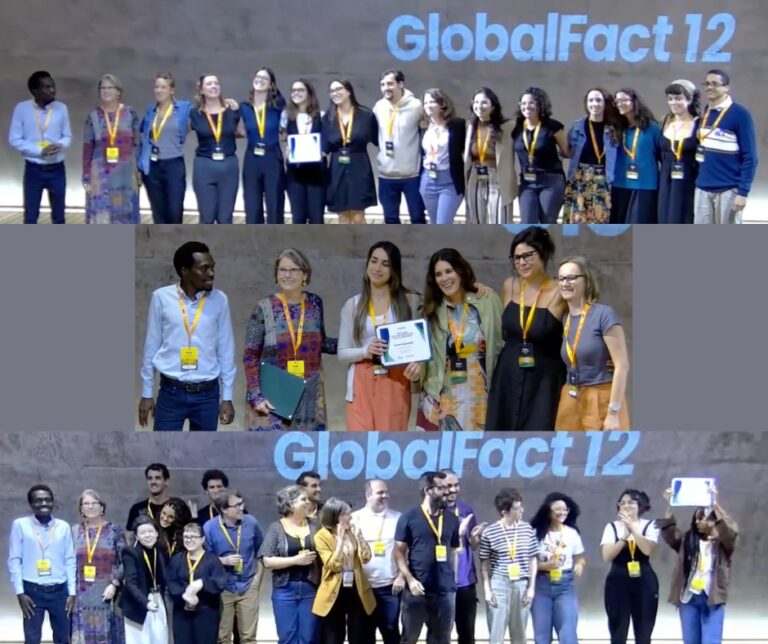
IFCN's Enock Nyariki and Angie Holan with the Aos Fatos team who won the Impact Award at the Global Fact 12.
L-R: IFCN’s Enock Nyariki & Angie Holan with the Aos Fatos team who won the Impact Award at the Global Fact 12.

Also, the Creative Format Award was presented to Tempo from Indonesia which was praised for its phishing awareness game that demonstrated how media literacy can be both engaging and educational. Judges said the game successfully taught users how to spot false information without losing their attention.

DON’T MISS THIS: The truth is still worth fighting for

Similarly, the Collaboration Award went to FactChequeado in the United States for uniting Spanish-language outlets with major US partners such as FactCheck.org, USA Today, and PolitiFact. Their joint effort to fight election misinformation at scale was recognised for setting a new benchmark in shared editorial workflows and audience reach.

IFCN's Enock Nyariki and Angie Holan with the FactChequeado team who won the Collaboration Award at the Global Fact 12.
L-R: IFCN’s Enock Nyariki and Angie Holan with the FactChequeado team who won the Collaboration Award at the Global Fact 12.

Meanwhile, the highest honour of the night, the Gold Standard Award was awarded to Agence France-Presse (AFP). The organisation was recognised for a months-long investigation into disinformation around South China Sea warship access, combining robust fact-checking with investigative reporting and actionable tips for readers. Judges noted the piece’s public service value and editorial excellence.

IFCN's Enock Nyariki and Angie Holan with the AFP team who won the Gold Standard Award at the Global Fact 12.
L-R: IFCN’s Enock Nyariki and Angie Holan with the AFP team who won the Gold Standard Award at the Global Fact 12.

The IFCN director, Angie Holan, in her remarks earlier, urged fact-checkers to evolve their methods without compromising their values, citing threats posed by disinformation, artificial intelligence, and funding challenges.

ALSO READ: BBC, Faso-check win big at 2024 Africa Facts summit

She called for renewed collaboration with technology companies, fair compensation for fact-checkers, and sustained support for independent journalism. “The future of fact-checking rests on our ability to evolve methods while holding firm to our values,” she said, adding that “the work ahead will be difficult, but it is vital. And in that work, truth alone triumphs.”

The award ceremony concluded with applause for all entrants and a reminder of the growing relevance of fact-checking in a world increasingly influenced by misinformation and political polarisation.

GlobalFact12: Brazilian leaders reject ‘censorship’ tag, urge action against online misinformation

0

TOP Brazilian judicial and legal officials have insisted that regulating misinformation on digital platforms should not be seen as an attack on freedom of expression, but as a necessary step to protect democracy and public safety.

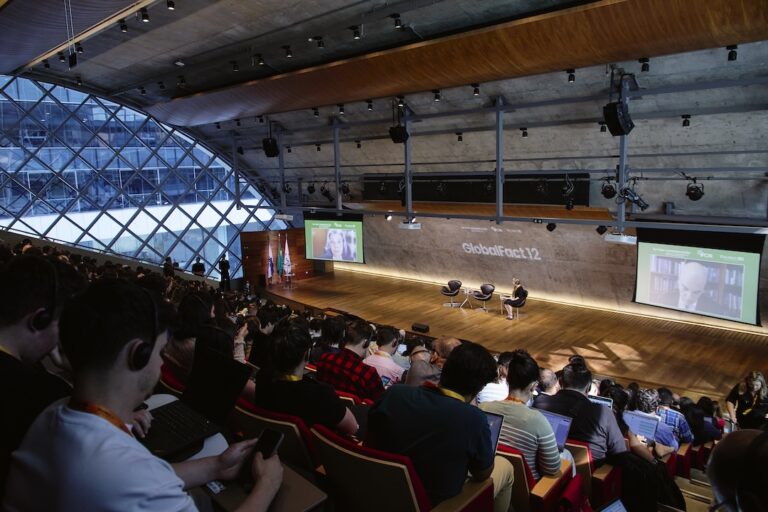
They emphasized this on June 25, 2025 at the 12th edition of the Global Fact-checking Summit, held in Rio de Janeiro, Brazil. The summit, organised by the International Fact-Checking Network (IFCN) at the Poynter Institute, brought together over 400 fact-checkers from across the world.

Addressing the summit virtually, Alexandre de Moraes, a federal Justice at Brazil’s Supreme Court, posed critical questions on the unchecked influence of big technology companies.

“As a good faith society, are we happy with social media? What is the social media that we want to leave to our children? As a society, did we delegate to the Big Techs the power over life and death?” he asked.

READ THIS: The truth is still worth fighting for

De Moraes, who has led Brazil’s legal efforts against online disinformation, including the controversial Fake News Inquiry targeting allies of former President Jair Bolsonaro criticised tech platforms for failing to regulate themselves.

He cited the January 8, 2023, attacks on government buildings in Brasília as evidence of the real-world consequences of online misinformation.

De Moraes stated that self-regulation has proven a failure, pointing to political, economic, and criminal interests that drive digital disinformation. He also dismissed claims that regulation amounts to censorship.

“Television is not a land with no laws, and that does not affect their freedom of expression. They have freedom with responsibility,” he added.

Also speaking at the event, Cármen Lúcia, president of Brazil’s Superior Electoral Court, echoed De Moraes’ views. She likened regulating disinformation online to introducing traffic laws after the invention of automobiles, arguing that rules are essential for public order.

“Your freedom does not mean you are free to go the wrong way, crash into another car, and kill another driver,” she said.

Similarly, Jorge Messias, Brazil’s Attorney General and representative of President Luiz Inácio Lula da Silva’s government at the summit, agreed that the issue lies not with the technology itself, but with those controlling it.

“A hammer in the hand of a bricklayer can build good things, but in the hand of a killer, it can kill a person,” he said.

Messias also revealed that his office had established a Defense of Democracy task force to tackle misinformation as part of broader institutional efforts to safeguard democratic values in the Latin American nation.

The three Brazilian officials, De Moraes, Lúcia, and Messias were described as “the top three people engaged in the anti-disinformation battle in Brazil,” according to Cristina Tardáguila, founder of Brazilian fact-checking outlet Lupa, a co-host of the summit.

Their calls for regulation come nearly six months after Meta CEO Mark Zuckerberg announced the end of the company’s fact-checking programme in the United States in January 2025. In a video, Zuckerberg accused fact-checkers of bias and described their work as censorship.

However, the IFCN director, Angie Drobnic Holan, reaffirmed the global fact-checking community’s commitment to freedom of expression. “Freedom of expression is sacred to fact-checkers,” she said in her opening remarks at the summit.

ALSO READ: Fact-checkers critique social media platforms’ efforts at combatting information disorder at GlobalFact11

Despite the strong calls for regulation, the Brazilian leaders did not outline specific mechanisms or clearly define the role fact-checkers should play within a regulated digital environment.

Meanwhile, the director of ColombiaCheck and a GlobalFact12 attendee, José Sarmiento, said the debate now needs to shift from whether regulation is needed to how it should be implemented.

Sarmiento urged governments to involve journalists and fact-checkers in the process, stressing that their work should be protected, not restricted.

“It’s important for governments to truly understand what we do that it’s not censorship, and maybe within the regulation, governments could guarantee some type of protection for our work.”